Prelude Era: The Young Emperor’s Raison D’être
New Calendar, 455th Year, 3rd Month, 31st Day
Imperial Capital Cardinal
Somewhere in the Imperial Demesne
Prologue
My first experience of the world was the glare of something bright—a light so strong, it stirred a primal sort of terror within me.
Next came the smell of blood. I heard the cries of an infant, loud and pleading.
“@##! %@@%!!!!!”
Someone was screaming. Then, as if a bubble had popped, a mob of voices joined the din.
Through all the noise, only the infant’s cries sounded clear to my ears. No...rather than that, they seemed to be coming from within my body. Was I the one crying?
Silhouettes thronged in my dim field of vision. I’d never witnessed a childbirth before, but surely this was too many people?
I’d...never witnessed one?
Right. Because I’d ended my last life without ever marrying. At least, I didn’t remember tying the knot.
Last life...?
Oh. This was one of those reincarnation situations, wasn’t it?
The moment the notion struck me, the memories of my former life came rushing back. The sheer volume of information was so overwhelming that my consciousness began to fade, as if drowning in the deluge.
The period that came afterward was defined by an uncanny atmosphere. My newborn self grew quickly, as though someone had pressed the fast-forward button on my life. But that was only my distorted perception; my growth had not actually accelerated. It was simply that my brain’s limited processing ability made each thought take far longer to form.
During that fast-forwarded period, the blurry shapes in my vision began to form into distinct contours, and I began to comprehend some bare scraps of language.
I also began to grasp who I was supposed to be in this world.
—My mother changed daily. I say “mother,” but I supposed they were wet nurses. To have a different one every day, though? How luxurious. Chances seemed high that I was living in premodern conditions.
—The words uttered each time I was taken up into someone’s arms were likely my name, or an affectionate appellation. But there was always something all too polite to the tone. Perhaps instead of a name, it was a title of some status?
—All the people I saw had what I would call European casts to their features. Was I the same?
—My wet nurses wouldn’t have looked out of place several centuries in the past. Their apparel stood in stark contrast to the room, which seemed styled in a fashion far closer to sensibilities I would have found contemporary in my old life. But maybe my perspective was based too far forward and this room was a grand indulgence, a bleeding-edge design only attainable through the very best of the era’s craftsmanship and technology.
—I could sense...something in the air that had never been present in my previous life. It was faint, but I could tell that it suffused me, tethered me, and responded to some yet unmapped means within me to exert my will upon it. A wild thought occurred to me: Could it be...magic?
If it was, then the broad strokes of this new world were clear to me. It was a fantasy world, its civilization and culture akin to somewhere in Europe during its medieval period, at the earliest.
And as for me...
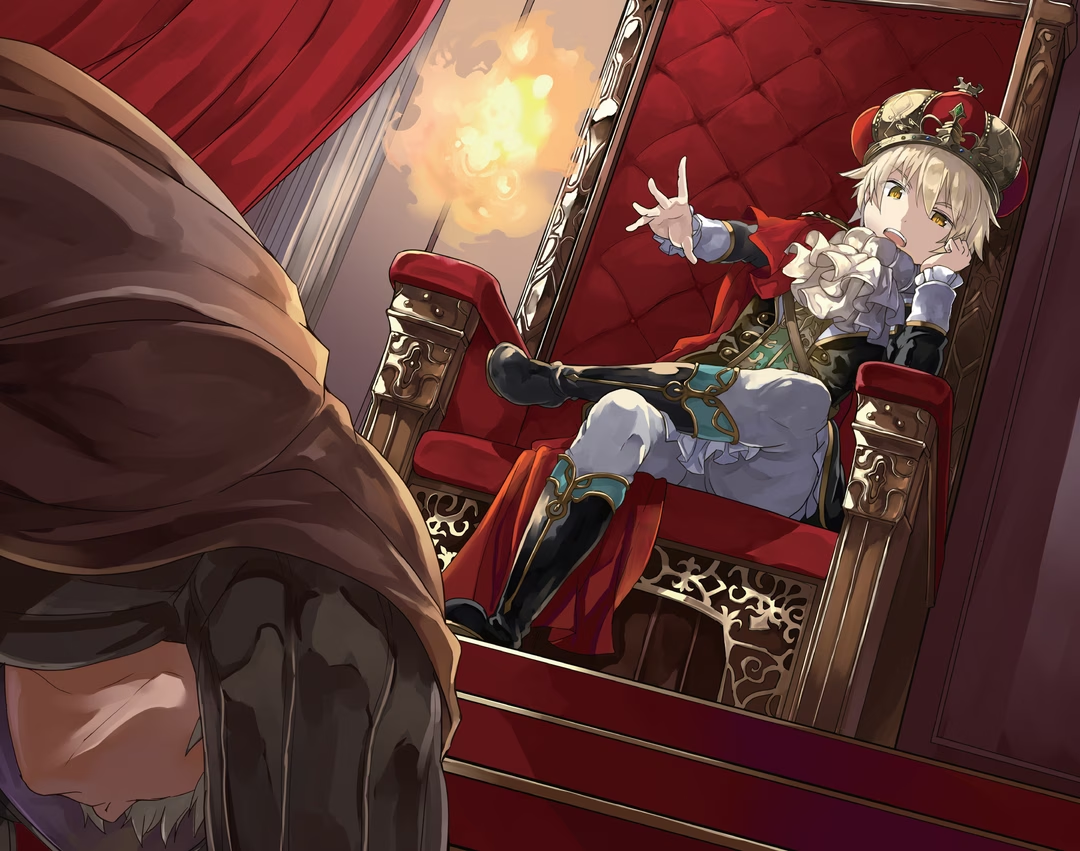
When the speed of my thoughts caught up to the flow of time and my neck was finally able to support the weight of my own head, I was placed on a throne and found myself looking down at a gathering of men, their heads bowed.
“Your Majesty. Your Lords have come to extend you their greetings for the New Year.”
—I was what you’d call a child emperor. From birth, no less.
And so I determined step one of my political agenda: bawling my eyes out with everything I had.
***
In any working system, infants did not become emperors or kings. Having a literal child as head of state came with a bevy of drawbacks and few if any real advantages. And if, because of how the line of succession worked, a baby did become the monarch, they were usually assassinated.
Let me tell you a story. It’s about a boy called John I, of the Capetian dynasty of the Kingdom of France.
When his father, Louis X, died, his only child was a daughter named Joan. However, Queen Clémence was with child (and there was apparently some kind of issue with Joan inheriting the throne). As such, Louis’s younger brother Philip became regent while they awaited the birth of the rightful heir. When John—a boy!—was finally born, the throne was his the moment he popped out of the womb. It took less than a week for him to turn up dead, and Crown Prince Philip took over as Philip V.
Now, let’s look over to China. After the death of Emperor He, fourth emperor of the Later Han dynasty, his son Liu Long succeeded the title at barely a hundred days old. Given his age, his political affairs were managed by his consort kin—the relations of the empress dowager. He died before the year was over.
In any time and place where there is no capacity or basis for modern medicine, infant mortality rates, especially for children of nursing age, will always be high. That’s exactly why it’s so difficult to distinguish between death by illness and death by assassination. In simple terms? Pulling off a hit without anyone noticing is a whole lot easier.
As long as I was still this defenseless, I had good cause to fear for my life at every turn. And yet I was still breathing. Clearly the real political shot-callers found a living heir more useful—at least for the time being.
Right now, I was still allowed to draw breath—as a puppet.
From that day on, I lived in desperation. Whose puppet was I? Why was I emperor from the moment I was born? I needed answers.
But I couldn’t reveal my intelligence. A puppet had to be incompetent and feebleminded, or they would cause trouble for the puppet master. I couldn’t voice any questions or doubts. I analyzed what information I had, and piece by piece, I assembled the beginnings of a picture. The first thing I learned about was myself.
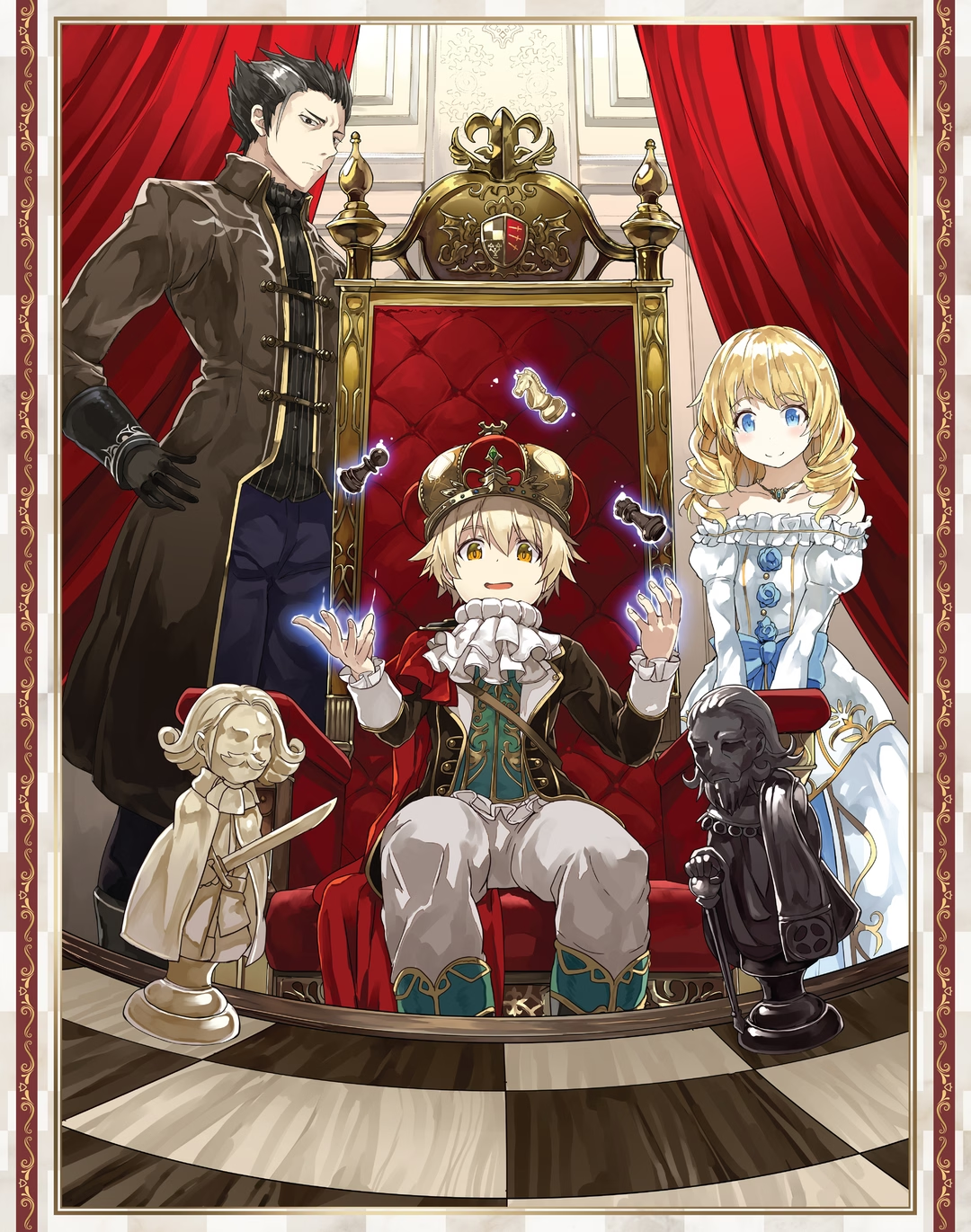
My name was Carmine de la Garde-Bundarte. Title: Emperor of the Bundarte Empire. Given that I had been made emperor as soon as I was born, things didn’t seem to be going well.
Two individuals held the reins in this empire: the Chancellor and the Minister of Ceremony. Both were Dukes of royal blood. Their houses formed the cores of the two factions currently vying for power. In short, if I died, the empire would probably split in two and break out into civil war.
Still, that alone felt like too weak a justification for leaving me alive, especially since both of the chief players in this power struggle had a fair claim to the throne. There had to be some other reason. If I happened to become an “inconvenience” without discovering why, it’d be curtains for me.
In plain terms, I was playing on hard mode. Some life this was. Had the old me done something to deserve this?
Whatever. I’ll pull through. Just watch me.
The Newborn Emperor
I was currently eating baby food. If there happened to be poison in it, I’d be dead before the day was out. Nevertheless, I suppressed my fear and swallowed the mush being delivered to my mouth.
In my past life, I’d read a few light novels about reincarnation, here and there. I wondered if the protagonists had spent their infancy feeling this same terror. And wasn’t I supposed to get an overpowered ability? Or a conversation with a god?
I didn’t even remember how I had died. I had the feeling that I hadn’t been the sort of guy who could risk his life to save someone in the spur of the moment. If I was right, then this reincarnation probably wasn’t a reward of any sort.
It likely wasn’t an apology gift for some divine mistake either. I would’ve gotten the chance to talk with a deity if it was, right? I supposed there was always the chance they’d just wiped my memories. But then why would they have reincarnated me in a prime position to die in my infancy, with no overpowered abilities?
That left the option I suspected was most likely: I was being punished. What had I done? I was pretty sure I’d just been an ordinary, timid guy, without the nerve for any real wrongdoing...
Parts of my past life’s memories were still hazy. I could remember my parents’ and older sister’s faces, but not their names, nor my own. The events surrounding my death were a complete blank. If I’d done something to deserve all this, nobody’d left me with any clues as to what.
That aside, whatever this paste was, it tasted awful. Are you sure this isn’t poison?
***
I could see only one path to survival in this world, and it was that something in the air that I’d never felt in my last life.
Finally, my confirmation came. One day, I witnessed a maid produce a spark from her fingers to burn litter in the courtyard. It was magic. I couldn’t help it; excitement bubbled forth from within me. Just a little, though.
That said, with someone always keeping an eye on me, I couldn’t exactly go about reading books or working out. All that little baby me could do was play around with the stuff of wonders.
Toys? Sure, I played with them too. Like building blocks and such. They were good for practicing fine motor control.
Now then, this magical energy thing...oh, to heck with it, I could just concede to convention and call it mana. If I could manipulate it at will and learn how to use magic, I’d be able to hold my own despite my frailty. From the Middle Ages to the early modern period, one’s personal strength was directly linked to one’s survival. I had to acquire magic, no matter what it took.
First, I tried touching it... Yep, couldn’t feel a thing. More accurately, I could still sense that it was there, but nothing had changed. Since I wasn’t actually looking at it with my eyes, I couldn’t tell if it was particulate matter or something else, or even if it was affected by airflow.
Next, I tried thinking really hard. Gather around my index finger! Gather, I say!
Nope. Couldn’t sense any gathering happening at all. I supposed it needed an incantation or something.
“Ah auh! Goo!” (Translation: O wind, blow!)
Nothing happened. I figured as much. The maid smiled at me like I was just the most precious thing. Damn you.
Oh, whatever. I had no idea what I was doing. And I’d been so optimistic about my chances too.
***
“Come on, Your Majesty. Time to go beddy-bye.”
The nurse picked me up—I still couldn’t get anywhere under my own power—and laid me onto a bed garishly decorated with gemstones and precious metals. Coupled with the canopy and railings to prevent me falling off the sides, it made for a resting place that was anything but restful. Also, it was stupidly large; two adults could’ve fit comfortably without touching.
Ostentatious furnishings aside, my thoughts were occupied by another mainstay of reincarnated-in-another-world light novels: magic items. If your world had magic, surely it had devices that capitalized on it. In fact, I was fairly sure that I was using one right now.
Given that I was presently an infant, I didn’t have a lot of voluntary control over my bodily functions, especially when it came to, er, waste management. Since I couldn’t fight it, I simply let myself become desensitized to the experience. Shame? Dignity? Those things didn’t have anything to do with this, thank you very much.
As one might expect, this world’s diaper technology had not come very far: Mine basically consisted of a wrapped cloth. However, I never stained the sheets.
Even stranger still, however, was that upon closer inspection, there was some kind of...device attached to me “down there.” It resembled a short pipe with a sealed tip, and after making this discovery, I spent the rest of that day observing it.
Each time one of my wet nurses changed my diapers, they also swapped out the device. More specifically, they swapped out the tip part by spinning it off and screwing another one back on. The only time they removed the device entirely was during my daily baths. I credited my failure to notice it until now to the fact that I always did my best to look away. Desensitized or not, some things were just uncomfortable to watch.
But returning to the device: It was clearly magical in some way. The tip was simply too short to retain much, which meant it had to be disposing of its contents in some other way. Given all the free time I had, I whiled away my boredom by trying to figure out how it worked.
Of course, lacking any knowledge about the laws, effects, limits, and costs of magic in this world, all I could do was form broad hypotheses. You could’ve told me it worked by invoking the aid of my dead ancestors and all I’d be able to do was smile and nod. Eventually I could remedy this issue by studying this world’s myths and legends, but for now I had to make do with what I had: my own past lifetime’s worth of practice with empirical inductive reasoning.
It seemed fair to assume that the device had some kind of liquid intake function. The fact that the wet nurses removed it during my baths was probably to prevent it from malfunctioning. The question was, though: was it absorbing the urine or compressing it? That it was transporting it was also a possibility, but that seemed unlikely with how often the tip needed to be changed.
My next hint lay in the device’s ability to remove odor. Since my diet consisted of various pastes, my excrement was, let’s say, not the most pleasant aroma I had ever experienced. However, with the magical device attached, my urine never produced any smell, including when the device’s tip was changed. Therefore, whatever absorbed the liquid also absorbed the smell.
I didn’t know whether odor could be compressed like liquid—I didn’t even know if the laws of magic had any commonalities with the laws of physics. I could only make the simplest assumption that the device absorbed both the liquid and odor simultaneously, rather than in separate processes.
Finally, there was the issue of cost-effectiveness. The device was, in fact, not the same one every time. While the parts that attached the main device shaft to the tip were uniform by necessity, there were often visible differences in shape, as well as various engraved emblems.
The existence of the latter had briefly terrified me with the unfounded worry that they were curses of some sort, but that seemed unlikely since the maids and wet nurses could clearly see them. The logical conclusion was that they were the maker’s mark or logo.
In other words, chances were high that the devices were handmade by skilled individuals with an obligation to advertise. That reintroduced the previously unlikely possibility that it was some sort of matter transfer device, but absorption and subsequent evaporation also seemed logical.
The scary thing was the thought that each device was custom made and disposable. If they were, it pretty much confirmed the absorption hypothesis, but the sheer cost was staggering to think about. All those craftsmen putting all those hours into something to be used once and tossed away? Talk about extravagance.
Wait. I was the emperor. That kind of luxury was par for the course. My bed alone was proof of that.
Was this empire going to be okay? There weren’t any revolutions brewing, right? There had better not have been a Lumières movement currently spreading through the populace. An intimate encounter with a guillotine was not my idea of fun.
Oh, I was getting sleepy. Beddy-bye time.
The Emperor Enjoys Being Outdoors
“Come on, Your Majesty, let’s play in the courtyard today.”
The news, delivered by today’s wet nurse, stirred a bubbling of excitement in my chest. I had only ever seen the courtyard from the windows before.
Technically, going by the standards of my previous life, “garden” or “park” would have been more accurate. Seeing so much wide-open space was thrilling, in a way. Once I learned to walk, I’d be able to go on entire adventures on my own.
For the first time in a while, I had something to look forward to. The lush carpet of grass looked terribly inviting, and the thought of dozing off on it had me feeling warm and fuzzy.
So you can imagine how betrayed I felt when the wet nurse plopped me down in a chair at the edge of the courtyard, rather than upon the great green expanse. If I had been able to speak, I would’ve told her to grab a dictionary and reacquaint herself with the definition of “play.”
I supposed it wasn’t her fault, though. There was probably some societal taboo against emperors rolling around in the dirt—not that that soothed my disappointment any.
Boy, was it hot, though. The stuffy clothes I could understand, given my status, but couldn’t the highest office in the land afford some more breathable fibers?
If only there were a breeze blowing. If I knew any magic, I could stir one up myself. I tried imagining what that would be like.
“Ah auh! Goo!” (Translation: O wind, blow!)
I worked my underdeveloped vocal cords into some mangled form of a vocalization, and to my surprise, there was a breeze—though only for an instant.
Was that me? Or just coincidence? If it was the former, what had I done differently than last time?
Well, nobody was looking at me right now. What if I tried using magic to gather the water in the air...?
“Auh ah-ah! Foo!” (Translation: O water, form!)
Plop-splash.
A tiny droplet of water formed in the air and fell to the ground.
I was confused. Why would magic start working for me now? I had to find out.
***
I’ll skip to the conclusion I reached: I could use magic in the courtyard, but not indoors. That was about it.
When I gave it further thought, it seemed fairly obvious why. In this world where everybody—or at least a meaningful fraction of the population—could use magic, allowing its use throughout the imperial demesne would be like an open invitation to anyone looking to discreetly bump me off. Death by spell would presumably leave even fewer traces of foul play than conventional assassination.
The solution would of course be to prevent the use of magic indoors. I didn’t know what sort of gimmick made it work, but there had to be something suppressing any magic use within the limits of the palace.
Why did the diaper device still work indoors, though...?
Whatever, I would leave that question for another time. Right now, I could bask in the joy of knowing I could use magic.
Since then, whenever I got the chance, I would use magic when the maids weren’t looking. Gradually, I became used to the sensation of manipulating mana. It didn’t come to me naturally just yet, but with enough concentration, I could get it to work.
I also made another major discovery in the process: There was mana in my body too. Furthermore, it was a heck of a lot easier to manipulate than the mana in the air. It felt kind of like using a magnet to accumulate iron filings: easier to gather, and easier to control.
With ambient mana, it was difficult to make small adjustments or manage the potency of my output, making it unsuited for practice in secret. I decided to stick to my personal mana reserves.
That being said, using my personal reserves alone didn’t result in any magic. There was some part of the process that I was missing...
***
Ever since the first day I successfully used magic, it was all I could think about. If the old light novel conventions held true, there was a possibility that the people here had discretely measurable mana reserves that expanded with training. In that case, I was obliged to start beefing mine up daily. Though, since I didn’t have access to a status screen or anything of the sort, I wouldn’t be able to tell if I was actually making any progress.
I think, deep down, I knew I was just desperate.
I couldn’t just use magic whenever I wanted, however—I needed to be outside. Thus, I threw tantrums every day. Whichever maid or wet nurse tried to console me, I wouldn’t stop until they had taken me out to the gardens. If I could instill the impression that I just really liked being outdoors, soon enough they would take me out the moment I began to wail.
Being honest, at least some of the crying was genuine desperation. Also, sometimes the wet nurses were so soothing that I fell straight asleep. That was some skill. Buses and trains had always lulled me to sleep in my past life, and the wet nurses’ rocking would give those a run for their money.
Whatever the case, soon enough I was getting outside almost every day.
Today was no exception; I had been left alone in a chair, and nobody was around. Hardly anybody was around me in general, in fact. I had worked out that as a general rule, only the wet nurses were allowed to touch me, while the maids assisted them. This wasn’t strictly enforced, however: While it was pretty much only the wet nurses who ever picked me up, sometimes a maid would hurry over to adjust my position before I could fall from the courtyard chair.
From their conversations—which I still couldn’t really understand most of—I figured out that the wet nurses were of relatively significant noble standing, while the maids were actually ladies-in-waiting—that is, the daughters of lower-ranked nobility. There were apparently commoner servants around too, but I had never seen them.
The maids—no, wait, ladies-in-waiting—were in a live-in apprenticeship kind of situation, where they also received an education. Whether they were paid or not, I wasn’t sure. But I digress.
Each time I was taken to the courtyard, my wet nurses went back inside, probably to take a break. Fair enough, given that I just sat in the same spot the whole time, though they’d come rushing back out at the slightest hint that I’d start crying again.
As for the ladies-in-waiting who couldn’t touch me, they would hover at a slight distance, keeping an eye on me. By which I meant they were slacking off and not watching me at all. Again, I didn’t blame them; it had to be boring watching an infant do nothing but sit there for hours.
All in all, it made for the perfect chance for me to get in my practice sessions. Over time, I made several discoveries that led to a better picture of how it all worked.
First, regarding the issue of mana reserves: I still couldn’t tell if using magic increased my overall supply or not. However, I could tell that when I cast spells, my personal reserves didn’t decrease.
I couldn’t make any definitive statements, but going off what I could sense, this was likely because I was only using my personal reserves as a medium. Thus, I was only expending the ambient mana. Given that, I probably didn’t have to worry about the size of my personal reserves.
Secondly, regarding magic itself: I was only fumbling about with half-baked concepts of what magic should be, but I could already tell it was a complex art. For example, I was practicing creating spheres of water, and it would often be easier on the days before a rainstorm. By the same token, it was far more time-consuming after a few consecutive sunny days.
I suspected this was due to the moisture content of the air. No doubt when I cast the spell, I was unconsciously gathering it in one spot. Regardless, the point was that magic could be affected by environmental conditions, such as humidity.
That being said, I had also recently picked up the ability to create a ball of ice—and this magic wasn’t affected by temperature, humidity, or even the presence of water. It simply created the ice from seemingly nothing, always taking the same amount of time, like the magic one saw in games or anime. My theory was that this was because it was an actual, formal spell rather than shapeless magic, and that it was consuming pure mana to manifest the phenomenon.
Once I found that out, I attempted to create water from pure mana, rather than using it to gather the moisture in the air. However, I couldn’t quite pull it off—the humidity levels still affected it. I didn’t think it was a problem inherent to the magic; I was probably still thinking of it as gathering moisture. I was going to have to start unlearning some thought patterns before I could learn to produce the effects I wanted.
With enough time, I could probably train myself into the right frame of mind...but I decided to focus on widening the variety of my magic for the time being.
I was pressed for time. At any moment, my puppet masters could decide that I was no longer worth keeping around, and I would be gone, just like that. Somehow, some way, I had to get strong enough to survive.
An Empire in Decline
By the time I turned two, I was a lot more mobile, and I could get away with a lot more talking without raising any eyebrows. I stuck to two simple words or less, though—I didn’t want to risk outing myself.
Things had changed a lot for me recently: I was starting to get male visitors to my residence. Specifically, a geezer and a grandpa. Apparently the former was the Chancellor, while the latter was the Minister of Ceremony. Both used the excuse of “paying their respects” to try and win me over while trash-talking the other. Not much point trying that with a kid my age, if you asked me. Maybe they were trying to get me to imprint like a baby bird.
Anyhow, these two were the political heavyweights who held my life in their hands, each spearheading their opposing factions. Even the ladies who minded me were part of the conflict. Though I had twenty of them, I only ever saw ten at once, and they swapped each day. I suspected the two shifts each worked for separate factions.
I doubted they were crack agents, though, because they had recently taken to gossiping while I was playing. It was rude of them to slack off right in front of the emperor—and I wholeheartedly approved of it. Dish away, ladies!
For brevity’s sake, let me condense what I learned into a primer of sorts.
First, the geezer—er, I mean, the forty-ish looking guy with a medium build. As the Chancellor, he stood at the apex of the empire’s political scene. I know what you’re thinking: Shouldn’t it be the emperor at the top?
And you’d be right—on paper.
His name was Karl de Van-Raul—though he was also known as Duke Raul, or the Second Duke Raul—and basically the entire empire’s political sphere answered to him. To the Minister of Ceremony and his faction, Duke Raul was a fat cat plundering the empire to line his own pockets. I should note: We were family. To be exact, he was the eldest son of my great-grandfather’s younger brother. He was also the older brother of my deceased grandmother.
In other words, my grandparents—the previous emperor and his empress consort—were cousins. Fun fact: up until their marriage, the Empire had recognized consanguine marriage as a serious breach of the law.
Why did it become legal, you ask? Well, I can’t say for sure, but I suspect it had something to do with the fact that Chancellor Karl’s little brother was the empire’s chief spiritual leader.
What, did you not get the message earlier when I said Duke Raul was a fat cat abusing his position? The more I heard about him, the more corrupt he seemed. Whatever, it wasn’t really my business.
Next came the grandpa—more accurately, the old man who insisted on playing the part of my grandpa: Phillip de Garde-Agincarl. Also known as Duke Agincarl or the Grand Duke, he was the Minister of Ceremony and another relative of mine. If I remembered right, he was the younger half brother (his mother was different) of my great-grandfather. More importantly, he was my mother’s father, which made him my actual grandfather. To the Chancellor’s faction, he was a schemer who manipulated the empress and invented new government positions to jam up the political process.
Case in point, all the positions he created were reserved for members of his faction. Naturally, their salaries came out of the empire’s treasury. Long story short, he was just as much of a vulture as the Chancellor was.
As for the power balance between their factions, the Chancellor’s faction currently had the upper hand, while the regency—yes, not the “Minister of Ceremony’s faction”—was losing ground. This was because the regent of said regency didn’t make public appearances.
For the unaware, a regent is someone who administers a state while a ruler is otherwise indisposed or not yet of age. The current regent of the Bundarte Empire was my mother, Acretia. While the most powerful individual in the empire was the Chancellor, on paper, the regent was second only to the emperor. But if the regent refused to leave her residence, it was no wonder the Chancellor’s faction was gaining in influence.
Why didn’t she make public appearances, you ask? Simple: because she was still grieving the recent loss of her child, who died of illness. While we’re on the topic of death, my father died before I was born. If that timeline sounds a bit jumbled to you, that’s because my esteemed mother has a lover, with whom she’d had her now-deceased child—while ignoring my existence entirely. Apparently, the affair had started while my father was still alive.
Not to be callous, but I didn’t think her child “dying of illness” was much of a surprise. The same couldn’t be said for Acretia, apparently; word on the street said she’d collapsed from shock at the news. Still, all I could think was, You know it’s probably your dad who did it, right? Throwing another possible heir into the struggle for succession only could’ve ended one way.
As you would expect, I didn’t have a warm feeling to spare for her, especially since I still remembered my mom from my previous life. The difference between them was like night and day. To be honest, I didn’t even want to call Acretia my mother.
Stepping back for a moment—you’ve got to figure it’s kind of catastrophic that the ladies-in-waiting know enough to gossip about this, yeah? Royal families have been disgraced for less. No doubt other countries knew about it too. Man, this empire really needed to get it together. If that was even possible...
Ah, I should also mention that my wet nurses had stopped coming by, since I didn’t need to be breastfed anymore. Since I was no longer an infant but a fully-fledged child, my care would be entrusted to the ladies-in-waiting from now on. Much had changed, including the fact that they could now touch me if necessary. Unlike my previous world, the line between child and infant was clearly drawn here.
Apparently, the wet nurses had been married noblewomen from the neutral bloc, which meant that their departure left me with even less breathing room.
“Neutral bloc” was a blanket term that referred to anybody not in the pocket of the Chancellor’s faction or the regency. There weren’t many of them, but they made up the majority of the imperial court and political body. Well, they used to.
Most of the neutral bloc were basically bureaucrats, and they tended to own no territory, though some had bits and pieces out in the sticks. In comparison, Dukes Raul and Agincarl were landed nobility, as you’d expect from their titles, and many of their lapdogs were too.
If I were to involve myself in politics, the neutral bloc would be my only potential allies. Since they owned no land, the collapse of the empire would mean the loss of their power. Their lives depended on a stable state. On the other hand, the landed nobility would be fine if the empire collapsed—they could simply swear fealty to another country or declare independence. Then again, more and more of the neutral bloc had been throwing in their lot with the Chancellor or the regency lately. Not a surprise, when the alternative was losing their positions.
If I couldn’t count on their help, then it was probably best to avoid politics entirely. The risk was simply too great.
Incidentally, my wet nurses had come from the neutral bloc because of the inherently fragile nature of the average infant in this era. If either faction had staffed my wet nurses with their own attendants, me dying—even from natural causes—would kick off a huge dispute over who’d screwed the pooch. And when it came time to pick the next emperor, the faction that looked most at fault would have a hard time installing their puppet.
In any case, with my wet nurses gone, all I had around me were the ladies-in-waiting, who were definitely in the pocket of one faction or the other. I felt surrounded by enemies.
Not that they were actively trying to spy on me or anything. I even felt a little bad for them—in the end, it was always the people in power who came out on top, while the rest of us had to obey. I couldn’t hold a grudge against the ladies-in-waiting when they probably never had a say in the matter.
The Chancellor and Minister of Ceremony, though? They could eat dirt. No decent person manipulated a kid, child emperor or not. Plus, I’d been your average prole in my previous life; I had no love for any of these swaggering aristocratic bloodsuckers.
I know that sounds rich, given the position I’d been reincarnated into, but honestly, being emperor really didn’t suit me. I’d much rather have been an up-and-coming adventurer making a name for himself.
Once I was old enough, maybe I would slip away and live as a commoner. If I had to spend my life sleeping with one eye open either way, I’d sooner do it living as a free man.
Still, if I wanted that, I’d have to learn more magic.
The Day a Mage Was Born
Time passed, and I turned three. My magical repertoire increased every day; I was getting pretty confident in my ability. It was perhaps the only advantage afforded me in this new life.
My motor control continued to improve as well—I took note of how similar grabbing and holding things felt to manipulating mana. Thanks to that, I discovered several new spells, two of which I had high hopes for and would bear the focus of my practice going forward.
The first was a spell that let me use ambient mana to manipulate objects at a distance—telekinesis, basically. As such, I decided to call it “mana-kinesis.” I couldn’t manage anything beyond leaves or pebbles yet, though.
There was an exception to that: Objects I created with magic, such as ice or clumps of dirt, were extremely easy to move around. Being mana constructs themselves likely made them more reactive, and I could handle objects of much greater weight and size.
I didn’t have a use for mana-kinesis right now, but I had dreams of deploying my very own array of funnel weapons one day.
The second spell was one that controlled heat. I had actually started out by looking for a way to chill objects. You would expect that having the mental image of cooling something down would suffice, but since I already knew about the concept of thermal energy, it wouldn’t work right until I pictured a destination for that heat to vent to. It was a far cry from how simple creating ice had been.
In the process of practicing the chilling spell, I became able to manipulate heat itself to some degree. It was quite convenient, since I could use it to regulate my own body temperature.
My most important discovery, however, was that converting mana to heat was relatively easy and energy efficient. Rather than straight-up creating flames, I could use less mana for a greater effect by simply converting it to heat energy.
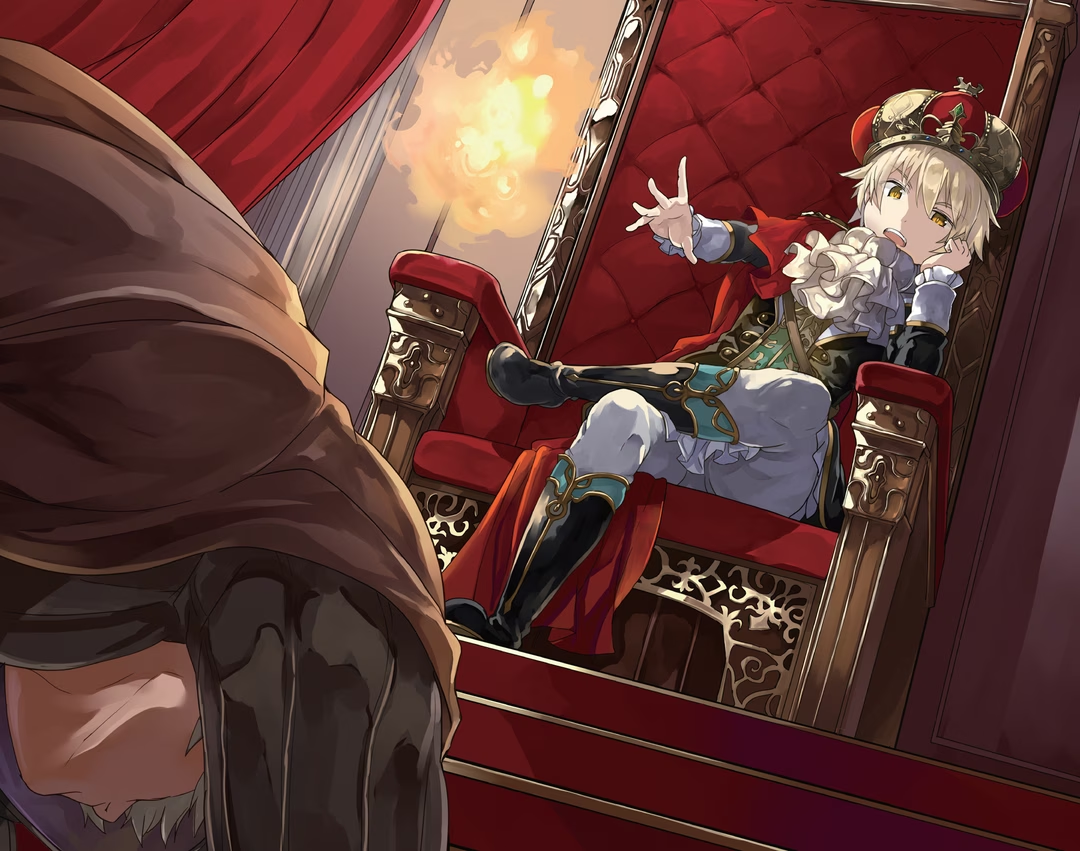
Followed to its logical conclusion, it meant that I had access to a potent means of attack—I just had to convert mana to heat energy, compress it, and direct it.
At the ripe old age of three, I had become a force to be reckoned with in a fight—so long as I could actually maintain the heat beam in my opponent’s direction. Figuring that part out was still a work in progress.
Also worth mentioning was that I was getting better at using my internal mana. Until now, I had been using it as a sort of magnet to invoke magic, but now I could circulate the mana around my body without casting a spell at all.
It felt like my internal mana was thicker than ambient mana in a way that was hard to explain, so circulating it seemed like good practice for my control. Above all, I could do it indoors. It felt like a big step toward getting ready to make my escape. Of course, trying to make a life for myself at my age was a tall order, not to mention that one whiff of my identity would put my life in danger. I’d have to bide my time for a while.
Despite my lack of motivation to be emperor-like, the role still had its way of happening around me. Aside from the Chancellor and Minister of Ceremony, I received visits from certain nobility—no doubt big shots in their own right—coming to introduce themselves. To be fair, it was never more than a one-sided conversation—I can’t imagine they looked to three-year-olds for stimulating discourse. All that was expected of me was to sit there.
In a lot of the stories I used to read where the protagonist gets reincarnated as one kind of nobility or another, they always have this uncanny ability to remember everyone’s name. But while the nobles who visited me gave their positions and titles, they never gave me a name to remember in the first place.
It made me wonder if it was a cultural thing. After all, everyone just called me “Your Majesty.” I’d only ever heard my name the once, when a priestly looking man had come by with a thick tome and conducted a ceremony that reminded me of a baptism.
Then again, the Chancellor and Minister of Ceremony had introduced themselves by name, so it probably wasn’t a taboo. Except I was their ruler, at least on paper, so maybe the rule just didn’t apply to me. I knew the pair didn’t have a loyal bone in their bodies, but they’d still follow formal etiquette.
I had no idea. It was something I could easily find out if I just asked, but I couldn’t come up with a plausible way to ask and still pass for a normal toddler my age.
I’d been trying to figure out illusion and invisibility magic, since I’d thought it would be useful for information gathering, but I’d made exactly zero progress. All of the magic I’d succeeded at had started with a clear mental image of the phenomenon I wanted to create, but illusions and invisibility were tricky to wrap my head around.
Fire and ice, sure, easy. But even with those, if I didn’t clearly picture the end result, I wouldn’t get anything. The principles of optic camouflage were unfortunately not something I knew off the top of my head.
I wasn’t sure whether I should wait until I was old enough to research such things, or prioritize my escape. It was all very inconvenient.
Also, I had finally become able to tell the difference between people from the two factions. The Chancellor’s people referred to him as “Second Duke Raul” and the Minister of Ceremony as “Duke Agincarl,” while the Minister of Ceremony’s people used “Duke Raul” and “Grand Duke Agincarl.” The people who used both “Second Duke” and “Grand Duke” were from the neutral bloc.
Of course, I had no doubt some allegiances were different behind closed doors, but being able to tell the difference in general was good progress. In fact, it would be vital information for my survival. Knowing how to tell who sided with who before I was expected to talk to them could be the difference between life and death.
***
One night, as always, I was tucked into my eyesore of a bed. Despite the size of the room, there were only two occupants: me and the lady-in-waiting sitting by my bedside.
The scary thing about humans is that we can acclimatize to pretty much anything, so I was actually able to fall asleep regardless of my circumstances. It was times like these when it really hit me that I’d become “Carmine.”
To my delight, there were occasionally times that the lady-in-waiting would fall asleep during her watch. Okay, technically that was a huge security problem, but I was grateful because it served my purposes.
After making sure that she was definitely asleep, I carefully reached my hands down to my nether regions.
Get your mind out of the gutter. I was going to examine the magical diaper device I’d been curious about for a while.
Now that I was three, I could go to the toilet by myself. I only wore the device at night, and I knew the time would soon come when I didn’t need it at all. I wanted to learn as much as I could about it before that happened.
Oh, incidentally, this world had flush toilets. Unfortunately, they weren’t the modern version with a lever, but the type where there was a small amount of constantly running water. It had been a surprise, since I’d heard flush toilets hadn’t existed in medieval Europe. Then again, apparently they’d existed in the Roman empire, so maybe it wasn’t all that strange.
But I digress. After carefully removing the device and taking it apart, I examined the pipe and cap segments carefully. My initial hypothesis was immediately proven correct: It was too dark to see anything.
As for my other senses, though, I couldn’t feel magic coming from the pipe segment. I moved on to the rounded cap and immediately felt a pool of strong...no, dense mana. What was more, minuscule amounts of it were leaking out.
It seemed safe to assume, then, that the device wasn’t powered by ambient mana, but a dense internal mana reserve in the cap. I wanted to turn the lights on to examine it more, but that would wake the lady-in-waiting, and my lack of knowledge about mana meant I probably wouldn’t get anything out of it anyway. I’d have to shelve the idea.
Still, it had led me toward a new experiment—one involving the leaking mana. I wanted to know if I could use it for magic, so first, I attempted to convert it into heat energy.
Despite feeling a brief initial response, the mana was quick to scatter and disperse.
Next, I used my hand to block the hole that connected the cap to the pipe and tried to convert mana into heat energy within the cap.
It worked. It didn’t even disperse after some time had passed. I removed my hand, but the heat remained in my palm—I could feel the warmth.
That explained a few things.
For a while now, I’d wondered what kind of spell or device prevented the use of magic indoors, and now I was closer to an answer.
Whatever it was, it rendered ambient mana inert, or something along those lines. Since casting magic required ambient mana to create phenomena or convert to energy, freezing it shut down any spell before it could even start.
A simple analogy was that it resembled playing with clay. The mana was the clay, which you could mold into whatever shape you wished, producing magic. However, if the clay was completely dried out, you couldn’t knead it into any shape. Odds were good that magical devices still worked and I could circulate my internal mana because neither was in contact with the ambient mana.
That was why, just like I had tested, I could cover the device, invoke magic within it, and produce a lasting effect, because the antimagic effect didn’t extend to shutting down active spells.
Of course, the active spell would still require mana to sustain, so this new method of casting magic indoors seemed pretty limited in use. The heat in my palm had already dwindled to nothing without any mana it could draw on.
Still, this was an indispensable clue. When I had attempted to use the mana leaking from the device, I had felt a brief response. That meant there was a slight amount of leeway between the mana leaving the device and being rendered inert.
If I expelled some of my internal mana and took advantage of that brief moment, would I be able to use magic indoors?
It was worth a shot.
I still had misgivings, so I carefully reassembled the device and returned it to its original place. Then I circulated internal mana into my right hand. Easy so far, but now how was I going to expel it? I tried changing my mental image of my mana. Until now, I’d pictured it as a liquid, but what about particles?
I imagined the particles—I decided to call them “manacules”—as small enough to pass through the pores of my cells.
Manacules began to stream from my hand. Hurriedly, I made to use them for a spell—I’d start by converting them to heat energy.
And it worked. I pulled it off. My theory about internal mana being denser seemed proven too; my palm was blazing hot. I was also struck by a sudden sense of fatigue.
Oh, I thought, so that’s what it feels like to bleed mana.
Everything went black.
Mana Absorption
Hello, it’s me. The three-year-old who can use magic indoors now.
In a sudden turn of events, I found myself surrounded by doctors when I woke up. I supposed that was no surprise, considering I’d passed out. The imperial physicians—their proper title—informed me that while my condition wasn’t serious, I should hold off from any strenuous activity for a while.
Incidentally, the lady-in-waiting who’d been asleep on night watch looked pale as a sheet. Sorry, can’t help you there. You did kind of doze off on the job.
As for my internal mana, it had gone some way toward replenishing. Though it was still far from topped up, it suggested that the people of this world had some sort of internal organ or mechanism that could generate mana.
Discoveries aside, I certainly hadn’t expected to feel so exhausted just from dipping into my own personal reserves. I hoped it hadn’t damaged my soul or anything like that. Not knowing how anything worked was really anxiety-inducing.
Come to think of it, being able to cast spells indoors wasn’t worth much if just one knocked me out. Was there maybe some way of increasing my internal mana...?
***
Turns out, there was. Don’t give me too much credit—I stumbled upon it by complete accident.
Several days after my little scare, I was finally given permission to go out into the courtyard again. Naturally, I spent the time practicing my magic in secret.
The particular spell I was working on created a miniature light source, no larger than a piece of candy. I was practicing adjusting its brightness, when all of a sudden, I noticed a lady-in-waiting started hurrying over. Before I dispersed the spell, however, I had a sudden thought: It seems like such a waste to just end it.
It was probably because it had taken so much mana to create. Regulating the spell’s brightness and adjusting its size had each required a chunk too. So, as I was undoing the spell, I pictured it coming apart as particles rather than as a liquid.
To my surprise, a small fraction of the manacules dispersed into my body. Without even intending to, I’d absorbed ambient mana. Still, that instance alone had given me the feel for it. Maybe I was pretty talented when it came to magic?
Actually attempting to absorb more ran into issues, though. It seemed I had a limit—and it wasn’t very large. The feeling of being full of mana was hard to describe; it was kind of like having a full stomach, but also like I was having difficulty breathing. If I converted my current limit, I could probably pop off two or three spells indoors before running dry.
That was when I recalled how internal mana felt “thicker” than the ambient variety. As an experiment, I tried blending the newly absorbed mana within myself until it was the same density as my internal reserves. Gradually, the feeling of fullness faded.
I repeated the process, absorbing and blending, absorbing and blending, and ended up with a significant amount in my internal reserves. It might’ve just been my imagination, but I felt like my physical condition had improved too.
The only issue was that absorbing and blending mana took a great deal of concentration and time, but if that was all it took to sneak around the suppressive effect, I’d take that trade any day of the week.
Of course, if it turned out that all mages could absorb mana like this, it was less of an advantage and more just me meeting the bare minimum. But I’d worry about that when it came to it. So long as I was a puppet, I doubted I’d be receiving a decent education, so in a way, learning how to meet the bare minimum on my own was good progress.
Ah, you’re wondering why the lady-in-waiting came running over in the first place? Apparently, she’d thought I’d picked up a stone or something off the ground and came to tell me off. Emperors shouldn’t do that, as it turned out.
***
I’d picked up hints here and there, but evidently the ladies-in-waiting didn’t see me as a puppet. They just saw a child. That left me with mixed feelings, given that I’d already had one go at adulthood—even if no one could tell—but I was grateful.
Those in the Chancellor’s faction switched to bowing and scraping whenever the man in question turned up, and vice versa for the regency faction and the Minister. My heart went out to them—having imperial court hierarchy hanging over you all the time seemed rough.
Anyhow, it meant the ladies-in-waiting would almost always answer my questions. Given my age, they didn’t seem to find it strange to chat with me—in fact, it probably would’ve been stranger if I didn’t go around asking what everything was. That was how little kids worked, right...?
It was particularly convenient for me that each faction’s ladies-in-waiting swapped out for the other set every day. Why, you ask? Well, since they were from opposing factions, they didn’t share information.
Since I’d been reincarnated, I had a backlog of knowledge that was difficult to hide completely, like how to use the toilet. The first time I’d used one, I hadn’t thought anything of it, but the lady-in-waiting had praised me for learning how in a single day—which meant she’d thought her counterpart from the opposing faction had taught me the day before.
The communication gap between them meant that I could be bold about gathering information, within certain constraints. I couldn’t ask about political stuff, and I kept most of my questions limited to myself and the things around me.
For example, the lights. Like in my previous life, my room had a light source attached to the ceiling. Apparently, it was a magic item—and a privilege at that, since few individuals in the empire could use them.
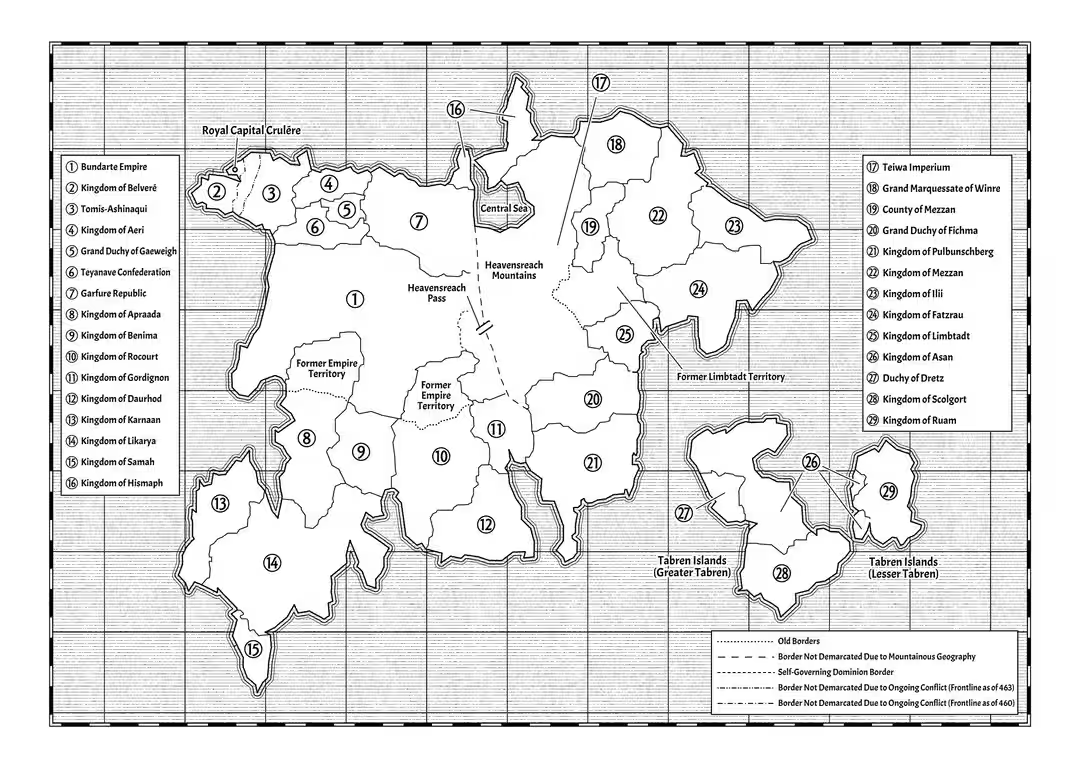
I also asked questions about the empire. Apparently, long ago, a nation called the Rotahl Empire had collapsed and splintered into several power blocs, causing chaos all around—a time known as the age of strife. Amid the unrest, a distant relative of the former emperor by the name of Cardinal stepped up and founded the Bundarte Empire. Generations later, we arrived at me: the eighth emperor.
I found out more about the imperial demesne too. Apparently, it comprised several different palaces because a new one was built—or an old one remodeled—with each new emperor. They were large enough and far enough apart that horses or carriages were necessary to move between them. I supposed this place had really earned the “empire” part of its name.
My quarters were a section of the sixth emperor’s palace—originally the crown prince of the time’s residence. In other words, it was my grandfather’s old digs.
Incidentally, the palaces not in use by yours truly were lent to nobles of high standing to use as residences, such as the Chancellor and Minister of Ceremony.
My residence had toilets, baths, and a fully working sewage system—though the water pressure was pretty weak on all fronts. Since it lacked showers and the toilets were the running water kind, I suspected that nobody around here had invented the pump yet, meaning their piping systems and such were limited in utility.
I felt a little vexed over the fact that I couldn’t remember how a pump worked well enough to replicate one. While the theory was simple enough, it wasn’t like I’d ever used one. My knowledge regarding stuff I’d never encountered in my daily modern lifestyle was full of holes, and I’d always been more into the humanities than STEM.
In my old life, a few key presses and an internet connection had been all you needed to look something up. I’d been amazingly blessed, but I’d taken it for granted.
There was one final piece of vital information I’d gathered.
By all rights, the emperor was supposed to go through two ceremonies—one inducting him as the crown prince, and the second his coronation—before formally becoming the emperor. Since I’d held the position since birth, however, I hadn’t done this. The biggest point of contention between the Chancellor’s faction and the regency at present was when I would be crowned, and who would place the titular object on my head—because that would solidify who was second to me in terms of power.
The point was, if I was going to make my escape, it would have to be before my coronation.
Funeral Prayer
Time passed, and I turned four. My days were filled with strolling around, asking questions of the ladies-in-waiting, and secretly practicing magic. Today, however, things were different from the moment I woke up.
“This will be your attire today, Your Majesty.”
It was clearly a ceremonial suit of some kind. Come to think of it, they’d taken my measurements the other day, hadn’t they?
I obediently allowed myself to be dressed. I’d gotten used to it—and to being undressed too. It was nothing compared to the embarrassment of the ladies-in-waiting washing me from head to toe during my baths. Though I’d gotten used to that as well, I suppose, loath as I am to admit it.
But setting that aside, after being dressed, I followed the ladies-in-waiting out of the building. If you didn’t count my forays into the courtyard, it was my first time outdoors. I felt a little excited—perhaps my spiffy clothes contributed. Was I about to conduct my first formal duty?
The thought sparked no small amount of curiosity. Having been a common citizen in my past life, this kind of thing was brand-new to me.
A carriage waited outside, accompanied by a retinue of mounted soldiers. I’d never seen a horse-drawn carriage in real life before—were they all this huge? Or was I just tiny?
I boarded the carriage at my attendants’ urging and found it piled high with cushions. I quickly found out why when the carriage started moving. Horse-drawn vehicles were rocky, and that was an understatement. Without all this padding, I’d be at genuine risk of injury—though personally, I was having fun. It felt like an amusement park ride.
Being excited at new clothes, enjoying the carriage ride—I was reacting like a child. My physical age wasn’t affecting me mentally, was it? That seemed scarily possible...
When the carriage stopped, I alighted in a much more somber mood.
My attendants led me to a place that resembled the churches of my previous world—not that I’d ever been to one, not being a Christian or anything of the sort. I couldn’t even tell you how similar the building was.
It looked gorgeous, though. The way the stained glass mosaics filtered the sunlight really set the mood. Their images depicted a ship, and some sort of leader figure?
I’d never been religious in my previous life, but the solemn air made me want to straighten my back and pay attention. That was why I found the lectern on the chancel—sort of like the one a school principal used at an assembly—such a crying shame. It was bedecked with jewels, precious metals, and other decorations, and was, all in all, an eyesore.
But maybe that was the fashion here? The place was packed with nobles in similarly gaudy accessories.
That aside, I was starting to get fed up with how nobody had told me what was happening. Would it kill you folks to explain anything ahead of time? I thought.
I put on my best “kid with no idea what’s going on” voice. “What’s happening?”
The lady-in-waiting beside me glanced at the surrounding nobles, then leaned in to whisper. “It’s a funeral, Your Majesty.”
“A few-nuh-ral?”
“Yes. It’s when you say goodbye to someone who died.”
Wow, really? Never would’ve guessed. “Who?”
“Well...” The lady-in-waiting hesitated. But why? Had the Chancellor or Minister of Ceremony died? “It was Lady Norn de Alleman.”
Uh, who?
“She was your esteemed father’s concubine, Your Majesty.”
The lady-in-waiting turned and bowed deeply. When I looked, I saw that the Chancellor had come up behind us.
“It has been too long, Your Majesty.” He dipped his head toward me.
Really? Just a head dip? Acting like you own the place already, huh? Whatever. What was that about a concubine?
“When your esteemed father died, we were all struck by grief, and we all responded differently. Your mother had his two concubines shut away in a dark tower and kept under watch.”
Ah, so that’s how it was.
After my father had died, the regent had been pregnant with me. But his concubines could have been with child as well, so she’d had them imprisoned, for all intents and purposes.
But then, why had they been kept there after it became clear they weren’t pregnant—especially if the ordeal had already cost one of them her life?
Incidentally, I couldn’t see the regent or the Minister of Ceremony around. It was just the Chancellor. And if my memory wasn’t failing me, most of the nobles here were in his faction.
Light bulb. I was being used for political clout right now, wasn’t I? In that case, the Chancellor would want me to express...
“How awful...”
Sympathy. How’s that for you? Subservient enough?
“Indeed, indeed!” The Chancellor gave an outsized nod. It seemed his mood had improved, because he let himself carry on. “And if that weren’t all, she had Your Majesty’s older brother killed—and his mother too! Of servant blood they may have been, but tragedy isn’t wholly reserved for nobility, I say.”
I’d had a half brother?! Had he been first in line before I was born, then? Probably not; that seemed like a big gray area if his mother hadn’t been nobility. Maybe that was why the Chancellor had turned a blind eye to them. If he wasn’t lying to me, though, all of that would’ve happened while my grandfather—the previous emperor—was still alive. How had he let the regent do as she pleased?
Wait. There was a simple explanation. Would the previous emperor really have let his grandchild die without lifting a finger? Wasn’t it more likely that he had tried something...and failed?
In other words, the previous emperor’s true cause of death was assassination by my other grandfather: the Minister of Ceremony.
Or at least, odds were good that was the case. Still, what was I going to do about it? I couldn’t even prove my suspicions, let alone act on them.
I went for my “clueless child” voice again. “I don’t get it.”
This imperial court was a minefield. One wrong step, and you were a goner.
***
I was instructed to sit in the front row, and the clergyman (this guy was probably the Chancellor’s little brother) gave his sermon. He’d chosen to go with one of the holy teachings of the empire’s religion—which was apparently called the First Faith. Evidently, speaking of the great deeds of past religious figures when sending off the dead ensured they made it to paradise.
When the sermon started, there was a minor kerfuffle at the back. I suspected it was because the whole “holy ancestor” speech was reserved for special people dying, like kings or emperors. Doing it for the crown prince’s concubine had no doubt sent the regency into a tizzy.
They said politics and religion were inseparable, and this was a clear example. Whatever—it didn’t have anything to do with me as I was now.
Now, the content of the sermon itself, that I was interested in. The clergyman was crap at public speaking, but the story itself bore a wealth of knowledge for my understimulated little brain. Uh, apart from the words I didn’t recognize, that is.
To save you the boring parts, I’ll sum it up.
Once, there was a man called Ein. He was born on the neighboring continent, and he could hear God’s voice. However, suspecting that it was mere witchcraft that had been laid upon him, he did not believe God’s words, even when God showed him a number of miracles. Ein recanted his skepticism only when God made him an Illuminatus, endowing him with the power of miracles.
God instructed Ein to spread His teachings and guide the people, and Ein obeyed. But in his journey to fulfill his role as a messenger—that was apparently what they called God’s evangelists—he was harshly persecuted. Yet, once again guided by God’s voice, Ein set sail on a long journey with a scant number of fellow believers. They encountered all manner of hardship, but overcame them with the power of miracles until finally, they reached the promised land—this continent. Eventually, after God’s teachings had taken root, the Illuminatus was invited to God’s side, having fulfilled his role. This was the origin of the First Faith.
As I listened to the sermon, I had a realization: The stained glass mosaics on each of the church’s four walls depicted Ein’s journey. The rear wall by the entrance showed him receiving the power of miracles. The left showed his persecution. In front was the mosaic I’d noticed earlier, of the sea journey, and on the right was the arrival on the continent.
I couldn’t speak to whether any of the story was true, but it was definitely fascinating. It was also a stark reminder of how little I knew of this world’s history.
Maybe after I escaped, I’d become a historian. That sounded fun.
The sermon finally ended, and the casket was closed. We all closed our eyes to pay our respects to the dead woman. I’d never met her, but I prayed for her peaceful rest. I had no doubt her life had been an unfair one—even her death had been turned into political capital, after all—so it’d be nice if she found solace in the grave.
Chances were that I (or anyone else in this church, for that matter) would end up just like her one day. That was just how the imperial court operated.
What an awful place. These people really needed a hobby.
Inheritance Law
Ever since the funeral, I’d had all sorts of people coming by to try to win me over to their faction. I couldn’t have been more grateful, to be honest—I was learning so much thanks to them.
First up was the reason I was the emperor, despite my age. Piecing it together had taken some effort, since everyone was rather hesitant to bring it up.
The previous emperor had been my grandfather, Edward IV, and he’d only had one son: my father, Crown Prince Jean, who had died on the front lines. When the news had broken, Edward IV had succumbed to grief and followed his son into the afterlife.
Yeah, right. He was obviously assassinated.
At any rate, that had left the throne vacant in the midst of war—but wait, because amid the chaos, the splendid leadership of Dukes Agincarl and Raul had guided the country to a miraculous peace treaty. And all it had cost the empire was some cession of territory—territory belonging to the Dukes’ political opponents, that is.
“Miraculous” my ass. The Dukes couldn’t have asked for a better setup. Hell, they could have been colluding toward this end all through the war.
Whatever the case, it wasn’t as though they were allies or anything. Their goals had aligned temporarily; that was all. Case in point: They’d immediately begun maneuvering to put their choice of puppet on the throne. However, all of that work behind closed doors had come to a stop.
Why? Well, because of me. Until my birth, it had been unclear if I was a boy or a girl, and that uncertainty had put a moratorium on political conflict for a while. I didn’t have a great grasp on the empire’s inheritance laws yet, but it appeared to follow the common trend of the eldest direct male descendant being first in line.
Thus, after I was born, the other potential inheritors—who were backed by the two Dukes—were killed off. By who, you ask? Why, the two Dukes, of course!
I couldn’t say that for certain, sure, but it might as well have been a given. The two Dukes were on another level of despotism. Though I guessed since all the nobles were talking about it, they’d more or less come to grips with the situation.
Regardless, with a baby on the throne, all the power in the empire fell into the laps of the two Dukes. The next step was a foregone conclusion: rip the power from the other guy!
Here’s where we move onto an interesting question: Why hadn’t the political conflict broken out into armed conflict—that is, civil war?
No doubt a significant reason was the gap in strength of arms. Duke Raul’s faction held sway over half the empire, just about, including all the most martially developed territories. In an outright conflict, Duke Agincarl and the regency had about a snowball’s chance in hell of winning. This was why Duke Raul held the advantage and was currently the most powerful man in the empire.
Additionally, in the event of my death, chances were high that Duke Agincarl would succeed the throne. The line of succession was enshrined in the empire’s inheritance law, and even Duke Raul couldn’t just ignore that—not that he wouldn’t off Duke Agincarl the moment the coast was clear. He’d killed the guy before him in line, after all.
Still, if matters broke out into civil war and I was assassinated in the process, it meant that Duke Agincarl would be in a position to declare Duke Raul a rebel. With the right of sovereignty on the former’s side, the latter’s faction would bleed defectors like no tomorrow. So naturally, Duke Raul was keeping me alive.
As for why Duke Agincarl wasn’t having me killed, it was because of good old family bonds. Since his daughter was the empress dowager, if it got out that he’d snuffed out his own grandkid, it’d be a major black mark on his record. Honor was kind of a big deal to the aristocracy—a certain interpretation of it, anyway—and it was tough to imagine many would support him inheriting the throne whether he was next in line or not.
Anyway, this precarious balance had created a temporary deadlock, of sorts. However, that was only if I remained neutral. If I took a side, the opposition would throw caution to the wind and make use of every means they had to survive.
My life was quite literally hanging in the balance.
***
I should inform you of a recent major change. The regent—yes, that regent—had finally come out of her residence. It seemed my politically obligatory appearance at the funeral the other day had lit a fire of anxiety under her. Little late, if you asked me.
Either way, it was a welcome change for me, since I wanted the two factions to stay in deadlock for as long as possible. Chances were better I’d find an opportunity to run off that way.
That being said, one of the first things out of her mouth when she’d paid me a visit was that ladies-in-waiting shouldn’t talk without the emperor’s permission. Ever since, they’d stopped gossiping around me and only spoke when I asked them a question. They’d even started distancing themselves when possible, probably because they wanted to avoid attention.
My guess was that the regent was scared she’d lose relevance if I got attached to the ladies-in-waiting instead of my “mother.” I could understand that logic.
Doesn’t change the fact that I hate you, though.
Anyway, she’d come by again today too. And the first thing out of her mouth this time was:
“Your Majesty, you mustn’t trust Duke Raul. He is certainly scheming something untoward.”
Give me a break, lady. Do you know how tiring it is to keep up the “innocent child” act? You know I’m going to have to play dumb so I don’t come off as weird, right?
“Um, mother? Who’s Duke Rah-ool again?”
Zip it, you. I know he’s the Chancellor.
“Everyone calls him the ‘Chancellor.’ He wants to take over this country.”
“Really?”
As far as I’ve heard, I thought, he’ll be leaving me alone for the time being.
“Yes, really. He made his own son marry your aunt. He’s a horrible man who forces people to do what he wants, and that’s very bad.”
Wait, hold it. My late father had a sister? And she was still kicking? This was news to me. Feed me more—more, I say!
“I have an aunt? I didn’t know that!”
“You do. Your father had two younger sisters, in fact. One is the queen of another country now, but Duke Raul compelled the other one to marry him. It must be part of a plot to depose you.”
I cocked my head and did my best to look confused. “Depose”? You suck at talking to kids, Acretia. Don’t make me do more acting than I already have to!
“Oh, I get it! My aunt’s gonna be the next em-pah-ror after me!”
This was a pretty significant revelation. The seesaw that I’d thought was delicately balanced was in fact already tilting.
“No, that won’t happen. Imperial law would allow it, but according to familial law, your grandfather is next in line.”
Another revelation. By grandfather, I supposed she meant Duke Agincarl, the Minister of Ceremony.
“Famil-yul law? What’s that?”
Tell me everything you know! Pronto!
My acting efforts were amply rewarded—the regent gave me a wealth of new information to consider. Evidently, there were two kinds of inheritance law in the empire: imperial and familial. To find out why, we’d have to go back to the time of the empire’s founding.
I’d mentioned this before, but before the Bundarte Empire was around, this land used to be a part of the Rotahl Empire. The Bundarte people had migrated here and become nobility, and after the Rotahl Empire collapsed, the Bundarte people had stayed loyal to its remaining royalty. The bloodlines mixed, stuff happened, and we arrived back at the current day.
Long story short, the Bundarte Empire was, in a sense, the new version of the old Rotahl Empire. Familial law referred to the inheritance method of the Bundarte people, while imperial law was a holdover from the Rotahl Empire—and both systems held legal weight.
Of the two, imperial law prioritized males, meaning female descendants could still become empress under the right circumstances. However, according to familial law, only males could inherit.
Incidentally, ever since the country had become known as the “Bundarte Empire,” it had never had an empress.
Come on, people, I found myself thinking. Consolidate your goddamn laws. What’s the point in even having laws if you can just pick the set that’s more convenient for you?
Then again, I supposed my indignance was misdirected. This was probably the first emperor’s fault more than anybody’s in the current era.
Anyway, after that handy infodump, it was apparently time for the hag—ahem, the regent—to leave.
“It’ll be okay. I’ll keep you safe. Just remember: Don’t trust Duke Raul.”
“Yes, mother. Are you going already?”
She could go ahead and scram for all I cared, but it was a shame I couldn’t squeeze any more info out of her. There had to be a lot she knew that I still didn’t.
“Yes. Duke Raul might grow wary if I stay too long.”
Really? ’Cause my bet is that you want to hurry to your rendezvous with your lover. I heard the ladies-in-waiting gossiping about it, you know.
“Okay, mother. Please come again.”
I was grateful, I supposed. I might’ve been screwed if she hadn’t been so generous with the history lesson. As a token of my gratitude, I decided to overlook my differences and give her a hug.
Eugh! Go easier on the perfume, hag! I feel like I’m drowning in the stuff!
***
“Your Majesty. It is I, Herc.”
After the regent’s departure, my butler, Herc le Diffé, came to my room. Ever since the ladies-in-waiting had started distancing themselves, he had come by to assist with my care. Apparently, he had the trust of the regent, the Chancellor, and several of the neutral nobility.
You might think that made him trustworthy, but a noble’s trust was a fickle thing. No doubt he was just convenient. To elaborate, let’s consider an example.
Since I was still young, most of the nobility didn’t bother to visit me. However, once I grew older, I’d no doubt be up to my ears in them. To differentiate themselves and make a good impression, knowing what I liked and disliked would be an advantage.
How would they get that information, you ask? Why, by bribing the guy who’s always by my side, of course!
In other words, this guy was only my butler so he could make stacks off of selling my personal info. And because of him, I had to keep up the incompetent kid act at all times. It sucked, but I couldn’t do anything about it.
For the time being.
Incidentally, there were fewer ladies-in-waiting in play lately. It was probably the regent’s fault. Was she really that afraid of the idea that I’d grow attached to them instead of her? She was chasing out everyone’s pawns, not just the Chancellor’s. I was beginning to suspect that she had zero grasp of the political game at all.
Regardless, I still didn’t have anyone I could call an ally. I had to keep my guard up around everyone. It would’ve been nice if a neutral noble or two lent me a hand...but it wasn’t like I had anything to pay them back with.
Also, wow, I stunk of perfume. It wasn’t all bad, though—now I understood that perfume was a thing here and something of its place in the order of things. You take what knowledge you can get.
“Yes, Herc? Come in.”
The thin door opened to reveal the man in question. Incidentally, the entrance to this room had two doors leading to it: a thicker outside one to prevent noise, and a thinner one you could hear through. The small room in between was where the butler waited—it was his privilege to get that far without my permission. Other nobility needed to speak with him first before coming in from the outer door.
Given how strict all the rules were, I wished people would show me some more respect. I was their emperor, wasn’t I?
Oh, the regent? She’d barged her way in without regard, since she was my “mother.” I suspected she’d be on the receiving end of a political barb or two tomorrow because of it.
“You have a visitor, Your Majesty. Shall I let them in?”
What, you’re not gonna give me a name or anything?
“Very well. Go ahead.”
I supposed the fact that he hadn’t given a name was an answer in itself. It could only be...
“Greetings, Your Majesty. It is I, Karl.”
Yep, the Chancellor.
***
Okay. Take a deep breath, and...
“Herc! This man wants to murder us!”
Screaming in anger really takes a lot out of you. Oh, you’re confused about my pronoun usage? Around the regent, I used “I,” but at all other times I used the royal plural. I was trying to give off the impression of a little kid doing his best to follow his lessons but who let his true self come out in front of his mother.
“Your Majesty?” Herc looked taken aback. “Whatever do you mean?”
“Get him out! Why did you let him in?!”
Well, that would have been because I said it was okay.
“Your Majesty, it seems there’s been a misunderstanding.”
I hadn’t spoken directly to the Chancellor, but he’d piped up anyway. Wasn’t that disrespectful? Not that I would bring it up.
“We don’t believe you! Our mother said not to! She said you want to kill us!”
“Your Majesty, I must insist that this is a misunderstanding. My son and Lady Maria are still only betrothed. If she were to marry into another country’s gentry, there is a chance that country would attempt to take over the empire. As the Chancellor, I am only acting in the empire’s best interests. The formal wedding will, of course, not take place until Your Majesty is already wed.”
Maria was the name of the late crown prince’s sister. I didn’t think it actually mattered if she was married or just betrothed, since the Chancellor would be her new guardian anyway. If he set her up to inherit, he’d hold all the real power. Also, I’d heard from the regent that if Maria married into another country, the Chancellor had the power to force her to renounce her right of inheritance, so his excuses didn’t hold any water. He just wanted to make her marry his kid.
Plus, I had no doubt that if I died, he’d kick off the ceremony right away, saying it was for the “sake of the empire.”
You think you can trick me with such a flimsy excuse? Well, you’d be right, because I’m four! I have to let it slide!
“Very well. We understand. We believe you.”
“Ha ha, I am grateful, Your Majesty.”
While I was at it, I supposed I could play it up a bit.
“Are you...on our side, Karl?”
“Your Majesty... But of course. It pains my heart that you must even ask. I am and will always be your ally.”
Damn, geezer. You have no shame, huh?
The regent didn’t come by for a while after that day. She’d probably landed herself in political hot water.
Two more ladies-in-waiting from the regency showed up, though. A sign of the Minister of Ceremony doing damage control?
Politics. Can’t live with it, can’t live without it.
Watcher in the Ceiling
It had been five years since I’d reincarnated.
Recently, I’d been meeting with nobility every day, mostly so they could introduce me to their daughters—candidates for my future empress consort, in other words. Of course, I doubted I would have a say in who got picked.
Incidentally, almost all of the nobles were men. That lent credence to my suspicion that society in this world currently trended pretty strongly patriarchal. Still, there were a number of noblewomen who held peerage, and apparently they were all extremely talented with magic.
For the most part, it appeared that the ancestors of nobility here had been mages. It made sense when you thought about it—back on Earth, nobility had tended to spring up from the military elite or warrior social classes. It was just that for some people here, your ability to hold your own in a fight had a lot more to do with your magical talent than your ability to swing a sword.
Once you had enough mages in the upper ranks of your society, they’d become nobility, and then their children down the line would be likely to inherit their magic. That is, if magical ability could be passed down genetically—which it very well could have been.
When viewed from that angle, perhaps this world’s society was founded on magical supremacy first and patriarchy second. The noblewomen I’d met had no doubt won out over their siblings to sit at the head of their families, after all. Still, they had all been lower nobility—baronesses or viscountesses. The upper peerage consisted almost entirely of men.
At any rate, this threw a wrench into my plans. I had been planning to hide my magic, but if having it was an inherent marker of my place among the nobility, that could get me ostracized—or worse. I’d have to pay attention to figure out what the right choice was.
By the way, none of the daughters dragged along by their parents showed any particular interest in me. The reason was simple: I was quite chubby. I absolved myself of blame for that—my caretakers didn’t let me exercise and they stuffed me full of sweet and fatty foods all the time. Of course I’d plump up.
Overall, though, I didn’t mind. It would be easier to evade notice if others looked down on me for my appearance.
Didn’t it hurt my feelings to have girls look at me like I was gross, you ask? No. Definitely not, okay?
***
I met with nobility, ate lavish meals, nodded along blindly to whatever the Chancellor and Minister of Ceremony said, and practiced magic. That was all my life was, these days. If you hadn’t figured it out already, that meant my little practice sessions were the only times I got to enjoy myself.
What about mealtimes? What about them? Are cold fatty foods with a bite taken out of them your idea of a good time?
Okay, so I couldn’t blame them for the poison testing—I mean, I was the emperor. Still, did they have to let the food sit for as long as they did?
Anyway, magic practice was the only fun in my life, and it was going well. I could freely manipulate heat now, and I could move objects at a distance with fine control. Plus, I’d added to my magical repertoire. So far the standouts were a healing spell and a spell that created an invisible wall; I was prioritizing magic that would be useful after I made my escape. I’d also learned a sleep spell that I could use to ensure my night watch didn’t bother me.
All of these I had learned without too much difficulty, but as always, I still had trouble with water conjuring spells. The way that magic demanded a strong mental image was a huge roadblock—my half-baked knowledge of physics and fluid dynamics were actually a detriment.
At least I could get the spell to work, though, no matter how inefficient it was. In comparison, I couldn’t make any headway at all in figuring out space manipulation or optic camouflage. There had to be laws and limits to magic that I just wasn’t aware of. It would be a fun thing to study once I got out of here.
Looking back, I had been far too carefree during this period of my life. If only I’d known what was coming.
***
It happened one night after I’d put the lady-in-waiting on night watch to sleep. I was seated on my bed, trying to work out a detection spell that I’d never tried before. I figured it would be useful for tracking any pursuers after I made my escape. Hopefully, I’d be able to get it to work through walls too.
My first idea was to create some kind of magical ultrasound, but it wasn’t going well because of the indoor mana jammer. Next, I tried firing a weak heat absorption pulse in every direction. With my skill in heat manipulation, the pulse would absorb from the warmest sources of heat nearby, and all I had to do was construct a three-dimensional mental image to get a rudimentary heat map of the vicinity.
This got past the mana jammer issue, since it used heat, and I could just keep feeding the spell with my own mana. Additionally, the heat absorption pulse could also work through walls. I decided to call this spell “heat detection.”
Forming the mental image of the heat map was by far the hardest part—I failed countless times before it gradually began to come together. I decided I’d polished it to an acceptable level once I could fully sense the two guards standing outside my door. Another perfected spell in my repertoire.
Of course...that was when I noticed that someone was in the ceiling.
I almost screamed, but managed to push the urge down. A chill ran through me that left me feeling like my blood had turned to ice. The sound of my own heartbeat seemed deafening.
This manor didn’t have a second floor. In other words, my mystery individual was hidden in the ceiling. Were they an assassin? Or another guard? Either way, this was bad.
I readied my mana to cast a spell at any second, just in case it was an assassin. Cold sweat trickled down my brow.
Even if it was just another guard, I was screwed. I didn’t know how long they’d been there, and I’d been practicing magic every night recently. If they’d been watching me, they’d know I was able to use magic indoors. In the entirety of my new life, I’d never seen anyone else do that. What if it was a mark of genius, or talent? If that got out, people would call me a prodigy.
Crap, crap, crap!
Had they figured out that I was only pretending to be incompetent?! I wasn’t going to be snuffed out, was I?!
Should I...kill them first, to silence them? I thought. No, that wouldn’t do anything but draw more suspicion. What the hell do I do?!
***
I didn’t get a wink of sleep that night. As it turned out, my watcher in the ceiling swapped out, with multiple someones taking turns to keep me under constant surveillance.
It continued throughout the next day and the day after that. I couldn’t sleep the entire time. As long as I didn’t know who the watchers worked for or what their objective was, I couldn’t discount the possibility that they were assassins.
The tension, fear, and sleep deprivation eventually began to affect me. On the third day, I vomited up my breakfast and passed out.
When I awoke, I was surrounded by imperial physicians. Apparently, rumor was going around that my food had been poisoned. If I didn’t do anything to quell that, some innocent bystander could end up accused and executed.
Thus, I was adamant in the face of the physicians’ questions—Did it taste strange? Was there a weird smell?—denying that there had been anything wrong with my food. In the end, after I explained that I hadn’t been feeling well for days beforehand, they came to the conclusion that I’d just had a bout of poor constitution.
The air of tension over the adults around me relaxed, and I was just as relieved. Unable to overcome the fatigue I was feeling, I went straight back to sleep.
As for the watchers in the ceiling, they continued to make no moves whatsoever, aside from swapping out with each other. With my heat detection spell, I could tell that their body sizes varied depending on the day, but that was about it.
The Chancellor and Minister of Ceremony still seemed ignorant of the fact that I could use magic. That went for the ladies-in-waiting too.
I decided to shelve the issue for now, figuring that if any assassin was a better mage than me, there’d be nothing I could do to avoid death anyway.
Incidentally, since the whole ordeal meant that “Emperor Carmine” now knew what poison was, nobody thought it was strange when I started eating less. Thanks to that, I successfully lost some weight, returning to an average build.
The Blue-Eyed Fiancée
Remember a while back, when I’d mentioned the possibility of sharing names being a societal taboo? Yeah, apparently that wasn’t a thing. Now that I could hold conversations, all the nobles who’d only given me their titles before happily gave me their names when I asked.
I suspected they only hadn’t done so before because they thought it would be easier for a child to remember the shorter official titles. That was fair enough, because even though they’d told me their names, I couldn’t remember most of them.
Some individuals, though, I made the effort to commit to memory: the ones who seemed to be part of the neutral bloc. Even though I’d be leaving this place behind eventually, it’d help my odds if I had sympathizers to rely on in the meantime.
First, there was Count Geoffroi de Nunvalle, the Minister of Finance. With a balding scalp, constantly unwell complexion, and tendency to hold himself by the stomach, he looked older than he actually was. He was the man in charge of the Empire’s economic situation, which was declining every year, given how things around here were on a visible downward slide to “collapsed nation-state” conditions.
Still, it made a lot of sense to me that a guy in his position would be part of the neutral bloc. No matter where you were, money was the fulcrum of everything, including politics. If the moneyman threw his lot in with either faction, the power balance would fall completely out of whack.
That didn’t appear to stop either faction from pressuring him constantly, though, which explained his poor health. Honestly, I felt sorry for the guy.
The second person was Duke Richter de Van-Warren. In the war preceding my birth, he had been the Imperial Grand Marshal—the highest-ranking military position—and apparently a good one at that, because our armies had outperformed those of our foes. However, when my father, the crown prince, had died in battle, the responsibility had fallen onto Duke Warren’s shoulders. He’d been stripped of his rank.
The duke wore an eye patch, as he’d lost an eye in battle, and bore scars on his face. That and the rugged military veteran look he had going for him no doubt made him a real lady-killer.
When he came by, it was always with his daughter in tow. Her name was...Nadine, if I remembered right. Ever since I’d lost weight, my marriage candidates had been eyeing me like carnivores watching a prime cut of rare steak, but Nadine was the only one who still looked at me like I was dirt. In fact, she let her scorn bleed all the way into her words, trying to prove that she was smarter or better than me with every sentence she uttered.
One of my current favorite pastimes was pretending to be an idiot while secretly making fun of her. Oh, and she was a huge daddy’s girl. No surprises there.
On to the third person of interest from the neutral bloc: Count Palatine Alfred le Vodedt. Apparently, he’d more or less publicly declared that he’d side with whoever placed the crown on my head at my coronation. He didn’t tell me his official position, but from what I’d deduced from others’ gossip...he was the Empire’s spymaster.
In other words, he was the most likely culprit behind the watchers in my ceiling.
Of course, I couldn’t ask him about that in front of my butler or ladies-in-waiting. I tried poking at the topic in a roundabout way, but intentional or not, he refused to give me anything. It wasn’t that he was expressionless and neutral all the time—more that he was slippery, never giving you any purchase to grab onto.
Thus, I decided to attempt a different approach, using the fact that he hadn’t given me his position as ammo...
“Oh, I get it! So you have no job!”
Yep, I said that straight to his face, in front of all the other nobility too. Though the words had come from a five-year-old child, they would clearly be taken as derogatory and result in a huge loss of face.
Wasn’t I scared, you ask? Of course I was. However, the Count Palatine’s only reaction was to look briefly surprised before smiling and saying that he did indeed have a job. That didn’t give me anything to work off of. No wonder he ran the Empire’s intelligence apparatus.
Still, from that day on, there was a change in the watchers in my ceiling. Depending on the day, sometimes I could sense boredom, and other times outright killing intent.
Don’t look at me like that—I’m just as surprised as you are that I can sense something like killing intent now.
Anyway, that was probably enough to confirm that Count Palatine Vodedt was their boss, which meant that my watchers were guards for my protection, albeit ones keeping me under surveillance. If I was going to make my escape, I’d have to figure out a way to deceive them...but I could leave that problem for later.
***
One day, I was to meet with a marriage candidate again. But instead of them coming to my quarters, I was taken to the parlor for the first time—a room furnished with tasteful paintings and fine porcelain. I took this to mean that I’d been meeting with a foreign envoy of some sort. Finally, my international diplomacy debut!
I waited, patient and slightly excited, and when my guest came, I saw that it was a girl of my age. She entered the room wearing a perfect smile, guided by my moneygrubbing butler, Herc le Diffé.
When I say her smile was perfect, I meant it—it was too well crafted. I could’ve spotted its artifice blindfolded. Apparently, she was nervous to be here.
“Your Majesty. May I present Rosaria Van-Chalongé-Cruveillier, first princess of the Kingdom of Belvére.”
As Herc introduced her, the girl performed this world’s gesture of greeting (picture a curtsy, but with both hands over the stomach where the other party could see them).
She had blonde hair styled not quite curly enough to count as stereotypical princess ringlets, an aqua blue dress that suited her well, and a clear, precise voice.
“It is a pleasure to meet you, Your Majesty. I am Rosaria Van-Chalongé-Cruveillier.”
The girl raised her head, revealing a pair of beautiful sapphire eyes—though they wavered uneasily.
In a word, she was beautiful. In light of that, her fear of me was disheartening.
I had no idea where the Kingdom of Belvére even was, let alone its level of influence or what relationship it had with the Empire.
Wait... Aha!
The fact that nobody had told me had to mean they didn’t care how I treated this girl in the slightest. It was obvious in retrospect; usually it’d be the Chancellor or the like who dealt with foreign diplomats, not a five-year-old—even if he was the emperor.
Also, why had the Kingdom of Belvére sent their young princess all the way here in the first place? Not to brag, but I was pretty sure my reputation was pretty below average, as these things went. After all, I never did anything except what the other nobility told me.
So to send me their princess—their first princess, no less—meant they had an ulterior motive. Were they aiming for a betrothal? Or were they hoping I’d cause some sort of diplomatic issue?
I had no idea, and everything was made muddier by the fact that the Kingdom of Belvére’s motives probably didn’t match up with the Empire’s. I realized that maybe Rosaria wasn’t scared of me, but of the Chancellor and the other bigwigs.
Hmm. Maybe I can trick the answer out of her.
“We have taken a liking to you! Become our wife!”
The entire room was immediately dumbfounded, from Herc, to Rosaria, to the lady-in-waiting. I felt a petty sort of satisfaction from it, actually. I could get used to this.
Herc was the first to gather himself. “What? Er, pardon. I mean, Your Majesty. I’m afraid that at your age, marriage would not be possible...”
“Then how about that other thing? You know, the one that’s like marrying someone, but not.”
This time, it was Rosaria’s turn to speak. “Do you mean...a betrothal?” It looked like the sudden shock had eased her nerves a bit.
I decided I liked her better this way. She didn’t have the fake, stiff smile from before getting in the way of her beauty.
“Ah, yes, that. You are very smart... What is it, Herc? Is a betrothal not possible?”
I put on my best “I am not happy” expression. When was it, exactly, that I had lost all sense of shame? This kind of acting didn’t even faze me anymore...
“Well, Your Majesty, we would have to consult—”
“Then hurry up and do it! What are you waiting around for?!”
“M-My deepest apologies, Your Majesty! I shall see to it at once!”
Herc hurried out of the room.
From his reaction, I suspected that the Chancellor’s faction hadn’t even imagined the possibility of a betrothal. The lady-in-waiting—who today was of the regency—left the room soon after, no doubt to report to the Minister of Ceremony or regent. They probably hadn’t expected this outcome either.
I didn’t know if this was going to fly, nor what the Kingdom of Belvére was after, but in the end, it was just a betrothal. It could be annulled at any time.
Plus, having to meet with so many nobles and their daughters was honestly a pain in the behind. I didn’t know if this would do anything to curb that, but it was better than nothing. Also, being brutally honest, it would be nice to have a friendly relationship with a beautiful girl, even if it was only until I made my escape.
For the record, no, I wasn’t into little girls. She’d be a real stunner as a grown-up, though, so maybe I’d see her that way then—who knew?
“So, tell us about this ‘belbeer kingdom’ thing,” I said to Rosaria.
Her clear eyes widened, and she showed me a cute smile. “Of course, Your Majesty. The Kingdom is—”
Yeah. When it came to girls, a natural smile beat a fake one any day.
Of course, since I was sitting there satisfied with myself for a job well-done and chatting happily to Rosaria, I didn’t pay close enough attention.
She had said “the Kingdom.” Not “my kingdom,” or “my homeland.” And since I hadn’t noticed that, I also hadn’t noticed what it meant, nor the steel resolve in her tone.
Two weeks later, my betrothal to Rosaria Van-Chalongé-Cruveillier, First Princess of the Kingdom of Belvére, was publicly announced.
The Day a Leader Was Born
I’d lived. But that was the only thing I’d done. My life had been colorless, devoid of any spark.
I had been nobody special. There had been nothing I was better than others at, and my circumstances had never been particularly blessed or impoverished. My parents had raised me with love, I’d graduated school, and I’d started working. There wasn’t much else to say. I’d had no dreams to chase and no partner to love. No doubt my death was a common one too.
I’d hated my life.
So what if I had no talent or ability? I still wanted to be someone special.
I couldn’t be, though. Not when I never even put in the effort. I didn’t have the courage, you see. So I simply lived adrift in a hazy fog of resignation until it was over, and that was my last life, beginning to end.
I didn’t want to die. That was only natural, wasn’t it? The instinct to survive was ingrained in all people—no, all living things. So to avoid assassination, I was choosing to discard my position as emperor. I was fine with not being special, if it meant living.
Yet, at the same time, a little voice whispered into my ear.
If this path would only result in a colorless life like my last, then maybe I...
***
What an awful dream.
Well, let me correct myself—it hadn’t been nightmarish enough to ruin my morning. Still, it definitely hadn’t been anything pleasant.
I opened my eyes and sat up. It seems I’d risen slightly earlier than usual. Ordinarily, that’d mean I had some time to laze about before the ladies-in-waiting set about their jobs. Today, however, they began getting me ready for the day as soon as they noticed I was awake.
It was no surprise; today was the third Imperial founding jubilee, with all the celebrations that implied.
I surrendered myself to the ladies-in-waiting, thinking back to what I’d been told about today’s ceremony.
A hundred and fifty years ago, Cardinal, first emperor of the Bundarte Empire and the man who would become known as the Emperor Paterfamilias, stood upon the Founder’s Hill near the would-be imperial capital and declared his intent to inherit the fallen Rotahl Empire’s legacy by founding a new nation.
Soon after ascending to his new throne, he toured every corner of his lands to inform his subjects and was met with cheers of delight from a people who fondly remembered the Rotahl Empire’s peace and stability.
Fifty years later, Edward II, the fourth emperor and a man famed for his wise leadership, held a grand ceremony in celebration of the Empire’s founding. On this day and this day alone were the common citizenry allowed to hold their heads high in the presence of nobility, in honor of the people who had received the Founding Emperor with cheers and applause.
A second Founding Day was held another fifty years after that, and today would be the third, marking a hundred and fifty years since the Empire was established. Anyway, the point was that there was going to be a parade today, the likes of which hadn’t been seen in half a century.
After the ladies-in-waiting finished dressing me, I was led aboard a carriage I’d never seen before—it was far more opulent and felt a little roomier despite the equally exorbitant amount of cushions. According to my attendants’ explanations, this carriage was meant only for the emperor and his consort (or betrothed).
Speaking of, Rosaria had already returned to the Kingdom of Belvére. I mean, duh, she was their princess. Depending on how things played out, I might never even see her again.
All of which was to say, I’d be on my own for a while. Just how I liked it.
Peeking outside the carriage’s windows revealed what felt like an entire company’s worth of mounted soldiers. They’d dressed up for the parade too, as evidenced by their spiffy-looking armor and full sets of weaponry. In fact, I wouldn’t have been surprised if they were the main spectacle.
The carriage slowly began to trundle forward. I expected to be thrust into crowds of people right away, but our first stop was going to be the church on Founder’s Hill so we could offer our prayers—the parade would happen on the way back. I settled in for the ride, swaying along to the carriage’s bumps and jolts.
Just to fill the dull stretch between boarding and disembarking, I’ll give you the gist of what Rosaria told me about her homeland.
The Kingdom of Belvére was located at the edge of the continent on a peninsula west of the Empire. It had little in the way of agricultural land, and what scant industry it had was propped up by the export of minerals and ore. Long story short, it was an impoverished minor nation.
That said, it had been around for a long time, having been founded in year 163 of the New Calendar, and they’d hung on all the way to the present day of 460 NC.
I should clarify: The New Calendar was a system of timekeeping based on the First Faith; Year One was when the Illuminatus Ein first arrived on the continent. Since the majority of nations on the continent observed the First Faith now, the New Calendar was the common standard.
Back to the Kingdom of Belvére. It’d historically had a close relationship with the Bundarte Empire that went all the way back to the Rotahl Empire, its late ally. What was more, the blood of Emperor Cardinal still ran in the veins of Belvérian royalty, meaning Rosaria and I were distant—well, very distant—relatives.
Oh, and the Kingdom of Belvére had recently been in the midst of an invasion.
While the Kingdom and Empire were on friendly terms, we were no longer formally allies. What little support we’d been sending them had dried up completely five years prior with the death of the previous emperor. Since our borders weren’t even adjacent, we could never expect any return for the aid we provided—a factor I imagined was the main reason behind the Chancellor and Minister of Ceremony’s decision to withdraw.
Enter a sudden shake-up: the Bundartian emperor announces he’s going to marry the Belvérian princess. The Chancellor had been awfully reluctant at first—no doubt he saw zero personal benefit in it—and the Minister of Ceremony had pounced on the opportunity. He’d given some spiel about us needing to provide aid for the poor Belvérian people, blah blah, yadda yadda. The key point was that he hadn’t said it to Rosaria, but to me, after she’d already left. Talk about calculating. He didn’t even tell me what kind of aid we were going to send, or how much.
Not that I was surprised, given how I was a puppet. I’d simply responded exactly how he wanted: “Excellent! No wonder you’re the Minister of Serry-money!”
Having publicly gained my approval, the Minister of Ceremony was able to politically lambaste the passive policy of the Chancellor, which had caused the man to retaliate by sending more aid than the Minister. They’d continued to one-up each other, resulting in more and more support for the Kingdom of Belvére, and in the end, the invasion had been repelled.
What, the details? Don’t ask me, I don’t know. You think they’d let a five-year-old anywhere near politics?
***
The church upon the Founder’s Hill was much smaller and plainer than the court church I’d visited for the funeral, which made it more appealing in my book. I liked how it felt like it was a place for prayer and nothing else. But while I wouldn’t have minded visiting again in the future, its location outside the capital made that prospect seem unlikely. Oh, and another big plus: While we were inside, the Chancellor and Minister of Ceremony actually shut up for once.
Once the prayers were concluded, I returned to my carriage. It looked like the rest of the nobility, starting with the Chancellor, had gone ahead in their own carriages. Our procession would pass through the city and return to the imperial demesne, during which the public were allowed to hold their heads high and cheer.
I’ll be frank: I was terrified.
I knew that, especially compared to the average person on the street, my life was extravagant. I also knew that because of the political conflict among the nobility, the Empire’s government had all but ground to a halt—and there was no way that could be good for the common citizen. But while it was my job to fix that, the nobility had me on a leash.
My point being, the masses had every right and reason to detest me. It’d honestly be stranger if they didn’t; any anger or hate they felt for me would be justified. That was why I was so terrified.
If the people revolted, my legacy would be rust on a guillotine blade. It was an outcome I’d always been prepared for, ever since I realized who I was in this world. But now that I faced the possibility of confronting the people’s raw hatred firsthand...well, my nerves were fraying, to say the least.
Even so, the procession advanced.
I heard cheers from the front. But were they genuine? Or were the nobility forcing it out of the crowds?
Finally, my carriage reached the city gates.
The roars were so loud that the air itself shook as palpably as the ground.
“Long live His Majesty the Emperor!”
“Our hope! Our light!”
The people of the capital were cheering for me. Every soot-streaked and emaciated face—everybody. They all wore the same dazzling smile as they watched their child emperor go by.
“Why...are they so happy?”
I couldn’t understand it. I was a useless puppet with a silver spoon stuck in my mouth, and they were just barely scraping by. How could they cheer for me so enthusiastically?
Evidently, one of the guards had picked up my whisper. “Because they have high hopes for you, Your Majesty,” he answered. “The previous emperor and your father were quite popular among the people.”
“Oh...”
For a while, I remained in a daze. Then I realized I was shaking. It was ridiculous. They should’ve blamed me for their hardships—hated me for being useless. But here they were, singing my praises.
I didn’t know how they truly felt about me. Was it genuine hope, or something else? But a question burned at the back of my mind: In my past life, had I ever smiled at someone else the way these people smiled at me?
The crowds stretched as far as I could see. Back in my old world, such crowds had been an everyday sight—I’d been a part of many. But here, now, everybody’s eyes were focused on one thing: me. It should have been terrifying. What if it hadn’t been hope in their eyes, but anger? What if they hadn’t been cheering, but jeering? If they had hated me, my fate at their hands would have been slow and bloody.
And yet I wasn’t shaking with fear.
I had never been placed on so high a pedestal in my last life. I’d been just some guy, easily replaced with anyone you plucked off the street. To be showered with such expectation, such hope...
Yeah. So maybe the joy I was feeling was foolish. Maybe I was just getting caught up in the energy of the crowd. But even if I was, what I saw in their smiles was worth giving my life for. The Empire would fall one day. All people died. Perhaps, in the end, my efforts would amount to nothing. Yet, amid the cheers so loud they seemed to shake the world, I made a vow to myself.
I would be their emperor, or I would die trying.
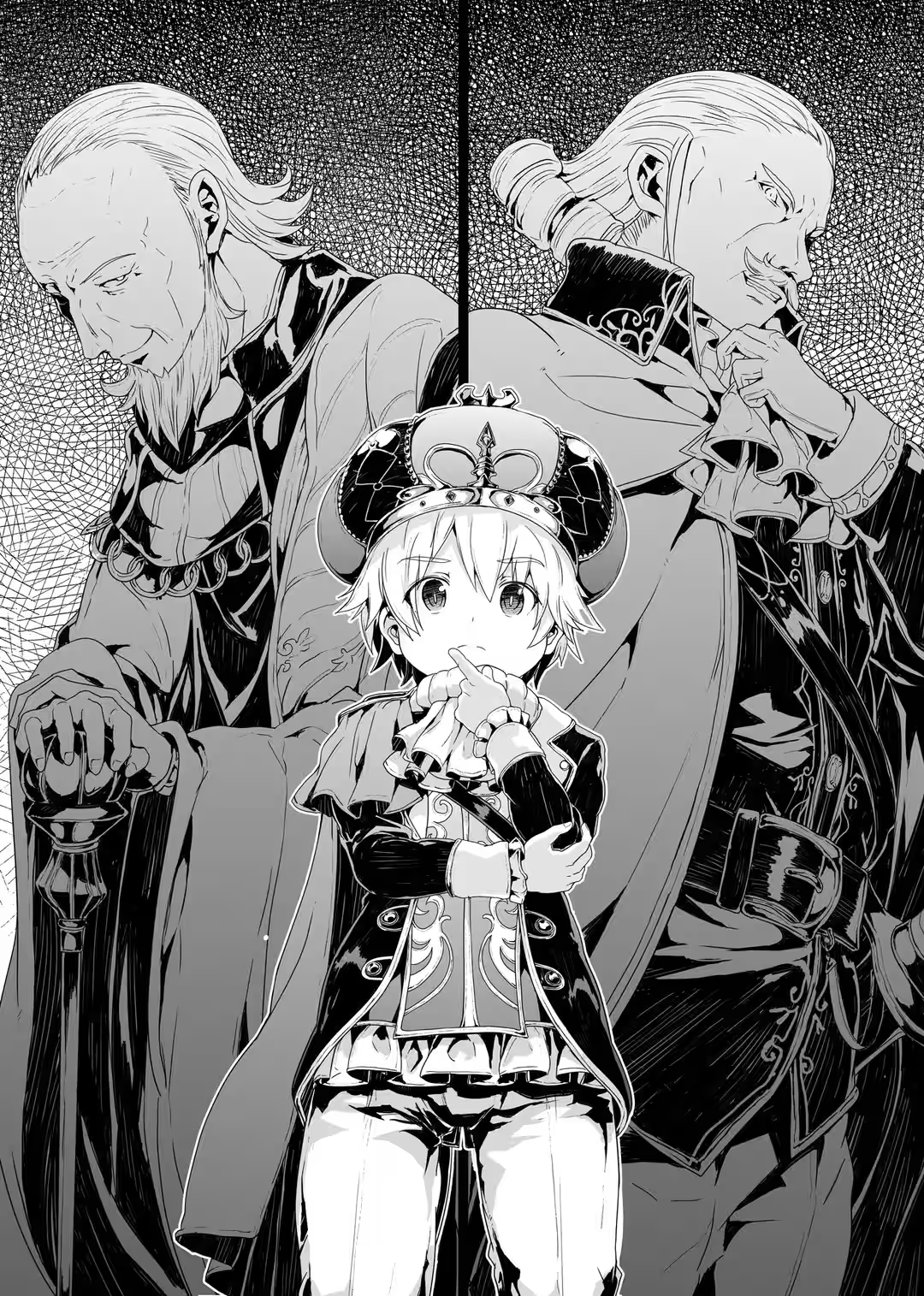
Interlude: A Chance Encounter
New Calendar, 460th Year, 9th Month, 14th Day
On a Certain Ship
Rosaria Van-Chalongé-Cruveillier greeted her seventh birthday aboard a ship bound for the Bundarte Empire’s capital.
The adults traveling with her each congratulated her briefly, before their expressions once again became stern and they convened to hold yet another conference—what number this marked, she’d lost count.
The Belvérian diplomats—for that is what they were—had but a single topic on their agenda, and that was: How would they secure the Empire’s aid? Rosaria was expressionless as she watched them, but she felt something quite close to resignation.
They’re going to offer me up as collateral to Duke Raul. Or perhaps Duke Agincarl. If I can curry their favor well enough, they might take me as a concubine. If not...
If not, her homeland could meet its end. For the Kingdom of Belvére was in dire straits indeed.
***
Princess Rosaria’s homeland was located at the northwestern edge of the Eastern Continent and situated on the Belvére peninsula. It was one of many nations on the Eastern Continent with a long history, but its most prosperous and stable era had been during its alliance with the Rotahl Empire...which, in practice, had been more akin to vassal statehood. But while that position hadn’t inspired pride in the Belvérian people, they had swallowed the indignity—such was the cost of peace.
This peace, however, had collapsed with the advent of the True Inheritors, a vocal branch of the First Faith. The True Inheritors believed that the land that the Illuminatus Ein first set foot upon on the day of his arrival at the Eastern Continent was sacred ground, and attacked the Kingdom of Belvére seeking to reclaim it. Their proclaimed “holy land” was located at the tip of the Belvére peninsula, coincidentally within a stone’s throw of the Kingdom’s capital of Crulére.
On one side was a kingdom that had been content to serve as a vassal state to avoid the fires of conflict. On the other was a militant host of religious zealots, to whom death in battle was synonymous with martyrdom and virtue. The war was entirely one-sided.
Many more moderate adherents of the First Faith nonetheless supported the cause to retake the holy land, adding extreme momentum to the True Inheritors’ crusade. This could be attributed to their religion’s teachings: In the holy scripture of many First Faith denominations, it spoke of how the land Illuminatus Ein’s ship first reached was awash with heathens. They were too attached to their wicked faith to heed Ein’s words, and the king of their nation ordered his imprisonment.
This scripture was grounded in truth: The kingdom that had existed before the Kingdom of Belvére’s founding had indeed captured the Illuminatus Ein. However, it hadn’t been for religious reasons—they had sought the knowledge and technology he had brought with him from his home continent.
At the time, the technology of the Old Continent, as it was called in the First Faith, far surpassed that of the Eastern Continent, and Ein’s ship had borne with it a number of skilled craftsmen. It was unanimously agreed upon by future scholars that the spread of this advanced technology was a key factor in the rapid propagation of the First Faith.
Other factors, such as the Empire-Imperium hostilities and the Western Orthodoxy of the First Faith being decried as heretics, solidified the Kingdom of Belvére’s status as a “kingdom of the sinful” in the minds of First Faith adherents. The downfall of the Kingdom that had imprisoned Illuminatus Ein (in fact, the Kingdom of Belvére had been founded by the very people who had overthrown the kingdom of Ein’s captors) became a movement that grew far beyond the True Inheritors and their cause.
Naturally, the Kingdom of Belvére had not been without its own cards to play. It formally recognized the First Faith as its state religion, attempting to avoid hostilities. Yet this proved to be a mistake, as they did not align with the True Inheritors’ beliefs. Instead, they adopted the same state religion as the Bundarte Empire: Western Orthodoxy.
This only inflamed the True Inheritors’ aggression. To the zealots, other denominations of the First Faith were heresy. And while heathens of other religions were unfortunate souls who did not yet know the truth, heretics were the corrupt and sinful who had been enthralled by the Devil. In other words, any measures taken against them were forgivable in the eyes of God.
With each crusade, more villages burned and more people were massacred. Even when the crusaders founded their own nation-state and named it Tomis-Ashinaqui, the violence saw no end.
Then the Rotahl Empire—the last ray of hope for the Kingdom of Belvére—met an anticlimactic end due to civil unrest. For two centuries, the Kingdom of Belvére ceded more and more land with each conflict. But finally, the point of no return had come.
Tomis-Ashinaqui, once the size of a single city, now commanded the entire eastern region of the Belvére Peninsula, and its influence on an international scale had finally surpassed the Kingdom of Belvére. Even when the Kingdom had possessed the diplomatic upper hand, it had suffered defeat time and again to the armies of Tomis-Ashinaqui, who were not afraid of death. In the past few years, their intrusions had only become more aggressive.
Thus, we arrive at the current year. The Kingdom of Belvére had been driven to the tip of the peninsula and the last of its scant remaining farmland had been put to the torch. Without a change in circumstances, there was little hope for the Kingdom’s people to survive the winter.
***
“I see no other option—we must somehow welcome imperial royalty into our Kingdom’s royal family.”
“That tactic was attempted a century ago and it failed! The Empire never broke its neutrality—we would have to sway a duke’s close relative at the very least to even have a chance at success.”
“I cannot imagine them agreeing. What if we tried begging the Imperium for aid?”
“From all the way across the Heavensreach Mountains? Get your head out of the clouds, man! We’re looking for realistic solutions!”
“But they say tensions between the two major Dukes are at their highest. If we seek aid from one, the other may ally with our enemies.”
“Worse—they could fracture our kingdom and use it as a staging ground for a proxy war.”
The same discussion had taken place upon this ship dozens of times over. In the Belvérian royal court, that number reached the hundreds. In the end, the king’s decision had been to send out a delegation with a single order: secure aid from whichever nations would grant it. Until this was achieved, they were forbidden from returning. And, to serve as the delegation’s representative, the king had sent his own daughter, the first princess.
However, this was not because the king had no love for Rosaria. Rather, he had raised his eldest daughter with care and affection. That he had sent her away to be little more than a hostage was a testament to his desperation.
This was why Rosaria had not been unwilling to go. Quite the opposite; as royalty, she felt a strong sense of duty to her motherland.
And I’ll do whatever it takes. Even become an old man’s concubine. But...
But she felt a seed of doubt. Would that actually save the Kingdom of Belvére? She didn’t care for her own fate if it meant her home was granted salvation, but if salvation was no longer possible—if all her efforts would only be for nothing...
Could there be anything more wretched?
Yet, despite her slim chances, her father had sent her away regardless. In his mind, whatever treatment she received abroad would be preferable to remaining in the Kingdom of Belvére and falling into the hands of enemy soldiers during wartime.
Rosaria knew this; she was an intelligent girl for her age. And because she knew this, she was determined to bear the fate of her country on her shoulders. Whatever came her way, she would face it.
Yet, she also could not deny the pain in her heart.
The resolve to save her kingdom. The pain of separation. The tension born of her grave responsibility. All of it mixed with fear and impatience, driving her into a corner in her own mind.
As the ship lurched across the waves, Rosaria had a sudden thought.
Come to think of it, the emperor is supposed to be younger than me. I haven’t heard good rumors about him, but...I wonder what he’s like.
***
At the end of their long journey, Rosaria and her delegation first made landfall in the territory of Duke Agincarl before sailing upriver to reach the imperial capital of Cardinal. When they arrived, the sheer size of the city shocked her into mute amazement—it was like all her fatigue had been blown away. Excitement welled up within her as she took in the walls that stretched as far as her eyes could see.
Perhaps this will work. Perhaps my kingdom can be saved!
She passed through the city’s gates with the warmth of hope in her breast.
That hope was snuffed out in a matter of days.
She had still been unable to secure an audience with either of the Dukes that held the true power in the Empire. Despite her desperate pleas, the nobility from both factions continued to be flippant and evasive.
A dark mood hung over her delegation, heads hung low and expressions glum.
“We should move on, Your Highness. The Hismaph Kingdom is a little far, but they may at least be willing to hear us out.”
Certainly, it would be a better alternative to an Empire that did not give them the time of day. However, it was questionable whether the Hismaph Kingdom even had the spare resources to provide aid. The Teiwa Imperium—a major power on the level of the Bundarte Empire—watched the Kingdom like a hawk, waiting for any vulnerability.
Rosaria decided to attempt an idea that had been formulating at the back of her mind. “I understand. But before we depart, would it be possible to arrange for me an audience with His Majesty?”
The diplomat looked at her, confused. “With the emperor?”
“I’m curious about him. It is not often that I meet anyone my age who bears as much power, or as much responsibility, as I do.”
He’s younger than me, even. Perhaps he’ll sympathize with our plight.
If he did, it could open a path toward negotiations with the empire’s aristocracy. For such was the weight of the emperor’s words, regardless of his lack of real power.
The idea of manipulating one younger than her pained Rosaria, but desperate times called for desperate measures. Like her delegation, she was at the end of her rope.
Besides, she had not been lying about her curiosity about the emperor.
The Kingdom of Belvére’s diplomats exchanged glances, their expressions all saying the same thing: When was the last time the princess ever made a selfish request?
“Her Highness and His Majesty both descend from the line of Emperor Cardinal. I believe they would grant her an audience, should we request it.”
“Well, why not? I’m sure other nations would be interested to learn more about the young emperor.”
“And if he expresses but a word of sympathy, it may open a path for us to the Chancellor, among others.”
Everybody knew the emperor held no real power. Even if he promised his help, there was every chance it would fall through, and opening negotiations to the rest of the nobility did not guarantee a result. Still, it was worth the attempt.
In the end, it was agreed that Princess Rosaria would meet with Emperor Carmine.
***
“It is a pleasure to meet you, Your Highness. My name is Herc le Diffé.” The butler gave her a cheerful smile that did not reach his eyes. “I shall show you to His Majesty.”
“Thank you.”
Oh. So he’s to be my observer. No doubt he’ll prevent me from talking much, if at all.
It appeared that her last-ditch plan had been for naught. Thus, when Rosaria came face-to-face with Carmine, it was with dark thoughts and a heavy heart.
“It is a pleasure to meet you, Your Majesty. I am Rosaria Van-Chalongé-Cruveillier.”
Upon raising her head, she saw a little boy in a chair. Though rumors made light of him, calling him a little piglet, he was in fact of average build—but Rosaria was in no state to notice this.
If I mention my kingdom’s plight, they’ll chase me out immediately. What should I do? And he’s so young—how much would he even understand?
Then, her eyes met the emperor’s, and her thoughts were replaced by surprise. His golden eyes watched her curiously, but it was not their color that had taken her aback. The light behind them hinted at the true depth of their owner’s thoughts—it was a sight she’d only seen from her father and wizened elders.
Isn’t he supposed to be an ignorant child...?
Then, Carmine spoke.
“We have taken a liking to you! Become our wife!”
In that moment, it seemed to Rosaria as if time itself had stopped.
His Majesty...wants to marry me? The princess of a minor nation?
It was an impossibility. Or, it had been, until Carmine had spoken it into being.
“Do you mean...a betrothal?” Rosaria felt like she was dreaming.
“Ah, yes, that. You are very smart.”
Rosaria could sense the sympathy within Carmine’s magnetic eyes. Her delegation would have told her that it was her imagination, but they were adults. It was because she was the same age that she could perceive that Carmine was...different.
The young emperor looked like nothing more than a child throwing a tantrum as he sent his butler away.
“So, tell us about this ‘belbeer kingdom’ thing.”
But would a child be able to change moods so swiftly, so easily? And with a single request, he had granted Rosaria the perfect opportunity to explain her kingdom’s predicament.
It dawned on her that her circumstances had made a complete about-face. Even though the emperor held no real power—no, it was because he held no power that his wishes held such importance. The nobility would hasten to get a leg up on the opposing faction and push for the betrothal, resulting in aid for her kingdom.
Betrothal... So I’m to marry this boy.
“Of course, Your Majesty. The Kingdom is—”
For both Rosaria and Carmine, this was the first chance they’d ever had at a prolonged conversation with someone else their age.
Becoming empress consort of the Empire, supporting him by his side? I think...I’d like that.
For Carmine’s part, he simply enjoyed the opportunity to talk without ulterior motives or hidden agendas. Perhaps this was why he did not notice the faint tinge of red that colored Rosaria’s cheeks.
***
After departing the Bundarte Empire, Rosaria’s delegation visited the neighboring nations to entreat their aid. By the time their ship returned to the Kingdom of Belvére, winter’s place on the wheel of seasons had already rolled to the fore. However, matters had already improved. Several cities had been seized back from their enemy’s grasp, and the food situation had recovered enough that the people would survive through to spring.
Within the palace—though the humble building hardly deserved the name compared to the Empire’s edifices—a father and daughter reunited in the audience room (a large chamber in the keep that had been remodeled). It was their first time seeing each other in months.
“I never could have imagined we’d overcome our plight so easily...” grumbled King Alexei, twenty-sixth monarch of the Kingdom of Belvére.
“But our kingdom is saved because of it, Your Majesty. Such dissatisfaction is unbecoming.”
“We’re alone, Rosaria. Spare your old man the formalities. And I’m not dissatisfied with our kingdom’s salvation. I am grateful, truly.”
Despite his words, King Alexei’s demeanor suggested he was leaving something unsaid. In truth, his dissatisfaction was not unwarranted. He had spared no measure or expense in the desperate attempt to save his people, yet in the end it had been a single word from a child that had proven more effective.
“I’m sorry, Rosaria. We won’t be able to annul your betrothal for a while yet, it seems.”
It was King Alexei’s belief that his daughter had entered the agreement, if not necessarily against her will, then at least forced by her circumstances. After all, to a certain subset of the political sphere, the Bundartian child emperor was rumored to be a half-wit.
“Oh, that won’t do, father. Breaking the agreement would cause other nations to lose faith in our kingdom’s word. And unless we can gather the resources necessary to fight back the enemy ourselves, history would only repeat itself.”
“I know, I know. We owe our safety to our enemy’s caution of the Empire’s military strength. It’s just...”
Politically, maintaining the betrothal was the correct decision, at least until the Kingdom of Belvére could establish its influence. Even so, King Alexei was also a father. He wanted more for his daughter than to be married to a half-wit puppet.
“It’s fine, father. I’m proud to be a princess for our kingdom. I will fulfill my duty.”
King Alexei, not noticing that his daughter’s words were to hide her own embarrassment, was moved to tears. Rosaria’s heart, however, was already elsewhere.
If I wish to support His Majesty, then I must study all that I can.
It was said that love blinded a child to their parents’ thoughts, but perhaps it was the other way around. Regardless, one thing was true: For the first time in an age, the Kingdom of Belvére knew peace.
Incidentally, Rosaria’s mother saw through her lovestruck daughter immediately, and teased her greatly over the matter.
Interlude: The Founding Day Festivities
New Calendar, 460th Year, 10th Month, A Certain Day
Imperial Capital Cardinal
The imperial guard were a storied fighting force, wreathed in history and tradition stretching back to the days of the Rotahl Empire. Only the elite of the elite from among the soldiery were chosen for their ranks, and their duty was to be the emperor’s shield unto death. The people saw them with respect and awe, and there was no end to the number of candidates who applied for the honor and fell short.
However, this was a story of the past. Edward III, the sixth emperor of the Bundarte Empire, implemented the infamous venal office policy, placing official positions up for sale to the highest bidder. Naturally, the honor of an imperial guardsman was no exception—in fact, such opportunities sold like hotcakes.
Ultimately, the position became no more than a tool for nobility and rich merchants to add to their prestige. Edward IV, the seventh emperor, abolished the venal office system, but the damage had already been done. The appointive power for the imperial guard had been transferred to the Chancellor in the time of Edward III (he’d sold it off himself), and Edward IV was unable to recover it.
In the modern day, the entire outfit was a mere shadow of its former self.
But rotten and decayed as their role might be, a guardsman was still a guardsman, and one who could not fight was no guardsman at all. Thus, several individuals of genuine ability were appointed to the position. One such man was Balthazar Chevillard.
Balthazar’s common birth led his superior officers—who were nobility—to shun him, while his former unit ridiculed him for becoming a toady of the blue bloods. He had but a singular comfort in this world, and that was spending time at the Goose tavern.
Well, more accurately, it was visiting the Goose to see its pretty barmaid.
***
“Inaaa... Listen to a man’s woes, would you?”
“You’ve had too much to drink, Mister Balthazar. Aren’t you on duty tomorrow?”
The nineteen-year-old Ina was something of a local celebrity, known as one of the most beautiful girls of commoner birth around. Still, the terrifying appearance of her father—the tavernkeep—meant that the Goose’s business wasn’t much more successful than any other tavern in the area.
Presently Ina was dealing with a drunkard named Balthazar Chevillard.
“Hee hee!” laughed a tavern regular. “You heard her. Better get going, Sir Imperial Guardsman.”
“Oh, shut up, Shuvalov. Don’t call me that.”
At twenty-four, Balthazar was in the prime of his working years, yet sitting there in the tavern, his disheveled figure made him look markedly older.
“What, you’ve got a problem with the job now? Said the pay was good, didn’t you?”
Balthazar frowned at the other regulars across the table. “Sure, but what’s an unmarried man like me to do with it? It’s just gathering dust. And don’t get me started on the work. You try running errands for blue bloods all day without wanting to puke your guts out.”
One of the regulars raised his tankard. “So what I’m hearin’ is it won’t hurt your wallet to get us a round, eh? Ina, drinks for the table!”
“Ahh, fine, fine—wasn’t going to use the coin anyway. Make that one for me too, Ina!”
Balthazar’s resigned words were met with cheers as people began to call out their orders.
“All right, but this is your last one, and that’s final!” Ina warned. She took Balthazar’s silver coin and hurried over to the tavernkeep to relay the orders. Even from across the room, the brief glimpse of the man’s eyes was enough to tell he wasn’t smiling.
Balthazar sighed. The last sliver of sober brain he had in him recognized that the scary tavernkeep would be putting in an appearance if he didn’t call it for the night soon.
No matter how drunk Balthazar got, he was always able to keep his wits about him, to an extent. It was part of how he’d managed to survive the world of the imperial guard, despite the class barriers.
“There’s no meaning in it,” he muttered under his breath. “No meaning at all.”
Ina chose that moment to return, arms laden with tankards of ale. “Ah, right. Will you be in the parade, Mister Balthazar?”
“Mmm. Should be.”
“So you’ll get to see His Majesty?!”
“Oh, the young emperor?” said another at the table. “I hope His Majesty takes after his grandfather and Prince Jean.”
Balthazar’s face scrunched into an involuntary grimace. “His Majesty’s a five-year-old born into every comfort and luxury I can name, and probably several I can’t even spell. No way he’d turn out all right.”
Ina wagged her finger at Balthazar, an action that caused him to grin messily. “Don’t say that! It’s rude!”
The man named Shuvalov brought them back on topic. “Will you, though? Get to see him.”
“Huh? Oh. Probably? I’m scheduled to ride alongside his carriage.” Balthazar tossed several roasted beans into his mouth and washed them down with some ale. His tone revealed exactly how bothersome he found the conversation.
“Then you might even get to speak to him!” Ina exclaimed. “You’re more amazing than I thought, Mister Balthazar!”
Hurt flickered across Balthazar’s expression as he processed the backhanded compliment, but it passed as soon as he cleared his throat. “Well, if anything interesting happens, you’ll be the first I tell, Ina.”
“Really?! Thank you!”
“Oh? Now that’ll be a treat,” Shuvalov remarked. “Don’t let us down, now.”
“I wasn’t talking to you lot!”
Balthazar’s exclamation served as the cue for the tavernkeep to step out of the back. “You’re bothering the other patrons.”
After receiving a quick but painful bit of physical encouragement from the ex-soldier—this was hardly the first time—Balthazar drained his remaining ale and left the tavern with a quick promise to return.
The sight of his departing figure was a soliloquy to the melancholy of bachelors everywhere.
***
Balthazar Chevillard was of commoner birth. However, his family had not been humble farmers, but a warrior-class household in the service of a viscount.
After his father perished in the line of duty, a fifteen-year-old Balthazar had stepped up as his replacement on the battlefield. At twenty-one, he had moved to the imperial capital alone on the recommendation of his lord the viscount, who had become a general at the time. It was only this year, after three years of service maintaining the peace in the city guard, that his exemplary performance won him a promotion to the imperial guard.
At first, the high salary had been enough to satisfy Balthazar, but he was fed up before the first month was over. The nobility scorned his common birth and envied his success in spite of it, and they constantly foisted their trouble into his lap. It was no wonder why he’d come to hate his new superiors.
Perhaps he could have endured it, if not for the fact that he’d had experience with nobility before. The commanders he’d known on the battlefield had possessed good sense and hearts dedicated to their duties. The rotten, greedy examples of their class dwelling in the imperial capital only seemed to fall shorter by comparison.
Despite his suffering, Balthazar had his reasons for not stepping down. His natural stubbornness contributed, but the most significant was that he knew his old comrades would not take him back. His former guard unit had come to genuinely hate him for “cozying up to the imperial guard.”
Such sentiments toward the nobility were not rare among the citizens of the capital, the reason being...
“They murdered Emperor Edward, and Crown Prince Jean to boot...”
Of course, it was only a rumor—albeit one everybody in the city knew. Most believed it too, including Balthazar himself, who went a step further and took it as sufficient cause to blame the two most likely culprits: the Dukes.
“Doesn’t explain how the rumor spread so much, though... It’s like someone’s doing it on purpose.”
A chill ran down Balthazar’s spine, which he shook off, casting away his dark thoughts as he returned to his home in the noble district. Despite the moniker, it was home to more than just the nobility; the name was only an indicator of the district’s civil layout.
To be nobility was to maintain a certain amount of distance between oneself and others. Naturally, alliances were a fact of life, both close and estranged, and such relationships changed drastically across generations. As such, the blue-blood residences in the noble district were placed quite far apart; the space in between was set aside for the houses of their retainers or servants of the imperial demesne.
Balthazar’s home was one such house. It was small for its sort, but it had its obligatory garden, and more space than one person could sanely use. Upon finally arriving, he let himself in through the heavily ornamented front door. The house felt desolate—he lived alone and had furnished the place strictly with the essentials.
Just as Balthazar’s family had served the viscount’s, it was common for a family to remain in the service of another for multiple generations. Because of this, there were no houses in the noble district meant specifically for unmarried individuals. The option to hire a maid was open to him, but in his own words, he preferred the ease of solitude.
That did not stop him from frequently visiting a commoner district tavern to scratch his itch for human contact, but then again, since he did not cook, he had to go somewhere.
He stumbled into his bedroom, tipsy. It was a mess compared to the rest of the house—a testament to its status as the only room he actually used.
“Ugh... Duty tomorrow...”
Balthazar lay on the floor, using a pile of his scattered clothes in place of bedding.
“Maybe I’ll buy a bed one of these days...”
For many commoners, a bed was an unaffordable luxury. But as we know, Balthazar was paid well.
***
On the morning of the Founding Day jubilee, Balthazar set out for work on the dot, prim and proper from head to toe. No matter how little worth he found in the job or his lack of motivation, at his core, he was a diligent man.
When he saw that his commanding officer—a short, plump man of the lesser nobility—was already in a foul mood, however, he wondered whether it would’ve been better to be late.
“Is...something the matter, sir?”
The man glanced at Balthazar. “Hmph. Of course something’s the matter! The gatekeepers have forced themselves into the festivities, the louts. They’ve no respect for tradition.”
As always, Balthazar hid his irritation at his commanding officer’s condescension. “The gatekeepers? Does that mean they’ll be escorting the parade?”
The gatekeepers were a product of the Empire’s internal struggle: a newly founded unit with the exact same duties as the imperial guard. Since the captain of the latter was of the Chancellor’s faction, the regency had established the gatekeepers as a counterbalance. In other words, they were a shoddy copy of an imperial guard that was already a shell of its former self.
Those layabouts couldn’t protect an apple from a hungry mouse...
As bothersome as Balthazar found guarding the emperor, that had no bearing on his performance. He had every intention of fulfilling his duty.
“Half of it. Ah, we’ve got the emperor’s carriage, though. Don’t screw up.”
The emperor? That’s His Majesty to you, you pig bastard.
Balthazar had no love for nor expectations of the young sovereign himself, but it rankled him to see the peerage treat the boy like a political plaything.
“Hmph. Anyway, you have your orders. I suppose it’s no wonder the regency runs roughshod on our traditions when a man of my standing is obliged to address you as a knight. Ridiculous. Be off with you.” The man made a shooing motion, as though anticipating Balthazar’s inner thoughts.
“At once, sir.”
If you’ve a problem with my title, take it to the Chancellor. He forced it on me!
Balthazar felt a foul mood creep up on him as he excused himself from the room and went to find his beloved horse. While knights were nobility in certain other nations, their position in the Empire was more complicated thanks to the lingering ramifications of the old venal office laws.
The title of Familiae Eques, or Knight of the Empire, had once been the privilege of noble offspring. However, during Edward III’s era of selling off titles left and right, he’d turned it into an official position. It had become the most popular commodity among all venal offices, with countless mercenaries, middling-sized merchants, and even bandits picking up a piece of the Empire’s prestige for themselves.
Of course, Balthazar’s title was not Familiae Eques, but Quare Eques, or Knight of the Imperial Guard. Unfortunately, the general populace, who had little reason to know the difference, assumed that a knight was a knight and subject to all the same depreciations in value—one of the reasons for Balthazar’s disillusionment. Yet, if not for his status, he would not even have been able to speak to his commanding officer earlier. Such were the trappings of the Empire’s social hierarchy.
Then again, as far as Balthazar was concerned, he would’ve preferred not speaking to the man.
In the end, he did not regain his composure until after the nobility had completed their prayers upon Founder’s Hill. After the emperor boarded his carriage, Balthazar mounted his horse.
His Majesty’s smaller than I expected. To think he rules the entire Empire...
Secretly, Balthazar thought the Bundarte Empire was done for. Thanks to his frequent trips to the commoner districts, he knew the air of resignation hanging over a portion of the city’s residents too well.
As the emperor’s carriage set out, Balthazar rode alongside it. He couldn’t deny he was curious about the child he’d only glimpsed from afar, but to turn his head and stare would have been the height of disrespect. Instead, he kept his eyes forward and maintained his horse’s steady trot. He was one of the emperor’s guards; it befitted him to act like it.
Not that His Majesty even needs us.
The emperor’s carriage had in fact been laden with protective charms from top to bottom. Each one had defensive effects so formidable that any projectiles or offensive spells would be turned away. It was rumored that they were unique relics of an ancient civilization and could no longer be reproduced by modern means. Assassinating the emperor in his carriage would at the very least require one of the massive cannons said to be undergoing development in Duke Raul’s territory.
I doubt we’d be able to be “shields of the emperor” against a weapon like that, thought Balthazar.
The procession continued. Soon enough, they had reached the Segue Gate of the inner wall. Although Cardinal had now expanded beyond its original scope, one had once needed to cross this wall to be considered to be in the city proper. This principle held for Founding Day, and all the citizens of the city—even those who lived outside the inner wall—had gathered within to await the procession.
When the emperor’s carriage passed through the gate, the boisterous cheers of the crowd became positively deafening.
“Long live His Majesty the Emperor!”
“Our hope! Our light!”
“Whoa, there.” As Balthazar soothed his horse, which had been startled by the noise, he happened to drift slightly closer to the emperor’s carriage. It was this accident that caused him to hear someone—a boy’s?—mumbled words.
“Why...are they so happy?”
So that’s what His Majesty sounds like.
It was the first time Balthazar had ever heard the emperor speak. It felt strange that this was how it had happened, rather than at some grand address.
It’s supposed to be a great honor to be granted audience to His Majesty’s direct words, isn’t it?
To say nothing of how someone like himself—halfway between aristocrat and commoner—would usually never get the chance.
Hmm? But was that a question, or was His Majesty just talking to himself? Well...I suppose if it’s the former, I should answer.
In the end Balthazar chose to respond as quickly as he did because he’d reasoned it would make for a good tavern story. It would be nice to see Ina’s smile when he told her.
A five-year-old wouldn’t remember his face in any case, and if worse came to worst, he could plead ignorance to avoid lèse-majesté. If he’d genuinely thought the emperor was speaking to him, it would’ve been ruder not to answer, right?
Slowly, Balthazar edged his horse closer to the carriage.
Why are they so happy, huh? Isn’t it just because they love seeing royalty?
Perhaps it was also because Carmine was a child. Though many had seen a decline in their living standards, few had become embittered enough to direct their anger at a more or less innocent five-year-old.
Still...that answer didn’t seem quite right to Balthazar. He gave the matter some more thought before he spoke.
“Because they have high hopes for you, Your Majesty. The previous emperor and your father were quite popular among the people.”
As soon as he said it, he regretted not coming up with something better. Yet for some reason, the young emperor looked dumbfounded.
“Oh...” he murmured.
It could be said that it was at this moment when Balthazar saw the emperor’s eyes for the first time.
Golden eyes, sparkling with joy. A child’s eyes. Happy simply because the crowds were cheering his name. That’s what Balthazar thought.
Then, the emperor closed his eyes. When they opened again, they no longer belonged to a child.
Wha—
They were the eyes of a soldier headed for war—someone who was prepared to lay down their life. The resolve was not half-hearted; Balthazar had seen the same gaze in the viscount he’d once served, the man who had risen to rank of general.
No. I must be imagining things.
A five-year-old boy could not possess such eyes. But as Balthazar tried to convince himself of this, the emperor once again spoke.
“You have taught us something valuable. What is your name?”
Balthazar did not immediately reply—his instincts were ringing warning bells. It felt the same as stepping into an enemy trap.
Sorry, Shuvalov, but I’ll be borrowing your name. Wait... I don’t even know his last name.
“It’s Shuvalov le Goose, Your Majesty.”
He had not intended to use the name of the tavern he frequented, but it had slipped out, perhaps because he’d been thinking of Ina.
“We shall remember that.”
Balthazar bowed his head and swiftly nudged his horse away from the carriage.
God in heaven. I never should’ve spoken.
It was too late for regrets, however. At least he’d given a fake name. He doubted he’d be discovered. The emperor would likely forget eventually.
Convinced it was just a matter of time, Balthazar didn’t pay the matter any further thought. That said, neither did he speak of the incident at the tavern upon his next visit—his nerves were shot, and it was better to be safe than sorry. Little did he know that his fate had already shifted course, for Carmine would not forget this day for the rest of his life.
After all, it was the first moment the young emperor became certain of his purpose: to rule.
First Era: The Foolish Puppet Emperor
New Calendar, 461st Year, 1st Month, A Certain Day
Imperial Capital Cardinal
The Ancient Watchmen
So, I had decided to be an emperor. To stand even a ghost of a chance, I’d have to purge the empire of corruption—namely the fat cats with their grubby mitts on the reins. However, acting now wouldn’t do me any good. Even if, let’s say, I succeeded in cleaning house, my complete unfamiliarity with statecraft would lead to the Empire fracturing, and I did not want a civil war on my hands. It would leave the land devastated, weaken our national power, and relegate the Bundarte Empire to a name in the history books.
My best option was to bide my time. Little by little, I’d shave away at the control held by the Chancellor’s faction and the regency, build myself a power base, and bank influence until the time was right. I’d keep playing the fool, even if it took decades.
There was only one problem: Here in the imperial court, with its ever-changing web of plots and schemes, it would be straight-up impossible for me to go it alone. I needed help.
Thankfully, I had someone in mind: Count Palatine Alfred le Vodedt, the Empire’s spymaster. I had to create an opportunity to speak with him alone—but I had to do it naturally, without drawing suspicion. For the next several months, I would stop Count Palatine Vodedt each time I saw him and give him some asinine chore to do. Since I’d called him jobless in front of the other nobility already, I judged that everyone would only see this as me being childishly tyrannical and him being indulgent.
If I pushed too far and drew his ire—or caused him to grow fed up with me—it would all be for naught. However, whether he was aware of my scheme or not, he accepted each of my “chores” without complaint.
After this pattern had repeated several times, I called him to my room one day.
“Ah, you came, Count Pala-teen. We figured you’d be bored today too, so we have some work to give you.”
As I cranked the condescension in my voice up, my butler, Herc le Diffé, quietly stepped out of the room. From the look of him, he didn’t suspect a thing. With my ladies-in-waiting off attending to other business, I was alone with the Count Palatine at last.
“I appreciate your generosity, Your Majesty, but as I have informed you, I do have an occupation.”
Although the Count Palatine gave me his usual stock answer, I noticed him watching the door. It was probably his way of telling me to be careful.
I cast a spell to scan beyond the room’s walls—all clear. There was just a single person in the ceiling, and they worked for the Count Palatine.
Good grief, man. Do you know how much trouble I had to go through to set all this up?
That being said, I was glad to see that he was overcautious—better that than the opposite. I set my heat detection spell to activate at regular intervals—just in case—then took a deep breath before I spoke.
“There—all the precautions have been seen to. It is a pleasure to finally speak to you, Count Palatine. Thank you for your unceasing efforts to guarantee our safety.”
This marked the first time since my reincarnation that I’d ever truly spoken like an emperor.
“Not at all, Your Majesty. It is only my natural duty as your vassal.”
As I’d expected, he’d long since seen through me. There wasn’t a hint of a surprised tremor in his voice—he was even smiling, albeit faintly. He’d be a dependable ally. If I could win him over.
“Incidentally, are the watchers on rotation in our ceiling your subordinates?”
“So you did notice. Indeed they are, Your Majesty. I have entrusted them with the duty of your protection.”
My surveillance too, no doubt, but I didn’t begrudge him that. For the first time, a muffled sound came from the ceiling. It looked like someone had been caught by surprise.
I looked up. “We don’t mind. Carry on.”
I had no bones to pick with my watchers. I’d even forgiven the ones who’d directed killing intent at me. Whether the Count Palatine was interested in disciplining his intelligence subordinates was another matter...but that had nothing to do with me.
In any case, I had to move on to the main issue at hand. What was the Count Palatine’s reasoning for remaining in the neutral bloc?
“We have heard that you have made it known you will obey whoever crowns us. Is this true?”
“It is, Your Majesty.”
Even now, the Count Palatine’s relaxed bearing still hadn’t slipped. I doubted I’d ever be able to get a read on his thoughts—certainly not from his expression alone.
“Would you turn your blade on us, should they order it?”
“It would depend on the circumstances. All I can say for certain is...my loyalty to them would not be permanent. Whether it lasts until their descendants’ generations or only a brief instant, however, I do not know yet myself.”
It was like he was intentionally feeding me hints piecemeal. He had to be testing me—how smart I was, how much I truly understood of my circumstances.
“So for the time being, you’ll allow us to live?”
He knew that I could use magic indoors—a secret that was both my trump card and lifeline. If at all possible, I didn’t want him as an enemy.
“Allow you? I will allow nothing. My people and I are Your Majesty’s servants.”
“But why is that? And please, spare us the circular explanations. ‘Because you’re the emperor’ is hardly a sound political motive.”
The Count Palatine had just told me he would consider killing me if the circumstances were right. His loyalty to the emperor wasn’t unconditional.
“Because Your Majesty is the rightful successor to the Rotahl legacy, and House Vodedt are the Rotahl legacy’s protectors.”
Had House Vodedt been close to the last imperial family? This was something to chew on.
“There are no direct descendants of Imperial House Rotahl in the Bundarte Empire; neither do we share our mother nation’s name.”
“Mere semantics, Your Majesty. The Bundarte Empire is the right and lawful successor to the Rotahl legacy.”
Okay. I didn’t know why he’d picked that specific hill to die on, but he had cleared things up. The short of it was that his loyalty belonged to the “successor of the Rotahl legacy,” and not the Empire or Imperial House Bundarte. And because I was that successor, he’d kept my magic a secret.
It was a short and simple motive. I appreciated that.
“Are Dukes Raul and Agincarl successors to the Rotahl legacy too?”
“No, Your Majesty. They are simply themselves. Nothing more, nothing less.”
“In other words, we are the only current successor.”
“Correct, Your Majesty.”
I was beginning to get the impression that the Count Palatine was a man who lived by faith and creed. That meant he would have certain triggers I was best off learning and avoiding well in advance.
“What would disqualify us from our inheritance to the legacy of Rotahl?”
“As long as Your Majesty does not forget, that will suffice.”
The Bundarte Empire’s culture, language, and history all picked up exactly where the Rotahl Empire left off, more or less. Not much of a surprise, considering how our nation had risen from the fractured remnants of theirs. Was the Count Palatine saying that I’d be okay as long as I didn’t make radical alterations to our culture or history? Or was there something else I was missing?
Of course, there was every chance he’d get rid of me as soon as I had a kid. I was fairly certain it was my bloodline he needed, not me.
Still, there were times when one’s only choice was to throw caution to the wind. I had decided I would be an emperor—a proper one. For that to work, I had to put my faith in Count Palatine Vodedt. Not blindly, of course, but enough to be vulnerable.
But before that, there was something I needed to ask.
“Why was our father and the previous emperor killed? And why did you let it happen?”
For the first time, the Count Palatine’s placid expression cracked. He closed his eyes before he spoke. “Among my family and subordinates, there is no longer anyone older than myself. This is because they all committed suicide.”
So it had been a mistake, and the House Vodedt protectors of the time had taken their own lives as penance. That would explain it—except for one thing.
“We were under the impression that the First Faith forbids suicide—that it is a sin beyond redemption.”
“House Vodedt have protected the Rotahl Empire since before it adopted the First Faith, Your Majesty.”
Ah. So one wrong step, and his people could be branded as heretics. That was a fitting set of circumstances for a pack of fanatics who still clung to their faith in a long-gone empire.
They would be troublesome enemies...and dangerous allies. But if I couldn’t handle a little danger, I wouldn’t make it as an emperor anyway.
“Very well. Then lend us your aid, Count Palatine. We mind not if it is only until the coronation. For we intend to seize this nation back from the vultures that have claimed it and rebuild it into one worthy of the name Empire.”
Count Palatine Vodedt bowed his head low. “As you command, Your Majesty. The Empire before all.”
And so, I gained my first ally. Well...accomplice.
Incidentally, a part of our conversation had piqued my curiosity. “After the late emperor’s passing, we were born a boy, which is all well and good. But what would you have done if we had been female?”
“There would have been no issue. Your Majesty would still have been the successor.”
I considered that for a moment. “And if we had not been conceived? Or our mother miscarried?”
For the first time, I saw Count Palatine Vodedt’s full-faced smile.
“My people and I would have massacred Houses Raul and Agincarl, down to the last. Then we would have killed ourselves.”
Ah.
Well, that meant that the Count Palatine, at least, was convinced it was one of the Dukes who had assassinated my father and grandfather. Maybe he even had proof. He was making a convincing case for his competence—putting aside the unhinged smile. Seriously, it was the biggest one I’d seen on him today.
Still, I didn’t mind that he seemed fundamentally damaged as a person. After all, what was it he’d said?
The Empire before all.
The Child Actor
So now I had an ally backing my bid for the Empire. But there was still one thing I’d forgotten to do.
“What kind of statesman should I be...?”
I had to make a decision. And to do that, I needed to solidify my objectives. I, too, was human, and thus not free of human wants. I had a number of them, some small, some large, but they’d invented a word for the greatest: ambition.
When my time passed, I wanted future generations to speak of me as a great ruler.
The cogs of history never ceased to turn. One day, I would be a historical figure, and I couldn’t stand the thought of being considered a tyrant or a fool. I had my pride, minuscule as it was, and that was cause enough to reform the Empire.
The question was, though, who would I reform it for? Take, for example, a pacifist king. To his nation’s neighbors, he would be wise and benevolent. But if avoiding all conflict came at the cost of his own people, domestically, he’d be considered a milquetoast ruler.
I was the emperor of the Bundarte Empire. Thus, my reforms would be for the sake of the Empire. If that required crushing other nations and being a tyrant to their people, then so be it.
That said, I had the knowledge of my past world—Earth—on my side. Things wouldn’t play out the same here, but a little applied sociology and awareness of precedent could go a long way. Put simply: I could predict the future, to a limited extent. This was an advantage I needed to use well; focusing on short-term prosperity wouldn’t get me anywhere.
After all, I didn’t want to end up like Alexander the Great, who built an entire empire in a single generation, only for it to fall apart after his death. Not that I had a fraction of his monstrous talent or resourcefulness to begin with.
In other words, my plan was to implement policies that allowed the Empire to prosper after my death, avoid leaving any unnecessary grudges behind, and leave a number of safeguards in place to cut off any future problems.
All in all, I wanted the Empire to remain thriving and stable for the next several centuries—that was my objective. Of course, whether it actually would last that long was a bit of a crapshoot. As evidenced by the Empire’s current circumstances, nations fell into decline at the drop of a hat.
Anyway, my first step would have to be establishing some actual influence. Also, I’d have to purge the Chancellor, the Minister of Ceremony, and the regent. It would have to be in one fell swoop. If I left any of them around—especially either of the Dukes—they could easily mount an opposition.
That being the case, fanning the flames of the conflict between their factions was at the top of my to-do list. Within reason, that is. I couldn’t let it come to civil war. Regardless, once I’d chipped away at their influence enough, I could consolidate enough power to be my own majority bloc. The problem was, I’d have to do it all without blowing my cover. Otherwise, they’d have me assassinated before I could blink.
For the time being, the name of the game was laying low. I’d gather power, secretly broaden my influence, and when the time was right, eradicate the rot in a single strike. If that meant playing the fool or the puppet, then I’d be the best damn actor they’d ever laid eyes on.
***
Now then, I was almost six. And with my birthday approaching, so did the pressing question of my education.
By the way, word was that the previous emperor’s education had begun at the age of four. Given how I was a puppet, though, it was no surprise that they’d put mine off. That was textbook political manipulation, no matter which world you were in.
However, given all the recent fuss stemming from my betrothal, the powers that be had evidently decided that leaving me a complete ignoramus was no good for anybody. I didn’t really blame them. Apparently, the situation with Belvére had been a pretty major shake-up, and during the hubbub, a section of the neutral bloc had used my lack of education as a line of political criticism.
This had led to the regency—which wanted to fold the neutral bloc into its power base—declaring it would educate me. The Chancellor’s faction had then promised the exact same. Currently, they were doing their usual political back-and-forth, except the topic of contention was who my teachers would be.
Don’t treat a person’s education as a tool to be fought over, you pricks.
Not that I’d be getting a proper education from either faction. I had no doubt they’d do their best to fill my head with self-serving propaganda.
If I was going to rule this empire one day, I needed the know-how. After all, I hadn’t exactly signed up for any Kingcraft 101 classes in my previous life. So, I needed a real education—even a single subject would do.
This was why I’d gone through the whole play-acted song and dance to get Count Palatine Vodedt into my room again.
“We will begin our education soon. Our butler Herc is slated to be our history tutor, correct?”
“Yes. Circumstances have not changed since my last report.”
Incidentally, it was my man Vodedt himself, in all his crafty ways, who had filled me in regarding the talks surrounding my education. He was the source of most of my info these days.
In his previous report, he had told me that the emperor usually undertook ten subjects: foreign language, mathematics, history, theology, military studies, magic, fine art, self-defense, political science, and riding.
However, I would only be receiving an education in five: foreign language, history, theology, fine art, and riding. From the selection, it was abundantly clear they didn’t want to give me any avenues to individual strength or political power.
I mean, I knew they were trying to keep me a puppet, but wasn’t this a little too blatant?
As for the five subjects I was missing out on, I would start them “when the time was right.” I had no doubt that statement would still apply a century from now. The whole lying by omission thing was one of the oldest tricks in the book.
Of my five subjects, the Chancellor’s faction would teach me theology and fine art, while the regency would handle foreign language and riding. For history, I would be tutored by my butler, Herc, from the neutral bloc.
As an aside, the convenient timing of the neutral bloc’s criticism had me convinced it was a setup by the Count Palatine. I suspected that he’d judged it a viable card to play after talking with me.
“The tutors for your other four subjects also remain the same as mentioned in my previous report. At this juncture, they are all but finalized.”
“We understand. We will remove Herc from the running, so volunteer yourself. Our understanding is that our history education was to be limited, with a person from the neutral bloc teaching us only the Empire’s history. Yet, Herc is in the Chancellor’s pocket, and we have no wish to vex ourselves by enduring verbal indoctrination.”
“I do not mind. But...shall I take that to mean Your Majesty has no qualms about your other subjects?”
“Foreign language, fine art, and riding won’t change much no matter who our tutor is. Theology, we had no intention of taking seriously in the first place.”
Religious stuff just wasn’t my cup of tea—not in this life or my last. My default reaction to it always ended up being skepticism.
“As you command... Will you require assistance?”
“No. We are well aware that you are still assessing how useful we can be, so we shall endeavor to put your doubts to rest.”
The Count Palatine simply smiled. “Your Majesty is too kind.”
***
My chance came soon after, when I came across Herc talking to the Minister of Ceremony. The pair paused when they noticed me, bowing.
“Oh? We did not know you two were friends.”
It was the Minister of Ceremony who replied first. “It has been too long, Your Majesty.”
“Mmm. It has. Good job with the belbeer kingdom situation. It pleases us to have loyal subjects like you.”
Oh, eugh. I was getting goose bumps. Maybe that lie had been too blatant, even for me.
Unaware of my pseudo-allergic reaction, Duke Agincarl looked overcome with emotion. Key word: looked. “Oh! You honor me, Your Majesty. As old as these bones may be, I am ever your faithful servant.”
In that case, I thought, could you hurry up and take a long walk off a short pier? Preferably with the Chancellor tied to you. Having this shameless ham of an actor for a grandfather was an embarrassment.
“You must visit us more often. We haven’t seen our mother much lately.”
“And how tragic that is! Ah, but I would not wish to impose.”
The Minister of Ceremony looked surprised, while Herc seemed calm. It took a massive amount of willpower to prevent myself from smirking.
Sorry, but I’m afraid your little honeymoon ends here.
“That’s okay. The chance-ler visited even when we told him no.”
I wasn’t even lying. Back when I’d first noticed Herc’s ties to the Chancellor, the man had entered the room despite my protests.
“I beg your pardon...?”
Your voice is getting rather growly there, Minister of Ceremony. Is your mask slipping a little?
A flustered Herc attempted to defend himself, but I beat him to the punch. “No point begging. Herc and the chance-ler are good friends. They talk alone together a lot.”
Now that was a barefaced lie—I’d seen no such thing. Just like Duke Agincarl, who even now had several people within reach, the Chancellor would almost never be alone within the imperial court. Guards, other nobles, maidservants, the list went on.
Thus, if Herc and the Chancellor had talked, it would have to have been in secret.
“M-Minister, this is all a misunderstanding! You must believe—”
“What? Are you calling us a liar?! We still remember, Herc! It was the day our mother told us to be careful of the chance-ler—he just walked in!”
The actual point Herc was trying to deny was that he’d talked to the Chancellor alone, but I’d shifted the topic. After all, I was trying to get the Minister of Ceremony to distrust him.
“N-No, that’s not what I—”
“Enough.” The Minister of Ceremony turned to me. “I believe you, Your Majesty. I could never doubt your words.”
“Mmm. Good.”
In point of fact, I was fairly certain he did doubt my words, what with me being a kid and all. Still, I should have successfully planted the seed, at least. The Minister of Ceremony would conduct his own investigation—and it just so happened that Herc the butler did have ties to the Chancellor’s faction.
With this, I could expect Herc to lay low for a while. Once implicated, it wasn’t easy to clear yourself of suspicion.
“We are taking our leave. Minister, you should be friends with the chance-ler too. Like Herc.”
Now that I’d bought myself a little deniability with the whole childish “let’s all get along!” bit, I saw myself out. Needless to say, I hadn’t meant a word. If the Chancellor’s faction and the regency actually did make up, I’d be in trouble. I was planning to crush them under my heel, after all.
Later on, my maneuver bore fruit. It was agreed upon that Count Palatine Vodedt would be my history tutor.
Silver Killing Intent
I turned six. Let me update you on the many changes that’d happened in the meantime.
First, Herc the butler had lost some of his duties. More precisely, the regency had entrusted their in-between work to someone else. Served him right, if you ask me.
Since he was still officially my butler, the regency’s people still needed to go through him—unless they created a new position for the same purpose. It was a signature move of theirs, after all.
As for this new person, they would be my “chief attendant,” a position that stemmed from House Agincarl’s cultural sphere. Apparently, in addition to Herc’s old duties, they would also be my poison tester.
But I’ll leave the job explanation for later. The issue at hand was the individual they had picked: Timona le Nain, a nine-year-old boy so pretty he could be mistaken for a girl. He had silver hair and literally never stopped glaring daggers at my back.
Turns out, I was simply not allowed to catch a break.
Apparently, the regent had wanted to provide me with someone who could be a close aide in the future (or even, dare I say it, a friend), and the prevailing general opinion was that my poison tester should be someone similar in build. Le Nain fulfilled both qualifications well enough for the regency, and thus he’d been foisted upon me.
The part about poison I understood. A person was best off with a poison tester of equivalent body mass—too heavy, and a dose that might kill you could pass them by unnoticed. However, that wasn’t the reason behind Timona’s perpetually murderous aura. That had to do with a certain other duty expected of a chief attendant—or at least, the Agincarl interpretation of the role.
You see, in Agincarl lands, there existed a formal tradition of male nobility being intimate with their male attendants. This tradition didn’t exist in the Bundarte cultural sphere (the lands around the imperial capital as well as Duke Raul’s territories), nor the Rotahl cultural sphere (pretty much the rest of the Empire), but regardless, to House Agincarl—or culturally adjacent nobility—a chief attendant was one’s “favored lover.” In other words, Timona had been chosen to be my partner.
Yeah, I was just as incredulous as you are. I certainly hadn’t asked for anything of the sort, nor did I have any interest. Timona had been mentally throttling me to death from the moment we’d met, and honestly, it had pissed me off. I was on edge enough as it was; now my stress levels were through the roof.
At first, I’d wondered why he hadn’t just turned the role down. Why was he looking at me like that if he’d agreed to it?
Count Palatine Vodedt had shed some light on the situation for me. As it turned out, Timona’s father—an Agincarl noble—had been aware of his son’s contempt for the practice and had refused the “invitations” from other Agincarl nobility. However, since this was a “request from the emperor,” his hand had been forced.
In other words, somebody had used my name against my will and trampled all over my—and Timona’s—dignity. When I’d inquired further, the Count Palatine had told me that this particular somebody was the regent. Her father, the Minister of Ceremony, was originally from the imperial family. Thus, he had been born in the capital and had no interest in the tradition. However, the regent had been born and raised in Agincarl lands, and to her it was a matter of course.
It was like the old hag was trying to get me to hate her more.
I should be clear: I had no beef with the practice itself. I just wasn’t fond of being dropped into this whole dynamic without my say-so.
Honestly, I felt bad for Timona. Not that I could apologize if I wanted to maintain my idiot act. Staying quiet and enduring his killing intent was my only option.
I’d have to do something though—and soon—because at this rate he would genuinely shank me.
***
Time passed, and I began my education. It turned out to be even worse than I’d imagined.
To begin with, my theology lessons consisted solely of praise for the Empire’s state religion, the Western Orthodoxy of the First Faith. Picture a tutor saying, “the Western Orthodoxy is the only righteous religion. Also, heretics suck,” and repeat that ad infinitum. You now have a functional approximation of my spiritual instruction.
That being the case, I had started making myself scarce whenever lesson time rolled around. I could’ve easily seen myself slipping up and firing back at my instructors for being blinkered, jingoistic fanatics otherwise. Plus, it was just a massive waste of my time.
On to fine art. My tutor trash-talked Agincarlish culture and glorified Rotahl’s. That was about it. Incidentally, the Bundartian people—the ethnicity, not the term for the Empire’s citizens—had a very brief and scant history of fine art. We had been made fun of as barbarians since the time of the Rotahl Empire.
By the way, dear tutor of mine, could you stop making snide, backhanded remarks about the young le Nain? I can sense his killing urges increasing with every word that comes out of your mouth. I’m glad they’re not directed at me for once, but I’m more worried about the mounting likelihood of him attacking you.
Now, that painted a pretty awful picture of my education, but wait—I still haven’t told you about my foreign language lessons. For starters, I was juggling far too many at once. Bundartian, the First Faith cant (picture something akin to Latin), Rotahlian, Agincarlish, Dapulian, and Teyanavi. Apparently, though some were the native tongues of neighboring nations, all of them were languages spoken throughout the Empire. Incidentally, Dapulian was spoken in the Empire’s southern region.
It was just too many. Then again, since they all stemmed heavily from Rotahlian, the task of learning them would only be daunting, not impossible.
Praise be for a child’s brain plasticity—it only took a few repetitions for me to remember most things. Damn, but the young had it good.
In fact, the biggest stumbling block I ran into during my foreign language classes was that my tutor refused to teach me my letters. Every lesson was oral—I’d listen, repeat, and hold conversations. That was all. It was practical, in a certain sense, but being accustomed to my old world’s education system had me itching for a pen to take notes with.
Seriously, how long were they planning to keep me illiterate?!
Now that I thought about it, there’d been a number of illiterate European monarchs, hadn’t there? Sure must’ve been convenient for the nobility, having a ruler who couldn’t read any proof of wrongdoing.
As far as I was concerned, though, it was a major problem. It didn’t help that this world’s alphabet was one area where my knowledge of Earth wouldn’t help me in the slightest. I wanted to become literate as soon as I could—and keep it a secret from the Chancellor and Minister of Ceremony—but it was easier said than done. Even my history lessons with Count Palatine Vodedt were watched by people from both factions.
Still, impatience could be deadly. I’d just have to endure.
Oh, riding? All that involved was buddying up to my horse and hopping on its back—just some good old wholesome fun. Horses weren’t two-faced, which put them ahead of humans in my book.
***
Today, I was in one of Count Palatine Vodedt’s history classes.
“Do you recall the contents of our previous lesson, Your Majesty?”
“Mmm, indeed. We got up to the Age of Fracture.”
Long ago, the branch of the Rotahl Empire that had existed in this region belonged to the Early Giolus dynasty—that being the term used by modern historians. It had come to be a hundred and one years before the New Calendar, and its original name was the Kingdom of Rotahl.
Combined, the Kingdom of Rotahl and the Early Giolus dynasty represented a legacy of rule that had lasted for roughly 350 years, or twenty generations. From its early days to its middle era, it had maintained hegemony over the lands west of the Heavensreach Mountains.
Incidentally, the Heavensreach Mountains were a mountain range right in the middle of the continent, spanning a considerable distance from north to south. On cloudless days, you could even see their craggy silhouettes from the imperial capital.
It was in year fifty-three of the New Calendar that the Kingdom of Rotahl adopted the First Faith, in order to extricate itself from its peculiar circumstances in relation to the Grand Monarchy of Karnaan, its neighbor to the south. Both nations had been polytheistic, but while the Kingdom had been more powerful, it had been subordinate to the Grand Monarchy from a theistic standpoint.
After the Kingdom of Rotahl adopted the First Faith, it reestablished itself as the Rotahl Empire, taking the moniker from the legendary Harperion Empire, a long-gone continental superpower. The new Rotahl Empire, now the greatest nation on the continent in both name and substance, experienced an age of prosperity.
However, the Great Revolution occurred in 220, provoked by the tyranny of the Chancellor at the time, and it led to the sacking of the imperial capital of Odieunau in 222. Though the city was quickly retaken from the rebels, the Empire had taken a major blow to its influence—border territories and vassal states began to secede and declare independence.
Furthermore, a religious civil war broke out (234-239, the state religion of First Faith Western Orthodoxy versus First Faith True Inheritors). This was followed by yet another revolution, ushering in the Age of Fracture (Beginning 245).
That was the general synopsis of what we’d covered last time.
Incidentally, there were brief moments during my history lessons when I felt flashes of unease. Namely, whenever Count Palatine Vodedt’s hardcore faith in the Rotahl Empire slipped out.
“Excellent memory, Your Majesty. Let us continue right from where we left off, then. Today, we’ll cover the period up to the Bundarte Empire’s founding. The names of many nations that swindled the Rotahl Empire will crop up, so please take care not to confuse them.”
Maybe it had been a bad idea to ask him to be my history tutor after all...
The Early Giolus dynasty fell in the year 248, at the hands of the Garfurian mercenary Gracción. In 249, just before the sack of the imperial capital, the Chancellor (a new guy, not the guy who’d caused the Great Revolution) smuggled the complete set of crown jewels—used by the imperial family for generations—to the fortress city of Halreau, where he was crowned as the next successor of the Rotahl Empire.
This was known as the Feyterre dynasty, and it was overthrown by a member of the Giolus dynasty’s imperial family who had raised an army in a different, provincial nation, establishing the Late Giolus dynasty. Incidentally, as far as Count Palatine Vodedt was concerned, it was this nation that was the rightful successor to the legacy of Rotahl.
However, returning to the status of a major nation, reviving Early Giolus dynasty politics, and choosing Odieunau as its imperial capital despite the city’s proximity to its new borders were all factors that contributed to its fall at the hands of the Celdonoire dynasty.
The Celdonoire dynasty reigned from the capital of Halreau as the successor to the Feyterre dynasty. But while the Feyterre dynasty had possessed the crown jewels and the Late Giolus dynasty their bloodline, the Celdonoire dynasty had neither. Historically, they soon became irrelevant.
“The Feyterre and Celdonoire dynasties are also known as the ‘Impostor Dynasties.’”
I should note there were no Feyterre- or Celdonoire-specific ethnic groups; both dynasties had originated from internal ideological splits, after all. However, as far as descriptions went, the people of the former were often referred to as deserters, thieves, cowards, and the disloyal, while the latter were called boasters, show-offs, liars, and fools.
Gee, I wonder if those descriptions are anthropologically sound.
“As I mentioned earlier, we will be covering the Bundarte Empire’s founding...but before that, I must briefly touch upon the Bundartian people.”
Bundartians were originally indigenous to the region now known as the Garfure Republic (the swathe of land northeast of the current Empire). During the mid to late period of the Early Giolus dynasty, a Bundartian branch clan by the name of Garde distinguished themselves, earning enfeoffment and the title of landgrave.
It was also during this time period that the nomadic, equestrian Garfurians drove many of the other Bundartian clans away from their native homes and into Garde lands. Before long, what was once a mere branch clan had become the head family of the Bundartian people.
The territory enfeoffed to the Garde clan with their minor landgrave title lay at the remote Rotahlian border, meaning they were able to avoid being enfolded into religious civil wars or the secession of vassal states. However, since the Garfurian nation was also on their doorstep, they were unable to send reinforcements to prevent the fall of the Early Giolus dynasty.
What they were able to do was shelter a member of the imperial family, something that eventually led to the Late Giolus dynasty. It was during this time period that the Garde bloodline married into House Giolus and was granted the title of duke, the highest rank of domestic nobility.
Recall, however, that the Late Giolus dynasty moved the capital back to Odieunau—and that Odieunau was close to the border.
“Unfortunately, it was also during this time that the Kingdom of Garfure announced its conversion to imperial rule.”
The grandchild of Gracción, the Garfurian mercenary who had conquered the Early Giolus dynasty (and was apparently still a hero to the Garfurian people to this day), declared himself emperor and restructured the government, justifying the regime change with a portion of the crown jewels that had once been stolen from the imperial capital of Rotahl. This new nation then invaded the other claimant to the Rotahl Empire’s legacy: the Late Giolus dynasty. More accurately, it invaded the borderlands belonging to the Bundartian people.
This sparked the Regime Wars, a series of brutal conflicts that also dragged neighboring nations into the chaos. It was these wars that took the Garfurian nation from a kingdom, to an empire, to the republic we know today.
During the Regime Wars, the Celdonoire dynasty invaded the Late Giolus dynasty, and since the Bundartians were engaged in internal conflict at the time (not everyone was happy with the Garde branch clan becoming the head family of their people), they were unable to assist the Late Giolus dynasty before it was overthrown.
“However, on the brink of its collapse, a contingent of officers and rank and file gathered up a number of key items—the imperial flag and coat of arms, the emperor’s crown, the seal of state, and so on—and broke through the siege around the capital, successfully making their escape. They delivered these items to Duke Bundarte—later Emperor Cardinal—who was related to the Giolus bloodline and the rightful successor by imperial law.
In only a year, Emperor Cardinal, who had just suppressed the Bundartian unrest, seized back the Late Giolus dynasty’s lands, and invaded deep into Celdonoire dynasty territory. Near the hostile capital of Halreau, he stood upon what we now know as Founder’s Hill and declared his ascension to the imperial throne, naming his newfound nation the Bundarte Empire.”
That had happened in 310. Currently, it was 461, with the 150th anniversary of Founding Day having come and gone last year.
To have achieved so much military success in a single year seemed a little too convenient, as far as I was concerned. I knew it behooved me as a member of the imperial family to believe the story, but it would be more natural to assume that the Bundartians had intentionally abandoned House Giolus.
If they’d spent their time meticulously planning, rather than managing their own civil unrest as history claimed, that would explain how they’d seized victory so swiftly. No matter how I looked at it, Emperor Cardinal came off as an opportunist who’d patiently waited until he had just cause to get what he wanted.
But if the Bundartians had abandoned the Late Giolus dynasty, that didn’t explain why Count Palatine Vodedt was so obedient to me. Was it because he intended to off me or one of my descendants one day? Or were there historical circumstances that he simply hadn’t brought up yet?
“I suggest we end here for the day, if that is agreeable to the both of you.”
I’d have to look into it sometime down the line.
By the way, Timona took all my classes with me. Yet it was only during history lessons that he actually focused and eased off on the death glare.
It always started right back up as soon as our lessons finished, though. Still, I’d kind of gotten used to it. If you thought about it, there had to be bigshot nobles weighing my life and death all the time without sending any killing intent my way. In comparison, sparing much thought for Timona’s was probably just a waste of effort.
If It Stinks, Put a Lid on It
Today we had foreign language lessons, and apparently my noble tutor would be changing again. This was common across all my subjects except history, which remained solely the responsibility of Count Palatine Vodedt.
Then again, this was all entirely my fault. Whenever I felt my lessons were boring, repetitive, or just straight-up a waste of time, I’d skip out. I mean, I was the emperor—who was going to stop me? As far as the Chancellor and Minister of Ceremony were concerned, me playing hooky gave far more peace of mind than me showing a passion for education. As far as I was concerned, their guards could stay lowered like that forever, please and thank you.
And, admittedly, with Timona around pumping rancid vibes into the air at all times, I had all the more reason to bail. I genuinely feared for my safety around him.
Today, however, he closed the valve the moment our new tutor walked into the room.
“It is a pleasure to make your acquaintance, Your Majesty. My name is Frederick le Nain.”
That explained it—this was his dad. Taking each facial feature piece by piece, you could see the resemblance between father and son, but where Timona’s had been assembled in a strikingly androgynous way, there was no such ambiguity in the elder le Nain’s rugged construction.
“Starting from today, I shall be your foreign language tutor. It will be an honor to provide you with instruction, Your Majesty.”
Oh, what a picture-perfect bow. I appreciated that. What I’d appreciate more, though, was if he took his son out of my life. Not that I could ever say that. Especially since Baron Frederick le Nain was in the regency’s pocket.
***
I hadn’t expected anything of the baron, since he was faction nobility, but his lessons turned out to be both conscientious and comprehensive.
And! Above all! He taught me my letters!
All was forgiven! Timona’s killing intent? Who cares?! Man, to think I’d be this happy getting to learn what I wanted. It made me feel like scolding my past self—that guy had hated studying.
One issue, though: the noblemen who watched my lessons. The looks they gave the baron were...well. Suffice it to say he was under a lot of very obvious pressure to stop teaching me how to read and write.
That being the case, why was he persisting? I was getting a bad feeling about this, but all I could do for the time being was wait and watch.
My days settled into a routine where I took foreign language, history, and riding seriously, while skipping out on fine art and theology. Mainly, I did so by hopping on my horse and roaming the grounds. I wanted to read books or study more history and language in my own time, but I couldn’t be too blatant.
Thanks to that, I gained a reputation as an avid rider—which wasn’t actually untrue. Trotting around on horseback was fun...and, again, horses couldn’t stab you in the back.
Of course, I couldn’t go anywhere outside the imperial demesne, which was enclosed by walls in all four directions, complete with stationed guards. That was fine, since I didn’t plan to escape anymore, but as a future ruler, I did want to see how my people lived.
Ah, well. They’d loosen my restrictions one day—I’d be able to go outside then.
Today, I was skipping out on my theology lesson and occupying myself with racing my horse across a vast, empty plot. I say racing, but I wasn’t allowed to go that fast yet. The most that the powers that be let me get away with was a trot.
Speaking of things they didn’t let me get away with, my horse was different every time I rode. No developing attachments for me, it seemed. They were probably worried it’d up my chances of making a break for it.
Incidentally, my guard detail was provided by the Chancellor’s faction. Although my riding lessons were the regency’s to handle, technically I had theology today. Me skipping lessons and putting myself on the fast track to idiocy was all well and good, but heaven forbid if the factions allowed each other any unallotted time with me.
Whatever. Now was the time to enjoy a pleasant horseback jaunt. There was somewhere I’d been meaning to take a good look at for a while now.
Going east from the manor where I lived led you to a stupidly huge villa-cum-palace that the sixth emperor had shut himself away in during his twilight years. Did I mention that the construction was still unfinished?
That aside, my interest lay in the high tower beyond the villa’s eastern wall. It was too slender to be for military use, and had piqued my interest the moment I’d first laid eyes on it.
I turned to the closest of my guards, some noble guy. “You. Er...”
Nope, his name wasn’t coming to me. Wait, no, tip of the tongue... Count Buhnra? Yeah, that was it—he was the captain of the Imperial Guard. That explained why he was guarding me. Duh.
He must’ve noticed I’d forgotten his name, because his eyebrow twitched in displeasure. “Hubert le Alleman, Your Majesty. The Count Buhnra.”
Uh-huh. Yeah. Not gonna remember that. The Chancellor had dozens of stooges just like him.
“Indeed. Tell us, Count Buhnra, what is that tower?” I pointed.
The count’s expression immediately became one of delight. “Ah, that tower? It is the prison of a woman who has committed no sin.”
Oh, so that’s where this was going. Why did it feel like everything came back to the regent?
“Her name is Vera-Sylvie le Chapelier. She is Count Chamneau’s daughter and was your father’s concubine, Your Majesty.”
“We have heard something similar before.”
A memory from a funeral—one I would never forget. One I could not forget. Because of my birth, the regent had gained power, and with it, she had imprisoned two women indefinitely.
“You must be speaking of Lady Norn de Alleman, Marquess Mardrusa’s daughter.”
Wait. Alleman...?
“House Buhnra are distant relatives to the marquess. As family to Lady Alleman, I was stricken by profound grief at her passing. It is why my heart hurts so for Lady Chapelier, who suffers the same fate.”
That cleared things up. Still, I was impressed he could push out a line like that with a straight face. I had zero doubt he didn’t feel a thing for either woman.
“Poor thing.”
“Oh! Your Majesty thinks so too? Isn’t it awful, what the Lady Regent has done?”
If you really think that, wipe the smile off of your face. You’re clearly just mining my words for political ammo.
“We have changed our mind. Let us go.”
I felt sick to my stomach. Because of the regent’s spite, because of all this political infighting, and most of all, because of my own powerlessness.
I couldn’t even help a single trapped woman.
***
Recently, even my history lessons had become boring.
Don’t get me wrong; I had no complaints about the Count Palatine’s methodology. It was just that I couldn’t find it in me to get excited over the deeds of every past emperor. Especially since it was the whitewashed version—a product of the factions’ pressure, no doubt.
It was for that reason that I mostly used the time to practice my reading and writing. The Count Palatine had allowed me to read historical texts and take notes down on paper, saying that it would improve my retention. The faction nobles on surveillance duty could hardly complain about that, since he hadn’t been the one to teach me my letters.
So far, we had made it up to the third emperor.
The first was, of course, Cardinal, the Imperial Paterfamilias. His legacy was so great that even the common folk avoided naming their children after him, lest they disrespect his memory. No matter who you asked, he had been a textbook wise ruler.
Apparently, he’d also been a deft hand in a fray. Though, perhaps that was understating it—according to some accounts, he’d fought with all the power and fervor of a deity made flesh.
Emperor Cardinal had seized back the Late Giolus dynasty’s land in a single year and ridden the momentum straight to the Celdonoire dynasty’s capital of Halreau. He’d declared himself emperor on Founder’s Hill—in other words, a stone’s throw away from where I was now—and traveled the breadth and width of his nation himself to let his people know, thus cementing the Founding Day ceremony.
My read was that he’d been provoking the Celdonoire dynasty. After all, he—an emperor—had shown up to the front line and then just left. Once their army had seen that, they’d gathered their forces and attacked, only for him to hurry back to the battlefield upon hearing the news, surrounding and annihilating their forces.
It had been an incredibly adept strategy—almost to the point that I didn’t want to believe it. But the truth was, in only nine years, Emperor Cardinal had then gone on to conquer four more nations that had declared independence upon the Early Giolus dynasty’s downfall.
No matter which way I cut it, it was all too quick. And if that weren’t enough, it was said he’d never lost on the battlefield—not once in his entire life. Honestly, it went so far beyond what mere talent could explain that it started to creep me out.
The only remaining nations in his conquest of the old Rotahl Empire’s territories had been the Kingdom of Agincarl and the Kingdom of Teyanave, but then, the invincible commander had succumbed to illness and passed away.
His successor had been Emperor Edward I, the Corpulent. As Cardinal’s eldest, he’d swiftly wrestled the Kingdom of Agincarl into vassalage and conquered the Kingdom of Teyanave. The new imperial capital had been completed under his reign, and he’d named it Cardinal after his father.
However, he’d suddenly passed away at the young age of thirty-eight.
The third emperor had been his young brother, Emperor Charles I, the Fortunate. He repelled a Garfurian invasion. That’s about it.
I could tell there were some huge, deliberate gaps in the historical accounts I’d been given. That was fine—I knew it wasn’t Count Palatine Vodedt who’d made that call.
For the time being, I’d simply have to believe the day would come when I’d learn those details, and obediently listen to his lecture.
Which Is Truly Terrifying: God or Man?
The First Faith was the state religion of nearly every nation on the continent. It was monotheistic and primarily concerned with living by God’s teachings, left behind by the Illuminatus, Ein. According to my theology tutors, these were called the “Prime Tenets.”
It would be no exaggeration to say that this was the only useful piece of information my theology classes offered me. Everything else boiled down to “the Western Orthodoxy is righteous, heresy is forbidden.” I assumed “heresy” here boiled down to “every idea ever articulated by another religion,” but I wasn’t taught a thing about what any of the other religions actually were or how their teachings differed. I wasn’t even taught anything about Western Orthodoxy, outside of the Prime Tenets.
As such, I was completely ignorant when it came to theology. That probably wasn’t good.
***
My deliverance came during my foreign language lessons with Baron Frederick le Nain, while he was teaching me the language of the First Faith. I encountered an unfamiliar word in the process of my usual reading, so I inquired about it.
“Baron le Nain. What does this ‘globe’ refer to?”
“It refers to the ‘globe of the world,’ Your Majesty. Are you unfamiliar with the term? It should be quite common in the holy scripture...”
The baron sounded surprised to see my blank reaction, but it was the truth—I’d never seen the word before. I turned to my ever-present classmate. “We do not know it. Timona?”
“H-His Majesty is right, father. We weren’t taught that word.”
As it turned out, Timona was capable of being obedient and honest—probably just because he felt comfortable when his father was around. Incidentally, his voice was awfully cute. Maybe that was no surprise, though, since he wasn’t yet old enough for it to deepen.
“I see...” The baron closed his eyes and pondered for a moment. When he opened them again, his expression looked resolved. “I believe this is essential knowledge for you, Your Majesty. As such, I will take the liberty of instructing you about the First Faith.”
“First, it is prudent to know that the holy scripture is a compilation of Illuminatus Ein’s words gathered by his disciples after his passing. One such teaching he left for us was that this world is in the shape of a globe.”
Wait, seriously? So gravity and planetary rotation were already common knowledge here? That was pretty incredible.
“I cannot fault Your Majesty for looking surprised. Here, I shall use an analogy. Are you aware of what the ocean and ships are?”
I judged it wouldn’t be too strange if I had prior knowledge of those. “Yes, though we have never seen them.”
“Taking heed of God’s words, Illuminatus Ein and his followers boarded a ship and sailed east. Now, until the Illuminatus taught us the truth, it was assumed that the world was flat, and that all that awaited past the ocean was a great void. After their voyage had continued for some time, the followers grew anxious, but the Illuminatus reassured them: ‘Look behind us. See how the Old Continent is gone from sight? This is because the world is round.’”
So he’d made use of the horizon to explain it. I’d heard a similar story originating from my old world’s ancient Greece. In fact, I was pretty sure a lot of scholars in Earth’s antiquity had taken the premise of a spherical Earth to be common knowledge.
“He then said, ‘Fear not, we shall not fall off the edge. As long as our faith remains strong, God’s power will keep us earthbound.’”
Go figure. The First Faith had hit on the empirical reality of the situation—it had just attributed the observable phenomena to God. That was a pretty big historical difference.
“Now, the First Faith has a number of different denominations. Of them, the True Inheritors and the Imperial Faith were influenced by the precepts and practices of the Apocalyptist creed, which had once been the dominant faith upon the continent...but, Your Majesty, are you unfamiliar with this too?”
There had been plenty of religions in my previous world that made a big deal out of some prophesized doomsday or rapture—uh, I think—but I didn’t know much about them.
“We were only taught about the Western Orthodoxy.”
“I...see. Then I shall speak of the other denominations as we go over the First Faith’s history.”
After Illuminatus Ein ascended to heaven, the First Faith quickly fractured into three denominations: the Imperial Faith, the True Inheritors, and the Fundamentalists.
But before getting into that, it was important to know that the First Faith had initially spread east of the Heavensreach Mountains, the mountain range that split the continent in half from north to south and was visible from the imperial capital.
If the largest nation to the west of the Heavensreach Mountains was the Empire, then to the east, it was the Imperium. The Imperial Faith was the latter’s state religion, and it was characterized by the belief that the Imperium was a sacred nation recognized by Ein himself. It was the first denomination to be enshrined as a state religion, and according to its believers, when the end of the world came, only the Imperium would be saved, as it was the “chosen land.”
When the religion had been adopted, state-scale efforts to build churches and other places of prayer had caused a rapid increase in the number of believers. However, this also led to more veteran members of the First Faith splintering—these were the True Inheritors and Fundamentalists.
The True Inheritors believed that the chosen land was instead the place Ein had first set foot onto the continent. In comparison, the Fundamentalists posited that the concept of an apocalypse didn’t exist in God’s teachings in the first place, and that a formally recognized church wasn’t a necessary vehicle for prayer.
Apparently, there was still a lot of controversy over these topics. It boiled down to where one’s beliefs fell on the scale of “God’s teachings,” to “rules left behind by Ein,” to “ideology appended afterward by believers.”
If you asked me, the bigger question was whether God existed in the first place, but I wouldn’t be voicing that anytime soon—being burned at the stake wasn’t my idea of a good time.
Anyway, after the initial splintering into three, the First Faith divided even further. Fundamentalist moderates and Imperial Faith reformists joined together to form the Orthodoxy, which became the state religion for every nation east of the Heavensreach Mountains that was an enemy of the Imperium. Meanwhile, the most fundamentalist (the adjective, not the other denomination) of the True Inheritors separated into the Regressionists.
Then we got to the main topic of concern: the Western Orthodoxy.
At first, the Rotahl Empire had adopted the teachings of the True Inheritors. However, the denomination’s holy land was a vassal nation of the Empire. This led to a breakdown between the religious proponents who wished to seize it by force and the Empire’s political policy, which sought a peaceful solution. Thus, the new Western Orthodoxy was formed.
Hang on, I thought, had they just made it up because it’d been convenient for the Empire’s needs at the time? Come to think of it, the other denominations considered Western Orthodoxy to be heresy...
I doubted the baron was willing to get that controversial with his lessons. In fact, I was already kind of worried for him as is—was he allowed to be teaching me this stuff?
“Your Majesty, I believe that Western Orthodoxy has respected the customs of this land and led to more prosperous development for its people overall. The denomination is characterized by harmony, and must never be used as a tool to oppress other peoples.”
Uh-oh. I recognized that resolved look on his face. The baron knew full well what he was doing. This was definitely stuff he shouldn’t have been teaching me.
“What a fascinating lesson. We quite enjoyed it! Teach us more we don’t know!”
Hopefully, that’d be enough to dissuade the observers from the Chancellor’s faction and the regency, who even now looked like they wanted to seize the baron and clap him in chains.
When the lesson ended with no sign of the baron’s arrest, I breathed a sigh of relief. It seemed like he’d toed the line quite skillfully.
However, three days later, Timona le Nain vanished. It was explained to me that he’d returned home.
The following week, Baron Frederick le Nain didn’t show up to our lessons. It was only then that they told me he’d been seized, to be questioned for heresy.
***
Let’s go back to the day Timona le Nain disappeared.
I’d already surmised what had happened, more or less. Archprelate Georg V, the highest authority in the Western Orthodoxy and little brother to the Chancellor, had made his move. He’d almost definitely had the baron arrested. As for Timona—best case, he was under house arrest. Worst case, he was in a cell somewhere.
That night, I put my night watch attendant to sleep with magic, then made a beckoning motion at the ceiling. I needed to get to Count Palatine Vodedt to confirm what was going on, but I didn’t know where he was. I’d thought to have my watcher in the ceiling take me there, but no amount of beckoning summoned them down.
Irritated, I generated as much heat energy as I could manage and began compressing it. The spy—a man—only came down when my mana started to spark and give off light.
“You’re slow.” My voice came out in a growl so low it surprised even me. Despite that, the man didn’t respond, simply bowing his head. “Take me to the Count Palatine.”
The man kept his head lowered. “Please reconsider.”
“I’m asking because I have considered the matter. Take me to him. Now.”
I could tell that mana was seeping from my body—a sign of my impatience. Even so, my thoughts were ice cold. There was still a chance that Timona and his father could be saved.
“You have two options open to you, and two only,” I said. “Kill me where I stand, or take me to the Count Palatine. I advise you to consider that I haven’t forgotten the feeling of your bloodlust—yours and your compatriots’ alike.”
The man’s response came out reluctantly, as if he were squeezing the words from his throat. “Right this way.”
There, damn you. It didn’t need to be that hard, did it?
Running Through the Night
I recast the sleep spell on the lady-in-waiting, just to be safe, and opened my room’s window. Since the entire manor was one floor, getting outside would be easy. Plus, at my age, it wasn’t too strange for me to be gallivanting about.
Ideally, though, I’d get back quickly and go unseen; I didn’t want my night watch losing their jobs—or worse, getting executed. It was of utmost importance that I was fast and left no evidence.
Wary of the possibility that one of the guards outside my door had some kind of magic perception, I wreathed myself in mana-reflective barriers, gathering them up around me into an impenetrable polyhedron. Naturally, the reflective property was directed inward. Next, I created another pair of magical barriers and molded them into the shape of improvised shoes—now I wouldn’t get mud all over my feet. I couldn’t overlook a single detail. Within my envelope of barriers, I set up another that filtered out everything—even smell—apart from air and mana. It wouldn’t do to let a stray leaf or whiff of dirt be my undoing. That was the limit of what I could cast indoors, though. My internal mana had run dry.
It was only recently that I’d learned how to make my magical barriers conditional. I didn’t think I’d be using them so soon, but it was a good thing I’d put in the practice. Incidentally, the more conditions I baked into the barriers, the weaker their durability became. A single offensive spell would likely be enough to blast this one to bits. That was fine, though—my current priority was stealth.
My preparations complete, I climbed outside and was immediately met with a sense of relief as I became able to absorb ambient mana again. My barrier prevented me from shedding any of my own, but the reverse process was free game.
I closed the window behind me—less suspicious that way, I figured—and after partly replenishing my internal reserves, indicated to my guide that I was ready.
“Apologies for the wait. Lead the way.”
The man who’d been in my ceiling—I could probably just call him a spy at this point—nodded and set off at a run.
I chased after him, cutting through the gardens I often played in. It seemed that the Count Palatine was in the west of the imperial demesne.
Very soon, I became aware that I’d overestimated the capabilities of my child’s body. Breathing was already getting difficult, no doubt because horse riding was the only exercise I ever did. Then again, the spy was running at full pace—his way of getting back at me, maybe?
I couldn’t let myself get sweaty, but I hadn’t picked up flight magic yet. I considered riding piggy-back on my guide...but that would probably slow us down too much.
Wait, who said I’d have to do the running? I didn’t have a vehicle, but that just meant I had to make one—a golem, for example, could easily carry me. Since we were outdoors, there was dirt aplenty to work with. The difficulty would be bumped up by having to work the spell mid-run, but it was worth a shot.
It would increase the odds of my getting spotted by the guards, of course, but I hadn’t seen any so far. Plus, they wouldn’t necessarily be able to tell it was me—just that someone had cast a spell.
I released my mana-reflective barrier and pictured my desired result in my mind: a figure of shifting earth, strong enough to bear my weight, durable enough to hold together, and pliable enough to make no sound.
Come forth, Mollis Lutum!
The ground in front of me shifted and depressed as the dirt formed into an honest-to-goodness golem. My construct scooped me—well, technically, the barrier around me—into its arms and broke into a loping run.
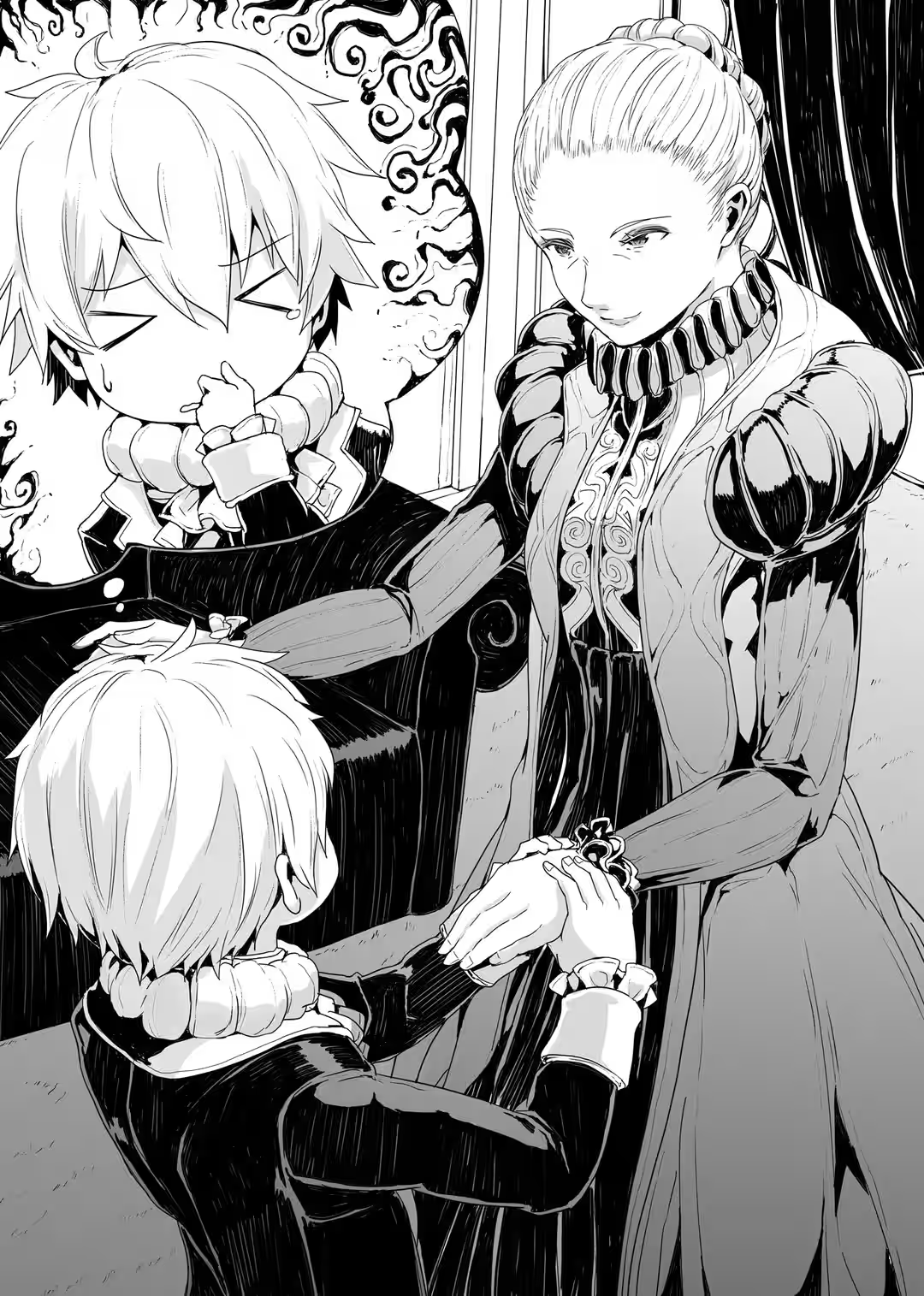
The spy glanced back, shocked, but I ignored him. I was more occupied with trying to maintain my golem—the upkeep was a lot harsher on my mana than I’d expected. Aside from keeping it together and running, I had to constantly reinforce its shape, since it kept shedding mass. Still, that was preferable to overstrengthening it and having its footfalls send tremors through our surroundings. Fine control was hard, since I was using ambient mana, but if that was all, I could manage.
After running for a while longer, my guide spoke up.
“We’re almost there. You may continue alone. Only our people are present in the building’s vicinity.”
By “our people,” I supposed he meant the other spies. Heeding his words, I urged my golem to trundle on. The spell was actually quite simple, now that I’d gotten used to it. Probably even easier than running myself.
Before long, I reached the Count Palatine’s quarters. They were on the first floor, like mine, so I released my golem spell and climbed in through the open window.
Count Palatine Vodedt watched as I did so. There was surprise on his face—a rare expression of genuine emotion from him. “It seems I’ve underestimated your ability.”
Ah. This was the first I’d ever shown anybody what I could do with magic when I went all out, wasn’t it?
“Really, Count Palatine? And here I thought nothing escaped your calculations.”
“I was aware Your Majesty was uniquely talented, true. Using magic indoors within the imperial demesne is normally impossible. Even so...”
Ah, so that really was a rare skill.
“Had you been born in other circumstances, you would have been a great Il Fabris—a mage with few peers.”
If I tried to be anything other than emperor, you’d turn against me. Plus, there you go using words I don’t recognize again. Ah, whatever, that’s not important right now.
“I assume you know what’s going on. Tell me everything.”
***
“Baron Frederick le Nain has been arrested under suspicion of heresy. The Church is handling his interrogation.”
I knew it. Similar stories had been all too common in my past world’s history: torture to coerce a “confession,” followed by a one-way trip to the chopping block.
“Currently, he is being held in a cell. As for your chief attendant, Your Majesty, he is being kept in a private room under surveillance.”
“I take it the powers that be didn’t like his curriculum, then.”
“More precisely, it was his statement that the First Faith ‘must never be used as a tool to oppress other peoples’ that was the issue.”
So teaching me about the other denominations and the Western Orthodoxy’s history had been okay? “Explain.”
“Currently the Empire, and Duke Raul’s territories in particular, arrests and forcefully converts those unaffiliated with the Western Orthodox church—which, of course, disproportionately targets the Empire’s marginalized ethnic groups. The policy was put in place by Archprelate Georg V.”
Ah. So the Western Orthodoxy’s grand high poobah was getting back at the baron for criticizing his methods in front of the emperor. I’d barely spoken to Georg V, but my impression of him was that he was similar to the Chancellor: a man who didn’t bother to hide his flagrant ambition.
“Then why the delay? Why didn’t they seize the baron on the spot?”
“Largely because he is a member of the regency, rather than the Chancellor’s faction.”
Wait, then that means... “So the regency abandoned him?” I’d known the Minister of Ceremony was mercenary, but to even consider the upper nobility from his own faction disposable? Still, he wouldn’t have given someone of the baron’s status over to his political enemy for free. “No, there has to be more to it. The Minister must have gotten something in exchange.”
“Your Majesty,” Count Palatine Vodedt interrupted. “Please reconsider this.”
Evidently, he’d caught onto my train of thought—that I was aiming to rescue the le Nain father and son. “I’ve already thought the matter over.”
His reply was immediate. “You are not calm.”
He...was right. I wasn’t. Maybe it was my physical age affecting my thoughts again. “Perhaps. But our intentions will not change even once we are.”
The Count Palatine sighed. His next words sounded resigned. “To begin with, this affair did not come about at the Chancellor’s behest. The Archprelate is acting independently. By which I mean, he and his people are.”
“You’re telling us the Chancellor’s faction is not a monolith.”
“Neither is the regency, Your Majesty. There are occasional discrepancies between the policies of the Minister of Ceremony and the regent. The former in particular believes strongly that women do not belong in politics.”
Yeah, I’d kind of gotten that vibe from those two. After all, attaching Timona le Nain to me as my chief attendant had been the regent’s independent decision. It wasn’t strange for Georg V to be acting likewise—in fact, that was something I could use to my advantage. Actually, from what the Count Palatine had just said...
“So it was the Minister of Ceremony who agreed to the transaction, not the regent?”
“She is not even aware that the baron and his son have been arrested.”
That was valuable information. A rescue plan was beginning to form. “What else should we know?”
“It appears the Chancellor was only informed of what happened after the matter. He likely gave his ex post facto approval, but I cannot imagine he appreciates deals being made on his behalf, even if it was to his benefit, and facilitated by his brother.”
“So depending on the circumstances, he could change his stance...” I muttered.
The Count Palatine sighed again. “You cannot act, Your Majesty.”
“We know. By all rights, we should be wholly in the dark. Until it comes by us naturally, we will feign ignorance.”
There was nothing we could do for the moment—Count Palatine Vodedt couldn’t afford making an enemy of both factions. The appearance of a third player would put the Chancellor and Minister of Ceremony on their guard and only make matters tougher down the line.
“That is only a matter of course. But even once Your Majesty learns, you must not lift a finger. When faced with the risk of discovery, no matter how slight, inaction is your best option.”
The look in the Count Palatine’s eyes was uncharacteristically genuine. I could understand where he was coming from. If I wanted to seize back political control, I’d have to play the fool until the very last moment. The Count Palatine was pushing a no-risk policy because his first concern was my safety. However...
“No, it is not our ‘best’ option. Simply a good one. Rest assured—we shall produce an outcome worthy of the risk.”
I owed the baron for everything he’d taught me, and if I couldn’t rescue one man, how could I bear the burden of an entire Empire? The problem was, I didn’t know how long he’d be able to endure the torture they were putting him under.
Hang in there, Baron. I’m coming for you.
Stop Me, If You Can
Among my memories of my previous life, which faded more every day, I recalled having a niece. She’d been the type of kid who could plainly say when she disliked something, and whenever her parents tried to convince her otherwise, she’d simply fall into a sulk and start refusing everything instead. Once she got like that, nobody could coax her out of it.
Often, she would throw a tantrum until she tired herself out and fell asleep. I remembered always trying to soothe her alongside my sister—her mother. Even when my sister threatened her with no dinner or alone time outside, she’d just keep yelling “no” or “don’t wanna.” In other words, she’d been a little hellion who paid no heed to logic.
I couldn’t even remember her name anymore, of course. But that didn’t mean I couldn’t borrow her tactics. In my position, it was the best I could manage.
Disgraceful, you say? Maybe. I’m technically still a kid, though, so I have a pass.
Now, stopping a child’s tantrums was one thing. But when that child was the emperor? Well, who was going to stop me?
***
The week seemed to continue forever. I hadn’t heard anything about Baron le Nain’s death, so I presumed he was still alive.
Finally, the day rolled back around to my scheduled theology lesson. My tutor, of course, was someone different.
“It is an honor to make your acquaintance, Your Majesty. I am Carlos le Vadpauvre, graced with the title of count. From today, I shall be your theology tutor.”
If I remembered right, this guy was an aide-de-camp of the regency, aide-de-camp being one of the many new positions the Minister had cooked up for his toadies. That wasn’t important, though. I needed to coax the topic of the baron out of him.
“Who are you? And where is Baron le Nain? Bring him here at once.”
The count’s expression twitched. “Your Majesty, beginning today, I am your new theology tutor.”
“We have no need for you. Bring Baron le Nain here at once.”
Nobility and pride went hand in hand. Faced with dismissal from a little brat, it would be easy to lure the words I wanted out of him.
“Unfortunately, Your Majesty, the baron is in jail. I cannot in good conscience bring that heretic before your august presence.”
Wow, I thought, that was easy.
“What? What is this ‘jayle’ you speak of?” I officially knew about the baron’s imprisonment. Finally, there was no need to hold back. “Why have we not heard anything of this? Who acted without our permission? Bring them before us, so that we may speak with them.”
“Your Majesty, I’m afraid that can’t be done.”
“Can’t be done...?”
Now see, a kid who’d received a proper education would be able to understand, if not accept, what the count was saying. Too bad for him I didn’t fall under that description.
“We are the emperor! Are you refusing a command from the emperor?!”
“N-No, but, I mean, that is—”
“You did it, didn’t you?! Guards! Kill this man! He has disrespected us!”
“No, Your Majesty, please! It wasn’t me!”
My chain of logic didn’t follow at all, of course. Good thing nobody had taught me logic!
“Silence! Kill him already! Guards, what are you doing?! Are you traitors too?!”
Anyway, you can picture the rest. Lots of shouting, lots of calling for their heads. And what do you do when the emperor’s gone mad? You call for people who might be able to soothe him, of course. Thus, when the Chancellor and Minister of Ceremony arrived in a fluster...I kept up my tantrum.
“Someone tossed our favorite tutor in jail.”
“Nobody told us anything.”
“All of you are disrespecting the emperor.”
Those were the main ideas I continued to hammer home. Seasoned with liberal amounts of calling everyone traitors, of course. Everyone who didn’t obey me was a traitor and thus trying to kill me. So I had to have them killed first.
“We demand whoever did it be killed!”
The Chancellor and Minister of Ceremony had wanted me to imprint on them—well, here I was, following their murderous example!
It was only a tantrum, of course. I was sure nobody would actually be killed as a result.
The Dukes promised that they would look into the matter and scurried off. Look into it? You already knew everything, you bald-faced liars. Incidentally, Count Vadpauvre had long since slipped away during the chaos.
Everything was proceeding as planned so far...but the hardest part had yet to come.
I rushed out of my residence, heading for the regent’s digs. Nobody stopped me, of course. They didn’t want to bear the brunt of a mad emperor’s wrath.
***
“Your Majesty, you mustn’t trust Duke Raul. He is certainly scheming something untoward.”
Those were the words the regent had once told me. It was not a far leap in logic to presume that she bore some enmity toward the Chancellor.
Nevertheless, she had also been away from politics for some time, and it was safe to assume that the Minister of Ceremony didn’t want her sticking her head into his carefully arranged chessboard—especially since he didn’t want the Chancellor lambasting him for her actions. No doubt the Minister preferred one set of hands on the reins to two. “Regency” or not, he likely considered it his faction, not hers.
All of which was to say, I was going to do something neither the Minister nor the regent wanted: force the latter out into the spotlight.
“Mother, mother! Help me!”
I made sure I had real tears streaming down my face as I forced my way past her ladies-in-waiting and into her quarters. Er, tears created with magic counted, right?
“Your Majesty? Whatever is the matter?”
Oh, good. I hadn’t accidentally caught her in the middle of a tryst with her lover.
I gave the regent a rundown of what happened. And, well, if there were a few holes or “misremembered” facts, that couldn’t be helped. I was a kid, after all.
“It’s the Chancellor, mother! He threw Timona le Nain—yes, the attendant you gave me—and his father, the baron—my favorite tutor!—in jail!”
Timona actually had nothing to do with this, and more precisely it had been a clique of the Chancellor’s faction who’d done the arresting (with the Minister of Ceremony’s permission, no less) but, again, I was a kid with a kid’s memory. Mm-hmm.
“My word!”
“But still, nobody’s obeying me! I just want them to release the baron, but they keep telling me no and disrespecting me... I know, they must be planning to take over the Empire! They’re going to kill me!”
Technically, I’d only asked for the baron to be released once, and all the refusals had been of my orders to kill everyone in sight, but hey, we were still working within the margin of error here.
“Shhh. It’s okay now. I’ll help you, Your Majesty.”
“Really? I can trust you?”
To really drive the point home, I made sure to act as feeble as I could. An emperor clinging to his mother and blubbering was a pretty pathetic sight, but a child sobbing and clinging to his mother was perfectly natural. Even if the individuals in question were me and the regent. I doubted it would arouse suspicion...even if this one act would, in time, split two factions into four.
“Of course you can. I’ll make sure you get everything you want.”
“Thank you, mother. You’re the only one I can count on.”
Feebly, I continued to cling to her.
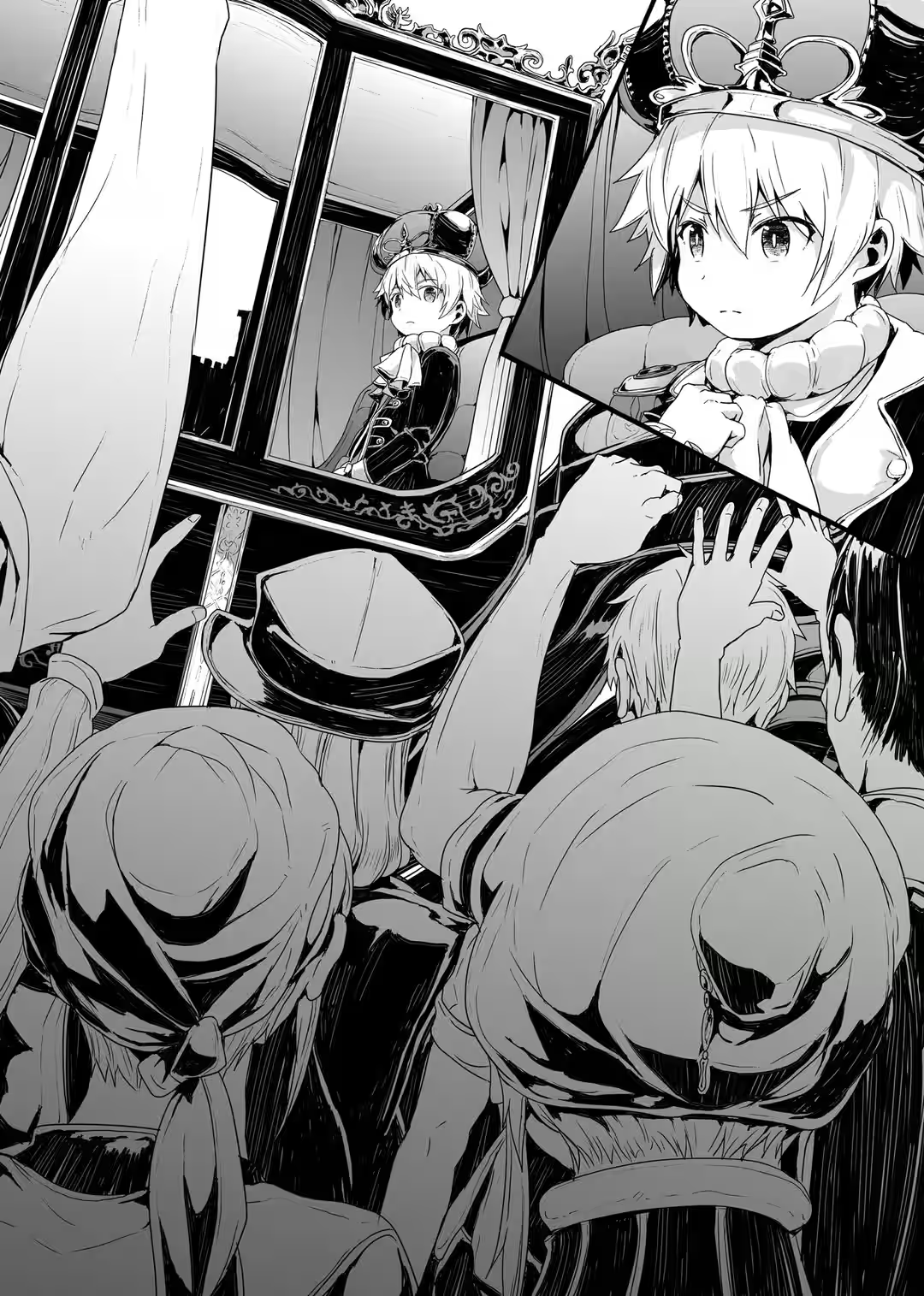
Soon enough, the regent would learn that the Minister of Ceremony had approved this whole affair. However, not acting bore the risk of earning my resentment, and acting came with the benefit of my dependence. With that, she’d be able to make a bold reentrance to the political sphere she’d so long been distant from.
While that triumphant return had the possibility of strengthening the Minister of Ceremony’s position, it also left him more open to an offensive from the Chancellor’s faction. After all, he had benefited somehow from handing the baron over. One could even say he’d come out the most ahead.
Given that, the Chancellor would choose to cut his losses. A simple explanation to me that his little brother had acted independently would be enough for him to wash his hands of the matter.
Georg V was the head authority of the Western Orthodoxy. No matter what I said or how much the regent protested, dismissing him from his position would be a herculean effort. Splashing mud on his reputation, however? That was doable.
Once the regent leveraged my “trust” to win herself a voice in politics, the regency would become a two-horse system. Georg V, dissatisfied at having all the blame foisted upon him, would represent a ticking time bomb within the Chancellor’s faction.
Tensions would rise, and everybody would be too busy jumping at shadows to realize their factions were losing influence. All according to my plan.
Like I’d said to Count Palatine Vodedt, I fully intended to secure a result worth the risk of this endeavor. Of course, as far as I was concerned, saving the baron would be success enough.
Only one issue remained: Would I make it in time?
The Baron
My last life had been haunted by regrets, all the way until the end. Now that I’d been given a second chance, I wanted to live a life free of them. I knew that would be impossible, though. Even if my birth had made me an emperor, on the inside, I was still the same old nobody.
The next day, the le Nain father and son were released from their respective confinements. Timona had evidently lashed out something fierce while under house arrest—he had a fresh gash just below his cheek.
As for Baron Frederick, he was immediately handed over to the imperial physicians for treatment. After a round of the finest healing magic the Empire had to offer, he was scratch-free from head to toe...on the surface. Unfortunately, nothing could be done for the internal damage, to say nothing of the significant mental stresses he’d suffered.
The inquisitors hadn’t managed to extract a false confession of heresy from the baron, even until the end. If they had, there would’ve been no freeing him. They’d done their work, though. Both his mind and body had reached the end of their tether, and death was all they longed for now.
I hadn’t made it in time.
“Your Majesty.”
“Yes, Baron?”
I’d come with Timona to visit the baron on his sickbed, but he’d asked his son to give us some time alone.
“First...thank you.”
Even talking seemed to cause him pain. But I couldn’t do anything about it. The only healing magic I was capable of wouldn’t work on others. I’d never studied medicine—figuring out how my own body worked had been the best I could manage.
“You...saved me.”
“Don’t, Baron. We both know I was too slow.”
There had to have been more I could’ve done, even if it had meant drawing suspicion. What if I had forced promises out of people earlier? No, forget that—what if I had just done something?
“Yet...I must ask.” The baron paused to catch his breath. When he spoke next, it was as though he were wringing out the last of his vitality. “Why did you save me, Your Majesty?”
He reached his withered right arm out to where I sat at his bedside and touched my shoulder. His hand was shaking. “You must never act for the sake...of a single servant. When you are older, your hands will run with the blood of thousands...tens of thousands...as you guide the Empire’s thirty million citizens into the future. You cannot let your heart be moved...by trivialities. Thirty million. Remember that number...for you bear that many lives upon your shoulders.”
“You’re...right. You’re exactly right.” I’d acted even though I shouldn’t have and failed in the end anyway. I was an idiot—a fool who only knew half measures. “I don’t deserve to be emperor.”
Ah, and there I went. Letting the weakness I’d kept so carefully hidden slip out. I’d wanted to be special. But I’d never escape my mediocrity, even when born onto a throne. How could someone like me ever answer the voices of the people?
“Your Majesty.” The baron wiped my cheek with his trembling hand. Apparently, I’d started crying at some point. “Even so, when I look at you...I feel hope.”
“People always say that about me—I’m their hope, or I’m their light. What does it even mean? I don’t know what I’m supposed to do.” The baron’s hand was warm. Like a father’s.
“Just be you, Your Majesty. Live how you think you should. It matters not if you wander, or struggle to find your way. You will choose right, in the end.”
“Choose right... Did I choose right?” I wasn’t able to save you.
“You saved me, Your Majesty. You simply don’t know it.”
What could I ever hope to achieve, as powerless as I was?
“You do not need to bring us hope, Your Majesty. Or guide us to the light. You are our hope. You are our light.”
What was I supposed to do with that? “I was hoping...for more specific advice...Baron.”
My tears showed no sign of stopping. Gently, I placed my own hand over the baron’s.
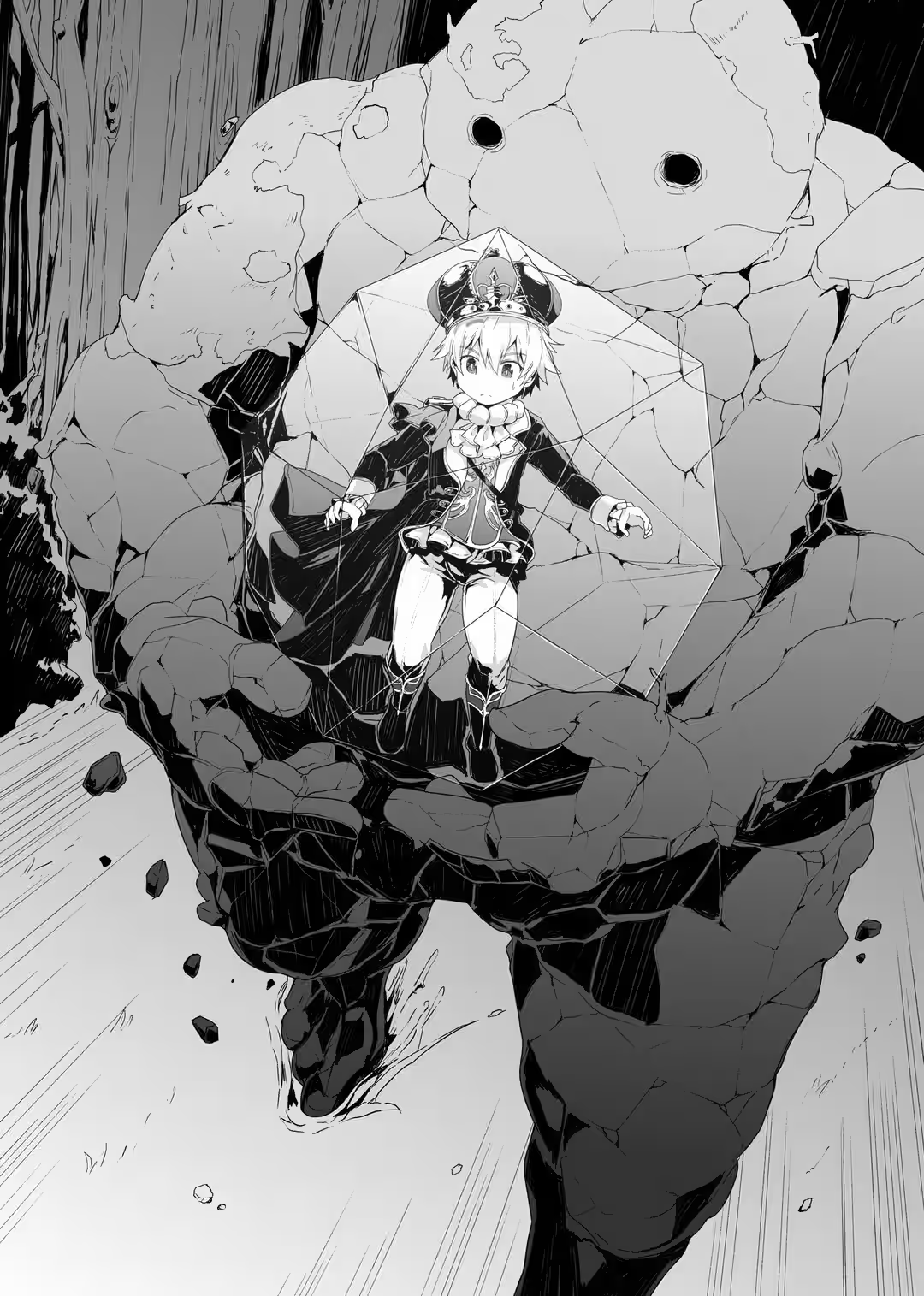
Oh, I remembered now. In my last life, I’d cared for my father on his deathbed, just like this.
“Forward, Your Majesty. Ever forward. For your advance forms a path behind you.” The baron smiled. “That is what it means to be emperor.”
Three days later, attended by his son, Baron Frederick le Nain quietly drew his final breath.
Before His Grave
Baron le Nain’s funeral was a quiet affair, only attended to by a number of family and friends. I didn’t attend—Timona had refused my presence, saying I’d only draw suspicion if I was seen showing the baron more support than I already had.
I was glad I hadn’t gone, though. I doubted I could’ve stopped myself from glaring daggers at the priest, no matter how pious or sincere he was.
The baron rested within a public cemetery intended for the nobility on the grounds of the imperial demesne, as according to his wishes. I had no doubt my feet would carry me here many times in the future, whenever I found myself lost.
I’d come today to offer my prayers before his grave. Count Palatine Vodedt had canceled our history lesson—I suspected he was being considerate, in his own way.
Publicly, we were here at Timona’s request, and I had deigned to accompany him as his master. He kneeled beside me as he prayed, but as emperor, such an act was only allowed to me at the mausoleums of my predecessors. So I stood.
Things just never seemed to work out the way I wanted them to.
As it happens, I’d worked out a fairly likely theory for why the baron had been willing to risk his life to criticize the Church in front of me. When I’d touched him, I’d noticed that there’d been active magic—earth magic, by my reckoning—at work within him.
All humans possessed their own reserve of mana, a phenomenon I’d dubbed “internal mana” during my own research. It wasn’t a stretch to then conceive of certain abnormalities that could trigger that mana and convert it into internal magic. For example, a disease that slowly turned part of one’s innards into dirt.
I’d tried to do something about it, of course. But I didn’t know how to disrupt others’ magic. Even though the baron hadn’t been doing it of his own volition, it’d still been his mana—and thus his magic—causing the effect.
The best I could’ve managed was forcibly obstructing the mana with a barrier, but then what was I supposed to do? I was no doctor; I doubted I could’ve even recognized which internal organ was which on sight, much less perform surgery. The imperial physicians’ efforts had fared no better. For all the healing spells available to them, it appeared they had no method of interfering with internal magic.
Even so, I couldn’t bring myself to accept it. Fine, so perhaps the baron had decided to take matters into his own hands, rather than waste away from illness.
But as far as I was concerned, I would’ve wanted him around for longer. Even if only for a day.
“We should go, Your Majesty.”
“Yes. We know.”
At Timona’s urging, we departed from his father’s grave.
I’ll move forward, Baron. Just watch me.
***
After the baron’s passing, Timona chose to cede the title to a distant relative, on the grounds of his youth. Evidently, he wished to stay on as my attendant.
“I shall take my leave now, Your Majesty.”
“Mmm. Fine work today...”
During the day, Timona took my lessons with me, or wordlessly accompanied me while I played hooky. In the evenings, he left for Count Palatine Vodedt’s residence, where he learned swordsmanship, among other things. Apparently, the “official” duties of an Agincarlish chief attendant mainly consisted of standing guard over me, a fact Timona had leveraged to request his lessons. It seemed he’d made peace with the role.
It was honestly a little unsettling how he treated me so courteously now; it was like he’d become a different person. Still, Count Palatine Vodedt was firmly in my camp—for now—and he’d greenlit Timona staying on as my attendant. If he said it posed no danger, then I’d just have to have faith.
Speaking of recent changes, the imperial court’s factions had seen some new developments. Tempers had flared thanks to the recent incident; the narrative the majority had settled on was that the emperor’s favorite tutor had been imprisoned. Of course, since the baron had since been released, they considered the matter settled. I hadn’t said anything further about the affair, and Georg V hadn’t received any kind of punishment.
However, while he remained in the same position, he had suffered a significant loss in influence. Also, word was that he felt dissatisfied with his older brother, who’d thrown him under the bus.
Since such friction could very well lead to the faction splitting apart, the Chancellor was doing all he could to keep it together. Those of his people who sympathized with Georg V were coming to see me every day, trying to extract words of praise from me. I needed to lay low for a while, since my efforts to save the baron had made such a big splash, so I played along. I followed the Chancellor’s lead and said all the things he wanted of me.
Apparently, people had started calling me the Puppet Emperor because of it. They were more right than they knew.
Ah, and the regency had been shaken up a bit too, to a lesser extent. The Minister of Ceremony had left imperial court politics to the regent and returned to the Agincarl duchy.
Both the Chancellor and Minister of Ceremony were Dukes with their own territory; they didn’t necessarily spend the entire year in the imperial capital. In fact, they made trips between the two fairly regularly. This time, however, it didn’t seem like the Minister would be returning for a while. He’d even taken some of the furniture he’d brought to the imperial demesne back with him.
His absence was likely why the regency was making an effort to look calm on the surface, despite the chaos that had been stirred by the regent’s return to politics. According to the Count Palatine, there were tensions and conflicts aplenty behind closed doors.
Ever since I’d run to the regent to make my tearstained ploy for sympathy, we’d been meeting on a daily basis. As for the Chancellor, he dropped by even more frequently. Such were the consequences of making such a noticeable play, I supposed. I would need to play the part of their obedient little emperor for a while.
In the midst of all this, I would occasionally hear nobles from the Chancellor’s faction gossiping with each other—and one thing in particular piqued my interest.
“At this rate, we’ll have a repeat of Haculea’s Folly on our hands.”
From context, it seemed they were talking about the regent. I figured I’d ask the Count Palatine when the opportunity next came—which it did, several days later.
I was in bed when I noticed that, for some reason, there were two people above my ceiling today. For a moment, I thought some other party had infiltrated my residence, but there were no signs that a fight was about to break out. After quickly putting the lady-in-waiting to sleep, I hopped out of bed. Shortly afterward, Count Palatine Vodedt descended soundlessly from the ceiling. With nimble movements like those, you wouldn’t think he was a nobleman at all. Who was he, really?
“Is there an emergency?” I asked.
“No.”
Then why’d you come by? And from the ceiling, no less. Well, I supposed that was neither here nor there. If his business wasn’t urgent, then I could ask my question.
“We heard something which piqued our interest the other day, Count Palatine. What is ‘Haculea’s Folly’?”
“Ah. I suppose you must have heard that from the Chancellor’s people. You see—”
Apparently, Haculea was the empress of the Late Giolus dynasty’s third emperor. The dynasty had already been in decline when said third emperor had died young of illness—and without fathering any children—accelerating the process. It certainly didn’t help that he’d killed everyone else in the line of succession (except his older sister) back when he’d ascended to the throne.
As it so happened, this meant that Duke Bundarte—yes, Cardinal himself—was next in line, since he was the eldest son of the emperor’s sister. The Bundarte family had already been married into the bloodline during the struggle for succession.
Yet Empress Haculea, not wanting a man from the “barbarian tribes” on the throne, adopted her nephew and had him crowned as the fourth emperor. Since he was so young, it was completely transparent that she wanted to keep the political reins in her own hands.
This act caused much of the nobility to turn their backs on her, with some defecting to the Celdonoire dynasty, and others joining Duke Bundarte under the pretext that they were “reinforcing the anti-Garfurian forces.” Nevertheless, Haculea’s dislike of the barbarians prevented her from ever calling on Cardinal’s army for aid, and the Late Giolus dynasty met an abrupt and unsatisfying end.
Go figure. My doubts about Emperor Cardinal and the Count Palatine had been cleared up in one fell swoop.
Anyway, by “Haculea’s Folly,” the Chancellor’s people must’ve been referring to the regent reestablishing her political influence. I was inclined to agree: I could easily picture her making the same kind of mistake as the bygone empress.
“So, Count Palatine. You had business with us?”
“Ah, yes, I’d almost forgotten.” The Count Palatine clapped his hands exaggeratedly.
Just from that gesture, I was already getting a bad feeling.
“The Teyanave region—that is, our northern borderlands—is showing signs that it plans to declare independence.”
Ah. That was definitely something worth telling me in person. He was right that it wasn’t urgent either, at least for me. It wasn’t like I’d be able to do anything about it.
“Tell me everything.”
A midnight extracurricular lesson, huh? This was probably going to take a while.
The Teyanave Confederation Secedes
The Teyanave region was located in the Empire’s northern region, bordering the nations of Tomis-Ashinaqui, the Kingdom of Aeri, and the Grand Duchy of Gaeweigh. It possessed its own unique culture, the popular language was Teyanavi, and it was the final nation that the Bundarte Empire had reconquered after it had fractured from the Rotahl Empire. The nobility in Teyanave were of the neutral bloc, rather than either of the Dukes’ factions—in fact, one of my wet nurses had been the wife of a Teyanavi nobleman.
It wasn’t until three months after Count Palatine Vodedt had visited my room in the night that Teyanave officially declared its independence and news reached the imperial capital; I was already seven. Apparently, it had adopted the moniker of the “Teyanave Confederation.”
Once the news broke, the imperial court had all the fuss and murderous clamor of a freshly stirred-up wasp’s nest. I had to admit, watching the Chancellor strut about in a panic put a pleasant spring in my step.
Okay, I know. As the emperor, I should’ve been more worried about the situation. What did you want me to do, though? It wasn’t like I had any real power.
I suspected the Minister of Ceremony had departed from the capital to hole up in his territory because he’d gotten wind of this early on. The Chancellor’s faction, in contrast, seemed to have been taken by surprise—they were in uproar. Was it because the Minister had a better intelligence network...or simply a matter of distance?
The imperial capital Cardinal was—er, had been—located more or less in the center of the Empire. The Agincarl region was to the southwest, while the entire eastern region of the Empire was Duke Raul’s domain. That meant that most of the nobility in the Empire’s west belonged to the regency, while most of them in the east belonged to the Chancellor’s faction.
Since Teyanave was in the Empire’s northwest, it was basically next door to the Minister of Ceremony’s sphere of influence. No wonder he’d left; he had to have bigger priorities than political squabbles in the capital right now. It was a little surprising that the regent had been blindsided, though, given how they were ostensibly in the same faction. Didn’t they know regular communication was a key factor in maintaining parent-child relationships?
Incidentally, I say that Cardinal had been in the center of the Empire because the southeastern and southwestern (east of Agincarl lands) regions the Dukes had ceded to other nations after the previous emperor’s assasi—ahem, death by natural causes—had shifted its position relative to the borders considerably.
Now, you might wonder why the Chancellor was in such a tizzy about the Teyanave Confederation seceding. After all, their lands had nothing to do with his, and he’d happily handed similar regions over to other nations in the past to screw over his political opponents. Well, it had more to do with the open question of the Confederation’s choice of foreign backer.
I’ll begin with the most likely culprit: the confessional state of Tomis-Ashinaqui. If you’ll recall, this was the nation that had been at war with the Kingdom of Belvére until my betrothal to Rosaria had led to an armistice—being geographically sandwiched between the Empire and the Kingdom was enough to make them cautious. However, the Teyanave Confederation’s independence meant that they’d lose their border with us, gaining a new Teyanave-sized buffer. Chances were good they’d promptly relaunch their invasion.
I spared a moment to silently offer the Kingdom of Belvére my condolences. They’d just have to hold out on their own for a while.
However, it was not Tomis-Ashinaqui that the Chancellor was panicking over. No, that had to do with the second possible culprit backing Teyanave’s independence: the Garfure Republic.
The Republic was a rather complex nation. Despite its moniker, political power did not actually rest with the public—it was only a republic in the sense that the nobility had molded a parliamentary body to suit their priorities. Plus, the Bundartian and Garfurian ethnic groups had a history so fraught with conflict that they could spend the next several centuries in peace and still hate each other.
Just to list some examples, the Garfurians had dispossessed the Bundartians of their homeland; the would-be Emperor Cardinal had obstructed their then-empire’s expansion and caused the collapse of their imperial regime; and then there was the historic crushing defeat that the sixth emperor of the Bundarte Empire had suffered during the so-called “Conquest of Garfure.” At this point, it was no exaggeration to call our peoples mortal enemies.
The Garfurian aristocratic republic system had risen after the collapse of the nation’s imperial rule. However, its name had technically remained the Kingdom of Garfure for some time afterward. Since its political decision-making lay at the whims of the aristocratic vote and the masses had no particular role worth speaking of in the halls of power, its neighbors had dubbed it the “Garfure Republic” fully aware of the irony of the nickname.
This only became its official name later on, during the time of Edward III—the sixth Bundartian emperor I mentioned earlier. He’d gone to war with Garfure to disrupt its efforts to abolish its monarchy, and he’d suffered a catastrophic defeat as a result. Fearing a follow-up invasion, Edward III had given a full quarter of the Empire—including the eastern region that bordered the Garfure Republic—to his own younger brother. And now we return to the present: Duke Raul was that younger brother’s son.
Thus, we have established why Duke Raul’s territory borders the Garfure Republic. From here, it is easy to see why he was afraid. The Teyanave Confederation’s independence could be interpreted as a move to spread the Empire’s military forces thin—in other words, laying the groundwork for a full-scale invasion.
Incidentally, the Garfurian people, partly because of their nomadic origins, were reputed to have the best heavy cavalry on the continent—yet another reason for Duke Raul to be quaking in his boots. His formidable private army, the cannons he was mass-producing in his territory, and the fact that he was still a part of the Empire apparently weren’t much consolation when faced with the prospect of a heavily armed knight charging him down on horseback.
In all fairness, despite my dislike of the man, I fully agreed with his wariness of the Garfurian heavy cavalry.
This world had already developed stirrups, a piece of technology that had caused a major shift in the fighting strength of cavalries back on Earth. It was entirely possible that a reliable countermeasure against a Garfurian heavy cavalry charge literally did not exist yet. I knew that firearms resembling early-stage muskets were in common circulation, but we were definitely still in the age of the mounted rider—and would be for some time.
One final note: According to Count Palatine Vodedt, the Teyanavi secession had been guided by the hand of an enterprising merchant company. That in itself was fine, as far as I was concerned. The more immediate problem was that the Empire losing the Teyanave region also meant more than half of the neutral bloc nobility had gone with it.
Just when I thought I’d taken a step forward, the universe conspired to push me two steps back.
***
Several days later, the Chancellor returned to his own territory. It seemed he was indeed wary of the Garfure Republic. You’d think this would mean the imperial capital’s political scene calmed down, but if anything, it was the opposite. Since the only folk left around were radicals (Georg V) or nosy busybodies (the regent), the vibes in the imperial demesne were more rancid than ever.
Still, despite the turmoil in the Dukes’ absence, it also meant I had fewer—and less attentive—eyes on me. During this chaotic period, Timona was assigned to be my night watch. I could spend my nights learning swordsmanship and self-defense.
My bedroom, being that of an emperor, was plenty spacious enough for my purposes. Although surveillance on me had slackened during the day, they weren’t blind enough to let me get away with swinging a sword around. Practicing secretly at night was the perfect alternative.
“Secretly,” of course, was the operative word there. It all hinged on whether I could trust Timona as my vassal. Quite honestly, I wasn’t sure. But he didn’t come off nearly so hostile toward me anymore—if anything, I got the impression I had his respect—and Count Palatine Vodedt had approved him, so I supposed I’d just have to go out on a limb and extend some trust.
Of course, the Count Palatine had also said that I should just run Timona through with my blade if I ever became suspicious of him. Apparently, he thought a bodyguard was a failure the moment they caused their master to doubt them.
Yeah. Stuff like that was...something I’d have to be prepared to do, when the time came.
I was keeping my magic a secret from Timona, though, at least for the time being. It was my lifeline, after all. But outside of that, I was going to give him a fair chance.
Thus, I began learning swordsmanship and self-defense from Count Palatine Vodedt (the great descender of ceilings himself) at night. Obviously, this meant I was getting very little—if any—sleep, so come daytime I would be stumbling around bleary-eyed and frequently dozing off. This earned me the nickname of the “Layabout Emperor,” as well as accusations that I’d gone “Agincarl-mad.”
The latter was whispered by the more gossipy nobility, who I suspected were attributing my sleep deprivation to my long nightly hours “getting up to something” alone with Timona, which was not exactly incorrect, but, well, not like that.
“I’m seven, you freaks!” was my indignant reaction, until Timona told me he’d been even younger when he’d been assaulted, and there was nothing I could say to that.
Still, “Agincarl-mad,” huh? I supposed I’d have to put in the legwork and meet with Georg V sooner or later if I didn’t want to pick up a rep for favoring the regency.
Man, I really hated that guy, though.
My Hobby is Magic
It was several months after the Teyanave Confederation had declared independence, and conflict had still yet to break out at the border. Amid the tensions, a visitor came to the imperial demesne.
“Ah. It has been too long.”
“Yes! Indeed it has, Your Majesty.”
Yep, it was Rosaria, my betrothed. Her expression seemed softer this time around, maybe because the Chancellor and his lot weren’t around.
You know, I hadn’t really thought about it, but my decision to be emperor meant that I’d actually have to marry her one day, didn’t it? Having my life partner decided at such a young age—especially since I’d been a bachelor in my past life—felt...odd.
Incidentally, Rosaria hadn’t just come to play. There was serious diplomatic business to be seen to.
When my betrothal to her had been sealed, both the Chancellor’s faction and the regency had shipped substantial material aid to the Kingdom of Belvére. Since the armistice with Tomis-Ashinaqui had come relatively soon afterward, the Kingdom still had a large surplus. Now that the Empire looked like it might be on the verge of war, Rosaria and her delegation had come to inquire whether we would like it back. There wasn’t any food left, but there was plenty in the way of military assets they could return.
Essentially, the issue depended on whether our aid had been a “loan” or a “gift.” Since it had happened in a series of increasing installments, the definition had never been formally nailed down.
Ordinarily, it would have been the Chancellor or Minister of Ceremony calling the shots on this decision, but neither of them were currently present.
“Which would you prefer?”
“If the Empire does not require it back, there is much the Kingdom could use it for.”
Yeah, no surprises there. “Then you may keep it.”
With the Dukes absent, I decided to make the call. It was their fault for not being around, if you ask me.
Is it really okay for me to get involved in international politics, you ask? That was a fair question; I would be assassinated the moment I was seen meddling in diplomacy and making a play for power. But I wasn’t doing that, was I? I was just “showing off to my fiancée.”
To be completely clear, that’s not what I was doing. If the Kingdom of Belvére could present a sustained military force, it would keep Tomis-Ashinaqui in check. I’d just have to get the Count Palatine to spread that rumor among the nobility. It wasn’t a hand I could play often, but in this case, it was necessary.
“Thank you, Your Majesty!” Rosaria beamed at me, her smile so wide, it resembled a blossoming flower.
Okay, fine, so maybe there had been a tiny bit of ulterior motive behind my decision.
***
In any case, Rosaria would be sticking around for a little while longer. I suspected she wanted to make a show of waiting as long as she could for the Dukes before “giving up” and returning with the emperor’s word as her answer. Frankly, I wouldn’t have been surprised if she’d intentionally come while they were out.
In the meantime, I showed her around the imperial demesne—under the watchful eyes of an escort consisting of members from both the Dukes’ factions, of course. The act of showing her around drew no suspicion, since she was my betrothed, and I made sure to puff myself up and be self-important about everything. I was trying to get our escorts to buy my “kid who wants the girl he likes to pay attention to him” act.
As a matter of fact, this was all just groundwork—there was a certain something I wanted Rosaria’s help with. The only problem was: How would she respond?
“You’re very knowledgeable, Your Majesty.”
Wait, she was praising me? Quite a bit too, and it was in a way that supported my actual goal. I knew my reputation was pretty crap, so I was actually taken aback by her reaction. I couldn’t feel any enmity or reluctance from her either. If anything, it almost felt like she actually cared for me.
But...why? Was she after something of her own? Maybe I was just mistaken, and it wasn’t even affection at all. Yeah, that was entirely likely.
Hang on, had I become somebody who could easily recognize ill will, hostility, and contempt, but nothing else? That wouldn’t do; if those were my only foundations for judging others, my future would be riddled with mistakes. I’d have to be careful.
That left...no, it couldn’t be—had Rosaria noticed my objective? She was nine years old!
“And this is the grand library.”
“Wow! They say this is the greatest library on the continent! There’s actually a book I’ve been searching for—would you mind terribly if I looked for it?”
“No... Of course not.”
Yeah, there was no way...
“Oh, here it is. I’ve been wanting to read this for ages. What kind of books do you like to read, Your Majesty?”
“W-Well. Er... Books like this, we suppose?”
There was no way...right?
“My, a book on magic! You can truly read such difficult tomes, Your Majesty?”
“Yes. We can.”
“You’re incredible, Your Majesty. I’m glad my future husband is so smart. I think we’ll get along really well.”
Aw, cripes. She had definitely seen through me. What was more, she was leading this exactly where I wanted it to go.
“Mmm, indeed. Would you like to borrow some books? You may pick whichever you like.”
You guessed it, my goal had been getting my hands on books about magic. It was the one discipline that Count Palatine Vodedt couldn’t teach me. However, the public face I put up was that of an idiot emperor with no thaumaturgical literacy whatsoever. The simple act of retrieving a relevant book from the library would put me under scrutiny.
That was why I’d enacted my “borrow a hard book I can’t read to show off in front of the girl I liked” plan. I’d figured the hard part would be getting Rosaria to play along...but it had gone more smoothly than I’d ever imagined.
I no longer had any doubt that she was backing me up on purpose. But seriously, what the hell? She was nine, right?
“Thank you, Your Majesty!”
Okay, yeah, so she had a cute smile. But was it just me, or had it started to look a little terrifying?
This was bad. Had she seen through my idiot act? If she had, then what was her objective? Did she want to extract some other political guarantee from me? There was even the chance that she had ties with one of the Duke’s factions. It was probably best if I kept her at arm’s length moving forward.
A month later, Rosaria returned home. She looked somewhat dispirited about it—I took that as confirmation that she had wanted some kind of guarantee from me. Maybe I should’ve at least heard her out.
***
“Have your studies borne fruit, Your Majesty?”
One night, Count Palatine Vodedt dropped down from my ceiling again. Since we hadn’t scheduled a swordsmanship lesson today, Timona was sleeping in the other room.
Huh? Oh. No, he was still my night watch. It was just that staying with me day and night meant he got very little sleep, so I forced him to get some rest on days we didn’t have any training.
Of course, since he was still ostensibly on night watch for me, he had to return to my room—from the ceiling—thirty minutes before the ladies-in-waiting came to wake me every morning.
Uh, was it just me, or was my ceiling getting more use than my door?
“They have. The study on infusion magic was particularly useful. We feel as though our horizons have broadened considerably.”
Since I was studying magic on my own, there was only so much progress I could make. All the volumes on magic left behind by past pioneers were worth reading, but my interest had been hooked by the theory of infusion magic. In short, it was groundbreaking research into the concept of applying an external concept to an extant spell.
Let’s use my magic repertoire to illustrate an example. The quickest spell at my fingertips was one that compressed heat energy and fired it in the shape of a beam. Its biggest flaw was its lack of potency; it could pierce through its target, but only given sufficient time and sustained effort. Sure, its initial blast could scald skin pretty badly, but that wouldn’t be enough of a weapon in a genuine fight.
However, if I used infusion magic to, well, infuse the heat energy with the aspect of fire, I could resolve my issue. The resulting beam would melt its target in an instant, even if it was a metal suit of armor. Sounds powerful, right? I hadn’t expected it to be so potent either—when I’d tested it, I’d almost outed myself to the ladies-in-waiting. Close call, that one.
The strengths of a beam attack were its speed and maintainability. Since infusion magic fortunately took little time to apply once you understood the concept, I had a formidable weapon in my hands. The increase in mana expenditure was a drawback, but not a significant one, as far as I was concerned.
Oh, it was important to delineate that I was talking about infusing the beam with an aspect of fire, not flame itself. Imbuing the latter would cause it to take on the shape of flames, as well as grant it fire’s capacity to fade and cool. Infusing a fire aspect, however, wouldn’t—the capacity to cool was an attribute of the water aspect.
This was, of course, an extension of old-school elementalism: a descriptive construct that used the properties of nature to describe phenomena. As someone used to modern-day Earth science, I’d thought the concept of the classical elements was antiquated, but it figured that the rules were different here. I’d have to be careful not to let my biases get the better of me again.
I’d also learned a number of other spells, as well as methods for applying more detailed filters to my Custor—my magical barriers. Turns out, I couldn’t help myself from getting enthusiastic when it came to magic.
“So, Count Palatine. What business do you have?”
“First, the results of my investigation. Lady Rosaria has no ties to either of the Dukes’ factions.”
“Indeed? Thank you.”
That pretty much confirmed she’d just wanted some kind of political pledge from me. I made a mental note to accommodate her as best I was able the next time we met. It was only thanks to her that I’d gotten my hands on these wonderful magic books, after all.
“And your main business?”
“Ah, yes. I happened to catch something rather interesting.”
The Count Palatine proceeded to retrieve an entire gagged and bound man from the ceiling.
“In regard to its fate, I thought it best to defer to Your Majesty’s judgment.”
I took a moment to compose myself. “Explain.”
Very funny, Count Palatine. Is getting a reaction out of me really that amusing to you?
The Three Houses Coup
Let’s turn the clock back to shortly before I was born. After Crown Prince Jean died in battle and the previous emperor, Edward IV, perished from grief, the Empire experienced a power vacuum. As you’d expect, much disagreement was had over who would succeed the throne, centered around three names in particular. These three individuals were all women—the late Edward IV’s sisters, to be precise.
Our first candidate was Eleanor, wife to Marquess Agincarl d’Decci. The second was Marguerite, wife to Marquess Ramitead, and the third was Lise, widow of the former Count Veria.
The question of imperial succession would of course be resolved by the birth of the late Prince Jean’s child. However, the three houses with their names in the running had objected to this, raising the flag of rebellion. In a feat of cooperation, the Chancellor and Minister of Ceremony came together to quell the dissent. They slaughtered the three houses down to the last of their lines and seized control of their lands. Thus, all rebellion against the young emperor was put to rest, and the so-called Three Houses Coup came to an end.
Of course, that was the official summary of events. The truth, as you’d expect, was quite different. Let’s start from the top again.
First, we must establish that until I was born, they had no way of knowing whether I was truly Jean’s child. You could blame that on the regent taking a lover, of course. Honestly, it was like everything the hag did stirred up trouble.
Anyway, the struggle for succession was, obviously, between the Dukes’ two factions. The Chancellor backed Marchioness Eleanor Agincarl d’Decci, while the Minister of Ceremony’s choice was Marchioness Marguerite Ramitead.
Incidentally, Marquess Agincarl d’Decci’s lands bordered the Minister of Ceremony’s, and the two were quite hostile due to a title dispute. Hmm, how to put it in simple terms...? Think of it like this: Imagine the Duchy of Agincarl as a “prefecture” and the territory of Agincarl d’Decci as a “city.” The issue stemmed from the fact that House Agincarl d’Decci had been extant for generations before Duke Agincarl had received his title.
In the Duke’s eyes, Marquess Agincarl d’Decci and his holdings were a part of the Duchy of Agincarl, and thus should be subservient. However, the marquess took exception to the idea of bowing his head to the new kid on the block. Naturally, this led to hostilities between the two houses. And then the Chancellor decided to back Marchioness Agincarl d’Decci.
Marquess Ramitead’s circumstances were similar: His territory adjoined the Chancellor’s, and the two were on unfriendly terms. However, this was a much more mundane border dispute. Since aeronautical charts and such weren’t a thing in this time period, there was no clear delineator for a border between any two given territories.
People often used mountains and rivers as markers, of course, but in the event there were none around, the nobility parceled up the land on a per-village basis. However, the common folk, who were ignorant of the circumstances of the aristocracy, were prone to pick up and move anywhere that would provide them with a better life. They developed new settlements all over the place, one thing led to another, and there you go: an instant recipe for aristocratic border disputes.
Then, as previously mentioned, the Minister of Ceremony had decided to back the Marchioness Ramitead.
Just as the political strife was reaching a boiling point, I was born. Once it was determined that I was Jean’s legitimate child, the entire situation was upended. Incidentally, they’d used a magical tool left over from the age of the Rotahl Empire to test my legitimacy.
Oh, I’d thought when I’d learned the full story, so that’s why there had been so many people around to watch when I was born.
Anyway, the insane thing about the whole situation was that neither the Duke nor the Minister of Ceremony had thought I would actually be Jean’s kid. Talk about some serious trust issues.
With the legitimate heir now in play, the Dukes arranged a temporary alliance. They had only backed Houses Agincarl d’Decci and Ramitead in the first place because they had been the “enemy of my enemy.” There had never been any warmth between the patrons and their candidates. In contrast, the newborn emperor was looking a lot more malleable. After all, the marchionesses had their husbands as supporters and shields, while I had nobody. Is it any wonder that the Dukes chose the puppet with lighter strings?
Now, we reach the climax. The nature of the Dukes’ secret agreement was a twofold plan to take over their rivals’ lands: Duke Agincarl would get Marquess Agincarl d’Decci’s, and Duke Raul would get Marquess Ramitead’s and Count Veria’s. Long story short, now that their candidates had become obstacles, they traded them off to each other.
I felt bad for Count Veria. His holdings had essentially been dragged in by pure happenstance and bartered away like a freebie.
In other words, no coup actually happened. It had all been a pretext invented by the Dukes so that they could slaughter their rivals without facing public objection.
And there you go: the truth of the Three Houses Coup that shortly followed my birth seven years ago.
“So, who’s this?”
Upon closer inspection, I saw that the trussed up man kneeling before me was, in fact, a boy of about thirteen or fourteen. He was gagged and blindfolded, and strangely, despite his raggedy commoner’s wear, something about him would’ve made me believe you if you’d told me he was nobility.
“He’s a survivor of House Ramitead. It appears his birth in the branch family of a branch family allowed him to escape the massacre unnoticed. We caught him trying to flee across the border.”
“Hmm. And?”
In a nutshell, this boy was wanted by the Empire. He would face immediate execution if his identity was uncovered. As long as the truth of the Three Houses Coup remained buried, that was set in stone.
“It is my opinion that you should have another piece on the board. Of course, the decision is yours.” Count Palatine Vodedt took a step back.
Ah. So if I wanted another pawn, I’d have to conduct the negotiations myself.
First things first, I readied myself to cast Flamma Lux—a fire aspect-infused compressed heat spell—at any moment.
“Nod if you can hear me. Good. I’m currently aiming a spell at you. Can you tell?”
The boy nodded frantically several times, visibly trembling. Hmm. If he could sense my magic’s potency, that meant he was pretty talented.
“The moment you raise your voice, I’ll release the spell, and it will burn a hole through your throat. And just so we’re on the same page, please don’t lie to me. Otherwise, my hand might...slip.”
The boy nodded again. I figured that was enough intimidation for the time being.
“Remove his gag.”
The Count Palatine did so. Pleasantly, the boy didn’t immediately plead for mercy.
“What’s your name?”
“Fabio. I’ve also taken the last name Denouet.”
His voice was shaky—no surprises there—but I was impressed by how composed he was despite his age.
“Why try to escape the Empire now? Seven years is a long time to wait.”
“I wanted to stay and clear my family’s name. But the neutral bloc I was depending on crumpled with the Teyanave Confederation’s declaration of independence. The Empire has no future now. Not anymore.”
That made sense. Even if he’d tried to reestablish his house in another nation, it would still bear the stigma of treason. No doubt he’d thought biding his time for an opportunity was a better prospect, despite the increased danger.
“Why do you want to clear your family’s name? It would have been simpler just to focus your efforts on staying alive.”
“Because I’m all that’s left of them. They died so quickly. Like...like it was nothing. I can’t let that be the end. I just can’t.”
From the way his teeth were clenched, I suspected he was being entirely truthful. If that was the kind of resolve he could show, I’d be able to use him, despite his age. It was also a point in his favor that he wasn’t trying to toady up to me or debase himself.
No doubt he could manage that because he thought he bore the entirety of House Ramitead on his shoulders. It was a self-deluding kind of dignity, no doubt, but personally, I liked that.
“Then I’ll offer you a deal. Work for me as my eyes and hands. In exchange, once I become emperor, I’ll expose the truth of the Three Houses Coup to the light of day.”
“Em...peror...?”
Hmm? What kind of reaction was that? Oh, wait, I hadn’t told him, had I? I supposed the Count Palatine had intentionally refrained from mentioning it too. That...was probably for the better, though. Helped to avoid furnishing him with any preconceived notions.
“Remove his blindfold.”
The Count Palatine did so. Fabio’s eyes widened to the size of saucers. No doubt he hadn’t expected to be talking to such a young child.
“Pleasure to meet you. Carmine, eighth emperor of the Bundarte Empire. I suppose you could also call me the direct cause of the Three Houses Coup.”
It wouldn’t be that strange if Fabio hated me. If I hadn’t been born, he could’ve become a branch member of the imperial family.
“N-No, I wouldn’t dare. I’ve never...thought of it that way. Uh, Your Majesty.”
“Why the sudden formality? Speak as you have before.” If anything, it only made him sound more suspicious. That was true in general, including for Count Palatine and Timona. “So, what do you say?”
“I... Yes. I’ll serve you. So, please...”
“I know. I can’t do it right now, but I’ll clear your name. I swear it.”
Fabio or no Fabio, dragging the skeletons out of the Dukes’ closet was something I’d have to do anyway, if I wanted to become emperor in truth. I’d essentially gotten a new subordinate for nothing. Still...I’d probably need some insurance.
“Count Palatine Vodedt.”
“Yes?”
“Adopt Fabio and care for him. That’s an order.”
As things stood, all that stood between Fabio and the chopping block was whatever flimsy cover story he could scrounge up for himself. If he was tied to the Count Palatine via adoption, any investigation would naturally implicate the Count Palatine too. Thus, by giving this order, I gained a set of eyes on Fabio to make sure he wouldn’t betray me—and more importantly, a set of chains for Count Palatine Vodedt.
Of course, the man knew exactly what I was doing.
“Heh. Ha. Aha ha ha! Excellent, Your Majesty. Very well. I hear and obey.”
When you got down to it, it hadn’t been Fabio he’d been testing, but me.
Good thing I’d passed.
***
Thus, Fabio began his education under the Count Palatine. That was just fine; I didn’t need him working for me yet anyway.
Right now, the Dukes were in their respective territories, each wary of foreign nations. If I went about whittling away their influence in the wrong way, we faced the risk of a genuine invasion. The citizens in the duchies of Raul and Agincarl were still citizens of the Empire—I wanted to avoid creating more victims than was absolutely necessary. As such, I decided to be patient. My days in the imperial demesne went as usual, with one exception. It was the perfect chance to implement a certain measure I’d been considering, especially since it wouldn’t impact the faction conflict.
My swordsmanship lessons were slowly becoming a daily affair. After one such session, I asked a question of the Count Palatine.
“Count Palatine. We...read in a book...that royalty used to dose themselves with diluted poison in order to develop a resistance. Would this be possible for us?”
Technically, I wasn’t lying. I had read it in a book—back during my time on Earth. Incidentally, I hadn’t said anything about my previous life’s memories. Still, I wouldn’t have put it past the Count Palatine to have noticed something was up.
“It would, if that is your wish. It is not very effective, however. Better than nothing, but that’s all.”
His words had a certain weight to them that told me he knew what he was talking about. Well, he was the spymaster. Perhaps he’d already undergone the process himself.
“We don’t mind.” I turned to Timona, who was standing silently to the side. “Timona?”
“I shall decline, Your Majesty. I am your poison tester, after all.”
A flat refusal. To be fair, it was probably better if a poison tester had no resistance. They’d be more sensitive to abnormalities that way.
The implication behind my question had been that Timona could quit the role, though. My would-be assassins weren’t idiots. Here’s a simple example: There were certain substances that were fine if consumed individually, but would become a potent poison if combined. All somebody would have to do was slip one into my food and the other into my medicine or something, and they’d kill me without laying a finger on Timona.
There had to be an endless variety of similar methods; a poison tester actually fulfilling their role seemed profoundly unlikely to me. As illogical as it seemed, though, I could understand why the role existed. We were all only human, and none of us wanted to die.
Still, I had a little trick called “magic” up my sleeve.
“Ah, right. We would also like you to bring us poison that one cannot develop a resistance to.”
That probably existed, right? I knew nothing about poison, but it seemed likely.
“Oh...? Very well, Your Majesty. Your wish is my command.”
***
The following week, on a day I didn’t have any swordsmanship training, Count Palatine Vodedt brought me a number of poisons. I lined the glass vials up single file—they were all clear, so I couldn’t tell one from another. There were also biscuits containing a minuscule amount of poison, to help build resistance.
I spent the rest of that night developing a new spell. To save you the extended explanation, I’ll just say it basically let me create an obex—a barrier—that only reacted to poison. Incidentally, the Count Palatine, who’d watched me through the entire experimentation process, had been kind enough to call me “clever.”
All that remained was to place the barrier in my esophagus when I needed it—but of course, this spell had a number of flaws. It couldn’t react to poison it didn’t recognize; it was a onetime effect, meaning it had to be reapplied; and it required my focus to maintain the spell. Oh, and if I wanted to eject the poison from my body, I’d have to regurgitate it myself, barrier and all. I could just use a different spell for that, though.
I figured I’d fix these flaws gradually over time. Also, unlike the contact lenses I’d worn in my previous life, my body offered up no resistance to the foreign object entering it. Maybe that was because I’d created it with my own magic.
“If you have that as a countermeasure against poison, there should be no need to develop a resistance.”
Such was the Count Palatine’s comment after I’d placed the spell-construct into my throat. I’d still been planning to go through with the whole “develop a resistance” thing, just in case.
“After all, consuming poison can lead to difficulties fathering a child.”
“Is that so?”
“Indeed. That, or the child may develop problems. Mine is blind.”
Oh, I thought, so he was speaking from experience...
How was I even supposed to respond to that?
The Cowardly Emperor
After I turned eight, the Chancellor and Minister of Ceremony returned to the imperial capital so close together that you’d think they’d prearranged it. At first, I’d thought they’d come to offer me their congratulations, but it turned out that was only a secondary motive of theirs.
Hey, don’t get me wrong—even if it had been their primary motive, it wouldn’t have swayed my opinion of them. Rather, if anything impressed me, it was their incredible skill at abusing the definition of the word “loyalty.”
The Dukes had chiefly returned to the capital to discuss the subjugation of the Teyanave Confederation.
With the Confederation’s declaration of independence, one marquess and four counts from the neutral bloc had left the Empire. However, the size of their territories combined was still smaller than Duke Raul’s direct holdings, much less his actual sphere of control. And since he couldn’t do much about the potential Garfurian invasion that he was so worried about, he evidently planned on nipping whatever enemies in the bud he could.
Personally, I was skeptical that it would work out so cleanly, but hey, it was his funeral.
At any rate, lots of political meetings happened that I wasn’t privy to. I had no idea whether the Dukes were arguing or hashing out a plan together, but eventually, a subject surfaced and became prevalent enough in the corridors of power that it even reached my ears: the idea that I would lead the military expedition.
In other words, they wanted me to be the commander in chief who the army rallied behind. It would just be on paper, obviously, but as for my first reaction to the news, well...
***
“No!”
It was a flat out rejection, of course.
“Your Majesty, please. Troop morale will soar with you in command—it will guarantee our victory.”
“We said no! We do not wish to die!”
The Minister of Ceremony was doing his best to persuade me to no avail. For the record, I had no qualms about stepping onto the battlefield. In fact, I considered it my duty as emperor to see what war was like with my own eyes.
I’d never experienced armed conflict in my previous life, and that was a blind spot I needed to make up for if I wanted to hold the political reins one day. It was just that, in this case, I had other reasons for staying my hand.
If I were to lead this military expedition and succeed, my newfound fame would give the Chancellor and Minister of Ceremony cause to be more wary of me. There was even a chance they’d have me assassinated outright, if my triumph was impressive enough.
On the flip side, if the expedition failed, the responsibility could very well fall onto my shoulders—to say nothing of the obvious risk of me straight-up being KIA. But most importantly, being known as a “weak sovereign” was a significant disadvantage if one wanted to garner the support of the people.
One day, when I held real power, the support of the populace—or lack thereof—would determine my fate. After all, by definition, a state was not stable if its people had no faith in its leaders.
Something I’d learned from my time on Earth was that a regime could carry out all manner of evils and still count on a certain amount of domestic support if they were strong in war. When you looked at that from the opposite perspective, the obvious conclusion was that all the good deeds in the world wouldn’t help a state on the losing side of a conflict inspire its people.
Exceptions existed, of course, like the beloved “weakest daimyo” of the Sengoku period Hitachi Province, but you get my point.
In any case, participating in the Dukes’ military endeavor simply wasn’t an option for me. It was a catch-22, where both winning and losing increased my chances of being sent to an early grave.
“Your Majesty...”
“Again, no! No, no, no!”
Even without all of the factors I’d elaborated above, what kind of gullible fool would say yes to a plan supported by both Dukes?
“Surely that is enough, gentlemen? His Majesty has made his unwillingness clear. Besides, the thought of something unfortunate befalling him on the battlefield is too horrible to bear.”
As for the regent, she had seen fit to speak for me and put on the whole “concerned mother” act. It was awfully irritating, but I’d just have to put up with it.
My priority was the people’s opinion: I had to avoid becoming known for “losing his first campaign.” After all, Edward III, the sixth emperor, who’d lost his first battle and then continued his losing streak, was still fresh in their minds.
***
Edward III, who’d been ridiculed as the “Palanquin Emperor” during his reign, had been crowned at the age of nineteen. When it came to rulers who’d been corrupted by the power they’d received at a young age, I could think of more examples than you could shake a stick at. However, with Edward III, the story had begun long before that.
Even as a child, he was known both for his temper and for how he took pleasure in tyrannizing others. Once puberty hit, the storm was unleashed. He had his first child at fourteen, after forcing himself on an attendant. After she reported the incident, the incredulous members of the court used a magical device to verify the pregnancy and were shocked to find she’d spoken the truth.
Afterward, Edward III basically went after every attendant he could get his hands on. His next child was his only son, Edward IV, followed by two daughters—all born in the same year. Needless to say, not a single one of his children shared a mother.
However, he never had another child beyond the fourth. The official record of events was that he’d contracted a venereal disease. If I didn’t know better, I actually would’ve considered that to be entirely plausible—Edward III’s unchecked proclivities had caused a staggering drop in the numbers of noble daughters willing to take on lady-in-waiting positions, so the vacancies had been forcibly filled using commoners and slaves.
According to Count Palatine Vodedt, though, the truth was that he’d been slipped a “medicine” that had made him infertile. What? That sounds like poison, you say? Well, two sides of the same coin, right?
Anyway, when Edward III turned nineteen, his father, Charles II, died. Legally speaking, there should’ve been no issues with him inheriting the throne, since he was the eldest son. However, since Edward III had nothing but issues, his half brother Charles-Petr revolted with significant support from the nobility.
The result: Edward III suffered a crushing defeat. Unable to even maintain his hold on the realm around the imperial capital, he attempted to reach a compromise by offering Charles-Petr the position of cosovereign.
However, after his subordinates waded through thick and thin and somehow got the compromise to succeed, the absolute tool had Charles-Petr assassinated and abolished the cosovereign law entirely. Naturally, this triggered the ire of the nobility who’d been backing Charles-Petr. Armed conflict broke out—again—and Edward III lost badly—again.
What followed from Edward III was a string of unnecessarily rash actions, constant meddling, and executions for any military officials who wouldn’t listen to his commands. To call him an idiot wouldn’t do it justice. That he was able to get away with it all was a testament to just how much power the emperor held back then.
Incidentally, with its leader dead, the revolt that had come to be known as “Petr’s Rebellion” fractured and collapsed due to internal conflicts. This turned out to be a terrible development for...pretty much everybody, actually.
Now that no one stood in his way, Edward III went on a rampage. He attacked the Teiwa Imperium across the Heavensreach Mountains—and lost badly. He invaded the Garfure Republic—and lost badly. When dissatisfaction among the nobility finally reached breaking point, he handed off the entire eastern region of the Empire to his little brother, Duke Raul, a major factor behind the current Chancellor’s level of influence.
Then, using the funds he’d gained from selling off official positions and knighthoods, Edward III invaded the then-minor Kingdom of Gaeweigh. Of course, yet again, he lost badly—the neighboring nations banded together to surround his forces. As a result, Gaeweigh became the Grand Duchy of Gaeweigh in exchange for a handsome sum in reparations from the Empire.
With his coffers once again empty, Edward III implemented a number of economic policies, such as the luxury tax and monopolization rights. He followed that up with a second invasion into the Garfure Republic, which he—say it with me now—lost, badly, exactly like the first time.
Then, a rebellion broke out in the Agincarl region. Edward III went to subdue it and—yep, you guessed it—lost badly.
If you’re thinking, “now this is just getting silly,” don’t worry. That was my reaction too.
With no options left to him personally, Edward III appointed his younger brother—the current Minister of Ceremony—as Duke Agincarl and ceded him control of the region, a state of affairs which still held true to this day. Of course, it didn’t end there. Penniless once again, Edward III began pumping vast amounts of new currency into circulation, crashing its value and sending inflation through the roof. Thanks to that, he didn’t even personally make much of a profit off the whole thing.
Strap in, because here’s where it really gets wild. You see, according to Edward III, if the mint couldn’t make him any money, then it followed that he might as well put it up for auction.
Like, for the love of god, I hesitate to call the guy a dunce, but only out of a desire not to insult all the good-hearted boneheads, fools, and imbeciles out there.
As little consolation as it was, Dukes Raul and Agincarl managed to scrounge together enough wealth in their panic to win the bid for the mint and avoid the worst-case scenario. The mint for gold coins went to Duke Raul, while the one for silver went to Duke Agincarl; both institutions were still in their possession to this day.
No wonder the Dukes had more power than the emperor—they controlled the rights of coinage. And yet Count Nunvalle, the Minister of Finance, had still somehow managed to keep things afloat. If I wore a hat, I’d tip it to him.
You might wonder what our favorite dimwit got up to with all that fresh capital from selling off the mint; naturally, he used it to fund an invasion of the Kingdom of Apraada, our neighbor to the south. Do I even need to tell you how that worked out?
Let’s sum it all up, shall we? In a single generation, Edward III had lost the Empire’s bureaucratic institutions, its standing army, all power held by the emperor, and the contents of the state’s coffers—assets the nation had laid brick by brick over centuries of history.
Edward III died forty years ago, in 423. My point being: There were still plenty of people around who remembered him.
Do you understand why my father and the previous emperor—Crown Prince Jean and Edward IV—were so popular, now? It’s because they weren’t Edward III.
But I digress. Long story short, if the people started drawing connections between me and ol’ Eddy number three, I’d have a miserable time ahead of me cleaning the stain from my reputation.
I’m sure I would’ve found his story funny if I hadn’t been emperor. It was kind of hard to find the humor when you had to step into the guy’s shoes only a generation out.
Anyway, I managed to avoid joining the military expedition. I figured that made me safe for the time being.
***
The month after, the Dukes returned to their territories and dispatched their respective armies, each led by a general chosen from their own factions.
Wait, I thought, there are two generals? What? Are they trying to lose?
It appeared not going had been the right call. Forget being compared to Edward III, I probably would’ve died on the battlefield. My tantrum had earned me the title of the “Cowardly Emperor” among the nobility, sure, but I didn’t give a rat’s ass about that.
One thing I hadn’t foreseen, however, was the arrival of a certain person who’d heard about my “disgraceful behavior” and seemed bent on lambasting me for it.
Nadine, the Thorn Princess
“I have come to beat that rotten nature of yours into shape! You’d best be grateful that my father deigned to send me!”
Yep, it was none other than Nadine, the infamous daddy’s girl. If you’ll recall, she was the daughter of the Duke Warren, Richter de Van-Warren, currently the noble who held the greatest amount of territory among the neutral bloc.
Those were in fact the first words she said to me upon seeing my face. Right in front of nobility from both factions, no less.
Duke Warren, why have you decided to make my life more difficult?
***
Duke Warren’s territory was located at the Empire’s southern border, so he didn’t involve himself much in the imperial court. He came from a venerated military house, and despite his holdings only being a fifth of Duke Raul’s in size, it was said that their armies were equal in might.
From my point of view, he was one of the nobles who seemed likely to side with me when I seized power—fortunate, because I definitely wanted him as an ally. His daughter, Nadine, though one year my junior, had been critical of me since the day we’d met. She was prideful, fearless, and had a sharp tongue—all factors that had earned her the nickname of “Thorn Princess.”
To be frank, I really didn’t know how to deal with her. I didn’t mean the condescension and verbal abuse—that was whatever. The problem was that if I wanted to maintain my puppet emperor act, I had to get mad at her, lest I draw suspicion. In that regard, all my past childish tantrums were coming back to bite me.
Yet, whether it was an act or not, losing my temper at Nadine would worsen Duke Warren’s standing. The Chancellor and Minister of Ceremony already kept a close eye on him because of his military prowess: It was why they’d used Crown Prince Jean’s assassina—ahem, death on the battlefield—to strip him of his title as Imperial Grand Marshal despite the fact that he hadn’t even been there at the time.
If I blew up at Nadine, the Dukes would happily twist that into a reason to attack Duke Warren. It wouldn’t be a heavy blow, given his distance from the imperial capital, but I wanted to avoid anything that would reduce the chances he’d side with me, no matter how little.
Yet, if I didn’t blow up at her, I’d only blow my cover. Seriously, Duke Warren, why’d you send her here? There was sucking at politics, then there was this.
Timona must have picked up on my predicament, because he whispered in my ear loud enough for the surrounding nobles to hear. “Your Majesty, I would advise lenience. She is your junior in age—it cannot be helped that she has not yet learned her manners.”
Oh, now there was a good idea. I’d go with that.
However, having also heard Timona, Nadine piped up before I could speak. “I’m only younger by one year!”
Shut up, would you? I’ll play along as much as you want later, so stuff it for five seconds. “Timona gives good advice. Indeed, we shall deign to forgive your immaturity. Aren’t you grateful that we are such a mature adult?”
“Wha—!”
Nadine’s face flushed red, and the rest of the nobility glanced at me like they very much wanted to fire back about the “mature adult” comment. Little did they know that I was an adult. Formerly, at least. I didn’t know if my physical age had affected my mental faculties and made me regress.
Difficult-to-prove hypotheses aside, Nadine opened her mouth as if to continue her tirade—and promptly snapped it shut when Timona murderously narrowed his eyes at her. It seemed she’d finally noticed the restless atmosphere. As impressive as it was that she could sense killing intent—it seemed she wasn’t Duke Warren’s daughter for nothing—I wished she’d been quicker to read the room.
Speaking of killing intent—Timona, dude, could you cool it a little? It scares me too, you know...
From that day onward, Nadine took up residence in the imperial demesne. That was fine in itself, but it seemed she had some strange sense of purpose driving her to butt heads with me. For example, she’d show up to my room to bar my way when I attempted to skip out on my lessons, or bring wooden swords along to challenge me at every opportunity, evidently trying to get me to pick up on some swordsmanship. I would’ve appreciated her obvious attempts to convert me into a respectable emperor, if they weren’t so hugely unnecessary. Incidentally, she refused all of my demands that she go home, shouting that she had no reason to listen to my orders. You know the Empire’s covering your residential expenses, right? The coffers are empty enough as it is—could you be a bit more considerate?
I supposed she couldn’t, really. As a kid, all that stuff would fly over her head.
***
I continued with my nightly swordsmanship and self-defense lessons, which generally didn’t end until just before dawn. Although clocks existed in this world, they weren’t too common, so most people rose with the sun.
Of course, as the “Layabout Emperor,” I woke up far later. My sleep schedule was more out of whack than it had been in my previous life. Since people were out and about in the mornings, I always ensured I was absolutely quiet after finishing my training.
Today, my nightly lessons had concluded at the usual time, and Count Palatine Vodedt had made his departure. As I pondered whether I ought to practice magic until it was time for me to get out of bed, Timona asked me a question.
“Will you be bathing once you rise?”
“Mmm. Please.”
Aside from being my night watchman and poison tester, Timona also handled the duties that were formerly my butler’s, including assigning the ladies-in-waiting their work. Personally, I thought he was overworking himself, but he always rebuffed my suggestions that he take regular breaks by saying he was still working well within his limits.
In the end, all I could do was pray that his pent-up frustrations wouldn’t explode one day.
As for Herc, he seemed perfectly content with being a butler in name only, since he still retained his job playing go-between for me and the rest of the nobility. No doubt he was still making a pretty penny off all manner of bribes, even though the Minister of Ceremony and some of the regency had switched to going through Timona.
Of course, I’d never expected Herc to mourn the loss of his duties—he’d never seemed to take any pride in being my butler to begin with. What that said about how far the position of the emperor’s butler had fallen in the eyes of the public was another matter, but I supposed that was neither here nor there.
Incidentally, I could take a bath whenever I wanted, so long as the ladies-in-waiting were awake. Not like I shared my bathroom with anyone, being the emperor and all.
“Also, Your Majesty, one of Lady Warren’s ladies-in-waiting is in regular contact with an outside party.”
As willful as Nadine’s gate-crashing might have been, she was still a young noblewoman, and heaven forbid the idea that she might see to her daily needs herself. Since she couldn’t rely on the imperial demesne’s ladies-in-waiting (that would bring about complications, since they were the daughters of other nobility), she’d brought a number of her own with her.
Now that I thought about it, actually, her ladies-in-waiting were more relevant than she was. Had they been sent to gather information about the imperial court, using Nadine’s claim of fixing my rotten nature as an excuse?
No, that seemed off. Let’s take a moment to really pick this apart.
First, Nadine’s personality meant she’d be a horrible actress, especially compared to me. I didn’t mean to brag, but I did a pretty good job of keeping the mask up—and thanks to that, I could tell she wasn’t capable of the same.
But was Duke Warren the kind of man who would trick his daughter? Surely not. Each time I’d met him, I’d seen nothing but an honest and decent father who truly loved his daughter. My read on him was that he was actively distancing himself from the imperial court to secure his house’s safety.
Although Duke Warren had accepted responsibility for Crown Prince Jean’s death on the battlefield, if he’d actually been responsible, he would’ve met a fate far worse than just losing his rank. There was the possibility that he’d bargained himself some leniency because the Chancellor was wary of his military might. However, by accepting his loss of rank, the House Warren had been burdened with the stigma of “causing the crown prince’s death.”
Noble folk were prideful animals. Forget just protesting; to some, the weight of that dishonor would be worth revolting over. And in Duke Warren’s case, his chances of succeeding were actually fairly decent. That begged the question: Would the Chancellor really try to strip the other Duke’s rank, given the risk? Duke Warren was ostensibly neutral, but there was every chance he could be pushed toward joining the regency.
Returning to the present, it was an objective fact that Duke Warren was no longer the Imperial Grand Marshal. Following this to its logical conclusion, it seemed likely that he’d relinquished the position willingly.
Duke Warren, knowing that he didn’t have a good head for politics, must have chosen to step down and put some distance between himself and the imperial court, which had to have been in an uproar after Crown Prince Jean’s death.
Yeah...that explanation fit far better.
But in that case, why would he risk the danger of rejoining the political sphere? It didn’t line up. The only explanation I could even think of was that his motives were aligned with Nadine’s: Lamenting the pathetic state of the emperor, he had chosen to bear the risk of returning, that he might whip me into shape.
Yet, if that was all, why hadn’t he come himself? If he was concerned about drawing the attention of the factions, he could’ve sent one of his vassals or subordinates among the nobility, instead of his blood daughter—especially if he knew the rumors about me being a little tyrant who ordered the deaths of everyone who incited my temper, nobility or not.
That could only mean...there was someone in between us, distorting the information. Best case scenario, it was imperial nobility engaging in their usual political warfare. If it was a foreign agent, though...
Ugh, how could I have forgotten? This was the imperial court. The constant conflict between the Chancellor’s faction and the regency that had monopolized my attention also made this place the perfect stomping grounds for foreign spies.
Oh. That explained why the Count Palatine had stationed his subordinates in my ceiling.
When I put it all together, it pointed to one conclusion: Unless I was wrong, some outside party was engaging in some good old-fashioned espionage, going through one of Nadine’s ladies-in-waiting to escape the Count Palatine’s counterintelligence network.
“Timona. There’s a chance it’s the work of a foreign power. Can you tell the Count Palatine to conduct a deeper investigation? He must move as swiftly as he’s able.”
There was a pause before Timona replied, “As you command.”
Now, the issue remained: What vector of attack would this mystery party use?
An Unstirred Hornet’s Nest Still Has Hornets
The army sent to subdue the Teyanave Confederation was annihilated.
This single piece of information incited chaos in the imperial court. From the rumors I’d heard, our force had lost despite being thrice the size of its opponents.
Almost all of the nobility in the imperial demesne returned to their own territories, holing up behind their own forces for protection. Thanks to that, there were fewer eyes on me than ever before.
Now, you might think the faction war would calm down in these conditions, but I’m afraid you’d be disappointed. Rather, things only got worse as they sought to lay the blame for the defeat in each other’s laps.
Compiling their biased claims with information from Count Palatine Vodedt gave me a clearer picture of what had happened. When the Agincarl forces had reached the front line, the Raul army had been lagging far behind schedule. A rapid offensive from the enemy had forced the former to retreat—a development that the Raul army was unaware of, because the Agincarl forces didn’t tell them.
Thus, as the Raul army continued to advance, surprise enemy raids sent them into a full-blown rout. This led to them pillaging—yes, pillaging—Agincarl supplies. While the Agincarl forces were having trouble regrouping due to the deficiency, another enemy offensive sent them into a rout too. The enemy then caught up to the retreating Raul army—which had been slowed down by the aforementioned pillaging—and cleaned them up as well.
And there you had it: a more or less full summary of the Empire’s latest military boondoggle.
God, what idiots.
Incidentally, the decimated forces had been mainly mercenary—the Dukes had kept their principal armies at home to keep themselves safe. I didn’t know if it was because they’d underestimated the enemy or because they’d felt lukewarm about the endeavor in the first place, but the fact that they were panicking and regretting their decisions only now really wasn’t helping with my perception of their intelligence.
It was worth noting that the Teyanave Confederation showed no sign of planning a reverse invasion, which meant that this blame game would continue for some time. Whatever. I’d leave the two stooges to it. My current priority was the imperial court’s counterintelligence situation.
“I come bearing a report from the Count Palatine, Your Majesty.”
Ordinarily, Count Palatine Vodedt always came himself to make his reports, but it seemed like Timona had finally earned his trust.
“Go ahead.”
“Yes, Your Majesty. To begin, the Count Palatine has long since been aware of the presence of foreign spies in the imperial court. He...believes that rooting them all out would be impossible.”
I casually wondered if there were really that many of them, only to be shocked by Timona’s next words.
“As for his reasoning, it is because Duke Raul has ties to the Kingdom of Apraada. Duke Agincarl, likewise, with the Garfure Republic.”
The Kingdom of Apraada was one of the Empire’s southern neighbors. Before my birth, it had acquired a significant amount of land (mainly belonging to the Chancellor and Minister of Ceremony’s political opponents) from the Empire. As for the Garfure Republic, it was the Empire’s mortal enemy. Yet the Dukes had ties to both countries?
Christ on a bike. I’d known they were rotten eggs, but high treason? Did this mean the Empire’s downfall was only a matter of time? Having to flee the capital and rebuild the nation from another seat of power would make my ambitions considerably more difficult.
Wait, hold on. The nations they fraternized with were different...but they had raised a joint army together?
“Does that mean neither nation is involved in the conflict...?”
“Yes, Your Majesty. We have confirmed that Tomis-Ashinaqui is the Teyanave Confederation’s only backer.”
That was a revelation and a half. It suggested that Duke Raul, Duke Agincarl, the Kingdom of Apraada and the Garfure Republic had actually expected to win the battle they’d lost.
“Additionally, the Count Palatine wishes to report that Lady Warren’s lady-in-waiting is reporting to the Golden Sheep. He says that the company’s reach is more extensive than he realized.”
The Golden Sheep Trading Company. If I recalled correctly, it was staffed by the previous emperor’s personal merchants. After his death, it had seemingly vanished without any fuss. According to Count Palatine Vodedt’s investigations, it was highly likely that the representative of the company—one Hilaire Fechner—had instigated the nobility in the Teyanave region to raise an army and was even now still supporting the Confederation from the shadows.
But why was Nadine’s lady-in-waiting in league with the Golden Sheep? Nadine—well, Duke Warren, to speak of the more relevant individual—was southern imperial nobility, while the Teyanave Confederation consisted of nobility formerly from the Empire’s northwest.
“Is the lady-in-waiting one of the Golden Sheep’s people, or just a collaborator?”
“Neither—she came up clean in the investigation. It’s the House Warren messenger she reports to who’s one of the Golden Sheep’s agents.”
“And the background check on the messenger...?”
“Is still ongoing. However...we know that they were born and raised in the Duchy of Warren, and still reside there.”
Damn. Things would’ve been far simpler if the agent had been a recent infiltrator. This suggested that the Golden Sheep Trading Company’s espionage network might encompass the entire Empire—and that it had for at least some years, if not longer.
But where could they possibly have acquired the capital necessary to outmaneuver multiple countries, one of which it was actively (if surreptitiously) steering? No, before that, why had the Golden Sheep Trading Company manufactured the Teyanave Confederation’s independence in the first place? From the initial secession to repelling the Empire’s invasion—the venture had to be exorbitantly costly. Yet merchants were creatures who lived for profit.
The natural conclusion was that the company projected it would see gains greater than the cost of its investment.
“Did the Count Palatine mention anything about the Golden Sheep’s objective?”
“No. Not a word.”
An information network that spanned the entire Empire, with enough funds to manipulate a country? I was already certain that the Company would be a troublesome player.
It was difficult to believe that a single private company had been able to amass so much wealth, given that we were still living in precapitalist conditions. Plus, it felt important somehow that the Golden Sheep Trading Company and the Teyanave Confederation weren’t synonymous, despite their relationship.
I wanted to order an investigation right away, but where were we to even begin? Our movements would be limited within the Confederation’s borders; I supposed our starting point would have to be the company’s trading partners.
“Timona. Are the Golden Sheep a maritime trade company?”
“As their focus? I’m afraid I don’t know. But at their scale, they undoubtedly possess a maritime division, at the very least. Trade is simply faster over water than land.”
Oh, right. Transport via oceans and rivers would be the main method, at least until we figured out rail transit. That opened up their sailors as promising avenues for intelligence gathering. If—
Wait, wait, wait. Was that where the Golden Sheep Company’s funds were coming from?
“Have you realized something, Your Majesty?” Timona asked, as expressionless as always.
I...supposed it wouldn’t hurt to tell him. He’d earned a degree of my trust. “The Golden Sheep are likely acquiring their capital from intercontinental trade. It would explain much.”
First, we needed to establish why the Golden Sheep Company held so much value as my predecessor’s personal merchants; he wouldn’t have elevated them so high without cause. However, if the company possessed the means to conduct cross-ocean trade and acquire rare curiosities that didn’t exist on this continent, well, that would be more than cause enough.
The company’s naval power would also explain their intelligence agent in the Duchy of Warren: Though the region didn’t border the sea, it was connected to it via a river—a set of geographical circumstances that was also true for the imperial capital. Doubtless the Golden Sheep had spies here too.
Furthermore, the intercontinental trade hypothesis also explained why the company had manufactured the Teyanave Confederation’s independence. Consider the Old Continent, birthplace of the First Faith. It was to the west of our Eastern Continent, meaning any trade during the previous emperor’s reign had likely taken place via the Empire’s ports.
However, the Empire’s “sea” was under Duke Agincarl’s thumb, and if he hadn’t already held total control, he certainly did now that I was emperor. Tariffs, taxes, and berthing fees were his to set as high as he liked. Even if the Golden Sheep Company managed to establish control over a port town of their own, it would never stand a chance against the might of the Empire if we decided to come knocking one day. Thus, they must have struck upon the idea of creating a nation of their own—one strong enough to rival the Empire. Enter the Teyanave region in the northwest, with neutrally aligned nobles and a coastline on its western border: the perfect trade destination.
In other words, there was much more to the Teyanave Confederation than a simple rebel movement. Its true identity was the Golden Sheep Trading Company’s mercantile foothold on this continent. That meant that even if we subdued the Confederation and reannexed it, it would only secede again and again for as long as the Company was there to back it.
“Intercontinental trade... Is it truly that profitable?”
I nodded. Well, if I was being honest, the concept hadn’t really sunk in for me, since I’d never been directly involved in such industries. However, I knew enough to be certain of my answer.
“Yes. Enough to establish a country, or ruin one.”
The Spanish Empire’s vast network of colonies across the world had earned it untold prosperity and the moniker of el imperio donde nunca se pone el sol—the empire on which the sun never sets. The British Empire came quickly on its heels, accumulating such wealth from its trade that it kick-started the Industrial Revolution.
The two superpowers had been the joint rulers of the world in their time, embroiled in constant conflict with each other and other international rivals. Yet still, they had boasted incredible wealth and prosperity.
If a single entity established itself a similar position, without any competitors...
“It would create a monstrosity. Unless we act now, matters will spiral out of our hands entirely...”
I’d never heard so much as a whisper of the nobility—Minister of Ceremony included—conducting intercontinental trade. That meant that the Golden Sheep Company’s maritime navigation technology surpassed the Empire’s. It wasn’t unlikely that they’d continue to hold a monopoly on economic sea power for some time.
If my assessment of the situation was correct, then I dearly wanted information about the continents west of ours. And to get that, I’d probably have to turn to the Hismaph Kingdom, which ruled the seas to the continent’s north, or the peninsula-bound Kingdom of Belvére.
“Belvére’s probably the more promising option...” Perhaps I could ask Rosaria. No, wait. Maybe it was still too dangerous to trust her so much. “Timona. I need information regarding the western continents, as well as the current state of international trade. Inform the Count Palatine that this is to be his highest priority. Make use of Rosaria if you wish, even Fabio if you need more hands. Ah, but in the event you go ahead with the former, take extra caution.”
I could only hope that I’d caught on early enough, and that we still had moves left to make.
A Not-So-Childish Children’s Conversation
One night, several months later, I sensed a presence outside my window. Cautiously, I turned to look and saw a vaguely human silhouette...
Since when had the genre I was stuck in shifted to horror? “Timona. There’s something outside the window...”
“I believe that is Fabio-Deneaux,” he replied, tone as composed as ever.
If you knew, why didn’t you tell me earlier?
“I wasn’t certain when exactly he would be coming.”
Yeah? All right. By the way, does mind-reading magic exist...?
Upon opening the window, I saw that it was indeed Fabio.
“It has been too long, Your Majesty,” he said, as he climbed through. “I have a report for you.”
A sudden question struck me. “Why didn’t you come in from the ceiling?”
“Oh, no, that’s far too difficult for me.”
“Hmm...” Huh? It was difficult? Timona did it all the time. “That aside, this is the first time you’ve come to report to me directly.”
“Yes—we’ve made significant progress, so I thought it would be faster.”
“Ah, of course. In that case, I’d better set up some soundproofing...”
“That shouldn’t be necessary, Your Majesty,” Timona said. “Your guards today are Lord Vodedt’s men.”
“Father says he only does that rarely, so as not to draw suspicion,” Fabio explained.
Go figure. The Count Palatine’s influence was more far-reaching than I’d thought. I was grateful for that at the moment, but I’d have to do something about it once my true reign began. Vassals who could interfere in departments outside their own were dangerous.
“Very well. Begin your report.”
***
Fabio-Deneaux le Vodedt, formerly Fabio Denouet, had been formally adopted by the Count Palatine and now worked as his subordinate. After being dispatched to the Kingdom of Belvére, he’d judged it would be too difficult to gather information at court, and thus turned his attention to the port.
Incidentally, while he was one of the Count Palatine’s subordinates, he was not a spy. He’d received a degree of espionage training, of course, but there had been more demand for an agent who could act in public.
Allow me to explain. Spies, by their nature, worked in the shadows. As such, their mere presence was enough to invite suspicion and mistrust.
Ever since my betrothal to Rosaria, the relationship between the Empire and the Kingdom had warmed considerably. One only had to look at the courtesy calls they paid me or the significant amount of aid the Chancellor and Minister of Ceremony had sent them to see why.
However, if they were to discover that we had a spy carrying out clandestine investigations within their borders, it would dump cold water all over our friendly ties. Not to mention the fact that spies were almost always of common birth—contriving reasons for them to interact with nobility was difficult.
Thus, agents who could act in public were also necessary. There were others aside from Fabio, of course. Since they were officially vassals of “House Vodedt of Bundarte imperial nobility” with no ties to spycraft—nor even any espionage training—they easily slipped under the radar. However, we were overwhelmingly shorthanded on this front.
Thankfully, this was where Fabio came in handy—as well as the surviving retainers of the former House Ramitead he’d brought with him. My promise to restore House Ramitead had managed to win them over. Now servants of Count Palatine Vodedt on paper, they assisted Fabio with his investigations.
“We first investigated the ships berthing at and departing the port, but not a single one was registered to the Golden Sheep Trading Company or the Teyanave Confederation.”
Geographically, that was plausible. They could have simply skipped the Kingdom of Belvére and gone straight to the Confederation.
“Then, we ran into a notable issue: Not a single Belvérian sailor recognized the name ‘Golden Sheep.’”
For a second, I thought maybe Fabio’s investigation just hadn’t been thorough enough, but the confidence in his tone was enough to prove otherwise. That left two options. The first: The Golden Sheep Trading Company weren’t conducting intercontinental trade. The second...
“They’re disguising their ships.”
“Yes, that was our line of thought also. We investigated the port entry records of the likely vessels—those with designs large or cutting-edge enough to convey goods over massive distances—and discovered that over half were registered to an anonymous company.”
In this era, the kind of vessels Fabio had just mentioned were basically equivalent to warships. Though they were of course inordinately expensive, money alone wouldn’t be enough to acquire and maintain one. You’d need an extremely large-scale—that is, a national-scale—shipyard too. The idea that such vessels belonged to some random anonymous company was preposterous.
“As for the vessels’ destinations, our best efforts pinned them as Karnaan, Likaria, Daurhod, Pulbunschberg, and nations on both of the Tabren Islands—all countries to the south or east of the Empire. Of course, I doubt those are their true destinations.”
I agreed; my guess was that at least half were bluffs. Some were probably legitimate, sure, but the Teyanave Confederation had to be the true objective for the majority. Also of note was that not a single nation mentioned shared a border with the Empire, likely to make it more difficult for us to stumble upon their plans.
“The question is: Where are these ships coming from?”
“The Belvérian sailors suggested they might have come from the Northern Continent. Personally, I don’t consider that a feasible explanation.”
The Northern Continent was a place of bone-chilling cold and dangerous magical megafauna that had long since gone extinct on the Eastern Continent. In spite of this, there was bustling naval traffic there and back. Goods like monster hides, fangs, and scales were rare on the Eastern Continent and useful for crafting magical tools, fetching high enough prices that one good haul could set you up for life.
There was a word for those who traveled to the Northern Continent in search of wealth and fortune: adventurers.
“Are you certain?”
“Completely,” Fabio answered with confidence. “We were able to establish contact with an expeditionary fleet from the Hismaph Kingdom. They informed us that the Golden Sheep had not even approached the Northern Continent.”
“Oh? An expeditionary fleet?”
The Hismaph Kingdom—the Eastern Continent’s gateway to the Northern Continent—was considered our continent’s greatest naval power. It made sense that they had a grasp on the Golden Sheep Trading Company’s movements; the latter was a potential grave enemy.
“Officially, their purpose is circumnavigating the globe to prove that the world is round. However, their true objective as they travel is to investigate the Golden Sheep’s trading partners on each continent.”
According to what the fleet had told Fabio, there were currently five continents in the known world. The Old Continent, cradle of the First Faith, was more colloquially known as the Central Continent, and there were a further four continents in each cardinal direction. The Empire was located on the Eastern Continent, and the Northern Continent was where many of our adventurers migrated.
The Central Continent, just like the sacred scripture described, used to be more developed than we were when it came to technology and such. However, much of its legacy had been lost to perpetual conflict and the churn of nations. Currently, word was that it was in general decline, having yet to establish a lasting peace of any kind.
The Southern Continent was mostly blanketed in dense forests and jungles, home to a race called the beastfolk. As for the Western Continent, very little was known.
In fact, it had been the Hismaph Kingdom that had recently discovered the Western Continent—their entire reason for establishing their expeditionary fleet in the first place. Meanwhile, the Empire didn’t even have a precise map of the Eastern Continent. Oof.
“They were willing to inform us partially of their course, as directed by their kingdom. First, they intend to head for the Central Continent, then to the Western via the Northern.”
“I see. That’s a rather strange route to take.” Relatively speaking, the Northern Continent was close to ours. I didn’t know how far the Central Continent was, but unless they’d plotted their journey perfectly, they would need to turn around and retrace their steps at some point. Or perhaps... “Naval journeys can be of sufficient importance to oblige a nation to obfuscate the vital details. Can we take them at their word?”
“Ah, regarding that, Your Majesty. The fleet’s admiral was pessimistic about the prestige of circumnavigating the world, and was seeking employment for after the expedition’s return. I must apologize—I took the liberty of extending a tentative invitation.”
Pessimistic? Wasn’t it a venture of national pride for Hismaph? “No, that’s fine. We’ll need people like that sooner or later. Is there anything else?”
“Since we had come to the conclusion that Golden Sheep Trading Company’s vessels had stopped at the Belvérian port, we made a number of purchases in the area—all items that those with adventuring experience stated they had never seen before. It is difficult to say whether all of these are Golden Sheep goods, but...”
***
“Hmm...”
I examined the suspected Golden Sheep imports that Timona and Fabio had lined up in front of me. Some I didn’t recognize at all, but others definitely rang a bell, and after hearing Fabio’s explanations, I came to a confident conclusion: Two of the items before me were coffee beans and cacao beans. Though their names here were different, their smells and uses were one to one matches.
I was beginning to get a good idea of what the Golden Sheep Trading Company was doing.
“Just to confirm, the Central Continent’s war is still ongoing?”
“Yes. Allegedly, it has brought a significant surge in beastfolk mercenaries and slaves from the Southern Continent.”
As their name suggested, the beastfolk were people with animalistic features. Apparently, their superb physical ability made them excellent soldiers. I say “apparently” because the Eastern Continent was nigh on a hundred percent human in terms of its racial makeup, so I’d never actually seen a beastfolk before. Most of them lived on the Southern Continent, which similarly had very few humans—and in fact, the landmass’s existence had only become common knowledge over the last several years.
“I see. Vast profits indeed...”
“Have you realized something?”
I supposed it was fine to tell them. The Count Palatine was still keeping an eye on them and all. “I suspect their profit mechanism is triangular trade.”
The lifeline of the Golden Sheep Trading Company was a trade route they’d established between the Eastern, Central, and Southern Continent—as long as that existed, dismantling them would be impossible. It differed from the triangular trade I knew from my past life, but there were enough similarities for me to recognize it.
“Triangular trade?”
Coffee and cacao beans grew in warm climates, like those of the Southern Continent we’d very conveniently just gone over. If, hypothetically, they were native to the Central Continent, then chances were high that First Faith adherents would know about them. However, we of the Eastern Continent didn’t know about them. Altogether, this suggested that the beans originated from the Southern Continent.
Now that I was thinking about it, it seemed pretty likely that the Golden Sheep Company was also importing sugar. Hell, maybe it was even their flagship product. In my experience, sweetness was rare in this world.
“They’re trading with the Southern Continent too, via the Central. Usually, you’d expect the presence of intermediary brokers making a decent sum for themselves as well, but it looks like the Golden Sheep are running the entire operation.”
“Ahh, I understand. But is trading between three continents really that profitable?” Fabio asked.
In contrast, Timona simply stood still, remaining as silent as ever. He was definitely listening, though.
“The supply and demand situation is favorable for them. The violent conflict on the Southern Continent has left them with a chronic need for weapons and able bodies.” That placed them in the weakest position in this trade triangle. “They’re importing the former from the Eastern Continent...but there’s a limit to how much gold and silver they can use to pay.” Precious metals were just that: precious. They were the standard by which the value of currency was defined and, of course, limited in supply. “When they became unable to pay the Golden Sheep directly, I suspect the company suggested selling their war prisoners and slaves to the Southern Continent.”
“Slaves? But there’s an influx of beastfolk slaves from the Southern Continent to the Central.”
The implied question behind Fabio’s statement was: What’s the point of just shifting slaves around? I didn’t blame him—that’s usually where your thoughts would go. However, I had knowledge of my previous world. Ever heard of the Mamluks?
“Their circumstances couldn’t be more different. Beastfolk are more physically gifted than humans, yes? To the nations of the Central Continent left to constantly scrounge for armed might, they would be more than worth their weight in gold. Do you think a slave who’s treated poorly would be willing to risk their life in battle for their master?”
“I...suppose not, no.”
“Now you see. Beastfolk slaves are treated well by necessity. In the first place, angering their people would only bring about a swift and certain downfall at the hands of the Southern Continent beastfolk nations. However, the Central Continent’s slaves and war prisoners are a different story. They despise their captors, who can’t release them because it would strengthen their enemies. This creates an oversupply, and when the merchants come around with an offer to trade them for weapons, everyone leaps at the chance.”
I realized my initial thoughts on the beastfolk had been pretty unfairly condescending: I’d felt pity for them because of what I’d perceived as one-sided slavery and persecution. However, a race of people who were physically superior to humans obviously wasn’t just going to let us walk all over them. It also helped that they occupied and controlled an entire continent, of course.
“That makes sense. So those prisoners of war are shipped to the Southern Continent?”
“Correct. That’s where they get put to work harvesting the Southern Continent’s produce, like what you brought me. The Golden Sheep import the final products here, and we come full circle. By selling weapons, they obtain expensive luxury goods. Hence, vast profits.”
“Supply and demand, I see. But it doesn’t sound like the beastfolk have much to gain.”
Fabio was right; my current hypothesis didn’t provide a strong profit motive for the beastfolk. The increase in cacao and coffee bean production represented by slave labor was disproportionate to the scale of the trade. They had to be getting something else they wanted from the Central Continent...but what? The latter seemed under too much strain to offer up much in the way of domestic industrial exports, so it was probably the Golden Sheep spearheading the venture...
“About that... Beastfolks’ claws and such make them unsuited for delicate work, correct?”
“So I’ve heard, yes.”
“Hmm... Do you know if the Central Continent is a producer of cotton?”
“Yes, I’ve heard that too. I’m impressed you know, Your Majesty.”
Yeah, that settled it. Turns out no matter which time period you’re in, processing cotton into textiles was always the best profit-making venture around. “Then that’s it. The triangular trade is bidirectional, not one-way.”
“I...see. So the Central Continent nations trade their cotton for weapons. The Golden Sheep Trading Company processes it into clothing—which is in demand on the Southern Continent—and trades it for their ‘final products,’ which they can then scale up the harvesting and production of over time.”
“Assuming my hypothesis isn’t wrong, that’s the gist of it.”
“May I?” Timona interjected, finally breaking his silence. “The Teyanave region was originally renowned for its woolen textiles.”
“Then they must have converted to cotton. That suggests the Golden Sheep has been involved in Teyanave for quite some time now.”
Hang on. Was Teyanave just this world’s version of Flanders? I mean, wool was still commonplace on this continent, and it would definitely be in demand on the Northern Continent, among elsewhere...
Holy crap, Chancellor and flunkies of same. Did you have to pick now of all times to let Teyanave go independent? An entire region fit for producing woolen textiles at scale could’ve served as the backbone of our foreign trade industry...
You know what? I was just going to avoid thinking about it for the time being.
“As for the Hismaph Kingdom...I suspect they’ve worked out the Golden Sheep’s operation too.”
The Northern Continent was the land of adventurers. Seeking monster materials, they traveled to the undeveloped landmass, erecting cities and reclaiming stretches of wilderness for humanity. Such settlements did not fly the flags of nations. They were independent city-states, loosely united by the Guild, which was itself an organization of adventurers.
The Hismaph Kingdom was the only nation that possessed a settlement on the Northern Continent—yet its relationship with the city-states was one of coexistence, rather than antagonism. But although this guaranteed stability, it also drastically limited the potential for expansion and development.
“The Hismaph Kingdom wants to extend its influence to the Central Continent. However, it doesn’t know what commodities are in supply, or what it can demand for its imports. That’s the reason behind its expeditionary fleet circumnavigating the world.”
It wouldn’t be an exaggeration to say the circumnavigation was just a pretext for an in-depth reconnaissance mission. No wonder the fleet was feeling so pessimistic. The official pretext meant it couldn’t interfere—publicly, at least—with the Golden Sheep Trading Company unless the latter instigated. However, it was also highly unlikely that the fleet would come out of the venture unscathed. They had to be wondering if they’d even make it home.
“The fleet must be stopping at the Northern Continent after the Central to drop off its newfound intelligence before its secondary objective: the Western Continent.”
Opening up trade with the Western Continent was an option too, but since the landmass was a complete unknown, it was only natural to prioritize the Central Continent.
“As for what we still don’t know... Where is the Golden Sheep Trading Company getting the weapons it’s selling to the Central Continent? Even if the Confederation had started production right after it seceded, it would still be too soon for it to have gotten off the ground. They couldn’t have been engaging in mass production beforehand either—the Empire’s nobility have an uncanny sixth sense for anything that would benefit themselves. Someone would have noticed.”
At the current point in time, the only imperial territories capable of weapons production were the holdings of Dukes Raul, Agincarl, and Warren. Moreover, the latter two were operating at bare minimum capacity thanks to pressure from the former.
“I believe I have an idea,” Timona began dispassionately. “The former Duke Raul, Jean de Van-Raul, planned on seceding from the Empire.”
One very important distinction was that this Jean was not the same person as Crown Prince Jean. The names of imperial royalty just tended to overlap a lot. Except for mine. Heh.
“I have heard that he devoted significant effort to increasing his armed might in pursuit of that goal. However, the current Duke Raul shifted his objective from independence to becoming the most powerful noble within the Empire. As a result, he made cuts to his military forces.”
Oh, god. Don’t tell me... “You’re suggesting he sold his surplus weapons to the Golden Sheep Trading Company?”
“Ahh,” Fabio said. “Come to think of it, I’ve never heard what he does with outdated equipment either. Perhaps...”
“Since he is maintaining new weapons development while curtailing his military, the likelihood is high,” Timona agreed.
Man. I was running out of insults for that moneygrubbing traitor. I—wait, didn’t that mean the Chancellor had lost a war to the weapons he’d sold? Okay, that was pretty funny, actually.
“That means our next step should be looking into where the weapons from the Raul Duchy are going. I suppose that would be more in the vein of spycraft?”
If we could confirm that Duke Raul was selling the weapons, it would mean the Teyanave Confederation’s weapons production capabilities hadn’t gotten off the ground yet, leaving us still with cards to play.
“It would,” Fabio agreed.
“I shall inform the Count Palatine.”
“Mmm. Please do, Timona.”
Of course, there was always the hope that the Chancellor would do something about his own mess. You know, in the time between pigs learning to fly and hell freezing over.
Who’s the Jester?
The investigation determined that the Chancellor was guilty beyond a shadow of a doubt.
As it turned out, he was selling his excess weaponry to a number of different companies. Unfortunately, despite his intent to disperse the goods, every company was a Golden Sheep front.
Now we’d established the Golden Sheep’s chief armorer—and wow, they really had their fingers in every pie. This was just a supposition on my part, but I suspected they had secretly manipulated the entirety of the Empire’s invasion into the Teyanave Confederation, from the decision to go ahead with it, to the choice to have two separate commanders for the Dukes’ armies, down to the decision to fill out the armies chiefly with mercenary units rather than standing forces.
After all, the two Dukes cooperating to form an army would ordinarily be unthinkable. While they both had reasons they’d want to beat the Confederation into submission, this was the Chancellor and Minister of Ceremony we were talking about. At best, I reckoned they could’ve managed a temporary ceasefire with each other while at war with Teyanave, but that was it. The two were such long-standing enemies that anything more would’ve been impossible.
Yet, they had raised an army together—one with two commanders. It was as if they’d been trying to say “please divide and conquer us.” And lo and behold, the Confederation had happily obliged.
Now, they were engaged in a back-and-forth blame game in the imperial capital, and both had a very passive stance on the idea of sending more troops into the Confederation. To be fair to them, losing a second time to the same opponent wouldn’t so much damage their credibility as it would shred it to pieces. Unless the Teyanave Confederation became an opponent they couldn’t ignore, there wouldn’t be any more saber-rattling for the foreseeable future.
Wars, after all, cost money. In a similar vein, a defensive war promised very little in the way of benefits: Prisoners and supplies left behind by the enemy were the best one could hope for. And while countries had to engage in defensive wars—you could even say they were the reason the concept of “countries” existed—the Golden Sheep were different. In their eyes, a war was nothing but a money sink; I had no doubt they wished to avoid it if at all possible. Given how the Confederation’s collapse wouldn’t even necessarily be fatal to the Golden Sheep, they truly had no incentive.
At the same time, if they simply remained idle, they would be attacked before long. In that case, why not decide the timing themselves? Thus, they incited the Empire into raising an army only to hand it a brutal defeat, thereby reducing their expenses to the bare minimum. It was a perfect strategy that also neatly convinced the Empire there would be no advantage in committing to a second invasion.
If my suspicions were on the money, the entire recent chain of events had gone exactly according to the Golden Sheep’s plans, which spoke volumes of their strategic brilliance. It was frankly terrifying how they had the Empire dancing in the palm of their hand.
Yet, if you looked at it from another perspective, it meant that having a second army show up on their doorstep was the last thing they wanted right now.
The Golden Sheep were salivating at the thought of selling more weapons to the Central Continent, but their production lines in the Teyanave Confederation were still being established. Did that mean they had no stock to sell? Of course not—they had all these weapons lying around from their defensive war against the Empire!
In other words, the Golden Sheep Company’s next move would be to keep the Empire in check—preventing it from launching another invasion—while it collected the arms and armor it had lent the Confederation’s soldiers to be sold to the Central Continent.
If that was the case, then I had options. The Golden Sheep’s strategy was predicated on the assumption that the Empire wouldn’t commit to another invasion. With the right move, I could send it all crumbling apart.
Of course, no matter how much you disliked war, you’d have to be a truly incompetent fool to not at least prepare for the chance of an invasion, no matter how unlikely. And sadly, the Golden Sheep Company were not incompetent fools. As long as there was any room for doubt, they wouldn’t curtail the Confederation’s military more than absolutely necessary.
If I wanted to put a stop to the Golden Sheep’s triangular trade—in other words, obstruct their weapons sales—then all I’d have to do was convince them the Empire might launch another invasion.
Which meant it was time to put my acting skills to the test.
***
Conveniently, my ninth birthday arrived. If the Chancellor and Minister of Ceremony wanted to maintain appearances, they’d have to show up and offer me their congratulations.
I had just finished breakfast and was considering the idea of taking a nap when my butler, Herc, allowed the Chancellor in to see me—without asking my permission, might I add. Did the title “emperor” mean nothing to him, or what?
“It has been too long, Your Majesty. As your humble servant, I have come to offer you my congratulations.”
The Chancellor sank to one knee and bowed his head. That was rare; he didn’t usually do things in the Rotahlian style. The gesture was meant to be a display of one’s respect, but I couldn’t sense even an ounce of it from the man. Funny, that.
If you’ll allow me to digress a bit, things like “court etiquette” and “court language” had been profuse and deeply rooted in the time of the Rotahl Empire. However, Cardinal, first emperor of the Bundarte Empire, had abolished most of it and simplified the rest, purely on the grounds that it was, colloquially, a pain in the ass. Of all the stories told about him, the ones like this were my favorites.
Thus, while he had revived much of the Rotahlian culture, imperial court etiquette was the one exception. Of course, it was this lack of appreciation for the finer details that had invited the Rotahlian people to treat the Bundartians as barbarians in the first place, but I digress.
Returning to our regularly scheduled programming, I quickly flipped the switch on my mood and returned the Chancellor’s greeting.
“Ah! It has been too long indeed, Chancellor. Today is a good day—make yourself at home.”
Actually, I hadn’t had a single good birthday ever since being reborn in this world. Back in my last life, I’d treat myself with an expensive fruit basket or a nice craft beer, but unfortunately, Emperor Carmine’s birthdays were purely political events.
“You have my gratitude, Your Majesty.”
Now then, time to get this ball rolling. “Incidentally, Chancellor, has the matter yet to be settled?”
“Pardon...? I’m afraid I don’t know what matter you speak of.”
“You know—the Teya-something-or-other rebels. Were you not going to destroy them? Or is the fight still ongoing?” Remember them, dear Chancellor? The folk you called unforgivable treasonous rebels in your attempt to drag me onto the battlefield?
“Your Majesty, they have already cemented their secession. Subduing them is not so simple a task.”
Hmm, he was pushing back. If only I could point out that it was only such an uphill battle because of the weapons he’d sold them. Alas. Still, according to the reports I’d received, the Chancellor had finally noticed his blunder and had ceased the sale of his old weapons ever since. Talk about being late to the party.
“Is that so? We have heard that the neutral bloc is untrustworthy and that the Agincarlish soldiers are weak, so we thought you were our only hope...but one cannot help one’s limits, we suppose. Perhaps we should entrust the matter to Duke Warren.”
The Chancellor was silent for a while after that. I didn’t know what he was thinking about, but I knew he only had two options.
Duke Warren had already sent his daughter to imperial court. If I commanded him to take the reins on the Teyanave affair, he’d come here himself, guaranteed. And if he then chose to cooperate with the regency, the power balance—which currently favored the Chancellor’s faction—would turn on its head. If the Chancellor wanted to avoid that, he’d have to commit to a Teyanave offensive.
Oh, his second option? That would be killing me and seizing the throne before Duke Warren joined hands with the regency. I didn’t think that was likely, since he’d have a hard time garnering the support of the nobility, but in a sense, I was putting my life on the line here. Still, I wasn’t too bothered—this was hardly the first time.
“I am not saying it cannot be done, Your Majesty. Just that it will take time.”
“But we have received no news of you raising an army.”
“Another time-consuming endeavor, Your Majesty. Please, I must beg your patience. I shall show you a victory worth celebrating, I guarantee it.”
Incidentally, those of you with an eye for detail will notice he mentioned “a victory,” rather than the “destruction of the rebels” I’d spoken of. In other words, he was ignoring my demands and shifting the goalposts.
Of course, getting him to do that had been my objective all along!
“Oh, indeed? Excellent, Chancellor, excellent! Truly, no one possesses more talented retainers than we. Our expectations are high, Chancellor!”
There: That should balance out all the praise I’d heaped on the Minister of Ceremony for the Belvére affair. The regent had been kicking up an unnecessary fuss by going around proclaiming her father as my one truly loyal servant.
If only she knew how much he probably hated her.
***
Now, back during the night I’d come up with this plan, Fabio had asked me a question: “What if the Chancellor really does defeat the Teyanave army? Wouldn’t that tip the balance of power too heavily in his favor?”
That was a fair concern. If the Chancellor achieved victory over a foe he’d lost to when cooperating with the Minister of Ceremony (not that either of them had been anywhere near the battlefield) then he’d gain enough prestige to bully the latter into submission.
However, Fabio’s mistake was assuming that the Chancellor would faithfully obey the emperor’s wishes. Poor, naive Fabio. A man who saw me as nothing more than a puppet would never do anything so decent!
Two weeks later, I received a report that Duke Raul’s forces had claimed victory over a large Teyanave force at the border. I leaped up in joy and immediately ordered for my compliments to be sent to him, alongside a suitable reward. I also sent him a message along the lines of: “We look forward to the day you report to us the destruction of the Teyanave rebels.”
Incidentally, it was actually the Chancellor himself who decided what rewards were distributed from the imperial authority. I had no idea what he’d gotten, but I assumed he’d just taken his pick of everything available. Mentally, I sent the Minister of Finance my condolences—his ulcer was probably screaming in protest.
Anyway, despite the report of the Raul army’s victory, the Minister of Ceremony carried on as usual, and the power balance held steady. Of course it did, given the truth behind the matter.
Let me fill in the blanks for you: Duke Raul’s forces (a minor detachment of hired mercenaries) had claimed victory over (pillaged) a Teyanavi force (a small border town. The mercenaries had run when the actual Teyanavi forces had shown up, but that wasn’t worthy of report, so they’d branded the poor villagers who’d fought back as Teyanavi soldiers and called it a day).
I supposed if you looked at it from really far away, it wasn’t technically a lie.
Regardless, these kinds of gussied-up reports were rather common—something that had been no less true in the political affairs of my previous world. It was the difference between being bound by the law and having the power to bend it.
I made sure to add it to the list of the charges I’d slap the Chancellor with one day.
In any case, I’d achieved my objective. Now all I had to do was kick up a fuss whenever I wanted and the Chancellor would send a token force to do some pillaging in Teyanavi lands. He’d likely stick to that method for a while; a handful of mercenaries barely cost him anything compared to raising a proper army.
Furthermore, although pillaging was the main objective of the offensives, they were still invasions. Faced with the risk of losing their foothold on the Eastern Continent, the Golden Sheep wouldn’t be able to leave the Duke’s forces unchecked. They’d hold on to their stocks of arms and armor, stagnating the rate of their exports to the Central Continent.
This was the limit of what I could achieve at the moment: a mere delay in the Golden Sheep’s rise to dominance. As soon as the Teyanave Confederation’s weapon production lines got off the ground, my efforts would be entirely nullified. In other words, I needed to seize control of imperial politics before that happened.
If things went according to plan, however...that wouldn’t be far off.
The Songstress in the Tower
One night, when I didn’t have any training scheduled, I found myself staring out the window. “Say, Timona. Think I could slip outside for a bit?”
“Do you have business to attend to?”
“No. I just...felt like taking a breather.”
Although I’d been born as emperor, it wasn’t the only lifestyle I knew. In fact, my private side was more influenced by my ordinary life on Earth. Having to keep up the child emperor act in public was one thing, but I didn’t even get to “switch off” when in my own room, since I was always under watch.
Don’t get me wrong, I wasn’t complaining about Timona. I just wanted some alone time, is all. More specifically, some alone time where I could shrug the weight of my position off my shoulders. Of course, I knew that if I wanted to continue on the path I was walking, I’d have to rid myself of that desire before long.
Timona seemed to consider my words. “That...should be fine. But please make sure you leave no trace.”
“Mmm. Be back soon, then.”
I threw up a few barrier spells, stepped up onto the windowsill, and launched myself through the air.
Unfortunately, no, I hadn’t figured out levitation or flight magic yet. My preexisting knowledge of gravity and air resistance kept getting in my way, so I had resorted to just brute forcing it.
Basically, I used the Custor spell—a magical barrier—to create a platform, which I then propelled through the air with my mana manipulation, making it seem as though I was flying. It was a massive mana sink and stupidly inefficient...but ambient mana was infinite anyway, so whatever.
The cool night air felt pleasant against my skin, and I noticed it was a full moon. How beautiful.
Incidentally, the patterns on the moon were visibly different from those of Earth’s moon—one more bit of evidence in favor of this not being a simple parallel timeline.
Such were the idle thoughts occupying my mind as I wandered through the imperial demesne. Before long, I realized I’d come to the eastern end, in front of a certain tower—which I knew also had an adjoining underground jail. It was in this tower where Crown Prince Jean’s concubine, Vera-Sylvie le Chapelier, had been imprisoned. I knew she’d entered her political marriage at the age of fourteen, so she’d be about twenty-four now, if she was alive.
I say “if” because I had no idea what conditions she was being confined in. In fact, I wasn’t even sure if the hag who’d had her imprisoned even knew. It was entirely possible that Vera-Sylvie was already dead...or worse.
I supposed this was a reality I’d have to face. There just so happened to be a balcony on the tower; odds were that was where she’d be, if she was still around. I didn’t expect much to come of it, honestly, but I headed there anyway.
Why not, right?
***
When I approached, I heard singing. I could’ve sworn I felt my soul waver, such was the sadness and desolation in that crystal clear voice.
In the process of my fine arts education, I’d heard a number of this world’s songs, but none of them could compare to the skill of this singer. With a start, I realized I’d almost spaced out and stopped moving, just so I could listen. In a stroke of fortune, the singing seemed to be coming from beyond the balcony I was bound for. I alighted without a sound. The air...seemed to quiver. When I looked up, I saw an iron grille fixed into the window, past which the only illumination was a single dim lamp. Carefully, I peeked inside.
The room’s interior was cleaner than I’d expected. It was a modest living space, certainly, but it didn’t seem to pose any hygiene issues. However, my priority at the moment was the room’s occupant—
“Who’s...there?!”
I realized that at some point, the singing had stopped. And that there was a girl—slightly older than me, by my reckoning—staring right at me. She was trembling.
Ah, crap. This really wasn’t good. If it got out that I was in a place like this—wait, no. It looked like she hadn’t recognized me. Maybe I could still salvage this? I would have to assuage her wariness first; all she’d have to do was shout for someone to come and everything would go to hell in a handbasket.
“Your singing was lovely.”
Those were the first words to slip out of my mouth. Don’t look at me like that—I knew this wasn’t the time for compliments either. But for some reason...I felt like I had to let her know.
“Tha...nk...you...”
In contrast to her singing, the girl’s voice was barely audible. The former was more surprising than the latter—I was impressed she could even summon up such volumes from her tiny frame.
“I didn’t mean to startle you. I was just so enchanted by your song—it was beautiful.”
The girl’s head tilted to the side in a single, adorable movement. “Are you...a fairy?”
I didn’t remember how many years I’d racked up in my past life, but if you added it to my time as Carmine then the number was definitely over thirty, at least. And I didn’t like the sound of a thirty-plus grown man calling himself a fairy. It felt skeevy as hell.
“Something like that, yes.”
Okay, hold on. Give me a chance to explain myself. It would be bad if she found out I was the emperor, right? So if she thought I was a fairy, why not play along? Besides, you try saying no to such an adorable girl when she was giving you such an uneasy puppy-dog look.
The girl breathed a sigh of relief. Wait, really? Me being a fairy relieved her? I began to wonder if she was all there. Someone really needed to give her a lesson on personal safety. Whatever the case, making a hurried exit would probably only seem more unnatural. I decided to play it by ear—this would all work out. Probably. If my cover got blown, well...the Dukes would grow more suspicious of me—barring a sudden bout of senility or something—but I doubted they’d jump straight to killing me because of it.
“Why were you singing?”
“Um, well...in the...d-day...the birds...a-and cats...come...to visit.” She spoke with difficulty, faltering on every other word. “But...at n-night...it’s...j-just me...so I...g-get lone...ly.”
That explained how terribly sad she’d sounded. “I see. May I ask your name?”
“I-It’s...Vera-Sylvie...”
Wait, I thought, so she’s the former concubine imprisoned here? Isn’t she supposed to be twenty-four? She doesn’t look a day older than thirteen or fourteen!
Huh? What? For real?
When Vera cocked her head again, I coughed and tried to quell my inner confusion. “W-Well, Vera-Sylvie, in exchange for letting me listen to your wonderful song, I shall grant you a wish. I’m afraid I can’t do much, since I’m a very weak fairy, but what would you like?”
With my magic, I figured I could cobble something sufficient together. Then after my fairy work was done, I’d make myself scarce.
“Um...c-could you...be...my friend?”
Oh. That would pretty much guarantee I’d have to come back. I probably couldn’t—
“Of course I can.”
Okay, look. Let me plead my case. What soulless husk of a person would say no, when she looked at you like that?
It wasn’t my fault, all right?
***
I spent a while chatting with Vera, separated by the iron bars. As it turned out, she’d been stuck in the tower ever since the age of fourteen. I suspected her childish figure was a result of malnutrition. Her confinement had stunted her growth in other ways too, from the naivety that caused her to immediately lower her guard around the “fairy,” to her nervous temperament and crippling shyness. She could probably only sing so confidently because her concentration blocked out everything else.
Incidentally, I couldn’t say for sure given the dim lighting, but I was fairly certain she had silver hair and green eyes.
When the eastern horizon began to brighten faintly, she gave me an uncertain look. “Um...w-will you...come again?”
“I...will, yes. On the next full moon. That’s the kind of fairy I am.” Oh, god, I was going to hurl from the embarrassment. This was thousands of times worse than pretending to be a kid emperor.
“Really?!”
Vera’s smile was adorable—it clearly came from the bottom of her heart. I supposed visiting her would make for a nice change of pace, all things considered. Even if it had landed me a new role to play...
“I’d like to hear your singing again. In exchange...I know—I’ll teach you magic.” She’d find some kind of use for it, I was certain. Of course, there was always the possibility that she was a capable mage already, but I figured that was the most I could do for her. That is, until I heard her speak again.
“Of course...I’ll sing...f-for you. But...I-I can’t...cast magic...”
“You can’t?”
“Mm-hmm. There’s...a seal...on this room. B-Besides...I’ve never...been taught.”
The Count Palatine had informed me that the indoor areas of the imperial demesne had their ambient mana “frozen” with the use of tools called mana-sealing wards. Was that true of this tower too?
I attempted to channel some mana and found that it was...slightly difficult. If that was the case out here on the balcony, then the interior did indeed have to have sealing wards. But earlier, I could’ve sworn that...
Ah. I was beginning to think that I had stumbled across a person of extraordinary talent.
“Don’t worry, I’m sure you can do it. I’m a fairy, so I can tell. Now then, until the next full moon!”
I waved her farewell and flew off back in the direction of my residence. I’d probably have to read a beginner’s magical tome or something before we next met. But how was I going to justify borrowing one? Hmm.
Eventually, I reached my room with no one the wiser. Timona didn’t say a word about my late arrival...which, now that I was thinking about it, was actually way scarier...
More Precious than Jewels
“Greetings, Your Majesty. It has been too long.”
In a rare turn of events, Count Palatine Vodedt had showed up to my room while the sun was still up today. Moreover, Timona had disappeared somewhere. These two events had never come to pass at the same time before. Still, I assumed the Count Palatine had done something about the guards in the hallway already, so there wouldn’t be any need for me to put on an act.
“You’ve seemed rather busy as of late...but I take it we should save your regular report for later. What’s your business?”
“Please, Your Majesty. Keep your flights of fancy in moderation.”
I racked my thoughts for what could’ve invited the Count Palatine’s reprimand. Wait, was it...? “And if I said it wasn’t a mere flight of fancy?”
“Then you must cease.”
Hmm. He was being rather forceful about this. I interpreted that to mean he’d force me to stop himself, if that was what it took. “A moment, please. Let’s talk. I assume this is about the imprisoned concubine?”
Ever since our first meeting, I’d been regularly visiting Vera-Sylvie le Chapelier, the former crown princess consort, in secret. It was no wonder the Count Palatine was unhappy—aside from her father being Chancellor’s faction nobility, my constant use of magic in the process of seeing her risked outing myself.
“What else?” the Count Palatine asked bitingly. It sounded like he didn’t actually know what I was doing at Vera-Sylvie’s tower.
I had long since noticed that, solely on nights of the full moon, her tower guard swapped out for one of the Count Palatine’s spies—one I recognized. If their presence alone hadn’t been enough for me to tell, my detection magic had ensured there was no doubt. Their reports had to have reached the Count Palatine, but while I’d thought he’d gotten the full picture, apparently that wasn’t the case.
“Are you not aware of what I’m doing? It should have been in the reports.”
“I was only updated recently. Regardless, the wards prevented any surveillance of your actions.”
Ah. So that was the limit of what his spies were capable of? That was good to know. Just because he was my ally now didn’t mean that couldn’t change down the line; getting a grasp on his people’s abilities had been a long-term objective of mine. It was also just good practice: An emperor couldn’t just have blind faith in his subordinates. He needed to definitively know what they could and couldn’t do.
Case in point, the spymaster who was—present tense—doubting me right before my eyes.
I had made sure to warn Vera-Sylvie not to mention me in her letters to her family. Naturally, since I couldn’t completely trust her, I was also having one of the Count Palatine’s spies inspect and censor her mail. Yet...he had only been updated recently about this?
I supposed that made sense, actually. With how busy Count Palatine Vodedt had been recently, Timona le Nain had been directing the imperial court spies in his stead—which meant that while Timona had the full picture, the reports had stopped at him for some reason. I doubted he’d suddenly decided to betray us, so why...?
“Your Majesty.”
Uh, right. I’d better convince the guy in front of me before getting into all that. “Her tower is equipped with mana-sealing wards, correct?”
The Count Palatine studied me carefully for a moment. “Yes. Of course.”
Despite the fact that his emotions were clearly trying to get the better of him, it appeared he could still maintain his composure. Three cheers for logic and reason.
Anyway, my motive behind my bold movements wasn’t complicated at all: I simply saw that much value in the result. “When I first visited her tower, I was taken by surprise. You see, her singing—it agitated the ambient manacules around her.”
The Count Palatine’s eyes widened. “Impossible,” he murmured.
“My surprise didn’t end there. Her singing was stirring the mana in the tower so actively that I didn’t notice the wards. I’m not sure I would have noticed them, if she hadn’t told me.”
Her singing had been incredible and the beauty of her voice had captivated me—all that was true. However, I had been more taken aback by my first time experiencing fluctuating mana—no, fluctuation was insufficient to describe the phenomenon. Resonance. She made mana resonate.
Maybe it even had something to do with why her singing was so entrancing. My understanding of magical theory wasn’t nearly developed enough to even begin considering that question.
Regardless, meeting Vera-Sylvie had given me a revelation: The magic I knew was but a single facet of the deeper whole.
I bypassed the mana-sealing wards by forcibly emitting my internal manacules to cast my magic. In other words, I was brute forcing it. But Vera-Sylvie was different. She could shift the frozen mana itself. That made her a bona fide prodigy in my book—proven by how quickly she’d picked up on magic from my lessons.
“I’m glad I found her before someone else noticed first.” It really was lucky—I doubted I was the only magically perceptive person around. “Aside from me, she’s the only one I know of who can cast magic within the sealing wards.”
The Count Palatine considered that for a moment. “I suppose that resolves one of the concerns Your Majesty has been struggling with.”
Indeed. Once I came into power, the question of who taught me magic would inevitably surface. Neither Count Palatine Vodedt or Timona were as skilled as I was, nor were they as “unique.” It wouldn’t be an issue if I was able to keep it hidden, but there was every chance I’d have to step onto a battlefield or fight off an assassin one day, and there was no sense in holding back.
However, presenting Vera-Sylvie as my magic instructor would resolve this issue. Even if her actual ability didn’t measure up to mine, her unique ability to work magic within the sealing wards would be enough to convince the skeptics.
One of the merits of this alibi was that it didn’t require her to actually say she was my instructor. If I simply made people think she was, they would assume she was hiding the truth.
After all, if she was to teach me magic, she would “obviously” have to come to my residence, which meant she would “obviously” have to be sneaking out of her tower at regular intervals—so it was no wonder she was trying “feign ignorance.” That would be the assumption everyone would reach, and I’d happily allow them to keep believing it.
Establishing this lie would be a simple task. Once I came into power, all I had to do was free Vera-Sylvie from her tower and treat her with courtesy, and the court would see it as me repaying my secret teacher. Then, as the story circulated among the nobility, it would take on a truth of its own. Such was the nature of rumors.
Another factor I needed to mention was that the ability to cast spells within the imperial demesne made assassinations and the destruction of evidence trivial. I couldn’t risk that ability just being out there in the wild. The option of simply eliminating it existed, of course, but the slightest misstep would create an enemy with a bone to pick—thereby only serving to increase the risk to my life.
However, all of this could be avoided if I simply made allies—or at least non-enemies—of such individuals instead.
“I have a favor I wish to ask of you, Count Palatine. Vera-Sylvie’s father, Count Chamneau. He can be convinced to be neutral, correct? I want you to back him—strictly under the table, to be clear. Once you have sufficiently secured his commitment, keep him in the Chancellor’s faction—but in a position where he may become neutral at any moment. Or do you find this request...excessive?”
The Count Palatine was silent for a moment. “No. Rather, it is on the trivial side.”
Nice—it sounded like I had him convinced.
“Your Majesty’s will shall be done. And...please allow your servant Alfred to offer you his sincerest apologies. He has shamed himself with his impudent behavior and shallow actions.”
“Not at all. Your concerns were entirely reasonable—you simply lacked the relevant information. If there is any issue, it lies with...” Timona. Why had he withheld the contents of the reports?
“If it is Timona le Nain you are concerned with...his exact words to me were: ‘We must never doubt His Majesty’s actions.’”
Wait, what? Since when did he have such blind faith in me? “That is...less than ideal. I make mistakes all the time. Is there a way you could get him to see reason?”
“I’m afraid that would be impossible, Your Majesty.”
Impossible? I don’t think the Count Palatine could’ve given me a scarier response if he’d tried. Blind faith was a double-edged sword: The moment I made some kind of misstep, there was every chance Timona would declare me an impostor of “His True Majesty” and run me through.
Oh. A shiver just ran down my spine. Now that I’d conjured the idea into existence, it felt like he might actually do something like that. I was going to be okay, right...?
“W-Well, at any rate, continue to proceed as usual. Now, your report? I’m aware you’ve been busy recently.”
“Of course, Your Majesty. I shall begin with the movements of the neighboring nations—”
For the record, all of our communications were carried out verbally. No sense leaving a paper trail for someone else to find.
In the end, the Count Palatine’s report continued until dawn, with a brief interruption around dinnertime—a testament to the sheer amount of activity our neighbors had been up to recently. After all, they were preparing for the aftermath of the Empire’s downfall.
It seemed that time was finally running out.
Incidentally, this affair confirmed that Timona knew I could use magic. He probably even knew I could use it within the wards.
Yet he still hadn’t said a word about it. That really didn’t help my fear of him at all...
***
When the full moon came around, I stopped by Vera’s tower again to teach her magic. Since Count Palatine Vodedt had been so busy recently, my nights had opened up a bit.
While my visits had initially been to give myself a change of pace, I’d quickly found myself engrossed in my teaching. Perhaps that wasn’t a surprise, since it was the first time I’d ever instructed anybody.
All in all, our lessons were a bit of a struggle for me, mostly since Vera was a prodigy. I’d often agonize over how to explain a concept only for her to happily exclaim that she’d pulled it off out of nowhere. After all the trial and error I’d gone through to teach myself, I’d be lying if I said I wasn’t a little envious.
“What’s...wrong?”
“It’s nothing. By the way, Vera, have you grown taller recently?”
“Huh? You...think?”
I’d been wondering about it for a while. The difference was so minimal that it could’ve just been my imagination, but I could’ve sworn she was growing.
“Maybe it’s...b-because of...the magic,” she said happily.
Ever since I’d introduced magic to her, she’d become obsessed. Still, if such a convenient spell existed, everybody would be using—wait. Maybe she was right, in a different sense. Was it magic that had been stunting her growth?
“Do you think...I’m taller?”
“Than me? Sure. For now.” I’d continue to grow, of course. Uh, not that I was treating this like a competition or anything. “Come to think of it, this tower’s pretty tall. I wonder if it beats out the city walls.”
“The walls? Which...ones?”
The casual question caught me so off guard that it took me a moment to find my voice again. “What do you mean ‘which ones’? There’s only one set of walls.”
“Aren’t there...two?”
Huh? No, wait, seriously, what? I’d passed through the walls during the Founding Day parade—I was pretty sure I would’ve noticed if there was more than one set. “Do you mean the walls around the imperial demesne?”
“No...” Vera-Sylvie cocked her head. I felt inclined to match the gesture. Evidently, my incredulity was visible in my expression, because she suggested, “Why don’t...you go look?”
That was easy for her to say; she thought I was actually flying, rather than riding on a barrier. Though to be fair, I was pretty sure I could get to the right altitude...
“Hmm. Good idea. I’ll be back shortly.”
I’ll save you all the in-between: There really were two sets of walls. The second set, incredibly, was beyond Founder’s Hill—which I distinctly recall being told was outside of the city. I’d been tricked! How was I supposed to know the capital had expanded since its founding?!
“You’re a fairy,” Vera said, grinning. “You can’t help not knowing.” Her smug aura was off the charts. It was nice to see her more comfortable with herself, given how stiff she’d been when we’d first met, but still...
“Calling me ignorant, huh?” The sheer cheek! I already knew she’d long since realized I wasn’t actually a fairy. “Well, this is what you get for mouthing off!” I reached over and pinched her cheek. Hey, this was actually kind of fun.
“Ow!” Then, Vera’s eyes widened. “Huh? Where...are the bars?”
“I melted them. An easy feat, for my magic.” My grin widened, giving her a blast of my own preening vanity. Iron was powerless before the might of my heat energy! I’d even kept it under careful control so that it didn’t harm Vera. Pretty incredible, right?
“How are you going...to fix them?”
Oh. I...hadn’t thought about that. Well, the melted iron bars would solidify once they cooled, right? Surely no one would look at the window close enough to notice that they were all out of shape.
Okay, fine, this one was on me.
It wasn’t exactly incorrect to call me “ignorant,” either. If only there was a way I could see the state of the Empire with my own eyes...
The Eastern Continent’s Two Superpowers (Are Both on Their Deathbeds)
The Heavensreach Mountains were approximately right in the middle of the Eastern Continent. Like their name suggested, they were an extensive range of craggy peaks that touched the very skies, making them a significant geographic obstacle. Getting an army across them was all but impossible.
As such, the history of the Eastern Continent had always been a two-part affair: Heavensreach West, and Heavensreach East.
If the Empire was the focal point west of the Heavensreach Mountains, then the Imperium was the focal point in the east. It was no exaggeration to say that the history of these two superpowers was the history of the Eastern Continent.
According to Count Palatine Vodedt, there was a point of commonality between these two histories: Around when the Rotahl Empire had collapsed and the Bundarte Empire had formed, the Imperium had gone through a dynastic change. Currently, it was the Teiwa dynasty that held power.
And coincidentally, in this turbulent period of the Empire’s gradual collapse, the Imperium was experiencing a major shake-up of its own.
***
The Imperium’s state religion was the Imperial Faith—a denomination of the First Faith—which was administered by a body called the Sacred Order. Needless to say, this position gave the Sacred Order considerable power—so much so that the history of the Imperium could be described as a record of the conflicts and compromises between the Sacred Order and the Divinity—the name for the Imperium’s sovereign.
However, the current Teiwa dynasty had established itself by greatly curbing the Sacred Order’s authority. The sovereigns of past dynasties had only been able to take the title of “Divinity” with the Sacred Order’s endorsement; without it, they were consigned to being mere “kings” with weak power bases, doomed to lose the support of their lords.
The Teiwa dynasty was the exception to this. It had managed to suppress the Sacred Order’s influence, establish a stable foundation of authority, and steadily move toward a centralization of power. Night and day, compared to the Empire.
But of course, there were problems.
Until the Teiwa dynasty had established itself, political power had rested in the hands of the clergy, who from a young age received the highest quality of education available from a specialized seminary. Unlike the nobility’s feudalistic system, these members of the clergy were completely baked into the Imperium’s government infrastructure from the ground up, a trait that made them highly valuable. After all, when your personal faith was the state religion, there was no chance of you betraying the state.
But the Teiwa dynasty was of the opinion that having clergymen be the backbone of the government would give too much power to the Sacred Order, and so it pushed them out of politics. Yet, someone had to fill the void, and the Teiwa dynasty’s choice had been the aforementioned nobility.
Honestly, both choices had their pros and cons. The clergy might sometimes oppose the Divinity, but they would never betray the Imperium. On the other hand, the nobility swore oaths of allegiance to the Divinity, but could very well betray the Imperium.
At any rate, pushing the clergy out of government greatly strengthened the authority of the Teiwa dynasty’s Divinities—for a time. Over the past several decades, that authority had been rapidly disintegrating. The reason was simple: The nobility who had taken the place of the clergy in government—otherwise known as court nobility—began to use their newly acquired power to browbeat the Divinity into submission.
The current Mayor of the Palace, who was the spearhead of the court nobility, held more actual power than the Divinity himself. In that sense, Helmut II, eleventh Divinity of the Teiwa dynasty and the current sovereign, was in a very similar position to myself.
Indeed: He was a puppet.
The Mayor of the Palace, who held the reins to the imperial court, was called Siegbert Wendelin von Frentzen-Orengau, and he had ousted the previous Divinity by means of a coup d’état, crowning Helmut II in his stead while maintaining all the real power.
Helmut II had been terrified of the Mayor of the Palace ever since he ascended to the throne. After all, the man could get rid of him at any time, just as he had with his predecessor.
Amid this situation, conflict arose between the Mayor of the Palace and the Sacred Order. The ousted Divinity and his household took refuge within an Imperial Faith church, supported by a clergy that had its eyes set on returning to political power, and secretly began planning a coup d’état of their own. Unluckily for them, the Mayor of the Palace caught wind of it and burned the church down before it could come to fruition.
However, seeing this as an opportunity, Helmut II began cozying up to the Sacred Order, leading to the currently ongoing Divinity Ordination Feud, as it was known.
The whole thing had kicked off when, one day, Helmut II suddenly declared he was joining the clergy and shut himself away behind the church’s doors. Since imperium law forbade a clergyman from becoming Divinity and vice versa, it was as good as a declaration of abdication.
Obviously, someone else was going to have to succeed the throne. The thing is, the next member of the divine family in line had already married into regional nobility, meaning all that awaited was a messy political conflict with the in-laws.
Deciding this would be unfavorable, the Mayor of the Palace sent a messenger to Helmut II trying to persuade him to abandon the abdication. He agreed, but only under the condition that the previous Divinity’s surviving relatives who didn’t participate in the planned coup d’état—an example being the previous Divinity’s younger brother—be executed, down to the last. Essentially, Helmut II was demanding that the Mayor of the Palace eliminate any possible substitute puppets, thereby buying himself some peace of mind upon returning to his seat on the throne.
Naturally, these soon-to-be dead members of the divine family did not exist in a vacuum: Helmut II’s demand carried with it the consequence of antagonizing all the various in-laws. Nonetheless, this did not mean the regional nobility would join hands to present a united front.
You see, while the Empire was “neatly” split into two factions, the imperium’s nobility were in a far more turbulent situation, with petty power squabbles everywhere you looked. That was an unfortunately common side effect of the centralization of power: None of the nobility held enough sway of their own to unite the others under their banner.
In any case, the Mayor of the Palace agreed to Helmut II’s request. He summoned all of the relatives of the previous Divinity to court and slaughtered them on the spot.
No longer having to fear being ousted, the relieved Helmut II retracted his declaration and returned to the imperial court.
And there you have it: the account of the Imperium’s recent shake-up as detailed in Count Palatine Vodedt’s report.
***
“What’s your interpretation, Your Majesty?” Fabio asked, from outside my window.
“I think it’s a lucky break for us. With how stormy their political situation is going to be, they won’t be meddling in our affairs for some time.”
Apparently, the Imperium had provided a token amount of support to the Teyanave Confederation after the latter’s war with us. To be fair, we were just as bad—we did the exact same thing whenever the Imperium tussled with its neighbors. Our two nations had quite literally never had a period of amicability, even during the time of the Rotahl Empire.
“Really? But now that Helmut II’s eliminated his rivals and shaved away at the Mayor of the Palace’s influence, he might make a return to actual power.”
“You need to consider where those ‘shavings’ are going,” I remarked. The report I’d received hadn’t made any mention of Helmut II beginning to assume political power—only that he’d returned to his original position. “The Mayor of the Palace committed a slaughter with no just cause—against members of the divine family, no less. I guarantee you his former allies among the nobility will begin distancing themselves. Before long, he’ll be isolated.”
When the Mayor of the Palace had executed his coup d’état, it had only succeeded because the former Divinity had been a son-in-law, as opposed to Helmut II, who was a biological son. This gave the Mayor of the Palace the just cause of “returning the legitimate heir to the throne.” However, circumstances were different this time around. The slaughter of the divine family had been a surprise foul play with no justification.
“Can’t he claim that Helmut II ordered him to do it?”
“Would anyone accept a puppet’s orders as reasonable just cause? To say nothing of the fact that it was an oral command.”
Fabio was silent for a moment. “His status as a puppet aside, I suppose the lack of written evidence would be a disadvantage.”
Dude, just because I’m a puppet too doesn’t mean you’ll hurt my feelings by speaking ill of them...
“The Imperium will be divided between the Mayor of the Palace and the rest of the nobility,” I continued. That would essentially mean he’d lose all control over the regional territories. “But most importantly, Helmut II’s relationship with the church will worsen.”
“With the Sacred Order? But...weren’t they his backers?”
The Sacred Order’s mitts had indeed been all over the recent Ordination Feud. But the relevant point was how long they had been involved for. “Think about it: What’s the Sacred Order’s objective? They want to return to political power, no? That was why they backed Helmut II. But at the end of the day, they were left empty-handed, and he went back to being the Mayor of the Palace’s puppet. If you’ll recall, he’s the man who burned down a church.”
“Ahh, I understand now. So the Sacred Order have lost their faith in the current Divinity?”
“That’s the gist of it.”
In the end, Helmut II’s actions had been half-baked. Sure, he’d curtailed the Mayor of the Palace’s power, but instead of seizing it for himself, he’d let it go to the man’s enemies—who would no doubt find the Sacred Order suddenly very willing to back them. In plainer terms, by throwing his lot in with the Mayor of the Palace, Helmut II was strangling himself. Sooner or later, the rest of the nobility would sniff around the previous Divinity’s family tree for an heir they could prop up, and the imperium would fracture apart.
“Incidentally, Your Majesty, what would you do in his position?”
Hmm. Well, I was no expert on the Imperium. Uh, or the Empire either, for that matter... “At the very least, after the Mayor of the Palace slaughtered the divine family, I’d use that as a pretext to eliminate him.”
“That would leave you with absolute authority... I wonder why he didn’t do that?”
That was the crux of it, really: Helmut II’s plan had actually been a good one. Only a single step further, and he’d have seized back total control of the government. So long as no evidence existed that he’d been the one to order the slaughter, the nobility couldn’t condemn him for executing the Mayor of the Palace. If anything, they’d applaud him. The Imperium would see the birth of a Divinity with true power, likely convincing even the Sacred Order to hop on the bandwagon.
“It’s a matter of intention. Remember: Helmut II didn’t spark the feud because he wanted to seize back control of politics—it was because he was afraid of being ousted. The idea of being in control never occurred to him in the first place.”
That kind of mindset was more common among monarchs than you’d think. In all fairness, having your vassals do everything for you did sound comforting, in a certain sense of the word.
I doubted I could ever be a ruler like that, though.
One who only knew the life of a ruler—to behave as one wished, run from one’s worries, and delegate everything to others, avoiding even the idea of thinking as one lounged in the lap of luxury—could perhaps be forgiven for it.
However, I had memories of my past life—of being a common citizen. And those weren’t something I was about to abandon just so I could wallow in the pleasures of sovereignty. If I had intended on going that far, I would rather have thrown everything by the wayside and established myself as an adventurer on the Northern Continent.
“As our two superpowers continue to decline, our neighbors will come crawling out of the woodwork, seeking opportunity. I suppose matters will only become more hectic, from here on out.” By the Empire’s standards, I would come of age at fifteen, after which I would have my coronation. But would the current balance last that long? “We don’t have much time left. I want to see you working yourself to everything short of death, Fabio.”
Fabio shrugged his shoulders. “Yessir. I can read between the lines. You’re asking me why I’m wasting my time here, right?”
“You’ve...really grown comfortable with this, haven’t you? In a good way.” Secretly, I thought a certain chief attendant could learn from his example.
“Rest assured, Your Majesty,” Fabio said, imitating Timona’s voice and giving me a theatrical bow. “You’re the hope of my house. It will be an honor to work myself to the bone in your service.” Then he turned and vanished into the night.
Hope, huh...?
I wasn’t like Helmut II. I would seize power and force the Empire’s cogs to turn with my own two hands. I would start wars, one-up the nobility, and ruin entire nations that stood between me and my ends. And when I looked the victims created by my endeavors in the eye—when I stared at the rivers of blood of my own creation—I would not flinch away.
I was not arrogant enough to think I could accept all that burden alone. Such sinful karma was beyond the providence of a single person. When I died, I would be bound for hell, or a reincarnation into circumstances close to it. Even so, as long as the Empire’s people needed their emperor, I would continue to stain my hands in sin.
All for the sake of those who called me their hope.
The Kingdom’s Prodigy and the Empire’s Fool
I heard an uncomfortable-sounding voice outside my window. “Your Majesty, I, ah...I have a report for you.”
“Didn’t you leave just three days ago? You did the whole ‘cool exit’ thing as well.” What could have dragged him back to make a report already? “Fabio?”
“I thought...it would be prudent for you to know... Is now a good time?”
He was really having trouble getting the words out. Had a country somewhere imploded or something? “Yes, it’s fine. I was just sparring with Timona.”
Since Count Palatine Vodedt had been occupied lately, Timona had been helping me with my swordsmanship training. Incidentally, I hadn’t managed to beat him even once. Considering the fact that I couldn’t even imagine beating the Count Palatine, maybe I just had no talent for the sword.
“Your Majesty,” came Timona’s voice.
I turned and saw him holding a silver cup out to me. I didn’t mean that it was silver-colored, by the way—it was made of actual silver. Just like in my past world, there was a belief here that the metal changed color at the touch of poison. I recalled something about it actually being due to impurities in the metal...but my memories were too vague for me to be sure. That’s what I got for picking the humanities over the sciences.
The caution was unnecessary, since I always maintained my antipoison magic, but, well, all of the tableware in the imperial demesne was silver anyway, so whatever.
“Mmm, thanks.” The exercise had made me thirsty. I brought the cup to my lips and discovered that today’s beverage was barley tea.
Yep, you heard that right. In this world—er, at least in the Empire—barley tea and green tea were common drinks. Herb tea and black tea were generally only enjoyed by the upper classes. Not that the nobility couldn’t enjoy the barley and green varieties either.
It was kind of surreal to see all these people with Western features gulp down barley tea on the regular, but I’d gotten used to it by now.
That was just another case of my past life’s knowledge biasing me—something I had to constantly watch out for. Differences were everywhere. For example, olives, a mainstay of European produce in my past life, hadn’t been discovered in this world yet. It was possible they just didn’t exist at all.
“All right, let’s hear your report.”
Timona came over and took a position by my side. I took it as him declaring his intent to listen as well.
“The truth is... Princess Rosaria will be moving to the imperial demesne soon. It was a sudden decision, hence why we only learned of it recently.”
She was...moving to the imperial demesne? “Which imperial demesne?”
“This one, naturally.”
“And by moving, you mean...?”
“She will begin living here as your betrothed.”
“Until...?”
“Forever, presumably. You are to be married, after all.”
I see. Yes, I see. Mm-hmm... Why? “Why?”
“Beats me...”
What? No, seriously, what? What was I supposed to do about this?
***
Three days later, Rosaria really showed up.
“It has been too long, Your Majesty.”
Her smile was as sweet as a flower in full bloom—she’d become more beautiful since I’d last seen her. Count on kids to grow up fast.
“Indeed it has. We are glad to see you in good health.”
“Thank you!” The delight in Rosaria’s voice was out of place in the room’s awkward atmosphere.
The Chancellor plastered a smile onto his face. “Your Highness, we have heard that your intent is to reside here. Is this true?”
Incidentally, we were currently in the throne room, and I was seated upon the, well, throne.
It was a pretty typical setup, with a few steps leading up to a blindingly gaudy golden throne, placing the sovereign high enough to look down on everyone. By the way, the throne had apparently been replaced every few years to match my growth. I guess these guys weren’t big on sustainability.
All of the Chancellor’s pet nobles were lined up to my left, while the regency’s nobility were lined up to my right. I’d never realized there were so many of them—it was my first time seeing such a large number gathered together. I felt like I was undergoing a company stress interview.
Even then, this was still only a gathering of the upper nobility that had happened to be present in the capital. While the Chancellor and regent were present, the Minister of Ceremony and Archprelate weren’t.
“It is,” Rosaria confirmed. “I thought the earlier I accustomed myself to the Empire’s customs and lifestyle, the better.”
What an answer. I’d known she was a prodigy, but I was still impressed.
The Kingdom of Belvére still practiced the Rotahl Empire’s imperial court etiquette, while our Bundarte Empire had simplified it—there was no way she’d had trouble with a watered down version of what she already knew. In other words, she was blatantly implying that her real motive lay elsewhere.
Naturally, the look in the eyes of every noble in the room shifted. After all, the only reason so many of them had gathered was to try and discern the Kingdom’s objective through Rosaria. While she had fulfilled a mainly diplomatic role during her last visits, all anyone knew about this time around was that she’d be permanently moving here—and thus the question of her homeland’s motives were still up in the air.
The nobility were highly sensitive to anything that could affect the factional power balance, so as unfortunate as it was for the general vibes of the room, it was no wonder they’d all shown up.
Anyway, my point was that I was watching the act of diplomacy in real time, with my own two eyes. In one corner, an eleven-year-old girl. In the other, a wretched swarm of conniving scum that called themselves nobility. Someone had clearly messed up the weight class distributions, but as unfair as it was, that was a part of diplomacy too.
Oh, we couldn’t forget me, of course: the emperor sitting on the sidelines. Real lame of me, I know, but there was very little I could do to back up Rosaria without blowing my cover as a puppet.
“My, what a splendid attitude,” said the regent, who stood to my right. “What did the king say about it?”
Wow, way to cut straight to the point. The hag was proving once again that patience was a virtue she did not have in abundance. To be fair, I wanted this to wrap up quickly too—her perfume was irritating my nose.
Incidentally, while politeness dictated that the regent call Rosaria’s dad “His Majesty the King,” our being in the Empire meant she’d face no blowback for her lack of respect. She’d probably intended to send the message that the Empire was far superior to the Kingdom and put Rosaria in her place.
Uh, unless she’d just been running her mouth without thinking at all, but surely she was capable of at least that much thought...right?
The question was how Rosaria would reply. Her answer would be taken as the Kingdom of Belvére’s answer, so if she handled it poorly, it could cause a diplomatic incident.
For argument’s sake, let’s suppose Rosaria decides to support one of the factions. In this case, the faction she sides with would actually be at a disadvantage. After all, it was a domestic dispute, and our nobility would despise the idea that another nation was blatantly meddling. Most of them would end up switching sides to get away from Rosaria; the bandwagoners did it often enough on their own, after all.
By the way, unofficial support and behind-the-scenes string pulling didn’t count—it was just common sense for every country to do that stuff. You could get away with murder if you played dumb enough, because no matter how shady you came off, escalating it into a public forum had all sorts of consequences for your accusers. On the flip side, it didn’t matter if Rosaria didn’t actually intend to meddle. If the nobility so much as interpreted her answer that way, she’d get slapped with the label.
Nevertheless, emphasizing her neutrality would be just as bad an idea. Doing so would imply one of two things: either that she was a fence-sitter who’d throw her lot in with the winner, or that she would be a third power introduced into the balance. And the Kingdom of Belvére declaring neutrality would definitely be interpreted as the latter.
While the Kingdom was small potatoes compared to the Empire, it was still a country. Monarchs being infatuated, dominated, or undermined by their marriage partners—thereby causing their country to become subservient to their partner’s homeland—was a tale as old as time. This wouldn’t happen to the Empire, given the overwhelming difference in national power between it and the Kingdom, but in the eyes of the nobility, the possibility still existed that I would become Rosaria’s puppet, and by extension the Kingdom’s.
Of course, the nobility were also the ones who’d denied me a proper education because they’d wanted to do the exact same thing, so as far as I was concerned they were just reaping what they sowed.
At any rate, Rosaria making a declaration of neutrality here would be synonymous to her stating her intent to enter the game as a third power. For similar reasons, a vague answer would be no good either. It didn’t matter how she actually acted; what mattered was how her words would be interpreted.
Though she was under the gazes of everyone in the room, Rosaria looked calm. “His Majesty stated that the Kingdom has not the time or resources to spare for another nation’s circumstances.”
Yeah, that figured. At present, the Kingdom of Belvére’s only border was with its old enemy, Tomis-Ashinaqui. It had more important things to prioritize.
However, that wouldn’t be a sufficient answer. It placed Rosaria in a position of neutrality, but it was a neutrality that “could one day become an enemy.” In the minds of the nobility to whom the factional conflict was a way of life, they would be best off crushing her to eliminate the possibility that she’d be a rival one day.
“However...” continued Rosaria, smiling, “should you find the wherewithal to assist our Kingdom in resolving its issues, His Majesty would be happy to dedicate all of our capacity to supporting the Empire.”
Ah, I see. The nature of the issues she mentioned was obvious: Tomis-Ashinaqui. In other words, she was claiming that the Kingdom would side with whichever faction crushed its enemy.
Damn, but that was smooth. I had to hold myself back from expressing my admiration.
Rosaria’s earlier position of neutrality had been vague, leaving the factions to wonder which side the Kingdom’s whims would choose—if it even chose at all. That had left the possibility open that she would become an enemy. However, Rosaria had just declared the conditions of gaining her as an ally. If you wanted her backing, you needed to crush Tomis-Ashinaqui. If you didn’t, you could simply ignore her. In a single sentence, she had handed the decision-making power over to the two factions.
The Kingdom of Belvére’s neutrality had become the “potential ally” kind. When comparing the merits of having it as an ally to the demerit of having to commit an army to its cause, the latter clearly made the idea not worth it. For now. There was no telling what the future had in store, meaning both factions had just gained a potential new card to play.
If that wasn’t all, the Empire setting out to crush Tomis-Ashinaqui meant we’d have to go through the nation in the way: the Teyanave Confederation. It would take a significant amount of time for any faction seeking to make the Kingdom an ally to fulfill its conditions, which meant that the opposing faction didn’t have to do anything about Rosaria now. It could just do it at a very nebulous later date.
The nobility would have no issue believing the Kingdom’s claim of offering full support either. Reclaiming its old land—or destroying Tomis-Ashinaqui, depending on how you phrased it—was its dearest wish.
This girl was so talented it felt almost criminal. The Belvérian king had to be a wise man indeed, to have raised a daughter like her.
“Your Highness.” The Chancellor was speaking again. “You mentioned earlier that you thought ‘the earlier, the better’ regarding your residence here...but I’m afraid I cannot agree with that reasoning.”
It sounded like the nobility, Chancellor included, had bought her claim of neutrality. However, their original suspicions hadn’t been toward why the Kingdom had sent Rosaria here, but what the Belvérian king’s intentions were.
While Rosaria’s answer had been sufficient to explain her journey to the capital, it wasn’t enough to explain why she was going to be living here. It was probably the best answer she could’ve given, but if she’d only come to be a messenger, she’d already be heading home by now.
To be honest, I was curious too. Why did she want to live here?
“I spoke of how our Kingdom has not the resources to spare for another nation’s circumstances. Similarly, we have not the latitude to settle for weaker allies—it is our hope that my residence here will strengthen the bond between our nations. Though, I do intend to return for a brief period after His Majesty the Emperor’s coronation.”
Huh. So in plainer terms, the Kingdom didn’t want to gain the backing of one of the factions in the hopes it would win, but wait for the conflict to conclude to join hands with the victor. And since the result would obviously be settled here in the imperial capital, that was why Rosaria would be living here. Perfectly logical.
Yeah. I figured she’d explained herself more than enough.
“Chancellor, surely this must be done by now,” I complained. Rosaria looked calm, sure, but she was still eleven. It’d be best to end things here before her exhaustion invited any unforced errors. “We wish to retire already.”
The incredulous look in the Chancellor’s eyes told me exactly what he thought—Does this boy not even possess the patience to sit quietly on a throne?—but he reluctantly called for the gathering to end.
“You must be tired,” I called out. “We grant you permission to be dismissed!”
Rosaria gave me a silent, picture-perfect bow and made her departure. That pretty much proved how demanding court etiquette was in the Kingdom, compared to the Empire.
All of the nobility were looking at me with blatant disappointment—I could tell they were weighing me up against Rosaria. Again, it was you lot who raised me. Get some self-awareness already.
Not that it’d change my opinion of you, by this point.
Master Fisher, or Master Detective?
“We shall be your guide around the imperial demesne!”
“Thank you, Your Majesty.”
After the audience, the emperor visited Princess Rosaria and dragged her outside. Since it was her third visit, she was already familiar with the imperial demesne...but the emperor, with his smug expression and puffed out chest, failed to realize this. Nevertheless, Princess Rosaria showed not a hint of boredom as she indulged him. Truly, the emperor was a hopeless imbecile...
Or at least, that was what I was hoping everyone would think.
There had been way more of the nobility in the throne room than I was used to; it had made me worried whether I’d exaggerated the act a little too much. But now, I could finally relax. To an extent, anyway—aside from Timona and Rosaria, the latter’s noble-looking attendant was also present.
My point being, my guard wasn’t lowered. It was just a little loose.
“You were very impressive earlier.” The clueless expression I was making would suggest I had no actual idea what she’d been talking about—business as usual for my foolish emperor act. Yes, that’s right. Things should’ve been just business as usual.
“Thank you. But I’m afraid it was all a lie.” Rosaria grinned impishly, like one would after sharing a secret.
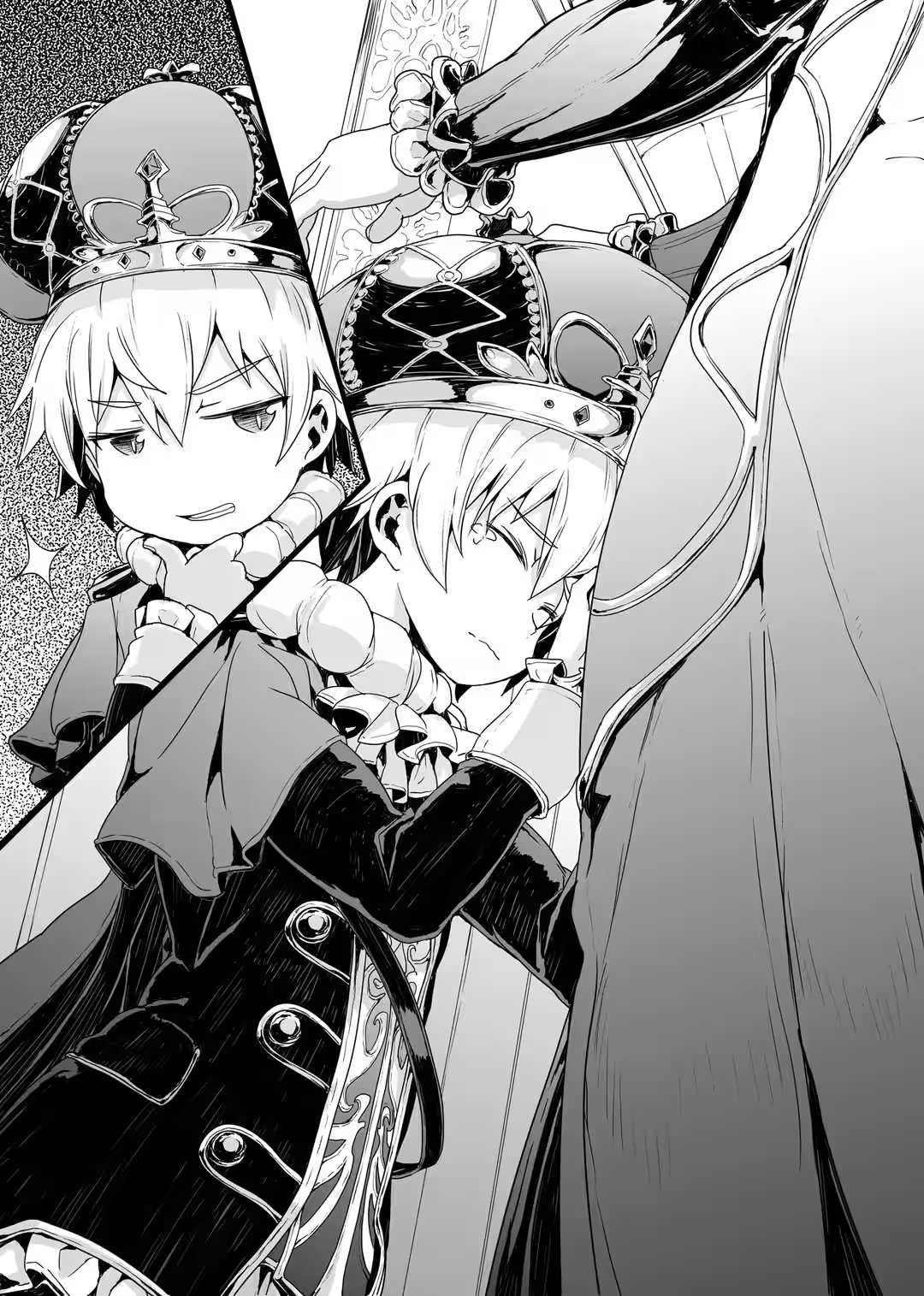
Wait, what? A lie?
“The truth is, mostly everyone was opposed to me living here, so I snuck out. Which means His Majesty the King never said any of the things I claimed.”
“Hwuh?!”
Wait, wait, wait. For real? Ignore the weird noise I’d made—hadn’t she basically promised to ally with the side that solved Belvére’s problems?!
Hang on... She’d never actually said anything about Tomis-Ashinaqui!
But, no, that didn’t matter, did it? The nobility had already interpreted it that way. With how overwhelmingly superior the Empire was to the Kingdom, she’d never get away with that kind of con. We could say the sky wasn’t blue and they would have to believe it.
“Since everything I said was informal, no one will be able to verify it. Besides, it’ll be fine as long as matters play out exactly how I claimed.”
True—although Rosaria was a princess, she wasn’t officially a diplomat. The sheer number of nobles present in the throne room had made it easy to forget, but everything that had taken place was an informal conversation. Any probes sent to the Kingdom of Belvére would be met with denials and nobody would think it strange, because that’s what closed-door diplomacy was.
However, while the king might have made no such claims, Rosaria most certainly had, meaning she was culpable. Yet she was right: If the Kingdom ended up acting how she claimed it would, her “lie” would become the truth without anyone the wiser, and she’d get away without even a slap on the wrist.
Except me—I would know. I’d just heard it from her very own mouth. Or, no, had she intentionally dragged me into this?
If I were to report this to the Chancellor or regent, they’d treat it as the truth. I was the emperor, after all. If I was wrong about it, they could just blame it on me.
If she hadn’t said anything, Rosaria’s plan would’ve been flawless. So why reveal it just to me? Did this...mean what I thought it meant?
“No nation would be willing to say their princess ran away, so I doubt they’ll try to drag me back by force. Of course, that will mean my stay here will be rather extended...”
Yeah, in essence, she’d basically eloped. If that went public, it’d mean a huge scandal. I didn’t know what the Belvérian king was thinking right now, but the option of ordering her to return wasn’t open to him—not without finding a justifiable pretext that trumped her reason for living here. And even then, it wouldn’t matter what the Kingdom thought if the Empire didn’t buy it. We were in the imperial capital, after all.
Rosaria’s fabricated reason for staying was to ally with the faction that won the conflict as quickly as possible. I couldn’t think of much that trumped that, outside of something like the death of a close relative.
In other words, it would actually take quite a lot to get her to return. This wasn’t just some ordinary kid running away from home during their rebellious phase.
“So you used a lie that rings more truthful than the truth to convince the nobility and secure your role here in the capital...”
Most importantly of all—and I really can’t stress this enough—she must have revealed her plan to me because...
“Yes! I’ve always wanted to have a real conversation with you, Your Majesty.”
Because she’d recognized me as someone who would understand and wanted to force me to drop my act. By intentionally exposing herself, she’d tricked me into being complicit!
“How long have you known...?” I felt like I’d gone from a proud tiger to a fish flopping about on a dry deck.
“From the moment I met you, of course!”
That was a terrifying answer. If it had been the Chancellor or the others, my life would have literally been over. It’s not my acting skills, is it? She’s just an outlier, right?
Wow, even Timona had broken out into a cold sweat. That was a rare sight.
I couldn’t see my own expression, but I knew I looked exactly like a Tibetan sand fox right now.
***
Afterward, thanks to Count Palatine Vodedt showing up out of nowhere and doing some high-speed string pulling (thank god), we managed to set up a secret meeting late at night in my room. It seemed that his spies were all out in full force, ready to cover for us if necessary.
“Please allow me to greet you properly this time. It is good to see you again, Your Majesty.” Rosaria—who should have been sleeping in her own quarters—performed a bow.
Incidentally, there was a female spy taking her place. Since Rosaria was only eleven, the woman probably had to fold up in some pretty impressive ways to match her body shape under the covers.
My sincerest condolences, Miss Spy.
“The gentleman beside me is my uncle, Salomon de Barbetorte. He will be my guardian during my time here in the imperial capital.”
The man she introduced was her noble attendant who’d accompanied us during the tour I’d given her earlier. He was in his thirties, by my reckoning, making him young for a titled man. If I recalled right...his name had been in one of Fabio’s reports as the Belvérian king’s right hand.
“It is a pleasure to meet you, Your Majesty. Please think of me as nothing more than the princess’s bodyguard.”
Yeah, right. “Aren’t you...a general or some such in the Kingdom’s army?”
I was about to ask why he was in a place like this, but he beat me to it with some pretty shocking information. “There is no issue, Your Majesty. The front lines won’t suffer in the absence of one or two individuals of my caliber.”
Did that mean...the threat of Tomis-Ashinaqui had abated somewhat?
“While this cannot be made public under any circumstances...the Kingdom has successfully entered a trilateral alliance.”
A trilateral alliance? There were seven countries both north of the Empire and west of the Heavensreach Mountains, including the Kingdom of Belvére itself, the westernmost of them all. That left five potential candidates—Tomis-Ashinaqui, for obvious reasons, wasn’t in the running.
To Tomis-Ashinaqui’s east was the Kingdom of Aeri, and to its south was the recently established Teyanave Confederation. These two nations sandwiched the small Grand Duchy of Gaeweigh, and all three bordered the Garfure Republic to the east. Further up north, there was the Hismaph Kingdom, which possessed territory on both sides of the Heavensreach.
If I had to pick the two likeliest nations to ally with the Kingdom of Belvére...
“Aeri and Gaeweigh?”
“Yes. Aeri, which borders Tomis-Ashinaqui, has launched an invasion, while Gaeweigh, which doesn’t, has dedicated its forces to blocking the Teyanave Confederation from providing reinforcements. A portion of the Aerish army has already made headway into Tomis-Ashinaqui lands.”
So the Kingdom of Belvére actually did have the resources to spare for meddling in Imperial politics? Didn’t that mean Rosaria’s position here in the capital was—no, wait, Salomon had said that it was a secret alliance.
Since the Teyanave Confederation was in the way, news of movements to the north likely wouldn’t make its way to the Chancellor or Minister of Ceremony. This was less due to any incompetence on their part and more because the northern part of the Empire that was supposed to monitor such things had, uh, seceded and begun calling itself the Teyanave Confederation.
Even Count Palatine Vodedt, who had sniffed out the secession before it’d happened, had a hard time getting his hands on any information of anything north of Teyanave. Incidentally, it was often Fabio and his men that the Count Palatine dispatched in that direction, because of how excellent they were. That aside, though...
“I’m impressed you managed to convince both countries.”
The Kingdom of Aeri and the Grand Duchy of Gaeweigh weren’t exactly newcomers to the international scene. This entire time, they’d simply watched the Tomis-Ashinaqui invasion of Belvére from a position of neutrality, too wary of invoking the former’s wrath to act. So why had they suddenly changed their stances?
“I would like to say it was due to our Kingdom’s talented diplomats...” Rosaria began. “But the betrothal was a significant factor.”
She looked a little embarrassed when she brought up the betrothal. Could you stop that? I thought. I don’t need to add you being cute to my list of problems right now.
Anyway, to puzzle this out, um... The Empire’s connection to the Kingdom (my marriage to Rosaria) meant that the country between us—Tomis-Ashinaqui—would be an obvious obstacle. Naturally, other nations would expect us to pincer invade it. Thus...
“They’re trying to seize a piece of Tomis-Ashinaqui for themselves while they still can. That, or by joining the conflict, they’re hoping to demand a cut from the Empire after we subjugate Tomis-Ashinaqui. Is that the gist of it?”
“Precisely, at least by my estimation of their plans,” Salomon agreed. “I suspect the Tomis-Ashinaqui/Teyanave/Garfure ‘belt’ created by the Confederation’s secession is another reason.”
Ah...that was a good point. If those three nations decided to ally, it would create a semicircle against the ocean that surrounded Aeri and Gaeweigh. They’d definitely want to prevent that.
“I see... This is valuable information. But what is it you want, Lord Barbetorte?” By all rights, he should’ve been back home leading his kingdom’s army. There had to be something he was after.
“My sole desire is that you take Her Highness Rosaria as your first wife. On this, I will not yield, but neither will I ask anything more.”
“Ah...sure. That’s the plan.”
Yikes. The look in his eyes was borderline fanatical. Were all Belvérians as terrifying as these two?
In any case, I supposed I’d gained a pair of new collaborators—ones who wouldn’t betray me so long as their trilateral alliance depended on my marriage with Rosaria. I didn’t know if this changed my circumstances much, but it was something, at least.
This also meant I’d gained the surprise presence of a fiancée in my daily life—one who had a strangely high opinion of me...which would probably plummet the moment I made even a minor mistake.
Positive thoughts, Carmine. Positive thoughts...
I Know, Let’s Leave the Capital
After Rosaria and her uncle had returned to their quarters, I sipped on some black tea Timona prepared for me while I waited for the Count Palatine. His spies’ hard work had made the secret meeting possible, and he was out there directing the whole operation.
I’d just picked up my second cup when he made his usual entrance from the ceiling.
“Good work, and sorry for the trouble. Take a seat.”
I signaled Timona with a quick glance and he stepped over to pour the Count Palatine his own cup. Honestly speaking, Timona had better brewing skills than my ladies-in-waiting. He told me it was just another part of his duties, but I certainly didn’t have any memories of Herc ever making me tea.
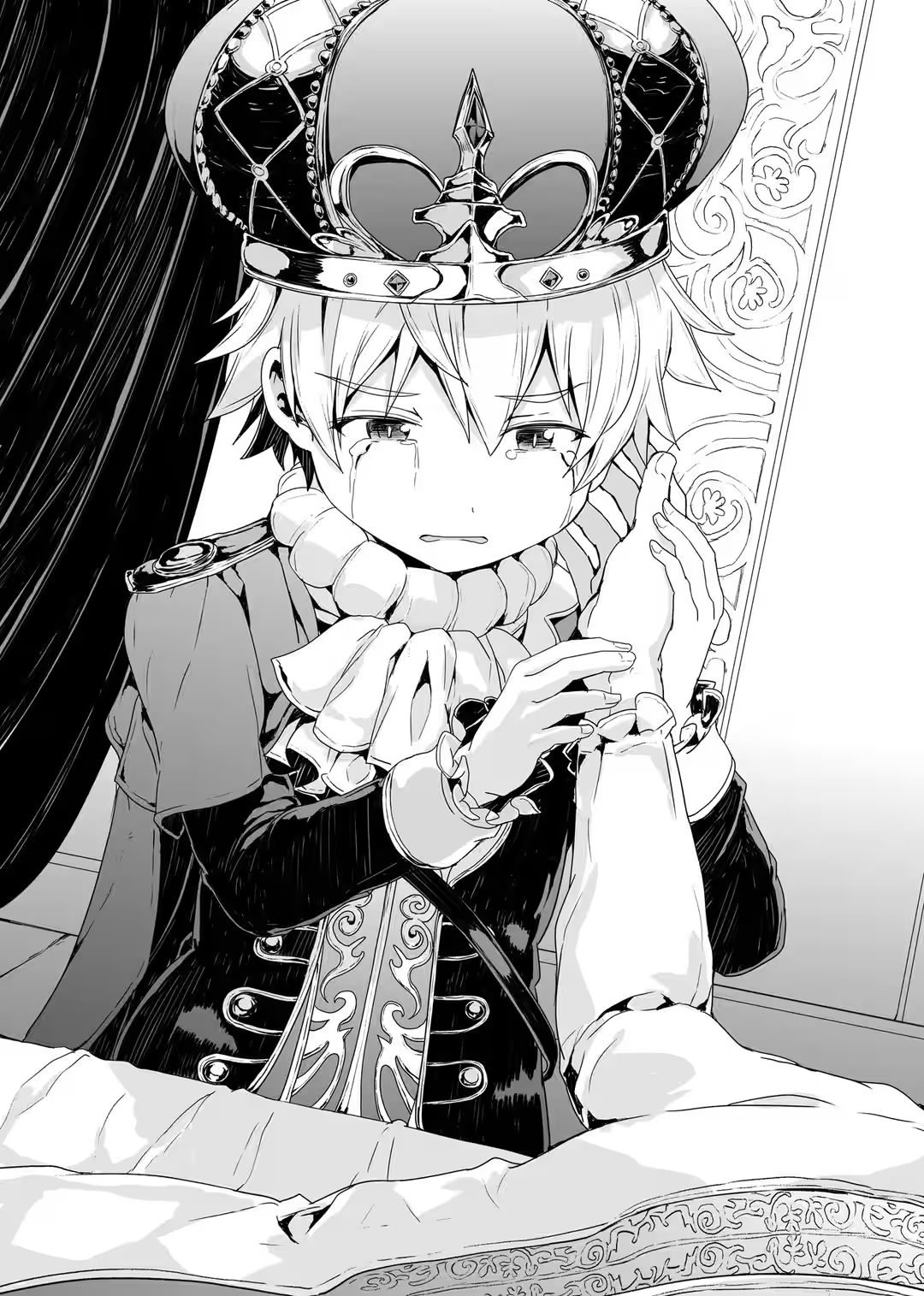
“Not at all,” the Count Palatine said from across the table. “It would take a lot more to truly trouble a spy.”
I sensed the spy in the ceiling twitch. Evidently, someone didn’t agree with their boss’s assertion. “No need to be modest. Please inform your people that we are grateful to them for their work.”
“If that is your wish, Your Majesty.”
Wait, he wasn’t using the carrot-and-stick strategy here, was he? I mean, it was only a good thing if his spies grew to like me more, but...man. He never missed a beat, huh?
“Just checking...but do you need a summary of the meeting?”
“No, that won’t be necessary.”
I’d figured he’d gotten the details somehow, since he’d set it up, and it looked like I was right. Well, now that I had been found out by Rosaria and her uncle, I probably couldn’t do much to stop the Count Palatine from “dealing” with them if he judged them to be a problem. After all, his priority wasn’t my personal will, but my bloodline.
“What do you think?”
“There is no issue. For the time being.”
I couldn’t stop myself from letting a sigh loose. “We expected as much.”
The justification Rosaria had given for her presence here and the way she’d secured her position had been magnificent. However, they were built on a foundation of lies.
That being the case, she had overestimated the imperial nobility’s capacity to be rational. They were blackguards who had stuck rival nobility with the label of insurrectionist traitors for their own personal gain. Their paranoia and obsession with power would eventually make Rosaria a target of their suspicion, and they would move to eliminate her. As unfortunate as it was, the fundamental principle that drove human beings was emotion.
The only way to control the nobility was by dangling continuous gains in front of them. The moment you stopped being useful to them, the mere possibility that you’d become an enemy one day would be enough for them to act.
The circumstances of the man before me were a testament to that. Although the Count Palatine was a neutral noble who had unequivocally proclaimed that he would side with whoever crowned the emperor, the fact that I summoned him often was enough to make the factions wary of him. That was why he constantly fed them information about me. Though only the harmless stuff, of course.
Basically, if matters were left as is, Rosaria would be in danger. Yet, since she’d eloped, she had nothing to offer that could be a “continuous gain” for the faction nobility. What to do, what to do...
“Perhaps...we should leave the capital.”
“Ah, a holiday? I believe that might be a good idea.”
Honeymoons weren’t a thing in this world, but going on a trip with your spouse-to-be wasn’t exactly unheard of either. Fortunately, Rosaria would likely play along, since we were collaborators now.
“Mmm. We know too little of our empire—there is a limit to what we can learn from your reports, so we had always planned on taking a domestic tour one day. The addition of a fiancée is not much of a change.”
I barely knew a thing about this world; even the daily lives of the nobility were beyond me, much less the lives of the common folk. Even once I seized true power, what was I going to do with it if I didn’t know my apples from my oranges?
Domestic affairs, diplomacy, military matters—I’d have to start from step one. The fate of an entire empire rested on my shoulders. Failing because I relied solely on my past self’s knowledge would be too tragic to even think about.
In a sense, the timing was perfect. On top of distancing Rosaria from the dangers of the imperial court, I could make a show of being a puffed-up little airhead who got way too excited around the girl he liked.
“Any objections?”
“Not to the idea itself, no.”
So it depended on the details. That was only fair. I could already think of a few issues. “We see three problems. One: Will the Chancellor and Minister of Ceremony agree? Two: It might give the impression that we are already subservient to Rosaria. Three: It might be interpreted as benefiting the neutral bloc. Stop us if we have overlooked something.”
My objective for this tour would be to get a good look of the Empire, which meant I’d have to sacrifice everything else. It would be too risky otherwise.
“Apart from one location, we will allow the Chancellor and Minister of Ceremony to decide all of our destinations. This should solve problems one and two.”
By giving the Dukes the final say, they’d gain the opportunity to move me like a piece on their board. I’d see what they wanted me to see and remain ignorant of what they didn’t. To get something, you had to give up something else. If I wanted to fulfill my objective, I’d need to let myself be used, to an extent.
Besides, who said I had to act exactly according to the Dukes’ itinerary anyway?
“As for the third problem, it ceases to be an issue if you remain in the capital, Count Palatine.”
“I see...”
There was a long silence as the Count Palatine considered the matter. It was making me kind of fidgety. Why did I feel like I was asking for my parents’ permission to stay over at a friend’s house?
Finally, he spoke. “There should be no issue if I entrust your security to my people in each area. Barring extreme circumstances, I shall endeavor to remain in the capital.”
Oh, good. I have his permission. “That would be appreciated. In regard to the ‘one location’ we mentioned earlier—are we correct to assume that the Dukes will quarrel over where we go first?”
From the Dukes’ perspective, they would want me to visit their lands and no one else’s. After all, there was no telling how long the child emperor’s curiosity would last. It was perfectly likely that I’d declare that I was bored and head home early.
“Of that, there is no doubt.”
“Then propose to them the resolution of asking us if there is anywhere we are interested in.” If I, the emperor, was expressly curious about a location, it would be entirely reasonable for it to be my first destination.
“Ah. Our border with the Teyanave Confederation, I presume...? That will likely mean your second destination will be the Duchy of Raul.”
The Teyanavi border was where Duke Raul was conducting the mercenary “invasions” that he’d been talking up to me. He’d do his best to cover up the trickery, of course, but since there was no guarantee I wouldn’t “discover” his secret, the Minister of Ceremony would offer up decision rights over destination two for the chance to hit him where it hurts. As for Duke Raul, he’d get his money’s worth from my first two destinations being “his.” Quid pro quo.
“We shall entrust the details to you. Can you manage it?”
“Of course, Your Majesty. But...a warning. You must also account for the regent. I suggest periodically returning to the capital during your tour.”
Ah, yeah. She was the type to get loud when ignored. “We understand. We shall return when we can and spend the winters in the capital too. It will extend the tour’s length to a number of years, but...”
“There should be no issue. I shall send any necessary reports to you via Fabio.”
“Please do. And thank you.”
The Minister of Finance’s Grievance
“We wish to tour the Empire with Rosaria. You two may decide our destinations. Just ensure they will be enjoyable for us.”
After I officially gave the command to the Chancellor and Minister of Ceremony—who had been prepped beforehand by Count Palatine Vodedt—the two immediately set about drafting my itinerary.
While some of the nobility were exasperated by yet another example of my egotism, the Dukes were rather enthusiastic about the idea. It was a good opportunity to raise my opinion of them while in their holdings, and my absence from the capital would allow them to act even more freely than they already did. To them, it was like Christmas had come early.
Incidentally, by “drafting my itinerary,” I meant that each of their factions had completed separate itineraries convenient to their own purposes, and were now in the process of bickering with each other to hammer out the final product.
Yeah, this was going to take a few months.
In the meantime, I found myself subject to the vehement objections of one nobleman in particular.
“Please reconsider, Your Majesty! The Empire’s coffers are already empty! We do not have the means to fund a domestic tour!”
Geoffroi de Nunvalle, the Count Nunvalle, was neutral bloc nobility, the Minister of Finance, and according to Count Palatine Vodedt, “the Empire’s last line of defense.” He had managed the Empire admirably throughout the financial straits it had inherited from its previous generations of emperors, and in that sense, that perhaps made him my most valuable and loyal retainer. Of course, since his grievances were convenient for my case, I didn’t drop my act.
“Is solving that problem not your responsibility?”
“I have done my utmost, Your Majesty, but we are out of options!”
Yeah, I know. You’ve done a killer job, man. I know all about what the overwork’s done to the state of your poor scalp, about how your stomach is constantly in pain, and about how those eyebags are from your chronic lack of sleep. I know everything...and I can’t do anything about it.
Currently, the Empire’s finances faced three major problems: The state did not have the authority to mint; inflation was through the roof; and, year after year, we had been in a major budget deficit.
Even if you didn’t take into consideration anything else, these three problems meant it wouldn’t be wrong to call the Empire “already done for.”
The first problem originated from the age of Edward III. Pretty much everything that buffoon had done was moronic beyond belief, but the act of selling off the mints alone was enough to ensure his name would be in history books for generations to come as a candidate for the biggest idiot to ever live. I was a layman when it came to economics, since I’d never studied it in my past life, but even I knew how stupid it was to hand over your money-printing institutions for a quick buck.
The emperor before me, Edward IV, had tried to establish state coinage rights again, but obstruction from the two Dukes had forced him to give it up. It would’ve been one thing if the Dukes only owned the mints, but the fact that they controlled all the personnel too was the fatal blow.
No matter which country you were in, mints were kept tightly under strict surveillance to prevent the production of counterfeit money, and minting methods were on the level of state secrets. In other words, only the employees of a mint knew how to make the money—and apparently, Edward IV hadn’t had the resources to train such craftspeople from scratch.
Of course, if the lack of coinage ability had been the only issue, the Empire would’ve probably managed just fine. Barter trade was even now still rife among the general populace, and taxes could have been collected in grain, which could have then been used to pay the military—a horribly inefficient system that would kneecap our poor tax institutions, but still a feasible system.
No, it was not the lack of coinage ability, but rather the fact that the mints had been purchased by Dukes Raul and Agincarl, and the fact that they had started issuing imperial currency under their own individual standards.
That is to say, they were engraving non-Empire issued currency with imperial markings. One of them would’ve been confusing enough, but since both of them were doing it, it caused utter chaos. Plus, the cheapskates had lowered their coins’ gold and silver purity percentages. As a result, as far as currency went, the “imperial gold” minted by the Duchy of Raul and the “imperial silver” minted by the Duchy of Agincarl were treated like trash. Trust in them was so low that they were basically worthless.
This was the cause of problem two: the stupid high inflation. Low currency value equals hyperinflation. This rule of economics was so fundamental that even I knew about it—just like I knew about the many countries throughout history that had been ruined by it. In case you were wondering, it was this good-as-worthless “Raul Gold” and “Agincarl Silver” that the Empire’s soldiers and public servants received as compensation. The nobility kept their own private stocks of foreign currency to use when dealing with merchants.
Speaking of, while ordinary merchants refused to acknowledge this bad money, the companies backed by Duke Raul and Duke Agincarl accepted it with no problem. In other words, our soldiers and public servants could only buy goods from merchants under the Dukes’ influence. It was because of this that those who’d sworn their oaths of allegiance to the empire had basically become the Dukes’ private armies.
This was tied to problem three: the budget deficit. Since the government’s officials were the Dukes’ yes-men, the Dukes could get away with reporting less tax than they actually needed to pay from their holdings. Naturally, this was also true for the territory of the other nobility in their factions. They kept the tax they collected and the Empire never received its cut.
If that didn’t take the cake, these so-called “imperial” nobles also stole from the already-skint imperial budget using the pretext of things like “famine prevention countermeasures” or “natural disaster recovery efforts.” So despite the Empire’s dearth of income, the expenses kept piling up, tacking fresh digits onto the end of the deficit every year.
Now, I propose to you a question: Why is the Empire still alive, even though any half-decent doctor would have pulled the plug already?
The answer is simple: because our neighbors have nothing to gain from our collapse.
Even if the Empire imploded today, it would only lead to the countries of Raul and Agincarl rising from the ashes almost entirely unscathed. So even if our neighbors had their sights set on our land, a collapse wouldn’t work for their purposes. In fact, they probably preferred us remaining in terminal condition because it posed less of a threat.
Plus, the idea of annexing parts of the Empire was one they would have to tread carefully around. It wouldn’t take much for us to collapse like a house of cards, and then the new countries of Raul and Agincarl would have just cause to launch a counterinvasion to seize the land back.
As for why the Dukes didn’t just declare independence...well, there were a number of possible reasons, but I suspected the biggest was because they were already seeing gains far greater than they should rightfully be making. Why would they secede if they were already on easy street, especially when the Empire’s political sphere was already theirs too?
Anyway, that was the rundown of the financial situation entrusted to Count Nunvalle’s care. Is it any wonder he looked in such poor health all the time?
Although I had no specialized knowledge of economics, there were still a few, let’s say, “domestic cheat codes” I knew about that could give us a boost. Now wasn’t the time to use them, though; since the Chancellor and Minister of Ceremony held the leashes of the government’s officials, all the gains would go to them. Nothing would get off the ground unless I took care of them—or, more accurately, their houses—first.
One of my objectives for my tour was to find people who could help me with that, so I absolutely couldn’t call it off.
“Compose yourself, Count Nunvalle,” said Count Palatine Vodedt. “You disrespect His Majesty by raising your voice.”
Count Nunvalle flinched and went temporarily silent. Incidentally, the Count Palatine was here to mediate because we’d predicted that the Minister of Finance would come to protest.
“The merchants are already refusing our requests for loans,” Count Nunvalle said. “Please, we cannot afford any additional expenses.”
“Hum. We do not understand what you are saying.”
I heard the sharp grinding noise of teeth being clenched together. Crap. Had I stirred him up too much?
“Count Nunvalle. Calm yourself.”
And now he was being scolded by the Count Palatine. I’m sorry, dude. Like, genuinely.
“Your Majesty’s tour needs money. We do not have money. So please cancel the tour.”
Talk about pressure. His eyes were practically bursting from their sockets.
Count Nunvalle was completely correct, of course. It was his job as the Minister of Finance to improve our economic situation wherever possible, and I was honestly grateful he cared so much. Still, the savings we made from canceling the tour would hardly be a drop in the bucket in terms of what we’d need to turn things around.
“Oh, is that what you meant? Worry not, then, Minister. We shall limit our travel to the places where the Chancellor and Minister of Ceremony will pay for us.”
“You cannot, Your Majesty! Please, anything but that! If we place ourselves in even further debt to them, they will take over entirely!”
Count Nunvalle was pleading so desperately that there were even tears in his eyes. I didn’t blame him, given how much the Empire owed the Dukes already. Both as the Minister of Finance and imperial nobility, his protests were completely logical and understandable. But with how bad things were, no matter how much he struggled, he’d never be able to do more than prolong the inevitable.
And that was unacceptable. The Empire needed to be rebuilt entirely, from the ground up.
“They are our loyal vassals. They would never do such a thing.”
“I shall inform them of your intentions forthwith, Your Majesty,” the Count Palatine said.
“Vodedt! Have you no shame, man?!”
Count Nunvalle glared at the Count Palatine. If anything was a shame, it was that two of the most competent noblemen in the imperial capital had to fall out like this.
“Shut up, you’re loud,” I complained. “Enough. We dismiss you.”
Count Nunvalle looked like he was on the verge of saying something, but the moment passed and he sagged in defeat. He bowed and made his exit.
Since we were in my quarters, there were of course ladies-in-waiting in attendance. News of the discord within the neutral bloc would reach the Dukes’ factions before the day was out. By my reckoning, it would convince them that the neutral bloc wouldn’t be able to consolidate for a while, leading to them lowering their guards around the neutral nobility—which now included Rosaria.
In other words, everything had gone according to plan...not that that was much consolation for Count Nunvalle, who was fully in the dark. Both his anger and his despair had been all too real.
Hang in there, Count. Once I’m in charge, I’ll dump more rewards on you than you know what to do with.
Of course, since he couldn’t read my mind, this was no consolation for him either.
Tour Preparations
As I’d expected, the Chancellor and Minister of Ceremony were quick to agree to covering my tour expenses. Their negotiations began in earnest, and while my first destination was already set in stone, they squabbled over every little detail, from the route I would take to who would be escorting me. In other words, it was going to take a while—at least a month, by my estimate.
In the meantime, there was something I needed to get done, and I wasn’t talking about packing my luggage. Trying to help with that would just be suspicious.
“Phew.” After taking a deep breath, I slowly alighted on the tower’s balcony. When I raised my head, my gaze met a pair of emerald eyes. “I’m sorry to do this, Vera. But I need to tell you something.”
Vera-Sylvie’s cheerful smile turned into a look of befuddlement. “What is it?”
“It’s about my promise to visit you every full moon. I’m sorry, but I won’t be able to keep it for a while.”
Promises to girls were very high on the list of things you shouldn’t break. And when breaking them was unavoidable, providing a detailed explanation and sincere apology was the absolute bare minimum. Although my memories of my past life faded by the day, this particular rule was still as vivid and loud as alarm bells ringing in my head.
What exactly did I do in my past life...?
“You won’t...come see me...anymore?” Vera’s eyes wavered with unease. Her voice had always sounded fragile, but now it seemed almost gossamer.
I started to break out into a cold sweat. “No, just for several months. I’ll still come by regularly when I can. During winter, at the very least.”
“I see...”
She cast her eyes downward. The dim light of the lamp made it difficult to see her expression. This was...probably bad.
Then, Vera appeared to remember something. “Ah...wait...a moment...okay?” She left the barred window and returned a short moment later—it seemed she’d fetched a piece of jewelry from her drawer. “Here...take this...”
“An emerald...earring?”
“Mm-hmm.”
That was nobility for you, handing around gems of a size I’d never even laid eyes on in my previous life. Not that it surprised me at this point—my room and other various accoutrements were bedecked in the stuff. I accepted the earring readily.
“If you...pass mana through it...like this...” Vera began to channel mana into the earring. Even this would’ve been a tough task for her back when I’d first started instructing her, but now she could pull it off smoothly.
<...then we...can talk. See?>
“Ah, so it’s a magical tool?”
<Yes!>
So essentially, she was asking me to communicate via the earring during my absence? “Got it. Thank you—I’ll hold on to it. I don’t think I can speak to you every day, though.”
“Yes...I know. But...yours is...this one.”
At Vera’s urging, I switched my earring for hers. “Is it one-way?”
“No, not...quite. That one...can communicate...at any time...but...this one...can’t.”
Ah, so essentially, only my earring could initiate the link. “So you’re saying I should decide when we talk?”
“Mm-hmm. Because...you seem...really busy...”
She wasn’t wrong about that. I was grateful for the gesture. “Thanks. I’m surprised you even have something like this.”
“My father...gave it to me...when I came...to the capital. He...said I should...give it to...someone I trust...but...I thought I’d never...get the chance...to use it...since I’m in...this tower...”
I figured she was talking about when she came to the capital to be married. “Wouldn’t it have been better to give it back to the count, then?”
“No... Father’s always...being watched...so...”
Always? Count Chamneau currently belonged to the Chancellor’s faction. While his territory was surrounded by that of the regency nobility, it was difficult to believe their surveillance extended into every nook and cranny of his living spaces...which suggested that he was being watched by his own faction.
And that suggested the Chancellor’s faction was keeping Vera-Sylvie as a hostage to keep him in line. That meant if I played my cards right, I had a high chance of making an ally out of Count Chamneau.
“I see... Sorry, but I need to excuse myself here. I’ll make sure to use the earring.”
“Mm-hmm. Be...careful.”
“Will do. See you.”
Just as I’d made a platform for myself and stepped off the balcony, Vera left me with a few final parting words.
“If you...see him...tell him...I’m doing well.”
I paused for several moments before replying, “Yeah. I’ll do that.”
Okay, so I was pretty sure now that Vera had figured out who I was...
***
The next day after breakfast, I invited Rosaria to go riding. As you might expect from a prodigy like her, she was at least decently versed in all facets of upper-class life, and equestrianism was no exception. But that aside, she wasn’t actually my main objective.
Just as I’d expected, when we arrived at the stables with our chaperones from the regency in tow, Nadine was already there. She’d been completely incapable of riding only a short while ago due to her dislike of animals, but recently she’d been throwing herself into practice with zeal.
That might or might not have had something to do with my taunting her for being a bit crap at it.
“Oh? May I be introduced to this young lady?” Rosaria asked, upon noticing Nadine. It was exactly what I’d hoped she’d do; bless her keen talent for reading others’ intentions.
“Ah, this is Lady Nadine, daughter to Duke Warren. Nadine, this is our betrothed, Rosaria. Introduce yourself.”
After taking a moment to glare at me, Nadine did just that. “It is a pleasure to meet you, Your Highness. My name is Nadine.”
Despite her clear vitriol for me, the greeting was formal and polite. No surprises there; she’d actually received a proper education.
Incidentally, when Nadine had heard about my planned tour, she’d reacted just as vehemently as the Minister of Finance, yelling about how it was “frankly unbelievable” that I was “running off on a leisure trip” despite my constant “scholarly apathy.” Timona had brushed her protests off with the statement that it was “simply another facet of His Majesty’s duties to the public,” and ever since, Nadine had taken to glaring daggers at me every time we met.
“Please, just call me Rosaria. I have few friends my own age. It would please me greatly if we could get along.”
“I-Is that so? Then you may forgo my title as well.”
“Yes, gladly!”
Wait, what? Wooed already? Talk about easy... Well, it was a good thing that they were getting along.
“Oh, we have had a brilliant idea!” I exclaimed. “Why don’t you join us on our tour?”
“Huh?!” After her initial surprise, Nadine fell into thought.
Hey! Idiot! Use your brain! You know you can’t say “yes” here! I know I made the offer, but I’m begging you, please don’t agree!
“Oh...I...will have to ask my father first.”
Man, I wished she wouldn’t scare me like that. I’d started to get chills down my spine.
As the “mere” daughter of a duke, Nadine didn’t have the privilege to act freely—not unless Duke Warren specifically said she could. In that case, she would be able to make her own decisions in the imperial court, by which I meant she could make deals with the factions of her own accord. However, as young as she was currently, that would only be a burden too heavy for her to bear.
“Indeed? Then go ahead and inform Duke Warren. Now, excuse us.”
Now then, how would Duke Warren respond to his daughter’s request? I suspected—and hoped—that he would allow Nadine to accompany me and use that as a pretext to ask for a meeting. After all, I would be leaving the imperial court, which Duke Warren was purposefully keeping himself at a distance from; this would be his sole chance to make contact with me.
Of course, the Chancellor and Minister of Ceremony likely weren’t going to allow me to travel to Duke Warren’s holdings, so we’d probably have to compromise and hold the meeting in one of their duchies. Still, for the time being, that was good enough.
***
We roamed the imperial demesne on horseback for a while afterward. Since we were constantly under watch, I had to keep up my act.
“What is that building?” Rosaria asked.
“Why, that building is...something Timona will explain for you, won’t he?”
“It is the palace that was used by His Majesty the third emperor and His Majesty the late emperor, Your Highness.”
“Oh. I’ve heard about this place.”
The palace built by the third emperor was located at the furthest end of the imperial demesne and walled off in all four directions. The previous emperor had also used the residence, and my read was that it was a pretty obvious clue that they hadn’t trusted their vassals.
“Yes, and if we recall, grandfather’s grave is close by. Let us pay it a visit.”
“Of course, Your Majesty. I shall lead the way.”
We followed Timona’s lead to the graveyard. Here was where the mausoleums of past emperors were built, each generation’s smaller than the last. The sixth emperor’s mausoleum was the notable exception. While he’d still been alive, Edward III had ordered it to be built larger than the first emperor’s, but after his death the mausoleum was destroyed before his corpse had even been buried there. Naturally, nobody had objected.
The previous emperor’s mausoleum was relatively small, only able to fit several people inside at once. There were a number of traditions associated with paying respects at the past emperors’ graves, and one of them dictated the order in which you entered: Essentially, you formed rows and entered based on how high your status was in descending order.
However, since the previous emperor’s mausoleum was such a tight space, you couldn’t fit rows of people inside, so Rosaria and I entered alone. Since she was my betrothed, that granted her the privilege of being in the “front row” with me.
All that being said, the mausoleum’s plot was actually pretty large. I had the suspicion that grandpa had wanted his gravesite to be as large as possible. Pretty vain of him, if you asked me.
Rosaria and I paid our respects in the traditional manner. In this regard, the Empire actually followed the Bundarte people’s ways, rather than the Rotahl Empire’s, but it seemed that Rosaria had studied up beforehand—something I was truly grateful to her for.
Unfortunately for the previous emperor, his grave received few visitors. The nobility hadn’t been terribly fond of him, and Crown Prince Jean had been more popular among the citizenry.
In order to avoid being assassinated like the previous emperor, I would have to use all manner of means—and people—at my disposal. Including Rosaria.
“I’m...going to be quite the burden on you,” I murmured. “For a long time to come.”
Rosaria’s reply was just as quiet. “One that would be my pleasure to bear, Your Majesty.”
I wondered how many good deeds my past self had stacked up to deserve an answer like that.
“I see. Thank you.”
After I silently resolved that this would mark the last time I ever voiced my weakness, we left the mausoleum behind.
The Starting Line Is Still Far
The ceremony for my tenth birthday was held during the thawing of the snows. Evidently, reaching one’s first decade was a major turning point in imperial culture. Unlike my previous birthdays, which had been relatively more subdued, there was an entire formal shindig surrounding this one—by which I meant I was forced to listen to a lot of the nobility make a lot of long, boring speeches.
The occasion was also marked by my domestic tour being formally announced. Of course, everyone present already knew about it, and they didn’t even give any details about my routes or destinations.
Today was the first time since being born that I would venture outside the imperial capital.
Accompanied by an armed escort roughly the size of a small fort’s garrison, my carriage exited the imperial capital’s north gate. Unlike the Founding Day parade, there were no cheers of delight...but I’d half as expected as much. It seemed the people had lost a great deal of faith in me over the last five years.
“It’s not you, Your Majesty,” came a voice from the seat opposite me. “The people...must not wish to draw the attention of the aristocracy, since this is the noble district. Besides, with such a large escort, they must think we are simply a detachment of soldiers.”
“Is that how it is?” I replied, turning my gaze away from the window and to the speaker.
“Yes. I’m sure of it,” said my betrothed and the first princess of the Kingdom of Belvére, Rosaria Van-Chalongé-Cruveillier, with a smile.
“I suppose you’re right. It’d be hard to see us with all these people and horses in the way.”
Tallied up, my retinue amounted to over two hundred people, guards and servants included. The number would increase throughout the journey as nobility whose holdings I passed through joined us with their private soldiers.
I would be accompanied throughout the journey by Rosaria, obviously, but also Timona, my coin-scrounging butler Herc, and a mass of other individuals from across the Dukes’ factions. Since our first destination was within the Chancellor’s territory, we had relatively more of his people with us, but the bulk of the padding came from the separate contingents of cooks and servants that each faction had brought along.
In other words, we had twice as many people with us than were actually necessary. And I wasn’t even convinced we needed the chefs at all, since we’d be staying at noble residences throughout the journey. Talk about pointless extravagance. How much wealth were the Dukes rolling in, if they could throw chunks away for nonsense like this?
I turned my gaze back toward the window. We’d already crossed the bridge and would be reaching the second set of gates soon. This area was where the lower nobility resided, and the manors of barons, viscounts, and such were a common sight. Traditionally, when these nobles encountered the emperor’s carriage, it was required that they bow their heads until I was out of sight. Otherwise, they risked being punished for their insolence.
As far as I could see, though, not a single soul was even bothering. They simply ignored my carriage...but they did make sure to bow politely to those of the upper nobility.
Frankly, I appreciated their honesty. It was a very clear symbol of my position in the pecking order. Not that I was going to let them off the hook for it. Watch out, you lot—I’ve got a good memory!
Of course, it just went to show how desperate they were to climb the social ladder. No matter how you sliced it, the Empire had way too many nobles. The noble district represented a full third of imperial capital Cardinal’s urban area, and it still didn’t even fit all the barons, viscounts, and other lower nobility. The aftereffects of the sixth emperor’s venal office policy were still clinging tightly to our society.
Damn parasites. Had they ever tried putting themselves in the shoes of those born into poverty? If I didn’t do something about this in my generation, the Empire was done for.
“Hah...”
Rosaria’s expression became slightly wry upon hearing my heavy sigh, but she refrained from making a comment.
My goal for this tour was to catch hold of something—anything—that would give me a chance to seize back political power. Of course, since the Chancellor and Minister of Ceremony had dictated every step of my journey, any such chances would be few and far between, if extant at all.
Yet I had the strangest feeling that I’d find something. And whatever it was, I was resolved to make the most of it, no matter how much danger doing so entailed.
Interlude: Salvation from the Saved
New Calendar, 462nd Year, 10th Month, A Certain Day
Royal Capital Crulére
Salomon de Barbetorte had become a marquess of the Kingdom of Belvére during his thirties—quite the young age indeed. The second cousin to the king was a trusted adviser, a brilliant commander who had repelled Tomis-Ashinaqui forces from the front lines on numerous occasions...and as far as Rosaria was concerned, a kind and beloved uncle.
When an attendant informed Rosaria that her uncle had arrived, she quickly looked up from her stack of books, her grim expression brightening. “Uncle! I’ve been waiting for you!”
“Hello, Rosaria. I practically flew here from the front line after I heard you’d asked for me.”
That was, in fact, the truth. Salomon had watched over Rosaria since birth and doted on her as if she were his own daughter. Upon hearing she’d summoned him, he’d hopped on his horse and urged it into a full gallop—something he hadn’t done in a while.
“Oh, my. But I heard you were in command. Are you sure you should have left?”
“Fear not; I put all my responsibilities in order before I departed.”
This was, in fact, a lie. The man had dumped all of his duties on his subordinates, and the current state of the front line’s command post was best described by the word “pandemonium.” In fairness, Salomon had made sure to delegate the work according to his subordinates’ individual capabilities, giving them just enough that they could barely handle it, if they put their backs into it. He’d also only come to the royal capital because he’d judged there was no risk of an invasion, as Tomis-Ashinaqui’s current focus was supporting the Teyanave Confederation.
Thus, despite this tendency to mix his professional and private affairs, Salomon was—unmistakably—a highly capable individual. It was simply that, on occasion, he misused his talents to indulge in his love for his family. Of course, since the family members in question included people like the king and the princess, one could say that he was the physical ideal of loyalty. In a certain sense of it, anyway.
“So, what compelled you to summon me? Do you have a favor to ask, perhaps?”
“I do, Uncle.” Rosaria lifted up one of the hefty tomes she had just been reading. “I want you to teach me magic.”
***
In this era, practically all mages came from nobility. The prevailing explanation in many schools of thought was that magical aptitude was genetic: Since much of the nobility were mages, it was more likely for their children to be mages too.
On extremely rare occasions, children with magical aptitude were born to entirely ordinary commoner families as well. This, the theory went, was an example of atavism: the resurfacing of ancestral genetic traits. However, the survival rate of these “commoner” mages was extraordinarily low.
This statistical phenomenon, too, had a logical underpinning. At the point a child awakened their magical capabilities, they lacked the knowledge or methods necessary for control, often leading to them running wild. However, a noble child’s magic could be kept in check by their parents, or by guards and attendants with magical ability. Such duties were common in the employment clauses for these positions.
Yet a commoner household lacked anyone capable of fulfilling this role. Thus, it was not unheard of for the entire family—or even an entire village—to be destroyed when a child’s magic ran rampant. Fearing this, some parents even committed filicide when their child began to show signs of awakening their magic.
An exception to this trend were the commoner families that served the nobility. In this case, a child with magical aptitude was very likely to ascend in station, as having even one additional mage was a great benefit for a noble family. Such children were treated very well by both their parents and noble masters, and most of them grew to become nobility themselves.
But while all of the above was true across the entire continent, the Kingdom of Belvére was the sole exception. Here, commoner families could entrust their magically adept children to the kingdom’s custody and receive a generous sum for their troubles. As such, commoners went to great lengths to notify officials about their eligible offspring.
This system existed for a simple reason: Mages were indispensable assets on the battlefield. Yes, even if they were children. One’s age was of no consequence, so long as you could cast the right spells.
This introduction of child soldiers to the Belvérian forces was a testament to how far into a corner the kingdom had been driven. Conversely, there was no longer any need for them now that the Bundartian emperor’s betrothal had overturned the state of the war—which wasn’t to say that the Kingdom was simply going to let go of the assets it had invested huge sums into. Currently, these child commoner mages were receiving a military education for the purpose of training them into an elite special force.
As for who was in charge of this force’s education, it was none other than Salomon himself. After all, there was likely no better magical instructor around—which happened to be the reason Rosaria had summoned him.
“Emperor Carmine is capable of magic?” When Salomon had asked Rosaria why she wished for magical instruction, she had told him it was because “His Majesty can use it,” and Salomon had been quick to realize that she wasn’t talking about her father, the king. “Are you...certain of this?”
The claim was difficult for him to believe. Among the many rumors surrounding the young emperor—he was a fool, he was cowardly, he was selfish, he was a puppet, and so on—was that he was utterly incapable of magic.
“Yes. I haven’t seen it myself, but I’m sure of it! He must be keeping it hidden for reasons I yet don’t know.”
A noteworthy fact was that Rosaria herself possessed magical aptitude. However, her magical education had been sidelined in lieu of her position as the princess. The presence of mana-sealing wards in the royal palace—although the Kingdom was destitute, it was not that destitute—was another major factor behind her delay in studying the magical arts.
“Hmm... Well, if you say it’s necessary, Rosaria...”
Although part of Salomon’s reasoning was swayed by his bias toward his family, it was his genuine opinion that Rosaria was far more intelligent than her age suggested. If she considered a magical education necessary, then it behooved him to at least consider the matter fairly.
I’ll need to conduct my own investigations, he thought. Ah, no. I cannot risk drawing unwanted attention to Rosaria. Agreeing and observing her progress might be best, for the time being.
Like most of the Belvérian nobility, the king was against Rosaria’s betrothal to Carmine. While this was in part because he did not trust the young emperor, it was mostly because he cherished his daughter dearly. Now that the Kingdom had gained some metaphorical breathing space, he had begun to consider whether marrying his daughter off was truly necessary.
In contrast, Salomon was for the betrothal—on the condition that he could guarantee Rosaria’s happiness by somehow securing her the position of first wife. He considered it a given that the emperor would go on to marry multiple consorts and even lay his hands on his attendants, and would do whatever he could to place her in the position where she could control such matters.
Of course, he had no way of knowing that Carmine currently had no intentions of marrying anyone else.
“Very well. Then starting today, I shall teach you magic.”
“I look forward to it, Instructor!”
Upon seeing Rosaria’s excited smile, Salomon couldn’t help but break into a grin himself.
So adorable... I have to ensure she becomes the emperor’s first wife, no matter what. And if he ever does anything to make her sad...his life is forfeit.
That same moment, across the continent, a shiver went down a certain emperor’s spine.
Interlude: The Caged Songstress
“You must be Vera-Sylvie. My father spoke well of you. Should you require anything, just let me know, all right?”
“Thank you, Lady Acretia. It is an honor.”
“Well, aren’t you just the cutest! I feel as though I’ve gained a little sister!”
To Vera-Sylvie, the memory of that day was still as vivid as the morning sun.
“I am Norn de Alleman. Though our faction allegiances may differ, we are all His Highness’s wives, and our support for him must take precedence. Inviting disharmony into his heart because of political squabbles would mean we have failed in our duties. Do you understand?”
“I do. Thank you, Lady Norn.”
“Nevertheless, that doesn’t mean you must tiptoe around every little thing. May I...address you simply? As ‘Lady Vera’?”
How much better would it have been, were it all naught but a passing dream. Yet Vera-Sylvie’s memories of coming to the imperial capital to be Crown Prince Jean’s concubine were as real as real could be.
To Vera-Sylvie, who had become Jean’s concubine at fourteen, his other wives were like kind older sisters. Acretia, being from the same faction, welcomed her warmly, and Norn was her patient instructor in matters of life, beginning with—but not limited to—etiquette. And while one might have expected the two to be on rocky terms, they coexisted well, dividing and seeing to their responsibilities with adept skill.
Although Acretia had no love for Jean, she took much pride in being a daughter of imperial blood and fulfilled her role as first wife with appropriate diligence, keeping her dalliances with her lover well in moderation.
Norn, too, understood her role well. While Acretia supported the “official” Jean, it was Norn who was his pillar in private. To all onlookers, it was clear that the two wives had constructed a fine coexistence indeed.
Vera-Sylvie discovered that her new life in the imperial capital came with few worries and no dissatisfactions. Once her marriage ceremony with Crown Prince Jean was held, she fully expected to join her predecessors in being a source of strength he could lean on.
However, the ceremony never took place. War broke out, and the crown prince—who was famous for his skill and experience on the battlefield—headed for the front line at once. At that point, Vera-Sylvie and Jean had hardly ever even had a real conversation.
Jean never returned.
The day after the news of the crown prince’s death reached the capital, the emperor followed his son. Vera-Sylvie had not understood what was happening. All she could do was watch as the people around her began to change—as the depths of human malice made themselves known.
Norn wasted away. Unable to accept that Jean had died, she spent her days awaiting his return. But although her lungs still breathed air, her heart was already gone. Such was the void within her that she could no longer even talk.
And as for Acretia...she had Norn and Vera-Sylvie imprisoned, as though driven by some unknown compulsion. Whatever impetus spurred her, it was enough for her to go so far as ordering the deaths of a servant said to have birthed Jean’s child, the woman’s entire family, and, of course, the child in question.
Why the uncertainty, you ask? It is because Vera-Sylvie did not believe the claims. There was no denying that the servant had been special to Jean, almost like an older sister might have been. But to Vera-Sylvie’s eyes, their relationship had never seemed romantic.
Vera-Sylvie reasoned that Jean’s death must have come as a far greater shock to his other wives than she could even understand. That was why Norn had drowned in her despair. That was why desperation had sunk its claws into Acretia.
Just before Vera-Sylvie was imprisoned, when she saw Acretia, the woman did not appear to her as someone drunk on power. Nor did she seem to revel or gloat at the bloodshed she had caused. All that was in her eyes was terror and firm, unmoving resolve.
It all clicked for Vera-Sylvie when a letter from her father explained to her the circumstances surrounding the next emperor. She realized that Acretia must have already known that she was pregnant with the heir.
If Norn, the woman who had loved Jean with all her heart, had been the expecting mother instead, perhaps things would have been different. But fate was a cruel mistress.
Vera-Sylvie was locked away in a tower and exposed to human malice. Eyes, eyes, eyes. Eyes holding pity and eyes holding condescension. The vulgar eyes of men. And the eyes of the Chancellor’s faction nobility, who looked at her as if she were livestock.
Vera-Sylvie’s father, Count Chamneau, had deep ties to Duke Agincarl. The count’s holdings faced the sea to the west, and the Duchy of Agincarl to the north, south, and east. However, because of Acretia’s independent decision to imprison his daughter, he was forced to shift his allegiance to the Chancellor in order to guarantee Vera-Sylvie’s life, placing him in a position where the Minister of Ceremony watched his territory like a hungry predator while the Chancellor exploited him with impunity.
Because of her father’s sacrifice, Vera-Sylvie’s circumstances were an improvement compared to Norn’s. There was worth in keeping her alive, and so her prison was livable.
But the Chancellor’s faction nobility only needed Vera-Sylvie alive. The state of her mind and spirit were of no consequence to them.
Vera-Sylvie lost her ability to trust. To protect herself, she was forced to lock away her heart. Such was life in the tower. Her dark, miserable tower.
Her only source of solace was the occasional correspondence she would receive from her father and former ladies-in-waiting. They were all she had left. Vera-Sylvie was starkly aware that one more push—just the slightest of nudges—would be enough to shatter her heart for good.
Each time she received a letter, each time she heard voices from outside, each time the birds flew away, each time she smelled the rain, each time she felt the dazzling sunlight on her skin, and each time night came, the frustration and loneliness threatened to crush Vera-Sylvie under their weight.
Time passed. Slowly. As if just to mock her. Eventually, all of a sudden, there was no more frustration. No more loneliness. Just despair. Now, and for the forever to come.
“No more... Won’t someone...save me? Won’t someone...end me?”
Salvation. An end. To Vera-Sylvie, those were one and the same.
In truth, it didn’t matter to her if the boy was a fairy. Had he been a demon or the specter of death itself, she would have welcomed him all the same. If he had come to kill her, she would have sat there silently and embraced the end. Of course, in the first place, she could not be sure that he was real. The ability to gauge her own sanity had long since fled from her.
It was simply that, when she saw him on the balcony with the moon at his back, his detached demeanor so at odds with his small frame, it was as if she really were looking at a fairy. And so the words had formed before she even realized.
“Are you...a fairy?”
***
“Um...c-could you...be...my friend?”
Undoubtedly, the question was a desperate cry from Vera-Sylvie’s heart. She did not have to wait long to gather if it reached the boy—his expression faintly troubled, he replied:
“Of course I can.”
Time for Vera-Sylvie began to move, flying faster than it ever had before. Before each full moon came, she would sort out and arrange everything she wanted to talk about with her new friend, as well as practice on her own so that she might converse better, and for longer. She practiced her singing—the singing he had praised—more often too. All of a sudden, her life was busy.
“Um...like this?”
“Hmm. Not quite, but close. You’re sure to get it after a few more tries. When it comes to this stuff, Vera, you’re the type who learns by intuition.”
And above all, Vera-Sylvie found a new world: magic.
The mana-sealing wards proved no obstacle to the strange fairy, who claimed Vera-Sylvie was the same. But while she’d started out doubtful, his careful instruction soon helped her grasp the sense she’d been blind to all this time. Before long, she was immersed. Magic was a world she’d never known existed, with unlimited possibilities to devote herself to.
Vera-Sylvie was alone no longer. Stripped of its monotony, her imprisoned existence became life.
“See you next time, Vera.”
“Mm-hmm. I’ll...be waiting.”
Where time had once stopped for Vera-Sylvie, it began again to move.
Just a little longer, and the bird would be freed from her cage.
Interlude: A Ray of Light
New Calendar, 461st Year, 11th Month, A Certain Day
Imperial Capital Cardinal
“Your...Majesty. Would you allow me...some time alone...with my son?”
“Of course. I’ll tell him to come in.”
After drying his tears, Carmine left the room looking no different to his usual self. It was but one of the many affectations he’d adopted to overcome the trials forced upon him.
You are an excellent actor, Your Majesty.
From his bed, Baron Frederick le Nain watched, content, as the vulnerable, crying boy of moments ago became a selfish little emperor.
Frederick le Nain was born the third son to a baron of Agincarlish nobility. With two elder brothers, he was destined for a bureaucratic position in the Empire’s central government, and thus was raised in the imperial capital from birth. At the time, the reigning sovereign was Edward III, sixth emperor of the Bundarte Empire.
Considered by many to be the most foolish emperor in history bar none, Edward III suffered eight major military defeats in his lifetime and was the direct cause of the Empire’s economy and military strength collapsing in a single generation. To Frederick, who grew up right in the center of the insanity, the emperor appeared a creature of insatiable hunger for luxury, who was intent on squandering the very empire in his charge.
It was no surprise that when the emperor’s son, Edward IV, took the throne, much of the nobility had high hopes for their new sovereign.
Frederick, who was still a child at the time, spent his impressionable years observing Edward IV’s reign from up close, and his hope became despair.
While Edward IV was a far preferable ruler to his father, his reign did nothing to stop the Empire’s gradual decline. His policies could be simply characterized as backlash to his father’s misgovernment; he lacked the political resourcefulness to bring about a recovery. To the misfortune of all, he proved to be Edward III’s son in truth. Deep down, they were cut from the same cloth.
As for his son, Crown Prince Jean...well, while he had a burning love for justice and was dauntless on the battlefield, he was a man ruled by black-and-white thinking, without the flexibility or open mind needed for politics. If he had been born a knight, he would have achieved great things, but alas, he was not suited for rule.
When Frederick’s elder brothers perished from illness and he was called back to his family to inherit the title of baron, he thought the timing quite fortunate. He felt nothing in particular for his brothers, who he’d never even met, and he had already given up any hope of building a future for himself in the imperial capital.
Eventually, he and his wife—between whom there was an age gap—had a son. Little Timona looked just like his mother, and Frederick doted on him fiercely. His attentions only redoubled after plague took his wife, leaving the father and son with nobody but each other.
However, right around the age Timona was beginning to understand the world around him, something terrible occurred.
Frederick, who had taken his son along with him to a party, took his eyes off him for the briefest moment, and Timona was dragged away into a private room. The offender was a viscount infamous for his abuse of the leverage of his station and Agincarlish sexual tradition to feed his zealous appetite for young boys.
Timona came to loathe the cultural expectation to be the bosom companion to another man. As for Frederick, he felt deeply remorseful that he was unable to protect his son. He resolved to do whatever it took to keep Timona safe, even if it meant isolating himself from noble society. From then on, every invitation sent from upper nobility seeking Timona as a chief attendant—in other words, a lover—Frederick refused.
However, when an invitation came from the regent, stating that the emperor himself wished for it, his hand was forced. A refusal could see him punished for the crime of lèse-majesté; after all, to the imperial family, even a baron was but a speck that could be erased at any time.
That being said, the most essential reason behind Frederick’s capitulation was Carmine’s age. Believing that the emperor was still far too young to even think about such acts, he sent his son away with the following words:
“Remember. They have only asked you to fulfill a position similar to a chief attendant’s. If ever you are faced with something you do not want, know you have my full support to refuse.”
Frederick was willing to submit his own head to the chopping block, if it ever became necessary. Illness had already left him with little time, and he was resolved to dedicate the remainder of his life for his son’s sake.
Yet, one day, a certain Count Palatine informed Frederick of the truth: that the emperor had made no such request at all—the regent had made the decision independently. Not long afterward, Frederick volunteered to become the emperor’s tutor for the sole purpose of conveying the truth to Timona.
He attained the position easily. At the time, the emperor was reputed to be a selfish, uncontrollable brat, and none of the nobility wanted to deal with such a nuisance. Nobody, Frederick included, had any expectations of the young emperor.
Yet Frederick did feel some pity, for here was a boy the same age as his beloved son, unable to receive a proper education. So, he taught the emperor his letters. The other nobility put pressure on him for it, but that was none of Frederick’s concern—his defense of Timona meant he was already generally disliked anyway.
But as the lessons continued, Frederick’s impression of the young emperor did a complete about-face. The boy was both aware of the current status quo and received his education with diligence.
Carmine feigned interest in matters he did not care for and treated matters he cared for with apathy. He absorbed knowledge at a startling speed, all the while deceiving those around him so that they did not notice. At times, Frederick even felt as though he were teaching a fellow adult.
Having sensed Carmine’s potential, Frederick risked the Church’s censure to convey his true opinions, fully aware that it could result in his own torture and execution. In his mind, his death could become an unforgettable memory for the young emperor—a compass needle that guided the way to the future—and at some point along the way, Frederick had realized this was well worth staking his life on.
Then, when Frederick had been freed from prison, he’d been incredulous. As he received treatment and the Count Palatine informed him of the events that had taken place, he pondered how unreasonable the young emperor was.
So there is a child in him after all.
For all of Carmine’s puzzling maturity, he turned out to be—rightly—a child.
Yet at the same time, it occurred to Frederick that perhaps the emperor, leader of the people, should be someone who had retained their childlike innocence.
Frederick realized that he had been naive. Him, a guiding needle? Carmine, who had not acted to save his own skin but used the opportunity to induce conflict among the nobility, was already a leader in every sense of the word. In Frederick’s mind, there was no doubt that even now, Carmine surpassed the previous two emperors.
Yet, hardly anyone had noticed! Could there be anything more joyous?
“Father.”
Frederick’s voice was hoarse as he spoke to his crying son. “Timona. Do you understand, now?”
The question was brief, but more than sufficient. Timona had known the truth from the first day Frederick had come to be the emperor’s tutor. However, wariness once-instilled was difficult to shake, and Timona had not lowered his guard around Carmine. This was, in part, also due to the animosity he felt toward the young emperor for being the reason he had to separate from his beloved father, who he knew had little time left.
“Yes. About His Majesty. And my own powerlessness.”
The day after Timona had been placed under house arrest, he had surmised the circumstances and attempted an escape in order to rescue his father. However, he failed, his violence earning him naught but bindings and a harsh beating. He was then thrown in a cell, left to rot powerlessly until freed alongside his father.
Frederick traced the new scar on his son’s cheek. “You’ve grown...so much.”
After several moments, Timona replied, “His Majesty said the same thing, when I was freed.”
“Heh. Did he now?” The amused light in Frederick’s eyes became serious. “Support...His Majesty. With everything you have. Even if...our family name disappears. Even if...our bloodline ends.” Frederick mustered his strength, his voice beginning to quaver. “Stake your life on it. For that is the worth...of His Majesty’s light.”
“I will, father. I shall become His Majesty’s shield and sword.”
Seeing the resolve in his son’s eyes, Frederick nodded gently, satisfied. “You really have...become a man.”
Your Majesty. This is my first and last gift to you.
Three days later, as calmly as if dozing off to sleep, and as though guided by the light of the morning sun shining through the window, Frederick drew his final breath.
Extra Chapter: Sign of the Next Era
New Calendar, 455th Year, 3rd Month, 31st Day
Imperial Capital Cardinal
The column of soldiers, having passed through the imperial capital’s south Sele Gate, advanced along the paved roads of the commoner district. The sound of their mounts’ horseshoes was drowned out by the rain, and the soldiers’ expressions ranged from gloomy to dismal.
Passersby who saw them whispered speculations among each other. Were they a funeral procession? The remnants of a defeated army?
In point of fact, this was a common sight in the imperial capital during this time. Although it had been widely proclaimed that the two Dukes’ skillful negotiations had brokered peace, the people of the city knew it had come at the cost of vast concessions of land—just as they knew there was nothing anyone could do about it.
That the Empire had lost the war was common knowledge among the imperial capital’s residents...and so was the fact that the death of the popular Crown Prince Jean had been the cause. To make matters worse, the emperor had passed away shortly after learning the news. The funereal mood was not unique to the procession of soldiers—it hung over the entire population of the city.
Abruptly, and not for the first time that day, the column stopped.
“Hey, look. Their armor isn’t damaged. Doesn’t look like they’re returning from a defeat.”
“Fool! Speak that loud and they’ll hear you!”
There was a nobleman amid the column astride a white horse, the finery of his dress making him stand out among his compatriots. An unmounted young man stood by him, holding the reins of his mount and glaring at the gossiping citizenry.
A runner from the front of the column approached. “Viscount. Another of the new recruits lost control of their mount.”
“I figured as much. Nothing to be done, I suppose, given this mishmash of new blood. Go; take your time and calm the horse.” The mounted nobleman made a shooing motion. “Speaking of, you’d benefit from some calm too, Balthazar. We’re not barbarian mercenaries, you know.”
“Yes, my lord. You have my deepest apologies.” The young man named Balthazar bowed his head. When he raised it again, the gossipers were already gone.
“And spare me the bowing and scraping. If word gets to Duke Agincarl, he might get the wrong idea, and then these past months of effort will have been for naught.”
Unable to make peace with his lord’s words, Balthazar replied with silence. Ordinarily, such insolence would be unthinkable for a sworn vassal. However, Balthazar’s discontent was not directed at his lord, but toward one of the greater nobility who governed the city.
The nobleman atop the white horse was named Patrice la Fowldarth. He was the current head of the viscount house of Denoy, had held the rank of general prior to several months ago, and was famous throughout the city’s populace, who knew him as one of the Twin Champions of Crown Prince Jean.
That this accomplished veteran and leader had been forced to handle the training of raw recruits was the source of Balthazar’s naked discontent. In his mind, this was poor treatment indeed for a man who had contributed so much to the Empire, and for so long.
The viscount himself had never once expressed displeasure with the state of affairs. It was this point that frustrated Balthazar the most, but the viscount, who recognized the feelings of his vassal, only replied with a wry smile.
The column sluggishly resumed its march. While by all rights the viscount should have been in the position to give commands, all he did was remain silent and watch. The commanders of this column were the young knights of the ducal house of Agincarl, and the soldiery were newly enlisted troops of the same. In essence, the viscount occupied a supervisory role.
Eventually, the column approached the Ramdedt River, which flowed through the city. When it had advanced past the bridge’s halfway point, Balthazar caught his lord staring in the distance, downstream.
“Is something the matter?”
“The flood bypass... I’ve never seen it in use before.”
The Ramdedt River followed a sharp curve as it flowed through the imperial capital, making it a natural defensive bulwark for the city’s southern and western sides. However, due to the risk of it overflowing and causing major damage, a flood bypass had been constructed. The sight of it in use was hardly rare for a resident of the city, but the viscount had practically spent his whole life on the battlefield.
“I think I’d like to see it up close,” the viscount murmured.
Balthazar shook his head. “We cannot leave the column.”
“I’ve bolstered their prestige plenty enough already. I doubt Duke Agincarl could ask for more.”
Duke Agincarl had requested the renowned general train his men...but had no particular desire to specify the nature of said training, for the reputation had been his goal. The viscount had complied to the request in the same vein; he was not close enough with the Duke to make a serious effort at whipping a pack of unmotivated slackers into shape.
“But...”
Seeing his vassal’s troubled expression, the viscount’s tone became gentle, as though spilling from his heart. “Please.”
No trace of the warrior who had once dominated the battlefield with his might remained in the viscount’s gaze. It was frail, the look of an ailing man, and beneath it, all the sworn vassal could do was nod.
***
Patrice la Fowldarth was born the eldest son of the viscount house of Denoy. Following his father’s footsteps, he had stood upon many a battlefield, earning much merit and recognition for his achievements—including the conferment of the dormant title of Count Point by Edward IV. Eventually, as one of Crown Prince Jean’s guardians, he became his military studies instructor, and even spent a temporary period as the Imperial Grand Marshal. So established was the litany of his successes in battle that it was said the moment he and his men charged marked the moment of victory.
Balthazar Chevillard’s father had served as the general’s aide for many years, and when the man fell in battle, his son stepped up to take his place, heart full of admiration for the general his father had told him so much about.
The Viscount Denoy treated the young man like his own son, going so far as to refuse Balthazar’s constant and eager requests to participate in combat. So regular was this argument between them that the general’s inner circle took to calling it “the usual family quarrel.”
In the recent war, the viscount had again been entrusted with one of the front lines in his capacity as a general. However, in the midst of a siege of a fortress in the Kingdom of Benima reputed to be impregnable, he contracted an illness that left him wandering the border between life and death.
While even sitting up became a gargantuan task for Viscount Denoy, the siege continued. Then...Crown Prince Jean died, and the emperor followed shortly after.
When the viscount was well enough to rise again, everything was over.
The slightly cloudy river flowed into the flood bypass, audible for quite a distance. Precise control of the water levels was managed with the help of mages and magical equipment.
“Hoh. It’s more intense than I imagined.”
Surprisingly despite the rain, there were a number of other sightseers standing sporadically throughout the area. A slight distance from these eccentric onlookers, the lord and vassal watched on from a more sparsely populated waterfall, so as not to scare the horse.
“I would have liked to see it from closer, upon my own two feet.”
The viscount gently rubbed his legs, which no longer obeyed him as much as he wished. Balthazar quietly averted his eyes, unable to bear the sight.
Although the viscount had survived his illness, it had taken a heavy toll. It was said that the moment he recognized he could no longer stand on the battlefield, he had whispered in quiet despair: It’s my loss. It seemed that even a pillar of the Empire and one of the Champions of Crown Prince Jean had found illness to be too great a foe to best.
“You’ll be alone from here on, Bally.”
The viscount, unable to return to the battlefield and aware that the Chancellor and Minister of Ceremony held complete control over the imperial court, had approached them with a deal. In exchange for resigning as a general on the grounds of his health, he sought assistance in finding employment for the imminently disbanded soldiers under his command.
By all rights, it was a soldier’s own responsibility to seek work after losing their position. Yet, the viscount had deemed this unacceptable and set about the task of guaranteeing the livelihood of his men, down to the last. This was why he had allowed himself to be used as a show horse to bolster the reputations of the Dukes’ new recruits without complaint.
“I imagine both Agincarl and Raul would accept you without strings attached. And Duke Warren would happily take you into his service... But whatever you choose, do be quick about it. I don’t have much time left.”
“Please don’t—”
Say that, were Balthazar’s next words, but his lord interrupted him. “I know my own body. Better than anyone else.”
The loneliness in the viscount’s expression caused his vassal’s words to die in his throat. After several moments had passed, Balthazar said, “Then I shall accompany you until the end.”
It appeared Viscount Denoy had anticipated Balthazar’s response. “You’re more than welcome. As long as you make a decision on what comes after.” The viscount continued, “My sons are now nobility in other countries. I don’t know if you can rely on them. Just...let me go with peace of mind, Bally.”
After some time spent in thought, Balthazar gave his answer. “I don’t mind where I go. It won’t change anything.”
This was his unadorned, honest opinion. Balthazar, who had admired the viscount—as well as the father who’d served him—since he was small, could not even imagine serving another. He was certain that no matter where he went after his lord’s passing, he would never again face his duties with the same zeal.
Seeing his vassal’s conviction, the viscount’s response was a murmur. “Well, that’s no help at all.”
Some time later, Balthazar adjusted his grip on the reins of his lord’s mount. “We should go. Any longer would be harmful to your health.”
“It’s just rain. I’ve practically drowned in the stuff before, on the battlefield.”
Despite his words, the viscount made no motion to resist when Balthazar began to walk.
As they headed for the center of the city, the vassal asked his lord a question that had been on his mind. “My lord. Do you...trust the Chancellor? Or the Minister?”
From the viscount’s earlier words—it had been a while since his lord had been so frank with him—it was obvious that the man had no love for either of the Dukes and their lot. That Balthazar had asked despite already knowing this spoke of the true intent behind his question: Do you trust the Dukes when they say they had nothing to do with the deaths of the crown prince and emperor?
The viscount’s reply was evasive, as though he were wary of something. “We lost to the enemy. That’s all there is to it. Our era has already come to an end.”
That he did not name this “enemy” was an answer in itself.
“But that does not mean the fight is over,” he continued.
Balthazar looked up at the viscount’s face, unable to understand the meaning of his words.
“The child will be born soon.”
“Do you mean...Empress Consort Acretia’s? But they say the child is unmistakably her lover’s.”
“Yet they do not have proof... Why else would so much of the Empire’s nobility gather?”
On this same day, nobles from across the Empire had gathered in the capital. As the powers vying over the throne, Duke Agincarl and Duke Raul were naturally present, and so were those who had formed hasty alliances with them, such as Marquess Agincarl d’Decci and Marquess Ramitead. Nobility greater and lesser had congregated in the imperial court, and everyone’s attention was focused on a single room in particular.
Suddenly, Balthazar realized that his lord was smiling. It was the same ferocious smile he’d seen the man wear on the battlefield, and before he knew it, he was speaking. “Have you sensed something, my lord?!”
“I have. The smell of victory... If you can believe me.”
Time and time again, succeeding with charges everybody else called reckless, with tactics everybody else called impossible—this was who the viscount was. This was the way his forces fought. Rumor even had it that one of the reasons he’d been appointed Imperial Grand Marshal was to prevent him from making reckless offensives, and that he’d been dismissed from the post soon afterward because it hadn’t curbed his tendencies at all.
The viscount was a master at reading the subtleties of the battlefield. If he smelled victory, he would seize it, no matter how harsh the conditions. If he smelled defeat, it was equally as certain, no matter how great the perceived advantage.
This instinct was not the product of magic. It was more akin to a superstition—something of a jinx. Naturally, this was difficult for some to swallow. Crown Prince Jean, who’d had immense faith in the viscount otherwise, had refused to believe in the existence of this “jinx.”
But Balthazar, who had heard so many stories from his father and fought by the viscount’s side—even if it had only been for a short time—believed it wholeheartedly.
“Of course I do,” he said. “But...even if it is the crown prince’s child, what path to victory remains? You said yourself that it is the Dukes who control the imperial court now, and that the emperor and crown prince’s factions have collapsed.”
“Who knows? Certainly not me.” The viscount’s answer was indifferent. He knew he would not be present for the struggle to come. “Our era is over.”
The words had a ring of triumph to them. Having spent most of his life on the battlefield, the viscount was proud to have forged an era that was in part his own. The era of a mighty general who supported a gallant prince. The era that had picked the Empire up onto its feet after the sixth emperor’s defeat-riddled reign and told it to stand proud.
That era had ended with the crown prince’s death, and the viscount considered it his duty to make peace with that. It was why he had assented to the dissolution of his forces and dedicated his efforts to settling his affairs.
“But the Dukes’ era will not last forever.” Viscount Denoy looked up at the sky. “A new one is coming. And, oh, what an interesting one it will be.”
The viscount smiled. Following his gaze, Balthazar too turned his eyes toward the sky, stopping in place.
The rain clouds had parted, and bright sunlight filtered down from between the rift, as though heralding the arrival of the new era the viscount had mentioned. He let loose a quiet sigh.
“How I wish I could have seen it.”
As the murmur of the man praised as a great commander vanished into the sky, so too did the sound of the rain.
That day, the infant born within the imperial court was given the name Carmine. Many records documented the cessation of rain over the imperial capital that had come simultaneous with his birth, and it was these records that were later cited in the biographies telling of his tale.
Two years later, Balthazar, who had attended to the viscount until his final moments, departed for the imperial capital alone. Perhaps he was trying to see the new era in his lord’s place, and perhaps he wasn’t. He did not know.
Eventually, the dying embers of his isolation would be rekindled after a chance encounter with the young emperor, and he himself would become one of the bearers of the new age to come. But of course, that wouldn’t be for some time yet.
Afterword
Hello, everyone. I’m Masekinokatasa. You have my utmost gratitude for purchasing volume 1 of Imperial Reincarnation: I Came, I Saw, I Survived.
The story begins with the protagonist, Carmine, being born as the emperor: a position from which he can’t work his way up. There are many isekai reincarnation works out there, but I think relatively few of them have the protagonist unable to undergo the common zero-to-hero routine. As a reader, I’ve enjoyed many zero-to-hero works, particularly “war chronicle” style series, in which a protagonist on an upward trajectory is a great fit. How strange that I did not include the zero-to-hero element I enjoy so much as a reader when it came time to write a story of my own.
Volume 1 depicts Carmine as he comes to terms with the status he was born into and gradually accumulates power in secret, so that the Chancellor and Minister of Ceremony who treat him as a puppet don’t notice. While maintaining his puppet act, he makes the most of his status as a child in pursuit of his goals, acting at times selfishly, and at other times with childlike innocence. I would be delighted if you were able to find some enjoyment in following along with his antics.
Writing the afterword like this, it’s really sinking in that I’ve made my authorial debut.
I never imagined that the world I envisioned during several months of hospitalization and put to paper during my rehabilitation would be able to reach you all in the form of a book like this one. I credit it all to you, the readers. Thank you.
I would also like to thank everyone at TO Books who helped put this finalized work together, as well as Harada-sama, my eternally patient editor, who had to deal with a shoddy author like me. My gratitude is deeper than I could ever express.
In addition, I wish to thank Kaito Shibano-sama, who took the time to provide such incredible illustrations. Thank you. When I was asked what kind of illustrator I would like to work with, I requested someone who could draw evil-looking old men, and I was most definitely not disappointed. I’m moved, truly. Also, I really want a set of the chess pieces on the cover...
Finally, to all of you who purchased this book: Thank you from the bottom of my heart.
I look forward to seeing you again in volume 2.
November 2021, Masekinokatasa