Fourth Era: Seizing the Imperial Capital
Prologue: Victorious Warriors Win First and Then Go to War
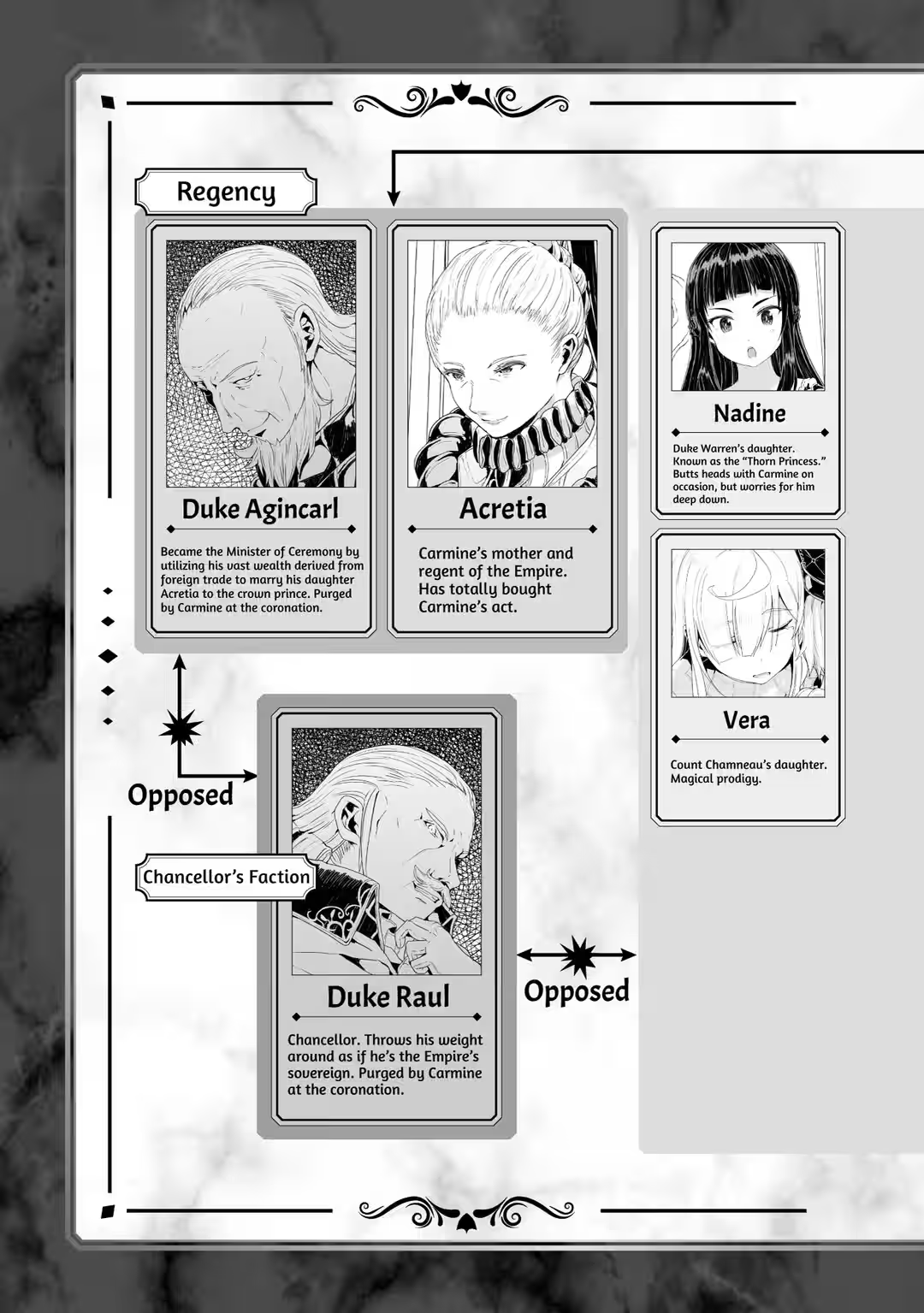
The Bundarte Empire. A nation in decline thanks to its chief political factions’ selfish misrule. Headed by the Chancellor (Duke Raul) and the Minister of Ceremony (Duke Agincarl), they spend all their time engaged in petty conflict rather than productive administration. It was in this nation that I was reborn as Carmine, emperor from my first day in this new world.
As a mere figurehead, the threat of assassination waited for me around every corner. In order to survive, I acted the part of a convenient puppet for the nobility, pretending to be a fool so that they need not be wary of me. All the while, I gathered allies in secret, waiting for my chance to seize back power.
And finally, that chance arrived. Panicked by Duke Warren’s insurrection, the Chancellor and Minister of Ceremony held a snap coronation for me. While their guards were down, I struck, purging them with my own hands, and declared to all that the nation was once again under direct imperial rule.
Yet make no mistake: The sum of all my efforts has done naught more than balance the scale. I have finally reached the starting line. The true battle is just beginning.
Even with the Chancellor and Minister of Ceremony eliminated, their factions are still in play. Their sons, too, must have a bone to pick with me over their fathers’ executions. And by declaring direct imperial rule, I have opened myself up to dissent from the nobility.
The Empire faces a long litany of problems courtesy of the nobility, who have allowed the government to putrefy for so long. Our neighbors pull strings in the shadows, intent on the Empire’s continued decline. Domestically, our nobility are all but certain to revolt.
Each of these issues requires my attention; each of these issues needs to be resolved.
Most importantly of all, I have spent my whole life pretending to be a fool. I need to dispel that image and unify the Empire before it is too late—and I have little in the way of military might to count on. If I lose this opening conflict, I will either return to being a puppet, or be killed and go down in history as an incompetent ruler.
No, that would be the preferable outcome. If the worst comes to pass, the Empire itself could cease to be.
Until this point, I’ve fought my battles with only a handful of lives on the line. But now, the existence of a nation rests on my shoulders.
I will not shirk from using every method at my disposal. All for the sake of victory.
The Audience
It had been three days since the coronation. But although the imperial capital was still in lockdown, completely halting the flow of humanity was an impossible task—the city’s population was simply too large. There was no hope of keeping a lid on my execution of the Dukes and arrest of the nobility either, of course.
Rather than waste intelligence agents on that futile endeavor, I put them to work gathering the information I sorely needed right now. They departed for the duchies of Raul and Agincarl—now bereft of their principal governors—to spy on the movements of their noble houses.
Assuming no obstructions, news of the coronation must have reached the duchies by now. They’d be mustering armies before I could blink.
The day after the coronation, Count Chamneau had requested permission to make public the news of the purge. I knew we wouldn’t be able to conceal it anyway, and it seemed he could make good use of the opportunity, so I acceded.
Upon receiving my permission, Count Chamneau apparently informed the commanders of the Chancellor’s faction and regency detachments within his army of the events of the coronation. He also told them that much of the nobility had escaped and were suspected to be hiding within the army—a lie—and that they faced a possible attack—also a lie—by the emperor’s personal army and Duke Warren’s army, which had returned to the fold.
The majority of the nobility’s commanding officers within Count Chamneau’s army were rear vassals—essentially the lowest rung of nobility, or near enough. With their lack of insight into the truth of the events, it seemed they’d chosen to return to their holdings first and ask questions later. Better that than remain in the imperial capital surrounded by enemies, in their eyes.
This was how Count Chamneau essentially defanged the coalition army. I was grateful—I’d considered the option of disarming them, but this method was better for my purposes. Having potential enemies hanging around the city who would no doubt resist attempts to disarm them would only tie up my limited and precious pool of military resources.
Okay, so maybe those “precious military resources” were untrustworthy mercenaries. Beggars couldn’t be choosers, all right?
Above all, the outcome I most wanted to avoid was the nobility’s armies trying to recover their respective lords and ladies by force. I’d take them returning to their holdings over running amok any day. After all, having the nobility in captivity meant I’d basically muzzled their subordinates.
In the meantime, Duke Warren, who’d received my personal letter, showed no sign of any hostile intentions. He’d already sent me a written oath stating that he would return to the Empire’s service and pledge his loyalty to the emperor. In fact, he would be arriving in person to the imperial demesne today for an audience with me, shared with Count Chamneau and Fabio.
In truth, I’d hoped to have him come earlier, but that had proven impossible. Duke Warren and Count Chamneau’s armies had been hostile mere days ago—even if the duke had agreed, his vassals would not have allowed their lord to simply walk into a possible death trap.
To solve that problem, we’d moved both armies out of the way. Count Chamneau’s, which was essentially just an amalgamation of mercenary bands now, had moved to the western side of the imperial capital, while Duke Warren and Fabio’s forces had set up camp to the south.
Not-so-coincidentally, the city’s western and southern sides were defensively quite sound, owing to its layout and construction. Even with the ceasefire (did it count as a ceasefire if no fighting had actually happened?) we couldn’t exactly let an army or two hang out on the city’s eastern side, given its lack of a wall.
***
Duke Warren, accompanied by a guard escort, passed under the city’s gates to the wild enthusiasm of the crowds.
Part of this was because I’d emphasized his loyalty during my public address, but it was mostly because he’d been very popular among the people during his time as imperial grand marshal. No surprises there—commanders who won a lot were popular no matter the day and age.
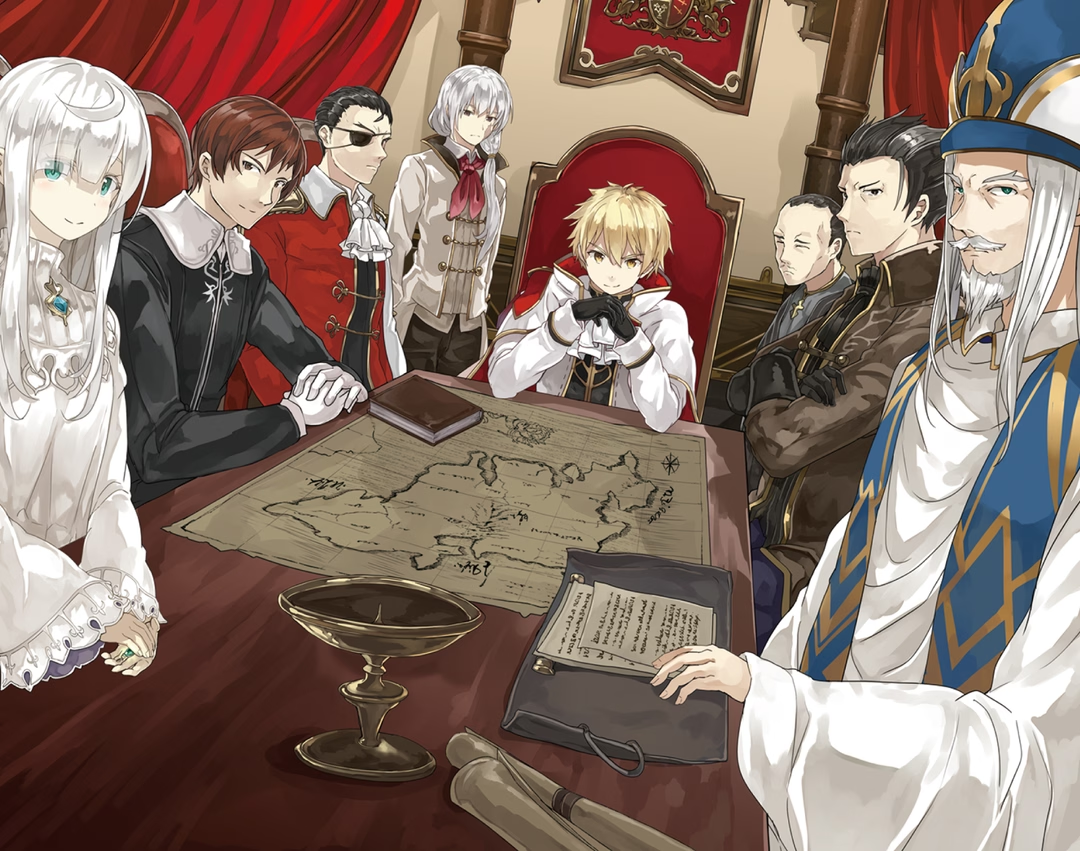
Soon, I would be granting an audience to Duke Warren, Count Chamneau, and Fabio. Rather than use the palace where my coronation had been held, we’d converted a part of the sixth emperor’s palace for social gatherings as a temporary audience chamber. The coronation palace was too deep into the imperial demesne to be convenient.
More relevantly, it was still being, ah, cleaned. A certain someone had spilled a good deal of blood in the process of subduing the coronation’s attendees. What was more, most of the imperial demesne’s servants were in the pockets of the regency or Chancellor’s faction, meaning we had to be wary about what work we entrusted them with. Long story short, we were suffering a manpower deficit.
Before long, Duke Warren and the others arrived at the slapdash audience chamber. Incidentally, the throne I sat on had belonged to Edward II, the fourth emperor—we’d pulled it out of storage and dusted it off. Despite it being the plainest of the thrones in terms of ornamentation, it had a refined elegance to it. Plus, it was very comfy.
Atop my throne, which rested atop a slightly elevated platform, I waited for the three men to kneel. Before you go calling me pompous—admittedly I was quite literally looking down at them—the act of me sitting on the throne ahead of time and waiting was the greatest respect I could show them in my capacity as the emperor.
When I’d been a puppet, everyone had made light of me. Naturally, that had meant I couldn’t perform the etiquette befitting of my station. Now that I was properly in power, I fully intended to act like a self-important emperor—to protect myself, if nothing else. This was not the time or the place for overfamiliarity; sometimes, being too nice could breed contempt.
All of which was to say that from here on out, I needed to play the part of a strong emperor.
Daniel de Piers announced the trio’s names and titles. Ordinarily, that would be the Chancellor’s role, but the position had experienced a sudden vacancy. Official procedure called for a member of the clergy to stand in as substitute herald.
“Your arrival is most welcome,” I declared once Daniel was finished. “Raise your heads.”
Incidentally, Duke Warren had come into the audience chamber accompanied by another nobleman acting as his guard, but formality demanded we treat him as invisible. Well, more accurately, he was deemed an object—a weapon of the duke’s—in the eyes of official procedure, and forbidden from speaking. Likewise, the imperial guards who were present to ensure my safety couldn’t speak a word either. Stuffy and suffocating, I know, but that was formality for you.
“Duke Warren,” I began. “We thank you for heeding our words. If you had not mustered your army, we would not have been able to enact our own plan. You have done well, and we consider you a paragon of imperial nobility—a model on which posterity shall rely.”
“Your Majesty is too kind. Your words bring me greater joy than I can express.”
From Duke Warren’s point of view, the purge had been abrupt and unexpected, carried out by a child he’d thought a puppet. No doubt he was still gauging my character, and it would take more than the events of the past few days for him to fully trust me. He’d come to the imperial demesne regardless because I’d publicly refuted the claim that he was a traitor, as well as because of the handwritten letter I’d bid Nadine to deliver to him.
“Once you have delivered just punishment to the Empire’s traitors, we shall reward you handsomely for your distinguished service,” I proclaimed.
The traitors I was talking about were the Chancellor and Minister of Ceremony’s sons, who would be mobilizing their armies as soon as they heard the news of their fathers’ demise. In the very unlikely event that they didn’t revolt...well, I’d still crush them anyway. Houses Raul and Agincarl held too much power.
“As Your Majesty’s sword and shield, I swear that I shall bring the disloyal to justice.”
“Well said, Duke Warren! We could not entrust the task to a more worthy man. Henceforth, Emperor Carmine of the Bundarte Empire appoints you as imperial grand marshal!”
Not to burst anyone’s bubble, but we were just going through the motions. I had included all of this and more in my letter.
Me gaining the opportunity to enact my plans because of Duke Warren’s insurrection; my promise to the duke that I would handle the Chancellor and Minister of Ceremony myself and subsequent request to refrain from engaging Count Chamneau’s army; another request to return to the imperial fold after I’d seized control of the capital, and of course, his reappointment to the rank of imperial grand marshal and the promise of further rewards after the civil war was concluded—all of this exchange had been decided in advance.
“You are known as a great commander, Duke, and famed for your ability. Deliver the Empire the stability it needs.”
“Yes, Your Majesty!”
I nodded emphatically, then turned my gaze to Count Chamneau. “Count Chamneau. Your efforts have produced magnificent results.”
“Your Majesty honors me in excess. I am undeserving.”
“Henceforth, Emperor Carmine of the Bundarte Empire appoints you as imperial grand marshal. Continue to avail the Empire with your capable talents.”
Naturally, my exchange with Count Chamneau had been prearranged too. I’d decided to appoint both of them as grand marshals so that power didn’t concentrate too much around one or the other, but given the scale of the Empire, I kind of wanted more. Meh, I’d sort that out after we’d dealt with our domestic instability.
“My deepest gratitude,” Count Chamneau replied. “I hereby swear that Your Majesty’s—and the Empire’s—enemies shall fall by my blade.”
“Mmm. Regarding your daughter, Count—she has already been freed. Consult Count Palatine Vodedt for her whereabouts afterward.”
There was a moment of silence before Count Chamneau replied, “Yes, Your Majesty.”
I’d freed the count’s daughter, Vera-Sylvie, on the day of my coronation. My judgment was that she needed a good deal of peace and quiet, accompanied by healthy doses of rehabilitation and medical supervision. You couldn’t just lock people up for years on end and expect them to come out okay, after all. We might’ve ensured that her conditions had improved recently, sure, but she’d lacked proper food and exercise for too long, and it would be some time before she could be called healthy again.
Still, if Count Chamneau and Vera-Sylvie wanted it, I personally thought it would be fine to let her return to their holdings. The imperial demesne’s medical faculties wouldn’t be back to full functionality for a while. Why, you ask? Well, probability pointed to it being the fault of an imperial medical officer who had carried out the previous emperor’s assassination. Count Palatine Vodedt was currently running a very thorough inquiry. For the time being, Vera-Sylvie’s care was being handled by a certain Storyteller and elf who was apparently well-versed in medicine.
Finally, we came to Fabio. Now that I was thinking about it, this was the first time we’d be talking in a formal setting.
“Fabio. Our loyal vassal. You have again contributed greatly to our cause. Your loyalty and devotion—unwavering for so long—must be rewarded.”
My words were more for Duke Warren and Count Chamneau than they were for Fabio. Of the trio, his army had been the smallest, and as a nobleman, his rank was the lowest. For me to nonetheless give him a greater reward than the duke and count, I needed to let them know it was because he’d been in my service for far longer.
“I am unbefitting of such kind words, Your Majesty.”
Of course, phrasing it like that made it sound contradictory, because officially, Duke Warren had pledged loyalty to me a long time ago as well. To explain, I’d have to get into some political semantics.
Take Count Chamneau as an example. He only pledged fealty to me recently, having not done so beforehand. From observing this example alone, one could interpret the phrase “swore loyalty” as “hadn’t sworn loyalty beforehand.”
Then we got to Duke Warren, who had helmed an insurrection “for the sake of the emperor.” If you interpreted his oath of fealty to me now as him not having sworn loyalty to me before (i.e., when he mustered his army), it would technically make his “insurrection for the sake of the emperor” a lie. Thus, to smooth everything over, the official state of matters was that Duke Warren had sworn loyalty to me a long time ago.
Honestly, there wasn’t a single soul in the room who would drag us up over such petty semantics. However, the faction nobility absolutely would, and we’d probably be releasing most of them soon enough. I couldn’t have them all killed—if I tried, every individual in the Empire with a drop of blue blood and institutional power would turn against me and have me ousted before I could say the words “murderous despot.”
Among the released nobles, some would go on to do good work and reestablish a position for themselves in central politics. I couldn’t stop that from happening. If I broke the core principle of meritocracy—punishments and rewards doled out fairly and accordingly—then no one would follow me.
Hence why we had to cover our tracks like this over the question of Duke Warren’s loyalty. It was a pain, but nitpicking and politics had gone hand in hand in my previous world too, so I’d just have to bite the bullet.
But I digress. Back to the subject of Fabio’s reward.
I accepted a sheet of parchment from Timona, who stood to my side. It was a formal document bearing the emperor’s signature.
“His Majesty, the Emperor Carmine of the Bundarte Empire, declares thusly,” I proclaimed. “Let it be known that the event known as the ‘Three Houses Coup’ was, in truth, an unjust persecution perpetrated by the former Duke Raul and the former Duke Agincarl. Consequently, the margravial house of Ramitead, the margravial house of Agincarl d’Decci, and the comital house of Veria, all of imperial nobility, are exonerated of all relevant crimes, and all effort shall be made to restore their impugned honor. Furthermore, the Empire recognizes the restoration of the margravial house of Ramitead, and the title of Marquess Ramitead shall be conferred upon the individual previously known as Fabio-Deneaux le Vodedt.”
Fabio bowed his head, tears streaming from his eyes. “I...cannot express the depths of my gratitude, Your Majesty. To finally be able to clear my family’s name...”
“Our proclamation shall be distributed among the public as an imperial edict,” I elaborated. “You have done well to endure until this day. Henceforth, you may give your name as Fabio de Ramitead-Denouet.”
He laughed. It sounded happy.
While this was undoubtedly a reward for him, it also benefited me. The benefit of granting one of my closest allies peerage and power was obvious, but it might also lure out any survivors of houses Agincarl d’Decci and Veria who might’ve gone into hiding like Fabio. I’d have a good chance of making new allies out of them, as well as leveraging their existence to further attack the legacies of the Chancellor and Minister of Ceremony.
“Finally, Duke Warren.”
There was a brief pause before he replied, “Yes, Your Majesty.” There was the subtlest of confused notes in his voice; he must’ve not expected me to address him again.
“We have heard that you fought with our father on the battlefield. Is this true?”
“It is, Your Majesty. His Highness was gracious enough to consider me, in his words, a friend.”
“We do not know our father. If you would, would you tell us of him? The Empire’s current strife leaves us with little time, but we can spare some, after this audience. We wish to hear tales of our father’s conduct upon the battlefield.”
Duke Warren’s eyes widened. When he spoke, it was as if he were struggling to hold back some surging emotion. “If... If only His Highness could have heard Your Majesty’s words,” he said. “How overjoyed would he have been. Of course, Your Majesty. The honor would be mine.”
Thus, the first ever audience I had granted as the emperor concluded with a brief trickle of tears streaming down Duke Warren’s cheek.
Interlude: A Silver Right Arm, a Copper Left
After the conclusion of the emperor’s audience, his vassals—Duke Warren excepted—vacated the audience chamber. Count Chamneau departed with Count Palatine Vodedt, to be reunited with the daughter he hadn’t seen in over a decade.
As for Fabio de Ramitead-Denouet, formerly Fabio-Deneaux le Vodedt, formerly Fabio Denouet, he was eager to inform his house’s vassals—who had accompanied him to the capital—of the good news. The restoration of House Ramitead and its honor that had been stained by the Three Houses Coup had been their dearest wish since its downfall.
Nevertheless, Fabio encountered a sight so rare he had to stop in his tracks.
“Shouldn’t you be by His Majesty’s side?” he asked good-naturedly.
His friend, who was as expressionless as ever, replied, “There is no need for me to hear the memories of Crown Prince Jean.” Timona le Nain, Emperor Carmine’s personal attendant, set off at a walk, making a gesture for Fabio to follow.
Until now, Timona had been one of the emperor’s few trusted confidants and guards. However, since the coronation, Carmine had gained the protection of the imperial guard, including one Balthazar Chevillard. Given this, retaining Timona as a guard would be akin to declaring his mistrust of them, which was why he’d relinquished Timona’s services from his security detail, and why Timona had exited the audience chamber with Fabio and the rest of them.
Fabio, walking at pace by Timona’s side, shrugged. “Still, His Majesty put on a pretty good performance, don’t you think? I had a number of chances to learn what Duke Warren was like on the way to the capital—he’s a military man down to the core. I can’t imagine anything would make him happier than getting the chance to talk about the crown prince he loved and respected so much with his son.”
Almost every topic Carmine had raised in the audience chamber had been prearranged. Fabio had stopped to follow after Timona after achieving the long-cherished wish of House Ramitead, and was so unconcerned now despite the tears he’d shed earlier, because he’d known about it all beforehand—and so had his house’s vassals.
However, from Duke Warren’s reaction, Fabio suspected that Carmine hadn’t informed him that he would be asking about Crown Prince Jean. This suspicion was, in fact, on the mark. A man like Duke Warren would hardly have been moved to tears otherwise.
“His Majesty has an excellent read on the duke’s personality,” Fabio remarked, “to ask that even though he actually cares quite little about Crown Prince Jean.”
In Fabio’s eyes, Carmine had no admiration for his predecessors whatsoever. Even when being regaled with tales of the great Emperor Paterfamilias, Cardinal—the first emperor—he would feign reverence, but in truth would feel no childlike adoration at all. He held no ambition to assume the mantle of his venerated ancestors; he considered himself to be himself, and others to be “other.” Nothing more, nothing less. Among all the people Fabio knew, he considered the emperor to be the furthest from the word “childlike.”
“His Majesty...does not have much interest in the legacy of His Highness, the Crown Prince Jean. That is true.” Timona paused, then continued. “However, he does harbor some emotion, perhaps akin to yearning, for a ‘father.’”
“Yearning? Seriously?” Such was the surprise Fabio felt that the words were out of his mouth before he even realized it.
“It might be more accurate to say that he has an unusually favorable ‘bias’ for family,” Timona said. “Even though His Majesty may have little interest in His Highness Jean in the capacity of the crown prince, that does not mean he has no interest in what the ‘man who is his father’ was like.”
It was subtle, and it was complex, but as the person who spent the most time by Carmine’s side, Timona understood.
“Similarly, His Majesty has no expectations of the former Crown Princess Acretia,” he continued. “Nevertheless, he harbors both love and respect for the concept of a mother.”
Fabio couldn’t help the teasing note that entered his tone. “This is rare. I’ve never heard you speak so much outside of your reports.”
The Timona he knew was taciturn and expressionless, as much made of steel as a man could possibly be. It was indeed unusual for him to be so loquacious.
However, the truth was that this was more indicative of who Timona was as a person than anything else. He would talk as much as was required, especially if the topic concerned his liege.
Timona le Nain came to a stop, turning to face Fabio. “I have a request for you,” he said.
A moment passed before Fabio replied, “Do you now? No wonder you’re so talkative today.”
Timona ignored the remark. “It’s about His Majesty. He will seek to order the execution of former Crown Princess Acretia. I’d like you to prevent him from doing so.”
“Ah. Yeah, I suppose it would be difficult for anyone else to suggest executing His Majesty’s birth mother. Knowing him, he would take it upon himself to bring the topic up.”
Despite being the emperor by natural birthright, Carmine had a tendency to think of it as a “role” he needed to fulfill. Consequently, when he realized that no one else would be able to suggest Acretia’s execution, he would consider it his duty to suggest it himself. This was one of Carmine’s shortcomings.
As for why it was a shortcoming, it was because to his vassals, he was their liege. And there were none by the emperor’s side—currently, at least—who would oppose his intentions. If, at the trial, it was judged that the emperor wished for the regent’s execution, it would undoubtedly pass.
“Still...” Fabio continued. “If we’re talking advice from a vassal, shouldn’t it come from you? You’re His Majesty’s personal attendant.”
In Fabio’s mind, it was no exaggeration to say that the emperor already considered Timona to be an extension of himself. The attendant was always by his side, and saw to his every need. It was a relationship that could not work if there was no mutual trust. What was more, the Emperor Carmine that Fabio knew was an open-minded ruler who did not mind lending an ear to the advice of others.
However, Timona thought differently. “His Majesty is a person of strict self-discipline—perhaps to the point that it could be called obsessive. And this issue concerns a blood relative of his. He will be more stubborn than usual. Even if my words are logical, he will not heed them.”
Fabio conceded the point with a nod. Though it was merely Timona’s conjecture, he heard nothing he disagreed with. “So you want me...” He paused. “That is, you want it to be a ‘request’ from the Marquess Ramitead?”
“It will be a politically sound objection, provided in a court of law, by an attending chief vassal. Anything less, and His Majesty would not cease with the execution. And I am not of a position which would allow me to speak during the trial.”
“His Majesty can be quite the headache sometimes,” Fabio grumbled. “You too, mind.”
An emperor that sought to kill his own mother because he was convinced it was his duty. An attendant who sought to stop him because he did not wish his liege to wound his own heart. If that wasn’t the definition of a headache, what was?
Still, if executing the former crown princess led to even a ghost of a chance that the emperor would one day go mad or lose his way, Fabio was more than willing to eliminate that possibility.
“Very well,” he said. “Imprisoned or not, it’s not as if the regent is a threat, and besides, executing one’s birth mother might well be considered a violation of the First Faith’s teachings. Even if the nobility don’t care, the people will.”
To honor one’s parents was a First Faith teaching that, in the Western Orthodoxy, was considered a Prime Tenet. However, to the imperial nobility, who believed in the notion of honorable death, executing a parent did not necessarily mean one was disrespecting them. After all, there were some circumstances in which one’s honor and good name were maintained by one’s execution. Of course, this interpretation was a construct of the nobility.
“The capital’s citizenry wouldn’t look favorably on it,” Fabio continued. “And since His Majesty’s image with them is particularly important to him, it would go against his own goals. Consider it done.”
“Thank you.” After that brief expression of gratitude, Timona walked away.
Fabio stared after him for a few moments. “What’s got him acting so meek? Is there going to be a storm tomorrow or something?”
One would be inclined to wonder how Timona usually treated Fabio, if that was enough to call him meek. Certainly, it was a side of Timona that Emperor Carmine did not know.
And fortunately, despite Fabio’s concerns, the following few days saw the imperial capital enjoying fine weather indeed, without a storm in sight.
Time to Gather Evidence
A week had already passed since the coronation.
Duke Warren and Count Chamneau had put their armies to work securing the local region—which should have been under the emperor’s direct control to begin with. They’d faced hardly any resistance, however. Most of the local faction lackeys who’d held the real authority of governance had already made themselves scarce.
My edict regarding the Three Houses Coup had already been promulgated throughout the imperial capital and its surrounds. It had yet to spread wider, but the plan was to deliver it to the Empire’s wider nobility along with other relevant news.
I’d made it clear during my audience, but I’d decided to lay responsibility for the coup onto houses Agincarl and Raul alone. The nobility who’d attacked houses Ramitead, Agincarl d’Decci, and Veria under the Chancellor and Minister of Ceremony’s order would get off scot-free.
On that point, our hands were tied. We couldn’t crack down too hard on the faction nobility, lest we make an enemy of every single one of them, and if that happened, we’d never win this civil war. Even if, by some miracle, we did, my subsequent reign would be shaky and unconsolidated.
Consequently, this formed the basic policy I was operating under as emperor: severe treatment of the ducal houses of Agincarl and Raul, and relatively lenient treatment of my other lords. It was a policy I planned to maintain...for the time being.
We still had the nobles who’d attended the coronation locked up, but we could get away with that by ascribing it to the need for a thorough inquiry. The Chancellor and Minister of Ceremony’s transgressions were a laundry list of serious crimes, from assassinating imperial family members to tax evasion and more. It was necessary for us to question the rest of the nobility regarding their knowledge of—or even complicity in—the Dukes’ malfeasance.
Not that we’d get any answer other than “I had no idea,” of course.
I had no illusions that we’d be getting useful testimony from any of the nobility. The only point of our inquiry had been to buy time. The week gave us enough breathing room to mobilize our intelligence agents and the Minister of Finance’s pencil pushers for a careful scrutiny of all official documents in the imperial demesne.
I planned on releasing the majority of the nobility before long, but not all. Those who we had sufficient evidence to sentence would be sentenced—I needed to make examples of them.
I’ll cut to the chase and tell you now that very little evidence of iniquity remained. The nobility weren’t morons, after all. They’d covered their tracks already. The regency had Duke Agincarl’s eldest son in the position of chief secretary, so no doubt they went to him to launder proof of their misdeeds. As for the Chancellor’s faction, the Chancellor probably did it himself.
Still, the sheer amount of shady nonsense going on meant that even if it had all been swept under the rug, there was one hell of an obvious lump. In plainer terms, the numbers were wonky. As it turned out, the calculations on the nobles’ tax documents, which they’d apparently never disclosed to the Minister of Finance despite his repeated insistence, seemed to pretend the concept of tax didn’t exist at all.
In contrast, the Minister possessed thorough records of their reported tax revenues and yearly expenditures. The tax evasion had all taken place in the stages before the reports made it to Count Nunvalle, meaning that we now had both the pre- and posttax evasion records. And when the two were compared, more holes turned up than you’d find in a block of Swiss cheese.
Of course, since the documents had been altered or falsified, we had no idea of who specifically had skimped on their taxes, nor by how much. Nevertheless, that would still let us drag the documents’ owners up in court over the charge of falsifying financial records.
Now, when I said earlier that very little evidence of iniquity remained, I meant that we’d still found some. It wasn’t evidence that our investigation dredged up, but that instead had been provided to us by the Western Orthodoxy.
Incidentally, the close aide of Count Nunvalle’s whom the Count Palatine had suspected of ferreting away the previous emperor’s fortune? Innocent, as it turned out. Well, technically, we hadn’t found proof of the aide’s innocence so much as we’d found proof that it had been a different culprit entirely—someone whose identity created a whole new issue of its own. What to do, what to do...
“Your Majesty,” Timona said, interrupting my thoughts. “Prelate Officium Daniel de Piers has arrived to give his report.”
“Let him in.”
Since the coronation, I’d entrusted my safety to the imperial guard, which had allowed Timona to refocus on his original, more secretarial role as my personal attendant.
When Daniel entered the room, he glanced around for a moment before returning his gaze to me. I didn’t blame him—I’d ordered some rather drastic interior decorating.
All the gaudy—and frankly excessive—precious metals and gems were gone, for one. I’d still have to dress to the nines in public, given I was the emperor, but I’d take the small victories where I could get them.
That aside, the way Daniel quickly scanned the room reminded me of Count Palatine Vodedt. More accurately, it reminded me of someone who knew their way around a fight. The old elf wasn’t a martial artist or something, was he?
After a respectful bow, Daniel began his report. “Your Majesty. Georg V’s execution has been conducted. Likewise, his five closest confidants were also executed.”
“Good. We appreciate the update.”
The Western Orthodoxy was the Empire’s state religion and a denomination of the First Faith, the most widespread faith on the Eastern Continent. After a decision made by its internal council, it had sentenced its top authority in Archprelate Georg V to burn at the stake. Ordinarily, the religion only allowed for interment or burial at sea—an execution by fire was the gravest penalty possible, as it prevented one from traveling to the afterlife. Even the emperor could not sentence someone to death at the stake without the church’s permission.
Since this matter had been decided internally by the Western Orthodoxy, I hadn’t been a part of the process—all they’d needed was my acknowledgment. I had no doubt that the severity of the sentence was in part the church currying favor with me, given what Georg V had done to Baron Nain, but even without that, he likely still would have met the same fate. My understanding was that he’d incurred the enmity of quite a lot of the clergy.
The reasons given for his sentence had been his acceptance of bribes and his wrongful exercise of the church’s inquisitorial branch. The bribes in particular were a violation of the Prime Tenets, which, since he was the highest authority of the entire church, was more than enough to justify his burning at the stake in the eyes of pretty much everyone.
Of course, at the time, Georg V had passed off the bribes he’d accepted as “donations” or “contributions,” a practice common even in the imperial court. Gathering enough evidence to prove they were indeed bribes must have been difficult, since it was such a carefully obfuscated gray area, but Daniel de Piers had nonetheless managed it.
“Quite the dexterous feat,” I said.
“Georg V only ascended to his position with the Chancellor’s assistance in the first place,” Daniel explained. “A development that disgruntled much of the clergy, albeit to varying degrees. With his shield purged by Your Majesty’s hand, it would have been simple to burn him at the stake even without any evidence.”
It didn’t surprise me that the church had been eager to get rid of him, given he’d embezzled all the bribe money for himself. “Still, it was your meticulous groundwork that allowed you to run a clean sweep of his lackeys,” I countered. “Was it not?”
I’d shed blood too, during my purge, but at the end of the day, I’d only killed two people. In comparison, the Western Orthodoxy’s internal conflict had been a bloodbath. “The church has no military might,” my ass. How could I have forgotten that a spell in one’s hands was just as deadly as a sword?
“Even so, a few were able to escape,” Daniel said.
“If you mean the ones who merged with the Raul army, don’t worry about them. That fight will happen regardless. But moving on. You have our gratitude for the evidence you provided.”
The evidence of wrongdoing given to us by the Western Orthodoxy had to do with the bribes that Georg V and his people had taken. Of the nobles who’d given them, there had been not only names from the Chancellor’s faction, but the regency too—evidently old Georgy had been a real money-grubber. Regardless, the fact that the church had sentenced him for accepting bribes could serve as proof that the nobles had given them. After all, to the Western Orthodoxy, both were equally criminal acts.
“We consider it an honor to have been of service to Your Majesty.”
“As for the question of who will become the next Archprelate...” I began. “We will not endorse a candidate. We presume that would be preferable?”
Daniel paused for a moment. “Your Majesty’s discretion is greatly appreciated.”
Georg V had become Archprelate via outside intervention—namely, the Chancellor’s. That had blown up in his face, ending with him going the way of Earth’s witches. Hypothetically, if I were to advocate for Daniel to become the next Archprelate, he could very well face accusations of hypocrisy. That said, without the emperor’s input, the church’s top officials would talk themselves in circles and never get anywhere with the decision. Internally, things would be a mess for some time—which actually served my purposes just fine. I didn’t want the church holding too much power.
“It doesn’t seem like it will stabilize for some time, does it?” I mused.
“The issue should resolve itself once the Empire’s unrest has abated.”
Yeah, that was obvious. It was nothing new either—securing domestic stability was my top priority.
I examined Daniel; he looked as if there were something more he wanted to say. “Is there something else?” I asked.
After some hesitation, he seemed to come to a resolution. “Your Majesty. I strongly believe that Count Palatine Vodedt’s interrogation of the imperial physicians must be stopped at once.”
Currently the Count Palatine was interrogating the imperial demesne’s medical officials over the previous emperor’s assassination. From the way Daniel had phrased his request, it sounded like he had a problem with the spymaster’s methods.
“He is acting like a wild animal,” Daniel finished.
“We would say an animal is rather meek in comparison. Cute, even.” Ever since I’d gained the Count Palatine’s cooperation, he’d seemed more to me like a machine—a robot programmed to serve as the protector of Rotahl’s legacy and nothing else. “Allow us to clarify. You believe that Count Palatine Vodedt is allowing what you perceive to be his emotions over the previous emperor’s assassination to influence his investigation. Is that correct?”
“That... Yes, Your Majesty. You must rein him in. His actions seem borne of nothing more than—”
“Revenge?”
Edward IV’s assassination. If it had never happened, perhaps my inheritance of the throne would have happened more smoothly. But it was equally likely that the Chancellor and Minister of Ceremony would have had me killed earlier on to make way for their preferred choice of successor. Given that, I felt no particular desire to avenge my predecessor’s demise.
Of course, as the emperor, I couldn’t just let the perpetrators go unpunished either. That was why I was overlooking the Count Palatine’s actions.
“Perhaps it is revenge,” I conceded. “But what it is not is the mere venting of his anger. Those still being interrogated by the Count Palatine are the individuals he has already decided are guilty beyond doubt. The majority of the physicians have already been released after hardly any questioning.”
One such individual was the doctor who’d cared for Baron Nain. Perhaps the Count Palatine had only allowed that to happen because he’d already known the man was blameless.
“So long as the Count Palatine has not acted in error, we shall not object to his actions,” I continued. “No doubt he thinks the same of us. He is currently involved in more tasks than this, and his results are nothing less than fruitful.”
The man’s methods were problematic, but what he was doing wasn’t wrong. Above all, he always produced results. Or perhaps, in his cold calculations, even his seemingly vengeful interrogation was but the most efficient method to achieve his goal.
“We are well aware that he is a dangerous man,” I finished. “Just as aware as we are of your concerns. We cannot tell you that how you feel is unjustified, so we will simply say that you may continue to monitor him, should you so wish.”
Daniel was silent for a moment before bowing his head. “Forgive my impertinence, Your Majesty. That concludes my report.”
Daniel de Piers and Alfred le Vodedt. There had to be a past between them that I wasn’t aware of. I’d have to tread carefully.
Trial of the Eight
The imperial capital was stable. So much so that you wouldn’t think that its reigning authority figures had just been purged.
There were a number of reasons for this, but one was that I’d given the investigations into the nobility a week to play out. I could have simply had them “investigated” as a formality and moved straight to the trial process, punishing them how I saw fit, but that would have unsettled the other nobility—barons and knights and such—who hadn’t attended the coronation. Since I was taking my time, the lower nobility seemed content to wait in their homes in the noble district and see which way the dice rolled.
This also applied to the merchant classes. The Chancellor and Minister of Ceremony—actually, I should probably make a habit of appending “ex” to their titles at this point—had dealt with many merchants who could now be considered my potential enemies, since I’d executed their benefactors. At the very least, they certainly weren’t cooperative with the throne. Still, I didn’t do a thing to them. I knew they would be useful soon enough.
Incidentally, touching back on my point about the Dukes’ titles, they had already been stripped of them in formal capacity, and thus “ex-Chancellor” and “ex-Minister of Ceremony” were the accurate terminology. However, since no one had filled the roles they’d vacated yet, use of their former titles was still understood to be referring to them.
As for the citizenry, they were exceedingly cooperative with the throne, on account of my speech. Of course, since their opinion of me could flip entirely if I made a single mistake, you could also say that they were the demographic I needed to tread most carefully around.
In fact, the only unstable element in Cardinal currently was the Western Orthodoxy. Though, since trying to intervene would only invite harm with no benefit, I’d leave them be for now.
“For now” being the operative part of that sentence. The church’s rot had reached its core long ago, and it would need a thorough reformation before long. I’d simply let them continue their infighting until the public opinion was that the emperor had to step in.
It was during this period of relative stability that two major pieces of news came to the imperial capital, roughly at the same time. The first was a declaration from Cavalry Commander Sigmund de Van-Raul, eldest son of the former Duke Raul, stating his intent to inherit his father’s ducal title. The second was also a declaration, sent by August de Agincarl, the Marquess Agincarl d’Decci and second son of the former Duke Agincarl, saying much the same thing.
Oh, yeah, and both men also mentioned they were mustering their armies against the emperor.
The civil war had finally begun.
***
So, there was a new (self-proclaimed) Duke Raul and Duke Agincarl in town, and they were gathering their forces to rise up against me. When I heard the news, I gathered Duke Warren—who had resettled in the imperial capital—Count Chamneau, Count Nunvalle—who had stayed in the imperial capital—Count Palatine Vodedt, and Fabio, who was the new Marquess Ramitead. Despite what you might assume, the meeting’s purpose was not to discuss our strategy against the rebel armies, but to carry out the trial of the nobility we had in captivity.
After seeing that my loyal vassals were seated, I started the proceedings. “We hereby exercise the emperor’s judicial right and declare that this trial is now in session.”
You might wonder if we really had the time to dedicate to such things, but trust me, we were fine. I had strategies in mind to buy time against the armies of Duke Raul and Duke Agincarl, the former of which I had already put into motion.
Apart from the five noblemen I’d already mentioned, we had the prelate liturgia and prelate scriba present to stand witness. After I made my declaration, they began theirs.
The prelate liturgia and prelate scriba were equal to Daniel, the prelate officium, in that they were at the highest rank of the clergy behind the Archprelate. They were also the two individuals involved in the conflict to succeed the role. I figured it was likely they’d try to ease this trial in the direction I wanted, in order to leave a good impression.
Incidentally, it appeared that Daniel had zero plans to get involved in their conflict. He’d mentioned that he wouldn’t be showing his face at court for a while to avoid drawing suspicion. Much of the clergy seemed to share a similar opinion, distancing themselves from the prelate liturgia and prelate scriba—common consensus expected the conflict to become a whole imbroglio and a half. One such clergy member was Deflotte le Moissan, son of Count Palatine Vodedt. After his turn as one of the more active advocates for purging Georg V and his lot, Deflotte had renounced his vestments, saying that his actions had caused matters to proceed far too hastily.
No longer a member of the clergy, his next move was to enter my service as a government official. According to him, he’d only taken up the cloth because it had been the most advantageous way to work for the Empire, and had discarded it because it would only now be a hindrance. Usually, leaving the church wasn’t such an easy process, but since he’d claimed responsibility for the recent events, he’d received special permission.
Despite spending much of his life in the clergy, I was beginning to suspect he didn’t have a religious bone in his body at all, let alone any genuine respect for the First Faith’s god...
Still, there was no getting around our lack of manpower. I welcomed him on the spot and dispatched him to serve as our envoy to the Gotiroir. I’d suspected that he’d already met their chieftain, Gernadieffe, because he’d shown up right after the battle on the hill, which had been masterminded by Daniel. It wasn’t a huge leap in logic to assume that Deflotte had served as Daniel’s messenger, and Deflotte had quickly confirmed that that had indeed been the case.
Deflotte had already reached the Gotiroir’s autonomous territory, and the Gotiroir had publicly declared their support for the emperor, promptly beginning an invasion of the holdings of Sigmund, the self-proclaimed Duke Raul. The original reason Sigmund had remained in the Duchy of Raul with the main Raul forces was because he’d known that the Gotiroir had been preparing for war. So while he could yell and scream and gnash his teeth about me all he wanted, he had to prioritize responding to the enemy at his doorstep.
Meanwhile, I’d instructed the Gotiroir to prioritize minimizing losses to their own army and holding the Raul army’s attention. I’d also told them that, if the Raul army ignored them, they were to rampage throughout the duchy and impair Sigmund’s capacity to sustain the war effort to the best of their ability. The ideal scenario was that they’d lure the Raul army into the mountains and begin a highly favorable war of attrition, but at that point I might as well ask for wishes from a genie as well.
I digress, though. Back to the trial.
“In the interest of brevity, we shall postpone the trials of those of rank viscount or lower until a later date,” I declared. “Now, to begin. We shall commence with the duchies of Raul and Agincarl.”
First, for posterity, we went over the sentences that had been levied upon Karl and Phillip, the ex-Dukes Raul and Agincarl, before moving on to the sentences of Sigmund and August, who had both declared their intent to inherit their respective ducal titles. Since the ex-Dukes’ sentences had not been rendered upon the individual, but upon the “head of their ducal house,” it also applied to their inheritors—albeit that part still needed to be ratified by other nobility.
Naturally, no one present objected to the decision, and so it was confirmed that Sigmund and August would be stripped of all their assets, titles, and positions, and sentenced to death, with their heads to be put on public display.
By the way, after we’d sentenced the ex-Dukes, we’d also seized their various estates within the imperial capital. While there had been some amount of artwork and furniture that could be liquidated to add to the empire’s coffers, it wouldn’t be enough to make a dent. Of cold hard coin, very little remained.
In this age, currency was silver and gold, which was a heck of a lot bulkier and heavier than paper bills. I’d basically expected as much, but it seemed the ex-Dukes hadn’t carried any around with them. Instead, they’d purchased from their merchant associates on credit, which they’d paid off in their own duchies.
Anyway, next came the sentences for the rest of the nobility.
To begin with, for the crime of forging official documents, Fried, the Marquess Agincarl-Novei, chief secretary of the imperial court and eldest son of the former Duke Agincarl, was sentenced to death, with all of his assets and titles to be stripped. It practically went without saying, but falsifying imperial documentation was a grave crime, and he’d done it for years on end, hiding evidence of tax evasion on countless occasions. Given all of that, capital punishment was appropriate.
Next up was actually his son, Phillip de Agincarl—the general, not the ex-duke—who’d been party to his father’s document falsification. He was sentenced to life imprisonment. Of the regency, another nobleman named Joseph, the Count Nunmeidt, received the same sentence for the same crime.
Moving on, we reached the sentencing of the perpetrators of the previous emperor’s assassination. Apparently, it seemed that the handful of medical officers Count Palatine Vodedt had been “interrogating” had finally confessed. Of course, given his methods, their testimony would not have passed muster as credible evidence in a courtroom back on Earth. I’d been reluctant to sentence them based on that alone, but thankfully, testimony from one of the noblemen we had in captivity—Gautier, the Count Voddi—relieved me of the need to grapple with that particular quandary.
Count Voddi was a Chancellor’s faction noble and former Lord Chamberlain who had been present in the imperial demesne and court at the time of the previous emperor’s assassination, making his testimony quite credible. He also stated that Boris, the Count Odamheim, who became Chief Seneschal after the assassination, had been responsible for covering up the evidence. And when this was asked of Count Odamheim under the terms that he would be given immunity for the crime, he readily confessed.
All of this explained what Daniel had meant when he’d accused the Count Palatine of simply venting his anger. His “interrogations” of the doctors seemed rather unnecessary, given that the evidence had been readily available via other means. Regardless, the evidence was used to sentence Chief Physician Auguste Claudiano and three other physicians to death, with their heads to be put on public display, and a further two physicians just to death.
Next, we moved on to those convicted of the crime of bribery: Bernard, the Count Peckscher and Minister of Foreign Affairs; Marius, the Count Calx and Chamberlain of Domestic Affairs; and Jean, the Count Copardwahl, Imperial Cupbearer, and lover of the regent. All three were stripped of their positions and fined—rather light sentences, all things considered. I hadn’t touched their titles.
There was a reason for that, of course. Rather than give the bribes themselves, the noblemen had used patsies, meaning it would be easy for them to claim that their original intent had been to make a donation, and that their patsy had twisted that into a bribe of their own accord. Thus, if I tried to levy any heavier punishment on them, they could force me to lighten it, even if it was obvious to everyone that they were lying through their teeth.
Naturally, my impression of these three noblemen could not get any worse. If they thought they’d get away with a quiet death of natural causes, they were sorely mistaken.
The rest of the nobility were more or less declared innocent. Sylvestre, the Count Kushad; Valère, the Count Mehimrahl; Theodore, the Marquess Arndal; Theophan, the Count Vadpauvre; Gautier, the Count Voddi; and Boris, the Count Odamheim all stood as examples of ones I’d release in due time—that being when the timing best suited me, of course.
There were also nobles whose sentences were put on hold, such as Hubert, the Count Buhnra and former captain of the imperial guard. He was still undergoing an investigation for misappropriating the imperial guard for his personal use. Of course, basically everyone had done that. In his particular case, I was just stalling for time.
In regard to this series of trials, there was a big difference between the sentences I wanted to render and the sentences I could render. To use Count Buhnra as an example, the ordinary trial process would declare him not guilty and see him freed from our captivity. However, his county was located in between the Duchy of Warren to the north and the Marquessate of Ramitead to the south. If we let him go and he linked up with the Raul army, the worst-case scenario could see the imperial capital cut off from Duke Warren’s holdings. From a strategic point of view, the County of Buhnra was a possible spearhead and staging ground for enemy counteroffensives; we could not allow the Raul army to have it.
Currently, we had a fair few plates spinning in the County of Buhnra. The count could accuse us of unjust imprisonment all he wanted, but he wouldn’t get his trial until they were over with.
Finally, we came to the regent Acretia.
Her crimes included aiding in the manipulation of the young emperor, unjust imprisonment of the former crown prince’s other wives, ordering the assassination of the servant suspected of birthing Jean’s other child, and ordering the assassination of the child in question. There was also the possibility that she had turned a blind eye to the previous emperor’s assassination. All in all, her crimes easily warranted the death penalty.
“In light of these charges being uncontested, the regent Acretia is found guilty,” I proclaimed. “We sentence her to be stripped of all assets and positions, and to be put to death. Should any object, make yourself known.”
Fabio raised his hand. “I have an objection, Your Majesty.”
“Permitted. You may speak.”
“Your Majesty, in no nation throughout history is there record of a sovereign killing their own mother. Not even the worst of despots committed such an act.”
Wait, really? There’d been that Roman emperor who’d killed his mother, but then again, that had been on Earth. Racking my memory proved Fabio right; if any examples existed in this world, I certainly hadn’t heard of them.
“Furthermore, the public hold the virtue of filial piety in high esteem,” Fabio explained. “The opinion of the citizenry is quick to change. If Your Majesty were to sentence Her Highness Acretia to death, there would be negative backlash sufficient to rival the support you have won of late, in my estimate.”
“That much?” I asked.
“Yes. At the very least, it is not something Your Majesty would want.”
Hmm. Well, it wasn’t like it had to be the death sentence, in Acretia’s case. Especially if it bought me the people’s distrust. If she began to get on my nerves, I could always just have her assassinated.
“We understand,” I concluded. “We shall rectify the sentence. The regent Acretia is to be stripped of all assets and titles, and sentenced to life imprisonment! Should any object, make yourself known.”
No objections were raised.
“With that, this trial is adjourned,” I finished.
As the two clergymen announced something to the same effect, I found myself exhaling a breath I hadn’t known I’d been holding. Strange.
Naval Policy
After the two clergymen left the room, I addressed the lords sitting before me. “Though the trial may be over, we wish for you to remain. We intend to hold council.”
“Council, Your Majesty?” There was a note of confusion in Count Nunvalle’s voice.
I didn’t blame him. My cursory studies of the previous emperor’s reign had revealed that, while he’d solicited his lords for their opinions, he’d never held open discussions or similarly collaborative gatherings.
“Yes,” I said. “We wish to revive the Early Giolus Dynasty practice of witenagemot.”
During the Early Giolus Dynasty of the Rotahl Empire, a witenagemot was when the emperor gathered his high nobles and family and consulted them for their opinions on policy. There were no witenagemots in the Late Giolus Dynasty—not a single one. I won’t bore you with the details; in essence, they apparently considered it “a factor in the decline of the empire.”
Personally, though, I thought the idea of a political roundtable in of itself was a perfectly fine idea—so long as I took care not to repeat the mistakes that had caused the original to gain such a negative reputation.
“Of course, that is a matter for the future,” I continued. “Today, we have readied this venue because we simply wish to hear our lords’ opinions. Unlike during the trial, you may speak proactively—in fact, we encourage it.”
“I understand, Your Majesty.”
“First, we wish to discuss the matter of the previous emperor’s missing fortune. Or, more specifically, the culprit responsible.”
Count Palatine Vodedt had continued his investigation into the matter, coming up with a number of findings. To begin with, after the previous emperor’s death, the Minister of Ceremony had established the new position of Chamberlain of Finance, appointing to it Salim, the Count Dienca. Naturally, an entirely new position with influence over the empire’s coffers was highly suspicious. Count Dienca had been at the top of the Count Palatine’s suspect list.
Nevertheless, after the count was arrested during the coronation and investigated afterward, he turned out to be completely uninvolved. It appeared that “Chamberlain of Finance” had been a made-up position with no responsibilities, leaving him ignorant of the matter. Still, since there was no evidence that he was innocent either, we’d put his trial on hold and kept him imprisoned.
In regard to actual evidence, a clue had been found among a batch of documents hidden by the chief secretary. It was a record of the previous emperor’s fortune being transferred to a certain individual following the crown prince’s death. And that individual was...
“Hilaire Fechner,” I said. “The woman who we believe to be the director of the Golden Sheep Trading Company, which is puppeteering the Teyanave Confederation from the shadows. Count Palatine Vodedt, explain.”
“Of course, Your Majesty.”
Hilaire Fechner was born the daughter of one of the Empire’s wealthiest merchants. By the age of fifteen, she had already ousted her father and taken over his enterprise, the White Sheep Trading Company, and in a mere five years, earned the honor of being the emperor’s personal trader. She revised the name of her company to “Golden Sheep” to reflect this rise in status, and swiftly turned it into the largest merchant operation in the Empire. However, after the previous emperor was assassinated, she vanished.
“A number of ships among the regency’s remaining trading vessel records match the description of the false ships identified by a prior investigation of Marquess Ramitead’s,” the Count Palatine explained. “It appears that they continued to make use of imperial ports for some time after the previous emperor’s passing.”
I took over. “However, it seemed that the Golden Sheep didn’t like the former Duke Agincarl’s excessive tariffs and docking fees. Thus, Miss Fechner set her sights on acquiring a port suitable for her enterprise’s needs.”
The Empire’s coastline was almost entirely controlled by regency nobility, who raked in huge profits off the tariffs and docking fees. Whereas the Chancellor had risen to power and expanded his faction with military strength, the Minister of Ceremony had done the same with economic strength.
Hence why the Chancellor had used Vera-Sylvie against her father, Count Chamneau. With a leash on the count, Chamneau’s port became the sole port owned by the Chancellor’s faction. Incidentally, since all of the merchants in cahoots with the Chancellor’s faction used that port, it was overcrowded to the point that the Golden Sheep likely hadn’t been able to access it.
“That was when she turned her eyes to the Teyanave region,” the Count Palatine continued. “There was regency influence present within the region before its secession, but she managed to supply enough capital and stoke enough fires to convince its nobility—who are regarded as neutral—to muster their armies.”
“So that is what led to the Teyanave Confederation...” Count Chamneau muttered.
I nodded. “Both the regency and the Chancellor’s faction sought to bring the region back into the fold by force, but you all know the result of that: an ignominious defeat.”
On the Eastern Continent, the Golden Sheep sold luxury goods like sugar, which they obtained via their massive ships capable of intercontinental trade. Our running theory was that they were using their nigh bottomless coffers to manipulate the Teyanave Confederation in secret.
“If it is true that Miss Fechner purloined our predecessor’s fortune, then the dignity of the Empire is riding on her capture,” I said.
“Are we certain the evidence is credible?” Duke Warren asked. “I have been told that Golden Sheep agents have infiltrated my duchy. Did they leave behind proof of these dealings?”
“An entirely reasonable concern,” I acknowledged. “We are also suspicious of the fact that this trail was simply left out in the open. However, Miss Fechner’s disappearance and the theft of the previous emperor’s wealth is too obvious of a link to ignore.”
There were two possibilities: Either there was a different culprit who’d framed the Golden Sheep, or Hilaire Fechner had purposefully left the trail for us to discover. “In order to confirm this, we are considering putting out a wanted notice for Miss Fechner,” I revealed.
If she had been framed, the true culprit would just ignore it. But if she’d intentionally left the trail, she might respond to us with unexpected honesty.
“A wanted notice...” Fabio murmured. “But the Teyanave Confederation is currently an enemy of the Empire. Will it have any effect?”
That was a valid point. Hilaire Fechner was no doubt in the confederation, so being wanted by the Empire would mean nothing to her. She could simply ignore it and go on with her life.
“We have no other options that might be effective,” I admitted. “Once the Empire is stable after the civil war, it should be more than possible to force the Teyanave Confederation back into the fold. However, even if we do, the Golden Sheep will simply escape on their ships, and Miss Fechner will slip through our fingers.”
Perhaps a sea blockade would have been possible, if the Empire had possessed anything resembling a decent navy. As it was, however, our seas had belonged to Duke Agincarl for far too many years. It was genuinely questionable whether we could even win a naval war against the Golden Sheep company’s fleet.
“Even so, if Teyanave is their base of operations, it may still be worthwhile to strike at it,” Duke Warren said.
A very military opinion. I shook my head. “Harming the Golden Sheep would only make an enemy out of them. Besides, they’ve been procuring luxury goods from other continents since their time serving the previous emperor. They’ve undoubtedly possessed strongholds in the Central and Southern Continents since before they orchestrated Teyanave’s secession.”
“The Empire currently possesses no shipyards capable of building vessels large enough for intercontinental trade,” Count Palatine Vodedt added. “We may be able to purchase one or two from the Hismaph Kingdom or elsewhere, but our estimate of the Golden Sheep’s number stands at several dozen. It is almost a certainty that they possess a large-scale shipyard—or multiple—on other continents.”
The Golden Sheep Trading Company was moving slaves from the Central Continent to the Southern. My guess was that they’d put some of said slaves to work and built a firm foothold for themselves somewhere. Even if they lost the Teyanave Confederation, they could simply reestablish a new base of operations somewhere else on the Eastern Continent.
“Pardon me, Your Majesty, but you mentioned that harming the Golden Sheep would ‘make an enemy’ out of them. But are they not already an enemy of the Empire? It was my impression that that was the premise we were working under.”
“Not at all, Count Chamneau. Our enemy is not the Golden Sheep Trading Company, but the Teyanave Confederation.”
The Golden Sheep had arranged the Teyanave Confederation’s secession for their own benefit, as well as to harm the Minister of Ceremony’s influence. In short, their enemy was not the Empire, but the regency. In fact, forget thinking of us as enemies; I doubted they even mildly disliked us.
That might have changed after the modest lengths I’d gone to in the name of harassing them, though. Who knew what they thought now?
That aside, if it was true that Hilaire Fechner had intentionally left the evidence, did that mean she’d predicted that I might end up in conflict with the factions? It seemed too preposterous to even consider—I hadn’t even been born at that point. No ordinary human could possess such foresight.
But then, what if she wasn’t an ordinary human? That was a more than plausible possibility...
“Your Majesty?”
“Ah, pardon us,” I apologized. “Regarding the wanted notice. Our current idea is to indicate on it our willingness to compromise.”
The theft of an emperor’s wealth was, naturally, a grave crime. But we could let the Golden Sheep know that we would consider reducing the associated sentence if they accepted a number of our conditions.
“We wish to entice them into becoming our allies,” I explained.
“They’re too dangerous, Your Majesty,” Fabio objected. During his investigation, he’d been the one who’d gone boots to the ground and felt the risk firsthand. “They could very well devour us from within.”
“They could, Marquess,” I conceded. “It would constitute a significant risk. But we are more apprehensive of allowing them to act as they please as our enemy. Better to hold their reins and keep them under constant surveillance.”
If the Empire had possessed a strong navy, antagonizing the Golden Sheep would have been a viable choice. Unfortunately, we didn’t, and our options were limited. We could also spend several decades beefing up our navy to the point where we could comfortably beat them, but what would that even achieve?
“I see. So Your Majesty’s intention is to maneuver them into the path of the Agincarlish Navy?”
As expected of Duke Warren, he’d immediately noticed the benefit of gaining the Golden Sheep as an ally.
The self-proclaimed Duke Agincarl, who was currently mustering his army, would no doubt take over the navy as well. It wasn’t much of one, but that was still better than the fat load of nothing we had. Even if we defeated him on land and seized the entire Duchy of Agincarl, we had no effective method of bringing the navy back under our control. Worst-case, they could turn into pirates and scuttle the entirety of our sea trade.
But the Golden Sheep would have the know-how to deal with pirates. Plus, a good number of Teyanavi warships had to actually belong to the Golden Sheep—the confederation had produced far too many too quickly after their secession for an unassisted effort. And if we allied with the Golden Sheep, that was that many fewer warships that the confederation could field against us.
“There’s one other major benefit,” I said. “Currently, we are facing a lack of military assets. The bodies we could compensate for with conscription, but we have no weapons to put in their hands. However, we’ve confirmed that the Golden Sheep are exporting mercenaries and weapons from the Central Continent. If we make purchases of the latter, we can solve our shortage of arms.”
As a matter of fact, our lack of weapons was currently our biggest problem—to the point that I’d even give the devil the time of day if he came knocking with a deal.
Speaking of problems, though, another was that we had hardly any information about the other continents. There was little interest in the Central, as we on the Eastern thought of it as the “Old Continent.” Rather, the nations in our neighborhood were more interested in the Northern Continent.
However, it was the luxury goods from the Southern Continent that held the potential to change the world. If we were too slow to act, other countries would seize all the slices of pie for themselves.
“But...will they be receptive?” Count Nunvalle contributed, somewhat hesitantly.
I understood his concerns. Interrogating someone about their crimes in one breath and asking to buddy up in the next was a good way to get ignored. But the Golden Sheep were merchants. And not just any merchants: ones whose acute senses had placed them at the forefront of the era.
“We believe they will,” I asserted. “In the first place, they want to export imperial food supplies to the Central Continent. Also, the Empire represents a good thirty million untapped consumers. But most importantly, we do not currently possess a personal trader. We find it doubtful they would pass up these opportunities.”
The Empire had not experienced large-scale war in close to a decade, meaning it had an abundant surplus of food, if nothing else. However, due to the disastrous mismanagement of the economy by previous administrations, the domestic circulation of currency was basically stagnant, and the people had reverted to a barter system, mainly using food. Yet, the surplus of said food meant its value was low, creating a severe societal deficit of other commodities. Our situation was a perfect match for the Golden Sheep’s needs.
“However, we must not forget that the Golden Sheep are capable of establishing independence for an entire nation simply to acquire a convenient sea port,” I reminded. “It is entirely possible that they will feign loyalty to us while maintaining their connection to Teyanave in secret. In order to prevent that, we must sever their connection to the confederation.”
Basically, I wanted to avoid the Golden Sheep using us to kill two birds with one stone. The Teyanave Confederation, as a country, was rather unique. It had no sovereign, and was instead ruled by a, well, confederation of lords who had seceded from the Empire. As such, they ostensibly took orders from no one. In reality, they tried to stay in the Golden Sheep’s good graces. To a certain extent, anyway. Our society was still a class system, and there was no way nobles would allow merchants, no matter how influential, to dictate their actions.
In addition, it seemed that the whole “Carmine Hill” thing hadn’t been a futile effort on my part, further widening the rift between Hilaire Fechner and her Golden Sheep, who prioritized profit, and the Teyanavi lords, who prioritized their nation. Enmity had most definitely taken root.
“We will send an envoy to Teyanave to negotiate,” I said. “We will demand the extradition of Hilaire Fechner, and in return, we will offer two things: formal recognition of the confederation as an independent nation and the establishment of an armistice, and the guarantee to leave the Golden Sheep’s other elements within the confederation, for the lords to do with as they please.”
In essence, we’d be telling a posse of nobles that they could keep their little separatist project if they just handed over the mere merchant giving them orders. I had no doubt they’d agree. As for the part about the other Golden Sheep elements, the Teyanavi lords saw the company as their golden goose. Giving them the approval to exploit it at their leisure was too good an offer for them to ignore.
“Your Majesty,” the Count Palatine said. “This has not yet come up in my reports, but our investigations indicate that when Teyanave seceded, the Golden Sheep also managed to bring a number of other companies who disliked the former Duke Agincarl’s tariffs with them. I would suggest offering them a letters patent for the Golden Sheep Trading Company in exchange for Hilaire Fechner’s person.”
I considered that a moment. “That is a good idea. Throw in the possibility of becoming our personal trader as part of the reward.”
“If we make the bait that appealing, won’t the Golden Sheep simply stonewall us instead?” Fabio asked. “They could wash their hands of Teyanave and the Empire entirely and move their base of operations to another continent.”
“That is possible, yes,” I acknowledged. “However, Marquess Ramitead, they are, at the end of the day, merchants. We believe that, rather than leave this continent ‘for free,’ they will choose to bear the risk of accepting our offer.”
I surveyed my lords. It seemed no further opinions would be forthcoming. For what was supposed to be a council, it had ended up being a whole lot of everyone nodding along to my ideas. Still it hadn’t been a total waste of time. I’d heard everyone’s opinions and they’d gotten to hear the thought process behind mine.
“Count Palatine Vodedt, see to the necessary arrangements,” I ordered.
“Yes, Your Majesty.”
Now then, it was time to get into the actual meat and potatoes.
“Next, we wish to determine our military policy, and our course of action against the Agincarl and Raul armies.”
Land Policy
First, we needed to review our current situation.
Dukes Raul and Agincarl were mustering their armies, but they wouldn’t be marching on the imperial capital anytime soon. They were both still gathering their troops, getting their supplies in order, and handling the bureaucratic and ceremonial boondoggle that accompanied the inheriting of their fathers’ titles.
Ordinarily, the transfer of power followed rigid procedure. Whenever it happened suddenly, there was always the possibility that the heir would find themselves with none of the resources or privileges their predecessor had enjoyed. Case in point: me. After my father and grandfather had died and the title of emperor had passed onto me, the authority and vassals under their purview had scattered to the winds.
Of the latter, Crown Prince Jean’s vassals had mainly gone to work under Duke Warren. It was pretty inevitable, if you thought about it—when one lost their liege lord, who better to move on to than one of their most trusted confidants?
Because of my purge at the coronation, a similar process had occurred within the ducal houses of Raul and Agincarl. Unlike me, their heirs still had a guaranteed degree of influence to establish themselves from, but abrupt changes caused abrupt—and significant—recoil. Their power bases, though seemingly solid, were likely brittle on the inside.
There had been the possibility that Duke Raul would try to seize the imperial capital on his own, given the significant size of his private army, but that was no longer probable with the Gotiroir pinning him down at his eastern border.
“At present they lack the means to mobilize, but we do not,” I said. “In short, we have the initiative. So, we ask of you, our lords: Will we start from the east, or the west?”
Trying to put down both of the dukes’ armies at once was not an option. I wanted to keep our forces operating as a single unit—with the exception of the branches we sent out to create diversions or defend key areas, of course.
Incidentally, we weren’t so much deciding our current policy as our future policy. Currently, our forces were busy securing control over the Empire’s south. Our spinning plates in the County of Buhnra were a part of that.
In terms of other relevant concerns, there was the question of whether Marquess Dozran—Anselm, the man who’d outmaneuvered his father and older brother to seize power—would obey us. We’d already sent out an envoy summoning him to the capital, but if he decided we were going to be enemies, we’d probably have to start this campaign by subjugating his marquessate.
“Then, Your Majesty, as one familiar with the Empire’s pecuniary circumstances, please allow me to provide my opinion.” It was Count Nunvalle, the Minister of Finance, who started us off. “At the present point in time, the people of the Empire lack a wide variety of commodities. However, there is a relative surplus of food. I would suggest prioritizing the Agincarlish region to the west and securing the ports, which would allow us to conduct trade and see an influx of foreign goods.”
The Empire had many land neighbors, but the majority either saw us as enemies or were standoffish at best. Attempting to open trade routes with them would only result in them lowballing our exports and overpricing theirs. Thus, if we were going to expand our commerce endeavors, we needed to control our seas. Exactly the sort of suggestion I expected from my resident bean counter.
“As commander of our forces, I believe we must first restore order in the east.” Duke Warren was next to offer his thoughts. “If we began by conquering the Agincarlish region, I would anticipate strong resistance from the old Agincarlish nobility. They are more trouble than they are worth. However, the Raul region is ethnically Bundartian. After a string of victories, stability should be relatively simple to establish.”
The old Agincarlish nobility, huh? Come to think of it, Duke Warren had experience against guerrilla tactics during his time in the Empire’s wars against our three southern neighbors. It appeared he was basing his opinion on that experience.
“I agree with Duke Warren. We should begin from the East.” Next to speak was Fabio, the Marquess Ramitead. “The Raul army is known for its strength. By defeating it in battle, we would be able to solidify the image of a strong Empire. Placing the question of whether we would need to dedicate our forces to full occupation aside, I believe attacking the Raul army on our own initiative at least once is necessary, if only to support our allies in the Gotiroir.”
That was a fair point. Even a single victory against the Raul army would have multiple payoffs.
“Those are all valid opinions worth closer consideration,” I mused. Nevertheless, if I had to pick between removing our most significant military threats and securing economic gains, I’d have to go with the former, in this case. “However, we do not have the time to dedicate the entire day to a thorough scrutiny. Very well. We shall begin by subjugating Duke Raul in the east.”
Above all, no matter how good the Gotiroir were at mountain combat, attrition was an inescapable reality. I couldn’t off-load too much of the burden onto them, lest it worsen our future relationship.
“Even assuming the Golden Sheep Trading Company heeds our proposal, it will be some time before that endeavor bears fruit,” I said. “Gaining their cooperation so that we can perform a pincer attack on the western regions is still not possible. However, it is possible to the east, with the support of the Gotiroir—but only if they aren’t forced to withdraw from compounding losses first. This is our best, and perhaps only, chance.”
There was another consideration I hadn’t brought up to my lords, since it had to do with matters of noble authority, but I had a plan for dividing and conquering the Agincarlish region. Said plan was why I’d had the Minister of Ceremony’s body preserved (apparently there was magic for that) and stored in the best condition possible.
“However, neither can we simply abandon the west,” I continued. “Therefore, Count Chamneau, we would like you to return to your county and take the mercenary forces with you.”
Prioritizing the east would result in abandoning Count Chamneau’s holdings—which were surrounded by regency nobility. That had likely also contributed to Count Nunvalle’s opinion that we should prioritize the west, though he hadn’t said it out loud.
“I am grateful for the consideration, Your Majesty, but that will not be necessary.”
As I’d anticipated, Count Chamneau staunchly refused. He likely wanted to show me he valued his loyalty to me over his holdings.
“We do not do this out of sympathy for you, Count,” I explained. “If the Golden Sheep agrees to our proposal, they will lose access to the Teyanave Confederation’s port as their base of operations. In light of that, we would like you to maintain control over the County of Chamneau’s port for their use.”
Plus, if we lost the County of Chamneau, the count and his subordinates would suffer a heavy blow to their morale. If that drew their resentment toward me, I’d be in a bind.
“Another point,” I continued. “Currently the Gotiroir are pressing the Duchy of Raul from the east, giving us the opportunity to attack from both sides. Likewise, we would like you to pressure the Duchy of Agincarl from the west, giving us a similar opportunity once the time comes.”
“I understand, Your Majesty. In that case, I shall obey.”
If I were a more honest individual, I’d also tell him that it was because I wanted to foist the mercenaries off onto him for a while. In the event we disbanded the mercenaries around the imperial capital, they’d simply turn to banditry and rampage through the area. Or perhaps they’d even contract with Duke Raul or Duke Agincarl.
Don’t get me wrong, the mercenaries were genuine military assets, and god damn if we couldn’t use more of that right now. However, if we were able to secure a source of arms, we’d be able to maintain our fighting force through conscription.
Naturally, conscripted soldiers couldn’t hold a candle to professional sellswords—they’d go running for the hills the moment a battle seemed slightly disadvantageous, for one thing. However, something they wouldn’t do was betray us. That sort of call was made by their commanding officers (nobility), not by the rank-and-file soldiery (common folk).
In contrast, it was entirely possible that mercenaries would flirt with the idea of betrayal. After all, their commanders were only beholden to themselves and their wallets. And in these particular circumstances, I figured deserters would be less of a catastrophe for us than turncoats.
Above all, the mercenary force wasn’t a coherent army, but a mishmash of various sellsword companies with little potential for cooperation. It would be impossible for them to triumph over the well-trained Raul army.
On that point, actually, if it came to a direct battle on even ground, neither our mercenaries nor our conscripts would stand a chance against the Raul army. Which was why I had no intention of ever fighting in such circumstances. Instead, I would create the circumstances necessary for an army of conscripts to seize victory—and for that, I needed soldiers who wouldn’t betray us. The mercenaries, being an uncertain variable, were an obstacle.
“Neither should you concern yourself over their pay,” I said. “We will see to it. Once it is in your hands, depart.”
The moment I mentioned the topic of pay, Count Nunvalle’s brow creased into a deep frown. Don’t look at me like that, man. Our prospects on that front look good, I promise.
However, it was not Count Nunvalle that spoke next, but Duke Warren. “A moment, Your Majesty.”
“Yes, Duke?” Was he not happy with some part of that plan?
“We should not place the mercenaries’ pay directly into their hands,” he said. “Instead, it would be wise to give them the bare minimum as stipulated by contract and transport the rest ourselves, even if it means dedicating military resources.”
I thought it over for a moment before realizing that made a lot of sense. If we paid the mercenaries everything up front, they could simply cut and leave. A large-scale mercenary company or a famous one constantly in demand with multiple countries wouldn’t engage in acts that harmed their likelihood of securing future work. Bands of what were essentially ex-brigands, on the other hand, weren’t the kind of people famed for their forward thinking.
“Yes, we see. Good point. Thank you, Duke Warren.” I hadn’t even considered the possibility. That was one possible disaster averted.
“Not at all, Your Majesty. My apologies for interrupting.”
“Very well, we shall see to it that the bulk of the payment is delivered at a later date. Count Chamneau, prepare for a prompt departure.”
“Yes, Your Majesty.”
That took care of the military matters for now. Next...diplomacy.
“Lastly, we wish to discuss the Empire’s neighbors,” I began. Whether it be directly or indirectly, I had no doubt that they would attempt to meddle in this civil war. “As a general rule, we wish to prevent all interference. From our enemies, naturally, but also from our allies.”
Harassment from our enemies would be a pain, but it would be nothing compared to becoming indebted to our allies. We’d have to dedicate a significant amount of resources to preventing both.
“Therefore, we will be assuming the Minister of Foreign Affairs’s position and conducting negotiations ourself, in person,” I announced.
“Your Majesty?!” Count Nunvalle exclaimed.
Duke Warren and Count Chamneau looked equally shocked. Fabio too, actually. Count Palatine Vodedt was the only one who hadn’t shown a reaction. Come to think of it, he hadn’t spoken during the military discussion at all. It seemed he’d decided to refrain from weighing in on matters outside of his expertise.
“You did not mishear,” I said. “From a legal standpoint, there should be no issue with the emperor assuming the role, correct?”
“Yes, but there is simply no precedent,” Count Nunvalle protested. “Emperors have taken the position of imperial grand marshal before, but...”
Yeah, I figured most sovereigns would prefer something flashier like that, standing on the battlefield themselves. I doubt there’s been a sovereign in history who didn’t covet a place in the spotlight. The role of Foreign Affairs Minister had to seem plain in comparison.
Personally, though, I thought it was pointless. What was the point of taking the imperial grand marshal’s position when the emperor already had the authority to command the imperial army?
“Naturally, it will only be a temporary measure,” I assured. “We simply wish to demonstrate to our international peers that we are willing to directly participate in diplomatic affairs.”
That, and we were also lacking in manpower. Better I took care of it than entrust it to someone else and lose an able body to overwork.
“There may be times where we will feign modesty or timidity in our negotiations,” I said. “But know that it is all for the purpose of stalling for time until our civil unrest is dealt with. Rest assured—we have no intention of entering any disadvantageous agreements with other nations.”
There was a chance I’d have to act weak and vulnerable again. I couldn’t have my lords losing faith in me or rebellion because of it, so I needed to tell them in advance.
“That concludes today’s council,” I announced. “We find that it was very worthwhile indeed.”
We had drafted up the broad terms of our future policy and ensured we were all up-to-date. All that was left now was to fine-tune it based on the nobility we had yet to release, and where they would fit into it all.
Bad Laws, Old Laws
When I’d been a puppet, I’d basically never gotten to leave the imperial demesne of my own free will, much less stroll around the capital. The only time I’d had any say had been during my tours of the Empire, and those hadn’t included a look at the city beyond what little I’d been able to see through my carriage’s windows. The Founding Day jubilee had gone much the same.
Ah, and there had been that one time I’d flown over the city to count the walls. But that was the whole list.
Now that I was no longer the emperor just on paper, though, walking around the city freely was—still completely off-limits to me. Yep.
Currently, in order to travel to the cathedral where I would give another public address, I was seated aboard the emperor’s carriage—affectionately referred to as a miniature fortress—and surrounded by three layers of guards. Any individual who would even get near me today would have undergone a thorough background check beforehand. It was all a bit much, but then again, maybe this was how a sovereign’s security should have been conducted all along.
Until recently, I’d faced a very low possibility of assassination for as long as I’d been a convenient game piece for the Chancellor and Minister of Ceremony. But things had changed. Now I could be targeted by anyone, at any time.
The problem with this situation was that it kept me from getting a good look at the city. Observing it from afar, behind the windows of my carriage, would no doubt mean I’d miss a whole lot. I wanted to know the prices of everyday goods, see how clean the back alleys were, and so on and so forth; these things were better experienced in person than as bullet points in a report.
Instead, here I was, with my bevy of guards obstructing the course of everyone’s day. I mean, several streets had been blockaded just so that I could pass through.
I had tasked Balthazar with setting up a smaller security retinue that would’ve allowed me to see the city in more detail, but he’d flat out told me it would be impossible. Apparently, given the number of merchants and lower nobility with faction ties in the city, reducing my guards’ profile any further would risk too much danger.
In case you were wondering, I had appointed Balthazar as a battalion commander of the imperial guard and given him functional command. I’d wanted to promote him all the way up to captain straightaway, but that might’ve invited blowback from the others. Instead, I’d created the new position of battalion commander, which put him below the captain but above the company commanders. And since the captain was currently in prison, he was the top dog.
But going back to my point, overruling Balthazar and causing a fuss would likely only worsen my reputation among the populace. If I wanted a closer look at the day-to-day of the city, it’d have to wait until after the civil war was settled.
That applied to the reforms I wanted to implement on our domestic and tax policies too. Winning the civil war came first—everything else could wait.
My imminent public address was, in fact, step one of that process. I had to convince the people that conscription was a good idea.
***
I’d kept the contents of my speech exceedingly simple, so it was over quite quickly. Unlike the rousing oration I’d given after my coronation, this one had been more along the lines of an explanation.
I waved in response to the people’s cheers and returned to the cathedral, wondering why looking upon the emperor’s face—and cheering raucously—was allowed during speeches, but not when I was passing by. I’d been close enough to get a good look at every face in the front row.
Idle wondering aside, my address had consisted of two main announcements.
The first was that the Chancellor’s son had proclaimed himself Duke Raul and declared open rebellion against the Empire, so I would be establishing a fortress on Chelán Hill—which was located at our border with the Duchy of Raul—in preparation. The general populace already knew that Duke Raul was mustering his army, and my raising a fortress in response caused no one to blink twice.
The second was that we would be recruiting able hands in order to construct said fortress. In a way, it was a public works project. Volunteers would receive pay, ample rations, and the protection of the soldiers who would be permanently stationed there. They would even be paid—albeit at a fraction of the rate—for off days, such as the time it took for them to get to the site.
I thought the conditions were pretty all right, as these things went. The pay was only market rate, but they got meals on top, and it was practically unheard of to be paid for travel, even if it was a reduced amount. If I wasn’t mistaken, the citizenry would see it as a profitable opportunity.
I knew better than to expect I’d secure their trust immediately, of course, but a few hundred volunteers would be plenty to start with. Once they were paid and the word spread, more would trickle in.
What’s that, you ask? What happened to the conscription? Ah, but you see, this was conscription.
If the enemy just happened to show up while we were constructing our fortress on the front line, well, naturally we would have to put weapons into the workers’ hands and get them to help with the defense. That was just the way of things.
Yeah, okay, in plain terms, I was duping them.
I still fully intended to use them as construction workers, of course. It would just be less of a fortress and more of a fortified encampment. And once we’d attracted enough workers and the site was sufficiently established (read: once it became difficult for the people inside to leave with ease) we would lure in the Raul army.
With escape no longer an option and a relatively easy to handle weapon—a crossbow, for example—shoved into their hands, the workers would be inclined to fight. They would have considerable advantages on their side too: solid fortifications and an uphill slope. In the end, their fear of battle would lose out to the exultation of getting to fight with the upper hand.
Or at least, that was how I was hoping it would play out. I didn’t know if it would go so well in reality, but there was only one way to find out.
I expressly hadn’t mentioned this during my address, but “off days” included days of battle as well, with one catch: Participants would be paid more than a regular day of construction work. That way, we’d get more people talking about their lucky windfalls than the fact that I’d essentially played them for suckers, preventing my public reputation from tanking much, if at all.
Of course, this was all only true if we won.
We would also be conducting a recruitment effort at a later date, but my hopes weren’t high for that one. No one wanted to die. Everyone wanted to be on the winner’s side. The imperial army’s record in recent years had been abysmal. I didn’t foresee many people answering the recruitment call.
Especially since it was summer right now. We probably could’ve expected a decent turnout of farmers looking to make some coin in the offseason, but alas, the harvest was still to come.
That had been one of the reasons I’d announced my “public construction project” here in the imperial capital. Even if we’d upped the advertised pay, those in our more agricultural demographics would’ve likely still been disinclined to volunteer. We had a better chance with cityfolk.
I’d also had the option of employing forced conscription, which was the mainstream option in this time period. The idea was simple: send a contingent of armed soldiers around to threaten civilians into service. However, that would only result in a steady stream of deserters once they actually got to the site.
Even if I had gone ahead with forced conscription, there would’ve been the question of who I’d send to conduct it. It wasn’t like there were conscription experts just sitting around waiting for the day they could employ their niche talents, and it wasn’t like I could trust mercenaries with such a task either. By process of elimination, I would’ve had to commit some of Duke Warren’s professional soldiers to the job, and they were a precious enough resource as it stood already, since I currently had them defending the imperial capital, capturing the County of Buhnra, and securing a through line to the County of Chamneau. I could’ve selected only a scant few, but then that raised questions of how they’d keep control of all the conscripts during the journey...
Anyway, that was all how I’d arrived at the conclusion that my little public works ruse would be our most efficient means of recruiting more able bodies.
Incidentally, I’d put off the announcement of the recruitment for a later date; if I’d done it the other way around, people might suspect that I was only using the public project as an excuse to gather people after a lackluster recruitment turnout.
All in all, in order to protect the Empire, I was deceiving its citizens. Whether that was the act of a good sovereign or a bad one, I couldn’t tell you. Was it enough to qualify me as the former, so long as the people still cheered when they saw me?
Such were the thoughts that occupied my mind as I stepped into my carriage and headed back to the imperial demesne.
Along the way, I saw three heads on display on the side of the road: Chief Physician Auguste Claudiano and his colleagues. The heads of the Chancellor and Minister of Ceremony, which had been displayed in the same place, had already been collected and placed in the same coffins as their bodies.
The Dukes’ heads had been in a wretched state by the end, but the physicians’ were worse—so many stones had been cast at them that they were barely recognizable. Perhaps the people had held back somewhat with the Dukes, not wanting to desecrate the remains of nobility, or perhaps the Dukes had enjoyed surprising popularity among a certain subset of the citizenry.
This was the outcome my decisions had wrought. I would not avert my eyes.
After the trial, the executions had been carried out with relative swiftness. Auguste Claudiano and two other physicians had been put to death as perpetrators of the previous emperor’s assassination, with their heads placed on public display, and a further two accomplice physicians had simply been put to death. Fried, the former Marquess Agincarl-Novei, had been executed on the same day, and his remains were being kept in the same place as the Minister of Ceremony’s. He’d spat a litany of curses at me before he was forcibly parted from his mortal coil, but none of them had been magical in nature, so all I’d replied with was my disregard. His son, Phillip de Agincarl, was currently in prison, where he would spend the rest of his natural life. The same was true for Count Nunmeidt.
Acretia was likewise serving a life sentence, but rather than a prison, she was being kept in a tower—Vera-Sylvie’s former tower, in fact. That had been a specific request of Count Chamneau’s. There had been no need for me to indulge his desire for revenge, but in this case, I hadn’t seen the harm. The tower was as good a place to keep her as anywhere else.
Theodore, the Marquess Arndal, and Theophan, the Count Vadpauvre, had been declared not guilty, and had already been released. Both of them were of the regency, with their lands situated in the Empire’s north, sandwiched to the east and west by the Chancellor’s faction. Whether they declared their sword for the Agincarl army or defected and joined the Raul army, they would make for a good distraction either way.
Needless to say, I wouldn’t at all mind if they pledged their allegiances to me either. I would be leaving the north alone for a while, so nothing they could feasibly do would cause any problems for me—hence why I’d allowed their unconditional release this early into the game.
Incidentally, aside from these two, the sentences of all the other nobles declared not guilty had yet to be publicly announced.
Lastly, there were Bernardan, the Count Peckscher, Marius, the Count Calx, and Acretia’s lover Jean, the Count Copardwahl, who I’d made sure to slap with exorbitant fines. All within the bounds of legality, of course—it wasn’t my fault that common law didn’t specify an upper limit. Regardless, it was an amount that they couldn’t pay, which was why I’d told the factions’ associated merchants that I would allow them to pay on their behalf—to which the merchants had departed the city, replying that they would get back to me after checking their companies’ available capital.
Now, obviously, there wasn’t a merchant worthy of the name who couldn’t at least estimate their own company’s liquid assets. They were clearly stalling for time while they tried to establish contact with either Duke Raul or Duke Agincarl.
By my estimate, the dukes would pay the fines to have the noblemen released. Their factions were currently in chaos, and plenty of the nobility were sitting on the fence, waiting to see which way the wind blew. Given that, the dukes would latch on to every ally they could get. They would direct the merchant companies to pay the fines and demand the loyalty of the indebted nobility as collateral once they were free.
When I laid it out like that, it sounded like I was pointlessly adding to my list of enemies. However, the three fined noblemen had belonged to the regency or the Chancellor’s faction to begin with; they likely wouldn’t have sided with me even if I’d given them the royal treatment. So if I had to release them into the enemy’s ranks, it only made sense to use the opportunity to add to the Empire’s war chest.
That being said, I had no doubt the fines would be paid in Raul Gold and Agincarl Silver: worth outrageous amounts at face value, next to trivial in reality thanks to inflation.
Overall, though, everything was going to plan...except for one thing.
Jean, the Count Copardwahl. He was Acretia’s lover, and it was likely only she who could tell you whether there was any significance to the fact that he had the same name as my father. Regardless, it was my understanding that the lovers had actually been childhood friends. It was for this reason that Count Copardwahl, despite being an extramarital lover, had been treated quite favorably even while the crown prince had still been alive, an example being his succession of his noble title at a relatively young age.
Jean, who had profited not from the Minister of Ceremony’s graces but Acretia’s, was foremost among her clique—the secondary power bloc within the regency. If I released him from imprisonment, it was feasible that he could consolidate Acretia’s followers into a discrete faction and enter the current political three-way as a fourth power.
Except, according to the man himself, all he wanted was to marry his lover and be by her side until death. He’d asked for his sentence to be changed to castration—yes, that castration—and to be imprisoned with Acretia in her tower.
Did he think the fine I’d given him was chopped liver, or what? Hadn’t anyone ever told him that the guilty didn’t get to change their sentences? There was no way such self-indulgence would ever be catered to by the legal system.
Or at least, that’s what I had thought before I found out that such self-indulgence could, in fact, be catered to by the legal system.
Okay, let me break this down. So apparently, the Bundartian people had considered castration to be the most shameful act one could endure, basically equivalent to death. This had been because of a cultural emphasis on perpetuating one’s bloodline—losing the power to produce children had made you as good as dead in their eyes. So, they’d established a preposterous law that had allowed any guilty individual to exonerate himself of any crime by instead volunteering for castration. From what I understood, the law hadn’t even been popular at the time, with the majority who’d faced the choice preferring an honorable death instead.
Moving away for a moment, before the Rotahl Empire had accepted the First Faith as its state religion, there had been an old law—established during the era when it had still been a monarchy—that allowed a criminal to choose a different sentence than the one given to them, so long as that sentence was heavier. Its purpose had been to always afford a guilty individual the right of suicide, and apparently it had been used quite often, until the First Faith came along and declared the act as against its teachings.
My point being, both laws had fallen into disuse—so thoroughly, in fact, that during the Empire’s rapid adoption of the First Faith, no one had even remembered them enough to abolish them.
And then Count Copardwahl had cited them in tandem to request his new sentence.
After some digging, it had come to light that both laws were still on the books. If no records of the laws being abolished were found, the count’s request would pass legal muster—and according to Timona, who was doing the digging to seemingly no avail, the chances of that happening were high.
At this rate, I could only foresee a future wherein I was constantly tripped up by forgotten, esoteric laws. I needed to find myself a legal expert so that I could start some spring cleaning.
Going back to the topic of Count Copardwahl, however, it seemed that he hadn’t been the one to cook up this plan; a certain someone else had put the idea in his head. Not that the idea wasn’t without its holes. You see, while castration was considered equal to death, that was a cultural belief—not an equivocation enshrined in imperial law, meaning its severity weighed against a fine was legally gray. And even if the castration was approved and carried out, Count Copardwahl would be considered to have served his full sentence afterward, meaning there’d be no reason to imprison him—much less for life—with Acretia.
All that being said, I was thinking of approving the count’s request. Part of it was because, quite honestly, I didn’t have the time of day to spare for someone like him. But more importantly, if it kept Acretia happy, I’d consider that reason enough.
She had never done anything motherly for me, but then again, I’d never done anything befitting her son. This would serve just fine as my first and last act of filial piety.
Okay, now while that was true, the more correct reason was that I wanted the County of Copardwahl. It was east of the County of Chamneau and, more importantly, Count Copardwahl’s title had yet to be succeeded by an heir. If he was happy to imprison himself and let his holdings devolve into chaos, I’d undoubtedly get the chance to meddle—and if I managed to spin that into an outright occupation, we’d have an easier geographical link to the County of Chamneau. To be blunt, I wanted it, no matter the cost.
But I’d leave the question of how to deal with Count Copardwahl for later. The real problem was the individual who’d put the idea in his head—the same individual who had been imprisoned next door to him, as a matter of fact. Oh, right. Given that, I’d probably have to review the security setup too.
Anyway, this individual—a man—had demonstrated a remarkable ability to memorize and exploit old laws that had passed into obscurity. Said sly bastard went by the name Charles de Agincarl.
And he was the Minister of Ceremony’s third son.
Eliminate or Exploit?
Charles de Agincarl, third son of the now-deceased Minister of Ceremony, had not been present at my coronation.
As I understood it, on that day he’d been in one of the mansions owned by the ducal house of Agincarl (well, previously owned—we’d seized it since) and had surmised what was happening at a relatively early stage.
Given that, he should have had the option to go into hiding or make his escape. Yet instead of either, he had chosen to present himself at the imperial court and willingly submit to imprisonment. Specifically, he had done so when the imperial guard had yet to establish full control.
I had left him alone thanks to his quiet acceptance of his bindings and lack of action, so why was he whispering old laws into Count Copardwahl’s ear now? It was too half-assed to be any kind of charitable attempt to rescue him, so I couldn’t help but think he had something up his sleeve.
Quite honestly, his decision to surrender himself had turned figuring out what to do with him into a bit of a headache.
Pragmatically speaking, exterminating the entire House Agincarl bloodline was the option that made things easiest for me. It would set an example for the other nobles too. However, there were no charges against Charles de Agincarl for which he could be sentenced. He hadn’t resisted my takeover, and it appeared that he hadn’t been involved in the Minister of Ceremony’s wrongdoings either.
If I couldn’t sentence him but still wanted him out of the picture, I’d have to consider assassination. But not only would that require dispatching an agent, it would mean showing that agent—and by extension showing their superior, Count Palatine Vodedt—an opening of mine they could exploit.
And I was already reliant on them as it was. I had the distinct sense that leaning on them any more would be, let’s say, bad for my balance. If the Count Palatine held too much influence, the emperor could end up forced to become his puppet.
Note that I said “the emperor” there. That’s because it wouldn’t necessarily be me, if you catch my drift.
Anyway, the point was that I wanted to avoid giving him and his spies any more clout, because once they had it, it’d be nigh impossible to make them let go.
I had successfully purged the Chancellor and Minister of Ceremony, who had led the Empire by the nose with their vast influence. But I was under no illusions: My success had only been a result of their specifically child-emperor-shaped blind spot.
To the nobility, I was no longer an incompetent child sovereign, but an emperor who had purged those in power. I couldn’t coast on being underestimated anymore. I mean, even Duke Warren had shown up to meet me with a guard retinue after I’d sent him that letter.
With all eyes on me, I had about a snowball’s chance in hell of succeeding if I stuck to the heavy-handed methods I’d employed so far, and that was doubly true if the Count Palatine’s spies were the ones I was trying to outmaneuver. On the flip side, I doubted I had any chance of beating him at his own game of intrigue either—the man had managed to maintain a neutral position between the Chancellor and Minister of Ceremony for years.
So—no assassinating the domestic nobility. No matter the potential gains, the risk was too much to stomach.
In light of all that, the prospect of keeping Charles de Agincarl imprisoned was, realistically, looking pretty iffy. You couldn’t just lock people up for no reason, after all. Currently, we were getting by with the excuse that he “could” be connected to his brother August, who had raised an army in rebellion, but once we stamped that down we’d have nothing left.
His recent move made this a good time to decide what I’d be doing with him moving forward. It was time to meet Charles in person.
***
I brought Timona and Balthazar with me to Charles de Agincarl’s cell. He was being kept in the prison for nobility, which meant that—unlike the dungeons, which only functioned as a vehicle to deliver suffering—he had all the furnishings and amenities one might expect from the average noble’s residence. If not for the iron bars, it wouldn’t look out of place in the more modest class of mansion.
The prison hadn’t seen any use in years, but since we were keeping the majority of the nobles we’d captured during the coronation here, it was currently operating at full capacity.
There were also a number of barons and other minor nobles we hadn’t had space for, so we’d either put them under house arrest or confined them in one of the many vacant rooms within the imperial demesne. As you might expect, security on them was loose. Some had even escaped already, but I chalked that up as unavoidable. We only had so many agents and imperial guardsmen to spare.
Incidentally, in this world, it was considered perfectly acceptable to lock someone up before their guilt was established. In fact, it was common practice, and not just in the Empire either.
I attributed that in part to the existence of magic. Any mage worth their salt could break out of an ordinary cell with no issue. Case in point: Most of the escaped barons had been mages. Mana-sealing wards didn’t exactly grow on trees, you see. That was likely part of why this prison’s rooms were so well furnished—to convince nobles to enter willingly. After all, despite their status, it was commonly accepted in this world that anyone could provisionally be sent to jail based on a single suspicion. Of course, the fact that this prison hadn’t seen any use in years said a lot about how those suspicions could be smothered or swept under the rug.
Regardless, iron bars simply held no meaning to any decent mage. In such cases, they were used in conjunction with mana-sealing wards. The combination was also used for ordinary prisoners whose jailers especially didn’t want them escaping, like with Vera-Sylvie.
Unfortunately, we had a limited supply of mana-sealing wards in the imperial demesne, none of which we could spare for a third son of no rank or position, whether he was the Minister of Ceremony’s offspring or not. Of course, that was the official excuse. The real reason was that I’d ordered the vulnerability be left on purpose, so that if he escaped, we had cause to sentence him to death.
But I digress. When we reached Charles de Agincarl’s cell, I thanked the guard for his efforts, dismissed him, and turned to the man on the other side of the bars, who was kneeling in respect.
“So you are Charles de Agincarl,” I noted. “Speak. You have our permission.”
“Your Majesty is most gracious. I am indeed Charles de Agincarl.”
“Lift your head,” I ordered. In the same breath, I motioned to Timona.
He caught my signal and cast a spell. That is, he made the pretend motions of spellcasting while I surreptitiously put up a soundproofing barrier.
Timona was capable of magic, but my understanding was that it wasn’t really his forte. I trusted my own spellcasting over anyone else’s anyway, so it was fine. We’d resorted to this little bit of pageantry because I wanted to keep my spellcasting skills—not to mention what kinds of magic I could use—pretty tightly under wraps.
Charles de Agincarl met my eyes. I could see something of his father’s face in his, though now when that image came to me it was from the moment after I’d parted his head from his shoulders. Not the best mental association for my mood, that.
“Why did you teach Count Copardwahl those old laws?” I asked. “No, first—did you even believe they would hold water?”
I’d give him credit for dredging up laws from the depths of Bundartian and Rotahlian history. But Count Copardwahl hadn’t needed to be imprisoned to begin with. If the intent had been to free him, that was a glaring flaw in the plan, but Charles had proven himself to be intelligent. My bet was that he’d had another angle.
“No, I did not,” he answered. “However, I had no reason to extend him salvation either.”
“So why did you act? Why choose now, of all moments, to break from your passivity?”
“It is simple, Your Majesty. His holdings represent—at least, in my humble estimation—an important strategic position that you would dearly wish to possess.”
My suspicions were right. He’d intended it as a gift for me.
“Fortunately, the count has no children,” Charles continued. “And under imperial law, if the heir to a title has not been established and the current title holder cannot fulfill their duties as a noble, their liege lord may take custody of their title and all right and responsibilities thereof until such a time as an heir is determined. If Count Copardwahl were to be castrated and imprisoned with his title still in place, he would be unfit to fulfill his duties in the eyes of the law, and thus his title would temporarily enter Your Majesty’s custody. I simply believed that to be a beneficial outcome.”
I knew about that law too. Its purpose was to prevent the creation of a power vacuum.
If Count Copardwahl died, his title would pass onto a relative or vassal of his house. But in this case, he was still alive, and thus his title was required to stay with him by right of law.
However, if any circumstances rendered him unable to fulfill his noblesse oblige, his holdings would, in practice, lack a liege lord. This happened more often than you’d think, with one example being lords who brushed up a little too close against death on the battlefield, leaving them barely alive afterward with the assistance of healing magic.
Such power vacuums made a region susceptible to bandits and foreign meddling—hence the title custody law. It was only a temporary thing, of course. If the noble ended up dying, the title would pass on to a chosen heir, and if they ended up making a recovery, they would reassume their title and duties. In this instance, that wasn’t a problem for me. I only wanted control over the County of Copardwahl until the end of the civil war.
If I remembered correctly, the throne had in the past taken custody of noble holdings in cases where said nobles had been captured by foreign nations. “But the law isn’t applicable if the noble is imprisoned by his own liege lord,” I said. “In this case, the emperor.”
After all, if it were applicable, I’d have the legal right to send soldiers into the holdings of every noble I currently had imprisoned. The fact that I didn’t was exactly why I was dedicating all my mental faculties to the sentencings, as well as negotiations like this one.
Charles de Agincarl smiled. “But Your Majesty is not imprisoning him,” he said. “In this case, the only sentence he would receive is castration, after which, of his own free will, he will choose to enter the tower, from which he cannot leave. His personal choices have no relation to Your Majesty’s intentions.”
Wow. So rather than me locking Count Copardwahl up in the tower, he would be entering a tower he couldn’t leave of his own accord? That was one hell of a spin to put on it.
“That would invite accusations that we have abused the law,” I pointed out. “And give us a reputation of twisting words to suit our needs.”
“All of which could be prevented by having the count swear an oath that it is of his own volition. If it is committed to parchment, Your Majesty’s lords would be forced to accept it. And any enmity borne from such an act is surely a cheap price to pay for such a vital strategic location. Is it not?”
He had a point. He really had a point. But it was a dangerous stratagem—one that could create more enemies for myself than necessary. Or was I being too cautious about this?
Either way, it was definitely another arrow to put in the quiver and draw should the situation arise. I’d put some time aside later to dedicate more thought to it. There was no reason I needed to adopt his ideas as a whole.
Now then, it was seeming fairly clear that the reason Charles de Agincarl had chosen this moment to act was to create this very situation. By bringing the old laws to light, he’d engineered a sense of urgency while simultaneously demonstrating his expertise in old legal systems. Then he’d proposed a viable and beneficial plan of action to the emperor. It would be prudent to assume that until this point, our entire conversation had gone according to his designs.
Personally, I didn’t mind the idea of ending things here, but I had to admit: I was now quite interested in the man named Charles de Agincarl. My assessment of what kind of person he was would hinge upon how he answered my next question.
“What is your objective in this?” I asked. “What is it that you want?”
***
“My objective...is not quite the phrase I would use, but there is one matter for which I would beg Your Majesty’s compassion.” Charles de Agincarl bowed his head respectfully. “I humbly request clemency for my household’s butler and attendants, who are currently being detained at my residence, as well as a guarantee that they will not be deemed members of the ducal house of Agincarl. They are personal servants of mine, and they have scant little to do with the matters of my house.”
I was somewhat surprised. The plea for clemency I’d expected, but I thought he’d ask for himself or his wife.
“You are married, are you not?” I asked. “Will you not ask for her?”
“If I were in Your Majesty’s position, I would not wish any remnants of House Agincarl’s bloodline to remain. A wife could possibly be pregnant, and thus represents an existential risk; I understand that you could not permit her to live.” The fact that he was so convinced I would have him and his wife killed rubbed me the wrong way. Perhaps he noticed, because he continued. “Of course, I cannot hope to presume Your Majesty’s will. The basis of my assumption owed simply to the presence of Lord Vodedt in Your Majesty’s service.”
Now that tripped a mental wire or two. It was as if he thought that the Count Palatine would have him and his wife killed even if I didn’t give the order. And if he thought that, maybe it was because there was a precedent he knew about.
My curiosity was roused, but I wasn’t going to make the mistake of believing everything that came out of this guy’s mouth. I’d refrain from biting here and file it away for another time.
“We shall give your plea due consideration,” I told him. “Our judgment will depend on your future words and actions.”
Once more, Charles de Agincarl bowed his head. To be fair, he couldn’t have known that this had been my plan for him going into this meeting too, so not much had changed.
If I had him killed, though, I would have to take into account the possibility of his servants attempting to exact their revenge. I didn’t know how loyal they were to him, but I figured the odds were pretty high.
I could always eliminate such possibilities by killing every loose end, but that would be nothing more than a one-sided despotic massacre—simply out of the question. Fundamentally, I planned on letting everyone live, and that didn’t just apply to the commoners—it also went for the viscounts and other lower nobility.
Suddenly, Charles de Agincarl lifted his head. “Come to think of it...” he began, as though he were merely participating in small talk. “A rumor reached me that Your Majesty spared a certain individual. If my conjecture is accurate, you plan to set up a rival to August and divide Agincarlish influence, correct? Ingenious and effective—I must express my admiration for Your Majesty’s tactical acuity.”
The Minister of Ceremony had three sons. The third, Charles de Agincarl, was right before my eyes. The second, August, the Marquess Agincarl d’Decci, had declared he would succeed the Duke Agincarl title and had raised an army in rebellion against me. And the eldest, Fried, the former Marquess Agincarl-Novei, had been executed several days ago.
As for Fried’s eldest, Phillip de Agincarl (yes, he had the same name as the Minister of Ceremony, and yes, it was unnecessarily confusing), he had been sentenced to life imprisonment, and as far as the official record was concerned, there was nothing to suggest he was doing anything except serving it quietly.
Off the record, however, I planned to use him as part of my plan to divide and conquer the Agincarlish army. Keep this between you and me, but apparently, during the process of transporting him to a different cell, he’d be freed by an Agincarlish sympathizer—which in this specific case was a synonym for “imperial intelligence agent”—who would make a convincing case that it’s what the Minister of Ceremony would have wanted. They will then proceed to recover the Minister’s coincidentally well-preserved corpse and return to the Marquessate of Agincarl-Novei, where Phillip would declare himself the true inheritor to the Duchy of Agincarl and raise an army.
If you’ll allow me to be self-indulgent for a moment, I write a pretty good script, don’t I?
Naturally, I wouldn’t be recognizing Phillip’s army in any legitimate form; on the books, he’d be my enemy. The amount of support he could potentially gather was a bit up in the air, but odds were good that the vassals of the deceased Marquess Agincarl-Novei would support his eldest son, and even if that was as much as Phillip got, it would be plenty sufficient to buy me some time. While the two “Duke Agincarls” duked it out, our forces could focus on crushing the Raul army.
That was the broad strokes of the war plan I had drafted up: a classic example of divide and conquer strategy.
Obviously, for it to work, I had to avoid raising any suspicion on Phillip’s part that I’d been involved in his escape. Something told me he wouldn’t be so receptive if he found out the idea had come from the guy who’d killed his father and grandfather—the former by sentencing, the latter by blade. It was vital that he was convinced that his savior was a surviving vassal of the Minister of Ceremony, and that he’d managed to outmaneuver the emperor.
By now, the fake Agincarlish vassal should have met him several times already and informed him to wait for their chance to escape.
For the record, none of my lords knew about this top secret plan, with the exception of Count Palatine Vodedt. Also in the know were several of his agents who would be enacting the plan, Timona, Balthazar, and a very small fraction of the imperial guard, who would also be cooperating. That was the entire list.
Or at least, it should have been. How had Charles de Agincarl found out? He’d been imprisoned relatively early on, so he shouldn’t even have known which of the nobility had received their sentences by now, much less what those sentences entailed.
The only individuals allowed within this prison for nobility were me, our surveillance agents, and the imperial guard. I found it hard to believe that an agent had let it slip, even if we had every single one of them working to the bone because of our manpower shortage. They all knew that loose lips were a one way ticket to the Count Palatine erasing them from the face of the world. That only left the imperial guard.
Despite myself, I found my gaze turning to Balthazar. “It seems someone among the imperial guard is rather the gossipmonger,” I remarked.
He’d been following our conversation, so his face was already as pale as a sheet. It seemed he hadn’t known. I couldn’t put too much of the blame on him—he was never supposed to have been in command of the imperial guard in the first place, and he had suddenly found himself with a great deal of unexpected responsibility on his shoulders. Having said that, I couldn’t exactly entrust the role to anyone else either. Balthazar had cooperated with me since before the coronation, which was meritorious enough of a distinction that it had prevented any command squabbles from breaking out within the imperial guard.
At least, it had on the surface. Maybe dissolving them and building a new guard outfit really was for the better...
As I considered that idea, I turned my eyes back to the cell and saw that Charles de Agincarl had lowered his head, almost as if in apology.
He was apologizing? But why? Was it for what he’d said?
Hold on. From the top. What information would it be strange for Charles de Agincarl to know? The former Duke Agincarl’s death—he’d known about that by the time he was imprisoned. Fried, the former Marquess Agincarl-Novei, and his son Phillip had been incarcerated at the coronation, so I could buy Charles knowing that too. He also would’ve known that August hadn’t attended, and you didn’t have to be a clairvoyant to guess that August would raise an army in response to my purge.
Charles also knew that I had not yet had him assassinated under the cover of an accident, so naturally, he would be wondering why. It wasn’t that far of a stretch that one of the possibilities he would consider was that it was because I intended to use him as a rival to August.
So in essence, the only thing he couldn’t have known was whether he was the intended rival, or just a backup for another member of House Agincarl. Which meant that...
“So Your Majesty does have another pawn in House Agincarl,” Charles de Agincarl said. “One besides myself.”
He’d tricked me with a leading question!
The way I’d reacted had all but told him that he wasn’t the one I was going to use for my plan. I’d been convinced he was talking about Phillip de Agincarl, but upon reflection, he hadn’t mentioned him even once. Who was I kidding, saying this was Balthazar’s problem? This was my screwup. How could I have been so careless?!
“You may have just given us a reason to have you killed,” I uttered darkly.
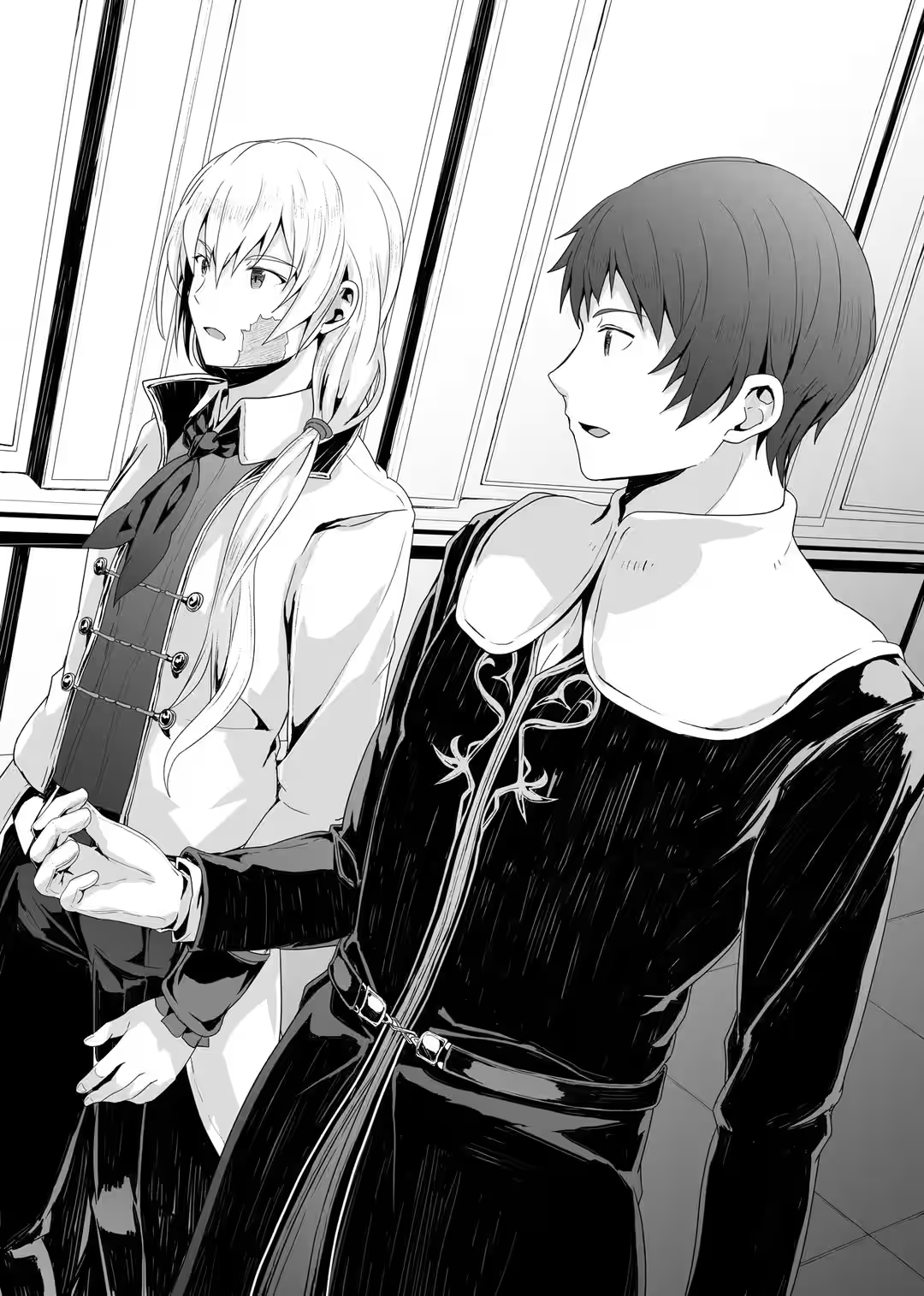
Charles de Agincarl was dangerous. If I wanted to avoid the risk he would pose in the future...
No. No, calm down. In the first place, why was he so certain that I was letting someone from House Agincarl live to use them as a rival against August? I could understand him thinking it up as a possibility, but he’d spoken as though it were a sure thing.
Maybe an imperial guard really had let something slip, and Charles was only pretending to as a leading question to hide it? There was the matter of the advice he’d given to Count Copardwahl too. Had an imperial guard turned a blind eye—or even cooperated—with Charles when he’d planted the idea in his cell neighbor’s head?
God damn it. The more I thought about it, the less clear things seemed. Maybe... Maybe I should have him killed after all.
“If Your Majesty would be so gracious as to pardon the presumption,” Charles de Agincarl began. “I have information which I believe may be useful to you. Namely, that Fried and August are on exceedingly poor terms, and that aspect of their relationship has spread among their children and, of course, their vassals too.”
Well, whether his question earlier had been a leading one or not, it wouldn’t have been hard for him to figure out that the House Agincarl member I was letting live was either Fried or one of his children. That was just a simple process of elimination.
“As for the former Duke Agincarl’s direct followers...” he continued. “I would expect their loyalties to shift to Fried and August at a roughly even split. There is no doubt that House Agincarl will fracture.”
I was well aware that he was taking control of the conversation, but part of what he’d said piqued my interest. “Inheritance law gives precedence to the eldest, no?” I said.
There were two systems of inheritance in the Empire, based on familial law and imperial law, but both gave priority to the eldest son—though of course, exceptions existed.
“It is a matter of names, Your Majesty,” Charles de Agincarl explained.
I didn’t know what his game was in all this, but I decided to hear him out for a little longer.
“Phillip de Garde-Agincarl, the former Duke Agincarl, bestowed a single one of his titles to each of his two eldest sons,” he said. “The title of Marquess Agincarl-Novei went to Fried Hudd Agincarl, and the title of Marquess Agincarl d’Decci to August de Agincarl. But the man did not allow either to use the name ‘Van’ for their house name.”
The “Garde” part of the Minister of Ceremony’s name originated from the Garde clan—the Bundarte imperial bloodline, in other words. He had been allowed its use because he’d been the son of the fifth emperor, but his offspring were considered the second generation of a branch family, and thus were not allowed the same privilege. They were, however, allowed to use “Van,” which indicated a branch family of the Garde clan.
One such case of this was Sigmund de Van-Raul, the man who’d named himself Duke Raul and declared rebellion against me. Strictly speaking, though, he was third-generation; the Chancellor had been of the second generation of the ducal house of Raul, hence his name: Karl de Van-Raul.
“Fundamentally, a house’s peerage is indeed inherited by the eldest son,” Charles de Agincarl continued. “However, there is an exception to this system that occurs when an eldest son is the head of his own separate house. More precisely, if any of one’s offspring marries into the inheritance of another house, or becomes the head of their own house, one can remove their inheritance rights for their original house.”
That made sense as a law; it would prevent the occurrence of hostile takeovers. “So you are saying his intent was to force them into independence?” I asked. By placing his sons at an equal rank, the Minister of Ceremony had essentially balanced them—and their entire margravial houses—across the scales from one another. It was inevitable that it had turned into a fierce rivalry over which marquess would inherit the title of duke.
“It was,” Charles de Agincarl confirmed. “Not complete independence, as they still bear the name of Agincarl rather than Agincarl-Novei or Agincarl d’Decci. However, if he had intended for either to succeed him, he would have given his chosen successor another peerage, at the very least. After all, he still possessed the titles of Marquess Sagon, Count Vigne, and Count Agincarl-Sey.”
Even branch families of branch families used “Van.” Rosaria was a good example: “Van-Chalongé-Cruveillier” indicated that she was of a branch house of House Chalongé, which itself was a branch house. Yet the Minister of Ceremony had forbidden his sons from using it, severing their relation to the Garde clan. It was highly irregular.
“From the circumstances you’ve described...” I said slowly. “One could interpret the former Duke Agincarl’s actions as signaling his intent to make you his inheritor. You were not given any peerage, and by legal right, your name is Charles de Van-Agincarl. Is that not correct?”
Indeed, he had not received any title at all. The reason he’d named himself Charles de Agincarl and avoided using “Van” was, as he’d claimed, out of consideration for his older brothers.
“I can assure you, that man had no such intentions.” There was derision in Charles de Agincarl’s tone, but it wasn’t directed at me. “His reaction to his daughter intervening in politics was visceral, to say the least, and the faster he could drive his sons away, the better. After all, family or no, how could he ever bear to hand what was his to another? Even when he reached the age at which one would retire into a life of quietude, he clung to his power with a vise’s grip. Bequeathing one’s station and responsibilities to the next generation is a nobleman’s duty, yet even that, he lacked the tolerance to do. No, that miserly old creature never spared a thought for anyone but himself.”
Each word that Charles de Agincarl spoke oozed with disgust so deep I wasn’t sure there was a bottom to be found. Though of course, it could have all been an act.
“But the vassals of our ducal house are blind. They failed to notice the fatal defect in his noble character.” Charles de Agincarl matched his gaze to mine. “So to answer Your Majesty’s earlier question: Yes. You were correct. The people of the ducal house of Agincarl sought to have me become the next duke. In plainer terms, that means that if I survive this civil war, they will again raise the flag of rebellion, and as their symbol, it will be my hands that will be forced to bear it.”
Looking back on our conversation, I wondered if perhaps, in his eyes, this had been the concluding point all along.
“Your Majesty, I assume you know the old rote that the nail that sticks out gets hammered down,” Charles de Agincarl said. “In the Agincarlish lands, there is another: The bent nail gets pulled out. I am a bent nail—I have been one my whole life. It is my fate to be wrenched out of place. Yet, if I had the choice of my own end, I would rather be hammered down. And if, by fate’s grace, I were allowed more, I would wish to prolong that end. This, I believe, is the only path I have to survival: becoming a nail that can be hammered down at any time by he who wields the hammer.”
I had asked him what his objective was. It seemed I’d gotten my answer.
“I have no doubt that Your Majesty will bring the Agincarlish lands to heel,” he said with conviction. “But your rule will be fraught with difficulty. The Agincarlish nobility may revolt again. Should you eradicate the ducal house of Agincarl, the seeds of rebellion will scatter without number, each small, but with the potential to grow thorns. As wide a net as you may cast, as much effort as you may dedicate to surveillance, you may still find yourself one step behind. But if a single member of the house were to survive, he would become the centerpiece. You would be able to focus your surveillance around him. And that is why, from the bottom of my heart, I pray for Your Majesty’s victory.”
Charles de Agincarl was not a man who had given up. Quite the opposite. He had already picked out his path to survival.
Fifth Era: Preparing for the Decisive Battle
Fifth Era: Preparing for the Decisive Battle
The Archducal Alliance
In the end, I decided to put the question of what to do with Charles de Agincarl on hold for now. Truth was, there were a number of benefits to keeping him alive. Keeping a finger on the pulse of any possible rebellions would be easier, for one, but I also wanted to make use of his legal expertise.
My end goal on that front was to take the common law that was so widespread throughout this age and put it onto paper, codifying it into an organized body. If Charles de Agincarl was going to swear loyalty to me, there was no way I would be letting his talents go unutilized.
Above all, I had already purged my relatives in the Chancellor and Minister of Ceremony, and if all went well, would be eliminating Charles de Agincarl’s family members in short order too. There’d hardly be anything left of the imperial family tree once I was done, so if I wasn’t careful, the nobility could see a massive upsurge in political influence.
Duke Warren was a good example. He was being cooperative at the moment, but there was no telling when he might turn into the second coming of Duke Raul. At the end of the day, balance was crucial. He was very much worth keeping around, but I also couldn’t give him too much power. It was, after all, quite possible that he was only being cooperative on the surface, and bore an intense enmity for me deep within. Only time would reveal what he truly thought.
***
I spent the next several days in talks with merchants and foreign diplomats. The latter were from the Empire’s various neighbors, and none of them had done much beyond paying their respects and conducting some light probing. By all accounts, it seemed that most other nations wanted to maintain a neutral stance throughout our civil war.
Evidently, they all thought it would drag on. It was clear that they were waiting for the Empire to weaken itself further before waltzing in and claiming whatever spoils they could.
As for our demand that the Teyanave Confederation extradite Hilaire Fechner, it had been met with complete silence—not even an acknowledgment. From all appearances, they had failed to apprehend her. Not only that, but it seemed they’d eaten quite a vicious counterblow from the Golden Sheep, who they’d tried to take over.
All in all, while the confederation had failed, I suspected the Golden Sheep would be getting in contact with us in the coming days.
But I had mentioned that I’d talked with merchants too, and in that regard, things were going well. To start with, a number of traders who had worked under the regency or Chancellor’s faction had begun to side with us—the emperor’s faction, so to speak. The majority of such merchants were based in the imperial capital. Initially, I had been leery of a possible ulterior motive, but apparently it was less a strategic maneuver from the merchants than it was the plain fact that all the craftsmen and workers that made up their clientele supported me.
We’d garrisoned Duke Warren’s army in the city, so public safety had been stable since the coronation. It had been a contributing factor in gaining the support of the commoner classes, and merchants always followed the way the market was trending.
Anyway, with my brand-new contingent of emperor’s faction merchants, the very first thing I did was borrow money from them.
Not that they’d been willing to lend me much. The Empire was, no exaggeration, in the middle of an economic collapse, so there was no faith in the state’s financial standing. Still, money was money, and a small amount from a handful of merchants added up to a sum I at least wouldn’t have sneezed at. We were heavily in debt anyway, so what was a little more on top?
What’s that, you ask? What about Count Nunvalle’s anxiety? I have no idea what you’re talking about.
As for the merchants who still supported Raul and Agincarl, there had been no progress regarding the fines they had agreed to pay on the imprisoned nobles’ behalf. It seemed they were still in talks with their patrons over the matter.
However, when it came to the lesser nobility—those of viscount rank and below—who were affiliated with the dukes, we’d be freeing a selection of them from their (admittedly easily escapable) house arrests on bail, paid by their merchants. Running the numbers, it would actually turn out to be one of our more profitable moneymaking ventures.
While putting these minor nobles on trial and sentencing them one by one was possible, it wasn’t realistic; there were just too many of them. I did want to curtail their numbers, eventually, but it simply wasn’t feasible right now.
Of course, while officially it was considered bail, it was for all intents and purposes a ransom—which was the word all the non-emperor’s faction merchants were using.
As far as the Empire was concerned, though, they were imperial nobility, not enemies. In this world, when a nation captured an enemy nation’s nobility, it was simply par for the course to demand a ransom for their release. However, we couldn’t apply that to the nobles in our captivity, because it would be equivalent to declaring them foreign enemies, and thus lose us the right to sentence them as imperial nobility under imperial law.
Not to get too much into the technicalities, but it was only their status as imperial nobility that predicated their duty to obey the Empire’s sovereign—not the stipulations of common law. That was only a method of obeying.
Thus, by frequently using the word “ransom,” they were really keeping me on my toes. I couldn’t publicly acknowledge the description, lest I brand the nobility as enemies.
From the Empire’s point of view, the lesser nobility were only under investigation for rebellion or other such illegal acts. At this point in time, they were definitively not considered criminals. This was why they hadn’t risked their lives by attempting to escape—doing so would be as good as declaring their guilty consciences.
In fact, some of them were probably even waiting for me to ask them for help due to our manpower shortage. I wasn’t against the idea, of course, but we still needed to figure out if we could trust them first.
Given all that, the lesser nobles who were released by the merchants paying their bail would likely go on to side with our enemies—hence why we’d only be releasing a small selection of them. Even if every single one turned against us, I didn’t think it’d be enough to impact the state of the civil war.
This was because the greater nobility (the marquesses, counts, and such) who’d been absent from the coronation were taking much longer than I’d expected to link up with the Agincarl and Raul rebel armies. Meanwhile, the fiefdoms of the greater nobility we had captive in the imperial capital were all in chaos as siblings fought over succession rights and branch houses attempted to rise in station by declaring their support for the emperor.
With the remnants of the factions unable to coordinate, rustling up the coin needed to pay the mercenaries I’d foisted onto Count Chamneau was actually the bigger problem currently, since defaulting would mean they’d scatter and resort to banditry.
Such being the case, that was where the money we’d borrowed from our merchants and earned from bail payments was going first. It would be in the form of Raul Gold and Agincarl Silver, which was only accepted domestically, but, hey, it was better than nothing, and at the very least would show the sellswords that we did actually intend to pay them.
Our moneymaking ventures had a secondary effect too: In the process of requesting bail from the merchants, it came to light that a number of the lesser nobility in confinement weren’t actually nobility.
The reason for this lay in the venal office policy implemented during the sixth emperor’s reign, where peerages (albeit mostly knighthoods) were sold to all buyers in large numbers. You see, these peerages were actually only supposed to have been valid for a single generation, but now, we had a bevy of people who were—knowingly or unknowingly—claiming to be nobility because their parents or grandparents had held peerage.
During Japan’s Sengoku period, there had been examples of families from the samurai class receiving ranks and offices from the imperial court in exchange for monetary contributions. This had eventually culminated in samurai assuming various positions despite never having been appointed at all.
In this world, the divide between nobility and commoner was starkly distinct. It stood to reason that anyone with a possible claim to blue blood status would milk it for all it was worth.
Traditionally, a knighthood in the Empire was a single-generation peerage, and the heavily sold once-venal rank of Familiae Eques—Knight of the Empire—was no exception. But while this was as obvious as the sky was blue to the greater nobility, one could not expect commoners to be experts on the ins and outs of the aristocracy. Some of them were definitely trying to fake it until they made it, sure, but I had no doubt others genuinely believed they were knights.
Regardless, we had a list of them now, and I couldn’t overstate how vital that was. When it came to pretty much anything in life, uncertainty was the scariest thing—and the biggest pain in the ass too.
Now, as for these pseudo-nobles, the merchants naturally had no inclination to pay their bail, leaving them high and dry. That put them in the perfect position for me to exploit them. I just, ah, had to figure out how. If I simply released them and put them to work as regular nobility, there was a good chance things would devolve into disorganized mayhem again.
Oh, the ones who’d already escaped from their house arrest? I felt bad about it, but I planned on wiping them out to make an example of them after the civil war was over. They might’ve gotten away with disobeying the emperor until now because the Chancellor or Minister of Ceremony had protected them, but I needed to show everyone that that wouldn’t be tolerated anymore.
On the flip side, I didn’t plan on doing the same to the lesser nobility we’d released on bail, even if they ended up siding with our enemies. They had, after all, obeyed the emperor’s directives—going on to obey Agincarl and Raul afterward didn’t negate that. With the scant power the lesser nobility possessed, it wouldn’t be reasonable to expect them to oppose the demands of the heavyweights.
***
My duties over the next few days mainly consisted of negotiations with the merchants—and pretty much only the merchants. On this particular day, after a meeting with them was over, Count Palatine Vodedt came bearing news.
“Your Majesty. The Raul and Agincarl rebel armies have shown new activity.” As the Count Palatine entered, Timona left the room, no doubt to tell the merchant who’d been scheduled next that there had been a change of plans.
It seemed the board state was finally developing. “What happened?” I asked.
“Both Sigmund de Van-Raul and August de Agincarl have declared independence from the Empire,” Count Palatine Vodedt reported. “They have also formed an alliance with one another, founded upon a mutual defense pact.”
Defense pact? So not a treaty of friendship or a nonaggression pact, but a solely military alliance in order to fight in unison against the Empire. “Gather our lords,” I ordered. “Then we would hear from you the details.”
Before hearing this news, I would’ve put our chances of winning this civil war as “likely, but still too uncertain to call.” Now? I knew we could win.
One of the many large rooms within the palace where I held my audiences was for ministerial meetings or conferences between bigwigs like the Minister of Foreign Affairs or Minister of Domestic Affairs, to name but two examples. During the years I’d been a puppet, however, all it had done was gather dust instead of fulfilling its purpose, so I’d had the servants tidy it up and refurnish it with a table and chairs.
Due to our break with the regency and Chancellor’s faction, the imperial demesne had lost access to the majority of its ladies-in-waiting. But because this kind of menial work fell under the purview of ordinary servants anyway, we didn’t feel the aftereffects here—they’d straightened the room out enough that no noble would have blinked twice at being received there. Of course, the servants, being commoners, couldn’t be completely trusted either, which was why we had intelligence agents mixed into the pool.
I sat at the head of the long table in the room’s center, with Timona standing behind me and to the side. On my left were Count Nunvalle, Count Palatine Vodedt, and Daniel de Piers from the Western Orthodoxy Church, in that order. On my right—once again in listed order—was Duke Warren, Fabio, the Marquess Ramitead, and...Vera-Sylvie le Chapelier.
If you’re wondering why she was here, it was to serve as the stand-in for her father, Count Chamneau, who had already left the capital with the mercenary army in tow. Actually, no, “liaison” was the more accurate term. Her gaze was fixed upon her feet—perhaps because she had not been among other people in a very long time—but she held the Chapelier earring in her hand. The magical item was capable of long-distance communication, and would allow Count Chamneau to participate in the meeting in real time.
And before you bring it up, yes, I had already asked if it could be mass-produced. The answer was apparently no, but I still hoped to find a way—instant long-distance communication would unquestionably revolutionize our concept of warfare.
“We have summoned you here for but a single reason,” I declared, looking at each of them in turn. “The rebel armies have finally displayed activity. Count Palatine Vodedt, give your report.”
“Yes, Your Majesty.”
By the way, I had informed everyone in advance that they didn’t have to stand while speaking. Part of it was to save time, but it was also to abide by the rule that one shouldn’t be in a position where they could look down on the emperor. I could likely get away with playing a little loose with that kind of thing right now, since the impact of the coronation still lingered, but it would be best to avoid giving anyone reason to take me lightly in the future.
“Sigmund de Van-Raul and August de Agincarl have taken the names Archduke Raul II and Archduke Agincarl II, and have declared independence from the Empire as the entities the ‘Grand Duchy of Raul,’ and the ‘Grand Duchy of Agincarl’ respectively,” Count Palatine Vodedt announced. “Furthermore, they have declared their entry into a defense pact which they have named the ‘Archducal Alliance.’”
The title of archduke didn’t actually exist in the Empire. While the Minister of Ceremony had often been addressed as such, it had been nothing more than an honorific for the guy, befitting the fact that his holdings were big enough to constitute a kingdom on their own. The archduke title did, however, exist in foreign countries.
During the era of the sixth emperor, the infamous Edward III, his constant losses had spurred him to set his sights on a war he had a chance at actually winning—namely, one against the Grand Duchy of Gaeweigh, a tiny country to the Empire’s north. He’d lost, of course; his invasion had been surrounded and crushed by an alliance of surrounding countries. However, the Empire, unable to stomach the loss of face that would result from losing against a country that roughly matched a regional imperial noble’s in terms of landmass, paid the then Kingdom of Gaeweigh an extortionate sum of coin to “officially” pledge subordination to the Empire, and gave it the new, important-sounding name of the Grand Duchy of Gaeweigh.
As you might expect, this gave the Empire exactly zero ability to meddle in Gaeweigh’s politics. Even we only recognized them as an independent state, which should give you a good idea of how watertight their “subordination” to us actually was.
Still, even if the new name of “Grand Duchy” had just been for appearances, it had seemingly been effective, because the tiny country had not been involved in any major conflicts since—likely to avoid the possibility of any further interference from the Empire.
Anyway, circling back to the issue at hand: Raul and Agincarl had both named themselves archdukes. “How lackluster of them,” I remarked. “We had been ready for them to proclaim themselves emperor, even.”
“That would have made it impossible for them to enter an alliance, Your Majesty,” Count Palatine Vodedt explained. “As both are of imperial family stock, one making a claim for the throne would naturally preclude the claim of the other.”
Yeah, I supposed that tracked. After all their interfactional conflict over who got to control the puppet emperor, it’d be impossible for them to put aside their differences and compromise over who got the throne. In other words, their declared independence was built on the presumption of their alliance—it was a way for them to ensure they remained at pace with one another.
“But why independence?” Fabio asked, a dubious note in his tone. “Remaining as rebel armies was a perfectly viable option for them, wasn’t it?”
The Empire, where the sovereign’s authority was relatively stronger, was actually somewhat of an exception among its neighbors, where insurrections happened all the time. In those countries, it wasn’t uncommon for the nobility to revolt whenever they were dissatisfied with their liege lord. Well, strictly speaking, the latter could be considered the “aggressor,” as this most often happened when the nobility made some sort of demand that their liege lord couldn’t abide by, to which said liege lord would—depending on the circumstances—send an army to beat said nobility into submission.
To put it into modern terms, it was kind of like a workers’ strike. Only kind of, though. Actually, given how Raul and Agincarl were the ones not listening to my demands, did that make me the workers in this scenario? Ah, whatever, I’ve lost control of this metaphor.
At any rate, how these things usually went was: If the rebels won, their liege lord would accede to their demands, while if the liege lord won, all the rebels would be put on trial as traitors. And if either side won by a significant margin, they’d be able to upsell on their demands or the severity of the punishment, respectively. That is to say, Raul and Agincarl’s rebellion had been, up until this point, just an ordinary, unremarkable part of the feudal system.
“They have likely done it to secure their holdings,” Count Nunvalle contributed. “For as long as they have not formally been transferred their fathers’ titles, we possess methods of granting their fathers’ lesser peerages—their margravial and comital titles, for example—to any of their relatives with inheritance rights. This would hold true even if, hypothetically, we were to lose and were forced to recognize them as the legitimate inheritors of the Duke Raul and Duke Agincarl titles.”
The count’s point was more easily illustrated using Agincarl as an example: While relatives such as Charles de Agincarl and Phillip de Agincarl were still alive, we could give them one or more of the Minister of Ceremony’s many titles, thereby carving out chunks of “Duke Agincarl’s” holdings. After all, if Charles de Agincarl’s words were anything to go by, the Agincarl siblings hated one another and wouldn’t be able to bear the idea of conglomerating.
To summarize, it suggested that Raul and Agincarl’s independence was an attempt to consolidate their holdings into a single entity—a grand duchy—and that they planned on using the conflict to gain the Empire’s recognition of their sovereignty by force.
If you asked me, they could’ve at least shot for a kingdom if they were going this far. It would’ve made the option of asking the Empire’s neighbors for help more available to them. Preventing that kind of foreign meddling was exactly why I had declared I would be handling diplomatic talks personally.
Then again, Raul and Agincarl borrowing foreign assistance might have forced us to do the same, and that would’ve risked becoming a bogged down, drawn-out proxy war. But if my read was right, that wasn’t their ultimate objective.
You might think that what they wanted was to inherit their predecessors’ holdings at any cost, but that wasn’t quite it. No, what they wanted was to inherit and return to the imperial fold as greater nobility, without having to face the consequences of all the crimes their houses had been party to.
“The purpose of their alliance and independence is to find a point of compromise,” I mused. “So in the end, they do not wish for independence at all.”
Their declaration of independence as grand duchies didn’t change their status as rebel armies in the eyes of the Empire, so there wasn’t much difference there. The important part was that it changed the reason behind their movement from “to inherit their predecessors’ holdings” to “to become independent.”
Needless to say, they still wanted to inherit, but by layering the idea of independence atop that goal, when it came to the eventual peace talks, they could play the “we’ll retract our declaration of independence if you recognize our succession of our predecessors’ holdings” card. By simply declaring independence, the so-called archdukes had created a situation where they could retroactively legitimize the independence by one: establishing that the emperor had tried to stop it, and two: “returning” into vassalage later.
In light of that, declaring independence as separate kingdoms and inviting foreign assistance would, in their eyes, risk too much damage to the emperor’s authority, thereby causing me to stubbornly dig in and refuse to meet them at a compromise. Since their goal was to rejoin the Empire and continue parasitically feeding off of it, they couldn’t let that happen.
But by declaring independence as grand duchies, our neighboring countries would see them more as autonomous states than completely separate entities, and likely restrain themselves from meddling. It also made the whole thing easier for the Empire to digest.
Or at least, that was my summation of what Raul and Agincarl were probably thinking.
“They’re making light of us,” I muttered.
Their entire plan was based on the premise that they would win the civil war. During the peace talks, they would need to be in an advantageous position—or at least an even one—if their plan of “giving up” on independence in exchange for concessions was going to fly.
Evidently, the possibility of losing hadn’t even occurred to them in their wildest dreams.
Perhaps spurred by my muttering, Duke Warren spoke next. “This is a fortuitous sign, Your Majesty,” he said confidently. “One who decides how they will handle the aftermath of a battle before it has even begun will always find victory beyond their grasp.”
I processed that for a moment. Uh, it didn’t apply to me, right? I mean, I was just planning for postwar eventualities, not making hard calls on anything. Like how I was considering setting Charles de Agincarl up as the next Agincarl head—it was just one possible plan of many. Mm-hmm. Yeah. I was safe.
“And here we were convinced they would fight us with bitter desperation until the end,” I remarked. Not that I wasn’t used to being underestimated, at this point.
“How shall we respond, Your Majesty?” Count Palatine Vodedt asked.
I leaned forward slightly as I gave my reply. “Fundamentally, our course of action remains the same. We will crush Raul first. Before that, however...” I looked at the earring in Vera-Sylvie le Chapelier’s hands, which she’d placed on the table. “Count Chamneau. Are you able to hear us?”
<I am, Your Majesty.>
It seemed that Vera-Sylvie had been spacing out, because when everyone’s attention fell on her, she dipped her gaze down, embarrassed. She reminded me a lot of a small animal.
“What is the state of the County of Copardwahl?” I asked.
I’d already had Count Chamneau lead the mercenaries—as well as his personal forces—back to his county. It looked like the ransom money from the nobles in our captivity would be enough to cover the sellswords’ pay. Even if it came up short, we had the option of borrowing coin from Duke Warren. Though of course, that would mean we owed him big time.
<It is in more chaos than we anticipated, Your Majesty. Control has already been lost by those in power, and the local nobility have sunk into a quagmire of squabbling and skirmishes.>
I made an appreciative hum. “Already?”
<That is but the least of it. A number of lesser nobles who fled from the imperial capital after the coronation turned to banditry, seizing Count Copardwahl’s castle to use as a base of operations for pillage.>
That actually represented a good opportunity for us, since we wanted to establish a link between the counties of Copardwahl and Chamneau, but I felt a little leery—things were almost going too well. Absent lord or no, would a region really fall into such disorder so quickly?
“General, can we take your use of the past tense to mean that you have already retaken the castle?” Count Palatine Vodedt asked.
<That is correct, Your Excellency. The remnants fled to a nearby city, but we have reached out to the city’s authorities with an extradition request, as well as to deepen ties.>
In other words, we already had an established base within the County of Copardwahl. “Excellent work, Count Chamneau,” I praised. “Proceed with caution.”
<I hear and obey, Your Majesty.>
“Your Majesty.” It seemed Count Palatine Vodedt had an additional report to make. “The confusion is not limited only to the County of Copardwahl—it is spreading all throughout the Empire. Our enemy’s new alliance will only serve to exacerbate the matter.”
At face value, it would appear as though the Archducal Alliance had consolidated our two enemies into a single, powerful entity. In reality, the act of forming the alliance was tantamount to dissolving the two great factions.
“The conflict between the regency and Chancellor’s faction was no minor scuffle of a mere few years,” the Count Palatine continued. “News of the alliance will, without a doubt, shock many of the former faction nobility—and we should expect no small number of them to hasten to Your Majesty’s side.”
I thought that over. Agincarl and Raul had placed their deep-seated grudges aside—at least for the moment—and joined forces in order to secure their lands. Yeah, that did sound like a ripe opportunity for former faction nobility to turn coat. Still, “no small number,” huh? I personally wasn’t so sure about that. Raul and Agincarl would’ve known what the fallout of their alliance would be, and would’ve already taken steps to tie down their circle of allies.
I would still make overtures, though. Even if they didn’t turn out that effective, every little bit helped, and I’d be happy enough if a number of faction nobility simply decided to wait out the civil war sitting atop the fence.
“We understand,” I said. “Issue a summons for the nobility to the imperial capital, and tell them to make haste. Additionally, we would like to begin negotiating with the nobles in custody—those with crimes lighter in nature—over a possible reduction in their sentences.” Ah. Wait. Who should I entrust this task to? Daniel de Piers was an option, but he could only act alone—I couldn’t put the Western Orthodoxy on it right now. In that case, someone of a high court rank would be best. “Duke Warren, may we entrust this task to you?”
“As Your Majesty commands,” he replied without hesitation.
Someone else chose that moment to interrupt. “A moment, please, Your Majesty,” Fabio said. “In our current circumstances, we may be required to conduct swift military operations at any given moment. Would it not be more prudent to have Duke Warren give his undivided attention to military movements for the time being?”
He had a point there. I just was about to amend my request when none other than Duke Warren disagreed. “No, that won’t be necessary,” he said. “Your Majesty—there is actually an individual whom I wish to introduce to you. He has a wealth of experience in military command, a solid grasp on politics, and is a former general of the Empire.”
The duke was playing matchmaker, now? Well, we did have a shortage of manpower, and the guy’s résumé sounded pretty appealing. Ideally I’d have wanted Duke Warren to bring this up after the meeting, but I supposed it wasn’t a big deal.
“Very well,” I said. “We assume he’s waiting outside? See him in.”
***
Timona exited the room, returning shortly after with a man of medium build and features deeply graven by the weight of age. The young attendant passed me a pair of letters. One had the man’s personal history written out on it—a letter of recommendation, of sorts, I assumed.
His name was Joel de Bourgault-Ducoudray, and according to the letter of recommendation, he was a renowned military commander who had been active during the reign of the previous emperor, earning himself a reputation as an equal to the Twin Champions—a pair of highly distinguished military commanders, and the pride of the Empire. They were also known as the Twin Champions of the Empire, or Jean’s Twin Champions, having served under the crown prince during his long frontline military career. During the Second Apperaas War, the Twin Champions had crushed the Empire’s three southern neighbors badly enough to leave all of their neighbors quivering in their boots.
Incidentally, Duke Warren wasn’t one of the Twin Champions. As much as he had a record of distinguished service all his own, it didn’t live up to the frankly incredible feats they had achieved. It probably said something about my luck that neither one of those prodigious military commanders were still around for my reign.
Anyway, I’ll give you the short version of Joel de Bourgault-Ducoudray’s history.
Of his major military achievements, he had served as a general in the Second Apperaas War, during which the army under his command had held back the overwhelmingly numerically superior main hosts of Alain IV, King of Apraada, and Carlos II, King of Benima. Worth particular note was the Battle of Merceo Plains, where his robust defensive encampment had forced both armies to abandon their attack, eventually culminating in the siege break of Fort Gurranque, the capture of Fastiau city, which had served as the through line between the kingdoms of Apraada and Benima, and the Battle of Elseine Pass, a string of victories which had ensured constant disruption of the two kingdoms’ coordinated war effort.
In the Battle of Fazio, the decisive engagement of the war, he clashed against the flying column of Geteau de Charneuf, a renowned military commander from Benima. Even in the midst of battle, he’d had the wherewithal to observe Crown Prince Jean’s main imperial force meeting the enemy farther away, and had sent his reserves as reinforcements—a move which became the decisive blow that won the entire Second Apperaas War for the Empire.
During the Third Apperaas War, Joel de Bourgault-Ducoudray had achieved a string of victories against the Kingdom of Rocourt, making it as far as the capital city before news of Crown Prince Jean’s death caused him to make the call to retreat. News of Emperor Edward IV’s death had come shortly after, throwing his forces into chaos, but he’d kept them disciplined enough to withdraw in good order and unite with the remnants of the crown prince’s force. He’d then managed to recover Jean’s body and return to the imperial capital.
And that about summed it up. I noticed quite a number of names had come up that I didn’t recognize—I’d have to look into them later.
Still, just from his final achievement alone—managing to keep the army together for an orderly retreat after the deaths of the crown prince and emperor—I could tell he was no ordinary commanding officer. Sure, he might’ve suffered some losses in the process, but he’d achieved a successful withdrawal in a situation where a weaker leader would’ve seen his men scatter to the four winds.
“We believe we understand now why you have Duke Warren’s recommendation,” I said. “Yet, this raises another question. Why does a man of your immaculate record possess no peerage?” Or perhaps this was one of those common “exaggerate your work history on your CV” kind of situations?
“Ah, therein lies precisely the reason I am being introduced to Your Majesty in this manner,” Joel de Bourgault-Ducoudray said. “You see, while I am indeed nobility, I am not imperial nobility, but that of the imperium.”
In this era, it actually wasn’t that rare for a servant of one country to enter the service of another. It would be problematic if the individual had simply cut and run, of course, but there were legitimate methods that could be pursued. Think of it this way: When you’re looking to make a job change, sometimes you inform your employer beforehand and they offer you a pay raise or other benefits to stay, right? Well, that was how it worked among the nobility too. If, for example, a vassal of Duke Warren’s wanted to work instead for Count Chamneau, all they would have to do is formally inform Duke Warren of their intent.
Of course, doing so would naturally result in having to renounce one’s peerage and/or official positions. The fact that Joel de Bourgault-Ducoudray still possessed his noble rank meant that...
“You came seeking asylum?” I questioned.
“His grandfather did, Your Majesty,” Duke Warren confirmed. “Rolf de Bourgault-Ducoudray fled to us after losing a political conflict.”
“Grandfather? That would be some time ago, then,” I said to Joel de Bourgault-Ducoudray. “Why have you not renounced your title? Do you perhaps still feel attachment to it?” Maybe it was one of those “for generations, my family’s dearest wish has been blah, blah” kind of things.
“No, Your Majesty,” he said. “I was simply not permitted.”
Hmm? Ahh, right. I think I got the picture. In short, the Empire wanted to use him.
Separated by the natural barrier represented by the Heavensreach Mountains running down the center of the continent, the Empire—to the west—and the Imperium—to the east—had been at odds with each other for centuries. And while the Heavensreach were precipitous enough that even a seasoned Sherpa would have difficulty crossing them, there was a single ravine through which you could squeeze an army, if you really tried.
This ravine, which curved in a loose S-shape, was known as the Heavensreach Pass, or simply the Pass, and it was the site of constant conflict between the Empire and the Imperium. In fact, if you included simple skirmishes, hardly a year ever passed without some sort of battle breaking out.
Incidentally, the last several years were among those rare exceptions. As for why, that was because the Teiwa Imperium currently controlled the Pass in its entirety. Yep! You heard that right! Another future problem to deal with on my ever-growing pile! Fun!
Fortunately, given the narrow confines of the Pass, sending a massive invasion force through it was effectively impossible. That was why an all-out war had never happened between the Empire and the Imperium—which wasn’t to say our relationship didn’t resemble a vicious mongoose trapped in a box with a spiteful cobra. Centuries of constant conflict and sabotage did not good friends make.
If the hated archenemy of the Bundartian people were the Garfurians, then for the Empire, it was the Imperium.
In Joel de Bourgault-Ducoudray’s case, the Empire could use him as a bargaining chip, or set him up as a figurehead and meat shield. No wonder he hadn’t been allowed to renounce his title.
“His heritage is the sole reason he is not spoken of in the same breath as the Twin Champions, even though his achievements rival—or even exceed—theirs,” Duke Warren explained.
“Let us guess,” I said. “Those of the nobility who can trace their honorable bloodline back to Rotahlian times pushed against it?”
“Correct, Your Majesty.”
To Rotahlian nobility, anyone from the Imperium—even an exile—was the enemy. I had no doubt that many would’ve strongly protested his presence, claiming he was a spy. It made me wonder if Duke Warren had chosen this place and time for our meeting to ensure Joel de Bourgault-Ducoudray encountered as few detractors as possible, thereby limiting the blowback.
Quite honestly, I had no solutions for situations like this, where the root of the issue was simply a knee-jerk emotional reaction. It was for the exact same reason I hadn’t summoned Péter Pál, the Atúr chieftain, to the imperial court. Instead, I’d had him and his highly mobile cavalry force on standby at the outskirts of the imperial capital. It was a far cry from their usual nomadic lifestyle, so I was grateful to Péter Pál for managing to keep them sitting still for so long.
It was unjust, ungrateful, and just plain unfair that I hadn’t summoned him to join this inner circle of mine, but my hands were tied on this matter. Not only was he of a different ethnic group, he was technically a heretic of a different religion. I couldn’t have him join us—not for as long as I didn’t know how Count Nunvalle and the others might react.
I perused the second letter. It elaborated upon how, not wishing to be dragged into the mess that had been the Three Houses Coup, Joel de Bourgault-Ducoudray had renounced his rank of general and departed for the Gotiroir, entering the service of their chieftain, Gernadieffe. It then went on to list his achievements in his service—actually, it read more like a military report on how the Gotiroir were currently kneecapping the Raul army. It was good to have detailed news.
According to the letter, the Gotiroir had so far managed to avoid outright battle with the Raul army, leading them around by the nose with continuous harassment and ambushes. As soon as the enemy showed up in force, the Gotiroir retreated to the mountains, where they gave any pursuers a thorough drubbing.
Conversely, the Raul side hadn’t been stupid enough to send their main force after the Gotiroir. While they’d let some of their more rash frontrunners be decimated, they’d prioritized consolidating and reorganizing the bulk of their army.
The letter also included information on what was believed to be mercenaries that the Raul army had hired, as well as a number of more internal details about the army’s affairs. Apparently, the sudden civil war had caught them unprepared, and they were suffering a provisions shortage. The fact that they were still bolstering their numbers, though, suggested they had a plan in mind for that. Finally, it seemed that among the sellswords they’d hired, many were mercenary bands known for a history of activity in the Imperium.
That was as good as the Imperium outright declaring their intent to meddle. I’d thought they’d still have their hands full with the Ordination Feud from a few years back, but—actually, wait, it would be the opposite, wouldn’t it? Right now, they’d want to sabotage anything and everything foreign they could get their hands on to prevent their enemies from meddling in their affairs.
“Joel de Bourgault-Ducoudray,” I said commandingly. “We bid you to be direct with us. This letter paints the Gotiroir effort against the Raul rebel army as being quite in our favor, but what is your evaluation?”
“Your Majesty,” Joel de Bourgault-Ducoudray acknowledged. He remained in a kneeling position, and his words flowed smoothly and without hesitation. “Currently, they are indeed akin to a child’s plaything in our hands. However, once the rebel army consolidates itself and commits a dedicated effort toward pursuit, the Gotiroir’s limited numbers will make any battle a struggle. To compensate, the Gotiroir will retreat to the Heavensreach, burning fields and killing livestock in their wake. That will buy a reasonable amount of time, but not enough to allow for any complacency.”
You know, that sounded a lot like Gernadieffe telling me in a roundabout way to get my butt into gear...
“In essence, the Gotiroir wish for us to pincer Raul at once, correct?” I confirmed.
“Not at all, Your Majesty.”
Huh? Had I been off the mark? “Duke Warren, your thoughts?”
“Mountain warfare is the Gotiroir’s bread and butter,” he provided. “As long as we provide them with sufficient support, they should be able to continue luring the Raul army around for as long as they wish.”
Support, huh? That meant provisions, among other supplies. So the key problem here was how we got that to them. Punching right through the Raul army, while an amusing mental image, wasn’t realistic. Would we have to establish a supply chain through the Kingdom of Rocourt, then?
No, extending any sort of friendly relations to Rocourt would invite backlash from former imperial nobility who’d lost their lands to them. Maybe taking out the Raul army while the Gotiroir still had breathing room was the right move after all.
“So if we cannot defeat Raul at an early stage, it will be necessary to establish a supply chain—as well as devise a method for how we will establish said supply chain.” I cut myself off and fixed my gaze on the man before me. “Joel de Bourgault-Ducoudray. We hereby permit you to reenter the Empire’s service. For the time being, you will serve as an adviser.”
“I shall strive to be worthy of the honor Your Majesty has granted me.”
This was the first time we’d met, so I trusted him about as far as I could throw him. Still, it was hard to believe he had any ties to the Raul army, given that he’d led the Gotiroir in a number of skirmishes against them, so he had that going for him, at the very least. Hence why—at least initially—I would see how he fared on our front line against the Raul army.
In fact, his history at the Battle of Merceo Plains, where he’d repelled the enemy from a defensive position, suggested he was ideal for what I had in mind.
“Duke Warren,” I said. “Aside from the matter we discussed earlier, we also wish to entrust you with training the new recruits conscripted from the city.”
“Understood, Your Majesty.”
“As for our movements against the Raul army, our front line shall be the fortress we are constructing on Chelán Hill, at the border between the Duchy of Aphoroa and the County of Veria.” This was the construction project I’d mentioned in my speech to the public. It was already gearing up to begin. “We wish to entrust on-site command to Marquess Ramitead. Joel de Bourgault-Ducoudray, we wish for you to assist as counsel.”
That was a competent combination, but no substitute for Duke Warren. “The necessary measurements and surveys have already been completed,” I continued. “Planning for the fortress itself will be done here in the capital. We wish for you to advise said process.” The groundwork I’d requested during my tour was already in place. It still needed to be fine-tuned, but the rest of the planning could be done here.
“A...fortress, Your Majesty?” A touch of reluctance entered Joel de Bourgault-Ducoudray’s expression. “That is something the enemy will not overlook. We will have to choose between a hasty, small-scale construction, or suffering an attack while it is still incomplete.”
If the fortress was completed, we could cooperate with the Gotiroir and cause the Raul army to die by a thousand cuts. We’d use the fortress as a staging point for invasions into Raul holdings, only to retreat and hole up inside when they turned a significant enough force our way. The Gotiroir could then attack while their back was turned, and vice versa. Repeat ad nauseam.
Naturally, the Raul army would be forced to react. And if given the choice between going after the battle-hardened Gotiroir or a group of civilian conscripts, I think we all know who was getting picked last for the baseball team.
“Rest assured. We call it constructing a fortress, but in reality, we have no intention of seeing it completed,” I revealed. I went on to explain the defensive encampment’s purpose not only to repel outside attackers, but also to prevent those within from fleeing.
“Ah,” Joel de Bourgault-Ducoudray said knowingly. “In that case... Ah.”
“Bear in mind this is the strategy of a layman,” I said. “We have contingencies in mind should it fail, of course. But what do you think? Will it fulfill its minimum purpose of luring in and holding out against the enemy?”
“Yes, that should be quite attainable.” There was clear admiration in Joel de Bourgault-Ducoudray’s tone. “Ah. I believe I understand why Your Majesty entrusted this, in part, to me.”
With that, I had explained the strategy we’d be using against Raul. By my reckoning, it should’ve more than sufficiently demonstrated to my lords that I was putting the sweat of my own brow into our conflict with the Archducal Alliance.
What they didn’t know, of course, was that the fatal blow against the alliance would take a different form entirely. Namely, my plan to free Phillip de Agincarl from imprisonment, manipulate him into raising his own army, and pit the two Agincarlish powers against each other. But while it was fine if that took a while to cook, I had to, at the bare minimum, crush Raul in the meantime. The faster, the better too, since we didn’t know what moves our foreign neighbors would make. Hence, Chelán Hill.
As the emperor, dignity precluded me from simply announcing that I was going to free a criminal and manipulate him to my own ends. In fact, Count Palatine Vodedt had even prepared a set of scapegoats.
At the end of the day, I just didn’t know how Duke Warren and the others would react to such “dirty tricks.” After all, unlike in a video game, I couldn’t see their loyalty stats. Being overly cautious was only paranoid until it wasn’t.
The Age of Gun and Cannon
Several days had passed since the news of the Archducal Alliance.
The Empire’s power struggle had shifted from a three-way brawl to a head-to-head conflict—one between me, the emperor who would rule the nation, and the dukes, who had declared independence.
The land from the Empire’s center to its south was under our control, but the alliance meant that we were now in a pincer between the Grand Duchy of Raul to the east and the Grand Duchy of Agincarl to the west.
Having said that, it wasn’t like the long years of cutthroat conflict between the regency and Chancellor’s faction had simply vanished into thin air. In their efforts to puppeteer me, among other things, they had shed rivers of blood and planted the seeds of some deep grudges indeed. I could very safely assume that they wouldn’t be putting aside their differences to make a coordinated assault on the imperial capital anytime soon.
Furthermore, the Gotiroir, our allies in the Empire’s eastern highlands, had already begun their attacks on the Raul army. Thus, once we made our move, it would be the Raul army in the jaws of an east-west pincer this time.
But if we wanted to pull that off, we had to deal with the problem of the Agincarl army. Couldn’t have them striking us from the rear while we were dealing with Raul.
Fortunately, my plan in that regard had proceeded smoothly, and was moving on to the implementation phase.
Enter Phillip de Agincarl, grandson of the former Duke Agincarl and son of Fried, the Marquess Agincarl-Novei, who I’d executed. I’d imprisoned him for life, but he’d recently made his escape and successfully fled the imperial capital—with the Minister of Ceremony’s corpse to boot. Ah, and I should mention that he’d done it with the help of one of our agents, who was pretending to be a surviving vassal of the Minister.
Count Palatine Vodedt’s agent had pulled the endeavor off perfectly, and matters were proceeding exactly as planned.
The idea was that it would drive a wedge into the power base of August, the Marquess Agincarl d’Decci. The best-case scenario was if Phillip mustered his own army to oppose August’s, but even if they joined forces, it would take the edge off the threat that Agincarl represented. Hard to stay sharp when distrust lurked within and everyone was worried they’d be stabbed in the back.
If my read on things was right, though, Phillip would oppose his uncle. After all, Marquess Agincarl d’Decci had occupied the holdings of Agincarl-Novei and was throwing his weight around like he owned the place.
If that wasn’t enough, unlike Raul, there were multiple siblings and more distant relations in the Agincarl rat race. August hadn’t actually been picked by the Minister of Ceremony to succeed the house, so the Empire’s western regions were showing some resistance to his declaration that he was now Archduke Agincarl. The only reason he currently held influence over all of the former Agincarlish holdings was simply because he’d had no rivals around when he’d been establishing himself.
Moreover, entering an alliance with the Chancellor’s faction—the regency’s longtime sworn political enemies—as his very first policy wasn’t exactly doing wonders for his popularity.
In contrast, the recently unincarcerated Phillip de Agincarl was the eldest son of Fried, who had been in turn the eldest son of the Minister of Ceremony. Since the Empire’s inheritance system was founded on primogeniture, that meant both August and Phillip had legitimate claims to succession.
Well, technically, neither were officially recognized in the eyes of the Empire. But what mattered in this case was how the multitude of Agincarl vassals would react.
Unlike August, who’d avoided the more direct consequences of my coup simply by virtue of being at home at the time, Phillip had made a “daring escape” from his life sentence and had even “recovered” the Minister of Ceremony’s remains. When he got back, everyone who was unhappy with August would flock to his banner. It would cause a rift in the Agincarlish camp that would give us a window of opportunity to launch an attack on the Raul army.
In any case, I was grateful to Phillip de Agincarl for being so gullible. A number of very obvious questions hadn’t occurred to him: Why had the Minister of Ceremony’s corpse, part of which was put on public display, expressly been preserved from decay? For that matter, why hadn’t it been buried yet, after all this time?
Incidentally, the members of the imperial guard who had been on duty at the time of Phillip’s escape had been executed.
Said guardsmen had been the ones who hadn’t cooperated with my coup of their own volition, but rather had simply been unable to resist the flow of the current. That alone wasn’t worthy of execution, but they had also been selling information to Agincarl- or Raul-associated merchants.
For the record, I’d let Balthazar be the one to decide what to do with them. It appeared they’d been very uncooperative with him, so it hadn’t taken him long to choose the death penalty.
Maybe I should rebuild the imperial guard from the ground up after all...
***
Such were the concerns on my mind as I allowed Duke Warren and Joel de Bourgault-Ducoudray to guide me to a certain building in a corner of the imperial demesne.
Upon closer inspection, the building differed in construction from the other palaces and mansions in the demesne. It had likely been built to be a warehouse rather than a residence.
The reason I’d come here was to inspect the weapons currently employed by our soldiery. While we’d be conscripting common citizens soon, we still didn’t have the arms to put in their hands. We’d be procuring more, of course, but I wanted to squeeze the most out of what we had. If there was stuff lying around that could be used, I wanted to use it.
The first thing that leaped out at me when I entered the warehouse were the cannons. There were several of them, almost resembling large concrete playground pipes, all sitting out in the open. It appeared the rest of the weaponry had been neatly stored away in crates and boxes.
Duke Warren opened one and retrieved the contents. “All the arms taken from the soldiers we disarmed or found abandoned in the city have been gathered here,” he explained. “Nevertheless...”
“It’s mostly firearms,” Joel continued. “We can’t put these in the hands of amateurs.”
“Is that how it is?” I asked. When it came to guns, my impression didn’t go much beyond “point it at a guy and pull the trigger.” Though, now that I considered it, I was thinking of modern-day Earth firearms.
“It is. From loading the weapon to firing, there are a number of rather involved steps. Even after firing, one must follow correct procedure lest they cause an accidental discharge. I’ve seen these given to the citizenry during a siege—they were overrun before anyone could fire a second shot.”
Joel retrieved a gun and a piece of cord from the crate. The gun was a matchlock that resembled examples I’d seen in Earth’s museums.
“These are known as sudum guns, and are quite widespread,” he explained. “Shall I give a demonstration?”
“You load it with gunpowder and ammunition from the muzzle, pressing it down with a rod,” I said. “Then you place more gunpowder into that small pan and light it with a piece of cord. Is that correct?”
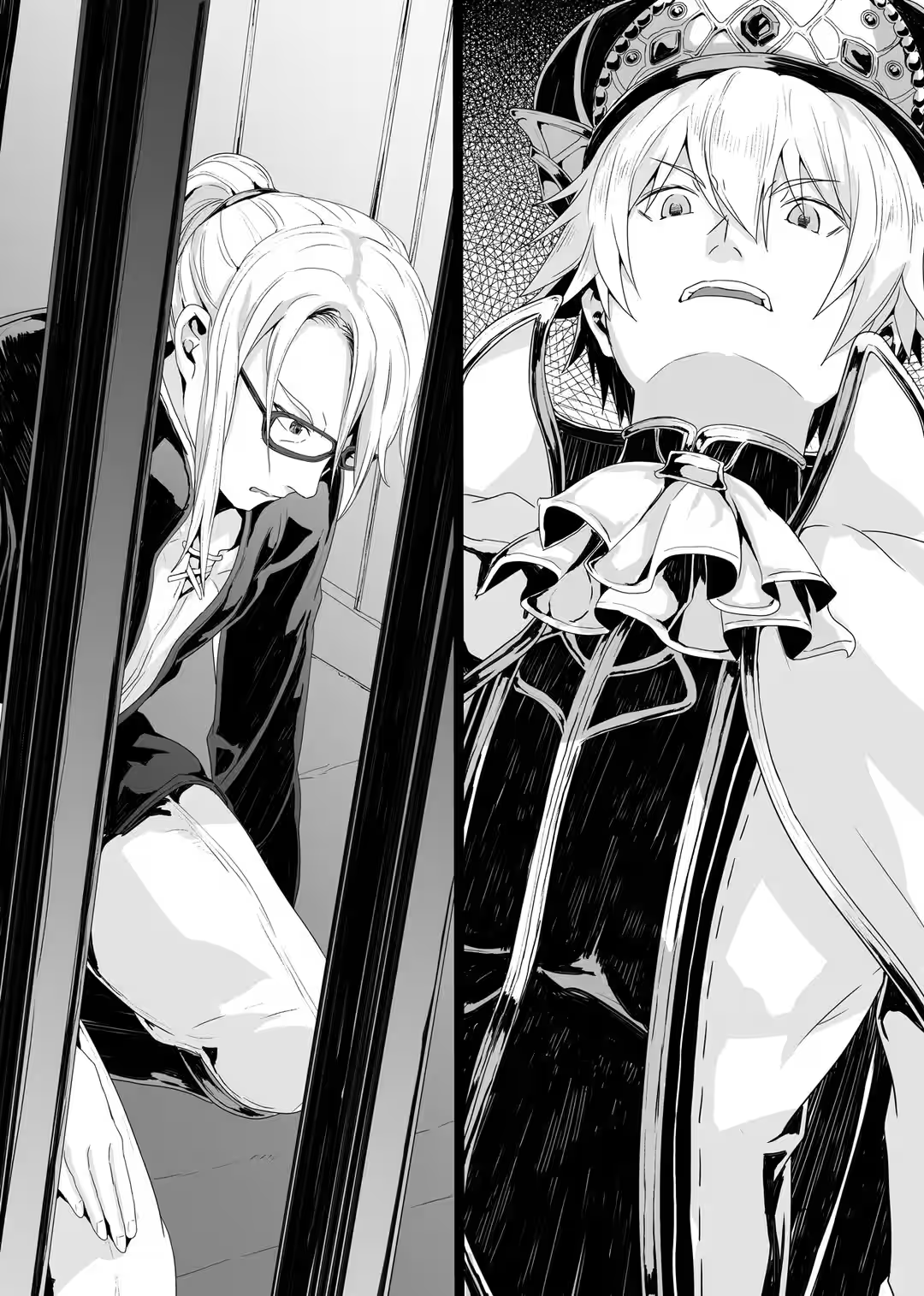
“Oh, very impressive, Your Majesty. Have you seen one used before?”
I only knew about the process; I’d never fired one myself before. But what he’d said earlier was right. With so many steps necessary to fire a reload, forget amateurs—even trained professionals would have a difficult time managing amid the chaos of a battlefield.
“We presume this weapon is rather prone to accidents,” I mused.
“Just as you say,” Joel agreed. “Misfires, accidental discharges, and the like are common in the hands of the untrained, and those who witness such incidents tend to lose their composure and desert.”
Yeah, that figured. It would only be even more true in the case of the conscripts we’d be gathering using the fortress’s construction as an excuse.
“With enough training, we would be able to make use of these sudums,” Duke Warren said. “But given our resources and timeline, providing said training to every militiaman will be impossible.”
“We understand that very well,” I agreed. “In the first place, they are officially only being trained ‘in preparation for an emergency.’ It would stretch belief to have our construction workers undergo in-depth firearms training.”
Well, if worse came to worst, we could always just have them throw rocks.
Hey, don’t give me that look. I wasn’t throwing in the towel here. Rock throwing was a perfectly effective method of attack that anyone could do without training. It could even kill if you got lucky or aimed well.
“I believe it would be more fruitful to teach them how to maintain a spear wall,” Duke Warren said, turning his gaze to a corner where evidently the spears and pikes were stored. “It could easily be explained as a defensive measure to ward off dangerous wildlife.”
“If only we had crossbows or the like,” Joel grumbled, scratching his head in dissatisfaction. “The only stock at hand is spread among our various towns and cities for defensive purposes, and it isn’t as though we can demand they hand it over.”
That made sense; any ordinary citizen could use a crossbow. It was a bit ironic that the quality that led to it being in the possession of the Empire’s settlements was also the quality that made it the weapon we needed on hand the most right now.
Joel continued. “We had some among the weaponry we seized, but Count Chamneau’s forces took them.”
“Ah, the mercenaries?” I said. It spoke a lot toward how useful crossbows were in this era if sellswords made common use of them. “We could put the city’s workshops toward building more, but whether they would produce enough in time for open conflict is...” I trailed off. This went without saying, but the craftsmen in this era had to create each weapon by hand. There wouldn’t be enough time.
“If we use the spears and crossbows we have, as well as provide firearms to volunteers...” Joel paused, considering. “We should be able to achieve the bare minimum for arms quantity by the decisive battle.”
“Achieving only the bare minimum would be playing with fire. We shall put some thought toward how we will acquire more.” That was when my gaze landed on the cannons I’d spotted earlier. “Incidentally, what are those cannons? We have been curious about them since we arrived.”
“The flock cannons? I’m...afraid those are unusable, Your Majesty.”
The cannons had fat barrels and metal wheels, giving them a powerful appearance, but appearances weren’t everything, it seemed.
“The cannons our army uses are carvers, meant for siege warfare,” Duke Warren explained. “The Raul army uses mass-produced pot cannons, which can be reasonably transported via horse-drawn wagon.” He placed a hand on a flock cannon and continued. “As for flocks such as these, they possess more destructive firepower than carver cannons.”
Yeah, I could tell they packed a punch from how they looked. What made them unusable, then?
Joel picked up where the duke left off. “But the cannon itself cannot withstand its own explosive potency—it will break after several shots. What’s more, it has a cripplingly long cooldown, and given its weight, conveying it to the battlefield is rather, well...” He rubbed his jaw. “Its fearsome appearance means it works well enough if you just want to look threatening, but then again, carvers would achieve the same effect.”
Hmm. Put another way, that meant the flocks could withstand several shots. As for the cooling period, well, there was a way to compensate for that too. “Ensure the necessary weaponry gets serviced and supplied to our forces,” I ordered. “Including the flock cannons.”
“Of course, Your Majesty. You have some purpose for them, then?”
“Merely as a contingency. Ensure the carvers are ready for use too, naturally.” As I’d mentioned, we had to use everything we could get our hands on.
***
“Your Majesty. I come bearing a report.”
Ever since I’d seized control over the regions around the imperial capital that belonged directly to the throne, I’d been receiving a steady flow of written reports about them, ranging from agricultural and mining surveys to analyses of the state of the imperial capital’s security. That being said, they were unfocused and had no standardized format. The former made their contents easy to digest, but the latter made it tiring to scan through them. Once the civil war was over, I’d have to streamline the process.
“Count Palatine,” I said. “I imagine it must be important if you’ve come yourself.” Maybe an emergency too, if he hadn’t had the time to delegate. Or perhaps it was highly confidential.
“No, it is simply something you should know regarding the escaped Phillip de Agincarl,” the Count Palatine said. “It appears the Storytellers have ensured that he made contact with the nobles resisting August.”
“Oh? Have they indeed?” That was beneficial for my plans, certainly. But it was less than ideal that they hadn’t informed me beforehand. “We will be sure to caution them at a later date. Is there anything else?”
“Do not put too much trust in them, Your Majesty. They see the Empire as nothing more than a convenient vessel. If it begins to sink, they will abandon ship on a lifeboat of their own.”
Yeah, that was my read on them too. They were doing the same thing with the Western Orthodoxy, utilizing it to their own ends. At the end of the day, their primary objectives were to safeguard transmigrators and dismantle the remnants of ancient technologies.
“We know,” I said. “But for as long as we’re still seaworthy, they are highly valuable members of the crew. Not mere idle passengers.”
Of course, that description was true of a Watchman like Count Palatine Vodedt as well. He’d turn against me the moment he judged me to be an enemy of the Empire.
The Count Palatine seemed satisfied to leave the matter there. He held out another written report. “Regarding the non-construction-related recruitment effort...” he began.
It didn’t escape my attention that he had failed to acknowledge what I’d said. I’d let it slide, though. It hadn’t been a pressing issue.
I placed the report I was holding on my desk and accepted the new one, looking over it. “Volunteer numbers are higher than we projected?” I confirmed.
“Yes. The city’s citizenry are quite vocal about their high expectations for you, Your Majesty.”
Were they now? And here I’d thought they would’ve viewed me with apprehension because of my age.
The Count Palatine continued. “It is good that their morale is high, but exceeding our projected numbers by too large an amount could cause budgetary issues when it comes time to pay them. Though reducing their salaries is an option.”
“No, we can’t do that,” I asserted. Gaining a reputation as a miser would hurt any future policies I tried to implement.
Even so, the Count Palatine was right to be concerned; there was a limit to how many people we could take on. If not for budgetary concerns, then for the simple fact that we had a critical arms shortfall. Orders had already gone out to commission the city’s craftsmen to forge weapons and cannons, but those would take time. And we had a fixed window of opportunity—we couldn’t just wait around until we were fully ready.
“Prioritize those with hunting or combat experience,” I decided. “And nudge some of the overflow toward the city guard.”
“Understood, Your Majesty. Moving on, then.”
“There’s more?”
Count Palatine Vodedt produced two more rolled-up sheets of parchment. “Only two worth Your Majesty’s consideration,” he said. “They pertain to the matter you entrusted to Duke Warren, regarding the summons of the nobility.”
***
Due to the formation of the Archducal Alliance, the Chancellor’s faction and regency had lost their antagonistic framework. However, the former faction nobility were still around, and the new development had left some of them displeased. There were, for example, certain nobles who had been essentially forced to join the Chancellor’s faction because the rivals with whom they’d had land disputes had been of the regency.
To begin with, neither the Chancellor nor Minister of Ceremony had been the liege lords of their faction nobility. As much as they’d liked to throw their weight around and act like it, they had only, at the end of the day, been dukes in station. And now their sons had declared independence, which was as good as declaring themselves sovereign and liege lord. Though perhaps in their eyes, nothing had really changed. After having the privilege to ignore one’s boundaries for so long, one tends to forget they were ever even there.
To the former faction nobility, however, it would seem like quite the significant difference indeed—an unbearable one, for some. The faction leaders they’d bowed their heads to because of a favorable profit-loss calculation were now asking them to bow their heads regardless of whether it posed them any benefit at all. Perhaps they hadn’t said it in such clear terms yet, but even the possibility of that happening would be reason enough for the former faction nobility to hesitate in joining the Archducal Alliance.
In plainer terms, while it might have appeared as though the Empire was currently split into two powers—emperor and Archducal Alliance—the largest power bloc was actually the majority of the nobility left fence-sitting.
I had put out a summons for those nobles to come to the imperial capital. Well, I’d bid Duke Warren to do it, that was. There was a reason I hadn’t issued it directly. Personally, while it would be nice if any of the nobility joined our side, I didn’t mind if they didn’t either. It would be no disadvantage to us if they simply remained on the fence. If I issued a direct summons, however, there was a chance they could interpret it as an ultimatum. Pressed by the emperor to return to the imperial capital, their choices would boil down to yes or no, meaning if they didn’t become an ally, they’d become an enemy—and we couldn’t have that.
At the same time, I had my reputation as the emperor to consider. It was easy to forget, given how irregular everything about my situation was, but fundamentally, I was supposed to possess absolute authority. Bowing my head and asking the nobility to lend me their strength could very well come across as weakness. I could afford to play that card with a select few nobles who’d be vital to me, but going around saying “pretty please” to every fence-sitter was out of the question.
A bothersome set of circumstances, overall, but it was why I had bid Duke Warren to issue the summons in my stead.
“We imagine the majority have simply chosen to maintain the status quo?” I questioned.
“It appears so,” Count Palatine Vodedt confirmed. “Most of the responses can be summarized as a promise to hasten to Your Majesty’s side ‘as soon as I have pacified the disorder in my lands.’”
I’d figured as much. Still, most wasn’t all.
“Of these two letters, one is from the County of Ethaiq,” the Count Palatine explained.
The County of Ethaiq? That had been neutral from the beginning, owing to the current count’s age—he was over ninety. On the other hand, his successor—his great-grandchild—was around my age. My understanding was that the possible inheritors from the in-between generations had already passed away.
Anyway, Count Ethaiq had declared that he would leave the choice of which faction to join to his successor, who in turn had refused to make the call because “that right belonged to the house head alone.” Consequently, House Ethaiq became neutral faction nobility.
Incidentally, Count Chamneau and the mercenary force had passed through the County of Ethaiq on the way back to his holdings and elicited no reaction. There had been no response to his notification of passage either. No obstructions, no protests—nothing. The count had called it “unsettling.”
“The letter is from the county, not the count?” I asked. “Has he finally passed away, then?”
“Yes—although it appears he did so a rather long time ago.”
“What?!”
I took the letter from the Count Palatine, scanning over it. He was right—it claimed that Count Ethaiq had died several years prior. However, the house’s vassals, believing that the successor’s youth would inevitably result in political exploitation—thereby enfolding the entire house into the power conflict—had kept the matter of the former count’s passing discreet.
“And no one even noticed?” I asked disbelievingly.
“Apparently not,” Count Palatine Vodedt said. “Including myself and my agents—albeit the County of Ethaiq gave us little reason to pay it attention.”
For real? How had they managed to pull that one off?
“It was well-known that the former count made few public appearances due to his intellectual decline,” the Count Palatine continued. “The remainder can be explained by a talented vassal—everything from the count’s handwriting to his political policy was cleverly forged.”
I ruminated over that for a moment. “And everyone else was happy to shut up and keep the secret?”
“Evidently so,” the Count Palatine confirmed. “They are the type of individuals who are not to be underestimated.”
The County of Ethaiq’s letter contained a condition for their loyalty to the emperor: Since the new Count Ethaiq was still young, they would not send him to the side of the dangerous emperor who had carried out a forceful and bloody coronation purge. However, if I didn’t mind that, they would be quite willing to obey me otherwise, and dispatch their forces to be at our disposal.
I was doing less summarizing than you might think—the letter was quite blunt in its wording. I didn’t know who’d written it, but they had some nerve. Calling me dangerous straight to my face? I was almost offended.
“How old is the new Count Ethaiq?” I asked.
“The same age as Your Majesty.”
Thirteen, then. “Is that...young?” I asked, somewhat unsure. I was often called “the young emperor,” so...
“The count’s circumstances differ greatly from Your Majesty’s,” the Count Palatine said neutrally.
“A fair point. So—what are the chances the new Count Ethaiq has been turned into a puppet?” If one of House Ethaiq’s vassals had taken over, we could have a problem on our hands. It was even possible the new count had been imprisoned or killed already.
“The letter may indeed be a cover-up,” the Count Palatine conceded. “The count has been confirmed to be alive as of last year, but there has been no news since. However, we should use this to our benefit regardless.”
Yeah, that was my conclusion too. I felt bad for the kid, since I’d been in a similar position. If he really had been turned into a puppet, then I’d be holding a grudge against those so-called vassals of his. But I couldn’t let that impair my judgment as the emperor.
“Very well,” I said. “We will accept their condition—but direct them to send a representative in the count’s stead.”
“I shall inform Duke Warren,” Count Palatine Vodedt acknowledged. “Now, regarding the second letter...”
I accepted the letter from him, noting how rare it was for him to hesitate in his speech.
“It is from Marquess Mardrusa,” he revealed. “The most influential individual within the Chancellor’s faction, bar those from the ducal house of Raul itself.”
Marquess Mardrusa was the father to Norn de Alleman, the wife of my father who had died in imprisonment. While the regent had been Crown Prince Jean’s consort from the regency, Lady Alleman had been his consort from the Chancellor’s faction—which should tell you exactly how powerful her father was.
“The marquess pledges his allegiance to you, Your Majesty,” the Count Palatine finished.
“Does he now?”
Contrary to the Count Palatine’s apparent feelings on the matter, my reaction was rather muted. After all, Marquess Mardrusa had plenty of reasons to turn his back on the Archducal Alliance. As greater nobility, it would be a stain on his dignity to bend the knee to “Archduke” Raul, and as the former Chancellor’s faction’s number two, joining the “Grand Duchy of Raul” simply wouldn’t be worth his while. It was also possible he loathed the regent and/or regency for imprisoning his daughter, and had rejected the idea of allying with them. Finally, he could’ve simply judged our side as having the upper hand. And those were just off the top of my head.
Incidentally, the Marquessate of Mardrusa adjoined the imperial capital’s territory to the northwest. If it joined the fold, we’d have a complete safety buffer in every direction.
The letter’s contents began with a pledge of allegiance to me, followed by a suggestion that—while the marquess was happy to travel straight to the capital—might it not be better for him to feign obedience to Archduke Raul and act as our informant? He would even be willing to send us a hostage in order to gain our trust.
That was a perfectly viable strategy, by my reckoning. If we had him feeding us information from the inside, victory over the Raul army was all but a certainty.
“What concerns might we be overlooking?” I asked the Count Palatine.
His brow creased slightly as he thought for a moment. “I have no proof of this...” he said. “But there is a possibility that the marquess was involved in Crown Prince Jean’s assassination.”
Hmm. “By ‘no proof,’ do you mean none at all?”
“Correct, Your Majesty. And that is the issue. Despite numerous investigations into Marquess Mardrusa, we have never unearthed so much as a stray suggestion.”
That was suspicious. But while it gave us cause to be wary of him, it wouldn’t hold up in a court of law. Apparently I seemed to be treating the matter too lightly, though, because the Count Palatine continued.
“I must emphasize the unusual nature of this matter,” he stressed. “Every individual has a shadow on their conscience, or a secret they wish to keep. For example, Your Majesty’s ability to wield magic within mana-sealing wards. However, with Marquess Mardrusa, there is only a lacuna, a palpable absence of information. Not only that—unlike other lords, there aren’t even any signs that he employs any counterintelligence agents.”
Now that was just plain ominous. It was like he was showing off on purpose.
“Everyone keeps secrets,” Count Palatine Vodedt asserted. “That the marquess seems to have none does not make him an exception.”
“Perhaps he covered his tracks well?” I suggested.
“There would be signs,” the Count Palatine said. “There are always signs.”
As much as everything seemed to suggest the marquess had nothing to hide, that was difficult to believe. He’d been in the Chancellor’s close orbit for years.
“Nevertheless, since he has complied with Your Majesty’s summons, we have no choice but to accept him,” the Count Palatine finished.
Yeah, he was right. If we doubled back on our word now, we’d make enemies out of every noble sitting on the fence.
“Abandon the informant plan,” I decided. “Convey to the marquess that he should make haste to the capital.”
How did the saying go? Keep your friends close and your enemies closer. These nobility could prove more difficult opponents than the Archducal Alliance could ever hope to be.
Sheep? As If.
The first batch of construction workers had finally left for Chelán Hill. Fabio would be the on-site commanding officer, with the Ramitead soldiers acting as his escorts.
Meanwhile, Count Chamneau’s army remained in the west, and Duke Warren’s forces maintained their defense of the imperial capital. Rather than simply remain in the city proper, however, we’d spread them throughout all of my direct holdings in the region.
Lastly, I’d dispatched the highly mobile Atúr cavalry—who I’d kept on standby at the capital’s outskirts as a reserve force—to further secure the region around Chelán Hill. All in all, the defenses around the imperial capital were the weakest they’d been since the civil war had started.
Despite that, I honestly hadn’t expected someone to seize the chance to slip in.
***
I was walking down a hallway somewhere in the imperial demesne, headed for a ransom negotiation with a merchant. Things were so busy, however, that I was using the travel time to receive reports and advice from Timona and Salomon, who were flanking me.
“Are you certain you wish to entrust such a vital matter to a foreigner such as myself, Your Majesty?” Salomon asked.
I smiled in response. “We consider the Empire and the Kingdom of Belvére to be one in all but name. And if compensation is your concern, rest assured—your efforts shall be duly rewarded.”
As it turned out, our recruitment effort had hit a stroke of luck and rustled up several magically capable individuals. In addition, several of the lesser nobility and their subordinates were mages, with whom I planned on negotiating their release or a reduction in their sentences in exchange for their participation in the war effort. I’d entrusted Salomon with their training.
“The majority of the Empire’s military mages are in the service of Agincarl or Raul,” I pointed out. “Your expertise would be invaluable.”
Eventually, I wanted to establish a mage force that recruited from every corner of the Empire, modeled after the Kingdom of Belvére’s methods—albeit it was less for martial purposes than it was for the sake of magical research.
On that, actually, my cursory investigations had revealed that the concept of thaumaturgical research was relatively basic in this world. It existed in the sense that people were always—if loosely—on the lookout for stronger or more convenient spells, sure, but as an established scholarly field? Not so much.
I attributed this to two possible reasons. The first was that, since magic had traditionally been proof of noble blood, any given house’s spellcraft had likely been passed down from parent to child in secrecy. That would only be doubly true if it was combat magic that qualified as a military secret. Of course, all the mage pedigree in the world didn’t necessarily guarantee one’s offspring would be magically capable as well. Even if they were, there was a possibility that they could be talented in every field except their family’s magic, causing it to be partially—or completely—lost forever.
The second reason was that, since magic was so heavily dependent on the caster’s mental image, the very act of teaching might be prohibitively difficult. After all, there were as many ways to cast a spell as there were mages to attempt it.
If my speculation was right, that would make the process of codifying an arcane curriculum riddled with problems. Although I had progressed via self-study, the most common method in this world was through the use of textbooks and grimoires. However, no two books were the same—there had to be dozens, if not hundreds, of visualization methodologies out there. And it wasn’t even guaranteed that they’d work. If you happened to find an evocation method that suited how your particular arrangement of neurons pictured a spell, then great, but if you didn’t, you’d have to fall back to the trial and error of self-study.
Incidentally, this was also true for the process of becoming mana-aware. I’d lucked out in that instance, having quickly figured out after being born that there was something in the air I had never sensed back on Earth, but picking up that “sixth sense,” so to speak, was apparently quite difficult for some people.
Finally, there was the issue of how one’s respective visualization method affected any given spell.
When creating flame, for example, were you producing a mass of mana with the attributes of flame, or genuine fire caused by a magical ignition? Would it be extinguished with the smallest drop of water, or would it continue burning even without oxygen? Some mages could delineate between and utilize multiple methods, while others weren’t capable of any.
All of this spoke to how difficult it was to standardize—at least for a given definition of standard—a group of mages into an effective military unit, but Salomon had successfully managed to do just that for Belvére. I knew other countries had similar pipelines running to varying degrees of success, but having someone with a successful track record was huge. In more modern terms, Salomon had the kind of experience and skill set that would guarantee him a job anywhere he went.
In case you were wondering, the Empire had run a mage training initiative too. The catch was that all the people and information involved were currently in the hands of Raul and Agincarl.
“I do not mean to doubt Your Majesty’s intentions, but are you certain we should prioritize only water, ice, and wind magic?” Salomon asked. “Earth and stone spells would assist greatly in the fortress’s construction.”
“We’ll make up for that with pure manpower,” I asserted. “And as for the wind—heated wind spells won’t be necessary.”
There was a moment of unspoken agreement that the topic was settled before Timona proceeded to give his report. “Regarding the crossbows, Your Majesty—orders have been placed with the city’s craftsmen. The funds we currently have on hand should be sufficient to cover the payment.”
Even on Earth, crossbows had been a dominant weapon on the battlefield for a considerable time span. They were a hell of a lot easier to use than a gun, for one thing. Being able to use a weapon was a far cry from mastering it, but quite honestly, I didn’t care if our conscripts couldn’t even hit the broad side of a barn. Their purpose wasn’t to make a dent in the enemy forces, but to lure them in.
“Funds for the carver cannons and cannonballs are proving more difficult to acquire,” Timona continued. “We have, however, managed to strike a provisional agreement. The smiths say they would be able to produce them on-site, provided they have access to the necessary tools and materials.”
“That is welcome news,” I said. “It would save on the time and effort required to transport cannonballs from the capital. In that case, it would presumably be necessary to gather stone from the local area.”
The word “cannonball” probably conjured up an image of a metal ball in your mind, but in this era, cannons were most commonly of the bombard variety, which fired round stone projectiles. Cannons that could fire metal ammunition had been developed, but had not yet entered common use. They were just too expensive to utilize compared to cannons that fired stone ammunition.
“Have them scout the surroundings for suitable quarry sites,” I ordered, before musing, “Which will mean more man-hours, of course.” Poor Fabio. I’d be overworking him again.
Suddenly, Salomon and Timona sprang forward, as though to cover me.
“Get back, Your Majesty!”
“Who goes there?!”
As the pair glared at the turn farther down the hallway, two women slowly rounded it into view. The one with gentle eyes performed a slight bow.
Not a moment later, three agents dropped from above, blades descending toward the women.
The woman with sharp eyes snapped a hand up, and the trio slammed into the ground, pinned. Gravity magic? But the mana-sealing wards should have been in effect. Could she cast under the wards like me, or was it a magic item of some kind?
For what it was worth, by the way, I had yet to feel any killing intent from them. Were they really assassins?
The woman with gentle eyes smiled and took a step forward. Then another. I didn’t want to reveal my hand here, but it was looking like I had little choice. I tensed, ready to fire off a spell of my own.
For a moment, everyone was still, all attention upon the gentle-eyed woman. Then, abruptly, she jumped.
There was still some distance between us, and I had Timona and Salomon in front of me. For a split second, I hesitated; would it be smarter to hold back, or cast my spell now, just in case?
I received my answer not a moment later, when the woman hit the ground, prone. No, wait, not prone. She was prostrating herself, Japanese dogeza style.
“I’m so, so, so sorry!”
That was when I realized the Count Palatine had materialized at some point. He was by the sharp-eyed woman, their blades locked against the other’s.
Man, way too much was happening, way too quickly. I couldn’t keep up. I couldn’t let anyone catch on to my discomposure, however, so I called out to the prostrating woman.
“We permit you to speak. Name yourself.”
“Of course, Your Majesty!” she said. She had a habit of drawing out the end of her sentences so that everything she said sounded plaintive. “My name is Hilaire Fechner!”
Like...from the Golden Sheep Trading Company?
What? How did she even get here? And why had she come straight to me, of all things? A barrage of questions came at me, all at once.
Why she’d come here wasn’t among them—that was clear enough already. It seemed the Golden Sheep Trading Company was willing to cooperate with the Empire.
“We shall have a space more suitable for an audience prepared,” I said. “You may explain yourself there.”
At my words, the sharp-eyed woman and Count Palatine Vodedt simultaneously withdrew their blades and sheathed them.
“Thank you, Your Majesty!” Hilaire Fechner cried tearfully.
“And Count Palatine—we have few enough agents as it is. Don’t kill them.”
There was a long pause—way, way too long for me to be any kind of assured in his agents’ safety—before he replied, “If that is what Your Majesty commands.”
That aside, a jumping dogeza, of all things? I couldn’t be certain yet, but it seemed that Hilaire Fechner was proving my suspicion about her being a transmigrator.
***
An audience chamber was prepared with as much haste as was reasonable, given no one had known Hilaire Fechner would be showing up in the middle of the imperial demesne.
Oh, the ransom talks with the merchants? Postponed. The important nobles had all been released already, and the very important nobles would be staying in imprisonment until the end of this civil war, no matter how much coin I was offered for them.
My upcoming negotiations with the director of the Golden Sheep Trading Company were far more important—I was talking state-level policy here.
Let’s do a quick review of the Golden Sheep, shall we?
Originally the White Sheep Trading Company, Hilaire Fechner had overtaken it, earned the patronage of the previous emperor, and changed the name. Its rise had been swift and meteoric, becoming the largest merchant operation in the Empire, but after the emperor’s assassination, it had vanished for parts unknown—and there was a suspicion that it had made off with the emperor’s personal fortune in the process.
Afterward, it had resurfaced as the secret backer—but in reality, manipulator—of the Teyanave Confederation’s independence effort, acquiring its funding from what I strongly suspected to be intercontinental trade, on which it essentially held a monopoly. This had granted it incalculable wealth—wealth that I wanted to exploit for the benefit of the Empire if at all possible.
Hence the vital importance of the imminent negotiations.
From my throne, I looked down upon Hilaire and the woman accompanying her as they knelt before me. I wasted no time in getting to business. “We cannot imagine you managed to infiltrate enemy territory alone,” I mused. “Hopefully the resources you dedicated to this endeavor were worth it.”
Hilaire remained silent and impassive, head bowed. For someone with such a puerile manner of speech, she could compose herself well when she needed to.
“So?” I continued. “Why have you come directly to us? And without warning, no less. We expect that it was not simply to waste our valuable time?” Now, how would she respond? “You may speak.”
Hilaire Fechner finally opened her mouth. “F-First, I have something I wish to show Your Majesty.” Hesitantly, she produced a sheet of parchment.
As always, Timona accepted it in my stead. But while ordinarily he would have handed it to me, whatever he saw on it made his eyes go wide as dinner plates and goaded him to turn to Count Palatine Vodedt. What could he have seen?
“Your Majesty,” the Count Palatine said. “May I?”
“You may,” I allowed.
It seemed pretty significant. Count Palatine Vodedt accepted the parchment from Timona, examining it. I couldn’t see his expression from where I sat, but he soon came up to the throne.
“Here, Your Majesty.” He paused for a moment. “It is a contract.”
I took it, looking it over. It was bulky for a single sheet of parchment, and had more weight to it than I expected. But the biggest surprise was the contents. The first thing that caught my eye was the name next to Hilaire’s:
The name of the previous emperor.
“That is to say, a contract between Your Majesty’s predecessor and one Hilaire Fechner,” Count Palatine Vodedt finished.
The contract had two main clauses. The first was an agreement that Hilaire Fechner would be transferred a sum to the total of one million imperial greatgold and one million imperial greatsilver.
The second was that if the soon-to-be-born eighth emperor was Crown Prince Jean’s legitimate child, Hilaire would transfer to said eighth emperor after his coronation a sum to the total of two million imperial greatgold and two million imperial greatsilver.
What the hell? Was this contract some kind of joke?
The thing read like nothing more than a simple bet. If I hadn’t been Crown Prince Jean’s child, Hilaire could’ve made off with a king’s ransom. But if I was Crown Prince Jean’s child, she’d be forced to pay back what she’d received twice over.
For the record, the Bundarte Empire traditionally separated the Empire’s coffers from the personal coffers of the emperor—a practice it had adhered to since the time of the Rotahl Empire. How strictly it adhered to it, however, was a different question. Ever since the collapse of the Late Giolus Dynasty and formation of the Bundarte Empire, there had been emperors who’d dipped into state funds for their personal use. My predecessor, however, had not. Pressure from the nobility—Chancellor and Minister of Ceremony foremost among them—had prevented him from spending anything but his personal wealth freely. As you might expect, those very same nobles proceeded to do whatever they wanted with the imperial coffers.
Oh, Count Nunvalle? He had pushed back, of course, being the Minister of Finance, but all they’d had to do to force his approval was provide a legitimate reason for the requisition. Then the money would invariably disappear somewhere before it reached that legitimate reason.
“So in essence, you did not steal our predecessor’s wealth, but obtained it via legal contract?” I confirmed.
“C-Correct, Your Majesty,” Hilaire said piteously. “It was entrusted to my care.”
Well, the immediate question here was whether the contract was authentic or not. Honestly, it didn’t get more dubious than this. I mean, even if the previous emperor had made this kind of bet with Hilaire, why use this particular phrasing? It just seemed off.
Don’t get me wrong; I absolutely wanted the money. I wanted it so badly that I was almost salivating, especially since it wasn’t worthless Raul Gold or Agincarl Silver, but out-of-print, high-trust imperial currency. But if Hilaire had stolen the money from the emperor, then returning it wasn’t doing me a favor, it was a matter of course—righting a wrong. I could use that as a bargaining chip to extract major concessions out of her.
I couldn’t let her appearance fool me. She was a monster who had developed an ordinary, unassuming mercantile operation into a world-spanning monopolistic behemoth. And if I could collar the monster...
“Count Palatine,” I said. “Is this document authentic?”
“It is a magical contract,” he confirmed. “With the use of certain magical tools in our possession, we will be able to verify it in detail, such as the identity of its signatories, and whether it has been altered in any manner.”
Oh. Well, that was convenient. Why the heck was I only hearing about this stuff now?
I turned back to the woman still kneeling before me. “Very well. Wait here while we verify the contract.”
“Yes, Your Majesty,” she said timidly.
I stood from my throne, motioned for Balthazar—who had been standing by as my guard—to watch Hilaire and her companion, and left the audience room. Chances were high that the pair could escape anytime they wanted to, though. After all, they’d displayed the ability to show up in the middle of the imperial demesne completely undetected.
Which was as terrifying as it was troublesome, by the way. If it had been anyone else but the Golden Sheep, I would’ve wanted them killed for that alone.
***
I followed after the Count Palatine, who eventually brought us to a room in the palace used during the first emperor’s reign. This was an archive—if I remembered right—of historical documents from the era of the Rotahl Empire. No one ever used it these days, since it contained nothing of any worth.
“A magically verifiable contract,” I mused. “To think such a convenient item existed.”
“It is the first I’ve heard of it too,” Timona murmured. He was standing by my side, dubiously watching the Count Palatine examine the contract with a tool that resembled a magnifying glass. “Is it reliable?”
“To be precise, it is the materials that are magical,” Count Palatine Vodedt explained. “Two of them. Blood oath ink, and anamnesis paper, which is made from a holy memoria tree.”
That was nice to know, but I’d never heard of either before.
“From the ink, one can discern a writer or signatory’s identity,” he continued. “From the paper, one can identify when passages were written and whether any have been erased. Convenient indeed, but unfortunately, both are vanishingly rare in this continent’s markets.”
I picked up on the implication. “So they are more common overseas?”
“Correct. Both materials can only be sourced from the Central Continent.”
Hmm. Made sense why the Golden Sheep could get their hands on it, then.
The Count Palatine tore his eyes away from the magnifying glass-like contraption and heaved a sigh.
“Finished already?”
“Yes,” he said, tiredly rubbing the bridge of his nose.
“What is the verdict?” Timona asked.
“A section was indeed written by His Late Majesty.”
A section, huh? That meant—
“The rest was penned by another hand,” he finished.
So in the end, this had been nothing more than a last-ditch attempt by the Golden Sheep to cover up their tracks. That figured. If it had been a simple loan, it would’ve specified that on the contract, and the wording was too strange to be a bet. I mean, why was I the recipient instead of the previous emperor?
Come to think of it, that meant Hilaire and her companion had probably run off already.
“So, how was it altered?” I asked.
“Well...” Count Palatine Vodedt trailed off.
The hesitation didn’t escape Timona’s notice. “No,” he exclaimed. “No, it couldn’t be!”
What possibility had occurred to him that would elicit that kind of reac—
“The first clause, regarding the transfer of one million imperial greatgold and greatsilver to Hilaire, was written by His Late Majesty,” Count Palatine Vodedt finally revealed. “The second clause, regarding the return of twice that amount to the eighth emperor should he be Crown Prince Jean’s child, was added afterward by another’s hand.”
Um. What? “Hold on,” I said. “What’s that supposed to mean?” Why had my predecessor given his money to a merchant unconditionally? Had he been in her debt?
No, if that had been the case, Hilaire could’ve just shown us the proof of loan. To begin with, why would she—assuming it was even her—add that second clause afterward? It made no sense.
Wait. Wait. Don’t tell me...
I had assumed that my predecessor had backed the Golden Sheep with his patronage because he’d been attracted to the allure of international trade. But what if that hadn’t been the only thing he’d been attracted to? What if Hilaire Fechner hadn’t only been promoting her company, but herself too?!
I spoke slowly, a tremor in my voice. It felt like all the energy was draining from my body. “Two possibilities occur to me. The first is that my predecessor was brainwashed with magic, or some manipulative technique that would achieve a similar effect. The second...” I paused. “The second is that he was simply that kind of man from the beginning. I did not know him, so I can’t draw a conclusion. Count Palatine?”
When I raised my head, I saw the Count Palatine making a rare sour expression. “By my judgment, both possibilities are valid,” he said.
Aw, god damn it. That was as good as confirming that it was possibility number two. This whole time, I thought I had been forced to deal with the debts left to me by the sixth emperor, the greatest fool in imperial history. But as it turned out, that wasn’t quite right. I wasn’t just liable for the sixth’s messes, but the seventh’s too!
***
Breathe in, deep. Breathe out, slow. Breathe in. Breathe out. Eventually, I managed to calm myself down, and Count Palatine Vodedt spoke. “The added clause was written in ordinary ink. That suggests the writer wished to send us a message.”
Aside from apparently being able to enter and exit the imperial demesne at will, I had little doubt that Hilaire Fechner had a broad knowledge of magic tools and items. The fact that she hadn’t used more blood oath ink to maintain appearances, if nothing else, implied that she wanted us to know that she was concealing the truth.
“That she made the addition before bringing this to us shows that she wishes to reconcile and strike a deal,” I surmised.
My predecessor had thought Hilaire Fechner was someone he could hand his personal fortune over to with no strings attached. In other words, she had probably been his mistress. It was well-known that his father, the sixth emperor, had a history of debauchery from a young age. It appeared that the apple hadn’t fallen far from the tree.
Actually, that would also explain how Hilaire had managed to slip past security and pop up in the middle of a palace in the imperial demesne.
“She must have used a secret passage...” I mused aloud.
I would put good money on there being at least several hidden escape passages in the imperial demesne. It seemed a safe assumption that Hilaire and her companion had used one to get in.
“We are aware of all such passages, but keeping them all under surveillance is unfeasible,” Count Palatine Vodedt admitted. “The unsupervised ones should have been closed up...but it appears there was an oversight.”
“We doubt you could have done much else, short of filling them in entirely,” I said, brushing off his concerns. “A barricade or two over the entrance wouldn’t stop someone sufficiently committed.”
At the heart of the matter, the Golden Sheep were silently offering me this contract so that we could all pretend the relationship between my predecessor and Hilaire Fechner had never existed. Even if the written contents were somewhat strange, if both the Golden Sheep and I declared that the document was legitimate, the narrative would be that it had always been a pseudo-loan kind of situation, rather than an unconditional donation. As far as the Empire was concerned, that “truth” was far more convenient than the truth.
By my reckoning, the Golden Sheep would prefer it that way too. Much like on Earth, it was considered rather sordid in this world for a person not of noble birth to become someone’s extramarital lover. Though, to be fair, the fact that the emperor had dallied with a commoner at all would be much more of a scandal.
That wasn’t all there was to this offer, though. Hilaire Fechner’s Golden Sheep Trading Company wouldn’t just cooperate with us in covering this up, but would return twice the amount of gold and silver they had taken as well.
At a glance, it was an advantageous deal. But they were merchants. And both they and I knew that there was no such thing as a free lunch.
“Perhaps it is also partly an apology,” Timona suggested. “For instigating the Teyanave Confederation’s independence and thereby preventing Your Majesty from gaining its neutral faction nobility as allies.”
A cynical smile crept onto my face before I could help it. “Yeah. That’s the problem.”
Quite honestly, I had been fine with the idea of never recovering my predecessor’s stolen wealth in the first place. If the Golden Sheep had been unwilling or unable to part with hard coin, I would’ve happily accepted goods in lieu. For example, I could have ordered them to supply us with the surplus from the weapons stock that they were selling overseas.
Taking that idea further, I might’ve also been able to push for a number of their ships, or naval support for our eventual offensive on Agincarl. And most importantly of all, I could have asked for information. The Golden Sheep’s repository of knowledge was quite literally invaluable. Maps and charts of other continents’ coastlines. What countries existed overseas, and which ones were at war. Analyses of those countries’ resources and projections of how much we could expect to import. And finally, details of the Golden Sheep’s entire operation, such as its precise scale, how many footholds they had established, and where those footholds were located.
You couldn’t put a price on that kind of info. You just couldn’t. I had reached out in the first place because I desperately wanted to get my mitts on it—my predecessor’s stolen fortune had been the perfect excuse I needed to demand compensation.
It seemed, however, that I’d never had the option of playing that card to begin with.
As for the doubled amount they were offering, I could probably interpret it as a loan they didn’t expect me to pay back. That eliminated another of my cards: demanding concessions for the political disadvantage they’d put me at by kicking off the Teyanave separatist movement.
In fairness, however, I’d never had a cooperative relationship with the Teyanavi nobility, so it would’ve been a weak bargaining chip, bordering on a false claim. The Golden Sheep had simply denied me the option by just throwing gobs of money at me.
All in all, by adding another one million greatgold and one million greatsilver on top, they’d nipped any attempt I could’ve made at demanding further compensation in the bud. Evidently, they really didn’t want to share their precious know-how. Trust a bunch of fat-cat plutocrats to know the power of information.
That wasn’t even the end of it. They were also showing off how willing they were to throw their financial weight around. Dangling this much in front of an Empire riddled with debt was equivalent to teasing a man dying of thirst with water.
“They made the first move, and with it, cut off our options,” I realized. Hilaire’s plaintive speech quirk, her meek attitude—it was all a disguise, just like the one I had used. “The Empire has lost the chance to seize the Golden Sheep’s reins.”
I had wanted to extract information from them as I gradually brought them under our control over time, but I’d stumbled at the starting block. They’d buried my bargaining chips under a truckload of coin, and now their precious knowledge—operation scale, footholds, foreign coastlines and countries—was beyond my reach. I could still ask, but all I’d be hit with in response was a cutting of ties or a price I couldn’t hope to pay.
I could, of course, attempt to seize control of them by force. But it wouldn’t leave a scratch on their power or influence. As long as I didn’t know where their foreign bases of operation were, they could always escape none the worse for wear—or topple us from the inside. The Empire still wasn’t politically stable, so forcibly assimilating a major, unwilling mercantile entity with as much power as the Golden Sheep would be akin to shooting ourselves in the foot.
And that was the less undesirable scenario. If they truly committed themselves to becoming our enemy, they could use their abundant wealth to buy the cooperation of the Empire’s neighbors and establish a coordinated, hostile encirclement. Now that was the stuff of nightmares.
Nevertheless, there was no way I was simply going to fold and hand them these negotiations on a silver platter. The Empire’s debt meant the Golden Sheep Trading Company’s economic clout was, quite aptly, worth its weight in gold to us. Taking on some risk was reasonable in light of what we could hope to gain.
“We’ll compromise with them,” I decided. “We don’t have an alternative.”
Getting them to obey us would be impossible now, so all we could do was attempt to foster an alliance, of sorts—one as equal partners. Some would see a nation the size of the Empire as weak for establishing an equal relationship with a merchant company, but I couldn’t do anything about that. The Golden Sheep had all the money.
“Two million imperial greatgold and two million imperial greatsilver...” Timona said pensively. “Even for them, that should be no small sum.”
I sighed. “Let us hope that is the case.”
The value of currency was fluid—it could rise or fall dramatically depending on factors like which country had minted it, or that country’s domestic situation. But you probably didn’t need me to tell you that, since it was the same back on modern-day Earth.
Regarding the relevant currency in this case, though, “imperial coin” was the name for Empire-issued currency of a certain precious metal content by percentage. The history of imperial coinage stretched back to the Rotahl Empire, which had established the standard four coin types—a standard that was still in use today.
I personally believed that one of the reasons the Early Giolus Dynasty had enjoyed such lengthy stability was because they’d been exceedingly strict with the percentage of gold and silver in their currency. The money—which was customarily engraved with the reigning emperor’s face at the time of printing—thereby maintained a consistent value and could be used even in other countries. And nothing said “political influence” like flexing your purchasing power abroad.
However, in its closing years, the Early Giolus Dynasty had reminted its currency to lower the gold and silver content, a factor that had contributed to its ruin.
To illustrate why this was the case, let us say—just for the sake of argument—that the gold coins they had minted until that point had been one hundred percent gold by content. If they then reduced that to fifty percent, that would allow them to mint two coins with the gold they had previously needed for one. “Why, Carmine,” you would say, “wouldn’t that mean that the extra coin could go into the emperor’s pocket?” To which I would answer: Yes, that is how it appears at first glance, isn’t it? The more coins you minted, the more profit you generated! This process was known as the debasement of coinage.
However, debasement was predicated on a single, vital assumption. Namely, that the one hundred percent gold coin and the fifty percent gold coin would hold the same value when used in a transaction. After all, if they didn’t, there was no point. If the fifty percent coin only traded at half the value of the one hundred percent coin, then there would be no profit to be made from skimming the “surplus.”
Naturally, to avoid this from happening, the emperor who ordered the reminting could exert pressure on his subjects, decreeing that the newly minted, lower precious metal content coins were to be traded at the same value as the old coins. The caveat to this was that if said emperor’s influence was weak, the people would simply ignore him.
That had been exactly what had happened at the end of the Early Giolus Dynasty. The state’s declining finances had prompted the powers that be to lower the precious metal content of coinage, but all that had achieved was causing the reminted coins to fail to qualify as “imperial coin” in the eyes of the populace. In the end, the state failed to scrape together enough funds to sustain itself and collapsed.
The same thing had happened in the Late Giolus Dynasty too. It had minted coins at the original precious metal content percentage during its early years, and had resorted to debasing its coinage to no success right before it had collapsed.
After that, Emperor Cardinal, founder of the Bundarte Empire, had minted currency at the same precious metal content percentage as the currency of the Rotahl era. This was the coinage commonly referred to as “imperial coin” today. There were four kinds: greatgold, smallgold, greatsilver, and smallsilver, and they traded at a rate of one greatgold to four smallgold to four greatsilver to forty smallsilver.
To give you a better picture of how much these coins were worth, it was commonly said that one smallgold was the equivalent of three days’ pay for a carpenter, and would buy him three square meals, a bed, and a tankard of beer every night for all three days.
Hmm? Oh, you want that in Japanese yen? Sorry, I don’t think that conversion can be made. Aside from general cost-of-living differences, this world’s societal values were simply too different; the price tags attached to work, risk, and human life were wildly out of proportion to what they were on Earth.
Returning to the topic, the “three days’ pay for a carpenter” example was actually outdated by several decades. Thanks to Raul Gold and Agincarl Silver—bad money—being forced by the former Chancellor and Minister of Ceremony to circulate through the economy, the higher-quality imperial coinage had soared in value. By my reckoning, an imperial smallgold was closer to about two weeks’ pay for a carpenter now.
In short, two million imperial greatgold and two million imperial greatsilver represented a considerable sum for us.
It wasn’t even close to being enough to pay off the Empire’s debts, of course, but it would by all appearances be enough to get us through the civil war.
“This will not be the end of it,” Count Palatine Vodedt warned. “They will continue to seek concessions into the future.”
He was completely correct to be wary of the Golden Sheep. But turning them away was simply not an option.
“That is simply part and parcel with the process of negotiations,” I said. “Besides, we need the money.” If I could help it, though, we’d be getting some concessions of our own. There was no way I was letting them walk away with the whole pot. “Back to square one. Let’s return to the audience chamber.”
I’d be going into these negotiations starting from scratch. No, perhaps that wasn’t right. This was round two. Time to fight back.
***
Upon our return to the audience chamber, I calmly sat down on my throne. My imminent negotiations with the Golden Sheep Trading Company would affect the Empire’s national policy going forward.
“We had not been aware of such magical materials,” I said. “Nevertheless, on to the matter at hand. In essence, your claim is that you were only entrusted with the money for safekeeping?”
“That’s correct, Your Majesty,” Hilaire said timidly.
I’d gotten the Golden Sheep’s message. That didn’t mean I was willing to accept it at face value, since it was still possible that Hilaire had tricked my predecessor somehow, or that she was the secret mastermind behind all of my troubles. That being said, the idea that my predecessor had been the one to lay hands on her just seemed to fit. I hadn’t known him, but he had been the offspring of the sixth emperor, after all.
Given this, I’d simply consider the slate wiped clean. Forget the matters of the past; right now, my only concern was making an ally of the Golden Sheep Trading Company and its vast fleets of ships fit to traverse the open ocean.
“Then, naturally, we assume it will be returned to its rightful place?” I probed.
“O-Of course, Your Majesty,” Hilaire bleated. “We have already readied the coinage for immediate transfer. Two million imperial greatgold and two million imperial greatsilver.”
Stripping away all pretenses, this was essentially the Golden Sheep offering funding to the Empire. The only question was whether it was a final settlement payment before they cut ties, or whether they wanted to continue dealing with us. By my reckoning, the former was possible, but unlikely—it was too much money for that.
“Then you may transfer it at once,” I said. “Now, regarding your hand in instigating the Teyanave Confederation’s independence. What is your defense?”
“We did no such thing, Your Majesty,” Hilaire protested meekly. “We only entered a relationship with the confederation to escape the Dukes. They were just so scary, you see...”
A brief glance to my side revealed that Count Palatine Vodedt was glaring daggers at Hilaire. According to his intelligence agents, it had been the Golden Sheep pulling the strings behind the whole Teyanave debacle, so I could keep pressing her on this, if I wanted. However...
“So you claim to no longer be connected to Teyanave?” I asked.
“Yes, Your Majesty...”
“Then we shall overlook the matter. To where have you transferred your base of operations? One of this continent’s islands? Or another continent entirely?” She’d only be evasive if I pressed her. It’d be more to my advantage if I backed off and showed her I was willing to compromise. Besides, the Count Palatine’s agents—more accurately, the Count Palatine himself—did not fully have my trust.
“Neither, Your Majesty. We were, um, hoping to recommence trade in the Empire. That is, if you would be so gracious as to grant your approval...”
So they wouldn’t work for the Empire, but were willing to work in it. Well, in our current state, even that would be a substantial boon to our economy.
“We see,” I said contemplatively. “We have no objections. However...” I glanced at the Count Palatine, intentionally long enough that Hilaire could see. She’d get the implication: “I don’t mind, but my vassals might.”
“Of course, the truth is we did cooperate with the confederation, if temporarily,” she said. “So it would be wrong of us to not offer a token of our apology...”
I really wished she’d stop talking like that. The plaintive, dragging syllables at the end of her sentences, slow speech, and pregnant pauses were actually getting a bit annoying.
“Accordingly, we are willing to supply Your Majesty’s contracted soldiers in the County of Chamneau with regular deliveries of pay and provisions,” she continued. “Naturally, we would gladly provide this service free of charge...”
Hmm. Well, we’d always known that the Golden Sheep had their own intelligence agents, so it was no surprise that they were up-to-date on the situation in the County of Chamneau. Indeed, we currently had to send regular payments to the mercenaries we’d stationed there—the Golden Sheep assuming that responsibility would patch another hole in our finances. The provisions would prevent any pressure from being put on the county’s food supplies too.
But I wasn’t going to make the mistake of believing she’d made the offer out of goodwill. The continuous shipments had to be an excuse to gain access to the County of Chamneau’s port. If the task was assigned to the Golden Sheep by the emperor, Count Chamneau wouldn’t be able to justify levying docking fees on them, especially since they were bringing him food and money. Those factors also meant that if the Golden Sheep happened to transport other cargo too, we wouldn’t be able to protest.
It went without saying that if the Golden Sheep wanted to do business in the Empire, they would want to use the port for cheap. Evidently, this was their strategy to achieve that.
If I handled this poorly, I’d basically be handing them a tax exemption—and I wouldn’t put it past them to sabotage us and drag out the civil war so that they could keep it for as long as possible. So if I wanted to cut that off at the pass...
I made an appreciative noise. “We find your initiative pleasing. Very well. We shall grant the Golden Sheep Trading Company a three-year exemption on docking fees, applicable not only in the County of Chamneau, but all throughout the Empire.”
If I wanted to cut that off at the pass, I’d give them what they wanted—my way.
It was mostly an empty promise, of course, since the County of Chamneau was the only imperial port currently under my control, but it was an empty promise that the Golden Sheep would be happy to accept. For one, they got free access into the Empire, and for another, if they could help me seize control of the Empire’s western regions before the three years were up, they’d likely see more profit than if they sabotaged me to drag out the war.
“Thank you, Your Majesty...”
“We will return all imperial land to the imperial fold before long,” I asserted. “The Teyanavi region is no exception.”
“A wonderful idea, Your Majesty,” Hilaire said fawningly. “If there is anything we can do to assist, please let us know...”
It appeared I’d been right—the tax exemption was attractive to them. This was going well enough that we could probably strike another agreement.
“We shall skip the formalities, then, and get right to the point.” I looked down at Hilaire and her companion from atop my throne, my voice unhesitatingly brazen. “The Empire requires money. How much are you willing to lend us?”

***
Money borrowed was money that needed to be returned—usually with interest. That meant you needed to be very careful about whom you borrowed it from. Especially since the First Faith didn’t forbid usury itself—just the use of violence to collect debts.
At least, it did in theory. In practice, ethics and morals were the privilege of societies more advanced than this world had to offer at the moment. Much of the populace was either ignorant or not pious enough to care, so those who borrowed money tended to live in fear of debt collectors.
“Depending on the amount...” Hilaire began. “We would be happy to make a contribution to the Empire’s cause...”
“No, we want a loan,” I said definitively. “We are sure you understand why.”
However, in this case, it was better to choose the loan. The Empire was already drowning in debt, so its credit was at rock bottom. No one was willing to lend us money. But if an enterprise as massive as the Golden Sheep did, it might be enough to convince other merchants to change their minds.
Above all, if the Golden Sheep made a contribution expecting nothing in return, well, that was a mere onetime transaction. The moment I lost a battle or suffered a setback, they could turn on us in the blink of an eye. But if we were in debt to them, that meant they had a vested interest in us. When the going got tough, they’d be incentivized to support us in order to get their money back in the future.
“So, how much can you lend?” I repeated.
“It would depend on the type of currency, Your Majesty,” Hilaire explained. “If we assume imperial greatgold, we are able to provide a loan of one million.”
Another million. Just like that. Good lord—how much money did the Golden Sheep have?
Actually, I supposed they could’ve simply had it lying around. Their international business would be conducted in foreign currencies, so it was possible they’d put away their imperial coin for a rainy day. It would certainly explain why they were so willing to shell out such an amount so easily.
“That’s all?” I said. “Very well. It should suffice for an initial loan.” Hilaire hadn’t mentioned a word about the interest, which I took to mean she didn’t expect the money to be repaid. In that case, it would be best to dangle more bait in front of her. “Hmm. But what of imperium coinage? How much of that can you lend?”
For the first time since we’d met, the look in Hilaire Fechner’s eyes changed.
Or maybe that was just my imagination.
“Northern?” she asked. “Or southern?”
Imperium coin, as its name suggested, was the currency issued by the superpower on the east side of the Eastern Continent: the Teiwa Imperium.
Now, I’ve gone into this multiple times before, but bear with me. The Eastern Continent was split down the center by the Heavensreach Mountains, resulting in trade between the east and west being all but nonexistent. As a result, imperial coin was in prolific use throughout the western side of the continent—courtesy of the eras when the Empire had actually possessed a decent economy—while on the eastern side of the continent, it was imperium coin that was in common circulation. You could compare them both to the American dollars of Earth in terms of economic supremacy.
Hmm, actually, maybe that was a bit too presumptuous. The almighty USD was probably still a tier above.
Leaving that aside, that was the context in which I was asking Hilaire for imperium coin. The easy conclusion to draw was that I intended to do business somewhere in the east of the continent—which was why I had expected Hilaire to ask me whether I planned to deal directly with the Imperium, or with another one of the countries in the neighborhood.
Instead, however, she’d asked me: “northern, or southern.” I wasn’t aware of the significance of her question, but I had the feeling that this was one answer I did not want to mess up. Time to put my thinking cap on.
Okay. I saw two possibilities here. The first was that Hilaire had assumed I wanted to wage war against the Imperium, and was asking me about my invasion route. The Heavensreach Pass that directly connected the Empire and the Imperium was too narrow for a major invasion force, so that left the options of passing through the Hismaph Kingdom to the north, or the Kingdom of Gordignon to the south. That would explain Hilaire’s question.
You might wonder why she was asking about this while we were in the midst of a civil war, but truthfully, war against the Imperium was a necessity. It might take years—or even decades—to get to that point, but there was no avoiding it.
The second possibility was that she was asking about my political stance on the Imperium. In that case, “north” would represent the Hismaph Kingdom, which from a geopolitical standpoint was forced to be an enemy of the Imperium. This was because Hismaph spanned two separate areas of land, split down the middle by the Tomainia Strait. If you’re aware of the Bosporus Strait in Turkey, it’s like that. Any country that seized control of the strait would effectively split Hismaph in two.
Meanwhile, for the Imperium, the Tomainia was a vital strategic position. You see, the Imperium only had direct control over two coastlines, and one of them was the Central Sea’s, an inland sea which could only be accessed via the Tomainia Strait. To use another example from Earth, it was like the Black Sea.
In other words, as long as the Tomainia belonged to the Hismaph Kingdom, the Imperium’s route through the Central Sea and out to wider international oceans would always be out of its own control, able to be closed off at a whim. To make matters worse, the ocean off of the Imperium’s other coastline was also Hismaph’s eastern coastline. In addition, The Hismaph Kingdom conducted frequent trade with the Northern Continent, and its vast merchant fleets could be converted to warships and mobilized without much difficulty.
So, to the Imperium, Hismaph was a thorn in their side that pinned down their potential military and economic maritime gains, while to Hismaph, the Imperium was a threat constantly prowling at their doorstep. You can see why they never stood a chance of getting along.
Though, contrary to what you’d expect, they weren’t always at war. There had even been periods in history where they had made friendly overtures at each other. They’d never gotten anywhere, of course. There was just no getting around the problem of geography. The only way they’d ever establish cordial ties was if one fell so far from grace that it became the other’s vassal state. It would take the Imperium—being the eastern superpower—centuries of decline before that was even remotely possible, while the Hismaph Kingdom—with its connections to the Northern Continent—could import literal boatloads of adventurers as mercenaries in the event of any wars breaking out. Which they did. Often. Like clockwork, really.
Incidentally, while the Imperium currently only possessed those two northern coastlines, it was not content with its lot, having a history of conducting regular invasions of its neighbors to the east and south in order to gain access to their coastlines. Naturally, this had resulted in those countries banding together to repel the threat.
To counter that, the Imperium had adopted a policy of expanding its influence via making vassal states of said countries (on paper, anyway—in practice it was more of an alliance relationship). Though, my understanding was that the policy had a rather spotty record of success, since betrayals weren’t uncommon.
Wow, I’ve digressed pretty significantly. My point was, if I was aiming to confront the Imperium, the “northern” choice would mean partnering with the Hismaph Kingdom.
In contrast, the “southern” countries, such as the kingdoms of Gordignon, Daurhod, or Pulbunschberg, to list a few examples, often flipped allegiances with the Imperium depending on a multitude of circumstances. These southern countries weren’t so much at odds with the Imperium as they were with one another, though the Imperium did its modest share of meddling as well. It went without saying that each of the southern countries had a channel of communication with the eastern superpower.
To sum it up, “north” meant a military invasion, while “south” meant opening a dialogue. Given that, there was only one answer I could give.
“Both.”
War and dialogue. I wanted both options available to me at all times. I had nothing against the Imperium, personally—in fact, it’d mean a whole heap of trouble for me if it collapsed—so I intended to switch between sword and olive branch depending on the time and circumstance.
This was true for the invasion route option too. Fundamentally, it would be impossible for the Empire to achieve victory if it invaded the Imperium alone; the Imperium would have the upper hand in both supply chain access and battlefield knowledge. Thus, it would be necessary for us to establish an encircling net, so to speak, with the Imperium’s neighbors. Doing so would give us an overwhelming numerical military advantage, which would be better utilized as a decentralized effort to harass the Imperium from multiple directions rather than as a single, large clump on some cramped battlefield. Consequently, it would be best to use both the northern and southern invasion routes.
“We will loan the Empire as much imperium coin as we are feasibly able... Did Your Majesty wish for anything else...?”
It seemed my answer had been enough to satisfy Hilaire. But I wasn’t done yet—I wanted more. “We need weapons,” I said. “Especially crossbows. You may decide the price.”
“In the interest of haste, shall we discuss the details now, Your Majesty?” Hilaire asked, dragging out the “y.”
She proceeded to list the weapons the Golden Sheep could sell to us in order of priority—an order of priority she decided, I might add. I’d brought up the Imperium to catch her interest, but she was evidently too sharp to forget that the Empire would need the weapons for our fight against the Raul army first.
Ah, I’d almost forgotten. I needed to leave her with a warning. “Bearing in mind that we are granting the Golden Sheep Trading Company special privileges, we must account for the possibility that enterprising charlatans may attempt to do business under your name,” I said. “We intend to keep such possibilities under strict scrutiny, so if you plan to purchase and assimilate other companies, ensure you seek permission from us beforehand.”
I knew from an old report of Fabio’s that the Golden Sheep also conducted international trade under front companies. However, I had only granted the docking fee exemption to the “Golden Sheep Trading Company.” My warning was a way of keeping them in check—a message telling them not to bother scrambling to return their front companies under the official Golden Sheep umbrella, because I would crack down on them for any shady activity. However...
“Thank you, Your Majesty. Your conscientiousness is very appreciated. We look forward to doing business with you.”
However, Hilaire’s reaction was as good as her telling me, Sure. Do whatever you want.
What a truly aggravating woman.
Mafia, Werewolf, Loyal Retainer
My negotiations with the Golden Sheep Trading Company had concluded without incident. Or at least, that’s what I’d thought. As I made to stand from my throne, Count Palatine Vodedt spoke.
“Your Majesty. There is one matter I wish to confirm with Miss Fechner.”
I studied him for a moment. “Very well,” I said eventually. “Proceed.”
He walked up to Hilaire, stopping at what combat-minded individuals would consider killing distance. The woman beside Hilaire whose name I still didn’t know shifted slightly. She remained on the floor, but from the way her knee was raised, even I, with my worse than amateur martial knowledge, could tell she was in a sword draw stance. In contrast, Hilaire showed no reaction at all.
“Was it your doing?” Count Palatine Vodedt asked.
“No,” Hilaire replied. “If not for that, I would not have received a settlement payment, but a port to call my own.”
They locked eyes, neither looking away. As if each was attempting to intimidate the other, or perhaps searching for something only they knew the identity of.
After several moments, the exchange ended. Count Palatine Vodedt bowed to me, and the audience was over.
“Count Palatine,” I said. “We shall leave the specifics of the agreement and other finer details to you and Count Nunvalle.”
“Understood, Your Majesty.”
***
After leaving the audience chamber, I headed for my personal quarters. I wasn’t in the mood to do any more work today.
I sat down on my relatively unpretentious bed—a new addition—and ruminated over Count Palatine Vodedt’s question and Hilaire Fechner’s answer.
If Hilaire was to be believed, she’d been on the brink of securing a port somewhere in the Empire from my predecessor. But something had made her lose her position as the emperor’s mistress. The question was: what? A person? Or some kind of incident?
Hilaire Fechner had absconded from the Empire shortly before my predecessor’s death. The timing alone made viable the possibility that she’d been involved in his assassination. That, or she’d had prior knowledge it was going to happen and had deliberately kept it to herself. Did that mean the “it” that Count Palatine Vodedt had been referring to was the assassination plan?
“No, that’s not it...”
According to Hilaire, my predecessor had broken off their relationship and given her a settlement payment as hush money. That meant “it” was the reason that had made him break off the relationship—and that was a jigsaw puzzle that the “assassination plan” piece didn’t fit into.
The most obvious reasons that came to mind: He’d either taken another lover, or his relationship with Hilaire had gotten out. Of the two, I was willing to bet it had been the former. I’d never heard of him and Hilaire being a thing, after all, which wasn’t conclusive evidence, but it was evidence nonetheless.
At any rate, this was all stuff I could consider later. The actual problem at hand was the question of why Count Palatine Vodedt had purposefully allowed me to witness the exchange. There had been no need for him to inject his words with such weighty implication, nor go as far as interrupting me just before I was about to stand. If all he’d wanted to do was confirm a suspicion, he could’ve asked Hilaire at any time and reported it to me afterward.
Nevertheless, he’d clearly wanted me to be in earshot. It was logical to assume, then, that it was to make me think about Hilaire’s relationship with my predecessor.
And while I was thinking about that, I wouldn’t be thinking about a certain fact I’d realized. A certain fact that the Count Palatine had realized I might realize. A certain fact that, in his eyes, was rather inconvenient for me to know.
“‘It,’” I muttered, just audibly enough for the agent hidden in my ceiling to hear. “What could ‘it’ be?” Then I placed my hand over my mouth, as if to prevent any further remarks from leaking out. There, I thought. That should be enough of a pretense for the moment.
When we’d been verifying the document Hilaire had given us, I’d reached the conclusion that Count Palatine Vodedt had known about my predecessor having a weakness for salacity. But another thought had occurred to me as well: In that case, why hadn’t the Count Palatine known about his relationship with Hilaire?
Ordinarily, an emperor’s intelligence operative would know all their liege’s scandals. It was, after all, their job to hush such matters up. Yet Count Palatine Vodedt, the purported spymaster, had not known—his sour expression had been a testament to that.
Why hadn’t he known? The answer was simple. He’d been lying to me this whole time.
Until now, I had assumed that the Rotahlian Watchmen had conducted a smooth information handover alongside their transfer of power. This was because, way back when I’d asked the Count Palatine why he’d failed to foresee the assassinations of my predecessor and the crown prince, he’d told me that he was the oldest individual among his house and subordinates, because everyone older had committed suicide.
I had assumed they’d done so willingly because they’d failed their duties. But if that had been the case, they should have passed on their resources to the next generation—Count Palatine Vodedt—to ensure that he wouldn’t encounter any difficulty in carrying out his duty.
However, there had been an informational gap. No one knew about Hilaire Fechner and my predecessor because the Rotahlian Watchmen of the time had skillfully covered the whole thing up. Yet, for as vital as that kind of information was, it hadn’t been passed down?
The conclusion was simple: They had not committed suicide. It was a lie.
Thus, there could only be one reason for their deaths. The Count Palatine had purged them. It was the only explanation that fit. Certainly, it explained the information gap. And following this trail of thought raised another question: Assuming this was all true, why, then, had Count Palatine Vodedt dedicated so much effort to gathering information on the assassinations of the previous emperor and Crown Prince Jean?
From the beginning, Count Palatine Vodedt had claimed that the mastermind behind my predecessor’s assassination had been the Minister of Ceremony, while the mastermind behind Crown Prince Jean’s had been the Chancellor. But mastermind meant they were the string-pullers, the manipulators, the shadowy figures behind the curtain. I’d encountered this fact so early on that it had given me a critical blind spot.
Rather than the dukes, I should have been paying thought to the actual perpetrators of the assassinations. The testimonies of Gautier, the Count Voddi, and Boris, the Count Odamheim, had proven that the previous emperor’s assassins were a coterie of imperial physicians. Until those testimonies had been obtained, however, Count Palatine Vodedt had been torturing those physicians to extract confessions, which suggested he hadn’t possessed any hard evidence.
If that was the case, why had he been so convinced they were the culprits? In the first place, it seemed entirely backward that the Count Palatine had discovered the masterminds first, rather than follow the trail back to them from the perpetrators.
One more thing. Who was the perpetrator of Crown Prince Jean’s assassination?
Officially, the crown prince had died on the battlefield. According to Count Palatine Vodedt, it had been an assassination masterminded by the Chancellor. Yet there were no strong leads regarding who had actually carried the assassination out.
That made me wonder if it had been a Rotahlian Watchman who’d done it. If, hypothetically, it had been, that would go a ways toward explaining the Count Palatine’s thoughts on Marquess Mardrusa that he’d recently shared with me. He’d said he lacked any evidence, but there was a possibility that the marquess had been involved in Crown Prince Jean’s assassination.
Well, maybe he only knew that was a possibility because he knew the Rotahlian Watchmen had been in on it too.
Count Palatine Vodedt had been my first ever ally in this world. At some point, I had subconsciously come to trust him. I had thought I’d kept my guard up, reminding myself at every turn of how dangerous he was, and how I should tread carefully around him, but evidently, I had been naive.
The Rotahlian Watchmen were deeply connected to the assassinations of the previous emperor and the crown prince. That was why they had known who’d masterminded the operations. No other explanation made sense anymore.
Did that mean Count Palatine Vodedt, who’d likely purged his predecessors, had been against the assassinations?
No, that was my unconscious bias talking again. He could’ve done it simply to bury the truth.
I didn’t know what to believe. What I did know, though, was that it would be bad if Count Palatine Vodedt discovered I’d drawn these conclusions. I couldn’t predict how he would act if he became convinced that I suspected him.
Once again, I would have to put up an act. But this time, it would be to fool the Count Palatine.
I had thought myself freed from the constant fear of assassination after I killed the Chancellor and Minister of Ceremony. Now, I realized how wrong I’d been. My life hadn’t been under threat because of them. My life was under threat because I was the emperor.
So, for as long as I wore the crown, this would never end. My entire life would be a constant battle for survival.
Silhouettes in the Sky
A mere week after my talk with the Golden Sheep Trading Company, they delivered us the full amount of promised imperial coin. Newly flush with funds, the various wheels we had in motion began to turn much more easily.
Or rather, perhaps this was the proper way of things, and it was our circumstances until now that had been irregular. Nothing will come of nothing, as the saying went, yet we had been dragging ourselves along on nothing regardless.
Now that we had some financial leeway, though, the imperial capital’s merchants—including those who had worked for the regency and Chancellor’s faction—were gradually taking their business to us. I credited it to my increasing influence and authority, as well as Raul’s and Agincarl’s decline in the same.
But that wasn’t the only reason the merchants were beginning to flip. You see, by now, they would have received two new key pieces of news.
The first was that Marquess Mardrusa had defected. As you can imagine, the Chancellor’s faction’s effective number two abandoning the “Grand Duchy of Raul” for the emperor sent a shock wave through the former Chancellor’s faction nobility.
Marquess Mardrusa had come to imperial court several days prior to answer my summons and pay his respects. Just like the Count Palatine had described, there hadn’t been anything particularly suspicious about the marquess. In fact, he’d been rather accommodating, handing his successor over to us as a hostage and even sharing information on the internal affairs of the former Chancellor’s faction nobility and the army composition of Duke Raul’s personal forces. All signs suggested Marquess Mardrusa was sincere about joining our side—not that I wasn’t still doing my due diligence by having Count Palatine Vodedt cross-check the marquess’s information.
Incidentally, I’d had the Count Palatine continue with his usual spymaster duties, making no changes. My distrust of him might have gone up a few notches, but it wasn’t like I had anyone who could replace him.
The second piece of news that had spurred the merchants into action was the Agincarl fracture. Phillip de Agincarl, who I’d intentionally let escape, had put out a call to arms, claiming that he was the rightful Duke Agincarl. The western region of the Empire had split into two power blocs: the Grand Duchy of Agincarl, headed by August, the Minister of Ceremony’s second son; and the Agincarlish Host, an army spearheaded by Phillip, the Minister of Ceremony’s grandson, who was calling himself Duke Agincarl.
To add fuel to the fire, the old Agincarlish nobility—those with roots in the former Kingdom of Agincarl—were coming to a boil. With their deep-seated grudge against the Bundartian people motivating them to stir up trouble, it was all but a sure thing that neither Agincarlish power bloc would have the spare military strength to interfere with our fight with the Grand Duchy of Raul.
All these factors had led to the merchants judging that the tide had turned. Up until this point, the Archducal Alliance had appeared to be in a position of strength because it pincered the emperor’s faction to the west and east, creating a two-versus-one situation. Now, though, we had clipped one wing and turned it into a one against one between us and Raul. And then the Chancellor’s faction’s number two had defected to us.
Everything was going our way.
It was all connected. The improvement in our finances had won over the imperial capital’s merchants, and in turn, that had vitalized the city’s people too. Until now, they’d followed along because of the expectations they’d had of me, but from here on out, the reassuring tangibility of cash in circulation would be another motivator. As long as I didn’t royally screw up somehow, I could count on them being in my corner.
One development on that front was that we’d started the second round of recruitment for laborers (read: militia) to send to Chelán Hill. Fabio was still in charge on-site, so I’d entrusted escort duty to the Atúr. If we could complete the defensive encampment in time, then all we’d have to do was lure in the main Raul host and destroy it, and the Empire would be as good as unified already.
Well, that was only if the plan worked out. If it didn’t, then worst-case, the Empire itself could collapse. That was why the construction effort was of such vital importance, and why I wasn’t planning to be stingy about the laborers’ pay.
Another group we’d be paying were the actual militia we’d recruited. The goal was to train them up so that they’d meet the bare minimum to qualify as a useful fighting force. That plus a decent salary would prove cause enough to not drop their weapons and run when the fight began, by my estimation.
Of course, just because we’d come into some money didn’t mean the rest was going to be easy. There might’ve been a whole lot more coin in circulation now, but it was only being moved around by the relatively affluent citizens of the capital or other big cities. Your average farmer didn’t use gold or silver; in this time period, agricultural communities and settlements used barter systems. The taxes they owed were calculated as a percentage of the grains they’d harvested, and there was no obligation for that to be paid in coin as opposed to just handing over the actual grain. Not that it would’ve mattered if there was such an obligation, as there was no point in trying to extract coin from people who didn’t have any.
This state of affairs could be attributed to the monetary economy system not yet being widespread, but by my reckoning, another reason was that the value of imperial gold and silver was simply too high. I mean, no one purchased their daily bread with silver.
In the past, aside from the standard denominations of currency, subsidiary copper coins had been in common circulation as well, and that was what people had used to purchase bread and other day-to-day commodities. However, the practice had died out over the Empire’s long years of decline.
In short, rather than hard currency, the value of which had fluctuated significantly due to the Empire’s circumstances, both taxpayers and state authorities had found it simpler and more reliable to conduct their transactions with actual goods (read: grain), which had a relatively more stable purchasing power.
If I had any say, though, things wouldn’t be staying this way. I wanted to spread economic development to every corner of the Empire and rid the state apparatuses of corruption—and to do that, I would need to implement currency reforms.
To achieve that, I’d have to centralize power and increase the amount of coins in circulation, as well as make them ubiquitous for people of every walk of life to use. Regarding the first point, a powerful central bureaucracy was a necessity because otherwise, management of the currency issue would be impossible. That would require confiscating a variety of different rights and powers from the nobility, who would be as sure to resist as the sky was blue.
Increasing the supply of coins in circulation was self-explanatory. The more there was out there, the more likely some of it was to reach the agricultural settlements that ran on barter. The first step to getting them to use coins was to put some in their pockets to be used.
Finally, regarding making the currency ubiquitous—well, you probably understood this already. The exchange rate of one greatgold to four smallgold to four greatsilver to forty smallsilver didn’t exactly make it easy for a person to make small purchases with said denominations.
Actually, this would be the most difficult issue to tackle. The coinage of this time period owed its value to the scarcity of gold and silver. The former was currently rarer than the latter, and so coins made of it were worth more. However, you didn’t need me to tell you that these values changed depending on the gold and silver output of the Empire and its neighbors. To illustrate with a simple example: If all the silver mines on this side of the continent dried up, its value could very well surpass that of gold.
I wasn’t an expert, but I was pretty sure gold and silver currency had stopped being used on Earth—outside of commemorative coins and such, anyway—precisely because their scarcity had driven their value up too high.
That would explain why the going rate for one greatgold was four greatsilver. I imagined that the numbers had been more numerically convenient in the past—like one to five—before a change in precious metal output had shifted the exchange rate to what it was today.
This meant that if I could mint a new currency with a weight and precious metal content that took into account the difference in value between gold and silver, numerically convenient exchange rates and ubiquitous usage were very much achievable. Something like ten silver to a gold might work.
That being said, the process of reminting currency could easily be abused, so even if I created a coinage with corrected values and an easily understandable exchange rate, there was no guarantee that the merchant class would put any trust in it. Long story short, my currency reforms would fail unless I had enough power to force the merchants to use the new coinage at the correct rates, which meant that attempting them in my current position would be an exercise in futility.
All of that was hypothetical anyway, since the state didn’t actually have any mints right now, neither for gold coins nor silver ones. The sixth emperor had, in his infinite wisdom, sold them off to Agincarl and Raul. If my sarcasm sounded rather caustic, that’s because it was.
To be fair, even if I implemented currency reforms and established an easy to understand rate like one gold to ten silver, it wouldn’t stay that way forever. The price of gold and silver would shift, and we might end up somewhere like one gold to nine silver someday. The only place gold and silver coins stayed at fixed values was inside the convenient confines of video games.
Maintaining a stable “one gold equals ten silver” exchange rate would require either constant and diligent remintings to account for the changes in value ratio—which in and of itself would require the state to have enough power that trust in the currency didn’t fall—or a centralization of power sufficient enough to keep complete control of gold and silver production, imports, and exports, thereby ensuring a stable amount of precious metals in circulation.
It was no easy task, that was for sure. Even the British Empire had struggled with it.
So, while I intended to implement currency reforms eventually, they were in no way feasible right now. Trying to force such sweeping changes while the Empire wasn’t even unified yet would only result in the attempt stalling at the halfway point and getting stuck in the mud.
Incidentally, there was actually a “simple” method of fixing the fluctuating gold and silver value issue: simply pick one to use and discard the other, just like how the British Empire had switched from bimetallism to the gold standard system. The prerequisite for this, though, was that you needed enough gold—or silver, whichever one you chose—to meet demand. The British Empire had managed to achieve this by being a world superpower with an extensive network of colonies across the globe. So, yeah. Simple.
Actually, returning to the topic of the farming class, I could probably revitalize them more easily than I’d initially thought. All I’d have to do was pay merchants in imperial coin, who would in turn pay the agricultural communities they serviced in goods. It wasn’t perfect, but it would get the economy moving. I supposed sniffing that out as a business opportunity was why the merchants had begun to sway to our side.
***
The board state had begun to shift. Nevertheless, I made no immediate move against Raul. I wanted to do everything I could to improve our chances first—even if only by a fraction of a percentage—including the inspection I was about to conduct.
“How are the results of the experiment looking?”
I had brought Timona with me to the open plot of land in the imperial demesne where Salomon de Barbetorte, along with the contingent of Belvérian mages, had done a little scientific inquiry for me.
“They are just as Your Majesty hypothesized,” he reported. “I am in awe of Your Majesty’s foresight.”
I gestured for the mage soldiers—who had bowed when they saw me—to continue working and came to stand at Salomon’s side. Before his eyes was a pile of magical equipment—mana-sealing wards, to be precise.
The wards, which were installed throughout the imperial demesne, thwarted the use of magic by forcibly freezing ambient mana, thereby preventing it from being channeled or otherwise utilized. They were extremely effective—acknowledged worldwide as indispensable assassination countermeasures.
Well, they didn’t work on people like me, who forcibly emitted internal mana to cast magic, or like Vera-Sylvie, who could just straight up manipulate frozen mana, but they would still render the majority of mages helpless, and were for that reason highly valued among the aristocracy. All nobles of a certain level of wealth had them installed in their residences.
The pile sitting before me had been confiscated from those residences—namely, the ones belonging to the nobility we had in captivity. Eh, I supposed it’d be more accurate to say we’d stolen them.
“So the experiment was a success?” I asked.
“It was. The mana within the wards remained unaffected, even as the ambient mana in the space around it was completely exhausted.”
As a general rule, one cast spells by channeling the ambient mana in the air. Thus, repeated intensive spellcasting could leave a space entirely drained of mana—otherwise referred to as being mana-burnt—making it temporarily impossible to cast any magic. “Temporary” being the operative word there; with enough time, the surrounding ambient mana would flow in and replenish the vacuum.
But since that took time, magical exchanges on the battlefield were always a stop-start affair, with intermittent periods of dead time.
On the other hand, mana-sealing wards locked down the ambient mana in a given space. Putting two and two together, I’d hypothesized that exhausting the mana in an area around a ward wouldn’t affect the mana within the ward. I’d given Salomon the task of carrying the experiment out, and it appeared that my hypothesis had been proven correct.
“We started by activating the mana-sealing wards and freezing the local mana,” he explained. “Then we used up the ambient mana in the surrounding area. When we deactivated the wards, the frozen mana flowed out and filled the vacuum. Your Majesty was right—this has promise for conducting surprise attacks.”
It was, in rough terms, a mana tank. Or perhaps a pseudo-mana potion, of sorts. The moment the enemy mages let their guards down because the area was mana-burnt, our spellcasters could launch a one-sided fusillade.
“We wonder why no one had thought to use this until now,” I mused. This had the potential to revolutionize this world’s concept of warfare.
“I would not anticipate it providing much utility outside of surprise attacks,” Salomon provided. “Unless one used a significantly oversized ward, the amount of stored mana would be a limiting factor, ruling out the use of any major spellcraft. Mana diffusion also occurs swiftly after the ward is deactivated, and accounting for that by using a wide-area ward would only hinder the activity of our mages.”
Introducing a new source of mana to a mana-burnt space resulted in that mana quickly spreading thin—this phenomenon was called “mana diffusion.” It was like how water evaporated faster at lower humidities.
“Then simply inject more mana into a small ward,” I suggested. “That should provide enough to be used for effective spellcraft. As for the mana diffusion issue, that can be compensated for by deactivating the wards at continuous intervals rather than all at once. That would make an extended, unilateral assault possible, no?” Well, not that I planned on using this to do any attacking.
“That would rely on the premise of having an individual capable of supplying mana into an active ward,” Salomon pointed out.
Oh, right. That meant it was limited to outliers like me, who brute-force emitted my internal mana, or prodigies like Vera-Sylvie, who could manipulate frozen mana. For most mages, it would only be a theoretical solution.
“Your Majesty,” Salomon continued. “To your average mage, a mana-sealing ward is tantamount to a death sentence. None like to be near them.”
Yeah...that would explain why no one had tried the idea before. “We shall bear that in mind,” I noted. “Now, tell us how the training is going for the magically capable individuals discovered during our recruitment efforts.”
As I changed the subject, I glanced at Salomon’s face. Naturally, since I was still in my teenage years, that meant looking up—which was how I caught sight of a number of dark silhouettes in the sky.
“What are those?” For a moment, I’d thought they were planes, before remembering those didn’t exist in this world. The silhouettes were in formation, and gradually approaching.
“I believe it might be a wyvern unit,” Timona answered. He didn’t look particularly surprised.
“Wyvern?” I repeated. As the shapes got closer, I saw that he was right. They were live, flight-capable magical beasts. Specifically, dragons—a fantasy staple.
“It must be an envoy delegation from the Northern Continent,” Timona said. “My father often told me stories of wyvern riders and their adven...” He trailed off, finally realizing.
Indeed, because of the nature of my upbringing, I had never been told such stories. Even those had been deemed as educational—and the last thing the adults around me had wanted was for me to be educated. The average child still probably knew more than I did in some aspects of life in this world.
“Wyverns are a species of dragon raised by the adventurers of the Northern Continent,” Timona hurriedly explained. “A history of domestication and selective breeding has atrophied their arms, leaving them unable to hunt for themselves. They use mana to ascend, after which they glide upon their abnormally developed wings. Specimens are relatively small in size, with even the largest only being able to carry three riders at most.” Toward the tail end of his explanation, the rear of the formation came into view, revealing a particularly large silhouette.
“Oh? It looks like they have a lesser dragon with them too,” Salomon observed.
“Lesser dragons are a species of wild dragon—the only species said to be trainable,” Timona recited. “Like with other magical fauna, overhunting has resulted in their extinction on our Eastern Continent. Although smaller than other dragon species, they are on average twice the size of wyverns, and have a ferocious temperament. The rider must be a capable individual.”
“I can see flags flying from the lesser dragon’s back,” Salomon noted. “I believe that one denotes...the Adventurers’ Guild? The Kingdom of Belvére’s is next to it.”
“And that white flag with black borders denotes a messenger,” Timona finished.
The wyvern unit, upon finally reaching us, began to circle in the sky above the imperial demesne.
“Dismantle all the equipment and carry the wards inside,” I ordered.
A messenger delegation from the Northern Continent, huh? What a pain. And seriously, dragons? Didn’t that basically grant them full air supremacy? Talk about a cheat code.
The moment I thought I’d solved one problem, the next one popped out of the woodwork. Story of my life.
The Definition of Foolishness
The wyverns landed at a gentle angle, not unlike how a plane would’ve done it. In contrast, the lesser dragon hovered, similarly to a helicopter, before making a vertical touchdown.
While we were still fighting in the second dimension with guns and magic, the Northern Continent controlled the third: the sky. Against a legion of dragons on the battlefield, we’d stand no chance; we’d be sitting ducks while they bombarded us from above.
They represented a genuine threat to the Empire, which meant that I had to tread carefully when dealing with them. If I slipped up and made enemies of them, we were screwed. Ugh, but I couldn’t let them maneuver us into signing an unfavorable agreement with them under the guise of cooperation either. What a headache.
Timona seemed serenely calm, though, so maybe dragons as a military asset had some sort of weakness I didn’t know about. Though I supposed it was equally likely that he was oblivious to the implications of air superiority.
After a brief period of hubbub, during which Count Palatine Vodedt materialized to act as our go-between, I got an idea of what our visitors wanted. As it turned out, they were indeed an envoy delegation from the Northern Continent’s Adventurers’ Guild, and they’d come with an official missive addressed to the emperor and Duke Warren. For the latter in particular, they were requesting a messenger to get the news to him.
Um, hello? Emperor here? What about me?
From where I was, I could just barely make out the faces of the delegation. The people who I assumed were the envoys weren’t even bothering to look in my direction. Perhaps they thought I was merely a curious onlooker.
To my surprise, Rosaria was with them too. She smiled and bowed when she noticed me.
“What is the meaning of this?” I asked Salomon beside me, as I smiled and waved back at my betrothed.
“She must have accompanied them,” he surmised. “From the envoys’ point of view, traveling with Your Majesty’s betrothed must have been the surest way to avoid being turned away upon arrival. Meanwhile, Her Highness likely saw it as the quickest and safest way to return to the imperial capital.”
When I’d made the decision to purge the Chancellor and Minister of Ceremony at my coronation, I sent Rosaria back to the Kingdom of Belvére around when Duke Warren had revolted, knowing that the Empire postpurge would be too unstable to guarantee her safety. Evidently, she had decided that matters had settled down enough for her to make her return.
“Surely she could have notified us in advance, at least?” I grumbled.
“Your Majesty took the words right out of my mouth,” Salomon commiserated. “Her Highness has always been rather unmanageable for us, in that aspect.”
Whenever nobility or royalty traveled, it was common practice to notify their destination of their intentions beforehand. It allowed for a smooth reception, enough time for the host to allocate their guards and other resources, and prevented any cases of mistaken identities leading to attacks.
I mean, they were less ubiquitous these days, but it hadn’t been too long ago that full-face helmets had been the standard for a guard escort. Having a contingent of armed and faceless soldiers show up at your door tended to be much less nerve-racking when the employer they were guarding had given you the heads-up beforehand. Nevertheless, it appeared that Rosaria hadn’t deemed such a thing necessary this time around.
Come to think of it, I was struggling to think of an instance when she had given advance warning before her arrival...
“She possesses a strong sense of initiative and never hesitates to take action,” Salomon remarked. “Fitting, for one who would be Your Majesty’s wife.”
I gave him a look out of the corner of my eye. “Is that an indirect way of saying we possess those attributes as well?” I asked. Personally, I thought Rosaria was much more light on her feet than I was. “Regardless, why Duke Warren?”
Timona spoke up. “Perhaps they are presuming that he is Your Majesty’s guardian?” he suggested. “It would be a rather logical conclusion to draw, given that the duke’s army is the backbone of our forces.”
Hmm. That suggested that our Northern Continent visitors weren’t aware of my true self. They didn’t still think that I was a puppet, did they? “But Rosaria is with them,” I noted. Surely she would have told them something that minor?
“My intention is not to gainsay Your Majesty, but Her Highness is your betrothed,” Salomon explained. “Were she to harm your relationship in any way, she would be viewed with shame upon her return to Belvére. She may even be abandoned as a failure...” He paused for a moment. “Her fate is already inextricably tied to Your Majesty’s own. I imagine she wishes to refrain from any action that might incur your displeasure.”
Ah. I supposed that made sense. I felt bad for making Rosaria’s uncle say such words out loud, though. “We are grateful to be betrothed to an individual as capable as her,” I reassured. “Truly.”
Now then, while someone else might have been rankled by the envoys ignoring him, this was actually great for me. You see, I wanted to secure consistent imports of the materials that the Northern Continent’s adventurers acquired from magical fauna. I also wanted to sell them our food, which would fetch high prices, given the cold climes of their continent. As a trade partner, they were a high priority.
That being said, I didn’t want to get involved with them beyond that either. I didn’t want them meddling in our wars, and neither did we have the leeway to be poking our nose into the affairs of a bunch of distant strangers.
To put it bluntly, I didn’t want them as allies or enemies. Securing them as a simple, no-frills trading partner was the best-case scenario. In that sense, it was convenient that they thought I was a puppet—a convenience I fully intended to take advantage of.
“Timona, get a message to Duke Warren. Tell him not to mention a word about us. If they inquire after the emperor, he is to sidestep the question as best as he is able.”
***
The adventurers of this world were a little different from the kind you usually saw in stories back on Earth.
Certain vital resources derived from magical fauna were essential to the manufacture of magic items and equipment, and as such sold for generous sums in every market in the world. Sadly, however, wildlife of the magical variety had already been hunted to extinction on the Central and Eastern Continents, in a case similar to the near-extinction of Earth’s Eurasian beaver. It seemed that the humans of all worlds were prone to choosing profit over preservation.
On the other hand, the frigid Northern Continent and its harsh environments still teemed with magical wildlife, which weren’t so much surviving as they were outright flourishing. And it was those who hunted these beasts—those who dreamed of earning vast fortunes overnight—whom the folk of this world called “adventurers.” In their quest for riches, they had migrated to the Northern Continent, built entire cities, and expanded the frontier.
It was important to note that the aforementioned cities belonged to no country; rather, they were autonomous city-states. They imposed their own laws, enforced their own order, and stipulated their own tax codes. Forget sovereigns—the Northern Continent didn’t even have any nobility.
However, there was a key difference between these city-states and the ones you might be more familiar with from Earth, and that was the fact that all of these city-states belonged to an organization called the Adventurers’ Guild. The name was rather self-explanatory: Aside from merchants and craftsmen, basically everyone on the Northern Continent was an adventurer. So the organization that managed all the adventurers was called—well, you could fill in the rest.
Actually, I supposed the name was a little misleading, in the sense that “guild” was the word used throughout the Eastern Continent for an association of craftsmen or tradesmen of any given profession. But while here our guilds were subordinate to the nations or cities to which they belonged, on the Northern Continent, the Adventurers’ Guild stood at the top of the hierarchy. Not a big surprise, considering that the guard outfits, government officials, and leadership representatives of all the cities were all adventurers themselves.
Incidentally, the Northern Continent considered any people who attempted to hunt in their jurisdiction without the Guild’s go-ahead to be poachers. It was no exaggeration to describe the continent as a land of adventurers, run by adventurers, for adventurers.
For practical purposes, the countries of the Eastern Continent generally regarded it as a confederation of multiple colony cities, seeing the Adventurers’ Guild as a central government and its leader as the de facto head of state. Since the Grandmaster, as the position was called, changed every four years, it was sort of a pseudorepublic. In reality, of course, it was an oligarchy. Whether the Northern Continent’s unique arrangement qualified it as a progressive system of government or a perverse one depended on who you asked. Perhaps because of its strongly meritocratic system, the Guild’s envoys strutted around like they owned the place, despite being lowly commoners.
Uh, those weren’t my words, by the way. Count Palatine Vodedt had provided me all the need-to-know background info while the envoys had been talking to Duke Warren, and the phrase had come up somewhere in the process.
Anyway, in the end, it was decided that the Guild’s envoys would be granted an audience with me as well.
I passed my eyes over a letter from Duke Warren, which went into detail regarding the envoys’ missive. The crux of it was a request to maintain the status quo in our trade relationship. Until now, the Empire, with our vast swathes of open fields, had been exporting food—the only resource we had in abundance—to the Northern Continent, which was agriculturally impoverished due to its cold soils. We also imported their magical reagents, mostly in their unprocessed form.
Of course, by “we,” I meant the late Minister of Ceremony, who had controlled the majority of the Empire’s coastline. He had been the Northern Continent’s primary trading partner, as well as the reason why, during my tour, I had seen so many facilities related to magic item production and development in the lands of the regency nobles.
Thus, I assumed the Northern Continent’s request to maintain our trade as usual was basically them telling us to hurry up and crush the rebel Agincarl army, or perhaps an offer to help us crush them in exchange for cheaper food sales. Both options were a pain in the ass. Still, I’d see what the envoy had to say in person and take this from there.
Incidentally, Duke Warren, who had been summoned out of the blue by the whole envoy thing and then been given an extra task by me, had some rather noticeable dark bags under his eyes. I wondered if I’d been giving him too many plates to spin recently. I didn’t want to be an exploitative boss. I’d have to be more careful with these things.
The audience commenced with me sitting on my throne as usual, and the envoy bowing his head before me. Before I could speak, however, he surprised me by looking up and naming himself first.
“It is an honor to meet you, Your Imperial Majesty. My name is Siegfried Tiselius, an A-rank adventurer. I am also known as the Green Dragoon.”
Whoa. This guy was incredible. Despite myself, I almost made a noise of admiration.
Oh, no, I wasn’t talking about his nickname or rank. He’d just committed a breach of etiquette so severe that I was basically within my rights to have him killed on the spot. In fact, Timona had even twitched in response. If I hadn’t waved him off with my eyes, he probably would’ve jumped the guy then and there.
I supposed I could’ve expected as much from an adventurer. They essentially had a monopoly on magical reagents, so big heads had to be a dime a dozen among their kind. I mean, the fact that he was standing before me right now suggested every other noble or sovereign he’d met before had overlooked his attitude.
As a matter of fact, I was about to take a page out of their book. Rather than lambaste him for his discourtesy, I simply looked down at him with as much confidence as I could muster. “Indeed,” I said, smugly.
Several long moments passed in silence. Eventually, Siegfried Ti...uh, Siegfried Something-or-other continued. “Your Majesty has my sincerest gratitude for sparing the time to grant me an audience. I imagine there must be a great many matters demanding your attention.”
Hmm, yep. That was sarcasm. He’d already pinned me as a puppet with nothing to do. Man, this guy. Despite his handsome face, the sheer braggadocio in his expression was his most striking feature. It made this whole exchange rather funny, from my point of view.
Still, I wanted him to underestimate me. It was why I’d had the ostentatiously gaudy outfit I’d worn during my puppet era dragged out and put on me for this occasion.
“Mm-hmm,” I hummed, smugly.
Another pause, before eventually: “To an adventurer, freedom is the greatest love one can know,” he said. “On behalf of all of us, please allow me to congratulate Your Majesty on your ascension to the throne.”
Oh? So this guy was the type who had an opinion on autocratic systems of government, huh? Well, his provocation game needed work. That had been a pretty amateur jab.
Hang on, was the “green” part of his nickname, “Green Dragoon,” meant to be a jab at my inexperience? If that was the case, it seemed whoever had sent him wanted to provoke me.
“Mmm.” I nodded sagely. “We are grateful.”
That was when the Count Palatine boldly strode into the audience chamber. I’d had him waiting outside, under orders to enter at the timing he best saw fit.
“Ah, Count Palatine!” I exclaimed. “Excellent, excellent!”
I wanted to make neither an enemy nor a friend out of the Adventurers’ Guild, so the strategy I’d gone with had been to use this audience to convince the envoy I was barely fit to tie my own shoes without oversight. If I could pull it off well enough, he’d have to go home without extracting a single promise or commitment from me.
However, since I’d instructed Duke Warren not to give him any information, there was a chance he’d suspect the duke of being the one with his hands on my strings. That was why I’d instructed Count Palatine Vodedt to stride into the audience like he was the second coming of the Chancellor—to muddy the waters.
“Ah, you must pardon me for being late, Your Majesty! And you, good sir envoy—your effort in making such a long journey is greatly appreciated!”
I legitimately almost did a double take. Um, waiter? I ordered one Count Palatine. Who was this guy?
With a jaunty stride and a cheerful expression—yet nonetheless exuding an aura of majesty that commanded the room—the Count Palatine made his way to the side of the throne. There was a sharpness to his bearing not unlike that of a veteran general’s, and if he had introduced himself as the emperor, I didn’t think anyone would have blinked twice. What was more, he pulled it off so naturally that anyone who didn’t already know him wouldn’t have suspected a thing.
The envoy bowed his head. The movement seemed almost reflexive, as if he’d been overpowered by the Count Palatine’s aura. “It is an honor to meet you, Your Excellency,” he greeted.
“No need for any speeches,” Count Palatine Vodedt said. “Apologies for the brevity, but may I see the missive you intended for His Majesty?”
Siegfried hesitated for a moment before replying, “But of course.”
The Count Palatine accepted the letter, broke the seal, and carefully read through the contents. That last one was probably an act, though. Earlier, he’d read Duke Warren’s letter after I had.
After some time, he placed his hand atop the backrest of my throne and handed it to me. “Here, Your Majesty,” he said. “For your perusal.”
“Mmm,” I hummed, confidently. “So, where must we sign?”
Deathly silence fell over the audience chamber.
Incidentally, Rosaria and the Belvérian envoy were present as well—their audience with me would take place after Siegfried’s. Rosaria in particular had a slight smile on her face. I’m glad you’re enjoying the show, Princess.
“Your Majesty, this does not require your signature,” Count Palatine Vodedt explained, almost-but-not-quite exasperatedly. “Simply accepting it will suffice.”
“O-Oh.” I pretended to deflate a little. “So we do not need to sign? Very well.”
The envoy turned squarely toward Count Palatine Vodedt. He’d clearly already written me off as a lost cause. “In essence, we are requesting larger food shipments at cheaper prices,” he stated. “It is not my intent to make this sound too transactional, but in exchange, for lack of a better term, we would be willing to cooperate with the Empire’s effort to arrest the Golden Sheep.”
Wait, as in the Golden Sheep Trading Company? But they were already partnered with us. Don’t tell me this guy didn’t know?
Oh. Right. The distance between the Northern and Eastern Continents would impose a delay on the flow of information. Siegfried had also made the journey by air on his dragon, so he wouldn’t have gotten any updates along the way. No wonder he didn’t know that I’d purged the Dukes, nor that I’d declared my intent to hold diplomatic talks with the Empire’s neighbors myself.
Rosaria’s presence suggested he’d stopped by the Kingdom of Belvére, but evidently he hadn’t done much legwork while he’d been in the area.
Actually, I thought, going back to what he said, does that mean that the Golden Sheep are enemies of the Adventurers’ Guild too? Seriously? Well, that probably means they’ve got a base of operations on the Northern Continent, at least.
“Ah, splendid!” Count Palatine Vodedt said cheerily. “It becomes rather difficult to deal with them once they escape to the open seas, you see.”
“We know all too well,” Siegfried agreed. “They have been a thorn in our side too. Pooling our efforts against them would be greatly beneficial to us both.”
Wait, wait, wait. Had Hilaire Fechner come at the time she had because she’d anticipated that this guy would be showing up? Damn it! If I’d known she’d been under pressure to strike a deal with me before her Northern Continent enemy arrived, I could’ve pushed for better concessions!
Siegfried continued. “In light of that, may I understand the Empire’s policy in that regard to be one of cooperation with us?”
“But of course,” Count Palatine Vodedt said easily. “We shall dispatch an envoy of our own with the specific details at a later date.”
With nothing to do, I pretended to examine the letter in my hands curiously. In reality, I was just reading it normally. It consisted entirely of trade talk—there wasn’t a single word in it about the Golden Sheep. In other words, the current exchange between Siegfried and the Count Palatine wasn’t an official expression of interest, but simply an off-the-books conversation. Which meant no one would be able to complain if nothing was formalized.
“In that case, please direct your envoy to Glassvar,” Siegfried said.
“Oh? Not Vissur?”
Ah. I was beginning to get the picture. For matters of convenience, the Adventurers’ Guild, pseudo-confederation that it was, considered its capital to be wherever the Grandmaster was based at the time. Currently, that was Vissur. However, Siegfried had requested that the Empire’s envoy be sent elsewhere. From that, it seemed safe to assume that the Adventurers’ Guild was far from a monolith as an organization. Perhaps that meant that some cities weren’t enemies of the Golden Sheep at all.
Actually, it was beginning to seem suspect that this guy was even an official envoy. Or maybe he was, but of the city-state of Glassvar rather than of the Guild as a whole.
Either way, there was nothing more we needed to hear from him. “Count Palatine, this is getting long,” I complained.
“Oh! My deepest apologies, Your Majesty. Very well, we may conclude once you have informed the good sir dragoon that you have acknowledged his missive.”
So, even the adventurers are caught up in factional strife, huh? I suppose it’s the same wherever you go. Best we don’t get involved.
“Your Majesty?” Count Palatine Vodedt prompted.
I turned to Siegfried. “Mmm, we acknowledge your missive,” I said grandly. “Do pass along our kind regards to your king.”
Count Palatine Vodedt made a show of putting his hand to his forehead. As for our visiting adventurer, it seemed my words had been too much for him to bear.
“We have no such thing as kings,” he ground out between his teeth.
I leaped up from my throne in mock surprise. “What?! No kings! Truly?!”
He shook his head. “It seems I have come at an inopportune time. Count Palatine, please ensure that your envoy is dispatched once the Empire has settled its affairs and your next sovereign has been decided.”
And with that, Siegfried strode out of the room.
I hadn’t gotten to play the part of idiot emperor in a while. That had been fun.
How Small Countries Fight
The Adventurers’ Guild’s envoy made a swift departure, leaving only a hurried few words with Count Palatine Vodedt. I didn’t know whether he’d passed on some kind of information or had plied the spymaster with lies, but the end result was that he was gone with nothing to show for it. Meanwhile, we’d gained some intel—albeit not much—on the Northern Continent. From a more personal perspective, learning about the existence of dragons was also huge. I’d have to find a countermeasure for them eventually.
Now then, on to my audience with Rosaria and the Belvérian envoy. I changed out of my ostentatious nonsense outfit into something practical and returned to the audience chamber.
The man I assumed was the Belvérian envoy stood next to Rosaria. He had moderately long black hair that was tied back into a ponytail, though his bangs had enough white mixed in to give them an ashen, salt-and-pepper kind of hue. It made him look old at first glance, even though his face revealed his relative youth. Maybe this was just my bias speaking, but he seemed the overworked and underappreciated type. Kind of like Count Nunvalle, actually.
“We bid you welcome, Rosaria,” I said before I went up to sit on the throne. “And we are grateful you made the long journey.” The amount Rosaria appeared to have matured seemed disproportionate to the short time since I’d last seen her. It was good to see she was doing well, though.
“I gravely regret that I was not able to be by Your Majesty’s side during such pivotal times,” she replied, giving me a deep bow.
I shook my head and offered her my hand. “It wasn’t worth the risk of exposing you to danger. And it appears you wasted no time making your return. We are gladdened by your effort and your presence.” Quite honestly, I was impressed she’d taken matters into her own hands and hurried back via an air route. That kind of initiative was admirable, especially since we’d won over the Golden Sheep as allies and were on the verge of securing our naval routes.
“Your Majesty does me too much credit.” Rosaria took my hand and allowed me to guide her to a spot by the throne.
In case you hadn’t picked up on it, I was not-so-subtly shifting her from the position of Belvérian envoy to an imperial asset. Our nations might have been friends, but when it came to diplomacy, you had to take every advantage you could get.
“You stand before Carmine de la Garde-Bundarte, eighth emperor of the Bundarte Empire,” I announced. “We permit you to speak.” I could see Count Palatine Vodedt from my position on the throne. Now that the Northern Continent’s envoy had gone, his expression had returned to its usual unreadable mask. I wondered how the Belvérian envoy was feeling right now, having been witness to that whole charade.
“Serge-Lehr de Van-Chalongé, Your Majesty,” the envoy greeted. “I have the honor of representing the Kingdom of Belvére, the Kingdom of Aeri, and the Grand Duchy of Gaeweigh as their appointed ambassador.”
He was calmer than I’d expected. And, wow, he was representing all three nations? That had to mean he was here on behalf of their anti-Tomis-Ashinaqui alliance, formed by the three minor nations to the Empire’s north to act as a counterbalance to the religious nation’s aggressive posturing. Rosaria had filled me in on those specific geopolitics before I’d gone out on my tours of the Empire.
Something else piqued my interest, though. “Oh?” I said. “Chalongé?”
Including Rosaria herself, the Belvérian royal family used the name Chalongé-Cruveillier, which meant “House Chalongé of Cruveillier” (Cruveillier being the Bundartian spelling of the Kingdom’s capital of Crulére). In essence, that meant “Chalongé” was the primary part, indicating that Serge-Lehr was of the main house and bloodline.
Hang on. Didn’t that make this guy imperial nobility?
Serge-Lehr performed a deep bow. “On behalf of my house, which was exiled from the imperial court by the former Duke Raul, please allow me to sincerely congratulate Your Majesty on triumphing over your disloyal retainers.”
Ah, so that was how it was. House Chalongé was descended from the Bundartian imperial family. Since that was true of the Chancellor too, he must have seen them as a threat and had them exiled.
“We recall that House Chalongé is imperial court nobility,” I mused aloud.
“That is correct, Your Majesty. It is unfortunate that we were never granted the opportunity of an audience with you.”
So after House Chalongé was exiled, they must have moved in with their relatives in Belvére. That couldn’t have been an easy journey. History aside, though, hadn’t this guy just watched me act like a complete idiot in front of an international envoy? He didn’t seem at all surprised by my sudden change. If anything, his expression was stormy, as if he was mad about something.
“You seem displeased,” I pointed out. “What bothers you?”
“Oh, not at all, Your Majesty,” Serge-Lehr said, sending a sharp glare Rosaria’s way. “I am simply doing my utmost to endure the heartache derived from my two countrymen and how they hardly ever see fit to make reports to their own homeland’s ambassador.”
Rosaria put her hand to her mouth and smiled. “Well, given that I am already of the Empire...”
Salomon, standing by the rest of my lords, simply shrugged.
Go figure. I supposed that meant that until now the Kingdom of Belvére had never really been lending me their aid; really, the Belvérian contingent here in the Empire had been helping me of their own accord. I wouldn’t have begrudged them reporting back to their own nation, though. What was up with that?
“As Your Highness is not yet wed, it would be greatly appreciated if you acted as a representative of Belvére,” Serge-Lehr countered.
Wait a minute. This wasn’t a roundabout way of trying to get me to hurry up the marriage, was it?
“But I presume that is why father sent you,” Rosaria said. “Because he gave up on trying to convince me to return.”
The Kingdom of Belvére was a minor nation, and that meant a single diplomatic misstep could mean its ruin. It wasn’t a superpower like the Empire, which could cling to life like a particularly stubborn patient on their deathbed even if the state apparatus was rotten to the core.
Thus, betrothed daughter or no, it was perfectly reasonable for the king to treat me—given my reputation as an imbecile—with the utmost caution. And although Rosaria had made it sound like a done deal, I reckoned he could get her to return if he really wanted to. Sure, it would have to involve either becoming my enemy on basically every issue or entering the Kingdom into an extremely subservient alliance with the Empire after I’d stabilized it, but it was probably possible.
“So, you’ve come to speak on behalf of the alliance?” I confirmed.
“No, Your Majesty,” Serge-Lehr emphasized. “I have come with full diplomatic authority—within the scope of the nations’ relationship with the Empire—as bestowed to me by the sovereigns of the aforementioned three nations.”
Hmm? But that just sounded like— Ah, wait. The alliance was a secret agreement, now that I remembered. So while in practice he had come on its behalf, officially, he was nothing more than the envoy of three separate nations.
That was actually really well-thought-out. It meant that I would either gain three allies or create three enemies in a single stroke, based on this upcoming conversation. From their perspective, it was a smart strategy. They were minor nations, certainly, but there was strength in numbers for a reason—they could easily pose a threat to the Empire.
If I had only been negotiating with a single one of them, I could’ve thrown my weight around, but with three, that was no longer possible. We’d be going into this on equal footing.
It also kept the Empire from pulling any fast ones. If we negotiated independently, I could, for example, enter friendly relations with only two of the countries, isolate the third, and force the pair into hostilities with it, which would pave the way for the Empire to conquer it outright. Such strategies were very much on the table for the Empire in the future, but this move on the alliance’s part effectively ensured they wouldn’t be catching any of that heat.
It came with certain drawbacks, though. For one, any economic talks would be an impossibility. As you’d expect of three different countries, everything from what they made to how much they made, how much they consumed, their ability to keep goods in circulation, and their tax systems were wildly different. Any attempt to wrangle all of that into a single agreement would inevitably result in someone getting the short end of the stick.
“We presume this will pertain solely to military affairs, postponing trade talks to a later date?” I confirmed.
If my insight had caught Serge-Lehr off guard, then his only reaction was to briefly hesitate before replying. “That is correct, Your Majesty.”
Economically, the Empire was currently in shambles thanks to the civil war and our ongoing economic collapse, just to name the most obvious factors. While someone with more of a stomach for risk would see this as an opportunity to reap vast profits, it seemed Belvére, Aeri, and Gaeweigh were choosing to play it safe. As smaller countries, this was how they did battle. I definitely couldn’t underestimate them.
“What does each country have to say, then?” I prompted.
“I shall begin with matters of foreign policy,” Serge-Lehr said. “The Kingdoms of Belvére and Aeri, as well as the Grand Duchy of Gaeweigh, would like to agree to a nonaggression pact as a preliminary step toward forming a formal military alliance. This, of course, would be with the Bundarte Empire—and I wish to emphasize this final part—as under Your Majesty’s reign. Upon the formation of this pact, all three countries will declare their nonrecognition of both the entity proclaiming itself as the ‘Grand Duchy of Raul,’ and the entity proclaiming itself as the ‘Grand Duchy of Agincarl.’”
A nonaggression pact, huh? Yeah, that was fair. More than fair, really, since it came with the sweetener of them formally denouncing the Archducal Alliance. I wouldn’t have blamed them for being more circumspect, since there was no guarantee I’d be winning the civil war.
“The formal stance of all three countries is that these ‘grand duchies’ are simply rebellious factions led by the houses of Raul and Agincarl,” Serge-Lehr finished.
“That’s more adventurous than we were expecting,” I noted. “The nonaggression pact is one thing, but the formal censure is as good as announcing their position on the matter.”
“That is correct. The idea is, after all, mine. The Kingdoms of Belvére and Aeri, as well as the Grand Duchy of Gaeweigh, simply desire a nonaggression pact and to maintain a neutral stance.” Serge-Lehr paused for a moment before continuing. “However, that was as of the time of the self-proclaimed Archducal Alliance’s formation. I was granted full diplomatic authority precisely because the interests I represent anticipated that circumstances might change.”
Huh. So rather than miss an opportunity due to the informational delay, the alliance had given Serge-Lehr full authority so that he could make executive decisions on the fly. That made sense, given we were still a long way away from the wireless age of communication.
“Well, the Empire is quite pleased to agree to those terms,” I said. “Placing the specific provisions aside for later, we have no objections to a nonaggression pact. As for the declaration of censure, we would like it to be formalized in writing.”
I preferred getting the statement in writing because it would make it difficult for the three countries to flip positions later down the line. The last thing I wanted was for them to act wishy-washy until just before the decisive moment. Meanwhile, they’d appreciate the hard evidence of their support for the emperor’s faction this early in the game, putting me in debt to them.
At the end of the day, what Belvére, Aeri, and Gaeweigh wanted right now was for me to owe them a favor. In more explicitly transactional terms, they wanted me indebted to them so that, after I won the civil war and implemented some stability, they could request greater compensation. And in this particular case, that would be a debt I wouldn’t be able to ignore, lest I make enemies of all the Empire’s neighbors.
“I, too, have no objections,” Serge-Lehr said. “Moving on to military matters... All three countries will refrain from directly intervening in the Empire’s civil war, dedicating their efforts solely to keeping the countries of Garfure, Tomis-Ashinaqui, and Teyanave in check.”
That was preferable for my purposes too. While the Empire could use every soldier it could get its hands on, inviting assistance from foreign allies came with the consequence of inviting those allies’ enemies to enter the fray as well. The three countries that the triple alliance would be attempting to stop were highly likely to mess with the Empire’s affairs if given the opportunity, so gaining that new safety net was a true blessing.
Incidentally, while the triple alliance had formed as a countermeasure against Tomis-Ashinaqui, they hadn’t made much headway curtailing the religious nation’s influence, so they likely wouldn’t have had the military resources to spare even if I had wanted them.
Serge-Lehr continued. “However, given the truth of each country’s military scale, it may be difficult to ensure the complete prevention of Garfurian interference. Please take this as an indication of policy rather than a binding promise.”
Militarily, the triple alliance’s countries were stretched thin as it was, and Garfurian heavy cavalry was fearsome enough to give even the Empire problems. If the republic made a committed effort to interfere in our civil war, it’d be impossible for the triple alliance to stop them. In short, this was Serge-Lehr’s way of ensuring they wouldn’t be liable in the event of that possibility. A touch pedantic, sure, but he wouldn’t have been entrusted with these negotiations if he didn’t have an eye for detail.
“We are of course aware that this is a gesture of friendship,” I said. “There will be no need to formalize it in writing.”
“Moving forward, I had intended on breaching the topic of support, primarily of coin and weapons,” Serge-Lehr revealed. “However, if it is true that Your Majesty has reached an agreement with a major business enterprise...”
That would have been the Golden Sheep Trading Company he was talking about. While the envoy from the Adventurers’ Guild hadn’t seemed to be aware, Salomon must have included it in one of the few reports he did make. Serge-Lehr had said “hardly” earlier, rather than “never.”
“It is,” I confirmed.
“In that case, there will be no need for me to present my proposal. The amount of support that any of the three countries could provide would be relatively minor, and likely not worth the risk of giving our foreign neighbors a justifiable pretext to step in.”
But to make up for that, they’d be keeping Garfure, Tomis-Ashinaqui, and Teyanave in check, huh? I’d have preferred the weapons, but you couldn’t have your cake and eat it too.
Serge-Lehr continued. “Instead, all three of the countries I represent are willing to write off the debt owed to each by the Empire.”
Full debt nullification?! Now that I’d take any day of the week. “An appealing offer,” I said. “And a significant one to make with such immediacy. Are you certain you can guarantee it?”
“It is within my authority, Your Majesty.”
Since when did diplomats handle matters of economic debt? He must have gotten the approval to use it as a bargaining chip beforehand. And actually, while I knew we were in debt to those countries, I had the vague recollection that it amounted to less than what we owed to the merchants. This probably wasn’t as painful of a concession for the triple alliance to make as it initially sounded.
“In exchange, the Kingdoms of Belvére and Aeri, as well as the Grand Duchy of Gaeweigh, wish to secure a promise in writing that the Empire will not attempt to interfere in any treaties formed by any of the aforementioned three countries with one another.”
So they were wary that we’d try to poke our nose into their foreign affairs, huh? Hmm. This was one concession I couldn’t agree to—at least, not as it was. “We are willing to agree, but only if said treaties do not concern the Empire,” I said. “We have no desire to hinder the diplomatic affairs of our allies in principle, but we will not have our good faith taken advantage of. Such a stipulation would be mutually beneficial, would it not?”
Serge-Lehr thought for a moment before replying. “Understood, Your Majesty. Those conditions are acceptable. Lastly, all three countries wish to declare that they have given permission for their soldiery to be hired by the Empire and stationed in the imperial capital, provided that the soldiery in question has volunteered of their own will.”
Did that mean we could essentially gain a volunteer army of professional soldiers? I was pretty sure that none of the countries in the triple alliance had the military leeway to allow for that, though. “May we expect much, in that regard?” I asked.
“I’m afraid not, Your Majesty. I believe that the Kingdom of Aeri and the Grand Duchy of Gaeweigh will be unable to dispatch any military assets at all, while my own Kingdom of Belvére may—and I stress the uncertainty of that qualifier—be able to send a thousand men, at best.”
So few? Then why even bother to expressly bring this u— Oh, right. We already had a mage unit from the Kingdom of Belvére here, so this was to formalize the provisos for that and make them unambiguous. Actually, since the mages represented a considerable military contribution—one that Aeri and Gaeweigh couldn’t feasibly match—this would put the Kingdom of Belvére a clear step ahead in terms of what it had done for the Empire.
Oh, I got it. This final offer wasn’t coming from Serge-Lehr, the representative of the triple alliance, but Serge-Lehr, the Belvérian diplomat. The smartest part of it was that technically it did nothing to preclude Aeri or Gaeweigh from sending their own forces, since it was entirely voluntary. That made it an “equal” opportunity for any of the three countries to take advantage of.
“We will gratefully accept the support,” I said. “Though the particulars will need to be fleshed out.”
“But of course, Your Majesty. I shall cooperate with your officials to have a working draft ready without delay.”
We were tying up these negotiations at a highly efficient pace; it was a world of difference compared to the green whatever-his-name-was from earlier. Count Palatine Vodedt and my other lords were present too, by the way—they just hadn’t spoken up. They likely would have if they’d had any problems or concerns, so I took that to mean that I hadn’t been robbed blind or anything.
Not that diplomacy was any of my lords’ strong suits. There was a reason I’d taken up the mantle myself.
That aside, though, Serge-Lehr was one outstanding diplomat. If only he could be an outstanding diplomat for the Empire. I wondered if he’d be in the market for a new job anytime soon...
The Prison Tower Incident
After his audience with me, Serge-Lehr drafted up the text of our agreement as promised, then made his departure. Incidentally, I’d tasked the Golden Sheep Trading Company with the responsibility of escorting him home. They had been happy to accept the undertaking free of charge, since I’d also told them everything about the audience I’d granted to the Adventurers’ Guild envoy.
While the Golden Sheep were unmistakably dangerous, that was because they were highly capable. Whoever had chosen to send me an envoy of Siegfried’s caliber clearly wasn’t worth giving the time of day.
On that note, Hilaire Fechner had sent us a large delivery of crossbows and bolts, along with a message claiming she had chanced upon a stroke of luck and been able to arrange the shipment faster than she’d expected. The weapons and ammunition were all uniform and standardized, to boot.
These were the same crossbows that she’d claimed she’d need some time to scrape together. But if that claim had been true, and she really had needed to run around procuring them, I reckoned there would’ve been more variety in the weapon models. More likely she’d had them sitting in a warehouse somewhere and had concealed that fact to extract more out of me during our negotiations. That, or she’d waited for my meeting with the Adventurers’ Guild envoy to happen first, as a sort of test of loyalty. Either way, it only reinforced what I knew: that she was cunning, dangerous, and never to be underestimated.
Lastly, we’d finally reached a conclusion on the vital matter of Rosaria’s status. Until now, she had been given a suite of guest quarters during her stays in the imperial capital, afforded to her by her position as a, well, guest. More specifically, as my betrothed from a foreign country.
From now on, however, she would formally possess her own quarters in the imperial court, and she would no longer be seen as a guest from the Kingdom of Belvére, but a resident of the imperial demesne. Technically, these quarters were still temporary, since after the consort’s accession ceremony was held, we’d be designating an inner palace—that being the term for the specific residence of the queen consort—for Rosaria to move into anyway.
Hmm? What’s the “consort’s accession ceremony,” you ask? Well...our wedding, basically.
Several days after my audience with the envoys, I gathered all of my lords present in the capital for a council. Unfortunately, this meant there were fewer of them than when I’d done the same shortly after seizing control of the city.
Count Chamneau was still in his county, putting pressure on both of the Agincarl factions. Daniel de Piers, the old elf and member of Ein’s Storytellers, was currently engaged in one of my plans against Agincarl, as well as busy with prolonging the Western Orthodoxy’s internal power struggle. And Fabio was at Chelán Hill, establishing the defensive encampment and making sure it remained unharassed during the process.
All up, that meant we only had six people present: myself; Timona; Count Nunvalle, who apart from overseeing our financial affairs had also been entrusted with the management and supervision of the imperial court’s bureaucrats; Count Palatine Vodedt, who much like Count Nunvalle was also doing double duty as overseer of the imperial court’s security on top of his usual duties as spymaster; Duke Warren, who was our go-between to the nobility, supervisor for military training, and also held the responsibility of maintaining the order of the imperial capital and its surrounds; and finally, Salomon de Barbetorte, whom I would no doubt also be working to the bone now that he was formally employed by the Empire.
You know, when I summed it up like that, I ran one hell of an exploitative company, huh? But when all was said and done, it simply came down to two inescapable truths: There were too few of us, with too much work that urgently needed doing.
By the way, it went without saying that Timona was the busiest of us all, doing quadruple duty as my guard, attendant, poison tester, and secretary. I kept telling him to get more rest, but he always replied with the exceedingly convincing, “Gladly, Your Majesty. I shall transfer my responsibilities to my replacement as soon as you select someone.” Needless to say, we both knew there was no one available.
Oh, right. I forgot to mention that I’d entrusted Balthazar’s imperial guards to Joel de Bourgault-Ducoudray so that he could retrain them from the ground up. This was partly because I’d planned on taking them with me to the battlefield, and partly because I didn’t need any lazy salary thieves riding my coattails.
“While our weapons procurement prospects are no longer as grim as they were, to place such large orders of mana-sealing wards is...” Count Nunvalle said, drifting off as he angled for a diplomatic way to say “totally unhinged.” His tone was as anxious as ever, but his complexion had rapidly improved ever since the Golden Sheep had propped us up with capital. “I cannot recommend it, Your Majesty. Especially after driving away the Adventurers’ Guild in that manner—there is no telling if and when they might raise the price of the materials.”
“The fact of the matter is that we need them, Count Nunvalle,” I explained. “You know better than anyone that we do not have the resources to spare for multiple engagements. We must dictate the result of the civil war with a single, decisive battle.”
Me having to coax a spending budget out of Count Nunvalle was nothing new these days, but he often expressed his opinion on matters outside of the financial as well. Since he trended toward caution in most cases, it wasn’t uncommon for us to clash.
Having said that, I didn’t have a problem with that at all. Rather, my opinion of him was quite high—and I wasn’t just saying that because he’d resisted the Chancellor and Minister of Ceremony when I’d been a puppet. If he hadn’t already had my respect, he could’ve earned it on the merit of his work alone.
After working alongside him ever since the coronation, I’d noticed that Count Nunvalle was a veritable maestro when it came to the efficient allocation of resources, especially in circumstances where we basically had none. It was as if the concept of waste was anathema to him, and one only had to look at the fact that the imperial court hadn’t fallen to pieces yet for the proof.
At the time of the coronation, almost every person working within the imperial court had been in either the Chancellor’s pocket, or the Minister of Ceremony’s. Anyone who’d been cleared by our intelligence agents we’d put back to work, but that still left us with a severe shortage of manpower. Yet somehow Count Nunvalle’s eye for management had kept us grinding along by the skin of our teeth.
“Your Majesty is, of course, correct,” Count Nunvalle conceded. “We do not have the resources. But may I ask, then, when this decisive battle will take place?”
“That is actually why we called this gathering. You see, this morning we received a number of new pieces of information.”
After the Minister of Ceremony’s death, his second son, August de Agincarl, who had been left in command of the Agincarl holdings during his father’s absence, had taken the name “Archduke Agincarl II” and declared independence from the Empire. Along with Sigmund de Van-Raul, who had declared the same, they had united the power blocs previously known as the Chancellor’s faction and the regency into the so-called Archducal Alliance, which had raised the flag of revolt against my rule.
As a countermeasure, I had purposefully released from custody one Phillip de Agincarl, son of the Minister of Ceremony’s eldest son, and had him subtly steered toward raising an army of his own. Since the Minister of Ceremony’s sons and their families got on about as well as cats and dogs, and there was a lot of bitter Agincarl sentiment in general about allying with their archrivals, the Raul, Phillip’s cause had been quick to get off the ground.
Consequently, the Agincarl had split into two power blocs, belonging to August de Agincarl and Phillip de Agincarl respectively. One thing had led to another, and it had soon become a full-blown, violent inheritance tussle, dragging in every noble in the geographic proximity of Agincarl lands.
“Phillip’s faction is gaining significant momentum,” I explained. “It appears they’ve managed to kill August de Agincarl’s heir.”
By my reckoning, the primary reason Phillip’s army had gone from almost nothing to a power large enough to contest August’s faction, which was essentially on the level of an (admittedly imperfect) country, was that Phillip had made a triumphant return from captivity with the Minister of Ceremony’s remains. Holding a memorial service for his grandfather would have rocketed him up the ranks of contenders for the Minister of Ceremony’s successor.
“While his escape and theft of a criminal’s remains represented a heavy blow to the Empire’s dignity, it is fortunate that we were able to adapt and successfully utilize the circumstances for our own ends.”
I delivered my piece with a completely straight face, to which my lords responded with a poignantly neutral silence. It seemed they knew—or at least suspected—that Phillip’s escape had been my plan all along.
I continued. “Additionally, it seems the old Agincarlish nobility have finally revolted.”
The old Agincarlish nobility were the descendants of the former Kingdom of Agincarl, which had been the most stubborn nation on the other side of the Bundarte Empire’s war to reclaim all of the fallen Rotahl Empire’s lands. They had lost almost all their holdings after being deceived by a past emperor, and their grudge against the Bundartian people had only festered ever since. While they had paid lip service to their liege lord, the Minister of Ceremony, they were constantly on the lookout for an opportunity to slake their thirst for revenge. It seemed as if that opportunity had finally come.
“This means the Agincarl region has split into three,” I explained. “Resulting in a morass of a conflict with everything down to the lines of territory a complicated mess.”
The presence of the old Agincarlish nobility meant that any attempt to rule over the region would be fraught with difficulty, so it would be better to let them all beat one another up first—it would at least make my attempt to establish control later on much easier.
“Additionally, a vital piece of information came in this morning—the Raul army has abandoned their front line in Gotiroir territory.”
Farther east of even the Raul holdings, on the slopes of the Heavensreach Mountains, was where the Gotiroir had been fighting the Raul army, as I’d bade them. The time they’d bought us had been vital to our preparations, but it seemed our enemy had finally taken notice of the fortifications I’d ordered at Chelán Hill, which was the Duchy of Raul’s western front line against us.
With this, Raul had two choices: either slowly suffocate between the east-west pincer that we and the Gotiroir had them in, or attempt to crush one side and break themselves out. And in the event they chose the latter option, enacting that plan on the Gotiroir was out of the question—they would simply squirrel themselves away into the craggy highlands they called home and begin a protracted guerrilla war against the invaders.
“The Raul army will be coming to Chelán Hill. None of the Agincarl forces have any spare resources to lend. And there are no signs that any of our foreign neighbors are preparing to invade.”
We couldn’t lose this battle. It would be my first large-scale engagement since assuming power. If I couldn’t seize a victory, I’d either return to being a figurehead for the nobility, who would strip away all my authority, or I’d be taken out of the picture entirely. Which is why I had laid scheme over scheme and preparation over preparation, all for the sake of winning.
“It’s time,” I declared. “We depart for Chelán Hill.”
In response to my proclamation, Count Nunvalle pinched his brow, Duke Warren frowned, and Salomon made a strained smile.
Huh. That was weird. I’d expected something more along the lines of, “Ah, at last!”
“What is it?” I asked. “Do you have some objection?”
“I have vaguely suspected this for some time now, Your Majesty, but...” Duke Warren paused for a moment. “You speak as though you intend to travel to the front line yourself.”
“Of course I do,” I said flatly.
“You cannot, Your Majesty!” Count Nunvalle protested, his voice trembling. “You simply cannot!”
Hmm. It seemed I’d need to explain myself. “All of you know as well as we do that the Raul army consists of skilled, professional soldiers who have spent the majority of their lives training for war,” I said. “Meanwhile, our forces are a hodgepodge of mercenaries, militia, and conscripts. Ten times out of ten, we would lose a battle of pure strength. Thus, we must defeat the Raul army in a single, decisive engagement, so utterly and thoroughly that there is no room for them to relaunch a countereffort.”
“That is precisely why you cannot go, Your Majesty! The Raul army is elite and highly dangerous! Why must you put yourself at risk?!” Count Nunvalle slammed his hand on the table. “Your Majesty’s most vital duty is to ensure the continuation of your bloodline! You cannot go when you do not yet possess an heir!”
He was, of course, entirely correct. If I died, the primary bloodline of the Bundartian imperial family would die with me. “If we had been born a year or two earlier, perhaps we would have heeded your opinion, Count,” I said placatingly. “But recall that we are thirteen. Do we seem capable to you of fathering children?”
Incidentally, humans in this world matured at the same rate as on Earth. I attributed that as the reason the Empire considered you to be an adult at the age of fifteen.
“Your Majesty,” Duke Warren said. “As your vassal, your courage and leadership is inspiring. But I must ask—do you truly believe the risk of this venture to be worth the potential gain?”
“We do,” I replied immediately. “After all, Sigmund is also without an heir.”
Sigmund, the Chancellor’s only child, had been betrothed to my aunt, Maria. However, the marriage itself had been successfully obstructed by the regency. “We intend to lure him out onto the battlefield and strike him down,” I explained. “Thus, we will need to give him a reason to be there—bait appealing enough for him to brave the risk.”
The basis of the Raul rebellion was their claim that Sigmund was the true successor to the Duchy of Raul. If I could get rid of him, that succession right would return to me, and the Raul power bloc’s reason to fight would dissipate into the wind. And unlike the Agincarlish region, the majority of the lesser nobility in the Duchy of Raul were Bundartian by ethnicity. Once their surrender was formalized, stabilizing the region would be a relatively quick affair.
“As you have all rightly noted, it is far from ordinary for us to be on the front lines,” I continued. “But that is precisely why we must be there. After the functional collapse of the Archducal Alliance, his failure to subjugate the Gotiroir, and Marquess Mardrusa’s defection, Sigmund’s position among his followers is untenable. If we go, he will be forced to do the same.”
Even if Sigmund was a rightful sovereign, as he so claimed, he would still only be an archduke, while I was an emperor. If I showed up to the front lines while he didn’t, everyone would see him as a coward. And right now, he couldn’t afford for his followers to think that of him.
In other words, I’d checkmated him. Every move I’d made, the plans I’d put into motion—all of them had been to create this board state.
“If we ride out to the battlefield, only one option will remain for him—to ride out himself and attempt to take our head. Knowing this, do you still believe our presence unnecessary?”
“Once Raul has been dealt with, the imperial army will have freedom of movement for as long as the Agincarlish region remains in turmoil,” Salomon added, backing me up. “That should prevent any foreign intervention targeted at His Majesty.”
“We must expend every effort to seize victory in this battle,” I stated decisively. “Including leveraging ourself as a military asset. We intend to stake our life on this endeavor, for if we are able to snatch the greatest possible outcome from fate’s hands, it will all have been worth it. Or do you believe otherwise?”
No objections came.
“It is decided, then. Duke Warren, we entrust the capital to you in our absence. We will, however, be taking roughly half of your forces with us—we will need the numbers.”
“As you command, Your Majesty. I shall send a commanding officer from my house with you.”
“Finally, in order to ensure the lure is successful, we must hold a parade in the city to signify our departure.” Making a show of it would ensure it reached Sigmund’s ears. It also had the added benefit of reassuring the imperial capital’s populace.
“In that case, please entrust the arrangements to myself and Duke Warren,” Count Palatine Vodedt said. “The city’s northern side is the noble district, so I would instead recommend heading east and passing through the districts that were formerly the city of Seydi, before turning north and departing from the city proper.”
“Very well,” I agreed. “The matter is yours to see to. Moving on, we have a request of Prelate Officium Piers. Inform him—”
I was interrupted by Balthazar suddenly bursting into the room. “Your Majesty! Grave news!” He was stained with sweat and dirt, which suggested he’d just been in the midst of training. From the way his shoulders were heaving, he must have sprinted the whole way here.
“What happened?!” I asked.
“Lady Acretia’s gone mad! She pushed Count Copardwahl out of the tower they shared and to his death!”
God damn it. What in the everloving hell was the old hag doing at a key moment like this?!
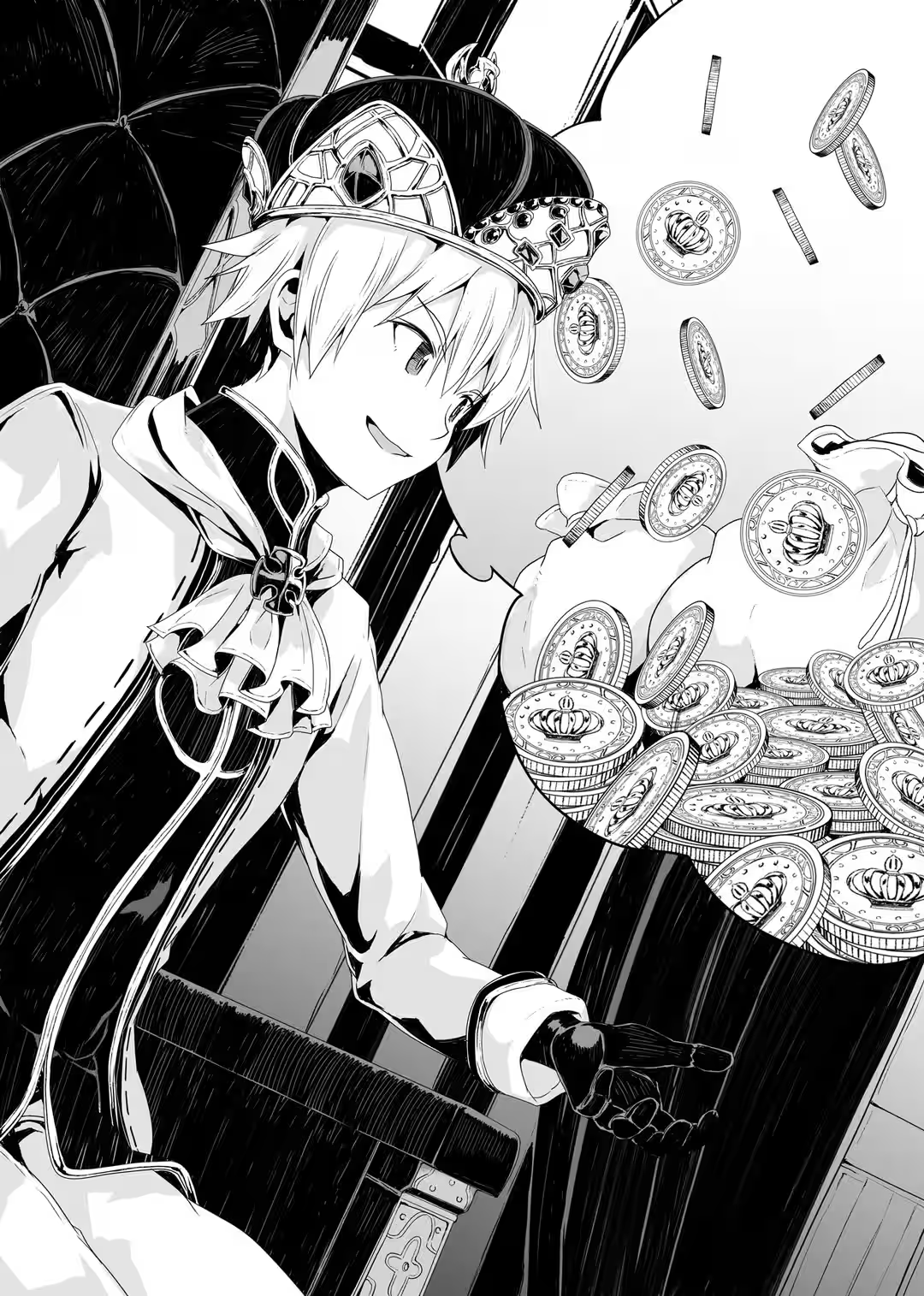
***
By the time I arrived, the corpse had already been taken away. All that remained was a slight indent in the dirt and the faint scent of blood.
I glared at the tower that housed the woman who’d pushed her own lover to his death. “I knew I should have killed her,” I muttered. I truly had no idea what she was thinking. And here I had just established control over the County of Copardwahl too.
“Your Majesty...” Timona spoke up from beside me. He and Balthazar were the only ones I’d brought along. “Now that the Agincarl region has split into three, a great deal of the pressure on Count Chamneau has been alleviated. Therefore, there is no longer a reason to keep the County of Copardwahl’s position in vague flux. We can simply present it with two options: It will either pledge allegiance to Your Majesty, or we will subdue it and achieve the same effect.”
The more I thought about it, the more I realized Timona was right. With the Golden Sheep Trading Company supporting Count Chamneau from the seas, he would be sitting fairly comfortably right now.
“Doing so would also serve as a message to the other nobility still sitting on the fence,” Timona finished.
I chewed on that for a moment. “Very well, then. That’s the policy we’ll proceed with.”
“Still, I wonder how exactly he fell from the tower...” Balthazar said contemplatively. Evidently, he hadn’t directly witnessed the fall.
Now that he’d mentioned it, though, how had Count Copardwahl fallen? I looked up at the tower with the strange feeling that I was missing something.
After some time, Timona made an observation. “The iron bars are missing from the window.”
Right, the iron bars. Vera-Sylvie had occupied this tower once, and the bars had been put there to prevent her from escaping or committing suicide.
“Perhaps they deteriorated from age,” Timona mused.
Wait. Wait, wait, wait. Hadn’t I melted the iron bars with magic to show off to Vera-Sylvie during one of my visits? What had I done to them after that, again? Oh, man. This wasn’t partly my fault, was it?
“One cannot change what has already happened,” I concluded, eventually.
I was no longer sure if this had been intentional. Perhaps Acretia had something in mind when she’d done it, or perhaps she hadn’t. Either way, though, she would spend the rest of her life imprisoned in the tower. Whatever ends she might have had planned, she wouldn’t be able to achieve them.
I couldn’t allow myself to base my decisions on my emotions. It wasn’t about what I wanted to do, but what I should do. And for as long as it was less harmful to keep Acretia alive, I would.
That was all there was to it.
Epilogue: The Emperor Departs for War
A week had passed since I’d declared my intention to head for the front line. Today, I would be leaving the imperial capital for Chelán Hill.
Despite the short time frame, the parade had been arranged without a hitch. I hadn’t been involved in the preparations at all, but I could tell from the outside that it had been a master class in logistics. Perhaps the Count Palatine had anticipated me proposing the idea.
The military training of the citizens we’d conscripted hadn’t finished yet, but apparently they’d be doing the rest on-site. Last I’d heard, they’d been drilling solely for the parade ever since it had been announced.
As for me, I would be riding in the parade on horseback this time, rather than seated in a carriage. It exposed me to a higher risk of assassination, but what kind of message would it send if a guy who was riding out for the battlefield did it holed up inside a carriage? Incidentally, Timona would be holding my mount’s reins. Apparently, it was tradition for that role to be given to the person the rider trusted most.
Just before I was about to depart from the imperial demesne into the city, I received an unexpected visitor.
“Vera? Did you come to see us off?”
She was clad in a dress, as usual, but the words that came out of her mouth took me by surprise. “I’m coming...too!” she exclaimed, at a volume that I considered forceful for her. She was gripping her fists tightly in front of herself, as if to reinforce what she’d said.
Instead of replying, however, I turned to Count Palatine Vodedt, who was standing beside her. “Pardon?” What the hell was he thinking? I was headed for a battlefield! What reason could I have had to bring Vera along with me?! “What’s the meaning of this, Count Palatine?!”
“As Your Majesty’s magic instructor, she is sure to be of assistance in battle,” he replied calmly.
He knew just as well as I did that Vera-Sylvie being my instructor was just a cover story to explain my magical capabilities. She wasn’t actually my teacher, so that didn’t hold water as a justification for bringing her to the front lines.
“I can fight,” she said. “I can.”
“She speaks the truth, Your Majesty,” Salomon said as he strode over. “I can guarantee it.”
I turned my glare on him, but he looked me straight in the eyes, unflinching. “Your Majesty said it yourself,” he continued. “To seize the ideal outcome, you will even leverage yourself as a military asset. Would that not also apply to her?”
Sure, I’d said that. But this was clearly different, wasn’t it?
“Besides...” Vera-Sylvie said, her gaze turned toward where Rosaria stood at a distance, silently bowing. “I was asked...to protect you...Your Majesty. I have to...keep to my word.”
Ugh, damn it. So everyone was in on this, but they’d kept quiet because they knew I’d object, huh?
“I’m going too!” exclaimed a girl approaching on horseback.
“Nadine?”
Unlike Vera-Sylvie, whose attire was no different from her usual fare, Nadine was clad in a set of plate armor. Duke Warren was beside her, so it seemed this wasn’t entirely of her own accord.
“We had thought you were still recuperating in your duchy,” I said.
Though she’d only spent a short time in the dungeons, that had been enough to warrant her returning to the Duchy of Warren to recover from the ordeal after she had delivered the letter I’d penned for her father. Just when had she returned to the capital?
“I was,” Nadine replied. “But not anymore. If it’s within my power to help, I will!”
I looked at Duke Warren, prompting him for an explanation.
“Unlike Lady Vera-Sylvie, my headstrong fool of a daughter is, of course, incapable of fighting on the front line,” he said. “But by establishing herself in Keighamer, she should serve as sufficient enough bait for Raul—even if she is not as appealing a target as Your Majesty might be.”
The town of Keighamer was west of Chelán Hill, close enough that we’d be using it as a supply base. The difference between its position and the front line was academic at best, so the danger Nadine would be exposed to would hardly be reduced.
I had the overpowering urge to click my tongue, but I endured. I thought I was supposed to be the emperor around here. Why was everyone else just doing whatever they wanted?
“So you’re using her as a hostage?” I asked. The Raul army could bypass Chelán Hill and head for Keighamer whenever they wanted. Did that mean Nadine was supposed to be a set of shackles for me, to ensure I was careful about how I approached the battle?
Count Palatine Vodedt answered. “No. Please do as Your Majesty wishes,” he said. “If that includes protecting Lady Nadine, then all the better. But, in Your Majesty’s words, this battle is one worth staking your life on. It is simply that Lady Nadine and Lady Vera-Sylvie hold the same opinion.”
Just as I was about to protest more, I heard the sound of a bell ringing in the city.
“It’s time, Your Majesty,” Timona said, gripping the reins of my mount. “Though if you wish to delay the parade and make the people wait, we may stay a while longer.”
Man, phrasing it like that was just unfair. “Fine,” I said sourly. I turned my gaze ahead, away from my traitorous inner circle. “But don’t think this will happen again.”
***
“Here comes His Majesty the Emperor!”
“Long live the Empire!”
The parade was underway. The voices of the people washed over me as I allowed Timona to pull my mount along. Since I was an emperor headed for the battlefield, I’d settled on a stern expression rather than a smile and did my best to project utter confidence rather than nervousness. As I maintained the act on the outside, on the inside, it gave me time to put my thoughts in order.
I had thought I had firmly settled into the role of the emperor, but it seemed that on a human level—as the boy Carmine—Rosaria, Nadine, and Vera-Sylvie were still a blind spot for me. My desire to keep them away from danger, to prevent them from standing on the battlefield, was both selfish and naive. And neither of those traits were what was needed from me right now.
“Fine, then,” I whispered, quietly enough that no one heard me.
Both the people and my retainers desired a strong emperor. From here on, it wouldn’t be enough to just act the part. I needed to fight, win, and drag the Empire kicking and screaming back to its position as a dominant superpower.
“To His Majesty’s victory!”
And if I wanted to do that, I needed to abandon this naivety of mine.
“Glory to the Empire!”
Yes. All for the sake of this country.
“Long live His Majesty the Emperor!”
Because for as long as the people called for me, I would answer.
Extra Chapter: The Way of a Watchman
In this age, the life of a farmer was one of great poverty. Their days were dictated by the sun, its rise marking the beginning of their toil, and its setting marking the end. It was highly uncommon for these simple folk to venture out into the night—settling in and waiting for the morning in peace was the much more attractive option.
This was because much of the nobility enforced a law in their holdings that stipulated that one must carry with them a lamp—or any similar such light source—when out at night. This law was a provision against suspicious activity, but unlike the more affluent city folk, the common farmer could not afford such luxuries.
This was especially true in this day and age, where it was famously said that the Empire’s farmers were wealthy in food and naught else. This caused some to go as far as illicitly producing candles of their own, which they sold to merchants at great risk of punishment if they were ever caught.
Regardless, this meant that, within any given agricultural settlement, the only light one saw at night belonged to the torch of the night watchman.
However, there were three exceptions to this general rule, nights when the entire village would light up the dark. The first was on the day of the yearly festival. The second was in the event of a fire.
And the third was when the village met its end.
***
A group of horsemen rode through the dark of night. They were roughly two dozen in number, each an elite soldier lent out by Marquess Mardrusa, and they held torches in their hands as they urged their mounts forward.
Their leader on this occasion, however, was not one of their compatriots. He was a spy, and though he rode at the front, it was at a lengthy distance. He spared not a glance for the soldiers following behind him, who despite being elite cavalry could not keep up with his skilled horsemanship, because his eyes were fixated on the burning village up ahead.
Mef-Palotte was a farming village in the Duchy of Adkal. Stretched across both banks of a small river, it was the most developed settlement in the local region—enough to warrant the stationing of a local magistrate.
When the spy reached it, it was in the midst of burning to the ground. It had been attacked by mercenaries. The sounds of swords clashing and guttural screams filled the air, wreathed in the glare of the fire. At the village’s entrance, atop his mount, the spy muttered several words to himself.
“Sounds of a fight, rather than screams... So this isn’t a pillage.”
In this age, it was not uncommon for smaller settlements to be pillaged. Mercenaries in particular were fond of the act, and often ignored any orders forbidding them from pillage, favoring the gains to be had right under their noses. Of course, it was just as common for them to be executed afterward, made examples of to maintain military discipline.
Thus, it had only taken the spy a cursory examination to realize this was something more than a simple band of greedy mercenaries at work.
“Mercenaries don’t light fires while they’re looting. Even if they do, it’s only at the end, when they’ve finished.”
It was simple, really. If one started lighting fires while still searching for valuables, one risked sending one’s profits up in smoke. Many mercenary bands elected not to light fires at all, unless they were the particularly cautious type who wished to delay any pursuers behind them.
The most conspicuous clue that this was no act of pillage, however, was that farmers did not possess metal weapons. That the spy could hear clashing swords in the air meant that the mercenaries were fighting soldiers somewhere within the village.
Before long, the spy noticed a slumped figure at the side of the road, and dismounted from his horse. Unlike what one might expect from his principal profession, he was clad in armor—though it was far lighter than what any self-respecting cavalryman would wear to a battlefield—and the light of the flames danced across it as he knelt by the roadside. The slumped figure he’d spotted was a corpse. A resident of the village, by its appearance.
The spy retrieved a dried leaf from a pouch at his waist and placed it in his mouth, grinding it between his back teeth. He inserted a finger into one of the corpse’s wounds and collected several drops of blood, which he smeared on his tongue.
As he knelt by the corpse with his eyes closed, one might have mistaken him as a devout adherent of the First Faith offering a prayer for the departed’s soul. In truth, tasting the blood had been his only goal. Though it would have seemed repugnant and macabre to any onlookers, the supernatural ability the man possessed was one that had earned the trust of many successive generations of past emperors.
At last, Marquess Mardrusa’s soldiers caught up. Each one of them—with a single exception—were clad in full armor, and as the spy stood, he issued them an order.
“The mercenaries are from the three southern countries. Eliminate them. No survivors.”
Marquess Mardrusa’s elites voiced their acknowledgment, dismounted, and advanced into the village on foot. None were foolish or arrogant enough to believe they could maintain control of their mount amid all that fire.
Once they were gone, only two individuals remained: the spy dressed as a cavalryman and the single unarmored rider. The latter was wrapped in a black cloak that seemed much more befitting a spy.
“Youth,” the black-cloaked man said. “Is he here?”
“He is,” the spy named Youth replied. “In the magistrate’s residence at the far side of the village.”
The magistrate—essentially the village’s headman—possessed a residence that would be considered palatial by the standards of this farming village. Currently, it was a chaotic battleground, where imperial soldiers clashed against the southern mercenaries.
Youth remounted his horse. “Shadow,” he said to the black-cloaked man who had dismounted. “I’m taking the direct route.”
The fellow spy grunted in affirmation. “I’ll accompany you.”
Youth unsheathed his saber and urged his mount into the fire and fray. A twist of his upper body, one kill as he rode by, two, and then he was at the residence’s entrance. The two mercenaries stationed there noticed him immediately and charged.
As Youth dismounted, Shadow—who had followed on foot—asked him a question. “Reinforcements?”
In the battleground they’d left behind them, the mercenaries had seized the upper hand. However, fire or no, it was still the middle of the night, so both sides were fighting cautiously to avoid harming their allies by mistake. By Youth’s judgment, the imperial soldiers would be able to avoid being annihilated.
“Unnecessary,” he said as he swung his saber. “Don’t let anyone near until I’m finished.”
The corpse of the mercenary slumped to the ground. Youth had not even looked in his direction. His compatriot who had charged with him had already fallen to Shadow’s thrown knife.
“Understood.”
There was a pile of corpses at the residence’s entrance. Youth spotted a mage among them and placed some of his blood on his tongue, just as he’d done at the village’s entrance.
It seemed that the magistrate’s residence had not caught fire because the mage had protected it with a water spell. It had been his undoing, however, as the mercenaries had killed him during the opening the spellcasting had created. More information came in vague drifts: the number of mercenaries who had broken in, the number of imperial soldiers opposing them, and the rough skill level of both. Once he was done “looking,” Youth spat out the blood.
He opened the door, sneaking into the residence without making a sound. The imperial soldiers had secured a position on the second floor, defending themselves from the mercenaries on the staircase. The imperial soldiers’ commander noticed the spy enter, and immediately issued an order.
“Push them back! All together now!”
As the imperial soldiers launched a full offensive against the mercenaries, the spy silently crept up to the latter, cutting them down from behind. Before long, a dozen or so mercenaries were corpses on the staircase, and Youth was slowly ascending the blood-soaked steps.
“Identify yourself!” shouted an imperial soldier, sword raised.
Before the spy could, the commander waved his man down. “Hold! Let him through.”
The soldier hurriedly lowered his blade, but Youth didn’t bother to spare him a glance as he ascended. “Our allies outside seem to be struggling,” he reported.
After a moment of thought, the commander issued another order. “Men. Go out and assist.”
“Sir!”
As the soldiers filtered past him, Youth passed a small stone to the young knight in the lead. “Give this to the agent by the entrance,” he instructed. “It’s a signal from me.”
“Ah. So you’re an imperial spy, then.” The knight accepted the stone, then briskly descended the stairs to reinforce his allies outside.
Youth followed the commander to a room on the second level—the magistrate’s office, by appearances, though it seemed the owner had already escaped. “Pardon me,” he said as he entered.
“At ease,” the commander replied, dropping into a chair as boldly as if he owned the place. He glanced at the spy. “I thought it was you when you entered. You two, join the others outside.”
“Sir!” The two soldiers who had been guarding the room departed, following their commander’s orders.
“Are you certain?” Youth asked, watching the men leave.
The commander barked a laugh. “They don’t know about any of this, anyway. Besides, I have nothing to worry about with you here.” It was clear from the man’s tone that he trusted the spy a great deal. “Your reinforcements are greatly appreciated. I can always count on you, Alfred, my friend.”
“It is good to see you safe, Your Highness.”
“Still, I find myself once again curious about that trick of yours,” said Crown Prince Jean, heir to Edward IV, the current reigning emperor. “You have not changed your face’s appearance, yet you looked like a different person entirely from a distance. How do you do it?”
“You managed to identify me nonetheless, and utilize the opportunity for a pincer attack.”
“Hmph. How many years do you think I’ve known you? Whatever your appearance, I’ll know.”
Alfred bowed his head. “You honor me, Your Highness.”
“I suppose that’s why you were dispatched, though,” Crown Prince Jean mused.
In fact, Alfred was not aware of what the crown prince was referring to, but he did not allow that to show in his expression. He needed to prioritize his primary objective—the one he’d come here to achieve. “Your numbers seem rather thin,” he observed.
“The village couldn’t accommodate all of us,” the crown prince explained. “I split our forces across several, but it seems that’s come back to bite us. But who could’ve guessed we’d get mixed up in a mercenary raid?”
As Alfred listened, he gradually began to see the lines of the script. A precisely timed raid carried out by mercenaries of the enemy countries that the Empire was currently at war with. It was unmistakable: someone in the Empire wanted the narrative to be that the crown prince had been killed by pillaging mercenaries. But Alfred firmly resolved not to let that happen.
It would be the last act of service that Alfred could do for the man before him.
“Given all the ruckus, though, the rest of my men should notice,” the crown prince noted. “They’ll be arriving soon, no doubt.”
“I concur. That being the case, we have little time.”
The crown prince gave the spy a puzzled look. “For...what, exactly?” he asked, slowly.
Alfred produced a single letter and a small pill case. “Please take your own life, Your Highness. Make your last moments befitting that of a member of the imperial family.”
The crown prince’s eyes widened, and his next words seemed to be spoken out of reflex. “What nonsense is...no. I see. Yes, I see. This is because...”
“The drug is painless. You will not suffer.” Alfred turned his gaze away, unable to look at the crown prince’s dumbfounded expression. “You are making an attempt on His Majesty’s life. You should have known that the Watchmen of Rotahl would have come for you.”
***
The Watchmen of Rotahl was a nickname for the Vodedt household (and the coterie of spies it led) of the Rotahl Empire and its successor countries. Its main house held the title of Count Palatine, and members possessed the ability to see the memories of the deceased at their time of death via their blood. It was due to this ability that they had been tasked with overseeing the Empire’s clandestine affairs by successive generations of emperors. Their support of the Empire from the shadows would, in later history, earn them a reputation as loyal and thankless retainers.
However, the spymaster, who was the head of the Watchmen of their generation, was not necessarily always a loyal individual. Power corrupts, and when one was given the power to assassinate any target they wished simply by issuing an order to one’s subordinates, many were the spymasters who fell prey to their own individual greed. Some used the position to fill their own pockets, others aspired to become the emperor themselves, and yet others simply allowed the Empire to fall to ruin out of sheer negligence.
Invariably, these spymasters would always be eliminated by another Watchman—a “Vodedt-killer.” Just as invariably, after the unworthy were cleansed, a talented and deeply loyal spy would emerge to become the next family head. Unlike other houses, whose heads operated in the imperial court, the Vodedt family’s duties necessitated fieldwork, and so whether or not they were trusted by the Empire was a matter of life and death for them. Given that, they always managed to produce an individual of high caliber to promote to the position of spymaster. This act of the Vodedt head eliminating their disloyal predecessor could perhaps be likened to a body’s metabolism, or its ability to rid itself of toxins.
Alfred le Vodedt had been raised in this exact way: to kill his predecessor. His grandfather, Edgebert, the current spymaster, was decidedly unfit to be a Watchman of Rotahl. He would not act for the benefit of the emperor unless expressly ordered to, and was all too willing to accept bribes from the nobility in exchange for whatever services they wished of him.
House Vodedt, seeing this as a threat, came to desire a Vodedt-killer. The current head’s son, Æthelwulf, began to instill this philosophy in the household’s children from a young age. Among them, he dedicated particular effort to educating his own son, Alfred.
To many, what he did could not be considered education. At the age of five, Alfred’s combat technique was on par with an adult’s. At the age of ten, he killed his own mother, who had leaked confidential information. By fifteen, upon becoming an adult, he had mastered the length and breadth of tradecraft and developed a resistance to many poisons besides. So inhumane had the education been that much of Alfred’s generation had attempted to escape. Silencing them to protect House Vodedt’s secrets had been a part of his training.
Having inherited his house’s secret techniques and gained control over its supernatural ability, Alfred became the most capable agent not only in House Vodedt, but within the Empire. None were his match, and he came to be known by the names of “Spy-killer” and “Vodedt-killer.”
To everyone’s eyes, he was the obvious choice to become the next Count Palatine—and he proved it by killing every rival who made an attempt on his life, escaping unscathed even from the ones who sought mutual destruction, lacking confidence in their ability to bring him down otherwise.
However, beneath the surface, Alfred was nothing more than an automaton. He swore absolute loyalty to the Empire and emperor, killing and exposing secrets as he was ordered. Even his marriage, the birth of his child, and the methods he applied to said child’s education were dictated for him—all for the sake of the great emperor. All for the sake of the imperial family, who worked tirelessly for the people. All for the sake of the glorious Empire. It was as thorough a case of brainwashing as could possibly be.
It was not long before this machine of a man was recognized for his exceptional talent and work ethic, earning the close trust of the emperor and crown prince. The latter, especially, took to referring to Alfred as his friend, treating him with particular warmth. Throughout the long history of the Watchmen of Rotahl, this was highly unusual.
There was another major change during Alfred’s rise in prominence: Spymaster Edgebert, the current house head, had a change of heart. Recognizing that his indolence would be his downfall, he threw himself into his work to the point that he seemed a different person entirely. Although the Empire had racked up a long string of defeats at the hands of its foreign neighbors in recent history, it was in some part due to Edgebert’s efforts that the trend began to buckle, and victories became more frequent.
Currently, in the Empire’s war against its three southern neighbors—the Kingdoms of Apraada, Benima, and Rocourt—it held the upper hand. Crown Prince Jean himself had taken command of the front lines. Recently, however, he had secretly departed from the front, accompanied by a scant escort of soldiers. During a night’s stay in the village of Mef-Palotte, he was attacked by mercenaries.
And the order given to Alfred was to kill the traitor Jean, who had attempted to take the emperor’s life—an order given by the emperor himself.
***
Crown Prince Jean crossed his arms and closed his eyes. “So these mercenaries are your lot’s doing?”
“I do not know. But it is unusual for mercenaries of our southern neighbors to be here. Someone’s hand is certainly at work.” Among the faces in the memories of the dead farmer outside the village had been a number of mercenaries Alfred recognized—ones who should have been on the front line, in the employ of the enemy.
“Fallen in battle to the hands of the enemy...” the crown prince said. “That is to be the story?”
“I will not allow it. That is why I came here in such haste.”
Crown Prince Jean opened his eyes, catching Alfred with a resentful glare. He glanced at the doorway, then seemingly reconsidered. “No... I suppose even if they had stayed, we wouldn’t be able to best you.” He uncrossed his arms, resignation in his features. “How much do you know?”
“Your Highness plans to breach the imperial demesne with a small number of soldiers and kill His Majesty. I have been ordered to stop you.”
“Hmph. So you know nothing.” The crown prince brought a hand to his forehead, leaning into it. “I’d almost forgotten. You’re not a dog of the Empire, but a dog of the Watchmen.”
Alfred could have taken those words as they’d been intended—as an insult. But he showed no reaction. To him, they did not even qualify.
“You were given an order to kill me because I was planning treason,” the crown prince said. “Is that it? That’s all you heard, yet you came?”
“I saw the letter you addressed to the Minister of Ceremony.” The calm neutrality in the automaton spy’s voice broke but for a single moment, sorrow seeping through. “Why?”
The letter that the crown prince had written to the Minister of Ceremony detailed his plan to carry out the attack with only a handful of men, so as to avoid notice, and included a request for the Minister to leave the gates of the capital and the imperial demesne open to allow him a swift entry. It was as ironclad as evidence could get.
“So we’re already here, are we?” the crown prince muttered. He looked up at Alfred. “I have a request for you.” The veteran general’s eyes hardened with steely resolve. “I do not mind taking my own life. If you want my head, you may have it. But as my last request to you—please, kill him for me. I know how capable you are. It should be within your ability.”
Alfred knew that it was the emperor who the crown prince was referring to. “I cannot do that, Your Highness.” For the emperor’s sake, Alfred would give his very life to ensure the success of his duty. That was his reason for living—his only reason. How could it not be, after he had been born and molded every day of his life to be what he was?
“He raped Aria.” Crown Prince Jean’s voice became a low growl. “He locked her in a room against her will and forced her to bear a child!” The growl became a guttural scream, shaking with rage. “And if that weren’t disgrace enough, he would pass the child off as mine!”
Alfred knew Aria to be a servant in the imperial demesne, of common birth. While her status would usually ensure she had nothing to do with the imperial family, a hapless stroke of fate meant that Crown Prince Jean had been raised by the same wet nurse, leading to a foster sibling relationship. In point of fact, the crown prince affectionately called her his older sister, despite her commoner status.
Now, the crown prince was claiming that the emperor had laid his hands on her, then forced her to bear the child—who he would not recognize as his own, instead attempting to claim it was Crown Prince Jean’s.
Alfred did not know if the crown prince’s claim was true. If it was, then it was most certainly a vile act of irredeemable depravity. Jean’s anger would be more than justified. This, Alfred understood well. Nevertheless, he felt compelled to respond, in a low murmur: “Is that all? That is the reason you abandoned the front line?”
After being ordered to kill the crown prince, Alfred had at first headed toward the front line. He should have found him staring down the enemy as one of the Empire’s generals. However, the crown prince had been nowhere to be found. Worse, the sudden disappearance of their commander had thrown the imperial army into disarray, leading to its annihilation by an enemy attack. A gaping hole had been punched into the front line for the enemy to exploit as they wished, and the Empire had hardly put up a fight to prevent it.
“What did you say?” the crown prince said dangerously.
To begin with, there was no need to kill the emperor immediately. The crown prince would have had any number of chances after the war. In fact, the task did not even necessitate his own hand. He could have chosen any number of methods—pulled any number of strings or delegated any number of subordinates—to do it in his stead. Yet he had decided to lead his own strike team, cause the collapse of his own army, and easily expose himself to his target, inviting a response. As methodologies went, the crown prince’s was far too crude.
Crown Prince Jean enjoyed significant popularity among the soldiery, as well as the general public within the Empire. He was dauntless, resolute, and led the Empire’s armies from the front. However, he was also impulsive. It made him a fine leader when he had other generals around him to keep him in check, but it appeared that on this occasion, no one had been there to stop him.
Alfred suspected that Jean’s hands, trembling with anger as they were, would never regain their calm until the man had taken his father’s head with his own blade. And that was far too narrow-minded for one who would become the next emperor. In brutal truth, it was not a temperament that befit even a general.
It was not as if Alfred hadn’t cautioned Jean about Aria on numerous occasions either. Nothing but conflict would come of the crown prince giving a commoner special treatment. All he had to have done to protect her was take her as a mistress without laying a hand on her, have her be adopted by a noble he trusted, or marry her to one of his subordinates. Those were only a handful of the methods he could have used to keep her safe. Yet, the inescapable truth was that he had been negligent.
“‘Is that all’?!” Giving in to his emotions, Crown Prince Jean unsheathed his blade, bringing it down on Alfred, whom he had called his friend—and whom he knew he could not best.
The blade did not meet its mark. For Alfred’s saber was already buried in the crown prince’s chest.
“A curse upon the emperor,” Crown Prince Jean choked out. “And your lot too.”
Alfred withdrew his saber. Jean, pressing his hands to his chest, crumpled to his knees.
“May ruin fall upon you all.” The crown prince spat the words with the last of his mustered strength. “You and this blasted country.”
Blood sprayed as the crown prince’s head was parted from its body. No more curses left its mouth.
“How could you, of all people, say those words?”
All for the sake of the great emperor. All for the sake of the imperial family, who worked tirelessly for the people. All for the sake of the glorious Empire. For his entire life, Alfred had believed in that creed, staining his hands with the cruelest of duties in its name. Yet now he could hear the sound of that belief crumbling around him. Like derisive laughter, mocking his way of life.
Afterword
Thank you very much for purchasing volume 3 of Imperial Reincarnation. I’m Masekinokatasa, and I’m very relieved to have reached this milestone without incident.
If this volume were to be summarized in a single word, I would say it is the “aftermath” of the coronation. Carmine has finally stepped onto the stage of history, but that doesn’t mean he can start working toward his goals right away. In order to gain the Empire’s trust as its sovereign, he must discard his foolish mask and exhibit true leadership. The nobles, the citizenry, the Western Orthodoxy, foreign countries—will he fight them, or ally with them? If he chooses the latter, will he be able to gain their trust? Such choices will be a constant during his journey.
Additionally, dangerous and capable characters such as Hilaire of the Golden Sheep Trading Company and Charles de Agincarl, among others, made their appearance in this volume. How will they act as the story progresses? How will Carmine interpret their actions, and what decisions will he come to? You’re in for some exciting developments...but that’s for the future, so you can safely forget about it for now.
Finally, this third volume also illustrates the strategy and lead-up time to the decisive battle. You might have noticed that I used a Sun Tzu quote as the title of the prologue chapter. In more recent history, the Battle of Sekigahara was an example of a conflict where the outcome was basically decided by advance planning and preparation. It’s made me think about how it’s vital to include such things when writing about wars or military history. Personally, I’m a big fan of the mentality that a battle is already decided before it begins. Having said that, I also really like the phrase, “fog of war.” Which is a good description for the next part of the story, really.
Speaking of Carmine’s future, he’s in a position where he may be forced out of power if he doesn’t successfully act the part of an emperor with absolute authority. However, the emperor currently doesn’t have absolute authority (otherwise he wouldn’t be having so much trouble). In other words, he must gain prestige if he wishes to survive, which means he must choose the most efficient method available to him. I bet those of you who love Paradox’s games already know, but indeed: That method is victory.
If Carmine loses, though, he’s well aware that it’ll be a disaster, which is why he very much doesn’t want to lose. In light of that, please forgive me for basically spending the entire third volume on war preparations.
Okay, yes, I know that’s just an excuse for my poor pacing...
Lastly, I would like to extend my deepest gratitude to Kaito Shibano-sama. The third volume’s illustrations are just as incredible as those in the first two. I’d also like to thank everyone at TO Books—I’m sorry for always being such a bother. Your support is greatly appreciated.
And, of course, thank you—the readers who decided to pick this book up—from the bottom of my heart.
August 2022, Masekinokatasa