
Contents
Chapter I: End of the Beginning
Appendixes: Explanation of the Strategic Offensive Rising Dawn

[chapter] 0 Prologue
JANUARY 15, UNIFIED YEAR 1928, THE GENERAL STAFF OFFICE
General Hans von Zettour was in an excellent mood.
An absolutely excellent, splendiferous mood.
He was refreshed and raring to go, a song of triumph on his tongue. His footsteps bounced lightly off the dull, impersonal floor of the General Staff Office in time to the staccato lilt of his heart, which was beating exuberantly thanks to the rarest stroke of luck.
“My, oh my.”
Zettour was acting rather strangely for his age; he knew that. But he couldn’t help it when he felt like a sudden gust of fresh air had banished the gloom that had been hanging over him since the start of the year. It left him relaxed, and the excitement was visible on his face.
“I see the way out. Yes, how wonderful!”
He had been in dire straits. Torturously constricted, an impossible burden weighing on his shoulders, his stomach twisted in viselike agony, and he was unable to speak except to groan. All the while, he sharpened himself as an instrument of violence in his role as a staff officer and as the devil Zettour, who was an enemy of the entire world, as necessity demanded. For the sake of the Heimat, he played his part in deceiving the world.
“I see it.”
He now clutched a single thread of hope. Just one. The narrowest of paths.
“Yes, like the eye of a needle. But I see clearly now.”
And why was it so narrow? Zettour, old man that he was, knew that it was his own mistakes that had led him here.
First and foremost, he had misjudged the timing of the Federation Army’s offensive.
“My own bungling led to this crisis. I will admit that. It was my mistake. I underestimated the determination of the Federation and the material support the Alliance was willing to provide. Feckless. Absolutely feckless for someone as involved in logistics as much as me.”
The result of Zettour’s miscalculation had been a headfirst plunge toward catastrophe, putting him on the verge of witnessing the dissolution of the very world he wished to protect.
It was either a divine blessing or an unparalleled feat of human intellect that allowed Zettour to secure a miracle while teetering on the edge of utter disaster.
“God is with us, or so they say… Those words can’t help but sound hollow. If God is with us, then what a sad way he makes himself known. Still, a far cry from being abandoned.”
Zettour snorted. Zettour, public enemy of the world, was now prepared to face it. To go beyond the bounds of human intellect, challenge the limits of mankind, vanquish the resentment pointed his way, and force his will upon the world.
He finally had the last piece he needed to make that possible.
The elation welling up inside made it hard for Zettour to maintain his usual smile of composure. Right now, more than anything, he just wanted to shout in exaltation. In Zettour’s subjective opinion, he was, at this moment, the happiest man in the world by far.
When was the last time he had smiled with such genuine joy? It mattered little. Here, in this moment, he was smiling.
There was only one reason. A single spider’s thread. And the man who had brought Zettour such wonderful news was here with him now. Zettour grinned like that would be enough to share his joy with that benign messenger.
“First Lieutenant Grantz, whatever is the matter? You look atrocious.”
If the emotion appearing on the aerial magic officer’s face could have been summed up in one word, that word would have been tragic—so tragic, in fact, that it nearly made Zettour want to cry despite his paroxysms of joy.
“As regrettable as it is that I cannot ask you about the situation…I am actually in quite a good mood at this moment.”
As a superior officer, Zettour was perfectly aware how severe he could be with junior officers and how much he demanded from staff officers. When it came to magic officers, however, especially the ones heading back to the front, Zettour had a mind to be more gentle.
All the more so, thanks to his current mood. Zettour’s high spirits made him feel particularly magnanimous.
Though he was a general now, Zettour had once been a junior officer himself. He was more than ready with a word of pity or two for those poor officers at the mercy of their command.
“Truly sharing this joy with another would likely be impossible, but if I could impart some small share of my good fortune…”
With a gentle smile, General Zettour rested his hand on Lieutenant Grantz’s shoulder, assuming the demeanor of a kindly old man toward this officer he once browbeat in Ildoa.
“No need to be shy. Perhaps you should get some sleep? As a mage, you must endure some rather long flights, I imagine. Don’t worry, I will speak to your commanding officer.”
That reminds me, there’s still the leftover Ildoan champagne from the New Year’s banquet. Why not allow the young officer to enjoy a glass?
General Zettour continued speaking. He was good humor incarnate.
“It is a shame we are in the middle of an operation. Otherwise, we might have celebrated with some of the Commonwealth Embassy’s finest champagne. Truly regrettable!”
“G…General! Get a hold of yourself…!”
“Hmm?”
“Please, General Zettour, calm down. Don’t you see? The situation we’re in…”
The young officer had gone pale. The sight of the young man’s face, so desperate to save the world from annihilation, finally brought General Zettour to his senses.
“Why, First Lieutenant Grantz. You must think I’ve lost it.”
“General?”
“Hmm?”
Before General Zettour could offer another bemused response, his thoughts emerged from the morass of euphoria and returned to dismal reality.
“Ah, of course,” he murmured.
This messenger had just come on a special mission from the front lines, entrusted by Lieutenant Colonel Degurechaff to deliver a bombshell. Of course it would be disturbing to see the general laugh like this as that bomb exploded at his feet. The first lieutenant couldn’t say so openly, but he probably suspected the senior officer had just gone mad.
“Lieutenant Grantz, I assure you I am quite sane.”
There in the depths of the General Staff Office, the chief officer of the Imperial Army and the monster who had become the nerve center of the Empire smiled as if he was human.
Zettour chided himself lightly. It had been more than just a little outburst. He flashed a smile to cover his embarrassment. This was something he hadn’t experienced in quite some time.
Upon further reflection, Zettour realized his giddiness was almost insufferable given his age. He grimaced at his own lack of discipline. It was mortifying, if he was being honest.
“Ha-ha-ha, forgive me, Lieutenant. It wasn’t my intention to worry you.”
However, General Zettour still could not completely disguise his elation as he continued:
“Thank you, Lieutenant Grantz. You’ve brought better news than I could have hoped for. I am now certain that I shall triumph over the world.”
POSTWAR
The Official Stance of the East
As the crisis in southern Alliance territory developed, the Federation Army had a difficult choice to make toward the end of 1927. Increased imperial activity in southern Alliance territory, known as Zettour’s Ruse, was intended to draw out the Federation’s principal forces. Once the Federation Army realized that this was an unscrupulous plot to bait them into counterattacking before they were fully prepared, the Federation was forced to choose between overlooking the danger the Alliance forces were in, or sacrificing the lives of its people by coming to their aid, fully knowing that this was a trap.
After considering the importance of diplomatic relations and the spirit of cooperation, the people of the Federation decided they could not ignore the threat to the Alliance armies and executed the offensive operation Rising Dawn in January 1928. Despite facing fierce opposition from waiting imperial forces and suffering heavy losses, the Federation Army was able to push back the front line that General Zettour was holding, decisively precluding any further possibility of the Imperial Army putting more pressure on the Alliance’s southern front. This sacrifice was politically necessary, as they had to aid their allies. While it was, tactically speaking, a textbook example of a hopeless battle, it was simultaneously a complete strategic victory.
The Unofficial Stance of the East
Despite achieving total strategic surprise with the offensive of Operation Rising Dawn, the Imperial Army was able to respond with speed and flexibility. According to in-depth investigations by military experts, reacting so proficiently to this attack should have been “impossible without prior knowledge.” Therefore, the most logical explanation is a catastrophic intelligence leak. It’s probable that, after learning of the offensive in advance, General Zettour instituted an information blackout and laid his trap by leaving the eastern theater unguarded. However, it is impossible to determine whether there actually was a leak and to what extent. If the events cannot be attributed to a leak, then General Hans von Zettour must have been the devil himself. Either that, or the west was responsible.
The Official Stance of the West
Toward the end of 1927, southern Alliance front had completely tied up the Empire’s strategic reserves and forcibly captured the attention of General Zettour himself. In January 1928, just as this situation was developing, the Federation Army launched its Rising Dawn offensive, aiming to bring an end to the war. While this successfully caught the Imperial Army unawares, General Zettour struck back with unrelenting counterattacks, and the Federation suffered tragic losses. Haste ultimately leads to defeat, and Rising Dawn was a textbook example of a tactical victory that was simultaneously a complete strategic disaster.
The Unofficial Stance of the West
The events of January 1928 were an unscrupulous trap laid by the fearsome General Hans von Zettour. This uncanny strategy, carried out by the general in the south of Ildoa in the latter half of 1927, was an ambitious tactical diversion that led to the implosion of Federation Army forces. If its purpose from the beginning was to reduce the Federation Army’s offensive capabilities, then General Zettour truly was an unparalleled strategic genius. The hostilities that occurred from late 1927 to early 1928 served as no more than a trigger for Rising Dawn and its counter, Morning Light. It is a distinct possibility that General Zettour anticipated everything. There is no other obvious explanation. These events have had a massive impact on current international relations, but just how much did General Zettour foresee? His impact reaches far!
JANUARY 21, UNIFIED YEAR 1928, BARUCH BRIDGE
War is cruel.
What’s the big deal?
Of course no one would disagree that war is brutal! Cruel or not, though, when was the last time people stopped a battle halfway because of brutality? The hand-wringing usually only starts after the fighting’s all over. Regardless of whether everyone truly recognizes the brutality of war, only those who survive can have those sentiments.
And no one is more aware of that than Lieutenant Colonel Tanya von Degurechaff.
“Incoming…!”
I quietly grumble, “Shit, they’re getting closer,” in response.
The whistle of artillery shells. Where will they land?
That sound is all it takes to understand what’s about to happen. As creatures, humans grow accustomed to things. The defining feature of the human species, you could say, is its ability to adapt to its environment. An ability that becomes extremely apparent on the battlefield. But accustomed or not…on the battlefield, entertaining extraneous thoughts is a luxury.
Humans and their oh so human thoughts are a wonderful product of civilization. Far be it from me to speak ill of civilization. But you can’t assume that civilization will always be there.
Is that sad?
We occupied these trenches that the Federation Army had so carefully prepared, and now the previous tenants are back, and they’re mad. Looks like they want to till the land with artillery and make sure they bury the imperial troops along with the remains of their old camp.
Dig a hole, fill it up.
Did I read that in a textbook somewhere?
The Communists should also give reading a try! Why not pledge fealty to Keynes and transition over to a market economy already? So long as you can build a home in peace, who gives a damn about productivity?!
Even as I continue to toy with these ideas in the back of my head while hugging the dirt, I have to admit: Who can aspire to anything more than survival at a time like this? At the same time, it only makes me wish all the more for peace.
As it says in “A Song of Liangzhou,” do not laugh. Of course, this is the eastern front. There are no jade cups to be found here, and the only thing a passed-out drunk will accomplish is freeze to death. The end is the same, either way. How many soldiers ever come home?
Yes, that is war.
Tanya, however, will still do her best.
In place of a lute, we have the overwhelming symphony of war pounding in our ears. The strumming of the Federation’s corps-level artillery leaves our inexperienced new recruits pinned to the ground, trembling and unable to move. Deplorable as it may be, the General Staff Office has infused a great deal of promising human capital into our ranks to make up the numbers needed for this mission. With any luck, they’ll get a chance to accumulate more value in the future.
Using the kindness reserved for new soldiers (a strong and entirely altruistic kick to the ass), I drive them forward, shouting, “Unless you want to die, move!” Adjutant in tow, I change position slightly, praying that the enemy barrage will soon come to an end.
In a sense, we are lucky.
Imperial or Federation, a trench is a trench, after all.
The Federation’s field engineers must have known what they were doing. These trenches, lovingly crafted and only recently stolen by us, continue to stand firm even as their former occupants rain artillery fire down.
A cynical smile crosses Tanya’s face. Former occupants? As if anything has really changed.
“Didn’t think we’d reenact the Rhine front here.”
Did we drop into enemy territory and seize this position just so we can sit here with our dicks out under enemy fire?! Tanya grimaces reflexively.
As the saying goes, infantry wins wars. However, from a footslogger’s point of view, it’s hard not to complain!
Besides, Tanya is supposed to be a mage. There shouldn’t be any reason whatsoever to use her as infantry. So what is she doing holding trenches like a grunt?
“…Looks like we’re here for the long haul.”
Apparently, the forecast in the east this January is partly cloudy with frequent showers of artillery shells. Too bad there are no cancellations due to bad weather in war.
“In any case, this is terrible. Even on the Rhine, you would normally get rotated back to the reserve trenches once in a while.”
We dropped in behind Federation lines and, like Horatius, are currently defending a bridge. After seizing this important critical point in the enemy’s supply line, my orders are to defend this lonely outpost in its bloody stream at all costs. Consider us open for business. Operating hours, twenty-four seven.
No reinforcements, and no hope of relief.
Of course, this particular paratrooper squad of ours is composed of mages.
Not only are we capable of deploying from transport planes like an airborne unit, but we also aren’t dependent on aircraft and, in theory, are fully capable of returning home on our own, making us a convenient power projection tool.
And if such a force can be used to disrupt enemy logistics? Obviously, that would be an extremely effective and attractive option. From a tactical standpoint, that is. As the one who actually has to carry it out, Tanya is less than enthused.
“Colonel, contact! They’re on the move! Enemy infantry!”
I sigh as Major Weiss reports, raising the alarm. They were bound to come.
“Use the captured LMGs to lay down suppressive fire! Conserve magic rounds for now. Don’t forget that this is going to be a long fight!”
“We knew it going in, but this is insane.”
“Yes it is, Major. But it’s also an extremely logical move.”
Put another way, logic is basically all this plan has to offer. I sigh internally.
After finishing with Major Weiss, I mutter softly to myself.
“Honestly, this is preposterous.”
Hmph.
As soon as that complaint leaves Tanya’s mouth, the sky shudders as a large artillery shell lands nearby. A striking reminder that complaining is a luxury. The shrapnel that punches through Tanya’s protective film and reaches her defensive shell is upsetting…but even more upsetting is the fact that the shot wasn’t even aimed at her in the first place. This is a textbook case of area suppression. But as the one on the receiving end, the fact that it is being carried out so by-the-books is what makes it all the more infuriating.
“Well, I suppose everyone is being rational today. How respectable.”
There is little to do now but laugh.
After all, the moment we air assaulted this supply base, I fulfilled my purpose. This is the crux of Zettour’s three-dimensional strategy. A large-scale airborne operation targeting key supply bases in the enemy’s operational rear with divisions of aerial mages.
On paper, at least, it’s very straightforward.
Unfortunately, there weren’t enough mages for the plan. The idea of scraping together whatever mages you could squeeze out of the Imperial Army, in its current state, and pasting them together into three full-size mage divisions and dropping them behind enemy lines? It was no small endeavor, to say the least.
But I suppose the extreme nature of radical ideas is part of what makes them effective.
We have captured the enemy’s base, after all.
Aerial mages wield a certain amount of firepower and armor. They also have the ability to hold a position, much like regular infantry. If three aerial mage divisions could be put together somehow, they would be a powerful set of spikes that could hold down an area for quite some time. And if three such powerful spikes were hammered directly into the Federation Army’s arteries? It could completely asphyxiate the Federation’s massive supply network.
Could, could, could. But the Federation Army has its own hard-fought lessons. As far as I can see, the Federation Army is ruled by pragmatism and more than willing to make hard decisions.
“Damn Commies, can’t you work a little harder?!”
What are those Reds doing over there? The Communist Party is supposed to be making life difficult for the army. Why can’t they make it a little harder? You call that being obstructionist?
What good is an ideologue, after all, if they don’t use their ideology to trip up their own comrades?! Even now, heavy artillery continues to bombard the supply point we’ve just taken. They clearly won’t hesitate to bomb every last inch of this position, even if it means losing a supply point their army depends on.
“This is just like Arene,” I grumble, taking a quick glance around.
At Arene, the Empire were the ones carrying out the bombardment. This time, the Empire is on the business end of the artillery. But there’s no padding with infantry. We overwhelmed the enemy with nothing but aerial mages.
Militarily speaking, interrupting the flow of supplies is a much more serious issue than whatever the current stock might be at any given point in time. Of course I know that. Apparently, the higher-ups think we should be able to “hold off the enemy with whatever captured supplies and equipment you procure on-site.” I wish the brass would keep those calculations to themselves.
“And General Zettour… Well, he probably also got burned,” I mutter, praying that the sound of heavy artillery will quiet down enough for me to ignore it.
While technically disputed territory, Arene can more or less be considered an imperial city. Yes, anti-imperial sentiment there was fierce, which caused plenty of headaches for military police and eventually reached the point of open rebellion, but it did show that an army is perfectly capable of raining shells down on its own cities given sufficient justification.
This is perfectly rational.
That was why it was so simple for Tanya to give the order to fire on the city. But for those civilized men and women on the receiving end who only know peace, it is difficult to see the one issuing that order as anything other than a monster.
At the same time, such condemnation is pointless, as no amount of it will bring an end to war.
On the other hand, General Zettour is the kind of man who would say, If you can’t avoid the hail of artillery, why not jump right in? What a terrible joke.
Ultimately, these sorts of issues tend to be decided with a single word: necessity.
“What a barbaric time, war is!” I mutter. That’s when I notice something lying on the ground by the wall of the trench. A wooden box.
No, a paper box? Something conical is sticking out… I go pale as I reach for the box, terrified for a moment about the possibility of secondary explosions. However, I quickly relax.
Almost collapse, even.
“Well, well, well, what do you know? In a place like this…”
A beverage! The logo and label on the bottle closely resemble products I’ve seen in my previous life.
Someone must have gone to great lengths to transport it here from somewhere very far away. Likely sent as part of an aid package from the Unified States. A carbonated beverage, straight from the high temple of capitalism all the way to the sacred seat of Communism.
One of the original occupants of this trench probably stashed it here. And now the Federation Army has come back to mercilessly dispose of it with heavy artillery, along with Tanya and her troops.
I glance around. The area near the trenches looks like the pockmarked surface of the moon. Scattered across the ground are holes, craters, flames, and—as a fun bonus—fragments of what used to be humans, as well as the remains of the massive Federation Army stockpile so generously provided by the capitalists.
Even with all her combat experience, Tanya has rarely been witness to a sight like this. Not only the ammo and fuel stored in the warehouses, but everything from foodstuffs to luxury goods is also strewn across the battlefield, mostly blown to smithereens. A joyous sight? No, this is the opposite of that.
At least I can savor the great taste of capitalism while we ride this out. I reach for one of the bottles of soda, materializing my magic blade in place of a corkscrew.
“Lieutenant Serebryakov, care to join me for a glass?”
“Colonel?”
I don’t know if these beverages were meant for celebrating the New Year or a successful offensive, but this generous gift of soda will taste just as good on imperial lips. In which case, the least we can do is enjoy it.
“A gift from the Federation! Or should I say, from the Unified States? Very considerate of them, either way. A little fizzy from the opposite end of the planet!”
“In that case, don’t mind if I do.”
“By all means!”
A smile plays on my lips. Delight springs onto my adjutant’s face as I gently toss her a bottle.
Just as Serebryakov is about to catch it…
…an artillery shell detonates directly above the trench where my unit is hunkered down. Shrapnel fills the air, striking the airborne bottle with perfect timing and splattering it and its contents onto the ground.
“Low-down Commies…! Too stingy to share a single lousy drink!”
I grimace. I expected nothing less from those bastards.
“Well, that’s disappointing. The one thing I did always like was their slogan. How does it go again? From each according to his ability, to each according to his needs?”
“What a civilized insight, Visha. Cheers! There’s still another bottle. How about it?”
“If you wouldn’t mind.”
I lob another soda to the lieutenant. Shell after relentless shell continues to explode in the sky over our heads. Tanya has no official qualifications as a weathercaster, but even an amateur can tell there will be heavy shelling, with occasional flares, for the foreseeable future.
With the way things are going, it might not be long before the enemy starts laying down a smoke screen in preparation for a charge.
Unpredictable weather is just another example of the many atrocities of war.
That’s why Tanya is supposed to be a force for equity and fairness.
And is it fair, I ask, that the Federation should be the only ones to rain explosions on the battlefield? With a swig of carbonated soda, I fire off a crude burp into the air in an attempt to bring some small measure of equilibrium to the Federation artillery’s one-sided balance sheet.
Unfortunately, that’s all Tanya can do here. There are no jade cups to be found. Flares light up the night sky in place of the moon, and the elegant sounds of battle are the only strains of music. There isn’t even any sand. Only deep and stifling trenches.
This is a battlefield.
And I fucking hate war.
There must be something wrong with the brass if they can still smile while all this is going on.
[chapter] I End of the Beginning
JANUARY 1, UNIFIED YEAR 1928, IMPERIAL CAPITAL
On this particular day, as part of his public duties as a high-ranking government official, Counselor Conrad was attending a New Year’s party.
For a pragmatist such as Conrad, getting drunk on wine and mingling with guests at such a supercilious banquet held little appeal. If it was up to him, he would have rather not put in an appearance at all.
First and foremost, he found it distasteful.
They were at war. The Empire was gray and ashen. The very idea of showing up to such an ostentatiously cheerful and drunken soiree with a smile! At a time like this!
The gap between reality and this farce made Conrad want to vomit. If he ever got the chance, he would like to ask whoever put this event together whether it had been intended as an elaborate form of torture.
But there were obligations that came with his position. High-ranking officials in the Foreign Office had certain roles they were expected to fill. This naturally included mandatory attendance at the New Year’s functions of the Imperial Court.
That was why Conrad reluctantly sipped bad wine and tolerated this revolting atmosphere with a smile on his face.
His military counterparts were similarly duty-bound.
In fact, since the nation was at war, there was much more significance attached to the military’s presence, making their attendance that much more mandatory.
That was simply their lot on this morning of January 1. Attendance was required regardless of how much they would have preferred otherwise.
And come that afternoon, it would include the mastermind of the Imperial Army and ranking Deputy Director of the Service Corps in the General Staff, a man whose presence inspired fear within the very Foreign Office bureaucrats in whom the system had been vested—General Hans von Zettour himself.
Zettour seemed to be one of the few members of the Empire who could still see the writing on the wall. He had greeted the morning of the New Year with a displeased look on his face.
However, it was always crucial for officers to keep in mind how they appeared to their subordinates. As the head of the General Staff, Zettour was aware that his every word was an object of public scrutiny.
People who held important positions were constantly watched for signs of change in their every deed and action. This explained why officers with long military careers were generally so regimented.
Despite it being the New Year, there had been no appreciable change in Zettour’s morning routine. He rose at the same time he normally did and drank his customary cup of coffee to start his day while looking over the reports presented to him by the personnel on duty. The only difference was the flavor of his coffee had suddenly improved, since it’d been sourced from Ildoa.
It was a wholly undramatic start to the day. This habit had been ingrained in him. Although he didn’t show it, due to the Imperial Court function he would soon be forced to endure, Zettour considered this a dark day.
The Empire’s lifeblood was trickling from its veins like sand through an hourglass. This was no time for extravagant and overblown parties. Or maybe it was exactly the time for such things. Zettour’s inability to judge what the moment called for left him feeling more disgruntled.
“Most annoying is the fact that I can sympathize.”
Unease. It was unease that ate away at people the most.
Uncertainty was a dreadful thing. It restricted thought, caused people to lose faith in themselves, and led to spirals of misery and self-hate.
Once such fear had lodged itself inside a person, dealing with it head-on was a daunting task. Even for imperial staff officers, who were expected to stand tall and resolute and to remain mindful that the eyes of their subordinates were always on them.
“Growing older is a terrible thing…”
Zettour took the cigar he’d just been about to place into his mouth, returned it to his breast pocket, and chased away the budding unease building in his chest with a futile sigh.
It felt difficult to breathe.
Each and every breath he took was like torture. What he wanted to do, more than anything, was flee from this place. And if it wasn’t for his position, he would have done so immediately. The muscles in his face, however, remained fixed in a perfect smile.
What else could he do? There were no circumstances that allowed a prominent staff officer to walk about with a frown on his face, least of all at a cheerful New Year’s banquet hosted by the imperial household.
What the current situation called for was a smile, bold and confident. Affectatious, vainglorious nihilism.
How deplorable. Zettour could feel himself sneering internally at the garishness of the capital this New Year’s. He supposed that before the shadow of ruin could appear, there must be light to cast it.
The sun was beginning to set on the Empire, and the atmosphere at this New Year’s banquet was as bizarrely cheerful—unhinged, even—as the war was ghastly. With the ladies and gentlemen replete in their finery, the banquet hall and the outside world was like night and day. The guests had left their anxieties at the door, full of good cheer and intent on nothing besides enjoying the moment.
It was a dazzling court ritual. The dresses, the jewels, the chandeliers.
“It seems all the beauty in the Empire has been gathered in this room.”
A dazzling, infinite collection of light. Even the bubbles in the champagne, poured by darting waiters, seemed to compete for exquisite attention to detail. Attending sons and daughters overflowed with the budding radiance of youth, and laughter rang throughout the hall, as if all was hale and happy.
Naturally, the children of important families were not the only centerpiece of this event.
Various influential and important figures in attendance had contrived to clothe themselves in their gala best—finery specially reserved for such occasions. General Zettour, too, was an unmistakable part of these niceties.
His clothing—immaculately pressed formal wear of the highest grade—was only the beginning. Exquisitely polished medals glittered on his chest, and the military saber strapped to his waist was resplendent with ornamentation. Even his feet left nothing to be desired, as his military boots had been polished to a mirror shine. The general looked as if he had just stepped fully formed from a painting, the very image of a majestic imperial commander.
He was impressive and powerful, exactly what one expected from a soldier of the Empire. His appearance was a carefully calculated representation of the nation, the army, and the General Staff.
It would make for striking photographs if anyone was taking them.
Hiding his phlegmatic self behind a smile, General Zettour slowed his steps, which had been growing too fast, and slowly presented himself to the influence-peddlers in the crowd.
He found the waste of time aggravating.
As far as Zettour was concerned, every second was invaluable. The crackdown in the south, the vigilance in the east, the aerial battles in the west—all three were sources of uncertainty. Truthfully speaking, he simply didn’t have the time to fritter a whole day away on social niceties at some New Year’s banquet.
But the entire Empire was gripped with unease at the moment. People craved the reassurance of victory. The heads of the army could ill-afford to show their own discomfort at a time like this.
Zettour had no choice but to continue to present a sanguine face to the party, one majestic and confident in victory. He continued to walk through the room in this fashion. Unexpected encounters, however, were inevitable. Several eminent figures Zettour was familiar with had gathered around a single table, and naturally, Zettour could not just ignore them.
“Why, hello. A good New Year’s to you all. How have we been?”
High-ranking military officials, imperial dignitaries, bureaucrats, and members of the nobility. The fundamental fact that they were at war practically forced them to come together at a court gathering like this in a friendly pretense of “leisure.”
“It’s been quite some time since we last met. I hope there’s room for a set of old bones such as myself at this table.”
Zettour took a seat, joining their circle and chatting pleasantly.
The impression he wished to leave the attendees was one of relaxation, even confidence. He needed to be the very embodiment of victory and couldn’t let them see any hint of trepidation or inner turmoil, no thoughts of defeat. Not even unintentionally. He needed to play the total fool and scatter false hope in his wake.
That was what everyone would want if they found themselves in similarly precarious circumstances—a powerful savior, here to sweep away their concerns. Understanding that this was the role expected of him, the all-too-human Zettour had no choice but to squash the vulgar unease teeming under his breast and fully commit to his part as Zettour the bombast, Zettour the extraordinaire.
“A toast!”
“Here, here. To General Zettour!”
A steady chorus of optimistic cheers rained down on General Zettour from passing guests. It was his duty as an officer to leisurely and elegantly raise his cup in response.
“Thank you, thank you. You are too kind.”
Officers always had eyes on them. It was one of the first things Zettour had been taught in cadet school. Only, no one had told him that it wouldn’t only be fellow soldiers watching his every move.
They had been terrible teachers.
A terrible era.
A terrible reality.
“I was highly impressed by your campaign in Ildoa last year. As long as we have your offensive might, the threats surrounding the Empire should prove easily surmountable.”
“No, no, General Zettour’s true value lies in his logistic expertise. It was absolute mayhem while you were gone, General, but everything is finally running smoothly again.”
“The situation with the Federation has grown much more stable thanks to your interventions as well. It seems our victory rests on your shoulders, General!”
A solution. It was what they all demanded. The general answered each voice with a smile on his face.
“General, we are counting on you!”
“General, may fortune favor you in battle!”
“General, this will be the year!”
The future was uncertain, and their own fates were equally unclear. They needed a deus ex machina to wipe away that fear. A figure to idolize.
General Zettour raised his glass and paused a moment before speaking.
“To our victory!”
“To victory!!”
They probably believed it, every last one of them. In victory. Victory would come in the end. Feeble, yes, but the general wasn’t going to laugh at them. He understood human nature too well for that. Once upon a time, he had also clung to the panacea of victory.
The hope of victory was a powerful drug.
For anyone who somehow managed to wake from the dream and free themselves from their addiction to victory, the world would become a place of cynical amusement, perverse to the point of cruelty.
Zettour stood up and began walking around the room, as if to enjoy the party. The guests seemed to have abandoned themselves entirely to diversion. The Empire was at war, but the general couldn’t find even the smallest shadow of remorse over holding such a lavish banquet.
It hadn’t always been like this.
At the start of the war, when it came to New Year’s parties and other events, the word on everyone’s lips within the capital had been restraint. That sentiment, too, had likely been sincere. But as the Empire’s destruction began to loom, those same people started to insist—with faces as serious as stone—that what was needed now, at a time like this, was gorgeous extravagance to chase pessimism away. It was difficult not to laugh at the absurdity of it.
“A time like this, indeed.”
People could deny it. They could protest. But deep down, humans always looked for ways to banish their uncertainty.
“Humans truly are amazing creatures.”
Strange creatures, incapable of being fully honest with themselves. Always in need of some sort of cynical enjoyment in order to prop themselves up.
“Today’s enjoyment provides energy for tomorrow. But perhaps tomorrow will be sunny. Maybe it isn’t as foolish as it sounds.”
So long as you don’t know what price will be paid, General Zettour added sarcastically to himself.
The cost of squandering today.
Time was an extremely rare asset. No matter how stingy you were with it, there would never be enough. And yet the Empire’s most important people had all gathered at this New Year’s party with the express purpose of wasting time.
How many of them understood? There was one, at least. One who, for better or worse, could see the writing on the wall.
That day, Counselor Conrad reluctantly made an appearance at the court’s New Year’s banquet. Counselor Conrad was both a diplomat and a high-ranking official at the Foreign Office.
Conrad, a career bureaucrat born of aristocratic blood, was so typical that men like him had almost become cliché in the Reich. Thus, despite his personal misgivings, Conrad found it easy to plaster a perfect smile on his face. His tongue moved loquaciously, driven by a power source other than his heart.
The counselor took care to receive each and every guest he met with a polite, seasonal greeting. People, however, could be sensitive things. Depending on time and place, even asking something as innocuous as Are you okay? could be considered intrusive and cause someone to pull away. And yet if you made them feel ignored, that could also create a rift.
It was important to always tailor the words to the individual in question.
Counselor Conrad was a chameleon. Although appearance-wise, he seemed more like a sloth.
The fundamental basis of social etiquette was to never make people feel awkward. As a diplomat, it was important to be extremely proficient in this skill. To be affable. Sophisticated, but cheerful. Maintaining a hint of delight at the corners of the mouth, even when the situation was unpleasant. Especially when the situation was unpleasant.
Despite the wariness he was feeling deep down, Conrad appeared every bit the carefree socialite as he strolled jovially about the magnificent venue. Occasionally, he spotted another guest with a similar, slightly forced smile on their face, but these encounters afforded no more respite other than to briefly wonder just how far ahead that other person had seen.
That was why the moment he saw a familiar face, Conrad was very tempted to flash a cynical smile. His very first thought was that it felt like looking in a mirror.
It was none other than the personification of imperial victory himself, General Hans von Zettour, surrounded by a crowd of people. At the moment, the general was under siege, penned in by fools with heads full of straw. Needless to say, General Zettour maintained a perfect mask of etiquette despite his encirclement.
Taking a glance around, Counselor Conrad could not help but chuckle painfully.
“I see a few familiar faces in that crowd. And oh, there are some more!”
In contrast to that nostalgic turn of phrase, Conrad was grumbling internally. People in our line of work are like sharks.
He had just spotted some diplomats who hailed from neutral counties. It was a good idea to engage with them. After all, making nice and forging connections was the job of a diplomat. In a sense, you could say that these neutral diplomats served as proxy hounds for nations at war, going here and there to unabashedly sniff out whatever favor could be curried.
Naturally, the greatest prize for such men was whichever piece of information that could be sold for a high price. In other words, rather than futilely trying their luck with His Imperial Majesty—who’d only appeared briefly at the start of the event—it made much more sense to take their time sniffing around the man who was the de jure boss, General Hans von Zettour. This would give them a better chance of getting the information they needed. It was practically a law of nature.
That was why the general was seemingly so popular among guests from the various foreign nations. Most were waiting close by with sharp eyes to catch some glimpse of whichever one of the arguably most important people in the Empire might betray once he grew weary from interacting with his own countrymen and his powers of courtesy began to slip.
For a diplomat, such duties were an unavoidable part of the job, but for a military man, these were tedious side tasks. Conrad found it difficult not to sympathize with the general. He made a decision on the spot to play the clown and come to Zettour’s aid. As one human to the next.
“Why, hello, hello! How are we all doing today? And a happy New Year to you all. If I had known so many familiar faces were gathered here, I would have made my way over sooner! So good to see you, so good to see you, you don’t mind if I join?”
Conrad called out in a loud voice to the familiar dignitaries, leaning on their relationship as fellow diplomats. Obviously, they could hardly ignore him.
“Why, if it isn’t Counselor Conrad! A happy New Year to you.”
“Yes, yes, Happy New Year. Why, what’s this? It almost seems like there isn’t a single bubble left in your champagne. Shame on us, serving flat champagne to our guests. How embarrassing.”
“Your consideration is greatly appreciated, Counselor Conrad. But the truth is, we found the aroma so nostalgic that we simply spent too long enjoying it. It seems we were distracted by the lively conversation as well. How shameful. Please, you mustn’t blame the waiters.”
Jab, jab, jab.
If a second audio channel could be added in, listeners might have heard Conrad say something like this: You must be up to no good, sitting here so long that your champagne has gone flat. And behind the feigned response of “nostalgia” came the other diplomat’s carefully crafted response: “We haven’t seen champagne in your nation for quite some time. The Empire must be on shaky ground, if it can no longer maintain a steady supply of luxury goods…”
After this gentle verbal fencing, they exchanged a few graceful pleasantries before saying their farewells and going on their merry way. Although neither of them had gotten the better of the other, Counselor Conrad had achieved an impressive tactical victory by scattering the diplomats who had gathered around General Zettour like hyenas.
As if he had been waiting for the right timing, General Zettour waved familiarly and spoke in a cordial voice, which carried surprisingly well.
“Is that Counselor Conrad I see?”
It was a farce, but the general acted as if he had only just noticed Conrad. Conrad understood but answered him in kind.
“Why! If it isn’t General Zettour himself!”
Conrad assumed a posture of deference, as if to apologize for having taken so long to greet him, offering a formal bow that was proper almost to the point of ridicule.
“General Zettour, Your Excellency, I wish you a happy New Year.”
“Why, Counselor Conrad. Perhaps I should refer to you as Your Excellency as well today, in keeping with court etiquette?”
Under the circumstances, this concern for position almost seemed like a joke. But all the more reason for Counselor Conrad to return a graceful bow. It was his duty, as a member of the aristocracy.
“Now is the occasion, but as it pleases Your Excellency.”
“Ha-ha-ha. And perhaps for other occasions as well?”
Despite the offhanded manner of his comment, it was actually quite a pointed rejoinder.
“Yes, well, this is the New Year. It is easy to let customs fall by the wayside in everyday life. We have to decide ourselves if we want to honor tradition. And at times like this, even pretense can be entertaining.”
“Yes, you’re absolutely right. At times like this, indeed.”
The grinning general took a champagne sword from a passing waiter and, in classic fashion, sabered off the neck of one of the champagne bottles. It was an elegant display, and the general himself was the very epitome of refinement.
Ignoring the excited crowd while doling out glasses provided by an attentive waiter, General Zettour raised his glass.
“To Counselor Conrad!”
The general was a straitlaced man who normally didn’t show even a hint of pageantry. But as he deliberately loosened up for the party, General Zettour displayed a natural sophistication in a way that was beyond compare.
“Thank you, Your Excellency. I would like to raise a glass in your honor as well, but I’m sure you’re tired of champagne at this point.”
“Thank you, Counselor Conrad. Your concern is admirable.”
Yes, yes, no, of course. The two exchange overly polite banter. The counselor bowed, apologizing for “causing a stir” and for “intruding on the conversation.” As he did so, General Zettour extended a hand, as if to say, Not at all.
“My apologies for taking up your valuable time in this way…”
“Nonsense. I am here now. I can afford to forget my military duties for a day and celebrate the New Year. Don’t fret over an old man like me. Spare a thought for yourself.”
The kindness, however, was touching, and Zettour nodded slightly in acknowledgement.
After draining his glass, General Zettour returned it to one of the waiters and gripped Counselor Conrad’s hand once more, before sending him off.
“Thank you, Mr. Conrad. Have a good year. And take care of your health, won’t you? The future is ours, after all.”
A thought suddenly seemed to occur to General Zettour. He drew a pen and nonchalantly began scribbling something onto a paper napkin lying nearby.
It read, The Rising Dawn is near—however, Morning Light will soon follow. An exclamation that could not be spoken out loud. Upon reading it, it took everything Conrad had to keep his expression from changing.
However…
How long would it take for the sun to once again rise on the fatherland? It would happen. Eventually…though there was no way to know if either of them would be around to see it.
“Your Excellency, please take care of yourself.”
In response, the general grinned and gripped his hand firmly once more. It was just a handshake. But Conrad couldn’t help but feel the most substantial exchange he had that day was contained within that simple gesture.
Empty formalities. Trifling obligations. Beyond them lay genuine, heartfelt gratitude.
It was a lofty exchange overflowing with humanity. Which perhaps explained why Conrad privately decided to act as General Zettour’s mosquito netting for a night. He chose to do this purely out of goodwill and with no expectation of anything in return, which was rare for him.
Just as Conrad endeavored to draw a spontaneous crowd…
“Happy New Year, Mr. Conrad. May relations between our country and the Empire be as peaceful this year as they were before.”
Conrad’s face nearly flinched, but he managed to recover and hide his agitation with a smile. With all respect, he hardly merited such formalities. When he spotted the person who had spoken, however, he realized it was someone in a very particular position. Conrad had no choice but to maintain his mask.
“Why, it is His Excellency, Honorary Consul Torm. And his charming wife as well!”
Counselor Conrad continued to play his part, acting more surprised than he felt in order to hide his actual shock. The honorary consul, however, was a capable man. Despite Conrad’s best efforts, he had likely seen through the ruse.
The consul and his wife wore plastered smiles of their own. So be it. Conrad had no choice but to wave the white flag, recognizing that any resistance against this pair of veterans was futile.
“A happy New Year. I can only hope that the friendship between our two nations continues to grow this year.”
“Thank you, Mr. Conrad. Though we may have our differences, as long-standing neighbors, it pleases me to be able to exchange words without hesitation.”
“I have a feeling our connection here will be the foundation of a beautiful relationship for our countries, Honorary Consul.”
It was a highly formal conversation. Natural enough for two officials engaged in foreign relations.
The unspoken implication of the honorary consul’s greeting was It would be excellent if these problems could be solved peacefully, through words. The official of a small nation was emphasizing their neutrality. And as an old friend, we can expect your support, I’m sure was the undertone of Conrad’s own reply.
However, there was something extremely strange about this exchange. Because as the name suggested, Torm was not officially the representative of any country. He was, in fact, an honorary consul, which was generally an unpaid position filled by a person already residing in the country. The natural conclusion would be that Torm and his wife were imperial citizens, just like Counselor Conrad.
However, while Honorary Consul Torm and his wife were extremely influential within the Empire, they were actually old-world aristocrats who didn’t hold imperial citizenship. Consequently, the Torm family found itself in the highly unusual position of being subjects of the imperial household but not imperial citizens.
“To His Imperial Majesty of the Reich!”
Conrad raised his glass, to which Torm quickly replied:
“We shall drink to His Imperial Majesty.”
Yes, of course. We.
As they raised their New Year’s cups, there was a distinct difference between the two. The faint distinction between a subject of the Empire, and a friend. Those who scoffed at the extremes to which empty formality could go would do well to understand the historical significance behind these conventions.
At the time of the Empire’s founding, those among the aristocracy who were of particularly noble birth generally attempted to transition from vassals under feudal contract to retainers.
Sneering at such arrangements would have been diplomatic suicide. At times of war such as this, anyone willing to laugh at such behavior as mere stubbornness or the backwardness of smaller nations would have to prepare for a fight to the death with the many diplomatic officials who craved the goodwill and support that could be provided by such nations.
Such a response was impossible for anyone with common sense. However, that was exactly what made conversations such as these, laden with so many diplomatic considerations, so tedious and roundabout.
“Thank you, Mr. Conrad. As a man of distinction in the Foreign Office, you would be doing me a great pleasure if you could spare a little time to discuss a small matter.”
“But of course, anything for Your Excellency.”
“Wonderful, thank you, Mr. Conrad. Although, it would seem a shame to disturb the Empire’s beautiful New Year’s celebrations with such uncouth matters…”
Honorary Consul Torm shrugged as if to suggest delicacy. His wife, meanwhile, flashed a carefully crafted and elegant smile, seemingly urging discretion. Naturally, she would never say such things outright. Not here, where others could hear.
When coming into contact with the peripheries of a manufactured community, artfully navigating the divide between courtesy, public persona, and true intentions was an unimaginably arduous task. There were always subtle differences between communities. But perhaps that was why the following invitation from Honorary Consul Torm and his wife was not entirely unexpected.
“You must have had your fill of champagne by now?” the honorary consul’s wife asked. Her husband seemed to understand.
“I may have partaken too much, and in front of Mr. Conrad to boot. How embarrassing!”
“No, I believe I’ve drunk too much as well. I was enjoying celebrating the New Year so much with everyone that the alcohol simply flowed.”
“Ha-ha-ha, you and I both.” Honorary Consul Torm laughed openly, brightening the mood. Without missing a beat, his wife cut in with completely natural timing to suggest a change of location.
“Perhaps we could take a moment to sober up. Speaking of which, we recently received a shipment of tea from our estate… Won’t you come and sample it?”
“Of course, madame. Why, thank you. It is almost too great an honor, a tea procured by your fine household, but nonetheless, I would be delighted to join you.”
“Excellent. You as well, dear, mind your step.”
As they proceeded deeper into the palace, guided by Honorary Consul Torm and his wife, Conrad naturally felt strange. Although it was a court event, even the guards, who stood by at attention, allowed them to pass with an affable “Your Excellency” when they recognized Honorary Consul Torm’s face. For Conrad to enter this deep into the palace chambers, an attendant would usually need to intercede along the way.
But Honorary Consul Torm and his wife were not even imperial citizens.
Despite this, for better or worse, their household enjoyed a favorable relationship with the Reich, having resided within the Empire for generations and even occasionally intermarried with the imperial family.
Which was why Honorary Consul Torm and his wife, though not formally citizens of the Empire, had their own private quarters within the imperial palace, where they were leading Conrad now. Conrad, a mere government official, thanked them, once again being reminded of just how unique the honorary consul’s position was.
Even now, from their own point of view, they considered themselves a subject of the old Empire, rather than subjects of the Reich that connected the past with today.
And so the pair were guests in the imperial palace who enjoyed elevated status and were deserving of respect. Even if they were seen as part of the Empire and officially referred to as Honorary Consul and his wife, they continued to live casually as figures of authority from before the unification of the Reich, equivalent in status to that of a markgraf. And from their point of view, people like Conrad were little more than the servants of their friend.
From an outsider’s point of view, such a hybrid situation might seem highly confounding. But within the imperial system, it had been a natural development.
When the Empire unified, it had relied on the authority of the imperial household and aristocratic society. Some might consider them relics of the past, but aristocratic rights and privileges still remained.
And yet…
…Honorary Consul Torm and his wife resided within the Empire but were also foreigners who did not share in the Empire’s destiny. Meanwhile, Conrad engaged in practical affairs of the nation while at this New Year’s banquet. For these aristocrats to go out of their way to speak to him and to invite him to tea in their private quarters away from prying eyes and ears… Well, it was no ordinary occurrence.
“Now then, Your Excellency, shall we get down to the important matters you wished to discuss?”
Straightforwardness seemed like what might be required here. Although he rarely took notice of common subjects, the honorary consul smiled.
“Indeed, Counselor Conrad. If you don’t mind, I was hoping you might educate me slightly on some matters related to the Empire.”
Conrad gathered himself. The fact that Torm had dispensed with the earlier formalities must mean that the important matter was coming.
“Insofar as diplomatic protocol allows?”
“No, please do not concern yourself to that degree. There is just one question I wish to ask. In terms of people or staffing… I do not know how best to put it, but is there a successor in place?”
“A successor?”
“Yes, the next person in line, I suppose. I really do not know how to put it, but yes, it is a question of personnel, I believe.”
Conrad found himself at a slight loss.
When it came to hiding one’s true intentions, the aristocracy were masters of the game. But it was quite rare to see a member of the nobility struggle for words like this after deciding to speak openly. Did Honorary Consul Torm trust Conrad so much that he was willing to give voice to misgivings that he had not fully mastered even within his own head? That seemed hard to believe. As Conrad hesitated, the honorary consul placed a cigar into his mouth as if to buy himself time.
Conrad remained quiet for several minutes, allowing the honorary consul to puff at his cigar.
“Counselor Conrad, I wish to ask about General Zettour,” Torm said at last.
“I see, you wish to know more about the general.”
Like the diplomats, it seemed Honorary Consul Torm was looking for information about General Zettour. Just as Conrad felt he was beginning to understand, however, the honorary consul shook his head as if to disabuse Conrad of that notion.
“Yes, to be honest, I suppose I would like to know more about what type of person General Zettour is. About his talents and his intentions. But as I said, I only wish to ask you a single question. And there is something more important for me to ask.”
“As you say…but are you sure your question is something I will be able to answer?”
“Counselor Conrad, if you cannot answer this question, then I am sure no one present at this banquet today would be able to.”
Hmph. Conrad cocked his head internally. It was a strange statement. For someone like Honorary Consul Torm, who occupied a high position within the court, asking after General Zettour should have been a simple proposition. With some private inquiry, surely he could have aristocratic officers or even high-ranking nobility at his disposal… What exactly was he driving at?
Conrad threw the ball back into Honorary Consul Torm and his wife’s corner, attempting to keep his face blank as he did so.
“And what is it about General Zettour that you would like me to answer?”
“Not about him, per se. Well, I suppose it has something to do with him…,” Honorary Consul Torm said, turning his eyes toward his wife.
Something unspoken seemed to pass between the two. They both nodded, as if reaching a decision. Torm began to speak once more, his expression determined.
“Has the Reich considered…who will follow after General Zettour?”
“I’m sorry, Your Excellency. What do you mean, ‘after’?”
Conrad didn’t mean to repeat the honorary consul’s own words back to him, but he genuinely didn’t understand what the man was trying to ask. As two pairs of eyes stared back at him, Conrad attempted to think, before finally grasping their meaning.
“Oh, I see.”
They were likely worried about a repeat of what had happened with Zettour’s predecessor, Rudersdorf.
“It was truly unfortunate what happened with General Rudersdorf, to lose such a distinguished person.”
Conrad made the face that was expected of him, putting on a truly sorrowful guise of grief; however, his eyes darted impatiently to the side.
“Do not worry, Your Excellency.”
“Counselor?”
The fact that Torm had referred to him by simply his title was likely designed to elicit some sort of sympathy. Conrad, however, smiled calmly.
“Even if the worst were to happen and something were to befall General Zettour, other staff officers would step up and take his place.”
“Is that really true, Counselor? Is it even possible? Who would it be? What is their name?”
“I’m sorry, Your Excellency. That is a matter of military staffing, so it would be better to ask someone within the military, rather than myself.”
Not that I expect the General Staff Office to be very forthcoming with that information, Conrad thought, thumbing his nose internally. A moment later, however, his mind reeled with bewilderment. For some reason, Honorary Consul Torm was suddenly staring at him as if he had said something ludicrous.
“I wish to ask you. With all due respect to the honorable individual, I wish to know the truth. Are you, sir, aware of any such person who could fill that role?” asked Honorary Consul Torm, leveling his gaze toward Conrad, who was still in shock at suddenly being addressed as an equal.
“I am afraid I do not see your meaning. Naturally, it would be truly saddening to lose someone as estimable as General Zettour. However—”
“Surely, you must know what would happen thereafter,” Honorary Consul Torm said, his face serious as he delivered this salvo. “Won’t you stop playing ignorant? Please, I’m asking you to tell me. If General Zettour falls, what will happen to the Empire?”
“What will happen…?”
What a strange turn of events.
“Your Excellency, allow me to speak openly. May I ask you instead why are you so fixated on General Zettour? Obviously, he is a very talented general. Perhaps incomparably so. But he, too, is no more than a single cog in the Empire.”
“Assuming you are not feigning ignorance, then perhaps it is because to an insider like you, it seems that attention is simply being paid to whoever and whatever it needs to be, and this all seems laughable. But how is someone like me, sitting outside on the sidelines, to know who the principal players are?”
Was he saying that it was difficult to assess who the key figures were from the outside? That made sense. Didn’t it? Conrad began to speak.
“Naturally, a rising star such as General Zettour will stand out. But it is an army, after all. There are always successors.”
“Yes, but what if he falls? Does the Empire have anyone who can take his place?”
“I’m sorry…? Are you asking what will happen to the Empire if General Zettour falls?”
Yes, precisely! Honorary Consul Torm assumed a posture of utter relief now that the counselor finally seemed to catch his drift.
“Ha-ha-ha, it would certainly not be good, I imagine. But the army would likely find a way. The government would struggle, and bureaucrats such as myself would be thrown into disarray, but such is the system. It would all work out somehow,” Conrad replied reassuringly. Inside, however, his feelings were precisely the opposite. Counselor Conrad was already beginning to realize the seriousness of Honorary Consul Torm’s words.
What would happen? It may not have been Honorary Consul Torm’s intent, but his question put the situation into stark relief. Those watching a boat sink were afforded a different view from the passengers who were still aboard. From an outside perspective, General Zettour had become the Empire himself, part and parcel.
When it came to parts in a system, the ability to effect repairs boiled down to replacement parts—or in other words, issues of succession. But if the issue was what would happen to the system itself, well, that was a question of whether the system could actually be repaired if and when it broke.
He may or may not have adequately voiced his concern, but it was clear now that Honorary Consul Torm’s main worry was the sustainability of the entire system. Or more specifically, its utter reliance on General Zettour.
Conrad had trouble recalling how he had smoothed over the rest of the conversation.
The shock of that realization had been too great.
After that astonishing tea party, Counselor Conrad somehow managed to drag himself back to the Foreign Office. As he strode along the hallways, a sour look on his face, the brighter officials in the office knew better than to do anything so foolish as to ask him what was wrong.
That, at least, was a little silver lining.
The halls were far too wide and decorated with paintings that were far too gallant. Conrad walked down their lengths, feeling as if he would rather crawl, before eventually washing up inside his own office. Once he arrived, he opened a secret compartment in his pompous counselor’s desk and removed the small bottle of whiskey he had hidden there, bringing the open bottle directly to his lips.
The strong alcohol burned as it went down his throat. Usually, Conrad believed it was better not to throw back something so ripe and sophisticated as if it were cheap swill.
Usually.
How could this be? General Zettour was just another part in the system, wasn’t he?! Just another person?
Conrad attempted to squash the thought.
A talented diplomat needed to face reality head-on. What was he? A second-rate official who made poor judgments based on wishful thinking, based on how things ought to be. No, that wasn’t even half of it. He was nothing but a fool. A fool who had mistakenly convinced himself he was capable of making difficult decisions. Another good public official, a member of the intelligentsia, puffed up on too much education and property.
Conrad had always striven to embrace reality. But today, for the first time ever, he began to doubt himself. The surprise came like a bolt from the blue.
Fortunately, Conrad had managed to pass off his distress while still inside the palace.
It was a celebration, early in the year. There was wine and socialization after a long dry spell, and people were in a good mood. Conrad doubted anyone had noticed anything unusual about him.
Or was that itself just more wishful thinking…?
No, navigating parties was like a diplomat’s very first baby steps. Something like that would always remain old hat. Perhaps he had faltered, but he would have still known if he had fallen on his face.
Wouldn’t he?
Conrad meekly readjusted his own assessment of himself. On further consideration, he began to feel his behavior may have been dubious.
“It seems I was more deeply affected than I thought…”
Yes, perhaps he hadn’t realized just how far he had stumbled.
While in attendance at a New Year’s banquet, Conrad the veteran diplomat had encountered a surprise more shocking than anything he had felt in quite some time.
“I need to work this out… Of course, even General Zettour can’t be more than a cog.”
When he encountered Zettour at the palace, the man had been breathing. Blinking, even. Of course he had. He was human. A living creature. The only people who didn’t live and breathe were those who existed as ideas, like juristic entities.
“When an actor takes a role, they are only playing a part, no more than pretending to be the system. The writer who writes the script, the director who directs the stage—no matter how you look at it, none of those people could be considered equal to the system.”
It was a kind of habit for Counselor Conrad to put his thoughts into words like this, investigating and organizing them, and to draw out and narrow down those thoughts so as to be ready when the time came. He continued to mutter to himself, trying to make sense of the shock he had just experienced.
“A monster—he is a monster…and Lieutenant Colonel Degurechaff?”
The person known as Lieutenant Colonel Tanya von Degurechaff was a changeling in the guise of a young girl. Conrad understood that she too, in her own way, was difficult to comprehend. A monster. An object of respect, but also a person who inspired fear.
“It is also difficult to understand the existence of monsters such as Lieutenant Colonel Degurechaff. But does that mean the two are similar? Are they?”
A child that small, with a Silver Wings Assault Badge. It was obviously strange.
“Anyone can see that. She is gifted, yes, but too much so. I doubt any would deny that it is disturbing…”
But something was different. A person like Lieutenant Colonel Degurechaff was recognizable as a monster at a glance. In attempting to compare the two, General Zettour seemed to have even less in common with Conrad’s image of a monster than he had initially thought.
“Looking at it in that sense, Lieutenant Colonel Degurechaff just barely falls into the category of the type of creatures who can possibly be understood. A genius but still a single part, someone who can still be assessed as a prodigy of my ilk.”
Not that I actually do understand her, Conrad thought, reaching for the small bottle once more. He wasn’t trying to drown himself in drink. But he felt cold.
There was a chill clinging to his spine that just wouldn’t go away.
As the strong liquor traveled down his throat and landed in his stomach, he finally proceeded to the next stage of his thoughts.
“General Zettour, then… What is he?”
Not who, but what. What in the world was he? Conrad continued to carry out a self-dialectic, attempting to order his thoughts.
“At first, I thought the opposite, didn’t I?”
Lieutenant Colonel Degurechaff was the monster in the guise of a young girl, while General Zettour was the man possessed of monstrous genius. But now with the situation laid out before him, Counselor Conrad could not help but realize his own mistake.
“Of course. Now I see.”
The former may, in fact, have been a monster in the guise of a young girl. But even still, she was a living creature. The monster known as Tanya von Degurechaff possessed two of the most cold and hollow eyes known to man—those with glass eyes seemed more human by comparison—but she was still a creature whom the diplomat could at least attempt to understand.
In comparison, there was no such possibility with General Zettour. Counselor Conrad could only despair. Comprehension seemed impossible.
Through elaborate mimicry, he was able to appear, on the surface, an exemplary soldier of the Empire, but peering closer, one could eventually see. The fearsome general…
He was a system in the guise of a man.
He ought to have just been a man, but he had long since become the system.
“Is…such a thing even possible?”
When it came to academic theories of government, like the source of state authority or the theory of the emperor as an organ of the state, Conrad knew his stuff. Every student aiming for an administrative position in government had at least a textbook surface familiarity with such ideas. There was nothing particularly strange about these ideas. There were ample instances of a particular person, due to circumstances of position, duties, or title, rising to the level of a system similar to an organization or government body.
“As a part of it, that is.”
His Majesty the Emperor himself held massive power, with an impact that cut across the worlds of government, bureaucracy, and finance. But even if he constituted the heart of the Empire, he was still but a part of the system. The emperor was merely a man pretending to be the system. But this was only a convenient fiction. The emperor’s true nature was as a part, meaning he could be replaced.
Not even the emperor amounted to the opposite, a system pretending to be a man.
It was precisely because of Conrad’s strong commitment to serving as an exemplary cog of the nation that he was so sure that even rising to the level where a person could be considered a portion of the system was a near insurmountable task. People were people and nothing more. Even by honing oneself through relentless public service, a person could only ever become a single piece of the cog.
Yes, perhaps a person could become incorporated into a part of the system and be consumed. But that was no different than, say, the way nutrients consumed by a person became a “part” of their body.
It’s true, you are what you eat. In that sense, food and drink could become a “part” of a person. However, the meat, cheese, bread, and wine consumed by a person obviously could not become a part of that physiological system. A person’s hands and feet might be a part of their body, but food could never rise to the same level as a pair of hands or feet.
And yet!
At some point, Zettour the individual had taken on a strange existence as a deputy director on the General Staff, conducting himself as a part of the warmaking system and then, before long, transforming into that system itself, for all intents and purposes.
When it came to key figures in an organization, the number may be small, but particularly exceptional officers could color the character of that organization. For a nation such as the Empire, however, not even a person as preeminent as General Zettour should have been able to constitute the hands or feet of the nation.
This was something Conrad had never before seen. It was as if an individual had been incorporated into and then begun to fuse with the Empire, the state itself.
“I would almost prefer simple usurpation…”
The seizing of the crown. To assume the place of a portion of the system. That would be easier to understand, at least. Conrad might not be able to approve, but he could at least comprehend it.
But this. This!!
It was like the hands and feet had sprung up of their own accord to naturally steer the body away from its course of danger. Moreover, in the eyes of the people, the hand of General Zettour was considered the same as the hand of the Empire! A strange transformation in the zeitgeist of their age.
On top of it all, Conrad himself was a part of that group, a good little collaborator in the end. How could he not be surprised to find himself living in a reality that had lost any sense of that word?
“This? This is reality?”
Reality was meant to be embraced. Internally, however, Conrad was finding it much easier at this moment to question his own reason, his own sanity even, than to live in reality.
For Counselor Conrad…right now, a person of “common sense” such as Colonel Lergen seemed much more endearing. Someone like that might not be capable of saving the Empire. But compared with taking a gamble on a system pretending to be a person—one that could lead the Empire anywhere, perhaps to salvation, perhaps to ruin—someone like Lergen was far, far more reassuring and comprehensible.
“Of course, I understand a gamble is precisely what is needed now… Ha-ha-ha…”
A strained laugh, full of unruly consternation, spilled from the counselor’s mouth. What could he do but laugh? Though whether it was a laugh of resignation, hardship, or self-deprecation, even Conrad himself could not say.
“What a strong drink to start the year with…”
It was all well and good to raise a toast and down that drink, but it was powerful stuff that left every drinker stumbling. Speaking of which, it was General Zettour who had plied him with champagne at the party. One drink from the system was apparently all it took to leave a man punch-drunk.
“Total war, total war, ahh, Zettour and his damnable total war.”
That exasperating, sinister, irredeemable monster, intent on burning everything. That son of a bitch.
“May the system consume you.”
Yes, if only. That would be for the best.
What if? Conrad knew that prayer was useless, but as a person, he couldn’t help but try.
“May the system known as General Zettour be successful.”
He wished for the end of that other system. If everything was as he envisioned, Conrad could admit, he was a foul, despicable man. Another system to replace the Empire.
“Can one person even achieve so much…? Is something like that even possible?”
As both a cynic and a believer, Conrad begged for mercy. Some tiny blessing, even. But it was vaguely beginning to take shape now.
“If it is true? If a person really can replace the system of the state?”
If the world really had mistaken General Zettour himself as the system of the Empire…
…then it was possible. Conrad could only tremble.
The dangling sword of Damocles would not fall on the emperor’s head, but rather on the lone, aging soldier who had set himself up as a tyrant, deceiving the world into believing, It is I who is the Empire!
“Victory is within our grasp… We can— Nay, we have won.”
Victory amid defeat. One miserable little grain of defiance. Compared with losing all hegemony, embracing certain defeat, and submissively accepting certain ruin, it was nearly inspiring.
Glorious defeat may be lost to them, but the future could still be theirs.
“For just the possibility… For a person to make it possible in the first place.”
Conrad couldn’t contain himself. He lifted his head and spoke into the air.
“How fearsome, General Zettour…”
A throne was still a throne, even with a sword dangling above it. If it was a throne surrounded by wealth and cloaked in the pleasures of contempt, from which one could stare at their surroundings from on high, it might be easy enough to temporarily ignore the chills such a precarious seat might afford.
Unfortunately, when it came to such matters, the Empire was severe in its aesthetics, its watchwords being simplicity and fortitude. Whether he liked it or not, General Zettour was painfully aware of this as he traveled by car from the palace back to his own nest.
The vehicle that had been provided for him by the General Staff Office was far from luxurious. The comfort provided by the rear passenger seats, which had been designed with practical use in mind, was nothing to write home about under the best of circumstances. When coupled with the discomfort of poor upkeep, bad roads, or even a combination of the two, the seat was like torture on an old man’s back.
On top of that, the only thing that awaited the general upon his return, after having been forced to take a breather at that stressful celebration just as his schedule was filling up, was a mountain of unfinished work. Although Zettour was familiar with the military’s administrative affairs and was exceptionally good at processing reams of paperwork, he was still just a single person. Replacing the system was like an ant moving a mountain.
The difference in atmosphere, as Zettour returned from that bright, surreal party to cruel, cruel reality, left his feet feeling leaden. Although the new year had just begun, he was already finding it difficult to breathe.
The moment he reached his chambers at the General Staff Office, as soon as he was out of sight of prying eyes, Zettour’s shoulders slumped forward.
His dazzling dress uniform and array of glittering medals hung heavily on his weary shoulders. He removed his ceremonial saber and collapsed into a chair, his feet practically planting roots into the ground.
“I’m so tired…,” Zettour said as he leaned against the back of his chair, the words coming from his very soul. He pulled out a cigar that had been waiting inside his breast pocket and silently lit it before taking a few puffs.
“A terrible thing for the old. The body betrays the will.”
He sighed heavily, his breath mingling with the smoke in the air. The way it lingered vaguely from his cigar could not help but remind him of a certain friend. Even the cigars that Rudersdorf had left behind were set in their ways. He had always been a stubborn man.
“It’s just like him. Even his daily accoutrements have taken on his nature… I suppose I am the same. Stuck in my ways,” General Zettour said, speaking to himself before smirking.
When was it he had first noticed? That the Empire was on the decline, and that the Imperial Army’s General Staff Office had begun to transform into the state? The change was so natural and inevitable that, at first, he hadn’t even noticed that one system was replacing another.
As their options began to narrow down irreversibly to total war, the Empire had lost the luxury of national strategy. All it could demand now were stopgap measures based on military logic. In other words, gradual decline. To put it bluntly, the Empire was at the end of its rope.
As this situation dragged on, it became extremely difficult for those involved to realize that the line dividing the state from the military—or more specifically, the government from the General Staff Office—was beginning to dissolve. From a bird’s-eye view, however, it was easy to see that the General Staff Office was expanding to become the system itself.
But what if that system was one where an individual could use the General Staff as a fulcrum to move the entire world? Zettour, old as he was, began to have strange fancies.
“Such grand delusions… Delusions that continue to grow into reality. Just further proof of the hopeless state of the world.”
The General Staff was running this interminably pointless race to the finish…and it fell to Zettour, as the mastermind of sorts, to wave the starting flag.
As one who knew the truth better than any others at the core of the Empire, Zettour could only laugh. But what mattered was not the facts; it was how those spectators, known as the world, viewed those facts.
If he could pull off this deception, though? Maybe Zettour was just a waste of space who could never stop the sun from falling. Someone who couldn’t even begin to compare to his old friend. But if he could manage this?
The cost would be repugnant. Necessary, but he didn’t like it. But if it could be pulled off, he wanted to win. Too much to lie to himself about that fact.
“When exactly did I become so eager to see the sun rise on tomorrow?”
Zettour emitted a small sigh and shook his head slightly.
It was trivial sentiment, the remnants of humanity. But as trifling as he knew these feelings were, they continued to gnaw away at the wound deep in his chest.
“This is hard,” Zettour said absently, the words coming out unintentionally. He frowned in surprise, realizing that he was talking to himself.
“Isn’t this a sorry state…?”
Even standing up from his seat was an ordeal. Despite his age, he had been limber enough when out at the front during battle, but now that strength seemed long gone.
“Is this, too, a part of growing old? How detestable.”
General Zettour placed his cigar in the ashtray and stroked his face. He realized he was covered in a thin layer of cold sweat. He shook his head.
“Perhaps…I am finally reaching my limit.”
Behind Zettour’s unconscious grumbling lay his own weakness. He attempted to put on a strong face, but he was also human in the end. He might have had the spirit for magnificence and determination, but in mind and body, he was no different from any other ordinary man.
His stomach hurt, his shoulders felt heavy, and even his eyes were bleary.
“Thoroughly…utterly wretched. I’m beginning to worry I may not be able to play my part to the end.”
Zettour had been applying the whip to his own back. But his role as public enemy of the world, or at least his energetic boasting of it, was only for show. Naturally, he had begun to feel that his own limits were approaching.
But maybe this, too, was only passing.
“Once I push past this weariness, maybe I will be able to stand again…though I will need to do much more than simply stand, in the end.”
It was only a matter of guts. General Zettour was just a simple man, lacking even a shred of that madness the world was so sure he possessed. All he truly had was stubbornness.
Zettour grimaced, placing the cigar between his teeth once more and recalling the face of his old friend.
“I need to take a lesson in not knowing when to give up from Rudersdorf, that fool.”
Otherwise…how would he keep his true feelings from spilling over?
“How much sweeter it would be to be an ordinary grenadier, dying defiantly on the battlefield.”
Zettour immediately sneered at himself.
“Fine dreams for someone who has betrayed the trust of the fatherland.”
What was wrong with him? Enough of this pathetic complaining. If he really were Rudersdorf, that old fool, this would be the exact time when he would have smacked some sense into Zettour.
“He may have been a fool, but at least he was faithful. What of me?”
With a grunt, Zettour extended his hands to his desk and finally rose from his seat. As he stood up and took a few steps, his legs began to respond.
“The trick is to stay on your feet.”
There was a lesson in this.
“If you can stand, you can walk. And if you can walk, you can keep moving. And if you can keep moving, you can reach the top. You just have to do it.”
As he spoke, Zettour stared into the mirror cynically.
The Heimat and the fatherland. Two ideas best not to compare, but like some arrogant god, Zettour had placed them side by side on the chopping block and was preparing to choose only one. What right did an upstart like him have to think he might rest his human bones? Although, of course, even supernatural beings were allowed a day of rest after they finished creating the world!
“What deep-seated conceit to think I can forge the future of the Empire… I don’t know how I will ever apologize to His Majesty the Emperor. Or to the many generations of the imperial family and my own predecessors.”
How? How had things come to this?
“I cannot find the words.”
General Zettour folded his arms and gave the matter serious thought, trying to find some sense of remorse in his heart, but the honorable old soldier, bastion of the Empire that he was, could only smile bitterly.
“Why can’t I find the words?”
He considered himself to be a relatively loyal man. A good imperial soldier, a von Zettour, the embodiment of commitment to tradition.
“Now when it all comes down to it, it’s almost as if none of that matters.”
A strange upset of values, one that differed from nihilism. Just now, in this moment, as the sun was setting on the Empire, Zettour realized that as a member of this doomed world, he could no longer be a loyal soldier of the Empire, pledging fealty to the fatherland and the imperial household.
How, how, how? He could only be surprised.
Holding his cigar, which had grown considerably shorter, in his hand, Zettour watched the bluish smoke float away like his vanishing sentiments.
“If the person I was a few years ago could see me now, we would likely come to blows…and no wonder.”
He had been the good Brigadier General Zettour, a man of honor and reason. With his good friend by his side. But now he had fallen and become the wicked General Zettour, a man who only believed in what was necessary. And his good friend was now gone.
“How far man can fall when necessity demands.”
War was misery. And those in charge, who were unable to bring war to an end, were a pestilence.
“From the outset…I made a grievous mistake. To err is a curse.”
Guardian of the nation. Shield of the Reich. Bastion of the Empire. The Imperial Army, praised as such for so long, had been toiling under the extremely mistaken belief that the army was protecting the fatherland. A belief that had yet to be corrected to this day. Even in their current situation, most had not even begun to consider the truth.
“‘Bring us victory! Victory will solve everything!’ Don’t they think of anything else? Our forebearers knew how to make use of a victory.”
Protecting the nation was not a matter of military victories. In the end, unless you could subjugate the entire world and beat every other player into submission…victory was ultimately something that still needed to be utilized politically. When necessary, even defeat could be turned into an advantage.
“The harsh reality is that terms need to be reached with the world.”
Zettour understood this. They had collectively failed in a spectacular fashion. A military approach was just one means at a government’s disposal. To think that the nation could be protected through such an approach alone was foolish. To select only military means when all approaches were called for was to foolishly limit one’s hand, plain and simple.
All options had to be on the table. All options, in every sense of the word. All options brought to bear for the fatherland, for the Empire. The only thing they could do now was pad their hand as much as possible and see this damnable game to its end.
“Farewell, my high-minded sentiments!”
He was now long past complaints and regrets.
“This is the crucial moment. This is the year I must become the enemy of the world.”
But first, he needed to win, so win he shall. General Zettour laughed slightly.
“What a freeing sensation. This must be what is meant by being content with what you have.”
General Zettour, the enemy of the world.
General Zettour, mastermind of the Empire.
In the end, he would deceive the world. As a single cog. As a fool. As a monster. As a symbol to be overthrown.
[chapter] II House of Cards
DOCUMENTARY: GENERAL ZETTOUR’S RESOLVE / A DRAMATIC REENACTMENT
War is full of mysteries.
More than its fair share, one might say.
Regarding the east in particular, most documents have been lost, and testimony from those involved in the war is vague and contains massive discrepancies.
However, unexpected time capsules from the past can also provide surprising answers to long-standing mysteries. Today, those answers come straight from the vault of a high-ranking foreign affairs official in the former Empire.
If the Londinium University research group tasked with cataloging surviving documents on behalf of the official’s family did not find a certain message, it would have surely been lost beneath the avalanche of history.
What we present to you now is a never-before-seen note, written by General Zettour himself, for a certain official in the Foreign Office with whom he had been close.
In truth, the existence of this note had already been known, with existing testimony attesting that General Zettour and the official had engaged in close conversation while in attendance at a New Year’s banquet, during which Zettour had written something on a napkin that he then passed to the official. This practical connection was one already known to scholars beforehand.
However, while the meaning of this connection had been a subject of focus, with General Zettour and this Foreign Office counselor interacting socially in public view during the banquet, previous scholars had paid very little attention to the actual contents of the notes, perhaps because the note had yet to be found.
According to a certain authority on the subject, “most had likely assumed the two were simply wishing each other a happy New Year.”
But what of the newly discovered note? Was it simply seasonal greetings, as expected? Or mundane everyday work matters? Perhaps even a cheeky little joke?
No, it was none of these things.
To someone at the time, the phrase written on that napkin could only be seen as a somewhat pretentious and roundabout smattering of words, but for modern scholars, familiar with history, it was an astonishing discovery.
In light of the importance of this discovery, careful consideration was required when determining its authenticity. To be certain, authorities at Londinium University investigated everything from the handwriting down to the paper composition of the napkin and even the ink that had been used. And to be doubly sure they had not missed anything, they even sought out cooperation from Commonwealth intelligence agencies, eventually concluding that “we cannot rule out the possibility that this note is authentic and, at the very least, could not find any evidence of forgery.”
Now then, let us take a look at the note for ourselves.
It says, The Rising Dawn is near—however, Morning Light will soon follow.
Anyone present at the time might have simply laughed this note off as something written by the general in jest while at a New Year’s party. Perhaps its meaning was not that significant.
But then why would this once high-ranking official in the Imperial Foreign Office have preserved it so carefully? Today’s modern scholars possess the keys to unlocking that mystery.
One such key is the fact that the Empire’s New Year’s banquet was held just shortly before a strategic offensive conducted by the Federation known as Operation Rising Dawn. The other, the Empire’s counterattack known as Operation Morning Light.
Naturally, the strange connection between the names Rising Dawn and Morning Light was something that had not failed to capture notice. The Imperial Army was supposedly caught off guard by the Federation’s Rising Dawn offensive and in disarray. For General Zettour to name his response, a hastily concocted defensive plan, as Morning Light?
Both sides have kept a tight lid on their secrets since then, but the connection remains highly unusual. The choice of names, however, was largely considered to be a rare coincidence.
But what if Morning Light had already been planned in anticipation of a Rising Dawn? What if—while the Federation was busily preparing Rising Dawn—General Zettour, meanwhile, was back at the imperial capital, scribbling a note for one of the leading officials in the Foreign Office, advising him not to worry?
This is one of the mysteries of history. What follows is a video reenactment. How much of history was decided in that moment? Please enjoy this reproduction, based on the latest academic theories.
Dramatic Reenactment—January 2, Unified Year 1928
On that day—deep in the heart of the Empire’s General Staff Office, an organization that had once shaken the world—General Hans von Zettour, presiding over the office of the Deputy Director of the Service Corps, glared at the various staff officers whom he had invited there to discuss the reformation of their defensive line in the east. He soon delivered a bombshell to the room with the same casual air with which one might inquire as to what was for dinner.
“Obviously, the Federation is coming. The question, however, is when.”
The slight rise in tone at the end of his sentence might have suggested a question. The look on his face, however, as he glanced around the room, seemed to show annoyance. Why could they not understand?
“Listen,” he said, standing up. “Much of what we know of the Federation Army’s logistics is mixed with speculation. But extrapolating from the general situation, a winter attack seems to be the only option available. They are coming.”
“Available is not quite the same as certain, though.”
A voice of dissent. How could Zettour be so sure?
In response to this question, General Zettour sighed as if to suggest the subordinate officer who had asked was slow-witted.
“In turning toward Ildoa, we’ve diverted a large volume of men and supplies from the east, and the Federation must have noticed. It’s a simple calculation. The mud season will come again soon,” General Zettour continued. “This is the Federation’s only chance to take advantage of that opportunity, now before the roads turn into rivers of mud… If they’ve got the guts to risk it all, the only time can be now. Which is precisely why I’ve quietly given them this push.
“Do you see?” General Zettour removed a cigar and quietly took a puff as his words slowly settled on the inner chambers of the General Staff Office.
“It is now. This moment is the most dangerous. Which is why the enemy will come. I’ve made sure of it.”
The faces of the collected staff officers stiffened in unison.
What is there to fear? General Zettour, alone, continued to speak with almost childish ease. As if there was nothing in the world he would shrink from.
“However, that does not mean there is no need to worry. To put it plainly, it is a fight against time. If they don’t come now, we will be in trouble. Unless we lure them in to strike at our weak side, the Federation will be in a position to ensure victory come spring, and they will be able to plow through our defensive line with sheer numbers alone.”
And if they do not come now, we will not be able to catch them in our trap. There is no record of what the others in attendance thought of Zettour’s confidence, but when questioned by later generations about that day, former Colonel Lergen simply mumbled that “he was known only as the enemy of the world,” before falling silent.
General Zettour delivered a decisive statement to the room.
“Now then, we must keep our essential plan of defense a thorough secret. Under the current situation, our sealed plans grant us a certain degree of surprise, so if our level of preparation were to be revealed, it would be a disaster.”
A strategic surprise counterattack, in response to a strategic surprise attack. To carry it out effectively, they needed to conceal the fact that they were lying in wait until the very last possible moment.
“This winter is a turning point. Gentlemen, every day is vital. This is not the time to relax. However, the days ahead will be tough. Breath in the fresh New Year’s air while you can. This will be your last chance for quite a while.”
For they would soon be busy.
With those last words, General Zettour granted the staff officers a short break.
Previously, scholars had seen the fact that General Zettour had approved this time off as evidence to support the hypothesis that he had not foreseen Operation Rising Dawn. A careless oversight during the holidays, and thus proof that he had mistakenly believed the Federation was not preparing to act. However…the opposing theory that this leeway arose precisely because the general had correctly anticipated the timing of Rising Dawn has now become the favored view!
In General Zettour’s words, “as long as I am here, the Empire will not lose, at the very least. I shall yet teach the Communists a lesson in reality that supersedes their ideology.”
JANUARY 2, UNIFIED YEAR 1928, THE GENERAL STAFF OFFICE
Holed up inside the depths of the offices of the General Staff of the Empire, the whole world wants to know what was going on inside General Zettour’s head. “WHAT ARE GENERAL HANS VON ZETTOUR’S THOUGHTS THE WORLD WONDERS.”
But the thoughts the whole world so wishes to know are dominated by a single concern. One that he reveals bluntly in a meeting with the commander of the Salamander Kampfgruppe, soon to be redeployed in the east.
“Obviously, the Federation is coming. The question, however, is when.”
The implication of those words is painful. The initiative is in the Federation’s hands, which is a brutal statement on the Empire’s position.
Whether they like it or not, Colonel Lergen, Colonel Uger, and Tanya understand the subtext of those words and have resigned themselves to the sad state of affairs. There is no wishful thinking here.
All three look as if they are nurturing headaches, with postures, each in their own fashion, that seem like they’re ready to groan.
Colonel Uger turns his eyes upward. He is a good man, the type to seek salvation. Colonel Lergen presses a hand against his stomach. He is one to face reality head-on. Tanya, meanwhile, closes her eyes and turns her head downward, obviously wishing to be anywhere but here.
In this moment, without making eye contact, all three know they are allies with a shared understanding of this distressing reality. But even if that wasn’t the case, it’d be unlikely that any of them would have been able to keep from reeling at General Zettour’s next words.
“Much of what we know of the Federation Army’s logistics is mixed with speculation. But extrapolating from the general situation, the possibility of a winter attack…can likely be ignored. Possibly.”
Zettour is an expert in logistics, recently back from a frontline tussle with the Federation. For a man such as he to use words like speculation, likely, and on top of that, possibly!
Of the three present, Colonel Lergen is highest in position. He raises his own question in response.
“Possibly is not quite the same thing as certain, though.”
Exactly. General Zettour chuckles softly and reaches for the cigar case left sitting atop his desk. As he is about to pull free a cigar, however, something catches his notice, and he softly puts the cigar back down.
“Your Excellency?”
Zettour waves his hand as if to indicate it is nothing, but his expression continues to harbor an unusual degree of hesitation. He begins to think out loud.
“In turning toward Ildoa, we’ve diverted a large amount of manpower and supplies in a very eye-catching way. In terms of simple calculation…if the Federation was planning a winter attack, they shouldn’t have been able to resist the temptation to do so as soon as we moved.”
Then General Zettour continues:
“On the other hand, perhaps deep down, they do have the guts to stake everything on a single wager…but I won in Ildoa. The Federation is careful. They will likely drag their feet until victory is certain.”
Without even meaning to, one might say. Tanya peers hard into General Zettour’s face.
“The only chance is now, in this moment. In spring or summer, once the mud season ends, the fighting will be fierce.”
It is a reasonable opinion. A rational, grounded, and common-sense analysis. Colonel Lergen and Colonel Uger remain silent, however. Something is strange.
“However, that does not mean there is no need to worry. To put it plainly, we are in a race against time. If they come now, we will be in trouble. There is no guarantee they will pass up this opportunity to strike at our weak flank. If they take until summer, we will be able to significantly bolster our defensive line, but still…”
Wait. I’m beginning to picture a terrifying prospect, but she endeavors to put that thought back on the shelf for the moment. It’s important to hear people out.
“Now then, we must draft a thorough essential plan of defense. Lieutenant Colonel Degurechaff, I’m sure you understand, but the sealed plans from when I was in the east are no more than rough notes. If our level of preparation was to be revealed, it would be an unmitigated disaster.”
Of course. Tanya nods.
While stationed in the east, General Zettour endeavored to shape strategy in a variety of ways and even formulated plans. Tanya herself had been involved in several of these efforts. General’s Zettour’s position at the time had been inspector. Thus…I am quite aware the sealed plans are not fully formed strategies but rather preliminary research.
What is he saying? That he wants us to prepare before this sorry state of affairs can be revealed to the enemy?
“This mud season will likely be a turning point. We still have just enough room to rest for a moment. However, the days ahead will be tough. Take this time to breathe in the fresh New Year’s air while you can.”
Good. I nod, waiting for him to continue. When nothing more comes, I decide to ask myself, eager to get down to brass tacks.
“The fate of the Empire is riding on this fight. Don’t you have anything more to say…?”
“Of course,” General Zettour says, his face showing distress.
“As long as I am here, the Empire will not lose, at least. I shall yet teach the Communists a lesson in reality that supersedes their ideology,” he says, adding no more.
The general’s face looks tired. The other staff officers understand that this conversation is now over.
The shrewd general, however, has been curiously evasive. The experience has been disconcerting. The three leave the room together, suddenly finding themselves without anything to say as they trudge along the General Staff Office halls together in silence.
Assuming there won’t be anything else, it seems like it’s time for all of us to drift off in our own directions. I’m thinking about finishing up my remaining work and leaving the office quickly for the day, when Colonel Lergen steps in to put the kibosh on my budding sense of freedom.
“Colonel Degurechaff, perhaps a cigar? I have some excellent stock from Ildoa,” he says frankly, sounding like a person suggesting a nightcap after a party has ended.
As socialization goes, it is almost a boilerplate invitation. But Tanya is underage. Care for a cigar, indeed!
In fact, it’s technically a crime. Maybe too much war has caused the good colonel to forget common sense.
Of all the… I open my mouth to remonstrate Lergen for his invitation, when I notice Colonel Uger stepping forward and promptly close my mouth.
What luck! A lieutenant colonel refusing an invitation from a colonel could cause offense, but if someone could rebuke the colonel in Tanya’s place? I feel a wave of gratitude for Colonel Uger’s attentiveness. How masterful!
“Colonel Lergen, please consider who it is you’re speaking to. It is Colonel Degurechaff.”
Yes, exactly. I nod mentally in response. Perhaps Colonel Lergen has something he wishes to discuss, but he should keep Tanya’s physical age in mind.
“The smoke would be too hard on the lungs for an aerial magic officer such as Colonel Degurechaff. Do you want her to choke up there in the sky? What were you thinking…?”
“Oh? It would only be a puff or two. But well… Ah, is it the secondhand smoke? Maybe it would be too much.”
Colonel Lergen and Colonel Uger are supposed to be the best of their generation, possessed, you could say, of a highly progressive spirit and—both as members of their organization and as individuals—relatively free from the conventions of the time. At the moment, however, they seem to have entirely missed the mark.
Perhaps because they lack the diversity of experience Tanya enjoys. Seeing as the conversation isn’t going anywhere, I grudgingly open my mouth.
“Excuse me, gentlemen? You seem to have forgotten that I am underage. Underage smoking is prohibited by law, and military law provides no exception.”
Smoking and drinking by minors is not allowed. It’s a simple enough concept, with no room for discussion. And yet.
These two staff officers who are allowed to pass freely through the inner chambers of the office on the merit of their talents—high-ranking soldiers reporting directly to General Zettour himself—suddenly stiffen in shock. They look as if they have just been struck by lightning, and it takes them a good moment to get their expressions under control.
If one was to attempt to describe the looks on their faces, one might say that Colonel Lergen’s expression is one of shock, whereas Colonel Uger’s is one of amazement. They seem to have realized that interacting only with their own closed circles has left their sense of what is normal somewhat skewed.
Still, though, those faces! I can’t help but feel a little exasperated.
They would have made for an amusing photograph. The way people would laugh if they could see them.
“That’s right, the lieutenant colonel… You are…the lieutenant colonel, you are the lieutenant colonel…”
Colonel Lergen appears to be rebooting. As far as I can tell, he is trying to say that I am a minor, but he only manages to repeatedly mumble the words lieutenant colonel, which are not, in fact, a synonym for underage. When all one knows is the military, however, they begin to interpret everything in terms of rank.
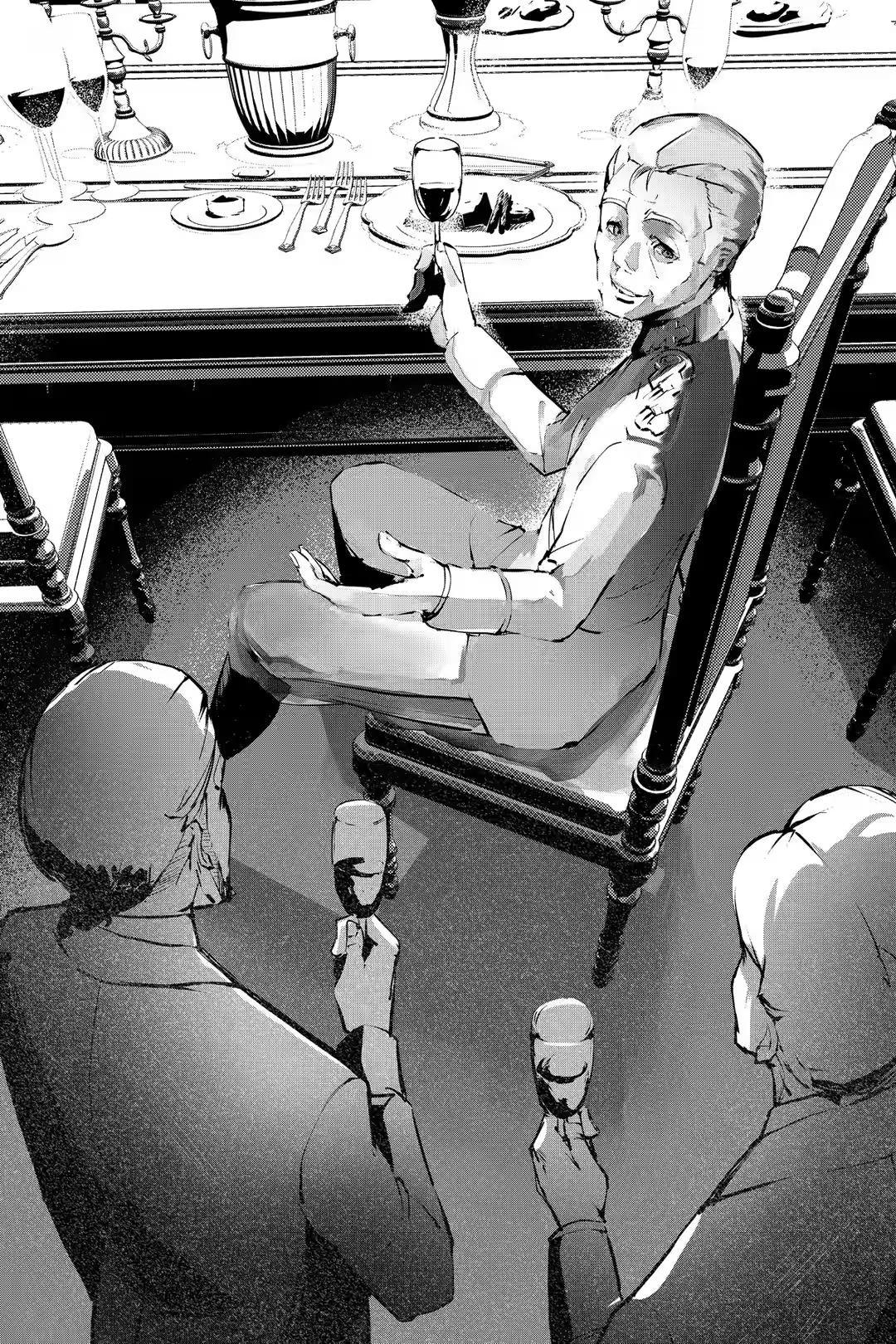
“Yes, if I was to smoke a cigar, we would all be reprimanded.”
Underage drinking and smoking is a very serious problem. It impedes healthy physical and mental growth and causes damage to society as a whole. Although, if anyone was to ask Tanya, she might point out that it is war that is most harmful to the health.
“Forgive me, Colonel Degurechaff. It’s not just that we were in war college together. You’ve also become such a rock lately that I can’t help but think of you as being older than you are.”
“Thank you for those flattering words, Colonel Uger. Although, the truth is, I don’t seem to be growing very much.”
An awkward silence begins to descend, but Colonel Lergen, ever the strategist, seems to have pulled himself back together again. He speaks in an obvious attempt to shift gears.
“Well then, Colonel…how about some tea?”
In that case, of course Tanya gladly accepts.
I would rather not be dragged along into this prolonged after-party, but rubbing shoulders with a hands-on man like Lergen might prove beneficial. The last thing I want is to wind up on the front lines, isolated and alone, because I overlooked a helpful connection.
Without further ado, Colonel Lergen claims one of the General Staff Office rooms. Colonel Uger casually has the orderlies bring in a collection of precious tea cakes, in line with the fashion of the times—an expression of his privilege as an elite, with influence even in the inner chambers of power. As someone who works mostly in the field, I’m feeling rather envious as the tea is soon laid out.
As I stand by and watch, however, my nose picks up on something curious. Despite recent circumstances, the General Staff Office’s reputation for legendarily atrocious food does not seem to apply to this current spread.
As Colonel Lergen urges us to dig in, he seems to notice the expression on Tanya’s face.
“Decent refreshments for a change, aren’t they? I thought I’d have an experienced orderly prepare it. Though, perhaps coffee would have done as well. Not everything must come from Ildoa, after all.”
Hmm? I raise my head in response.
“I’m sorry, but this wasn’t plundered, was it?”
“These are my own personal provisions, procured by legitimate means. I say this in front of Colonel Uger, but the Service Corps is very strict when it comes to embezzling spoils of war. As they should be. I bought these goods myself.”
Personal provisions. I bring the cup of tea to my lips dubiously. It is extremely mellow. Truly, a stray visitor from the world of aroma, color, and flavor.
I am no expert and can only describe it as good, though even an amateur could immediately tell the difference between this and some muddy imitation.
How did he get his hands on something like this in the middle of total war, here in the Empire, where tea is not produced?
“The palace’s New Year’s party was just yesterday. I purchased some of the leftover share from the wife of one of the officials.”
“The connections one enjoys when one works for the interior. But where did it originally come from?”
Constantly stuck on the front lines, I cluck my tongue in jealousy of those who get to work in the rear.
“Are you interested in the logistics, Colonel? Honestly, these fine wares were likely carefully shuttled in by various embassy employees remaining in the capital, by way of their diplomatic bags.”
“Well then, if Colonel Lergen doesn’t mind, let us enjoy this delicious meal.”
And it is delicious. Limpid and luxurious, the cup of tea brims with delicate aromas, and the balance of acidity and body is transporting. There is an inimitable depth to the flavor.
I sip my tea, enjoying the elegance. As I sample one of the cakes, I turn toward Colonel Lergen, remembering something.
“Yes? Was there something you wished to speak about?”
“Well…if you are in the mood for conversation…”
“You were kind enough to invite me to tea, Colonel, so I will sit here politely and sip my tea, but is that really the only thing you had in mind?”
Colonel Uger stares at Colonel Lergen as if to suggest this is his own fault for managing the invitation so poorly. Captain Lergen slumps his shoulders and gets down to business.
“It is about General Zettour.”
“The general? You mean you’ve gathered us here to gossip about him in secret?” I ask, pulling back with a somewhat wary expression on my face. In response, Lergen hastily waves his hand as if to suggest he means nothing so unsightly.
“General Zettour has my full support—do not mistake me.”
“Please, Colonel Degurechaff, I am asking you as well. Please hear us out.”
“You as well, Colonel Uger? Fine, what is it you have to say?”
With a quiet grunt, Lergen crosses his arms and furrows his brow slightly, as if carefully choosing his words.
“It is…difficult to put into words. But at the moment, General Zettour is— How can I put it? He is not frightening. And the fact that he is not frightening is extraordinarily terrifying.”
That fact that General Zettour is not frightening is in itself frightening? As I decipher Lergen’s meaning, I quickly turn my eyes toward his. The colonel’s eyes appear normal. Completely sane.
“I know, it sounds strange. Our deputy director was doing excellent in Ildoa just the other day. He came, he saw, he conquered. I remember.”
“I saw him when he arrived at the front as well. I’ll never forget the chill that ran down my spine at the moment of victory. But even with that memory, I cannot find anything fearsome about the general now.”
“Is the difference that pronounced?”
“Yes,” Colonel Lergen says, the conviction evident in each word he speaks.
“In the east, there is a clear difference. The general is simply ordinary.”
Uger nods in understanding, although the two are usually reticent to speak ill of others.
“I’m sorry, Colonel Uger, but what exactly do you mean?”
“When standing in General Zettour’s presence…I would usually find myself reflexively trying to stand up taller. Perhaps it is different for one of your mettle, Colonel, but it is impossible for us ordinary people not to tense up in his presence. At the moment, however, the general’s fearsome aspect seems to be growing somewhat—how to put it?—thin…”
Lergen leans forward in total agreement and begins speaking again.
“To put it plainly, something seems to be missing, something difficult to describe. Whatever magnetism it is that makes the general himself.”
I think back on our earlier interaction. Yes, it’s true. While Zettour was delivering his thoughts on the east, something was lacking. What might be called his aura. Ultimately, I shake my head.
“Yes, I suppose there was something worn out or scattered about him…but everybody hesitates at times, don’t they?”
That aside, I shake my head in thought. For better or for worse, the two colonels have ample opportunity to be in close contact with Zettour and know him best. If even Tanya sensed it vaguely…
“We cannot say, without a shadow of a doubt, that there is no cause to worry…”
“You saw it as well, Colonel?”
“Yes. What do you think, Colonel Uger? Perhaps an issue with General Zettour’s health…?”
“He has been tired. Especially after yesterday’s banquet.”
“Has he?”
“Yes. After he returned, his complexion was quite poor.”
Colonel Uger’s words only further strengthen my misgivings.
“I’m sorry, but may I ask something?”
Uger turns toward her questioningly.
“Was this palace banquet, or whatever it was, really such a draining affair?”
Unfortunately, I have no experience with such things. I’m deeply unfamiliar with the connections between the army and the court. At times like this, I can’t help but be reminded of the difference between my current situation and the career path I failed to walk.
For better or worse, however, Colonel Uger is decidedly a career soldier and, as one of the inner elite, is well-versed in such events. He seems to be considering how to answer Tanya’s offhand question in a way that can truly convey what these parties are like. After a moment, he seems prepared.
“Yes, Colonel, truly draining indeed,” he explains carefully, beginning in classic detail with his thesis statement before moving on to supporting details. “Events such as this party are truly exhausting. They leave your shoulders stiff, and the difference in atmosphere and mentality is even more shocking than the difference between the front lines and the rear. Even when one knows what is coming, they are difficult to endure.”
Colonel Uger offers his own personal opinion as well.
“This is only my subjective view, but…based on my experience providing support, I imagine even commanding a great battle might be significantly less stressful.”
“Plus, he is far too busy with his duties to begin with,” Colonel Uger adds, a weighty expression on his face.
“Honestly, it’s ridiculous. He is serving as deputy director of both operations and the service corps. And for all intents and purposes, he is practically chief of staff as well. He is filling three roles alone, and he even went off to Ildoa to bolster morale and oversee the troops. On top of everything else, he was forced to act as the face of the military at the New Year’s banquet. How much can be asked of one person?”
I grimace in response. This sounds like an example of organizational failure being temporarily covered for by the competency of on-the-ground administration. When administrators with such a wide range of abilities happen to be present, the fact that they can handle such things allows the ridiculous to soon become the norm…and fortunately or not, such people tend not to rest even when they know doing so is necessary.
What comes next is simple. When humans do not rest, they break down. And when a person goes beyond their expiration date, there is only one possible outcome. Once the capable administrator collapses, with so much still on his plate, there is sure to be a mess. I frown and sigh.
“Priorities need to be kept straight. There is only one General Zettour. And if there is only one, then his strengths must be focused where they belong: on administration. The entire game should not be placed on a single player’s back, regardless of how skilled they are.”
I believe what I’m saying is fairly obvious, but I’m met by a dubious expression from Colonel Lergen. I’m practically scowling internally, wondering if I’ve misunderstood something. But what the colonel says next causes my lips to twitch in displeasure.
“Oh, that’s right. Colonel Degurechaff, you are so abundantly capable that they never assigned you to work as a strategist back here at the General Staff Office.”
Well! Wouldn’t we all like to be inner elite, sitting back here at the General Staff Office, like His Highness Colonel Lergen? His magnanimous tone of voice only serves to further prickle my nerves. Though, of course, I know that the colonel didn’t mean anything by it.
Colonel Lergen is one of the central staff officers, favored sons of the organization—in other words, a man of sterling career. As someone whose own career path has not taken me to the inner chambers, I understand the colonel’s words are just a natural reflection of his position. But whether I like it or not, I can feel it. A barrier, like an invisible ceiling, above my head!
For Colonel Lergen and Colonel Uger alike, even their regimental commands are really just a formality. They are essentially fixed in place. Although they do occasionally find themselves venturing outside, this is just a part of the distinguished leadership’s efforts to better grasp conditions on the ground. Their permanent place of residence is still the heart of the center.
In the end, their upbringings are simply too different from Tanya’s.
When we were together at war college, it seemed like Colonel Uger would wind up becoming a serious rival for promotion. Somehow or other, though, my career led me away from the limelight. That is what was so confounding about it.
Not that I have any bizarre ideas about dying along with the Empire. There is no point getting overly invested in a career at a workplace that Tanya will transfer out of someday.
Of course, Tanya is a person of civilization, good, peaceful, and free. But in the end, it is impossible to ignore the Imperial Army’s personnel assessment—their assessment of her marketplace value. In an odd reversal, it is faith in the market that has left Tanya conflicted.
But that can’t last forever.
As I turn my attention back to the discussion at hand, Colonel Lergen finally reveals what it is he’s been thinking.
“The General Staff has traditionally kept to an ethos of small but elite. The office’s reputation is great, but inversely, the number of actual strategists present is limited.”
“Hmm, so…what you are saying is the system has limits? Personnel fatigue?
I begin to say “That makes sense,” but stop short. Based on the look on Colonel Lergen’s face, I realize that I have once again misunderstood.
“No, no, that’s not it, Colonel.”
Two nos! I close my mouth, realizing I really missed something fundamental. Now is the time to wait for an explanation.
“When it comes to the Imperial Army, there are so few strategists to begin with that administrative positions are generally not necessary. For deputy directors and so forth, it’s standard for them to be enormously talented. As long as they can handle administrative tasks in their free time, that’s considered more than enough.”
“What? So then how are operations actually planned and developed…?”
“It is an idealistic notion, but when it comes to plans, a broad outline is enough. Similar to a train diagram. Elaborate and complex, but at its roots, still only a sketch.”
“Colonel, does that mean that…these so-called plans, strictly speaking, are meaningless on the actual battlefield? That we are in constant need of better blueprints?” I venture, urging him to get to the point with my eyes. This is beginning to feel like some sort of verbal examination back at academy, and I’m growing tired of the back-and-forth.
“True, there is some friction with reality. No matter how far technology comes or how well trained our soldiers, there will always unfortunately be fog of war. Even assuming a plan is perfect at the time of drafting, perfect implementation is impossible.”
The idea of a perfect plan, itself, is armchair idealism.
However, that is precisely what makes advance conjecture and planning so important. By considering the possibilities and how they might unfold, one can make the necessary preparations. I’ve had the importance of planning drilled into me at both military academy and war college, so I can’t help but remain skeptical.
“There is no such thing as ‘according to plan.’ The battlefield is a cauldron of uncertainty.”
“And yet you still feel that plans are necessary?”
“As you should well know,” I say, smiling in reply to Lergen’s question. “Plans are futile, yes. A plan provided today and executed with conviction is of much more value than a perfect plan that won’t be ready until next week. But that statement only holds true within the larger framework of planning. Even if only to compare the worst and best and decide which to choose, there is meaning to planning in advance. During officer training, that fact was drilled into our heads over and over again.”
“That is correct. But I would like to add the addendum that in reality, combat levels must often be compared on the front.”
“Colonel Degurechaff, if I could add to what Colonel Lergen has said, you have often carried out operations while in direct communication with General Zettour, have you not? That may be an exceptional situation, but it is not rare for the Imperial Army to devise its strategies around the axis of such exceptions. Our plans are highly dependent on the capability of individuals. Though, it is an understandable misconception, of course,” he says.
I involuntarily blink at that.
“Even if the strategies of the General Staff are like works of art, so to speak, created by individual craftsmen, and not the creations of an organization…”
“You misunderstand. The operational-planning capabilities of the General Staff are not so simple at the individual level. But do you see, Colonel? We are always operating according to how things ought to be.”
In an elegant gesture, Lergen touches the frames of his glasses, his eyes taking on a faraway look.
“Recall the Empire’s largest offensives. Operation Revolving Door. Operation Iron Hammer.”
Against the François Republic, and against the Federation.
“Even when choosing the wrong opponents,” Colonel Lergen says, getting to the point, “our army has traditionally not valued having a plan B when carrying out these types of attacks. Or perhaps it would be better to say, it’s less that we haven’t valued having a plan B, and more that we haven’t had the capacity for it.”
“Not just that those on the ground haven’t been informed…?”
“During Operation Andromeda, that shortcoming almost led to our army dying in vain.”
It was a massive setback in their war against the Federation. Perhaps even a fatal failure. The hardships brought about by that strategy are all too familiar. I can only nod in understanding.
So preparation is clearly lacking when it comes to having a plan B. Or perhaps, because they can’t afford to fail in the first place, no one has given much thought to what to do when failure does occur. I’m beginning to see where the issue lies.
“That is the terrible side of being dependent on victory. If you cannot afford to fail, you may begin to devise strategies under the assumption that you will not fail and simply lean fully in. In a way, it is understandable. I see. So that is why objectives given on the ground are always so simple yet excessive,” I say in conclusion.
Come to think of it, although the expressed intentions were always understandable, when it came to strategic objectives, we were only ever given one aggressive option on the ground: plan A. My comment, however, causes a sour expression to appear on Lergen’s face.
“True, but are you sure that is not just your frontline syndrome speaking?”
“Colonel Lergen, that is too harsh,” Colonel Uger warns.
Lergen shakes his head in denial. “Listen,” he says, turning this way and speaking slowly and carefully. “Commanders in our army pick out the meaning in our orders and then act freely and appropriately to achieve goals. We have come to value the discretion of individual commanders in fulfilling the orders they are given.”
“Well, it is the commanders who must execute the mission. Is this not a good system?”
“It is not bad, but our army has become overly specialized. To put it a different way, we do not know any other way to give orders. And we rely on the discretion of those implementing the plans to figure out the finer details.”
“Is that a problem? The system seems to be functioning perfectly fine.”
If functioning as envisioned, with individual commanders at all levels striving to make the most appropriate decisions without needing to rely on constant communication with and oversight from superiors, such a system would be unbeatable. Creating the necessary organizational culture would be difficult, but once created, it’d be truly powerful. But the Empire succeeded in creating and implementing exactly such a system. So then where is the problem?
I find my own job much easier to handle due to Visha’s ability to understand my intentions. Likewise, I’m more than pleased to leave things to Major Weiss. But what if…? And before I can entertain those doubts, the two colonels have already begun to explain.
“Strategically, our defensive plans have always been built around interior line strategies. We have specialized in making the best choices within that framework.”
“Yes, when it comes to interior lines, we are a fearsome foe to behold…,” Uger says, nodding in agreement with Lergen. It takes me a moment longer, however, to comprehend.
Why are they mentioning interior line strategies?
Researching countless military topographies, keeping precise and flexible diagrams, a doctrine of delegating practically all tactical decision-making… As I think about all this, I finally begin to notice the problem.
“With interior line strategies, in an environment dedicated to counterattacking, every last soldier is highly familiar with the territory, and there is no real need to clarify the order of priority for what areas should be protected.”
Lergen grimaces in response as I realize what he’s been saying.
“Exactly, Colonel. Our army is strongest when we are fighting in our own backyard. And we have spent many years studying only that type of fighting. It is the fundamental character of our army, even when conquering enemy territory.”
“If I could add to what Colonel Lergen has said, when it comes to delegating defensive plans to ground forces, we have not gone far enough in instilling a unified approach toward how to act when not fighting in our own backyard. Do you understand?” Uger asks.
My brain finally grasps what it is the colonels are leaving unsaid. The root of the problem is their organizational culture. In this regard, the Imperial Army’s culture, while a type of strength, is also a type of weakness.
The Empire’s approach to operational command is based around transmitting targets to commanders. To put it in extreme terms, the Empire’s approach to orders is akin to saying, We are going to provide our guests with dinner, so acquire enough steaks for four people. In the extreme example, what kind of steaks per se, and how to acquire them, is up to the commander to decide. They could buy their own preferred cut and cook it to their liking. Or if they were worried the flavor would be underwhelming, they could telephone a steakhouse and have steaks delivered. They could even place it all into the hands of a talented chef who just happens to live next door. Everything is permitted.
On the other hand, if the only option is game meat, then the commander’s only choice would be to take the classic approach and go hunting.
Even an outsider can likely understand that much. But that is just the tip of the iceberg when it comes to how the Empire does things. The byword of necessity means that commanders of all rank are expected to go above and beyond as a matter of course.
Using the example of steaks, a commander might interpret those orders to mean, The fundamental requirement is to provide dinner, but a different menu would serve perfectly well for vegetarian guests, and so, rather than steaks, they’d provide a vegetarian meal more to the guests’ liking. This would qualify as a clear-cut example of observing the intention of the order, even while not taking any of the directions literally for the particulars.
Within the Empire’s organizational culture, this is the fundamental role expected of commanders at all levels.
But what about by-the-book orders, with oversight of everything down to the smallest details? The basic framework of the order, Provide steaks for four people, might be the same. However, the finer points would be clarified in the manual, with a scheme to ensure that the same results could be achieved regardless of who’s carrying the orders out. For instance—Provide steaks for four people from Steakhouse A. All steaks must be cooked medium-rare. If catering from Steakhouse A is not available, instead procure 150 grams of red meat per person from Butcher B, at a budget of up to 3,000 yen per person; cook steaks to medium in accordance with the standard manual for steak preparation; arrange and serve in a simplified fashion as appropriate to wartime conditions. If 600 grams of said meat cannot be obtained solely from Butcher B, Hamburg steaks may be permitted (but only if command is informed and prior consent is obtained). If preparing Hamburg steaks, the ratio of ground meat must meet or exceed military standards. If obtaining the appropriate meat from a butcher proves difficult, report back immediately.
Under this approach, the issue would be whether this litany of eventualities could account for all circumstances. For instance, if the existence of vegetarians has been accounted for, then a clause such as If vegetarians are present among the guests, provide suitable vegetarian meals can be included in advance, allowing the commander to make such arrangements without delay.
But if not?
The order is to provide steaks. And if, unfortunately, Steakhouse A is able to provide catering for four? Well then, the order can be fulfilled. The commander can arrange steaks for four people.
Naturally, upon realizing that one of the guests is a vegetarian, an obvious issue will arise. But the order given leaves no room for interpretation. It calls for steaks from Steakhouse A. In that moment, the commander on the ground will be left in a dilemma. Follow orders, or commit insubordination?
These are the obvious differences between the Empire’s approach and a by-the-book approach to giving orders. At a glance, the Empire’s way of doing things seems superior. An organization like the Empire, composed of officers who can think for themselves, obviously seems preferable at first glance. A place where people can do what needs to be done, appropriately and without constant interference from higher-ups over every little thing. It would seem to be the ideal workplace.
The reality, however, is that the latter type of organization is far more robust. And why is that? The answer is simple. Because the latter system allows anyone to fulfill orders to a reasonable degree.
The Empire’s style relies on an unspoken agreement among commanders, with results and on-site adjustment evidently relying on every person understanding the role they need to play for the greater goal.
Imagine another unit has been tasked with providing a wine that pairs well with the steak. If the person responsible for providing the steaks has suddenly, in their judgment, decided to switch to a vegetarian menu instead, then ideally, under the Empire’s approach, once the person has informed others of the change, the one in charge of providing the wine would, of their own accord, pay special attention to the fining technique used and choose wines that don’t use any animal products.
For instance, in response to requests for “an X-year bottle of A,” they might decide, Naturally, I will secure Wine A, but even without being told to do so, I will also secure a wine suitable for vegans. The servers and valets would then take similar care. All without anyone needing to give directions. As long as information is shared, each person will be able to make an appropriate judgment.
This is what allows the Imperial Army to turn quickly on a dime… They are highly adaptable to changes in circumstance and, when necessary, can even do the unthinkable and ignore finalized plans. The Empire’s strategic planning takes such flexibility for granted.
However, without mutual understanding and confidence of one another and of how each unit will behave under the circumstances, such flexibility is impossible.
In other words, what would such an arrangement look like when they are placed outside their own backyard? Considered in that light…I tremble. With close acquaintances such as Lergen and Uger, it would be one thing, but if told to cooperate with a colonel I know almost nothing about? How am I supposed to figure out how this unknown colonel might act during large-scale maneuvers in enemy territory?
With an interior lines strategy, it might still be doable. Imperial officers have been trained on what to do in almost every eventuality, and I can trust that the others have all undergone identical training. But with this current chaos…?
“Colonel Lergen, that would mean that when it comes to defense plans in the east…”
“It barely needs saying, but yes, we have no shared footing.”
Sighs fill the room. In that moment, I understand, whether I like it or not. From a different perspective, the Empire’s style of giving orders, which seemed so impressive before, is not suited for total war, where the strain on human resources is too great.
In an organization where all the employees are lifers and have all gotten to know one another well. Where everyone knows how to approach their work, and not only voluntarily throws themselves into their duties but also continues to proactively self-invest. Where long periods of time are spent training new people. Then yes, that would be fine.
An organizational structure such as that, where everyone comes together as one, obviously has its strengths and clear advantages. But as I’ve said before, war is cruel, and it is always hungry for more human capital.
To take drafted soldiers—who have been made officers only by virtue of graduating from the war college but who are still outsiders and not career men—and incorporate them into such a structure, and to ensure they behave appropriately…
Even someone like Tanya, whose watchword is training, is forced to admit it would be impossible.
Once upon a time, the Empire never dreamed of resorting to part-timers, but it has found itself forced to turn to such soldiers as a last-ditch effort, due to the demands of rapid expansion. Although they assumed they would see the same level of ability and results from these part-timers as from full-time staff, instead, they have found themselves with a limited number of full-time staff cleaning up after their part-time staff, while company conditions grow increasingly worse.
Throwing large volumes of talented staff at a problem is a decent enough solution, but real strength lies in avoiding any such dependency on any individual through talented management. But if a company can’t do that? I’m beginning to realize why General Zettour emerged onto the front lines so many times.
“So that was why he showed up directly, despite his age.”
Their current organization is one that requires management to fully commit as players on the field! Organization? What a laugh! Scorn drips from my lips.
“So in order to keep objectives clear and simple and prevent confusion among soldiers, administration needs to be sent all the way to the front…? That is awful. That explains all the trouble my troops experienced as guards.”
“You’re complaining about when I served as the temporary head of the 8th Panzer Division, I assume? I, too, have opinions on that matter.”
“For my part, I found it somewhat enjoyable,” Uger says, although his smile seems rather bitter. “I come from the Railroad Department, where we’re generally in the rear, but it’s not just diagrams. Most of the people who work on operations have been plucked for duty out in the field managing the railways. It’s quite rough.
“So you see…,” he says, casually continuing. “We’re in better shape compared with other departments when it comes to losing men, but even the railway builders, who are supposed to be all-important, have encountered the same problems. How much room is left for unspoken agreement at this point? Other departments, I imagine, are in similarly rough shape. Last-ditch efforts to replenish ranks aside.”
“Well, when it comes to magic officers, recruitment is almost nonexistent…”
I come very close to complaining about how overworked we are and how rotations have gone to shit, when Lergen intercedes:
“You are unhappy about the lack of new troops. But in many other units, their magic battalions have been reorganized into two companies right now, with one of those two companies chronically short on manpower. The entire army is in the same state. You’ll just have to make ends meet.”
“The armor divisions in Ildoa seemed strong enough.”
“Yes,” Lergen says, puffing his cheeks out nostalgically at the mention of Ildoa. In the next moment, however, he shakes his head from side to side.
“Ildoa was an exception. You should assume panzer units are completely barren. Even in exceptional divisions, replenishment of tank regiments is, at best, around sixty percent. I’ll say this up front, but any company with a new-model tank should consider itself extremely lucky. In many cases, the priority is simply on replacing equipment. The prevalence of old models is bad enough, but the drop in skill levels among tank operators is abysmal.”
Terribly threadbare. Lergen and Uger likely mean what they said. But for me, someone who is familiar with another world’s history, 60 percent seems far better than anything we could have hoped for. Although, that, of course, is only by comparison.
“Nothing in the cupboards, and nothing in the pantry. It seems the Imperial Army is now just as poor as everyone else,” I grumble. I turn toward the ceiling and sigh lightly. “I was under the mistaken assumption that the Imperial Army is blessed when it comes to manpower. I would have never guessed we were already beyond numerical problems and are dealing with quality issues as well… Although, there is a balance to be had with infantry. Maybe I have overestimated the importance of mages. Not that I mean to play favorites.”
At this, Lergen waves a hand, likely to assuage my concerns.
“We may be able to produce orbs in factory, but it’s not as if we can exactly mass-produce mages.”
“True,” I say, agreeing.
“It takes about ten years of training. Even if we began mass production now, we know they wouldn’t be useful by summer, let alone by next month.”
“Usually, it takes twenty years. Even speeding up the process, it would take sixteen.”
“I wonder.”
“Colonel Degurechaff, Colonel Lergen is once again correct in this regard.”
With a sigh, I momentarily lay down my arms.
Lergen seems to say So you see… before speaking up again. “Either way, that is exactly why I want to get an exceptional unit back into the east as quickly as possible. In order to alleviate the burden on General Zettour.”
“I understand. Is that all you wished to speak about today?”
“No, I am only getting to the important part. The truth is that I wish to investigate a range of questions related to General Zettour’s pullout from the east.”
“A range of questions?”
“Yes,” Colonel Lergen sighs, as if nurturing a headache. “The 203rd Aerial Mage Battalion reports directly to the General Staff, as does the Salamander Kampfgruppe. A piece on the board that, until now, has been managed directly by General Zettour. When General Zettour was flexing his might in the east, this was not an issue; however…”
Ahh, now I finally understand.
“…while General Zettour is in the capital as an administrator, handling Eastern Command, which is essentially in its own jurisdiction, can be a challenge for us.”
Territory and authority. These are always thorny issues.
“When it comes to Eastern Command, General Zettour tends to have a short temper. Well, we’re giving it our best with General Johan von Laudon, a strict fellow whom General Zettour once called dedicated. But there are plans to switch out senior staff in the future.”
“You mean…”
A cull? I digest what he has said. Lergen smiles uncomfortably and nods.
“The truth probably isn’t far from what you’re imagining. It will likely take some time for General Zettour to muscle his way through. But to improve operational efficiency, Colonel Uger will intercede directly in a variety of ways to ensure thing go smoothly when transporting Salamander back to the east.”
“Leave it to me, Colonel Degurechaff. I’ve already prepared transport. I am calling it an experiment, but I have arrangements in place that should allow a single Kampfgruppe to be deployed to the east in about three days’ time.”
A promise of aid, from specialists in the rear. Of course, I realize, this must have been what they brought her here to discuss. As I’m thinking this, however, I notice that both colonels are wearing somewhat tense expressions on their face.
“I’m sorry, Colonel. Is there something else?”
Finally, Colonel Lergen’s expression seems to say. He begins talking once more.
“This is what I really wished to speak to you about… The real effect of General Zettour’s removal from the chain of command in the east is highly unknown. Thus, if you find your unit seems to be withering on the vine…if necessary, you may make use of my name.”
So that’s what this is all about. The real purpose of this nightcap is a thoroughly off-the-books discussion. I ask my own question in response. One that shows I understand.
“As Lergen Kampfgruppe, you mean?”
The answer I receive, however, is unexpected. Today is turning out to be just full of surprises.
“As Colonel Lergen, if necessary. And ex post facto when required. In terms of logistics, you may also impose on Colonel Uger using the General Staff’s name. We should be able to more or less square accounts in that regard.”
“Unless I’ve misunderstood you, you are giving me carte blanche to launder your name and interfere directly in logistics.”
“Your ears appear to be working perfectly, Colonel. The proper authority, to the proper person, in the proper dimensions. Though honestly, I do find the prospect of writing you a blank check somewhat terrifying.”
Can it be? Is this real?
I turn a questioning look Lergen’s way but am met with an expression of apparent resolve. The confidence surfacing in Lergen’s face, however, only lasts a moment.
“Just don’t go burning Moskva again! Or well, maybe it would be better if you did. I don’t know. At the very least, try to mention it to me first?”
“Don’t count on it. Not in this half century, at least.”
My response is greeted with laughter. Strange, he must have thought I was joking. I’m not sure what is supposed to be so funny about it, though. Maybe it can be chalked up to a difference in culture and world views.
Sometimes, people don’t see eye to eye, but that is just a part of being human.
“I feel relieved, Colonel Degurechaff. Thank you. However, I imagine you may run into troubles even with my name in your keeping. Direct communication would be proper, of course, but I will authorize contact by messenger on this end—”
“Excuse me for interrupting, Colonel Lergen, but might my lines of communication as a railroad man be acceptable?” Colonel Uger says, with an expression on his face that suggests he is worried he is being too forward. Colonel Lergen, however, sighs and shakes his head.
“We’re always hungry for information from the ground. In particular, accurate information. As a clear deviation, there will be trouble…but internally, only a direct line to General Zettour can be secured. First and foremost, we want to get information out to General Zettour, out on the ground, as quickly as possible. All the more so, with the situation in the east so dangerous.”
“Understood,” I say, before continuing. “To be honest, however, isn’t it a bit early to redeploy to the east? Salamander Kampfgruppe is accustomed to being overused, but we’ve already reached the point where I am getting notices from Personnel cautioning me to not use leave.”
“When was this?”
“Just now, I picked one up in the General Staff mail room.”
“Do you have it on you now?”
“Yes, here it is.”
Lergen, most inner of the inner elite, takes the outstretched piece of paper and begins scribbling on it.
“Full exemption granted due to operational necessity. By order of the Service Corps of the General Staff Office.
“There you go,” he says, as he begins to hand the notice back to me. His hand, however, freezes partway, and he passes the paper to Uger instead.
“Colonel Uger, would you handle this?”
“Yes. I shall explain as well. Worry not, Colonel Degurechaff, you can count on me.”
“You both have my gratitude, I’m sure.”
Although, if you really want to help, how about a little time off instead?! At least, that’s what I think in the back of my mind.
JANUARY 3, UNIFIED YEAR 1928, MOSKVA / SUPREME HIGH COMMAND
In contrast to the size of the army, which operated under party authority, the Stavka of Supreme High Command in Moskva was actually fairly modest.
Exterior aside, the inside of the building was surprisingly practical. The room was so dominated by pragmatism that, were one accustomed to socialist realism, it might feel like a different dimension.
A glance at the faces of the men seated in the room, meanwhile, would have been stunning.
The small group gathered in that meeting room, which was located in the inner depths of the headquarters, was made up of generals, party elite, and even the general secretary and members of Internal Affairs—all models of no-nonsense dedication. Even the salutations of the officers were simple and utterly practical.
There was nothing laid-back about their attitudes, however.
“It is the appointed time, so let us begin,” the moderator said nervously, punctual down to the second. Although he remained calm and kept his voice level as he made eye contact with the general secretary, his stiffly controlled posture was the product of great effort and artifice.
The moderator was far from alone in that regard.
“Today’s agenda concerns strategic objectives for Operation Rising Dawn.”
The proceedings were now in the military’s hands. Without hesitation, one of the gathered generals, a man of late middle age who was there to share their proposals, stood up and began speaking.
“As requested by the party, the military has prepared two plans, one that is certain to be successful and one geared toward decisively winning the war. We are prepared to proceed with either.”
This man, General Kutuz, possessed a distinctive manner that had avoided earning him any ill will, even during the storm of purges that had battered the military. Strict and capable, General Kutuz did not believe in attempting things that did not make sense. Though talented, he had protected his position as a veteran general by remaining largely nameless. In other words, he had long been seen as a harmless fixture.
At the moment, however, General Kutuz was the man behind the planning of the Federation’s strategic offensive, Rising Dawn, and he was advocating for a militarily rational solution rather than any grand displays of genius.
“Thank you, Comrade Kutuz. The question, then, is whether our objective in Operation Rising Dawn should be for two hundred kilometers or six hundred kilometers,” the general secretary said, folding his arms. The assembled military men and party elites were there today to make up their minds on that difficult question.
“And there’s no point in attempting a compromise?”
“Correct,” Kutuz said, adopting an apologetic manner as he spoke.
“I, too, understand the desire to push the enemy back a bit farther if possible, and I would have also liked to aim for a compromise, but there are too many difficulties… A compromise would be akin to herding cats.”
Despite being a military specialist speaking to nonspecialists, Kutuz’s answer was both extremely polite and perfectly serious. To put it in other words, General Kutuz completely lacked the arrogant and condescending attitude so common to specialists. Regardless of who was talking, even when opposed, the general’s personality was prone to see this not as opposition but rather an opportunity to consult. A virtue that life had taught him.
“At two hundred kilometers, we should be able to strike and cross the stone bridge. It is very likely that our army would smash the Empire’s defensive line while also blunting their spears and suffering comparatively few losses ourselves.”
It was a simple and clear plan. The others nodded in understanding as they stared at the map. It involved advancing along a 100-kilometer front and seizing 200 kilometers of ground, dealing the Imperial Army a heavy blow.
A straight push, without any of the tricks General Zettour was so known for, meant to teach the enemy a lesson and drive them back. The argument for this approach was clear. Through the appropriate combination of fundamentally mundane and easy-to-understand parts, General Kutuz ensured that the party members and key players would grasp the plan without backlash.
Though the steps were individually mundane and underwhelming, when taken collectively, they could easily shake the world. A simple, straightforward, and by-the-book plan. In other words, powerful when done right.
At the same time, it was unfortunately also the type of proposal likely to attract criticism from those expecting more after so much preparation. Hence why an alternative plan had also been arranged, one focused on pushing the limits. A grasping final plan to end the war with a single blow.
“At six hundred kilometers, we would aim for the best possible outcome and attempt to entirely decimate the Imperial Army’s main fighting force.”
General Kutuz’s style of speaking was professional in manner, but free from enigma and obfuscation.
“The envisioned advance, six hundred kilometers, is quite long, but even this is a preliminary supposition at most. It is the minimum distance that we estimate would be necessary when prioritizing pursuit and damaging of defensive lines. If the Imperial Army is able to retreat more swiftly, emphasizing attacking the enemy’s main fighting force—with an advance of more than six hundred kilometers—could also be on the table.”
Repeatedly turning over what needed to be done, what was expected, and what options had been explored in this manner might be circuitous. However, it was perhaps just what was called for in order to get everyone to reach an agreement.
“Whether two hundred kilometers or six hundred kilometers, the initial steps of the plan remain the same. First, we attack along a front of at least one hundred kilometers. Within that area of operations, the initial goal is to destroy the better part of the enemy’s defensive lines through a concentrated deployment of artillery and air assets. Preparations for this have already been completed.”
Meticulous planned fires. As the attackers holding the initiative, they had the freedom to choose when and where to strike the Imperial Army. The Federation Army had been slowly and stealthily camouflaging its intentions, stockpiling supplies and making preparations, and marshaling its forces to secure local superiority.
As an abstraction, consider some hypothetical numbers. In the case of 100 vs 120, it would be difficult to say that 120 had a clear superiority. But if 90 of the enemy was locked down by 90 friendly troops while the remaining 10 were attacked by 30, the effect would be overwhelming. Achieving something this decisive might be difficult, but the basic principle was self-explanatory.
General Kutuz continued to lay out the details of the plan simply, without resorting to any difficult calculations.
“If we are only pushing the front forward by two hundred kilometers, the operation will conclude after the first stage for all intents and purposes. We should be able to push the enemy out simply by pummeling them with artillery and sending mechanized units forward. However, some of the enemies remaining troops are likely to retreat. As a result, the enemy will be able to reform their defensive line and, although weaker than before, will likely take steps to bolster their defenses.”
If things went well, they would be able to whittle down the Empire’s numbers during the pursuit. They might be able to make it 80 vs 120, or even 70 vs 120. However, the 120 would also suffer losses. But 90 vs 110 would still be slightly advantageous. And 80 vs 110 or 70 vs 110 would not be bad, either. But they would not be able to eliminate the enemy entirely.
“In the event that we send our army into enemy territory in a fully committed attack to destroy them decisively, we would have to move on to stage two, in which we expect we would have to advance at least six hundred kilometers. In this event, once the initial first stage is completed, our vanguard will need to advance aggressively. In other words, we will need to commit to a nonstop attack. Entertaining the Empire’s stronghold tactics would likely be futile. Laying direct siege to isolated outposts will instead be the work of trailing forces, which will follow in the wake of the first echelon.”
In other words, a wave attack. Inundate the enemy. Such overwhelming force would require 30 behind for every 30 in front, but the Federation Army had already calculated the necessary numbers.
Meaning 30 of the Federation to strike at 10 of the Empire. And if the first wave came to a stop, another 30 fresh soldiers would be waiting to take their place and punch through the enemy’s already beleaguered defensive line. Any remaining pockets of resistance would be surrounded by other units. In other words, 90 would continue to hold down 90.
The truth was that it was a very straightforward calculation: 100 vs 120 plus 30; 90 vs 90 for a stalemate; and 10 vs 30 plus 30 to sustain the push.
Putting aside the specifics of how many divisions could be deployed or the Empire’s own defensive strength, multiple echelons were what allowed for such an excessive fighting style. It all came down to numbers.
“In any case…,” General Kutuz continued. “If any Imperial units decide to hunker down and defend isolated outposts, we should let them. Our first wave will simply continue to advance along the hundred-kilometer front. When the wave hits, they will be like towering castles of sand.”
While 90 continued to hold 90, the remaining forces would arrive to lay devastation in its wake.
Real waves eventually receded. A military wave, however, could continue to drive forward in a torrent. Enemy soldiers, holed up in their sandcastles, would be swallowed up in enemy territory. They would find themselves quickly surrounded. And once they began to run out of ammunition, fuel, and food, the fighting strength of that 90 would begin to dwindle.
Even if their strength only fell by 10 percent, it would already put them at 81 vs 90.
Of course, the Federation’s own attacking force would lose strength in much the same way. But those concerns had already been incorporated into their plans.
“Naturally, between fuel, gunpowder, and human fatigue, the first echelon will inevitably lose momentum at some point. That is unavoidable. Such exhaustion could give the enemy time to rebuild their defensive line. With reserves in place, however, they will never get the chance.”
If the strength of the advancing troops was only 30, the enemy might be able to muster their troops to some degree and attempt to smash the breakthrough force before their encircled 90 could be worn down. That, or rebuild their defensive line.
But with another fresh 30 to continue the charge as soon as soon as the offensive momentum of the first echelon dried up, plus the 90 already pinning the enemy in place?
“With the reserves surrounding the enemy’s isolated outposts, not even the Empire’s stronghold tactics will be able to hold out forever. While the main force is advancing, I believe we should lock them in and let them hunker down all they like to be easily picked off at a later occasion.”
Maneuver and restrain. That was the long and short of the plan. No novel stratagems or other fantastic contrivances. Just the understandable outcome of mundane, down-to-earth, plodding efforts.
“The advantage of having a second echelon of identical scale to replace the first once the first comes to a halt is naturally the ability to sustain the offensive. Once the Imperial Army believes it has stopped the first echelon and begins to rebuild its defensive line, we will crush them with the second echelon. And once the second echelon is on the verge of reaching its limits, the now refreshed and resupplied first echelon will advance once more. This is how we will achieve the second-stage objectives.”
Obviously, the geniuses among them would probably itch for more. Something more adroit and efficient. This approach, however, while very demanding in terms of manpower, had the benefit of being easy to pull off. Even by those without, to put it bluntly, any genius.
When it came to accomplishing things steadily and beneath notice, General Kutuz was a master who could not be easily replaced. After all, he had been able to take a complicated military strategy and, through syntax that brought them all together onto the same page, thoroughly dissipate the tension between the government and the military.
The general’s presence was significant. If the Empire’s resident Lieutenant Colonel Tanya von Degurechaff, for instance, was to learn of General Kutuz’s activities, she would have likely plotted an assassination or schemed to bring him down through slander and other devious tricks.
“Seizing territory is secondary. Our main focus should be on completely eliminating the Imperial Army’s field army. If we can succeed, it will help achieve the party’s goal of ending this Great War with a single decisive blow. At the very least, taking these six hundred kilometers will ensure the Imperial Army is unable to reorganize and allow us to wipe the slate clean, including any supporting organizations. But this will take every ounce of our strength. In other words…”
So far, the specialist had been the one delivering this laborious explanation. The general secretary himself, however, now spoke up to deliver the conclusion.
“There is no room for error. In the worst-case scenario, you’re saying that even one mistake could lead to our collapse.”
“That’s correct,” General Kutuz confirmed, nodding in response. Although a look of pleasure appeared on the general’s face now that he was certain he had communicated everything clearly, there was not even a whiff of ingratiation in his expression.
Loria, watching from the side, couldn’t help but recognize the advantage. But he still interrupted, understanding that the humble general was not the type to say unnecessary things unless directly asked.
“Excuse me, Comrade General. If I may.”
“Yes, Comrade Commissar for Internal Affairs. What is it?”
“Are you saying that we will need to commit everything, even our strategic reserves, to this supposed six-hundred-kilometer area? And even then, success is not assured?”
“Yes,” General Kutuz said, confirming once again.
Can’t was a word that many people had trouble saying. The ready ease with which the general could say, We will try, but we cannot guarantee, was no small thing.
“Adding to Comrade Loria’s question, would two hundred kilometers be successful?” the general secretary asked. General Kutuz responded once again with similar ease.
“With two hundred kilometers, failure is not possible. We would carve through the Imperial defensive line with artillery, rebuffing the Imperial Army’s counterattack and applying pressure.”
It was a forceful push with no particular stratagem. A no-frills steamroller approach. The implications were short and concise, allowing the general secretary to sum the situation up plainly.
“In other words, it would simply be one large attack and would not be particularly decisive in terms of ending the war. The decision is difficult. Two hundred or six hundred kilometers. It is very much like comparing a short- and a long-distance race. I understand there is no compromise available, but…”
Here, the leader of the Federation leveled a question that revealed his political itch for a striking victory.
“…what can we do to ensure victory with the six-hundred-kilometer plan?”
“Well, the certainty of the six-hundred-kilometer plan rests entirely on doing everything we can and concentrating enough manpower to ensure that the advance never stops.”
“Yes, comrade, you’ve stressed that several times, but what of it?”
General Kutuz nodded slowly.
“You see, if our frontline units pause for even a moment, it will give the enemy time to regain their footing. Naturally, our plan is to have a second echelon waiting for the exact moment the first echelon stops—at which point, we will send them forward to take the first echelon’s place. However, if we are even slightly delayed and the enemy is able to recover its defensive footing—”
“Someone like General Zettour needs to be strategically crushed, so it might be better if we avoid any possibility of playing into his hand.”
General Kutuz nodded once more and began speaking again, his tone of voice affirmative.
“I believe that to be the key point. Whether or not there are reserve forces available to maintain the offensive, in the event that things go awry, it could significantly impact not only operational tempo but also our chances of success.”
“Understood,” the Federation leader said gravely.
“If we could prepare a third echelon for such an event, though, the situation would be different.”
The room filled with confusion at this unexpected response. The Federation was already squeezed tightly. From where were they supposed to come up with even more?
“If…such a thing could be managed.”
The regrettable tone in General Kutuz’s voice spoke volumes. While no one present said it, they all understand immediately how difficult it would be to prepare a force that the general would consider unassailable.
It had been so hard to keep their composure when those upstarts from the new world had come around, prattling about “joining the war.” “Well, well, isn’t this a fine mess? We’ll be needing equipment ourselves now. And of course, large quantities of weapons, ammunition, and equipment will be required to rearm the Ildoan Army. What a mess, indeed. Plus, there’s the dire food situation in southern Ildoa, so really, there’s not even enough room in the ships. Looking at the whole situation, top-down, the constraints on distribution and supply are pretty severe. I’m afraid we’re going to have to do away with lend-leasing to the Federation…”
Damn that Zettour. Everyone agreed it was good that the son of a bitch was out of their faces now, but he was hurting their efforts even when he was maneuvering in other countries. The man was like a plague, causing trouble no matter where he went.
Seeing that the moderator was not able to turn things around, Loria decided to raise his hand and share his own opinion.
“The majority of what we can muster up under present conditions has already long been committed to Operation Rising Dawn. It is inconvenient that the capitalists, unlike us, cannot pull their weight, but it is unsurprising.”
Indeed. Seeing that the room was now warmed up, Loria turned to the higher-ups for their judgment.
“This is a political question. At two hundred kilometers, victory is assured, yes, but if were we to make similar preparations, could something like this be easily done a second time?”
“A good point, Comrade Loria. Excuse me, Comrade Kutuz, but if we wished to conduct another offensive at the same scale, it would take a considerable amount of time, I presume?”
“Yes, it is just as you say. Unfortunately, regarding how much time it would take to gather reserves for something of similar scale and muster up this much manpower without the Imperial Army catching wind, I cannot provide an answer on the spot…”
“An approximate estimate is fine, comrade. A rough number, for argument’s sake. How many months would be required for a strategy of similar scale?”
At the general secretary’s urging, General Kutuz seemed to think for a moment before answering:
“For two hundred kilometers, it would likely take about three months. However, if we hit a setback with six hundred kilometers, I’m afraid we could be stuck in place for more than six months at the least. Even if we succeeded, there is still the possibility that we might have difficulty moving due to the losses we would suffer.”
The general secretary grunted as he began to think. As he fell silent, so did the rest of the room.
However, worried that this pulling back, this shrinking in fear, could arouse notions among their highly suspicious leader…Loria decided to purposely stir up the room.
“Comrade General, may I ask one more thing? These are just the thoughts of an amateur, but…expanding the plan to include a third echelon would be difficult, correct?”
In response to Loria’s questions, General Kutuz almost looked relieved. He answered in the negative, with a clarity he had yet to express. His expression was purely professional.
“Quite a great many units have already been squeezed to their limit. And with the need for the mechanization of the first and second echelons, the need for a certain amount of skill is also a significant concern…”
“Would we really need to go that far? We don’t know if we would even need to use the third echelon.”
Was the general not being too cautious? However, despite his reputation for being a people pleaser, as a professional man of the military, General Kutuz never made empty promises.
“Unfortunately, thorough preparation would be necessary. The Imperial Army excels at artifice and stopgaps. In particular, the twenty-some divisions General Zettour has set aside as a strategic reserve are a challenge. If those forces are brought to bear and concentrated, it is a very real danger that our breakthrough force could be cut off and encircled. I heard there had been an extended deployment in Ildoa—”
—but against that charlatan. The end of General Kutuz’s sentence was cut off before he could finish, intercepted by the general secretary, a grin on his face.
“Regarding that… Comrade Loria, please explain.”
“Of course,” Loria said, nodding, as he began to share his latest intelligence with General Kutuz. Information he had shared with the general secretary only moments ago.
“Our marvelous friend has exposed the Imperial Army’s whereabouts,” Loria boasted. The hands, feet, and ears of the secret police have done well. What one can accomplish when one is secretly in love!
“Regarding the Imperial Army’s panzer divisions, most will be wintering in Ildoa. The earliest they expect to move east is after two months. A portion have already begun to uproot themselves, but it seems that provisioning, resting, and retraining will not go swiftly.”
“I see,” General Kutuz said, seemingly impressed… All the same, the general was a veteran. He appeared to think for a moment, a look of confusion on his face. After a brief pause, he posed his own question for Loria gingerly but clearly.
“Looking at it another way, then, is there not a risk that, just as we are overextended due to our offensive and reach our operational limits, the Imperial Army could send in several fresh panzer divisions?”
Kutuz’s concern was that they might be subjected to a painful counterattack right when they could least afford it. It was a fairly mundane concern, which made it all the more understandable.
Loria smiled. “Do not worry on that account. Regarding the two-month estimate, replenishment of the Imperial Army’s panzer divisions is unlikely to proceed so fast. According to intelligence reports, the Empire’s panzer divisions have been chronically short on men. They are currently at less than fifty-percent strength, and the replenishment rate is just barely putting them at seventy percent.”
Although, Loria’s real thoughts on the matter was that it was a mystery how, no matter how many times they fought, they kept getting led around by the nose by an enemy with such limited fighting force. He had another thought as well, though. With his current intelligence on the Empire, which showed that they were barely making ends meet, if the Federation could overwhelm the Empire through an operation like Rising Dawn, it would immediately put them in checkmate.
Most importantly, Loria had gotten his hands on a major secret.
“Comrade Loria, perhaps you should explain the other item as well.”
Loria glanced toward the general secretary for confirmation and received a nod.
“After repeated clashes with our army, General Zettour likely assumes we are in no condition to stage a winter offensive. He seems to reason that if we were being deceptive, we would have struck in Ildoa.”
Loria flashed a reassuring smile at the look of astonishment that appeared on General Kutuz’s face.
“So you see, Comrade General, your concerns are diligent. But as you’ve just heard, Zettour will not be anywhere near the eastern front. And the likelihood that our attack will enjoy the element of surprise is high.”
“But the Imperial Army was pressed in August of last year as well, to the point where it seemed like General Zettour would need a miracle. They will stop at nothing when cornered. Imperial decapitation tactics pose the greatest danger. And most importantly, General Zettour is particularly skilled in calculating backward from logistical needs. Such things come almost secondhand for a man like that, and lines of supply and communication can be a weakness even for very large armies.”
Loria’s eyes widened. A direct counterargument from General Kutuz was rare. He almost never refuted someone this firmly to their face. Moreover, it was unusual for anyone to disagree with Loria, save the general secretary himself. Rarity upon rarity. The general must have felt strongly about this.
Loria waited for him to continue. General Kutuz voiced further concerns, his expression absolutely professional.
“In the worst-case scenario, the enemy could capture our logistics bases.”
Hmm? Loria’s face was a mask of curiosity.
“I’m sorry, but aren’t you worrying too much again, Comrade General? What exactly is it you envisage happening?”
“The strongest risk is an airborne assault. The Imperial Army is adept at striking deep with long-range decapitation attacks. We should be worried about their strategic reach.”
“Now that you mention it, the Empire performed something similar before. But we’ve developed countermeasures, haven’t we?”
“Yes, countermeasures are in place. But they are only equipped to deal with what we’ve seen before. We’ve accounted for a regiment of airborne mages, but if more than that should show up—”
“Comrade Kutuz, the Empire has, at most, two divisions of mages deployed to the eastern front. Their numbers are lacking to boot. Do you really believe they can afford to scrape together a fresh regiment?”
“There is always the fog of war. Even if the information obtained is complete, it is only complete at the time it is acquired, correct?”
Hmph. Loria’s shoulders relaxed. On that point, at least, they had no need to worry.
“I understand. It is natural for you to worry, as I cannot fully explain our intelligence-gathering capabilities. However, rest easy. I know everything down to the brand of wine that General Zettour drank at the Empire’s New Year’s banquet.”
“And the Imperial Army’s movements—”
“Are under full surveillance. Even their parade grounds are under close watch. As for the force you were referring to… What are they called, the Salamander Kampfgruppe? I’ve already ascertained that they have returned to the Imperial capital from Ildoa.”
“I see, I see,” General Kutuz said, nodding readily, but then his face suddenly grew tense. After a moment, he turned with a look of agony on his face and gave voice to the dreadful thought that seemed to have risen in his chest.
“And if they return to the east at this time?”
“General Zettour is formidable, it is true. Quick on his feet and prepared for anything. In many ways, he deserves praise.”
As a hunter of love, the timing could not be better for Loria.
“All the same, those Salamanders are only a single unit. No more, no less.”
Regardless, Loria did not take his work lightly. And hunting that little fairy was his destiny. In that very moment, Loria made the decision to work toward achieving final victory, and final victory alone.
“Six hundred kilometers it is, then.”
As the general secretary himself made up his mind, the entire Federation fell into lockstep, springing into action like a well-lubricated precision machine. There was a buzz as the specialists in each department began barking out necessary work orders, covering everything down to the smallest detail.
“What kind of equipment? New models?”
“Tanks, fighter planes, and computation orbs, all of similar quality to those in the Empire.”
“There is one issue. The new equipment is strong, but maturation takes time. Even some of our elite units will still be using existing equipment at the end of the day. Don’t expect newly equipped units to live up to what’s written on paper.”
The Federation were excellent at getting all their ducks in a row. It was the execution, after all, that was their sticking point.
JANUARY 2, UNIFIED YEAR 1928, EVENING, IMPERIAL CAPITAL
After leaving the General Staff Office and returning to her own dormitory, Tanya quickly takes command back from her second-in-command, who was left in charge in her absence.
The beginning of the year is always a busy time, and the tasks have already piled up while we were in Ildoa, so the soldiers are busy. Even contriving as best we can, we can only manage alternating holidays for the core combat unit officers. Of course, a majority of the miscellaneous work has been taken care of, so people are mostly engaged in small talk, waiting for their relief.
“Let’s see…the latest models of tanks, assault guns, tank destroyers, and just for good measure, the newest model of computation orbs.”
As I inspect the list of new equipment included in the document received from Major Weiss, I emit a heavy sigh despite my subordinate’s presence.
“They must think they can turn the tide with new weapons…”
Understandable or not, this feeling of hopelessness is difficult to shake.
When playing catchup, new weapons seem like an easy remedy. But a solid foundation is required for effective implementation of such weapons, meaning these remedies only apply when one already has the strategic footing for the likes of new weapons to be sufficient.
Nuclear weapons may be powerful, but the entire world cannot be subjugated with a single atomic blast. The world only fears nuclear attacks when the military strength to effectively exploit them exists.
“Colonel?”
“Have you seen this, Weiss? All garbage.”
“The specs seem pretty impressive to me.”
“The specs?” I answer bluntly, exasperated at Weiss’s typical reply. “The new tanks have all the suspension of a thoroughbred, and the Jagdpanzers are as large as an elephant. The only interesting thing among the lot is the assault guns…and even those will only be useful against pillboxes. Do you think we’ll be attacking any enemy pillboxes soon?”
To put it in other terms, the mechanical reliability of the new tanks is catastrophically dubious. And reliability aside, the new Jagdpanzers are far too heavy. The one piece of equipment that catches my eye is the new-model assault guns, which would give us some respectable firepower on the front lines…but considering the type of battles we’ll most likely be fighting, they are, practically speaking, a ridiculous waste of money.
They’ve got the funds to create new weapons. If only they had the brains to create reliable ones.
“As for the orbs…”
“I didn’t think they were that bad.”
“Junk doesn’t even begin to cover it,” I declare. “Development of next-generation orbs is going poorly, but the rest of the army doesn’t have the skill to use Type 95s. In which case, the idea of using a high-low mix of Type 105 Defense Computation Orbs and Type 97 Assault Computation Orbs makes sense… But this?”
“The issue is the 105s are no good.”
“I don’t know, Colonel. Having picked one up, the performance kind of reminded me of the ones we used for advanced training.”
“As they should, Major. The 105s are based on the orbs we used for prewar training. Since they were just meant for drills, the defensive shells were the one thing they had going for them.”
To put it bluntly, they’re sending sparring equipment into the field. Trying to force armaments into a practice tool will just leave it bulky and heavy and wind up interfering with mobility.
“If they had aimed for an easy-to-use skirmish unit, that would have been something, but by focusing too much on defense, they’ve sacrificed speed, maneuverability, altitude, and even flexibility in deployment options.”
“It sounds like we would have been better just copying the orbs we captured from the Federation.”
“I thought the same thing. I’ve even heard that opinion from someone else’s lips. They’re durable and boast exceptional firepower. Isn’t that enough?”
“And what did the higher-ups say about that?”
“Apparently, they can’t make them.”
“Huh? Sorry, but I didn’t think Federation orbs were that advanced…?”
“No, not advanced,” I say, waving my hand. “The bottleneck is raw materials. Currently, even supplies for Type 97 production are shakier than we would like. The engineers at Elinium Arms can be flaky, but from what I could tell, getting the materials to create robust Federation-style orbs is not possible in the Empire right now.”
“Incredible…,” Major Weiss says, speechless. A very understandable response.
“Up until now, whether with the Type 95 or Type 97, our side has been obsessed with capabilities. It’s nice to see them finally paying some attention to manufacturability, but they could have started before our pockets were already empty.”
Cost cuts are always good, especially when it comes to unnecessary expenses. But cutting the fat because you’ve gone on a diet and wasting away because you’re starving are two different things.
“I wouldn’t want to use the Type 105 in actual combat. Not even for our unit.”
“Even our unit? Is it that bad…?”
“Major Weiss, imagine you encounter a company’s worth of Federation mages while equipped with the 105. Do you think we’d be able to take them head-on with the same number of troops? Without the mobility or even firepower of a mass-produced general-purpose orb, and when your defensive shell will be able to resist maybe one shot, if you’re lucky?”
Major Weiss folds his arms and thinks before coming to the same conclusion.
“Even a battalion like ours might only just barely be able to handle them with superior coordination…”
“I’m almost tempted to submit a formal opinion. I’ll tell them to issue a 105 battalion live rounds and give me blanks. Then they can watch me still kill them all on my own. By the way, it should go without saying, but Type 95s are off the table. Type 97s will just have to do. At least they can manage decent speed and altitude…”
Numbers are important, but without a minimum threshold of quality, is it even worth counting them? It is a tough reality to face, but there is no point burying our heads in the sand.
“What if we went back to the starting point with mages?”
“The starting point?”
Interest piqued, I wait for Weiss to say more.
“What about ground infantry mages? We learned it back in my department at the academy, but…mages were originally conceived of as ground infantry.”
“I didn’t know you were a fan of ancient history,” I say, rolling my eyes but nodding as well. “Though, maybe that is the final destination we’re already bound for.”
Instead of taking mages who could barely fly and turning them into glorified target practice, what if we have them crawl along the ground instead? In theory, they could dig in like ticks and become major obstacles.
Wait. With the current state of military technology…
“Hold on, Major. What about their mana signatures? As infantry, they might be slightly more durable, but given current technology, they would be very easy to detect.”
“Ah, I forgot about that. I guess they wouldn’t be very practical as things stand now.”
“As infantry, they’d obviously be even lower altitude than low-flying troops. They probably wouldn’t set off sensors until fairly close, but still…”
In light of the Type 105’s performance limitations, Weiss agrees as well.
“As long as we’re sticking to orbs, I guess a Type 105 magical barricade is out of the question.”
“Why do they need to be mages in the first place? Might as well just stick with ordinary infantry.”
Despite these being my own words, I only understand them as they leave my mouth. This is like the naval abandonment of surface-combat ships. When naval forces choose to focus all their strength on tactical nuclear submarines, it couldn’t even truly be called a matter of selection and concentration. Surface ships are abandoned as a matter of natural selection. The fact that there is no other path is self-evident. In reality, it’s the only way.
Freaked out by the implications, I quickly try to brush that idea under the rug.
“Forgive me, Major. Don’t mind my grumbling.”
“Well, it was a natural reaction to seeing the kind of new equipment they’re sending, I guess…”
“Although, when it comes to drill orbs for new recruits, I can appreciate the impulse to max out their defense capabilities. Too bad we can’t have a compromise between the 97s and the 105s. Something easy to use but with excellent survivability.”
I suddenly realize my second-in-command is staring at me with a strange sort of determination on his face.
“What is it, Major?”
Some sort of criticism? But no, my fears prove to be mistaken.
“If it isn’t too much trouble, with your assistance, Colonel, I would like to submit an opinion of my own to the Elinium Arms Factory.”
Say what? But why? Before I can stop myself, a look of confusion plasters itself across my face.
“Is that necessary?” I ask in response. “I mean, if it is, I don’t mind, but can’t you submit a report without going through me? I’m not interested in controlling each and every idea of the people under my command. Really, I thought you would have already known this.”
“It’s more about feeling things out on our end…”
Of course. I understand Major Weiss’s intentions now. He wants to toss out an idea that he hasn’t fully worked out himself yet. Proposing ideas like that can be difficult.
Even when it comes to the most brilliant and inspiring ideas, sometimes, there is still too much chaff mixed in with the wheat. It is rare for such ideas to be welcomed by the specialists working in research and development. Weiss is likely hoping to bank on my connections to avoid being turned away at the gate.
“I don’t mind, but I’ll need to hear the idea myself before passing it along. But if I hear and recommend it, it may come off slightly as something I am putting forward. It is your idea, Major. If you really think it is a good one, you should go through the proper channels.”
“If possible, I would rather borrow your name and knowledge, Colonel. My idea was, what if we equip everyone who has at least some drop of magical aptitude with a simplified version of the Type 105s…? What do you think? So the magical signature could work instead as…well, a decoy.”
“You mean, to overload the detection net!”
Weiss seems pleased with himself.
“Exactly. If we could create momentary confusion—in a way that is similar but different to the way signatures become temporarily difficult to detect during spatial explosion formulas—more elite units equipped with Type 97s could use the opportunity to launch a surprise attack.”
A diversion, and a surprise. A standard approach, but still. I lift my head.
“That’s a very interesting idea! But the mana signatures in question are too different. It would probably work at first, but after repeated attempts, won’t they notice the difference?”
“You think they’d just detect it anyway?”
“No, it’s worth giving it a try. Let’s test it out right now.”
“Now? But it’s already evening.”
“So? Let’s call it practical training for low-visibility conditions. Come on, let’s get started.”
While her second-in-command is still standing around with a look of bewilderment on his face, Tanya jumps into action. Got to strike while the iron is hot!
“It wouldn’t be very kind to cancel the whole squad’s leave, but a lot of us are free already with the New Year. We’ll gather any officers on standby. Major, I’ll leave that up to you.”
“Wh…what will you do, Lieutenant Colonel?”
“Me? I’ll approach Colonel Uger and arrange for the necessary number of Type 105s and infantry. Wait. It would probably be faster to just rope in those already training on the 105s.”
Rather than combing through infantry for those with magical aptitude and forming an experimental squad, it would surely be faster to utilize what we have on hand. After all, 105-equipped greenhorns are in the capital right now.
Although, considering the season, those greenhorns are probably on leave at the moment as well…but this is no time for coddling! I’ve made up my mind. Time to kick some dirt on their little holiday.
“It’s early in the new year, so they’ll probably hate me for it…but time is money! Such is life!”
Obviously, I don’t want to do it. It isn’t by choice. After all, Tanya is supposed to be a cultured citizen. A person of civilization, committed to fully respecting the rights of others. But when necessity calls, Tanya is unshakable. Free pass in hand from the General Staff, Tanya sounds the trumpet on the capital. Early in the year or not.
It’s January 2, meaning the three-day holiday period isn’t even over yet. A sudden call to duty, in the evening, at a time like this, is certainly a lot to ask, but the army is a demanding mistress. The veteran mages, well used to this kind of treatment, soon arrive, their faces showing resignation—along with trainees, who seem out of sorts at being pulled from their leave, with open confusion on their faces.
From there, a mage platoon formed from officers in charge of training, and a battalion-sized sample group formed from untrained candidates, is cobbled together and plopped onto the muddy New Year’s training grounds. The results of the demonstration test, carried out by the similarly scraped-together volunteer officers from the Salamander Kampfgruppe’s 203rd Aerial Mage Battalion, prove to be decisive.
First Lieutenant Wüstemann, while somewhat perplexed, shares his own confused impression of events.
“In terms of scale, I thought it was two companies of mages at first…but the distribution of signatures was strange. Based on experience, I thought maybe there was just some camouflage or diversion happening.”
First Lieutenant Grantz, meanwhile, is completely stunned. He explains that he detected the appropriate scale and was more focused on morale.
“In terms of scale, I thought it was a battalion. But not one that was particularly fearsome.”
Spoken like a true veteran.
Questioned last, First Lieutenant Serebryakov gives a response that’s the most interesting. She seems to have taken several notes while suspended in the air. After some hesitation, she begins speaking carefully.
“Hmm. I’m not really sure if they’re there or not.”
“You’re not sure?”
“Numbers-wise, it seemed like there’s less than a platoon, maybe a squad. These are worrying. But the others might actually be mages as well. Or maybe they’re not. It’s weird that it’s hard to tell.”
Well, well. This is an eye-opening response for Tanya and Weiss. But taken together, the result is clear.
“Even the officers in our own battalion are unsure at first, it seems. This is excellent, Major Weiss. The idea alone deserves a medal.”
I smack Weiss on the lower back with a look of satisfaction on my face.
“Is it really that good?”
“Handled right, this could be another clever trick up General Zettour’s sleeve. Expect a bonus in the near future! You’ll need to write a report and send it up the chain, though! Everyone else, dismissed. Get back to work!”
What a find, I think with a laugh, but a more sober part of me sneers at it as simply more desperate tactical chicken scratch on our part. Yes, Major Weiss has done well. And Tanya arranged it all properly. Just as is expected of those of us on the ground. But can workers in the field be expected to solve all of an organization’s problems? Obviously not.
If something that ridiculous were possible, management would just be deadweight. The reality is that when management fails to solve a problem, more often than not, everyone else sinks with them.
It should be obvious, but the people working on-site can’t cover for mistakes made at the strategic level forever. As nice as the phrase grassroots innovation sounds, the correct approach is to always keep numbers up and exercise one’s military power from a position of decisively superior strength.
Back on the Rhine front, I still believed reports such could change things. When we had a Dunkirk pulled on us, I could feel victory slip through our fingers. But during Operation Iron Hammer, in that moment, I clung to possibility once again.
I have long since passed my limit.
What of the campaign in Ildoa? And now we’re going to be dispatched to the east again so soon. What have I really accomplished?
Maybe it’s time to change jobs. Diligence and toil do not a promising career path make. It’s more than just a matter of declining industries. What a massive opportunity cost.
Hmm? With a sigh, I finally realize that my subordinates are still there.
“Umm, Colonel…?”
“What is it, First Lieutenant Grantz?”
Is there something else? The first lieutenant’s expression seems reluctant but also resigned. With a look of courage, he begins to speak.
“We just had our leaves canceled. Do we really have to start on the report now and prepare all the documents to submit to the General Staff?”
“Of course,” I say, nodding mercilessly. “Major Weiss has done us the service of coming up with this marvelous idea, and so early in the year. Unfortunately, there is little time left before our redeployment to the east. It’s now or never.”
“But…what about our half leave for New Year’s?”
My underlings look as if they are about to cry. Oh, their poor leave! They were probably expecting to get at least a little rest until the third…but these are officers!
Resting when one gets the chance is part of an officer’s job, true, but when it comes to the accursed scourge of deadlines, there is no stopping the inexorable hands of the clock.
“Hmph, rest when you’re finished. We start our march back to the east on the evening of the third. As long as you’re back by departure time, you may even leave the capital if you like.”
Behold, the glory that is discretionary labor! Beautiful words to an employer’s ears. Although, someone in middle management like Tanya has their own complaints on that front. There is no end to the amount of work placed in her lap by wicked slave drivers such as General Zettour.
Still, the system must be fair to all.
Is it really fair to not only cancel their leave, but also give them even more work on top of that? After some thought, I come to the conclusion that officers in the military are public servants. And is it not common knowledge that labor laws do not apply to public servants?
“Fulfill your duties as an officer, First Lieutenant Grantz. After that, you may do as you wish.”
“But we’ll never finish this! Not before departure…!”
The young first lieutenant cradles his head. However, as he notices the subordinate standing next to him softly remove a sheet of paper from her pad, his face jerks in realization.
“First Lieutenant Serebryakov! What if we use the notes you took earlier during the proof-of-concept test in place of a report?”
“Hmm? Let me see.”
I glance over the outstretched page. It is well written, documenting the conditions leading up to the start of pinging, first impressions of the signatures detected, the misgivings of the officers upon further scrutiny, and even changes in their awareness over time. I noticed her taking little notes during aerial reconnaissance, but I had no idea they were this detailed. The notes can be submitted as is.
“Full and to the point, Visha. Excellent work.”
First Lieutenant Grantz stands by, open-mouthed, as Tanya passes the piece of paper over as if urging him to read it.
“See here, Lieutenant? This is how it should be done. The military is also a bureaucratic organization. Documents should be well organized, tactful, and preferably simple.”
Major Weiss nods, moved by Tanya’s words.
“Impressive as always, Serebryakov.”
I nod in agreement before glancing toward my second-in-command.
“Now then, as the original proposer, you will need to write up the results and the pitch. Once they’re ready, submit them to my desk.”
“Huh?”
Major Weiss stares blankly but soon recovers.
“Co…Colonel?”
“I am recommending it, after all. To put it plainly, I am involved now. I even contributed toward arranging the experiment. Which is to say, I can no longer guarantee objectivity. I might at least provide a critique, but the report is the privilege of the person who came up with the idea.”
Both the glory and the work belong to the inventor. I believe this is a fair approach.
“I have no intention of stealing my subordinates’ thunder, not even unintentionally.”
“Maybe if you could provide me with a little guidance…”
Major Weiss doesn’t want to do everything himself. It’s written all over his face. Unfortunately for Major Weiss, I simply shake my head.
“My business hours are officially over. I’ll be taking a short break, but don’t worry, that won’t stop the document from getting passed along for approval. I’m staying in the capital, so I’ll check my desk before going to bed and again tomorrow morning.”
“B-but…”
“You know what they say about the cat being away. So long as the commander of the Kampfgruppe is at her post, it will be hard for the other soldiers to rest. As commanding officer, I figure if I slack off a little, it will give everyone else the chance to take a break as well.”
It is half expedience, half how I truly feel. A good manager lets those under them rest. It is one of the fundamentals of managing people, as is trusting and delegating to other managers beneath you.
“Major Weiss, I believe in your ingenuity. Now, if you’ll excuse me.”
“Colonel, may I come with you?”
“As you like, Visha.”
Yes, as a good boss, why not treat her subordinate to some coffee? It is the least she can do.
“We’ll be going back to the eastern front soon. We’d best fill out stomachs in the capital while we can. How about it, Visha? Some coffee?”
“Don’t mind if I do!”
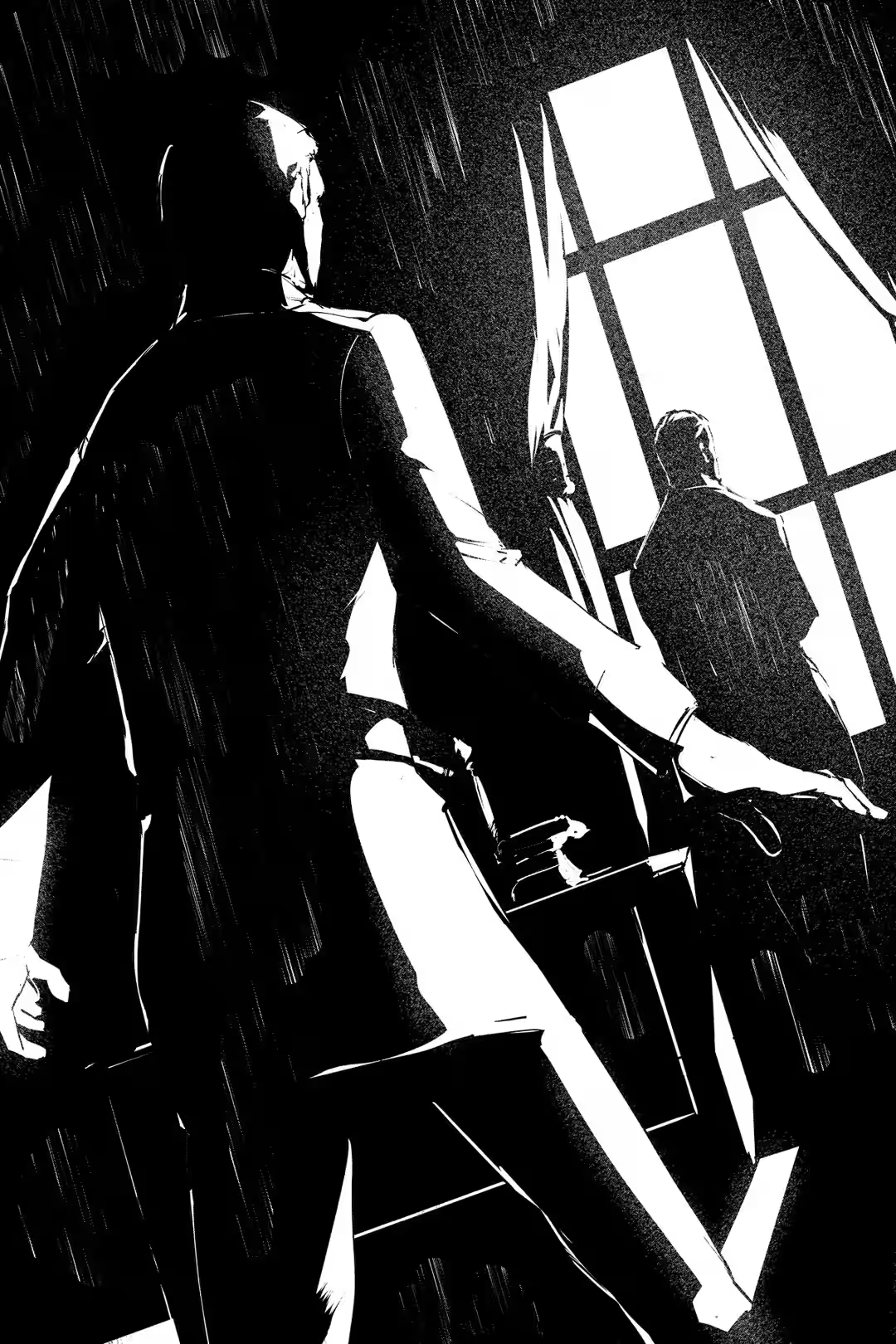
[chapter] III Last Ditch
Mages are an all-purpose painkiller, able to scratch those difficult-to-reach places. Unfortunately, they are only a treatment for the symptoms, not a cure.
When applied, however, they do provide temporary relief. After all, they boast exceptional firepower and defense, are blessed with mobility, and are extremely easy to deploy. Managing orbs and making sure their skill doesn’t dull takes effort, but otherwise, they are generally on par with infantry.
Fuel is simple. While they do require more calories than regular infantry, some extra food on top of standard infantry rations quickly solves that issue. Even motorbikes, relatively adaptable compared with other vehicles, will not move simply by shoving a piece of bread into its fuel tank. Additionally, even when forced to cross long distances, mages rarely break down in the same way that heavy machinery can.
As a household medicine, they are perfectly capable of serving as a state’s instrument of violence, and in a sense, they’re an inordinately vital part of the medicine cabinet. In a way, they are almost too convenient.
More useful than a horse. This was often the catchphrase when magic-based tactics were first introduced, but it was also the clincher. When magic engineering brought modern applications of magic to the world—that is to say, when the door to magic was opened and the Imperial Army succeeded in creating its mage division through the combination of computation orbs and rifles—it was convenience that was stressed above all else.
During the dawn of this new age, much was attempted through trial and error. Training was strengthened. Technologies were researched. Combat techniques were explored. At some point, through significant effort, mages gained the ability to fly through the skies. This would eventually lead to aerial mages.
At first, the ability to fly was not actually considered that significant. No more than another convenient bonus. Not flying units, per se, but units that happened to be able to fly. It was originally envisioned that mages would be utilized as a type of elite infantry, much like marines or snipers.
And why did that change? The answer is obvious. Like any sweatshop, the Imperial Army has its own proud history of tradition and trust. It certainly isn’t about to change its practices now. The fact that mages can fly means that, when out on the battlefield, they’re easily ordered about and can be given all manner of preposterous tasks.
“Flying infantry? What could be better?!”
And when push comes to shove…it turns out mages really can do anything. Before long, aerial became the de facto standard for deploying mages.
The degree to which mages have transformed the sky into their primary battlefield means that, today, all mages are effectively aerial mages. But there is one major caveat to this idea, and that is primarily because only well-trained mages can carry out these duties.
In other words, there is a need to screen and train them.
Before the war, the attrition rate suffered during minor conflicts was negligible. In those days, even for essentially limited departments, losses never exceeded what was “acceptable.”
To repeat, mages are convenient. No one can resist such flexibility and ease of use. And yet they also conceal a painful fault that no country can avoid in times of war.
Namely, there are never enough mages.
Even if full numbers are secured at one point, they will begin to dwindle off around the edges. Militaries are constantly chasing after new mages. From a supply point of view, the pool of available mages is decided by individual qualities and thus is never sufficient. Ideally, mages are deployed in teams, but despite everyone’s best efforts, there are never enough mages to make this reality.
Additionally, there are many fields in which mages need to be trained. Progressing from new cadet to useful mage requires time. And if, instead, early deployment is favored and promising new greenhorns are thrown onto the front too quickly, incorporating new recruits into the core force will only grow more difficult as time passes.
It is lamentable, but mages simply aren’t very compatible with total war. Their replenishment can never keep pace with attrition.
However, as the Federation and the Empire continued to clash in the east, the severe erosion of both armies’ aerial mage forces revealed a startling truth. And that was that even mages who cannot fly are still mages.
The human resource layer had evidently degraded too far in quality for aerial mages. But with a slight shift in perspective, what remained could still be transformed into magnificent nonaerial mages.
The Federation Army, which had limited experience in deploying magic technologies, was less set in their ways and were able to more easily free themselves from the preconception that mages must always be aerial.
A new pair of lenses can often make the world seem different. In this way, the Federation Army quickly rediscovered a simple truth about mages: They can also be powerful infantry. As versatile as other foot soldiers. But with more mobility than cavalry. And with enough firepower to substitute for heavy weapons in a tight spot. But still just as easy to keep supplied as foot soldiers.
What could be more convenient? Human weapons that can walk on their own feet, don’t break down as often as normal equipment, and can be used in place of tanks and cannons!
They were theoretically superior troops, and experimentation revealed one hypothetically optimal application. Regiments of ground mages formed through en masse conscription of people with mixed magical aptitude could prove highly effective at punching through the front. This offered a potentially powerful vanguard for operations that drove deep into enemy territory.
In other words, mage troops could once again become a force for world supremacy.
And certainly, this seemed to be the direction the world was heading. But if there was a problem, it was that the ground where these seeds were being strewed was already barren. The continued existence of mage troops, by this time, was already uncertain.
—Twilight of the Mages: Why Have Mages Disappeared?
JANUARY 6, UNIFIED YEAR 1928, SKY ABOVE THE EASTERN FRONT
“Ridiculous…”
Tanya von Degurechaff grits her teeth at the absurdity of the world, embracing reality and summing up the current situation with a faint sense of pride, rather than disgust.
“They’ve certainly got it easy over here in the east.”
The Ildoan front had been exceedingly political, with a need to decipher General Zettour’s intentions, and even military pragmatism was subordinated to the greater strategy. The anxiety Tanya felt on that battlefield was far beyond any demands put on her from above.
The eastern front, however, is an entirely different beast.
“This is supposed to be a main area of operations,” I mutter, shrugging before rubbing my eyes. The beautiful reality, however, still remains.
The eastern front, the main battlefield upon which the Empire and the Federation have bet the fate of their nations. War may be an extension of politics, but when war drags on for too long, it can become an end in and of itself in extreme cases. In that sense, the east is a battlefield. Even political bargaining here is for the sake of war, a phenomenon similar to—but quite different from—the idea of war being a tool of politics.
It is the extremity of absolute war.
A totally futile battlefield. But that means what must be done is evident. Fight and win. That, or be at the mercy of war’s fortunes. A simplified world, where no other options need be considered.
That also means, however, that there is less room for the side that is inferior in strength to play any tricks.
Regarding whether or not we can win.
If there was a good job to be had, then maybe the Imperial Army could make ends meet by virtue of pure strength. But a good patriot of the Empire would probably do better to despair, as the limits to what can be accomplished under the current situation are almost entirely limited to prolonging defeat as far as possible, rather than achieving decisive victory for the Empire.
I, however, do not fall into the category. I shrug internally as I turn my attention to the sky. On that point, at least, I don’t believe I must share the state’s fate.
Our altitude is nine thousand feet. We’re conducting reconnaissance and patrol in pairs.
Other than my adjutant, no one else is within hearing distance. We are quiet as we fly. Aside from an occasional complaint or navigational remarks, the world is silent. As the peaceful eastern sky stretches onward, I begin to grow strangely philosophical.
The sky is almost too pleasant to just be an afterthought. Even the stinging air is bracing. When not accelerating for combat, the Type 97 flies much like an elite sports car. Although the phrase assault orb sounds bombastic and awe-inspiring, it also conceals a capacity for exceptionally smooth and stable flight.
An unruly steed, but incredibly faithful if one can tame it. Computation orbs are perfect works of craftsmanship that never betray expectation so long as the user has sufficient skill.
“Lieutenant Serebryakov, this Type 97 is a profound work of art. Though, I think the designers could better spend their time developing weapons.”
“They seem like practical enough tools of war in our hands.”
“You are not wrong, but that is exactly the issue.”
The Type 97 Assault Computation Orb. A masterpiece created by Chief Engineer Schugel at the Elinium Arms Factory. The dual-core orb is, of course, both a technological marvel and a complete nightmare from the viewpoint of military affairs.
First, the atrocious manufacturing costs. I have heard that even competitive race cars are easier to produce than Type 97 Assault Computation Orbs. And while the number of defective orbs produced is maddening, even the slightest relaxation in standards would definitely result in the cores blowing out during acceleration in combat. Not maybe, not possibly, but definitely.
When the instructor squad tried to make use of the defective orbs, there were even instances of veteran mages—precious commodities of the Empire who were worth more than their weight in gold—dying in the line of duty as a result.
The finished products, meanwhile, can only be described as unruly steeds. In the end, at least eight hundred hours of solo flight experience was set as the minimum requirement before a mage could officially operate a Type 97. One thousand six hundred flight hours and four hundred hours of orb-specific training if you wanted to play it safe.
These were the instructor squad’s desired standards, but they have never been taken seriously. Hence why there have been so many accidental deaths among promising new recruits when using Type 97 Assault Computation Orbs. Valuable human resources—who only just finally completed their minimum training—lost along with their expensive machinery. A great blood tax paid by citizens of the Empire to the earth.
With that in mind, I flash a cynical smile.
“What do you think would have happened to the Type 97s if we hadn’t been able to use them effectively, Visha?” I ask casually.
In response, First Lieutenant Serebryakov crosses her arms and thinks for a moment. With a look of realization, she laughs.
“I’m sure we would have been told to figure it out. We are their favorite fixers, after all.”
“What about these new toys, all specs and no bang? Do you think they’ll get put to actual use?”
I certainly hope not, I think privately with a laugh. Worse, First Lieutenant Serebryakov is probably right on the money. The Empire truly is a sweatshop.
Results at the time the orbs were first sent out were underwhelming. The higher-ups are probably desperate to see real-life performance live up to specs.
“As mages, we are adherents of modern science. Not some one-stop shop capable of miracles or deux ex machinas…”
“You do seem to play the hand of God from time to time, though, Colonel.”
I immediately correct my adjutant’s misconception.
“No, I am a person. Not a god.”
The last thing I want is to fall into the same category as someone like Being X. I’d rather be good and peaceful, a citizen with a lowercase c, a lover of free and open markets. That is Tanya to the core.
Speaking of which, I’m hardly the type to get sentimental. Nevertheless, this pleasant exchange and beautiful sky seem to have made me turn over a new leaf. Sometimes, flight patrol isn’t so bad.
It’s nice, the way that jogging can be nice. Maybe it is no time for such thoughts, seeing as we’re at war, but the current flight is so picturesque that it seems like it should be captioned.
But it’s not perfect. As time passes, my pleasure begins to dissipate. The east is cold, after all. Hostile, not only physically, but conceptually as well.
“We’ve come this far, and still no sign of enemy hides…”
“Neither hide nor hair.”
“Yes, neither hide nor hair,” I repeat, agreeing with First Lieutenant Serebryakov. “Visha, have you picked up any radio transmissions?”
“It’s completely quiet; all I’m getting is the occasional friendly signal.”
“Do you think the enemy is using cables? Or are the field engineers who lay our own cables just overworked?”
“Can’t it be both?”
“That’s possible. Between the partisans and regular wear and tear, they could also just be cut off…”
Which would necessitate communicating by other means, even if it meant creating detectable radio signals. In any case, any large-scale attack or aerial deployment would be preceded by plenty of chatter. That means silence is golden.
I stare down at the snow-covered earth, remembering how quickly sounds dissipate in that sea of white. Part of me wishes the snow would just melt and bring the mud season already.
If, as General Zettour expects, there is no significant movement on the front before then, we’ll be relatively safe for a time. But the trusty mud season is still a ways away.
A respite as we wait in hope for the mud season. There is no sign of the enemy on the ground below, which is wrapped in a blanket of snow. The sky, from all corners, is quiet.
“Still, it seems odd that there’s absolutely no sign of them. This doesn’t sit right.” I have a bad feeling about this, but hopefully, I’m wrong. “I don’t know why, but I just don’t like it.”
“You too, Colonel?”
“You feel the same way?”
“Yes,” First Lieutenant Serebryakov says. She is a trustworthy adjutant. With Serebryakov as my wingman, we should be able to cut through any number of intercepting enemies we happen to encounter. But as we proceed closer to the enemy’s sphere of influence, it would be best to heed our intuitions.
“An eerie silence, so to speak.”
I can’t help but grow tense. I hope my misgivings will turn out to be nothing, but I know better. On the battlefield, such wishful thinking is a luxury.
And yet as we continue to peer around cautiously, nothing seems to change. All clear, at least as far as the eye can see.
Not just clear, but desolate. The sky above the eastern front, which has donned an uncharacteristically peaceful form, is almost entirely uncharted. After a moment of hesitation, however, I rouse myself.
“Let’s increase our altitude and see if we can lure them out.”
“Understood, Colonel.”
We purposely reveal our mana signals as a lure. However…
“No response,” First Lieutenant Serebryakov says.
I nod reluctantly, looking stupefied.
“Apparently so.”
Climbing causes signatures to be detectable from a greater distance. In other words, this increase in altitude should have triggered a response from the enemy. In the parlance of the east, it was a blatant provocation. And yet nothing.
After being sent careening back to the east by Colonel Uger’s pitching arm, I expected a few chance encounters while out on patrol. Now that there haven’t been any, I can’t help but feel unsettled.
It is almost more frightening than spotting the enemy.
“It’s just like we were told…,” I mutter as I scan the area again together with my adjutant. “When they told us how peaceful it is out here, I wasn’t really listening, but…”
For it to be this quiet? I’m amazed. My adjutant nods in agreement.
“Honestly, I find it hard to believe this is really the east.”
What the two remember about the east is its biting sky. The air literally thick with the stench of war. Scrambling to intercept enemy air attacks. Ground control raising the alarm. Transmissions from the air defense net. Enemy radio transmissions.
But this?!
Where is the stink? I furrow my eyebrows. To a veteran like me, this clean air smells fishier than anything.
A sense of danger is important. Such instincts shouldn’t be underestimated. Normalcy bias can blindside people into an early grave. As a result, when Eastern Command briefed us that “the front is all quiet,” I simply nodded and smiled. “We’ll see about that,” I grumbled. They even suggested holding a welcome party. I nearly screamed but managed to keep my composure.
General Johan von Laudon was appointed by General Zettour. I eagerly look forward to the day he whips the other senior officers at Eastern Command into shape. For now, there’s no way I could take that briefing with anything but a pinch of salt.
After playing nice with Eastern Command for a little while and returning to our roost, I decided to set out on an urgent recon mission together with Visha. We’d barely unpacked our things.
“All that trouble for this?”
“There are no signs of the enemy. At least nothing obvious, Colonel.”
“We’re still in regular contact with HQ… Nothing to report from forward outposts, either. Air intercept control seems fine as well. It’s rather early in the year to be made the fool. This all seems too good to be true.”
Crossing her arms in midair, I cock my head in confusion at this strange, almost off-putting peace that has descended on the front.
“Colonel. Look at the ground.”
“Hmm?”
“They’re friendly forces. A ground unit is waving their caps at us.”
Isn’t that nice? I think as I let my face relax.
“Let’s bank at them.”
Although dressed in white winter camouflage for the snow, the human shapes on the ground below have removed their caps and are now waving them cheerfully in our direction. In response, Tanya and Visha pay their respects with a nicely executed aerial maneuver.
After saluting the troops on the ground, we continue our flight, but there are no signs of anything unusual. The area is so clear that we even have time to check out friendly bases.
“Maybe General Zettour’s predictions were right.”
Maybe the Federation Army really is suffering from terrible attrition. I furrow my brow as the cold sends a shiver up my spine. I’ve gotten far too accustomed to the warmth in Ildoa.
To be transferred from that world of color, culture, and for better or worse, saturated brightness, to this, the eastern front! I may be accustomed to the east, but I can still feel the cold in my bones.
I am an officer, however. The cold is no excuse. In fact, it is precisely times such as this when it is incumbent I step out in front.
“This is what it means to take the initiative, set an example, and lead.”
It is in times of difficulty, more than any other time, when people begin to question leadership. This is a universal truth in every day and age when it comes to human organizations.
The eyes of subordinates are always on the boss. Higher-ups can say whatever they like, but if action doesn’t follow suit, their words are meaningless. And when it comes to soldiers, who risk their life in their line of work, they expect impeccable behavior from their commanders as a matter of course.
Tanya lacks the slightest intention of ever dying for her troops, but she knows that her soldiers are her best meat shield and does not hesitate to worry over, sympathize with, and when necessary, even do right by them out of pure self-interest. That’s precisely why she is currently patrolling herself.
“Truly, neither hide nor hair… Maybe they really are hunkering down for the winter,” I say, after readying her binoculars once more. I only half believe what I say. “I feel like we’re falling for a poor excuse of a scam.”
“Or maybe it’s just harder to relax when the enemy is gone than when they’re here where you can see them, Colonel.”
I’m tempted to wax philosophical about how much I hate those filthy Commies, but instead, I just shrug.
“I’m hardly pining for an enemy. But we know what they are.”
“You mean Commies.”
Exactly. I nod.
“Neither hide nor hair, when we know they should be here. Who could relax? What do they call it again? Maskiróvka?”
“It’s scary to not know what the enemy is really thinking. But Eastern Command believes this lull is just the result of both sides trying to build their forces back.”
“Yes… Maybe that does make the most sense.”
I nod, half out of momentum, and fold my arms.
These days, even in the Empire proper, a flight so uneventful that you have time to scan the ground at your leisure is unusual. And yet here we are, carrying on a full conversation as we casually fly.
“It doesn’t seem entirely impossible, but still…”
Winter sky or not, the only mages within detection range at the moment are myself and First Lieutenant Serebryakov. Despite being the commander, I have slightly more leeway to speak what is on my chest at the moment. I can likely be forgiven for a few small complaints.
“If it makes so much sense and things are this peaceful, then I would have rather we spent at least the holidays in the capital. There was no need to cancel our leave. I’d like to give them an earful about that.”
“Agreed… The new year just hit, and they’ve already got us running around like chickens with our heads cut off.”
“Exactly,” I agree with a sour look on my face. I keep the rest of my complaints to myself, but the General Staff seems to be getting a little too attached to the concept of discretionary labor. Not that I could talk. I canceled their three days of New Year’s leave to carry out a proof-of-concept experiment, but it had been Major Weiss’s idea, so let’s just say the buck stops with him.
Either way, this applies to our sudden eastern deployment as well. One wave of the hand by General Zettour and off you go. Plus, what about Colonel Lergen’s strange request? I know Lergen was worried I might get caught up in a bureaucratic pissing contest over here, so instead, I’m just expected to handle myself in the deep end and somehow display ingenuity and autonomy on the battlefield. It doesn’t get much more exploitative than that.
What I wouldn’t do for some labor standards.
“Actually…”
Labor standards are no more than a fight for worker rights based in law, but the power of the state is capable of constantly contorting that law. Or to put it another way, reason is contorted for the sake of war.
It all boils down to the same thing.
“War is awful.”
“Colonel?”
“It’s nothing. Being back in the east after so long has probably just left me a little discombobulated. For some reason, I keep imagining the worst.”
My adjutant sighs, half in understanding, half in confusion. She smiles uncomfortably.
“The gap between reality and instinct is frightening, isn’t it?”
“You said it. Still…better paranoid than addled by peace. Too much vigilance may be a problem as well, but at least it’s a problem you can laugh off later.”
Which is why, as commander, it is probably best to push ahead a little farther with this aerial recon while my reliable adjutant continues to cover my back. Of course, what is best ultimately depends on the time and place, as I am well aware.
“Either way, it looks like our fears were for nothing this time.”
It had been hard and long work. And not particularly fun, even as war goes.
“With how quickly General Staff rushed to redeploy us, I may have allowed myself to get a little too worked up… Do you think they really canceled our New Year’s leave just so we can jump at shadows out here?”
“They’re probably thinking the same thing over there, though, Colonel.”
“‘They’? You mean the Federation?”
“Yes. I’m sure they would have much preferred we spend our time enjoying ourselves back in the capital.”
I laugh as I put away my binoculars. Visha got me there.
“We’ve got so much to agree on.”
“Naturally.”
I nod in agreement.
“Definitely. Now then, since the enemy still hasn’t shown their faces yet, shall we advance a little farther?”
“Precisely,” I say, smiling at my adjutant. “Not to be flamboyant, but while we’re here, we may as well knock on their door and wish them a happy holiday. It would be rude to not at least say hello!”
“Roger that! Let’s go wish those Commies a happy New Year!”
FEDERATION, OFFICIAL NAME: FORWARD OBSERVATION BASE / AIRBASE COMMAND
Keeping Operation Rising Dawn secret was taken very seriously as a matter of course. The Federation’s intentions needed to remain thoroughly hidden. With the exception of commanders, not even soldiers on the front line had been informed of the plan.
But keeping intentions hidden was not the same as keeping every sundry detail hidden. What mattered was the when. In other words, obfuscating when the attack would commence. There were many other points that were also best kept secret, but what mattered most was timing.
After all, even the biggest moron in the Empire could understand the problem was not if, but when the Federation would strike. Federation authorities had already been tolling the virtues of a “great counterstrike,” hadn’t they? And they had taken an offensive posture. Repeated, sudden drills. Unannounced readiness maneuvers. All sorts of other clever schemes to make it appear as if a massive offensive was on the horizon.
They weren’t hiding their intention to launch an offensive, only the crucial timing of it.
Spring? Summer? Such whispers were common in both armies alike.
But these rumors were wrong. The offensive was not so far away. It was nearly upon them.
At the very least, the commandant and the political commissar at the front knew the truth. Stationed on a wide, sweeping plain, this posting was officially a forward observation base. A variety of equipment had been brought in, under the pretense for surveillance.
The site was even referred to as an observation base in documents shared with friendly forces. The truth, however, was that it was an air base. The equipment, which base personnel thought was for surveillance, were items that could also be used for air control, in fact. Planes were taking off from the recently opened runway.
At the start of the offensive, they would send air assets to hit the Empire hard. They were constantly on standby for that fateful day. In contrast to the troops, who were enveloped in a celebratory holiday mood, those who knew what was coming had begun to gird their loins in anticipation.
Hence why the presence of a couple of snooping Imperial aerial mages was currently so unwelcome.
The Federation soldiers, who were placidly unaware of the real situation, thought that the only reason they were hiding was to avoid catching the attention of an apparently strong enemy, but the commandant, who knew the base’s true purpose, prayed that the two mages would not come this way.
“There is a pair of Imperial mages steadily approaching,” the officer on observation duty reported. Unfortunately, it seemed as if the commandant’s humble request was not going to be granted.
As part of the ruse, the site was full of observation equipment. There was no chance the signal had just been misread. The commandant shrugged lightly, but he would have preferred to have shouted, Go away! Go home! at the shockingly aggressive flight path of the two mages.
“Such pushy guests, and so early in the year.”
“Yes, Comrade Commandant. They are flying quite high as well… Perhaps it’s command reconnaissance.”
“This could be strategic recon, then.”
The commandant felt his stomach drop. He could not show such worry in front of his men. Despite vague assurances that “sprawling or not, there’s nothing much to see here,” in the back of his mind, he was painfully aware of the fact that two very dangerous guests had just shown up on the front porch of the area he was responsible for, right as the Federation was on the verge of launching a critical strategic offensive.
As the party mandated atheism, the commandant knew it was wrong to believe, but in his heart, he couldn’t stop himself from praying to every god he could think of. With a sigh, however, he was forced to admit that his day-to-day public disavowals had most likely left his spiritual balance in the negative. It seemed no blessings would be coming his way.
“Observer! Can you verify the mana signature?”
The observer stared at his equipment for a moment before shaking his head sadly.
“The library data is corrupted. I’m unable to get a match.”
Hmph. The commandant released a sigh. They may have had plenty of observation equipment on hand, but the delay in new parts had grown severe. Parts for the various pieces of lend-leased observation equipment, in particular, were in dangerously short supply.
They were not completely tapped out, strictly speaking. There was still some in stock. But as soon as it became apparent that there was a chance the supply from overseas might get cut off, all departments began fearing the worst and suddenly became extremely reluctant to lend out what parts they had. As a result, the number of parts reaching those in the field had taken a serious dip.
“I’m sorry. Equipment has been in bad shape for some time…,” the observation officer apologized, shrinking slightly.
Obviously, no officer would be eager to report that precious equipment under their care had fallen into disorder. There was always a risk they could be personally accused of sabotage, after all.
However, for better or worse, on the harsh battlefield, the Federation followed a philosophy of realism. As the commander displayed his displeasure, the political commissar lost no opportunity to intercede with a friendly smile and place a hand on the observer’s shoulder.
“Of course, our domestic parts still aren’t very reliable. You have my respect for doing the best you can under these difficult circumstances. Thank you, comrade.”
“Comrade Commissar?”
As the observer stared blankly, the political officer returned a warm, unguarded smile.
“Issues of mechanical reliability can be reported to higher-ups. Just as I, too, can carry out my own work. To be clear, I am not saying they must be; I am saying they can,” the political officer affirmed, tapping the equipment lightly as he spoke. “It is not your fault, comrade. This is an issue with the equipment that you were provided. In which case, it falls on me to inform the higher-ups.”
Managers needed to respect the experts on the ground, keep their work environments in good order, and protect them when necessary. To ensure the Federation was seen as an open organization, it was crucial that political officers fostered a sense of psychological safety through their bearing.
“Hiding problems and pretending they don’t exist is the much bigger issue. The party does not need simpering, flattery-wielding patricians but good, hardworking, honest proletariats.”
Internally, the political officer added what he could not say out loud. Federation Army aside, the leaders of the party detested mages. This fact was so well-known that people on the ground were loath to offer up negative reports. What people didn’t know, however…was that, lately, the real anger on high was at the lack of accurate reports in relation to issues dealing with mages.
Once it was evident that the truth was being embellished, the Commissariat for Internal Affairs was immediately dispatched. Although accurate reporting might leave the mules at High Command somewhat unhappy, such reports would hardly be squashed. In fact, when appropriate, they might even contribute to evaluations when the time came.
The commissariat was so hungry for detailed information on enemy mages that they were even asking for separate, direct reports from political officers. They were desperate for every scrap of truth they could get their hands on. Hiding information because it was inconvenient would only lead to death. There was no shooting the messenger. On this topic, at least.
Still. The political officer and the commandant made eye contact.
“The Krauts are certainly aggressive. What do you think, comrade?”
“Yes, they seem very insistent in their patrol, Comrade Commandant. Perhaps they are poking around looking for our whereabouts.”
The two were in tacit agreement. They only had one choice: to reveal their camouflage for the suspicious enemy to see.
With the exception of a few forward observation bases, the bulk of their army was in the rear, and they had taken careful steps to make it appear as if they were hunkering down for the winter.
A few of these units had already begun mobilizing, but both internally and externally, this was being treated as a typical supply and training mission. Fearing there might be spies, they had even been carrying out preparations for a casual New Year’s celebration, as a way to disguise their intentions from even their allies. To be doubly sure, they had asked inspectors from friendly forces, who knew nothing of what was going on, to report any suspicious movement, just to give themselves a bead on what enemy eyes might be seeing.
The risk of having their cover blown was low. More dangerous was the risk of revealing themselves by doing something stupid.
“Continue to watch them closely. Once they come a little closer, see if Command can identify them with their library. After then…”
Just as he was preparing his resolve, however, the situation suddenly took a turn. Warning alarms began to bray from the equipment.
“…! We’ve got a large-scale signature response! It looks like a spatial explosion formula…!” the observer shouted, barely managing to get the warning out as the blood drained from his face and he went pale. The commandant immediately rushed to the desk and picked up the receiver.
“Warning! Two enemy command recon units conducting reconnaissance in force! Intercept! Case C!”
Regardless of their power, large-scale spatial explosion–type magical formulas have long since been seen as one of the most impractical battlefield formulas in the Great War. The height of recklessness. More reckless than heavy artillery conducting direct fire instead of indirect fire.
Artillery usually do their best to keep their presence hidden until their first shot. Mage formulas, however, are like a salvo to the world at large and are even known as “interference formulas.”
Meaning when one uses such a formula, they stick out like sore thumb.
And if the formula involves blasting an entire area with significant force, the scale of interference will only grow that much heavier in scale, making it easy to detect the source even from long distances. As a result, time is needed to prepare such formulas.
Even when forced with top-spec computation orbs like the Empire’s Type 95s or dual-core type 97s, these formulas still involve standing exposed for an extended period time and thus demand time to safely work the formula.
On the one hand, they are useful as a grand and flashy statement. On the other, however, their practical uses are limited, as they cause the user to stand out in a way that could easily backfire. After all, the ability to be detected from extreme distances makes you a sitting duck for long-range optical formulas. In other words, attempting a spatial explosion draws widespread attention and can force any nearby enemies to respond.
If one spins the formula carefully, diligently, and deliberately…that is.
“There doesn’t seem to be any jamming.”
With a nod, Tanya activates the formula. She tries to release it far into the distance, but…
“I should have guessed winging it wouldn’t cut it.” She sighs.
In the end, it is indeed a big flashy show. A massive explosion, yes, but essentially, all I’ve done is cause a large fireball to appear in a deserted field of snow. The Type 97 is a good computation orb, but it is highly lacking when it comes to power. Not that it completely lacks it, but tossing some snow into the air is hardly fair compensation for getting stuck in position and having all your movements restricted for several minutes.
“First Lieutenant Serebryakov. I don’t expect much, but…what’s the BDA?”
“Just a moment. At such a long-range and after such a large explosion, visual confirmation is…”
“Yes, I know… Hmm?”
I’m the first to notice. A faint response, coming from a distance.
“A signature response, maybe?”
“A signature? No, wait…”
First Lieutenant Serebryakov seems to pick up on it a moment later, but the signal seems different. It does appear to be a mana signature, but something about it—it is difficult to say—is unfamiliar. However, the composition reminds me of one thing in particular.
Of course…the dummy signal cooked up by Major Weiss! I think I see what the enemy is after.
“We did something similar at the Ildoan front.”
“The sudden ground-to-air strike against enemy mage troops, right?”
Exactly.
“Well, well, at last. Looks like the enemy’s real move is coming from below?”
A classic decoy. Drawing a combat maneuver, I brace myself for a cunning ambush. Distract with a dummy mana signal while the main attack comes from another direction. Despite having pulled this trick off myself before, it’s still possible to fall for the same trap when the shoe is on the other foot. At least, it is when you get caught by surprise on the battlefield.
A mental blind spot is all you need. I laugh as I roll up my sleeves. Too bad I already know the trick.
“Lieutenant Serebryakov, keep your eyes peeled.”
“Affirmative.”
As the first lieutenant deftly covers our backs while scanning the ground, I focus on the approaching signal. The faint mana signature seems to still be gaining altitude. Either the decoy advanced enough to rise to some degree on its own, or it has already been equipped in an aircraft. No… Scratch that. While it’s difficult to detect perfectly due to the residual noise of the spatial explosion, the signature suggests a vertical takeoff and landing.
Could it be an aerial mage? I can’t get a read on the orb’s characteristics, however.
As far as I can tell, the Federation’s computation orbs, while durable and possessing excellent firepower, are generally below average in terms of mobility. As they focus on accessibility, however, they are comparatively easy to use. They are also not bad in terms of survivability.
“But in turn, they’re supposed to be poor at stealth and concealment…”
With a defensive shell, protective film, and flight formula active all at once, any Imperial mage in engagement distance should be able to detect these mages immediately.
Real-world conditions don’t always match theories on paper, but if an enemy took off at a distance close enough to detect, I should be picking up a clearer signature… Time to consider another possibility.
“Does this resemble the signature from a Type 105? Or maybe someone not used to their orb… A person with just barely enough affinity?”
It could be an issue with either the quality of the orb or the user. My suspicion grows. This is smelling more and more like a trap. What First Lieutenant Serebryakov says next, however, boggles my mind.
“No sign of enemies on the ground. It doesn’t seem like they’ve got visuals on us, either.”
“Wait? You mean it’s not a diversion? They’re not trying to hit us with a surprise attack while we’re distracted?”
I already convinced myself this was the same trick we pulled against the Unified States mages. The shock of hearing there is no sign of enemies on the ground is immense.
“I was certain the enemy’s main attack would come from the ground below us.”
“I thought so as well, Colonel. But I’ve checked, and…I can’t find anyone. At the very least, if there are any enemies hiding out down there, there aren’t enough to even call them a unit.”
“A lone attack from a Named, then? No, but… Let’s get some altitude just in case. Climb to ten thousand. And let’s shelve the possibility of a surprise attack for now.”
“Roger!”
The two increase their altitude.
Even if a strike does come from the ground, the potential energy they have from gaining altitude—the difference in kinetic energy—will still ensure Tanya and Visha’s advantage. Taking the high ground is always a good thing.
High equals energy. On top of that, more altitude gives a better view.
“The signature still seems a bit far. The distance is unclear.”
First Lieutenant Serebryakov quickly picks up on the signature coming from ahead. Likewise, I begin to rescrutinize what I’m detecting.
Their conclusion is that the signal does not warrant caution.
“It’s a good thing we got a look at the 105s in advance. It seems like the enemy is pushing something similar as well… The speed of that climb is slow as molasses, though. Do you think they’re loaded with bombs?”
I’m pretty sure there are no bomb-equipped fighter planes in this world, either, though. And besides, when it comes to interceptors, climbing rate tends to be vital. As attached as they are to firepower, even the Federation is still bound by the laws of physics. Their requirements for an intercept squad can’t possibly be very different from our own.
The two experienced Imperial mages agree. The signal doesn’t make sense.
“Is it…a platoon? No. There’s more coming up after them. Based on the signature, it seems like a company of enemy mages. But the way they’re assembling…” Serebryakov trails off.
“It’s atrocious, isn’t it? And maybe I’m just imagining things, but they seem to be packed in pretty tight, don’t they? That would be a dangerous way to fly.”
“Maneuvering in pairs in anticipation of close combat is standard practice, but flying so close that you are practically holding hands just makes you a good target. Usually, mages try to strike a good balance…”
“This makes no sense,” I mutter. “As far as I can tell from tracing their signatures, their movements are sluggish… Maybe they just don’t want to fight. But then why head toward us?”
“Based on the signal, I don’t think they’re putting out much speed. But what does it mean? None of this fits…”
“I’m having trouble figuring it out myself. Maybe…it’s not a problem with the orbs or their aptitude.”
“This signal is too weak, either way. Unless they’ve got cloaking devices, it almost looks as if they’ve only got their protective films up.”
Despite her confusion, I smile uncomfortably at my adjutant’s suggestion.
“This is the Federation we’re talking about. Tough defensive shells are what their orbs do best.”
“I mean… I doubt they’ve had any sudden leaps in orb-deployable signal-blocking or concealment technology.”
“Yes, that would seem like a leap, wouldn’t it? But to enter battle with just a film and no shell? That would be like an open-topped self-propelled artillery gun charging a tank head-on.”
Aerial mages adapt to their environments by deploying protective films, and then they clad themselves in defensive shells, as armor, underneath. Theoretically, film alone might be enough for flying, and if one is particularly skilled, they might be even able to make their film as hard as a shell… But for the average mage to do something as crazy as entering battle without their armor—their shell? It’s beyond comprehension.
“Still, the majority of those with magical aptitude don’t necessarily match those in our battalion. If the Federation is suffering from the same level of attrition as we are…”
“They might promote simplicity instead? It sounds crazy to us… Still, though, without shells?”
That would be like making an MBT without armor. Maybe if they’re using mages like self-propelled guns, but throwing them on the front lines like that? Anybody who knows anything about mages could see the problem with that…
“Anybody who knows anything about mages…”
Hmph. I consider my own words. For better or worse, the Empire is a mage sweatshop, aware of the risks it can get away with before needing to worry about how easily their mages will crack. The Federation, however, is new to this exploitation game. Maybe they are such amateurs that they don’t even know when and how to exploit mages in the first place? Never mind labor standards.
“First Lieutenant Serebryakov, this may actually be an unprecedented chance for us to learn more about the enemy’s magical combat capabilities. Let’s hit them.”
“Roger!”
If it were possible to see the future, that hastily conscripted compulsory magic unit may have very well bemoaned getting the short end of the stick.
Their commander had just returned from the gulag. The political officer attached to the unit was an ideologue. And the troops were all rookies with computation orbs newly thrust into their hands who didn’t know the first thing about magical tactics.
On top of that, the majority of them didn’t have any magical aptitude beyond what could barely be described as present.
Human attrition was slowly causing the Empire to drop its own pretenses, but even the Empire, regardless of how far they lowered standards, still included the ability to deploy a defensive shell as part of the minimum requirements for mages.
This was because the Empire expected mages to be able to fundamentally withstand aerial clashes with other mages. The Federation’s military leadership’s understanding of mages, however, went no further than seeing them as troops with magical aptitude. Beyond that, it was simply a matter of effort, indoctrination, and training.
Firm, clear decisions always derived from organizational logic. Free from assumptions, they represented a kind of possibility. In reality, however, such decisions could not escape distortion.
Leaders at all levels could not help but think of quotas. So when one layer of the machine scraped together whomever they could with magical aptitude to meet their quota, and then the bureaucratic machine took these personnel who’d been scraped together and formed a great number of magical units—again, to meet quota—and handed them over to operations. On paper, at least, the task had been accomplished. The mass deployment of newly formed magical units!
When putting these new troops together, there were naturally some in the Federation, experienced mages and others in similar situations, who naturally wondered if this was the best approach. There were even those in the field who had their misgivings.
But things had kicked off with such great fanfare from the top that halting trials, when serious results had yet to be achieved, was difficult—at least in an organization with such a rigid hierarchy. This was how they had reached a point where rookies were essentially being sent into the battlefield on their own.
For most of these troops, deploying a protective film and getting airborne was almost more than they could manage. For them, taking on a pair of Named Imperial mages—two thoroughly accomplished mage hunters—was just as impossible as it would have been for them to take on a whole company.
Those poor, unlucky bastards who flew up into the sky to intercept those two Imperial mages. The word flight was almost too kind of a description for what they were doing.
After all, these motley forces barely had time to even learn flight. They floated haphazardly like balloons, wafting about and managing only by hook or by crook to ready their weapons and point them in the enemy’s general direction.
On top of all this, due to a malfunction caused by electromagnetic interference from the earlier spatial blast, the commander who was supposed to be giving them direction had gotten stuck in military observer mode. Despite being in their own friendly territory, they were essentially isolated and alone.
The outcome was pathetic. A complete massacre.
“They were completely wiped out,” the political officer muttered, quietly stating the obvious, his tone of voice half-resigned. As mundane and unoriginal as this statement was, it had an effect akin to lobbing a stone into a sheet of ice.
The commandant nodded, somehow managing to force out his own equally uninspired statement on the matter.
“They didn’t stand a chance, did they?”
This company of mages, equipped with the latest orbs, had been placed in their hands—in the experienced commandant’s and the faithful political officer’s care. Well then, why not send them to intercept?
The result: The company had been annihilated by a single attack.
When engaging head-on, Imperials mages tended to open with explosion formulas in order to contain the enemy. This had been pointed out so many times, in so many reports, that they had almost grown tired of reading it.
“Which is why orbs capable of producing tough defensive shells had been provided as a countermeasure… That’s what it says on paper, at least.”
“Maybe the two mages were just very skilled.”
True. Between their smooth maneuvering, coordination, and the fact that they appeared to be engaged in command reconnaissance, they had likely been among the best of the best.
But that was why they had played it so careful, sending a whole company to intercept and overwhelm the enemy with numbers.
“This is more than just an issue of training. You saw, didn’t you? Even the enemy probably expected that explosion formula to only serve as suppressive fire at best. Our company was flying in such close formation, though, that they were immediately destroyed.”
Maybe it only seemed that way while observing from the ground, but the Federation political officer felt certain that anyone, friend or foe, would have been shocked by the sight. Even the enemy seemed to hesitate after seeing how a single explosion formula was enough to mop up.
The enemy’s probable intention was to toss out formulas to restrict their movements and close in for an advantageous dogfight. Immediately after firing off the explosion, the pair picked up speed, apparently accelerating for imminent combat, but once the company was eliminated, their maneuvers seemed to stall, as if they were in shock. For a moment, they continued to fly in a simple straight line.
From the Federation’s vantage point on the ground, the reaction was obvious to the point of being comical.
“There are so many issues we need to correct before we can even think about using our mages to fight the enemy. From an observer’s point of view, I’m not entirely sure our men even raised their shells. Who was responsible for putting that unit together? At this rate, these new orbs may as well be baubles…”
You’re not wrong there, the commandant thought, agreeing internally with the political officer’s assessment, but the conversation was starting to cross into dangerous ground. He casually turned the topic back toward the enemy’s movements.
“It looks like the enemy has finally turned back, at least. What do you think, comrade?”
“They probably don’t plan to advance any farther… Their recon mission must be complete. Although, the cavalier way they turned back is a little infuriating in its own right.”
“If only they had come in just a little farther.”
Internally, the commandant rued the fact that the two mages hadn’t advanced far enough for command and control to identify them. He tried to speculate on who the fearsome enemies might have been.
“They must be Named. Command reconnaissance or not, there can’t be that many mages of that caliber. Can there?”
The threat posed by the Empire’s mages was nigh legendary. In particular, the Named were considered especially lethal.
“Maybe it’s just what I want to believe, but I’d hate to think that’s what their ordinary, run-of-the-mill mages are like.”
The commandant sighed, allowing a moment of weakness. It was over now. He smacked himself on the face to clear his head. They still needed to get ready for Rising Dawn.
“We are less than amateurs, while they are adepts. The situation is far from ideal. But as long as we commit to compensating through operations, there is much that we can do.”
In other words, why play to the enemy’s strengths when they could seize the initiative and proceed according to their own rules, on their own terms, in the manner that was most advantageous for them? They had no obligation to approach the enemy head-on and fight fair and square.
“In the end, problems are best solved through steel.”
Our plan had been for recon-in-force. I knew the enemy might be rookies. I thought I accounted for their underwhelming aptitudes and even the possibility that they might not even have defensive shells up.
For once, my habit of preparing for the worst has turned out poorly.
“Well, that didn’t go as planned.”
“And how… A single shot. Who would’ve thought?”
We manifested three explosion formulas simultaneously in order to check the enemy’s movements. Instead, the explosions wiped them out completely.
From Visha’s and my point of view, the outcome was so bizarre that we couldn’t stop ourselves from turning and staring at each other midmaneuver.
After all, the heavy armor of mages in the east is usually extreme. As a dual-core orb, the Type 97 can put up defensive shells that are fairly tough in their own right. The Federation, though, threw balance to the wind, practically adopting defensive shell strength as their mantra. Such technical advances mean that explosive formulas, which were once considered one of the most effective anti-mage tactics available, are now strikingly underpowered. Or at least, so they thought.
Explosive formulas could possibly serve like anti-materiel rifles, but they are basically an AT gun that is too underpowered to be of any actual use against tanks. That’s the limit of their effectiveness. It’s why veterans tend to use them for suppressive fire.
While we were opening up, I thought there was no way they actually had only protective films up. Will wonders never cease?
“That didn’t even qualify as a test…”
It was like plinking away at an enemy MBT, hoping just to piss them off, and watching an entire company of armor explode instead. I’m gobsmacked!
“Well, Visha, I guess you were right.”
“I know what I said, but I still can’t believe they didn’t have shells. That’s…just so…”
Poor, pathetic bastards. Enemy mages or not, even I feel sorry for them. They got thrown into the lion’s den, under the pretext of OTJ, without even minimum training. Disposable.
The labor board would have a field day.
“Colonel… Do you think the enemy might be running out of mages?”
“I don’t know. But if that’s the state of their intercept units, I can understand why no one thinks they’re ready to make a move.”
Both the Empire and the Federation continue to blatantly squander their human resources. They’re scattering the earth with what were once good citizens, severing the possibilities that these talented figures ought to have carved into the future, and forever losing the chance to collect payout on their long-term investment into well-disciplined and trained human capital. The impact is colossal.
“The enemy is beginning to wither as well. Maybe not at the roots, but at least at the ends.”
If this is a sign of deteriorating quality for the enemy, then the Empire, which still has veterans in its rank, is in slightly better condition. However, I understand that reality is not that simple.
“Their fighting spirit remains just as ferocious as before…”
To be honest, this is more troublesome than anything else. If I was in the enemy’s position, I would never want to be inserted into battle with that level of equipment and training. Even if the Commies stopped me from running and conscripted me against my will, would I be willing to go into battle with my life on the line with such spirit and determination? Obviously not. But the Federation soldiers—they have strange tastes. And I recognize the threat.
“An age of warmongers.”
The enemy’s inscrutable will to fight is vaguely alarming. After all, the members of our unit are fairly aggressive as well, but their confidence is backed up by actual ability.
But the enemy is who the enemy is. With a slight shiver, I’m once again reminded of the mess we’ve found ourselves in. But we’ve gathered enough information. It’s time.
“First Lieutenant Serebryakov, let’s start heading back soon.”
“Really? We could still go a little farther,” First Lieutenant Serebryakov says, indicating her willingness to continue their recon.
Very admirable, but I smile uncomfortably. I’m not interested in doing unpaid overtime.
“Your go-getter spirit is commendable in a unit such as ours that is always ready for battle, but the human body has its limits. Relax when you can and save the enthusiasm for when it is most needed.”
Resting at every opportunity is an important part of producing results. Just as using the talents of one’s subordinates appropriately is a vital part of management. If I don’t keep the environment up to snuff, how can I expect my little meat shields to do their job?
“Resting is a part of work, Lieutenant.”
“I got plenty of rest in the capital, so I’m raring to go!” my adjutant says.
She’s just full of vim and vigor, it seems.
“So you’re saying that while all the other officers were busy working, you were busy resting?”
“Of course not, Colonel. You know what a workhorse I am.”
“I didn’t mean that as an insult. You take your work very seriously, get it done quickly, and enjoy the bare minimum of labor like a true person of culture. Just as it should be.”
“To be honest, I wish we could have spent more time in the capital. I was genuinely shocked when they deployed us back here so quickly.”
“The decision came from above.”
The higher-ups have their own ideas about how things should be done. I know this too well.
“The brass probably wanted to deploy strategic reserves to the eastern front, even if only on paper. That’s what we get for being so good at what we do, First Lieutenant.”
Strategic reserves are a type of insurance, a necessary part of any plan B. You would have to be mad to do anything so foolish as to go into war without contingencies. Or maybe you would just have to be mad to go into war in the first place. But that’s a question for another time.
“Are you sure our Kampfgruppe is really being deployed as conventional reserves? If they are expecting us to deliver principal mobility and striking power in the event of a counterattack, at our current strength, I’m not sure that would work out too great.”
The Salamander Kampfgruppe’s fighting capabilities are presently rough around the edges. As rough as they have ever been. The mages were thoroughly exploited back in Ildoa. Infantry and artillery, of course, advanced together with the mages, so ammunition stores are on the verge of running out. Although, having any on hand at all puts them in a better position than some units. Regardless, even Captain Ahrens’s armor is on deferred maintenance.
As First Lieutenant Serebryakov fears, if we get the order to move to the front lines now, the men might have no option but to die valiantly. In short…it would be extremely difficult to describe us as being at full strength at the moment.
I’m painfully aware of all this. The shortage of artillery shells practically has Tanya tying her hair in knots. The higher-ups, though, have put their stamp of approval on the situation, deciding that, for the moment, this is not that pressing of an issue.
“We probably don’t need to worry too much yet.”
“What do you mean?”
“General Zettour is of the opinion that there will be a lull on the front for at least a little while, and—well, this all depends on General Laudon—but…the brass will likely do what they can for us.”
“That may be too optimistic.”
“True,” I say, nodding at First Lieutenant Serebryakov’s statement. I don’t disagree, but I thought it was worth putting the possibility out there.
“Well, we have confirmed one thing with our attack. Fortunately, perhaps, it doesn’t seem like the enemy is in great shape. Based on this, we can surmise we still have time to recover.”
The Imperial Army is in a shabby state at the moment. But the Federation Army, which put us in this state, seems to be suffering as well. That much seems clear. At the very least, the Federation Army is currently in no condition to take aggressive action.
Maybe that conclusion is obvious, but it was enough for General Zettour to take a gamble and uproot their strategic reserves, sending them into Ildoa. And the result of that gamble? As we know, the general made big bets and won big while there, likely earning the Empire a decent amount of strategic leeway. At least, that is my assessment.
“The state of Alliance logistics in Ildoa is as miserable as can be. On top of that, the current situation should give us strategic depth in northern Ildoa. We can likely expect Alliance reinforcements and material support to the Federation to dwindle for the foreseeable future.”
Meaning even if it is a battle against time—we are still all right for the moment. At the very least, there is no need to panic yet. This seems like a reasonable judgment to make in my mind.
“Considering everything, the brass’s assessment that the enemy will also need time to regroup does not require any significant leaps of logic.”
“But with the Unified States joining the fight, the situation must be serious, right? The Ildoan front will obviously get steady reinforcements by sea, but won’t the Unified States be able to do the same for the Federation as well?”
“That’s always a possibility… But at the moment, we seem to have them by the short hairs. We should be able to contain them for a while, at least.”
“Lack of freight ships?”
“Exactly,” I say, smiling in an almost devilish fashion. “They may be giants across the sea, but even giants need to come by sea before they can tour the old world. It goes without saying, but the bottleneck will be ships and harbor facilities.”
And as for the state of goods in southern Ildoa…now is the time for Tanya to boast of her own past accomplishments.
“And it’s sorry for them, but between myself and the Alliance, the ports in southern Ildoa have been thoroughly demolished.”
True, First Lieutenant Serebryakov indicates with a nod, but her face is still taut.
“So you see, Lieutenant? You can rest easy. The south is safe and secure for the time being.”
Yes, the time being. The unpleasant reality is painful clear. Safe, but only for now. This lull is temporary. And after that? The enemy’s near-inevitable superiority is systemic. And an enemy with such an advantage is almost certain to launch a counterattack.
Like anyone in the Empire with half a brain, Visha and I understand the self-evident future that awaits us.
“As for me, I think we should be retraining our units while we’ve got time to spare. Hopefully, the eastern defensive line gets strengthened in the meanwhile with reinforcements.”
“And while that’s happening, what should we do…?”
“I’m glad you asked,” I say, flashing First Lieutenant Serebryakov a winning smile. “The only thing we can do: dote on our soldiers and stockpile ammo and fuel as much as possible. If necessary, we shouldn’t hesitate to engage in training missions for friendly forces, either.”
“You mean we should train friendly troops?”
“It will be a hassle, and immediate results will be difficult to see, but last-ditch effort or not, there is no other way. Sometimes, you’ve just got to bite the bullet.”
If markets were functioning, we could have resorted to headhunting to get useful personnel. In war, with the exception of culling from the retired, all we can hope for is entry-level hires. And training is OTJ, as new recruits are expected to hit the ground running.
Any effect from Salamander Kampfgruppe attempting to improve training would likely be supremely localized, but if we could put new recruits coming to the eastern front through a serious enough wringer, it might at least create opportunities. And if those recruits happen to be hard-nosed, then we can push those noses to the grindstone. Maybe we’ll even teach the sweatshops a lesson or two.
However, it’s important to remember that people are stone walls. People are stone walls, people are castles, people are moats. The words of Shingen Takeda, which encapsulate how best to use people in an age of total war. It’s times like these that remind me of how important the classics are.
Speaking of which, it is crucial to delegate, after all. I turn to my subordinate and ask a leading question.
“How about it, Lieutenant? Care to discover the joy of teaching?”
“I go where you go, Colonel!”
“In that case, I expect you to watch my back. I’ll be counting on you to keep your eyes peeled in case anyone tries to knock me down from behind.”
“Knock you down? I doubt there is any hero out there who’s brave enough to dare!”
“You’d be surprised,” I mutter softly. Even in a world as supposedly peaceful and sensible as her previous one, those people exist. Those who do not understand social norms, rules, and contracts, those who will not hesitate to carry out even the most outrageous acts.
It is important to learn from mistakes. I now consider back insurance a necessary expense.
“Complacency is the greatest threat. I always want somebody watching my back. It’s simple, Visha. The enemy is coming eventually. This is what it means to be ready.”
“But putting aside whether they are actually coming…when, exactly, is ‘eventually’?”
“There’s no way to know the answer to that. Based on Air Fleet reconnaissance and the predictions of Eastern Command, the Federation Army is probably banking on summer or later. From our latest impressions, that estimate doesn’t seem too far off.”
My adjutant sighs in relief.
“In that case, even in the worst-case scenario, we’ll still have a two- to three-month reprieve during the mud season. Maybe even as much as half a year.”
“It’s difficult to say for sure…”
I shake my head. According to estimates from the higher-ups, we have at least two months. At most six. We can probably cram the basics into the first two months, then spend any remaining time on supplementary training. That could expand the scope of possibility in all sorts of ways.
It might not be the best approach to learning, but if we can focus solely on applied skills, breaking them down, and making sure that recruits learn the basics through repetition and cramming, we can expect a little.
If we do have a full half year, we might be able to greet the summer with a well-fortified defensive line. Even four months would be something.
“It all comes down to a race against time, but there’s still much that we can do… So long as the east gets those reinforcements, we can whip them into shape.”
Faint hope, and numerous worries.
With these thoughts whirling in the back of our heads, Visha and I make a U-turn and head back toward base. They use a designated air route and quickly arrive in their target air space.
Customarily, the location of the Salamander Kampfgruppe’s encampments in the east are generally chosen with considerations that differ markedly from those of purely military rationale. For instance, General Zettour might plop us down into a piece of impossible terrain and order us to “defend it with our lives” so that he can draw out the Federation Army. Crazy strategic deployments like this, based on the military logic of higher-ups, may be sensible from an army’s point of view.
This time, however, we are camped directly next to Eastern Command. Stationing a unit immediately next to Command that is neither command reserves nor under their direct control must be a nuisance. From Command’s point of view, all they can do is urge us not to get out of line.
Unfortunately, this whole arrangement stinks of a bureaucratic pissing contest. In fact, our position forces us to take a strange route back from the front, because we need to ask permission from Control to approach the area near Command.
“Ost Control, this is Fairy 01. Requesting identification.”
“This is Ost Control; you are verified. Permission granted to enter Command Air Defense Space. Any route changes?”
I answer the controller briefly.
“This is Fairy 01, no change.”
“This is Ost Control, copy that. Signing off.”
The transmission cuts off shortly. I glance at my radio and smirk.
“You hear that, Visha? Our allies appear to be as uptight as the Federation is laid-back.”
We had an easier time entering enemy air space than we did coming home!
“Well, we are resting our heads right next to Command… It’s probably normal for there to be a little hassle.”
“Yes. A little.”
A reserve force, on standby, near Command.
To an outsider, this might seem like the embodiment of pure military rationale, but contests over jurisdiction are no laughing matter. Besides, the root problem is that our assignment differs from Command. The Salamander Kampfgruppe is one of the General Staff’s pawns. The eastern forces are only borrowing us.
“It’s just affiliation. It might not seem like much, until it is.”
Any company man would understand. The Salamander Kampfgruppe is under the direct control of the General Staff. In other words, not only are we outside the eastern chain of command, but our deployment is also no more than a provisional measure. Which is why we are being subjected to IFF protocols even though our mana signals identify us as an Imperial unit.
“It’s still ridiculous, though,” I mutter, unable to contain my anger. “If the libraries were down, that would be one thing, but do they really need to interrogate us every time when it could be done automatically? What, do they prefer the risk of us getting intercepted?”
“If they’re willing to go this far, we should have just been stationed farther back.”
“Absolutely,” I say, agreeing with that assessment. As a middle manager, however, I can appreciate the concern of the higher-ups. I smile uncomfortably. “They’re probably scared to place us in the rear…and I suppose it would be a waste as well.”
What are the Eastern Command staff officers thinking? By and large, they probably want to keep us in their pocket in case push comes to shove. At the same time, they know that if they misuse us, it could lead to trouble, and so they’re trying to avoid that as much as possible.
“I guess the Salamander Kampfgruppe is like a soup bone at the moment.”
“Not enough meat to eat, but still a waste to throw away. In other words, until they feel like making broth, we’re just in the way.”
Obviously, we are a powerful combat force. A stellar unit that can produce huge results when sent into the field. But if they send us into hot zones too readily and we get bogged down or, worse, suffer heavy losses, the responsibility of whoever gave the order might be called into question.
“Any transfer sent in by higher-ups is bound to find their welcome a little…unpleasant.”
“Does the fact that we belong to the General Staff really matter that much?”
I laugh.
“As adjutant, I would think you should know. I’ve been granted an unusual amount of authority for a field officer…a mere field officer in direct communication with General Staff. When exceptional circumstances demand, I can even exercise leadership on par with chief strategists—that’s a level of authority that even allows me to interfere with Command.”
“That’s because you are trusted.”
“And that’s precisely why senior officers out in the field are so on edge. They’re worried I could cause trouble.”
“Are they? If General Laudon and General Zettour are in agreement, I don’t see why there should be any trouble adjusting.”
“Yes, that is an entirely correct opinion for a company officer to hold.”
It is also correct on a tactical level. I nod in agreement with First Lieutenant Serebryakov.
For field commanders, bleary-eyed and trapped on the battlefield with only two choices before them—destroy the enemy in front your nose, or watch yourselves get wiped out—a commander with a clear-cut approach is probably the strongest. One who considers consequences something to worry about after you’ve lived to see tomorrow.
“However, even if the people up top agree, the people on the ground have their own concerns. Or instead of concerns, maybe I should say turf. Face to save. Bureaucratism is the chronic disease of organizations. We can expect things to improve sooner or later, though.”
“Sooner or later?”
“It’s not hard to imagine why General Zettour appointed Laudon.”
I smile and continue. I heard this at the General Staff Office, but…
“Rumor is that the reason that General Zettour interfered in Eastern Command’s staffing and placed someone as important as General Laudon there, so early in the year, is that he is expecting big cuts.”
“As rumors go…that sounds pretty open-ended.”
“My source is two colonels in the Service Corps and Operations. We were having tea in the capital.”
“But…the information still isn’t certain.”
General Laudon’s record is impressive enough on paper, but more importantly, he was once General Zettour’s commanding officer and mentor, meaning Zettour can ask him for personal requests.
The Imperial Army is a relatively open, merit-based organization, but it is still an organization. Connections pay, after all.
Besides, there are plenty of exit strategies open to those who work in Command. There are enough of them who are ready to abandon responsibility to more than justify soldiers grumbling about command staff who have no intention of dying with their men. But with the bold and experienced mentor of General Zettour among them, perhaps staffers can be expected to shape up after all.
“The important and powerful must have their own concerns.”
“General Zettour is terrifically easy to understand, after all, isn’t he?”
“Visha… I don’t think there is anybody in the world as hard to understand as that man. What exactly is it about him that you think is so easy to understand?”
“Huh?” my adjutant says, answering with a broad, magnanimous tone as if she doesn’t understand.
“But he’s the same as you, Colonel.”
“The same?”
“You’re willing to do anything if necessary, aren’t you?”
“I’m…not sure how to answer that. Should I be flattered? Or are you suggesting that I’m simple?”
Seeing my subordinate hem and haw as she flounders for words is charming. Even shooting the shit in the middle of the eastern sky like this, however, we are still two mages at a time of war and are always prepared for battle.
First Lieutenant Serebryakov’s expression suddenly changes, as if noticing something. Her face goes from warm and friendly to the hardened expression of a seasoned soldier.
“Colonel, I’m picking up a mana signature. Directly over Command. Coming from one o’clock.”
Yes, I nod, having picked up on it earlier. But it’s good to see First Lieutenant Serebryakov was still scanning our surroundings while we talked.
“I’m aware. It looks like they’re hard at work as well… This is rough, though. For a combat air patrol directly over Command, their flying is awfully stiff. I’d be worried about their proficiency level.”
A platoon of friendly mages, giving off a clear mana signature, was currently patrolling in formation.
“At least they’re not as bad as the Federation guys we saw earlier…”
“As bad? Maybe not. But what are we comparing? These mages are right on top of Command. Those Federation mages were at a forward outpost.”
I’m not sure whether to bemoan the fact that Command’s security is only a platoon, or if I should criticize them for tethering such precious personnel to Command in the first place, given the dire situation on the eastern front.
Poverty ruins everything! I cry internally. This is the epitome of what people mean when they say a light purse makes a heavy heart.
“And we’re supposed to act as strategic reserves in conditions like this?”
The Salamander Kampfgruppe’s current formal designation is strategic reserves. Meaning we are the ones who will be called upon to put out fires when worse comes to worst. The eastern army may be trying to save face by not putting us out on the front lines immediately, but they’re still keeping us close so that we can be deployed immediately in an emergency.
Tanya is supposed to understand such niceties.
At the same time, I have my own ideas about how things should be done as an aerial mage who is capable of lording over the skies.
“There are far too many cheap tricks at play. Consideration is fine and all, but did those powdered wigs in Command forget that we’re in the middle of a war?”
As the name suggests, strategic reserves are a matter of strategy. If their idea of effective operations is sticking difficult-to-use units on the shelf as reserve units, are they really even doing their job…?
“In a pinch, will they even be able to make the decision to use us? If they’re going to hesitate, I’d much rather they place us in the rear to build up forces.”
When the house is burning, waiting to call the fire department is a recipe for disaster. Calling for a fire truck is the first thing a person should do…or so you would think. Unfortunately, the nature of human perception is that people can act in strange ways when under constrained, high-stress environments. Ways they would have never considered under normal circumstances.
No one would argue against the notion that, during a hail of bullets, running out from the safety of cover and into the open would be an inexplicably irrational thing to do. It would constitute purposely running from safety and into danger. But when exposed to such pressure, a few soldiers are bound to reach their limit and freak out.
“Reserving a dedicated force for counterattacks is fine and all, but…”
There’s no guarantee that omission bias won’t come into play. In the end, issues of jurisdiction are huge. What would happen when the time came? When decisiveness is required? Would Command have the grit?
Not everyone can be General Zettour.
“That would be frightening enough in its own right, though.”
“Colonel?”
“I was just thinking what it would be like if everyone in the eastern army was General Zettour. A whole army of Zettours! How terrifying.”
“If each of us were a Zettour? The unimaginable would happen, probably.”
“There would be tough times, I assume, but I’m sure it would all have a purpose.”
I sigh and smirk.
“I do seem to be complaining a lot lately. But I doubt I would feel so comfortable complaining to anyone else. Keep this kind of conversation between us, okay?”
“It would be my honor.”
I apologize and bow my head, while Visha shakes her own head lightly. This is no time to indulge themselves, however. A grimace appears on my face.
“Either way, we’ll need to work out details with General Laudon eventually, but for now, let’s just do what we can on our own…”
“The situation is quite tense. It’s enough to make you feel sick.”
“You’ve got that right.”
Flying close to Command affords us a glimpse of their facilities. We spot the gaggle of buildings, which appear warm and well constructed, and slow down for a tick. Our own encampment where we will be landing, however, is just an ordinary village, cold and drafty. I feel my bile rising at the sight of it.
“The cold is dangerous…”
Preparing for the cold is one of the most pressing requirements for enduring the eastern front winters. Our one saving grace is that this village was originally a Federation settlement, and while it seems to have been completely abandoned, the homes themselves were originally built with a fair amount of insulation… Though, they were abandoned, so the condition is far from perfect.
A tattered unit, in a tattered village. From the moment our unit arrived, we have been running ourselves ragged making preparations to winter here.
“And we’re supposed to be getting special treatment as General Staff’s precious strategic reserves,” I mutter absently.
She descends slowly with Serebryakov, landing in the very middle of the settlement. It’s not even a proper landing zone, just a clearing. Even now that we are on the ground, the area looks like a regular village. After all, we are still trying to get individual foxholes dug. First Lieutenant Tospan is in charge of that.
This incredibly run-of-the-mill village is almost depressing when viewed from the air. It is so underwhelming that I almost wonder if we should just abandon it altogether so that it will be harder for the enemy to spot us. Behold, the base from which we are meant to reconstitute our forces!
We might wind up becoming decent survivalists by the time this is all over, but whether that would be an appropriate use of our time is a different question.
“Should we take care to prevent the enemy from realizing a unit has reached this village? Or should we fall back and try to regroup, knowing it will cause issues with Eastern Command? This is our chance to really consider what to do.”
I lightly kick the packed snow where I’ve landed, my heart full of bothersome concerns.
Rolling my shoulders, I decide to get down to business. Even the command center…or whatever you want to call it…the simple command post, let’s say, is just another crumbling village home. Far from luxurious, even when considering that it’s only been twenty hours since their deployment.
In a positive light, at least it is camouflaged well. If I gave an order to attack this place, I wouldn’t immediately know where to strike. However, that’s quite a lot of mental gymnastics to find one minor advantage. Whether or not that is worth complaining about, though, is up to the individual, I suppose.
The real problem is the state the place is in.
“Hopefully, it doesn’t come down on our heads while we’re asleep.”
One of the terrors of trench warfare is the risk of being buried alive. But I never thought I’d have to worry about that while sleeping above ground… I pry the ragged door open with a heave. Inside, Major Weiss, who had been left to look after things while they were gone, greets her with a look of worry.
“Colonel, how did recon go?”
“It was quiet. There was no sign of enemies on the ground. They did launch an intercept, but…”
“There weren’t that many of them?”
“No, it was almost a full company. But they may as well have been lead balloons.”
“I see,” my second-in-command says with a nod, his expression relaxing slightly. “You mean the enemy’s skills are severely underdeveloped?”
“Not just underdeveloped—I’d be surprised if they had more than a hundred hours of flight time. Also, I think we should write a report on this matter, but…they only had protective films.”
As I share that detail, Major Weiss blinks. “Mages without defensive shells?!” he exclaims in surprise, the shock so great that the thought tumbled right out of his head. I know exactly how he feels, but it’s the truth. I turn the conversation back to our recon flight.
“Honestly, returning was the hard part.”
“You ran into trouble on the way back?”
“Pushy interrogation in the air defense identification zone,” First Lieutenant Serebryakov answers, looking annoyed. “Strictly speaking, we aren’t assigned to eastern forces, after all.”
“But up until now…”
We never had to deal with that. These were old friends in the east. Previously, they had been less interested in nitpicking the fact that we were a neighboring unit, and they were more interested in the fact that they were short on hands and in need of help.
Now, though…? I cross my arms. Perhaps this is because General Zettour lost his patience and sent in his mentor to shake things up.
“On the bright side, they’re just following rules. On the other hand, it’s a revival of bureaucratism. When General Zettour is in the east, it may be different, but for now…” I trail off, and Visha, who was subjected to the same interrogation, nods in agreement, seemingly exasperated.
“It’s an extra hassle. I know grunts aren’t allowed to think for themselves, but if they are going to be sticklers for the rules while not taking responsibility, there is going to be trouble before we even get to fighting the war.”
“It’s ridiculous,” someone interjects. “I mean, they’ve got to know the harm it could do.”
As a commander with combat experience, Major Weiss believes it’s a bridge too far. This is a man who’s been in the trenches. He emits a heavy sigh of exasperation in the cramped confines of the command post and suggests that Eastern Command should face reality.
“How can they be so stubborn? Who cares about a rule like that at a time like this? If they could just pry their noses out of their manuals…” Major Weiss trails off suddenly and makes a sour face. He starts speaking quickly. “Please don’t throw the past in my face right now.”
Previously, during the battle in Dacia, Weiss blundered, earning Tanya’s rage for doing things too by the book himself. But there is no reason to scold him about that again at this point. Seeing as it still bothers him so much, I decide to throw him a bone.
“Major, that’s ancient history.”
Major Weiss sighs, scratching his head and stepping back, while Tanya begins summarizing what they witnessed during recon.
“In any case, there were no signs of the enemy being on the move. Everything was quiet.”
“I was expecting a little more in terms of combat flight patrols or intercepts, but maybe this is it.”
“At the very least, it doesn’t seem as if Eastern Command’s assertion that things are peaceful and quiet was completely unfounded.”
However…as soon as I mention this optimistic assumption, my face sours.
“Something feels off. It’s a little too quiet.”
“You think the enemy might be up to something?” Major Weiss asks.
I nod.
“We can’t get careless. If the enemy were fools, we wouldn’t have struggled against them so much and for this long.”
If they were foolish, weak pushovers, then the Empire could have afforded contempt. But better to look in the mirror before throwing stones. That’s assuming you’re sentient enough to take a proper look, that is.
“We can hit the enemy, but they are fast learners. Never forget that. If we’re not careful, they may turn out to be even greater pragmatists than ourselves.”
An organization that can learn from defeat is more powerful than one that cannot afford to fail. Experience is the best teacher, but its fees are exorbitant. Although poor in iron and blood, the state never hesitates to pay those lesson fees when war demands it.
That’s why I remain skeptical of such a convenient situation.
“Is the enemy force actually stationary? The question merits careful investigation. Do we have any information from Command?”
“We do,” my second-in-command says with a nod, handing me several envelopes from a holding desk that had been placed in the middle of the wide space that was probably once this house’s living room.
“This is the latest intelligence from the Air Fleet. Even the newest reports agree with your assessment, Colonel. There are no signs of enemies massing. There are occasional signs of the enemy, but they seem to be hunkering down for the winter. As expected, there are no signs of them mobilizing.”
“Hmm? We have reports already? That was faster than expected.”
“Yes. Things seem to be functioning much more smoothly compared with last year.”
“I see.” With a smile and a nod, I reach for the envelopes. Tearing open the seal and peeking inside, an exclamation of wonder escapes me.
“Now this is a surprise. General Laudon, indeed! Look, Lieutenant Serebryakov! Aerial recon, with photos. Recent ones, too!”
Whether or not command staff are giving us the cold shoulder, this must be the doing of the newly arrived General Laudon. Working closely with Operations clearly has its advantages.
At the end of the day, for better or worse, work is work. It’s good that things are so cut and dry.
“Hopefully, everything is going this well, but I’m guessing that’s not the case.”
“True,” Major Weiss says, continuing his report with a sour look on his face.
“Regarding the suspension problems Captain Ahrens’s tank unit has been facing, news from the maintenance crew is worse than expected.”
“I was prepared for that, but how bad is it?”
“It’s not ideal. They were overexerted in Ildoa, and orders for redeployment came so suddenly. When we arrived, several units were already out of service, and well…”
Upon hearing the number, I can’t help but go stiff. Three! Only three of the tanks in the Kampfgruppe are currently ready for combat!
“That’s not even enough for a platoon. We may as well have been wiped out. If they could have just spent time overhauling the tanks back in the capital…”
If it was just a matter of Eastern Command being assholes and preventing us from doing repairs, we would be able to do something about it. Appeal to authority, appeal to connections, appeal to the greater good. Political strong-arming, basically. We could even lean on General Laudon’s sympathies via General Zettour. Or use Colonel Uger’s authority to force the issue. But when it comes down to a simple lack of function and facilities, there’s no point in playing such games. All we would manage to accomplish is cause problems for honest workers.
I sigh and stare at the worn and musty wall.
“Besides, even our sleeping arrangements are in a sorry state.”
The buildings might be old, but at least they’re insulated.
The risk of carbon monoxide poisoning is frightening, but we are mages. Always keeping orbs equipped and protective films up is a little straining, but configuring them to sound an alarm when carbon monoxide levels become dangerous is surprisingly simple.
Besides, manpower has already been stretched thin opening up the road between our camp and command. As real-estate properties on the eastern front go, we could do worse. Even if it is drafty!
In war and real estate alike, location is king.
“We are so obviously short on everything we need to fight a war that it hurts. Just thinking about it makes my head spin. And the more I think about it, the worse it gets.”
With a sigh, I turn toward Major Weiss and First Lieutenant Serebryakov. “We have our work cut out for us,” I say with a vague smile. “I suppose we have no choice. We’ll send Captain Ahrens to the rear to do what repairs he can. We’ll simply have to make do in the meanwhile. Lieutenant Serebryakov, I know we’ve just gotten back, but bring me a coffee. It’s times like this that I truly appreciate your skills. Major Weiss, would you like a cup as well?”
“If you don’t mind!”
“By all means,” I say, smiling faintly. “Two coffees, please. Three, if you would like a cup yourself, Lieutenant.”
“Thank you, Colonel!”
As my adjutant cheerfully goes to prepare the coffee, I turn my eyes back toward Major Weiss and begins speaking.
“Now then, I’d like to finish discussing work before the coffee arrives. You seem to have organized things well, but how are the troops?” I ask casually. The answer, however, comes surprisingly quickly.
“According to Lieutenant Tospan, a portion are ready for immediate action.”
“Those are the units that didn’t receive replacements. As for units that did back in the capital, well…”
I understand what it is Major Weiss is hesitant to say.
“Understood. Please say no more.”
“Colonel?”
“Even a veteran unit won’t be any use when they have fresh recruits in its ranks that have had less than a month to acclimate. They might as well be a boot camp at that point, and that’s putting it lightly. Lieutenant Tospan is dependable, but I wouldn’t call him clever.”
He’s hardly the type of man who knows how to put new recruits to good use. As an officer, he’s very good at doing what he’s been told, exactly as he was told. Anything more is expecting too much from him.
Although, these days, successfully doing what you’re told is no small feat.
“My head hurts,” I say with a sigh, furrowing my brow. “We’re lacking infantry capable of conducting maneuver warfare. Not a good place to be in.”
We could make up for this to a degree with mages, but that’s assuming the mages have the time. Truthfully, the fact that we don’t have any other cards to play besides throwing mages in the mix is a serious problem.
“Our armor is out of commission. We don’t have any real options other than pouring infantry into the trenches. At this rate, if they attack as soon as the mud hardens in spring, we’ll almost certainly be swept away in a Federation flood.”
But once winter passes, we might be able to do something about this.
After wintering here, even raw recruits will become more accustomed to the eastern cold. That is part of what it means to gain experience. But there is so much training that needs to be done, and time keeps ticking away.
“On that note, Lieutenant Tospan and Lieutenant Grantz have submitted a joint training plan.”
“Let me see it.”
“Here you go,” Weiss says, handing over the paperwork. It seems acceptable at a glance. The opportunity cost and use of supplies are slightly painful, but our skills need to be honed as quickly as possible, so this can be forgiven.
When it comes to ammunition, frontline commanders are forever on tenterhooks. Drills that use large amounts of ammo will always seem a bit lavish. Also, having infantry conducting maneuvers in the snow is less than ideal. Just thinking about the fuel that will be required to dry everyone off invites new headaches.
Wait…is it my job to think about emergency provision of socks and gloves? I’m never sure. But frostbite can be a serious issue. I’ll need to do something.
“It’ll be a bit of a hassle for me, personally, but overall, it’s solid. Not a bad plan. Getting the necessary supplies is going to be tough, but I’ll speak with the eastern army and the General Staff.”
I know I’m asking for the impossible. To construct a base and amass resources while also catching up on training. Teaching the recruits eastern geography and combat drills. But…I am pleasantly surprised to see my officers handling things just about as well as I could’ve hoped for.
Subordinates make good use of their bosses, and bosses make good use of their subordinates. That is a part of work. Tospan was once a first lieutenant who just waited around for someone to tell him what to do, but now he has grown into a fine member of staff with personal initiative. It’s impossible to imagine the old Tospan casually requesting supplies from his boss.
It was almost certainly Grantz’s suggestion, but still, Tospan deserves credit for agreeing to it so readily. Tanya can be proud of her training chops.
“I guess training the infantry is worth a shot.”
“Colonel?”
“With magical officers and staff officers alike, it’s easy to focus on what stands out. But people… In the end, it’s all about people. In my opinion, so long as you make sure that the regular people can do what needs to be done, then… Never mind, I’m just rambling.”
I shrug and turn the conversation back to work matters.
“The sooner we can whip the infantry into fighting shape, the better. After all, the foundation of any army is its infantry. At the end of the day, they’re the ones who make victory possible.”
“As aerial mage officers, it may be strange for us to say such a thing, but you may be right,” Major Weiss says, amused. I nod in total agreement.
“In sports, games are carried out by the elite of the elite. But this is war. Total war. Everyone has to be involved. In which case, it is the lowest rung that makes the quickest path.”
“But with only infantry…”
“You mean you can’t rely on the infantry alone? If anything, the opposite is true.”
“I understand the logic. But the actual problem right now is a shortage of armor. And as a result, we are trying to make up for it with mages. If we ask too much from the infantry, losses will skyrocket.”
True. What Weiss is saying makes sense.
“I understand. After all, in mobile warfare, you need to be prepared for things to move at a speed where artillery simply can’t keep up. Trying to force infantry to run at that pace would be useless… What a headache.”
With a grumbling moan, I cross my arms.
“Let’s appoint Captain Meybert as acting commander in our absence. Fortunately, he and Lieutenant Tospan work well together.”
We probably don’t have enough artillery. And for all practical purposes, our armor is gone. The only things we can rely on right now are our infantry and mages. The infantry and artillery will also have to be left at base until they’re up to snuff. They can be used as tactical reserves at best. Victory may depend on how far these units can be shored up by summer.
Come summer. A summer of war. All would likely depend on whether General Laudon assumes command…but if things go as General Zettour expects, the situation shouldn’t be too bad.
“Either way, until the next campaign begins, we need to focus entirely on preparing. Unproductive and unfair as that might seem.”
“This is war, after all.”
“Yes, exactly,” I say with a shrug.
War is very different from sports. There is no concept of fairness in war. But that also means there are other ways of winning in war. Even if you don’t win outright, it can be enough to simply not lose.
But I shake my head. Even if victory and defeat is defined as a matter of magnitude and how you make use of the results, those involved in prosecuting a war still prioritize eliminating problems on their own plates first and foremost.
“Ultimately…all our issues boil down to a shortage of game pieces. That’s probably what inspires these absurd demands that come from above.”
“By above…do you mean the General Staff?”
“Most likely. They’re flying by the seat of their pants in the east. General Zettour was right to send us in as quickly as possible.”
Personally, I would rather not get caught up in it. But I can understand why the brass are so eager for a pawn they can actually use.
“Different positions provide different points of view, I suppose.”
“Colonel?”
“Think about it, Major. We’re both being used as workhorses, correct? And yet you and I are both considering how to do the same to First Lieutenant Tospan’s infantry, as they are the most useful right now. Or racking our brains over how to best utilize Captain Ahrens’s armor, despite the state they’re in. In the end, we’re all the same.”
It’s not a matter of who is in the wrong. It is the necessities of business and breakdowns in the market that ultimately create environments that support sweatshops. If the market was functioning properly, surely we could look forward to improved conditions, whether through new hires or transfers!
“Major Weiss… I am once again reminded of how much I hate war. It takes so much from all of us.”
“I’m sorry, is our army really in that bad of a state…?” my subordinate asks, staring at me. I nod firmly but also use the moment to drive home a point.
“Major…shouldn’t you know this already?”
“I guess I haven’t studied enough.”
“No…despite what I just said, it’s natural not to know. Maybe it’s unfair of me to criticize you.”
Hmph. I ponder the point for a moment.
Major Weiss is a career soldier. The position of number two in the unit carries a heavy responsibility that demands a wide range of knowledge, but to be fair, the lack of economic knowledge could hardly be considered his fault.
“Never mind, it was…my mistake.”
My second-in-command stares blankly when I quickly apologize for my indiscretion.
“I’m sorry, Major Weiss. I expected too much.”
“What?! No, it’s simply my own ignorance!” my second-in-command insists, but I wave my hand.
“There is no need to be embarrassed. My personal experiences have just been a little extraordinary. This kind of knowledge is something that takes time to learn. Live long enough, and you’ll likely begin to see where I’m coming from.”
“Honestly…all the experiences in this unit tend to be on the extraordinary end.”
Major Weiss looks a little perplexed. Usually, he’s so serious. Maybe the pressure is getting to him.
But one should not go around giving advice based on vague speculation. I only just chastised the man inappropriately a second ago. For now, I decide to just nod in agreement.
“A long life is full of all sorts of extraordinary moments. The only reason I can sit here lecturing you so smugly like this is because I’ve experienced a bit more of it than you have yet.”
“Oh, you…must mean combat experience. Of course, I’m sorry.”
Well. If that’s what he wants to believe, that’s fine. I wonder for a moment if I should clarify, but I quickly decide it’s more important to give my subordinate an opportunity to save face.
Besides, my focus has already shifted to the next matter at hand. Better to examine the issues currently facing the army than to spend my time throwing egg on people’s faces.
“As you already know, Major Weiss, our unit is relatively fortunate. Don’t forget that standards here are very different than elsewhere.”
“Yes… Er, no. That is…”
The major’s gaze flickers around in confusion. I think back on our conversation thus far. Aside from his alcoholism, my second-in-command is generally quite straitlaced. Have I really mentioned anything strange enough to merit such an awkward response…? After a moment of thought, I realize the problem.
Of course, what was I thinking? How could I let myself speak so freely?
“Listen to me rambling. We’re so blessed when it comes to people, and yet here I go complaining, wishing for more. And in front of one of my subordinates, of all things.”
Evidently, even someone as amiable as Major Weiss can find himself at a loss for words when his superior commits a terrible blunder. As a tried and true company man, I should have known better. Especially with all my experience! Quickly realizing my mistake, I apologize again.
“I’m sorry. My words made you uncomfortable. Let’s just forget I said anything, if you don’t mind.”
“No, I’m the one who should be apologizing. You were giving excellent advice. Thank you.”
Another example of thoughtfulness on his part. Before I can thank him, however, my nose picks up on my adjutant’s imminent return with the coffeepot in hand.
Yes, coffee, in all its authentic, mellow aroma. You needn’t be a war dog to pick up on that glorious scent, as unsuited as it is to our present surroundings.
“Thank you, Lieutenant Serebryakov. Perfect timing.”
“Shall we take a coffee break?”
“Yes…it’s important to relax now and again.”
The folding desk, which was made for field use, is an inconvenient height, but more than good enough to enjoy a cup of coffee in this crumbling country house.
Major Weiss smiled slightly inside as he stood before his magnificent boss, whose presence was as incredible as she was short. The lieutenant colonel, currently sipping elegantly on her coffee, was one of history’s greatest military figures.
Even as one of her own subordinates, as a career soldier, Weiss held Lieutenant Colonel Degurechaff in high regard.
But sometimes, he couldn’t help but think… Most of the time, it slipped Weiss’ mind, but the lieutenant colonel’s height was a reflection of her age. On the rare occasion that he was reminded of how old she was, he couldn’t help but feel strange. On the one hand, she was unmistakably a figure of greatness, but when you stared hard enough, she was, after all, quite tiny.
First Lieutenant Serebryakov was casually enjoying her coffee, chatting pleasantly with the lieutenant colonel. This pairing was also amusing in its own way. Sometimes, they looked like a child and her big sister, playing soldier.
Weiss shook his head. It was best he keep such ridiculous thoughts to himself. To the grave, if need be. From the side, the pair may have looked as if they were just playing make believe, but the truth was they were both Named. Veterans even among veterans.
On top of that, Weiss’s superior officer was decorated with a full brace of medals, with a Silver Wings Assault Badge not least among them. Her brutality had been proven in combat. She was a mage who had survived battle and achieved results time and again. Who would dare tease such a person over something as trivial as height?
“Only someone with a powerful death wish,” Weiss muttered to himself. No one with any sense of risk management would ever dare.
“As for the handover of duties…”
“You’ve just come back from recon, Colonel. Shall I stay in command for a little while longer?”
The lieutenant colonel flatly refused Weiss’s thoughtful suggestion.
“Thank you, Major. But I’d rather you get your appropriate rest, as proscribed. You’re aware, aren’t you, that even as we recover from physical exhaustion, concentration continues to erode? Or are your powers of concentration such that rest is no longer required?”
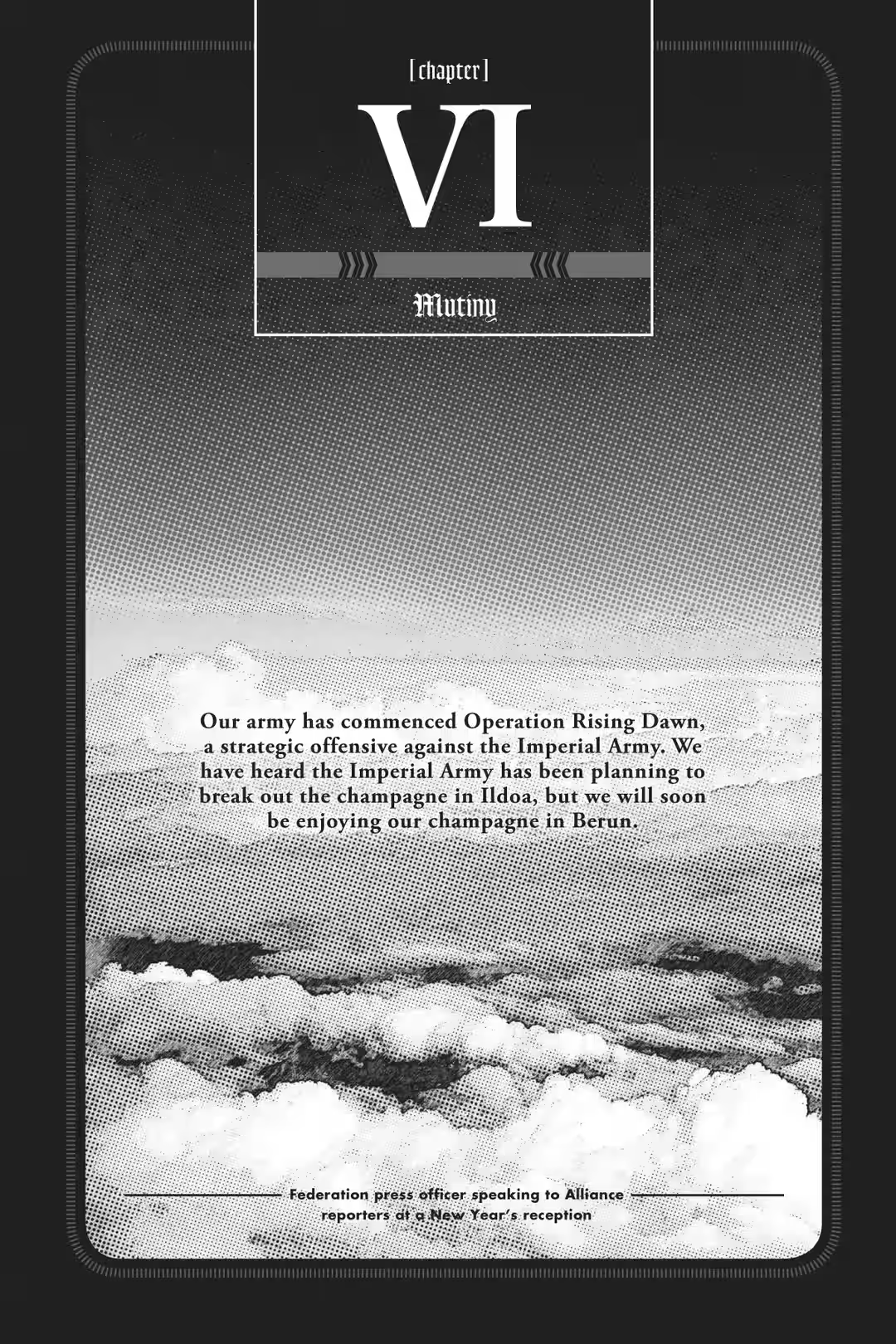
“No, ma’am.”
“Thank you for your consideration. But regulations are preferable to unnecessary flexibility in such matters. And besides, bosses should always toil more than their subordinates. It is the duty of those in authority.”
Despite agreeing, Weiss eyed First Lieutenant Serebryakov, looking for backup. The first lieutenant, however, simply remained silent, her face suggesting there was no point in arguing.
At a loss, Weiss left the command center behind, crossing his arms and staring up at the sky as he stepped outside.
“I guess the sensibilities of capable people are just a little different.”
On top of having an exceptional sense of responsibility, for better or worse, his boss was the type to be excessively consistent and reasonable.
However, she was also eminently simple, seeming to think that what she could do, others could do as well. In that context, it was a little mortifying to hear the words I expected too much come from her lips.
“Expectation weighs heavy.”
Whether General Zettour or Lieutenant Colonel Degurechaff, Weiss was forever surrounded by towering figures of excellence!
“I can try, but I’m not sure I’ll ever catch up.”
All he could do was sigh. It was hard to explain, but Weiss’s boss was outside the scope of his understanding. As poor Lieutenant Grantz, who had twice been given the runaround by a certain general, once said, such people were just a different breed.
“I wonder…”
His boss often spoke about things outside his understanding, almost as if they were the most natural things in the world. Forget about General Zettour, whom Weiss rarely came into contact with. Weiss was constantly struggling to understand Lieutenant Colonel Degurechaff’s perspective, despite seeing her day in and day out. It was strange how different their perspectives sometimes were.
“Not that thinking about it will do any good.”
With a sigh, Weiss the field officer placed his thoughts on the shelf for now. There was nothing wrong with thinking, but there were few things more important than resting one’s mind. It went without saying, but work that required thinking was tiring. As an officer with war zone experience, Weiss was familiar with how dangerous a tired mind can be. Fatigue could result in mistakes that were usually unthinkable.
Which is why it was important to rest fully when one had the chance.
As simple as it sounded, however, making the effort to rest properly was difficult. For the 203rd Aerial Mage Battalion, resting was always part of the battle. Experience had drilled that fact into the very marrow of Weiss’s bones.
Swallow the food he was given, lay his head down on what little bedding (better than nothing) that he was provided, and catch what little sleep he could. Veterans who continued to survive knew to eat when they could and sleep when they could. That was part of being a good soldier.
After all, battlefields were full of free time, with nothing to do. If one didn’t find a way to use that time wisely, they might just go mad.
Nap accomplished, Weiss woke up somewhat groggily, passing the time by chatting with some of the others in the unit in order to wake himself up, chasing the blues away by complaining about the lack of military mail, and thoroughly stretching his shoulders. Before long, it was time for duty again.
After nibbling on a bit of military chocolate—instead of additional canned rations—to get himself back into working order, and sipping on some of the strange coffee substitute they were issued, Weiss headed back to his post.
“Good morning.”
As Weiss poked his head inside the command center, his superior officer, looking slightly sleepy, beckoned him over.
“Oh, Major Weiss. You were lucky!”
“What do you mean, Colonel?”
“I mean, you were lucky to get sleep. I was planning on taking a nap, too, after I took over, but the higher-ups had some bullshit for us,” Lieutenant Colonel Degurechaff grumbled with a sigh, unable to even force a smile. “I guess I pulled the short end of the stick.”
Weiss wasn’t sure what she was talking about, but the lieutenant colonel wasn’t usually one to complain. An internal switch flicked inside Weiss. His superior, meanwhile, glared at him with a mask of intensity, much like a ferocious tiger…fitting for one whispered of as the Devil of the Rhine.
“Wait, orders? Directly from above?” Weiss asked, though the lieutenant colonel hardly seemed that impressed. “What are they?”
“Reconnaissance in force, from the General Staff. With General Laudon’s approval, we’ve been ordered to try and suss out the state of Federation Army reconstruction.”
As we grow drowsy, toward the end of a shift, humans apparently have a tendency to become less friendly. It’s just been about time to switch out when a new hassle lands on Tanya’s plate. Although I would prefer to bury my head in my hands, I continue to deal with the mountain of paperwork and orders. Which is when my second-in-command finally chooses to poke his head into the command center, looking just as fresh as a fiddle. I regret glaring at him… Perhaps it was a little childish of me.
It’s warranted, however. The sort of matter to warrant a complaint.
“Strictly speaking, the order is for the 203rd Aerial Mage Battalion. Some of the enemy’s movements seem suspicious in places, so they want us to hit them. Orders courtesy of General Zettour, it seems.”
Tanya snorts through her nose before continuing:
“Well…at least they haven’t forgotten that we’re capable of hit-and-run tactics,” she says, explicitly verbalizing the brass’s clearly high opinion of them. Aerial mages are only convenient, of course, if they are skilled. For good and faithful middle managers, meanwhile, properly sharing such evaluations is one of the minimum requirements of the job.
“A boss with a good memory…is a bother,” Major Weiss replies amiably, but I shake my head.
“It’s better than those amnesiacs over at Command. Although, we’re still busting our butts, either way.”
Even while ensuring that my subordinate understands that our skills are appreciated, I make sure that it is clear that we are on the same page in regards to the fact that the work will be hard. The point-and-call method. It is always worth being thorough, with these little extra steps.
“Now then, Major, let’s get down to business.”
I select a portion of documents laid out on the desk and pass them over to Major Weiss.
“These are aerial recon photos from the Air Fleet. Surprisingly, there seems to have been some movement among Federation troops.”
I urge him to take a look at the photos as I continue explaining.
“It looks like the bear has failed to fully hibernate and has now crawled out of its hole in the form of a mechanized unit.”
After peering at the photographs and carefully reading the documents, Major Weiss lifts his head. Pure doubt is written on his face.
“Despite the appearances…I’m guessing they’re not just a mechanized unit. After all, the fact that they’re bothering to send orders our way…makes that seem unlikely.” Major Weiss is wise to question.
Mechanized units are troublesome foes, but not so dangerous that it would merit General Staff putting the 203rd Aerial Mage Battalion the table when they specifically deployed us here as strategic reserves. Timing is everything when it comes to reserve forces. If we respond to every mechanized unit that appears along the front, we could find ourselves in the grim position of being completely out of strategic forces when they are really needed.
Besides, the fact that they first coordinated with the Eastern Army’s General Laudon shows that the order was too systematic to have been issued on a whim.
However. However…
“No, no, it’s just as it seems, Major. A Federation mechanized unit.”
“But why would the bigwigs want to send a bunch of unruly hounds like us after a unit like that? Is there anything special about them?”
Excellent instinct. I welcome my subordinate’s question with a smile.
“Apparently, they were giving off a strong mana signature.”
Of course. Major Weiss’s face grows tense, clearly understanding what that could mean. A mana signature from a mechanized unit. The implications are big. It is natural that General Staff would want to respond.
“A mechanized unit. And giving off a mana signature… That does smell pretty fishy.”
“Agreed, Major Weiss. A mechanized unit with a mana signature sounds like our own MO when attempting a breakthrough. If there is a possibility the Federation is using magic in that way, we can’t ignore it.”
Just as Major Weiss said, something about them smells fishy. Mana signatures are something given off by mages. Usually, these are detected in the air. Because, after all, they are flying.
It goes without saying, but flying mages are faster than tanks. With speeds a whole digit, maybe even two, greater. However, while they make for versatile troops, mages are also easy to detect and thus present many problems when attempting a covert breakthrough. But while this issue is difficult for mages on their own, the conversation is different when paired with transport methods such as transport trucks or planes.
In fact, when working at a small scale, it is not strategically rare to utilize mages in this manner. Having mages walk or ride in a vehicle up until the moment they are ready to be used and thus leak a signal—approaching quietly in order to launch a surprise attack—is even included in textbooks.
But something like that at larger scale, with full units…
“If the Federation Army is planning something systematic and in secret, combining mage and mechanized units, we can’t overlook it. It obviously needs to be examined more closely.”
In any case, all the conditions are there. The fact that the eastern front is so peaceful and quiet has only served to stir the Imperial Army’s suspicions. The correct call for the higher-ups was obvious. We can’t overlook this; it is time for reconnaissance in force!
“On careful thought, the Federation could even come in spring,” I say, voicing my worries aloud as an indescribable sense of loathing begins to bubble up within me.
“You’re not serious! An attack during the mud season?!” Major Weiss says in disbelief.
It is a sensible response. Even General Zettour believes the possibility to be low. But what if?
“It would explain why they keep drilling tank desant maneuvers in secret… An offensive may be much closer in fact than we presumed.” “Just our luck,” I mutter, preparing to order Major Weiss to marshal the unit. Right then, however, I notice First Lieutenant Serebryakov rushing toward them. It looks like she has come from the communications room. She is clutching what appears to be a telegraphic message in her hand and immediately begins to speak, foregoing formality.
“Colonel, a request from Eastern Command.”
“Thank you,” I say, glancing over the message while frowning at the terrible timing. “I hate to do the eastern army a bad turn, but seeing as we’ve already got orders from above…”
My words, however, are soon replaced with an expression of surprise.
“Why, what is this?!”
“Colonel?”
I share my reason for surprise with the confused Major Weiss.
“According to Eastern Command, there is a suspicious mechanized unit. It seems General Laudon and General Zettour are of one mind. So nice of him to go out of the way to order us to follow the General Staff’s order. This should go far in reducing bureaucratic friction.”
I could almost cackle.
Through shared paradigms, the General Staff strives for a “shared tactical brain capable of common judgments, whereby every person under identical conditions displays a certain degree of interoperability.” Until that time comes, however, it is delightful to see that they are keeping practical concerns in mind.
“All the higher-ups have endorsed the same proposal. Good. Let’s make quick work of this.”
Now that the decision has been made, preparations go smoothly. As for troop commitment, I immediately decide to go with the full battalion, holding nothing back. I give Captain Meybert, who is left in command in my absence, the usual spiel about staying concealed and counterattacking in case of an incident, but we are both used to it by now.
Command is handed over with a word.
All that’s left to do is take off. Marshaling a whole battalion of aerial mages is an ordeal, but it is still much easier than trying to pull a rapid sortie after getting hit in our sleep.
Once everyone is ready, I give brief instructions before departure. Next, Major Weiss reports their objective, “a mechanized unit leaking a mana signature,” and notifies them of the general situation.
Next, one after the other, they form up in company formation in the sky. Glancing down, I can see the base has been camouflaged splendidly.
“First Lieutenant Tospan has gotten quite good at that.”
Even from my vantage point, it looks to be no more than a simple village at first glance. One you might even describe as decrepit. No one would ever guess that a Kampfgruppe unit is nestled within. Given an aerial photograph, even the most hawkeyed, the most eagle-eyed of analysts would struggle to notice it.
Knowing my base is down there doesn’t help me spot it any better, so it’s unlikely the enemy would ever suspect. If you just insist the village isn’t impoverished, but rather that the shabbiness is part of the disguise, the buildings suddenly seem a little brighter.
While I’m still staring down, my adjutant suddenly speaks.
“Something to smile about, Lieutenant Colonel?”
“Indeed there is, Visha. Look down.”
“Is there something with our base…?”
“I was just impressed at how well it’s been camouflaged.”
“Oh, of course. I know it’s our own camp, but from up here, it looks just like a normal village…”
“Right,” I say with a laugh. “Any unit can camouflage a defensive position, but completely hiding an encampment is a whole other matter.”
“Of course,” my adjutant says, nodding in agreement, but then sighs. “Although…if it’s nighttime when we get back, we could be in trouble.”
“You don’t have to worry about that,” I say, laughing off my adjutant’s concerns. Searching for such a well-camouflaged base at night would likely be a pain. But this time, there is a clear landmark nearby. “If worse comes to worst, we can always set our sights on our neighbors over at Eastern Command. They’d probably even give us radio guidance, if we requested it.”
“Oh, of course.”
Upon pointing out the benefits of being next to Command, I have a sudden realization. Despite our thorough camouflage, being so close to Command is sure to attract enemy eyes and ears. They might still be spotted in the end.
“Camouflage, concealment, and deception… It takes a village.”

[chapter] IV Setback
JANUARY 7, UNIFIED YEAR 1928, THE FEDERATION
In preparing for Operation Rising Dawn, Federation officials had racked their brains trying to come up with ways to “somehow neutralize the Empire’s defensive strategies.” The main issue that presented itself was the “stronghold,” or “strongpoint,” tactics the Empire practiced.
Based on the assumption that breakthroughs could and would occur, rather than attempt to preserve the breached defensive line, the stronghold method instead focused on having units stationed along the line hold positions constructed in advance. Naturally, hunkering down in a strategic position near the front, after their line had been broken, meant being surrounded. But the imperials were willing to resign themselves to that as necessary.
A change in perspective. Instead of thinking of it as being surrounded, why not think of it as an opportunity to tie the enemy down?
In other words, all they needed to do was hold out until reinforcements came to relieve them. In a way, it was like being under siege. Strongpoints might seem like a last resort measure on the part of the Empire, since it didn’t possess the reserves necessary for elastic defense across all fronts. However, it was in fact highly troubling, as ignoring the strongholds and advancing would result in being threatened from the rear. If instead they played into the enemy’s hand, they would become bogged down in attacking fortified positions. The Federation had been tearing their hair out, trying to figure out a way to quickly neutralize an enemy who had hunkered down in this way.
Even if their defensive line was weak in places, with fortified positions such as these, it was relatively durable. Close attacks with infantry would swell casualties, and even heavy artillery would require significant time and steel while the supply situation remained uncertain. And if they dawdled, the Imperial Army, vicious as that charlatan Zettour, was sure to counterattack.
Thus, although neutralizing these strongpoints was a major issue…General Kutuz, who had taken the lead in the formulation of Rising Dawn, had found a simple solution. One that didn’t require engaging.
If the Empire’s field army could threaten units that broke through—i.e. the advancing first echelon and their logistic routes—all that needed to be done was to have separate units ready, apart from the first echelon, to bottle up the enemy inside their own strongholds.
In other words, two separate forces. One for advancing, and one for encircling the enemy. An Egg of Columbus solution. Comprehensive deployment of a massive force in the correct way and with appropriate timing. That was all it took for Operation Rising Dawn to become the key to crushing the Imperial defenses that had proven so resilient.
General Kutuz’s style may not have been the most inventive, but his initiatives were backed by strong logic that firmly married theory with reality and endeavored to be immune to any artful trickery.
The Federation, however, was a nation of ideas.
In response to the suggestion that a problem could just be dealt with later, there was the suggestion: “But what if we could deal with it immediately instead?” And the next question after that was “And how do we make that happen?”
In other words, if they could just pave over the enemy’s strongpoints instead, it’d be even better.
As ideas went, the concept was clear. The answer was that they would need “a can opener capable of opening up enemy fortifications.” The next response? “Well then, let’s invent the necessary can opener.”
The research soon followed.
In the process, their attention was drawn to Imperial tactics. Namely, the practice of mages moving via tank desant.
Originally, they thought it was simply a way to hide mana signatures during movements, for the sake of surprise, but the Federation discovered another advantage that not even the original implementors, the Imperial Army, were aware of. That is to say, the use of such tactics as a revolutionary method for attacking strongpoints.
When attacking a strongpoint with an armored unit, if the mechanized unit was to be formed entirely with magical aptitude, they discovered it would theoretically be possible to conquer these points using infantry that were both armored and yet mobile.
Of course, scraping together a whole brigade with magical aptitude would be difficult, so as a test…the 1st Mechanized Mage Experimental Regiment went into the field with the hope that they could serve as that can opener.
General Kutuz’s honest opinion was that they should just leave the encircled troops be, but being sensitive to internal matters of balance, he knew better than to share such a pointless opinion. After all, he could see that the party was already on board. And he was well aware of what happened when you opposed plans that higher-ups had taken a liking to.
If the plan you opposed succeeded, that would naturally result in losing face. But that was actually the better outcome. What would really be terrible is for the plan you opposed to fail. The higher-ups would see that as your smugly foretelling their downfall. Nothing could be worse.
Using your specialist position to flatly reject each and every one of the relatively harmless notions of the amateurs was like reserving a one-way ticket to the gulags. Moderately opposing only the truly disastrous notions was more than enough. Or at least, that was General Kutuz’s approach.
Thus, the 1st Mechanized Mage Experimental Regiment, which had captured both the interest and approval of the party center, soon appeared on the eastern front.
New, ambitious, and inventive. An arrangement that might have easily become the de facto standard. However…
…that day, immediately before the start of Rising Dawn, something highly unfortunate occurred.
A lizard appeared in the Federation’s path. One that breathed fire.
Its name: Salamander—the fire-breathing pride of the Empire.
After increasing his altitude and briefly searching for the enemy, First Lieutenant Grantz returns, a look of surprise on his face. Flying abreast of Tanya, he reports what he has found.
“I sensed something straight ahead! It’s weak, but it matches our projected target location. Position has been acquired!”
“You sensed them? From this distance?! You’re sure?”
“It’s the area that was reported! I’m pretty sure it must be them!”
For our own part, we were avoiding using even radio. Considering how careful we were not to give ourselves away, I assumed the enemy would take at least as much care.
I hesitate for a moment, and then make up my mind.
As much as I hate to repeatedly leak our mana signal just to scout, I purposely fly up abruptly, gaining altitude and orienting myself toward the suspicious region in question, searching for any signatures in the area, just to be safe.
“Unbelievable.”
I sense it straight ahead. There is no other word to describe it. A mana signature. Honestly, the fact that we can pick it up at this distance… For me, who is ever conscious of keeping my signal as hidden as possible and who is constantly crawling at low altitudes to avoid emitting a powerful flight formula signature, the idea of leaking such a massive signature, like the enemy is doing now, is completely alien.
Unless this is some sort of strategy on their part, the enemy is being woefully happy-go-lucky.
“Major Weiss! You search as well, just to be sure!”
“Roger,” Major Weiss responds in admirable fashion, immediately gaining altitude. Hmm? His face shows surprise. And then Huh? A look of worry. No way, he seems to mutter as he descends once more.
“I sensed them, just as Lieutenant Grantz reported.”
“I can’t believe you both doubted me! How rude!”
“Sorry!” I shout back to First Lieutenant Grantz, before turning to ask Weiss a question. “What do you think, Major? Any ideas?”
“I find it hard to believe the enemy could be this bad at covering their magic… Maybe they’re trying to lure us out?”
Hmm? I furrow my eyebrows in response. As with the Type 105s, Major Weiss has continually proven himself to be an idea man. If a possibility occurs to him that I’ve missed, it would behoove me to hear him out.
“Hold on, Major! You mean you think it could be a diversion, a trap, deception?!”
“They’re just so exposed!”
Hmph. Tanya folds her arms. During yesterday’s officer recon, as well, she seriously considered the possibility that the mana signal they’d picked up had been a trap. That turned out not be the case…but there’s no guarantee this time might not be different. Underestimating your enemy is a dangerous mistake.
“What’s the saying…? Pride cometh?”
Underestimating the enemy isn’t just a mistake; it’s a bold first step down a steep slope. I’d rather not stumble headfirst into enemy crosshairs just because I overestimated my own skills or the proficiency of my troops.
Caution—the ability to imagine the worst, even to the point of cowardice—is an admirable trait.
“Major Weiss, wait a second! I’ll double-check!”
Honestly, I do not like repeatedly gaining altitude like this. When you stare into the abyss, the abyss also… Well no, I guess that doesn’t really apply here. But if we can pick up their mana signal, then we can assume they can probably pick ours up as well.
If we’re hoping to surprise them, it would obviously be better to leave them be. But I’d rather we wind up doing a shock attack than stick our heads into a trap. I climb and search for a signal in the distance once more.
Although it is far, there undoubtedly appears to be a signal leaking. It is a proper signal, not like what they got from the Type 105s or those piss-poor Federation mages from before.
A leaking signal, plain and simple. There is no other way to describe it.
“Yes… There doesn’t seem to be any explanation for it other than that they are amateurs.”
Or if it is a trap, that would also make sense. It isn’t entirely impossible that they might be leaking their signal on purpose. As I lower my altitude and rejoin ranks, Major Weiss is waiting with a questioning look on his face. He flies abreast without speaking, but I know what he is thinking. I just shrug.
“So you think it is a decoy?”
In response, Major Weiss nods emphatically.
“We did the same thing in Ildoa! Lured the enemy out by pretending to be rookies and then ambushed them!”
I grimace, remembering they had, in fact, done something similar back in Ildoa when hunting that Unified States mage regiment. Would the enemy do the same? It is good that her men have a healthy sense of caution. But I’ve noticed before that Major Weiss can sometimes be sensible, or perhaps pessimistic, in misplaced ways, and he has a habit of overestimating the enemy.
“If they were trying to lure us out, I doubt they would let us know they’re combat ready by going through the trouble of putting up defensive shells.”
Exactly. The enemy’s mana signature would be too shabby as camouflage or a decoy. If they just failed to cover their magic and accidentally revealed their location, that might be one thing, but as decoys go, leaking a signal showing themselves to be combat ready doesn’t seem particularly well-thought-out.
Naturally, that could all be more deception to lure us like a moth to the flame. Intentionally meant to confound our judgment. It’s not impossible. However…
“If it was a decoy, what would it even be a decoy for in the first place?” I say with conviction, almost certain by this point.
As with Operation Bolo, which the US Air Force carried out in Vietnam, the strategy of disguising your forces as something else to lure out an enemy is not unheard of. But in general, such tactics are for luring out a target enemy as part of a cunning game of cat and mouse, using sophisticated camouflage.
“What are you arguing? That this amateur mana signature is a disguise for just a mere skirmish?”
“The Federation Army are not amateurs. They are extremely dangerous.”
“I agree entirely. The Federation army are not amateurs and are extremely dangerous. But that is the Federation Army as a whole. When it comes to the quality of their mage units, there is little room for dispute.”
Our encounter with those mages from the other day, who didn’t even have shells, made that exceptionally clear. As an organization, the Federation Army may be fearsome, but at the individual level, they are often frail.
However, Major Weiss, who usually does not challenge Tanya’s words to such a degree, seems to have become a staunch figure of opposition today.
“Lieutenant Colonel, failing to respect our enemies is dangerous. They are a mechanized unit, and not just a regiment—a whole brigade. And based on signal alone, the mages appear to be a battalion as well. If it is a trap, we’ll be flying straight into the lion’s mouth.”
I furrow my brow as my subordinate speaks, his face serious and anxious. It is precisely because I rate him so highly as a soldier that I’m confounded to see such a difference of opinion at such a crucial moment.
“Don’t you see? Overestimating the enemy is just as dangerous. Something that can only lead to lost opportunities for victory.”
“I understand what you are saying, Colonel—very well. But something about this theater seems strange to me…”
“The east always smells suspicious. I agree with you wholeheartedly in that regard.”
But this time is different. The Federation Army’s cunning, their exquisite intricacy as an instrument of violence, is more often at the strategic rather than the tactical level.
“Putting aside tactical and strategic cunning, to do something this exposed and obvious at the tactical level? I don’t the Federation is the type for such shabby camouflage.”
“On principle, that is absolutely correct, but…”
“Either way, once we take a pass, we’ll know for sure. If there is a trap, then we’ll just have to gnaw our way through.”
As the rambling conversation carries on, I’m keenly reminded once more of the ills of being shuttled about in such a hectic fashion, deploying first to Ildoa, and then the capital, and now back to the east.
After fighting on the front lines for a certain period of time, you need time to fall back and regroup. In the end, even the most powerful unit is just an assembly of individuals. Once their energy wanes, vital combat strength will be lost.
For those who say a unit is strongest when it’s always fighting, maybe they should try facing an equal foe head-on for themselves, one that is well rested, after they themselves have already fought for ninety hours without sleep or rest. The respectable unit is usually the one that has been shored up with the proper rest and training. And the 203rd, what is essentially Tanya’s own child, is no exception, as lamentable as it is.
The same is true for this difference of opinion with Major Weiss. What’s needed is some proper time in the rear, adjusting, before deployment to the battlefield.
“On the surface, things appear okay, but deep down, the roots have rotted much more than they appear…”
“Colonel? What do you mean?”
“Don’t worry, it’s nothing, Major Weiss. Please prepare for battle.”
Major Weiss nods but looks puzzled.
Tanya, of course, is aware that the command was unnecessary. For aerial mages, preparing for battle is simple and clear. In the worst-case scenario, all they need is their orbs, their rifles, and some formulas.
However. As an expert in magical warfare, Tanya adds one more point. The truly crucial point when it comes to mages is implementation.
Maximum effort on the battlefield, rooted in familiarity with specs and careful consideration of the expected environment, is indispensable.
“Sorry, I mean mental preparation.”
“Ahh,” Tanya continues. “You are too serious, Major. You make things too complicated, you know that?”
“This again…?”
“Instead of seeing malice in every shadow, what if sometimes the enemy is just incompetent? Above all else, we must never forget the big picture.”
Conversation finished, they continue flying. Before long, the distance has shrunk enough to pick up the enemy’s signal even while at a low altitude. That is where the enemy is, make no mistake about it. The fact that we can detect the enemy’s mana signature vaguely now, without even searching, means we must be in close proximity.
As they approach, the 203rd Aerial Mage Battalion naturally begins to increase altitude, flying in pairs, with the prospect of air-to-air combat on their minds. It has become a habit. Mages, by their nature, hate to get pinned down from above.
Even well-trained mages tend to think of contour flight paths as something only driven by necessity. When in contact with an enemy, in the end, even I prefer to gain altitude whenever possible. No reason to pull back on their reins now.
“Moving in. Maintain speed and course, and climb to six thousand in preparation for combat.”
The battalion responds with striking speed.
“Climb to six thousand and maintain both course and speed! And stay in formation!”
Repeating the orders, there is no disarray in their ranks as they rise. Not a thread is out of place when it comes to combat maneuvers. Speed, spacing, and most crucial of all, coordination, all thoroughly maintained.
As they gain altitude, however, a vague thrill begins to take hold.
“Keep your magic under wraps as much as possible. But prioritize detection of the enemy.”
“Roger,” comes the admirable response.
All that is left now is to identify a good point for entering combat as they continue to scout the enemy situation…or at least, that is how the process would usually go. This time, however, circumstances are somewhat different. Or rather, strangely enough, there does not seem to be any need to go out of our way to detect the enemy’s situation.
First Lieutenant Grantz, who is positioned slightly ahead as if to advance, shrugs as if exasperated, the usual tension of battle absent.
“It certainly makes our jobs easy when the enemy leaks their signal this clearly.”
Tanya furrows her brow slightly, realizing that most of the battalion are nodding in agreement with Grantz. Accurately assessing the enemy is good, but there is a fine line between mocking their weakness and carelessness.
I hesitate whether to correct him, but officers have their own face to maintain, and besides, in terms of order, a commander must think carefully before purposely scolding a first lieutenant in public immediately before battle.
Tanya is still wondering whether to say anything once they get back, when the problem is taken out of her hands by Major Weiss, who responds to her hesitation immediately. To my surprise, he flies forward quickly, casually speaking to First Lieutenant Grantz in an almost joking manner.
“Wise men learn from the faults of others, Grantz.” As Grantz’s face grows tense, Weiss nods, delivering the appropriate caution there on the spot. “Let’s focus on keeping our own magic under wraps. It’s important we play it safe.”
Weiss noticed the problem and handled it on the spot. All while effortlessly preserving the first lieutenant’s face. And rather than grow defensive at being rebuked in this way, Grantz nods in response, appearing to take the correction in humble fashion.
“Roger that, Major Weiss!”
Similarly, Grantz’s somewhat mischievous response does much to dispel the tension of the moment. He shows no sign of shrinking or feeling resentment at being corrected. This is the meaning of a positive atmosphere. Tanya quietly adds good personal skills to her mental appraisal of Major Weiss.
Not to brag, but as a superior officer who always takes special care of my staff, he must have learned that from watching me. Seeing your employees grow is an amazing feeling. After all, as the one in charge of their education, as they grow, my value and security grow as well. And as a professional, it is always pleasant to catch a glimpse of one’s own professional hand at work and to bathe in the open air of communication that has been fostered in a department you lead.
While Tanya’s breast continues to swell with pride over this new discovery, however, she also mulls over the current situation. Apparently, we don’t need to scout the enemy’s situation. But do we have enough breathing room, then, to widen the scope and scout for other enemies? Yes, likely. But should we also consider the possibility that, under the circumstances, such efforts would be wasted?
Yes, they would almost certainly be so.
Still, there is something to say for the cautious view. Major Weiss only just suggested it, after all. Tanya decides that emphasizing safety is the consistent approach in this instance.
“Major Weiss, change of plans! Let’s search for enemies!”
“Huh? What do you mean?!”
“I’m taking your opinion under advisement, Major. Let’s consider the possibility that the enemy could have other troops waiting in ambush! I know we’re on the verge of conducting a strike, but let’s scout the area first!”
A look of pleasure appears on Major Weiss’s face at hearing that Tanya has taken his worries on board.
“Thank you!” he says with an artful salute.
“Not at all,” Tanya says, waving her hand. Since we’ve already located our target and have the breathing room for an assault instead of a surprise attack, extra caution is within acceptable costs.
Sometimes, the difference between putting off operations too long in search of information and thus missing out on chances for victory, on the one hand, and enduring the cost time to appropriately grasp information about the enemy, on the other, can be paper-thin. But we can certainly manage a quick scan of the surroundings.
As we are three companies, we disperse into three groups and begin scouting the area near where the enemy brigade has already been confirmed. Assuming the enemy may be attempting an ambush, we even look for surface camouflage such as what First Lieutenant Tospan has pulled off. Working in small groups, we pour over the surface with our eyes, with some of the soldiers even alighting onto the snow to look around. By the time an all clear has been given, some have gone so far as to dig into the snow, thinking a whole unbroken field of snow might be a disguise.
In the end, it all turns out to be for nothing.
There are literally no enemies waiting in ambush. The whole battalion just spent its time fumbling about in the snow for no reason. The conclusion is clear. There is absolutely zero possibility that the enemy has laid a devious trap for us.
Major Weiss is the serious type. After advocating for caution, he likely feels mortified. At the moment, his face appears so stern that even I sympathize.
While we are assembling once more, Major Weiss suddenly bows his head, a look on his face as if he just can’t hold back any longer.
“I’m just… I’m sorry.”
The measure of any boss truly shows in those moments when they are apologized to by a subordinate. That’s what I think. If that subordinate bungled something or took an inappropriate action, then it should be dealt with accordingly. But if the action was reasonable and could be justified according to what was foreseeable, and if she herself had previously agreed with that reasoning, Tanya could hardly sanction shifting blame to that employee based solely on outcome.
“Don’t be ridiculous, Major.”
“But all that effort…”
“I was the one who decided to scout the area. You are not responsible for mistaking the situation. Your opinion was reasonable. It was I who decided to adopt your opinion; I am the one who is responsible. It was not your fault. Do you understand?”
It is true elsewhere as it is in the army, but when authority is powerful, one must take special care to avoid unnecessarily demoralizing one’s subordinates. Nothing could be worse than surrounding oneself with yes-men.
“Humility is a virtue in my opinion, but instead of wasting your time apologizing to me over nonsense like this, I’d rather you go out there, get some results, and then strut around all full of yourself.”
Having finished motivating Weiss, Tanya mobilizes the unit toward their target, closing the distance as they prepare to attack.
Tanya would have almost preferred to get a response from the enemy. There is none, however. They seem to be completely oblivious. Maybe the mana signature is too close, causing their enemy’s seeking capabilities not to function correctly?
The enemy is inactive either way. And there are no signs of reinforcements nearby. The initiative remains in our court, and we are in position to attack at any time. We had already been preparing for an assault before searching the area, so we are in ideal formation.
After preparations are in order, Tanya reaches for her long-range radio.
“This is Salamander 01 to HQ, please acknowledge.”
“This is HQ, reading loud and clear,” the voice on the other end of the line says, acknowledging receipt.
It must be nice to sit in the rear taking calls. With a twinge of envy, Tanya begins to describe the scene before her.
“Regarding the matter forwarded by eastern forces, Salamander 01 has confirmed what appears to be a brigade, not a regiment, of mechanized mages.”
“Salamander 01, we are not able to detect an enemy mage unit signal from here. Please report on enemy situation.”
Hmm? I begin to feel doubtful. We are not that far from front lines, and the enemy is leaking their signal as plain as day, but the control center can’t detect them? With the superior equipment they supposedly have? Tanya breaks out into a cold sweat, worried they may have mistaken their target. She immediately requests confirmation.
“HQ, please confirm our location. Are we in the correct location?”
“Salamander 01, we are picking up your signal. Enemy mage signature in your current area is not clear.”
Ah. Maybe Control just lacks the skill. That could explain it.
“When you say ‘not clear’…are there bogeys?”
“There is too much noise for a clear determination. Salamander 01, please report on enemy situation.”
“Roger,” Tanya says, answering the HQ controller. Internally, I curse the officer for their incompetence, but naturally, my sense of professional self-control prevents me from saying that part out loud.
“Visual confirmation is still in progress. As expected, enemy is a mechanized unit of brigade size at most. Judging from mana signature, they may be accompanied by a company of what appear to be mages. This is the enemy force in question, correct?”
“HQ confirms. Is removal possible?” the person on the other end says. Tanya’s ears don’t grasp the meaning of what he has said.
“Salamander 01 to HQ. Your previous question was unclear. ‘Is removal possible?’ Please clarify.”
“This is HQ to Salamander 01. Can your unit attempt an attack against the bandit without additional support? If a lone attack is possible, please proceed.”
Tanya can’t help but blanch at the controller’s question. Is an unsupported attack possible? What in the hell is that supposed to mean?! I doubt my ears. General Staff sent us here to attack the unit, then Eastern Command requested the same, and now some controller sitting on their ass back at Command has the nerve to ask if we can handle such a big job all by our widdle selves?!
Do they have no idea what kind of unit I lead?
“Salamander 01 to HQ. Officer, how long have you served?”
“Huh?”
“I get the feeling you’re a rookie. You should watch how you talk about me and my troops,” she says, admonishing the controller with a huff and a sigh.
Selling oneself short is unacceptable. Skills must be demonstrated. A good company man must always deliver a clear message in regard to their skills and act in a way that avoids inappropriate undervaluation.
“My unit are not amateurs.”
“H…huh…?”
Tanya sighs again, seeing that the foolish rookie still doesn’t understand.
Once upon a time, the Empire was full of control staff who were professional and expected professional work. Diligent and faithful. The notion of something like this would have been unthinkable. But now? To think that the day would come when Tanya would doubt a controller’s very intelligence!
Unbelievable. The way things are going, Tanya feels like she might scream, but she manages to rein in her fury. Sucking her teeth, she forces herself to speak to the controller as if he is simple.
“Listen. Of all the… Of all the notions. For some rookie, who can’t even fly, to question whether we, elite mages, who have survived aerial battles even in the west, can handle an attack on our own?”
We have battled giants. Sacrificed blood, sweat, and tears to overcome, to compensate for, and to create parity in the face of unbelievable odds.
The Imperial mage division’s motto may as well be attack on sight. In her very first battle, Tanya and many others were ordered to delay a full company. The controller on the radio gave the order without even batting an eye.
Naturally, retreat is permitted when necessary…but after so many years of being expected to be the Empire’s vicious hound, forever aggressive and daring, it is infuriating to suddenly be asked, Little doggy, do you think you can bark?
Absolutely absurd.
“Prepare to see for yourself. We are the spearhead. We are the perfect instrument of violence!”
I will not allow our many achievements to be diminished. Evaluations must be accurate. No common whelp who doesn’t even know the meaning of the word achievement is going to worry about us.
Reliability and achievements must be taken seriously. Tanya’s unshakable opinion—her conviction, her pride as a good and ordinary citizen living in the merit-based economy—demands it. As someone who prides myself on being kind and upright, this is the minimum for humans who engage in business with other humans.
To be ridiculed like this on the battlefield? Is there no justice, no credit where credit is due?!
“Just the other day, we broke through AA fire from the Unified States in Ildoa. We were reared in battle; the enemy’s screams were our lullabies! And you think these stumbling fledglings will give us trouble? You honestly believe that horseshit?!”
Tanya pauses for a beat and then hisses mockingly.
“What a laugh! The first real knee-slapper of the new year! You must think we’re a joke! But allow me to deliver a correction now in blood and steel.”
“A…correction…?”
“Yes, we will physically remove the cause of one of Command’s headaches for you by force. I expect to see extra rations as an apology. Salamander 01, out.”
With that, I sign off, having failed rather spectacularly to control my temper. I must have made quite a scene. Major Weiss, who ought to have been waiting quietly by her side, ventures reluctantly to speak, a look of hesitation on his face.
“What did Command say, Colonel?” he asks, looking worried.
Tanya shrugs and laughs, as if to indicate it is nothing.
“Eastern Command’s fine young controller appears to be worried over whether we can make an attempt against the enemy.”
“Attempt…?”
“Yes, Major. They are worried for us. Over our fitness for engaging the enemy. It seems they do not think very highly of us at all. Unbelievable,” Tanya says, narrowing her eyes and pointing toward the enemy. “Against that! Disgraceful!”
Major Weiss blinks twice, cocks his head, and deftly arches his brows before turning his binoculars toward the enemy to whom Tanya is pointing.
“Against that?”
“Yes, against that, Major.”
“You’ve got to be kidding,” Major Weiss says, removing the binoculars from in front his face and squinting. A heavily equipped Federation column awaits below. In terms of size, they look to be a brigade at most.
As far as can be seen, this ground force appears to be of moderate skill, at least. Their attention to disguise is decent, and despite marching through snow, their ranks remain in surprisingly good order. The spacing between units is also within acceptable standards. As simple, mechanized infantry go, they are of a decent level. An impression, however, that is completely ruined by their accompanying mage unit.
Their leaking mana signal has completely ruined the mechanized unit’s attempts at camouflage. On top of that, they have exposed the locations of the commander, communications, and other high-value targets, which of course suggests that the mechanized unit lacks sufficient experience in combining with mage units.
This is a classic example of two powerful forces being combined to create synergy, but instead, they hold the other back and lead to a decrease in their value or total force.
“They make for tempting prey. I want to just eat them up. Even if I thought they were a decoy, I’d have to actually see a hunter in their midst before I would pass up on such easy pickings.”
The Federation unit is practically a sitting duck. Definitely not the type of enemy that a fine warrior would be proud to face. However, prey is prey. In the end, rather than valor and glory and battles to the death against grand and imposing enemies, I would much rather wipe the floor with easy pickings.
This is war, after all. If I’m going to risk my life, I’d prefer it be easy.
“Major Weiss, prepare for a ground attack. Let’s take out the enemy mages from above before they can get to interception altitude.”
Tanya quickly relates the usual preparations. Waiting for a response, she turns her eyes toward Major Weiss, who looks slightly perplexed.
“Major Weiss? What’s wrong?”
I notice Major Weiss staring off into space as he flies, as if his mind is somewhere else. After a moment, Tanya seems to understand.
“Hello? Major Weiss? I get that you’re shocked over what that controller said, but come back to us,” Tanya says, trying to snap her distracted subordinate out of it.
“E…excuse me. It was just so unexpected. What were you saying…? Take them out from above while keeping our magic completely covered?”
“That is not what I said.”
“So then an air raid, like standard aerial mages? A one-sided ground strike?”
“Yes. What good are aerial mages if they don’t fly, Major? I want to see a classic, textbook ground strike. Finish off the mages before they can take off. They’re sitting ducks, remember?”
“Understood! They’re still living in two dimensions. Let’s introduce them to the three-dimensional age!”
Though Major Weiss’s statement is impudent, it is eminently reasonable. Pure professionals, the 203rd Aerial Mage Battalion begins maneuvering at full speed, prepared to educate these amateurs. The enemy does not detect us until just moments before contact, allowing us to strike the Federation Army unit from above in what is fortunately almost a complete surprise attack.
For practical purposes, the battle has been decided. Altitude is everything. Any enemy mages who attempt to lift off from the ground will be easy marks. And with no environmental cover, those who flee in confusion on the ground will be shot like dogs from above instead, one after another. The outcome is already settled.
“The battle is ours.”
I ready myself. It is now or never for the enemy. They should be lifting off any moment now…any moment now…
“Huh?”
Without thinking, Tanya peers into her binoculars and desperately searches around, not understanding what is happening. Eventually, she is forced to recognize the truth: that the enemy mages are not, in fact, lifting off.
“They’re facing certain annihilation, and they’re not even going to bother taking off?”
It seems unthinkable. Tanya had been so focused on preemptively batting down the enemy once they attempt to rise in a panic, the notion that they might not lift off at all never even occurred to her.
“You’re kidding?! They really aren’t going to fly?!”
In aerial mage battles, altitude is usually the deciding factor. Considering just how much of a tactical advantage the Elinium Type 97, capable of combat altitudes of eight thousand, has proven itself to have against enemies who can only reach altitudes of six thousand on average, it would not be an exaggeration to say that allowing an enemy mage to get on your tail is an almost primal fear.
And yet as Tanya stares down at the enemy, which seems to be getting into position in response to their attack, she sees what appears to be mages scrambling back and forth on the ground, intermixed with fleeing infantry. Tanya furrows her brow. This doesn’t make sense.
“What are they doing?”
Has the enemy intentionally chosen not to take off?
No, even if their commander ordered them not to fly, at least a few would certainly lift off under these circumstances. Could order in the Federation Army really be this ironclad? Are humans even capable of such discipline? And if the enemy is so disciplined, why are they scrambling on the ground in disarray? It doesn’t add up.
Any enemy that could fly would. And then suddenly, a crucial possibility dawns on me.
I mutter aloud, “Maybe it’s not that they won’t fly. Maybe it’s that they can’t.”
A small difference, but there are many instances out there where a small difference means all the world. Not mages who won’t fly. Mages who can’t fly.
Fully ground-based mages! Realizing what I’m seeing, I immediately doff my cap to the Federation’s ingenuity. This is a tangible paradigm shift.
“I’ve got to hand it to them. That’s smart… Damn smart.”
Depending on how they’re used, nonflying mages might make for unprecedentedly superior infantry.
With their defensive shells up, they would likely be able to ignore rifle fire, already making them ideal as assault infantry. And they could easily produce about as much firepower as light machine guns or grenades. With good enough computation orbs, they could even field firepower and armor equivalent to a tank while still remaining infantry-size and thus being much more concealable.
In irregular warfare, they would pose a particular threat.
Why didn’t I think of this? It’s mortifying! What a brilliant change in mindset. Like the Egg of Columbus.
The enemy, however, lacks experience in aerial mage combat. That is why they are leaking mana signals… In other words, they are still groping in the dark. Meaning they have discovered this before the idea has even hatched.
Naturally, the ability to fly allows aerial mages to seize the advantage. Currently, these ground mages are no more than sitting ducks and, even in future, might not pose much of a threat against their aerial counterparts. But this is war. Total war. There is no reason for nonflying mages to go out of their way to engage flying ones.
In fact, there’s no reason to expect it at all. Why should the enemy proactively fight in an arena where they are at a disadvantage? Tanya holds no such distorted and self-interested principles. Fighting fair and square means availing yourself of any and all methods you can fairly and squarely use while limiting your own losses. That’s the real principle at play.
“The enemy is smart… Mages are still mages, even on the ground. The Federation has hit upon an ingenious idea.”
Tanya, however, turns her thought back to the battlefield at hand. The long-term, bird’s-eye view of things can wait. There are times when battle commanders need to focus completely on what is happening before them. And this is one of those times.
“Time to crush them. Now, let’s see… How should we go about this?”
The Federation troops are like fish on the chopping block. They have no idea what is coming. While I’m still considering how to best dispatch them, I suddenly realize they would make the perfect target for live-fire training.
Such opportunities are few and far between these days.
Since we’ve already gone to the trouble of scouting the area in case this unit was a decoy, we know there is no risk of encountering immediate enemy reinforcements. They’re as isolated as they can be, and their coordination is inconsistent.
They must have assumed they’re hidden from signature detection because they’ve been sticking to the ground. They’re purposely trying not to stand out. Hence how isolated and unusual they seem. That’s their mistake, but their reasoning at least is beginning to click into place.
“Everybody, listen! The enemy may not be able to fly! Assume these are ground units only! Don’t bother with air-to-air tactics and focus solely on ground strikes instead! Assume the enemy’s AA may be relatively powerful!”
If there is no need to worry about air superiority, the strike can be pushed forward a phase. Any chance to avoid unnecessary work is always welcome. Tanya switches tracks.
“First Lieutenant Grantz, First Lieutenant Wüstemann, I’ll leave it up to you. Mow down the enemies on the ground using First Lieutenant Wüstemann’s company as the main axis.”
“What? My…my unit?” says Wüstemann, the youngest officer in the battalion, a blank look of confusion arising on his face as he is taken by surprise.
“First Lieutenant Wüstemann, are you surprised that your unit should lead the way?”
“Well, it’s just…”
“You all are nearly first-rate now. Let’s see you prove your worth.” Tanya changes her tone. “No, I am already well aware of your worth, First Lieutenant Wüstemann. So don’t prove it to me. Prove it to yourselves. Show yourself that you can do this.”
A quick glance reveals courage in his face.
“Roger!”
“Good,” Tanya says kindly, before repeating her orders. “Assume ground-strike formation and hammer them until it’s done. And expect enemy AA fire. Remember, don’t overestimate your protective films; focus on keeping shells up as well.”
“Leave it to us!” First Lieutenant Wüstemann shouts enthusiastically. Tanya nods magnanimously.
However, the orders are for both officers, not just First Lieutenant Wüstemann. Tanya flashes a surreptitious glance at First Lieutenant Grantz as well, letting him casually know that she expects him to keep an eye on things.
“First Lieutenant Grantz, you’re on support. Understand? I don’t expect any enemies to take to the sky, but if they do, respond appropriately in support of First Lieutenant Wüstemann’s unit.”
“Of course.”
“Good,” Tanya says with a nod. However, her subordinate still seems to have reservations.
“But…if the enemy can’t fly, aren’t we just picking on weaklings? This feels kind of wrong.”
A rather bold opinion for First Lieutenant Grantz. The weakness of the enemy seems to have loosened his lips. Tanya decides a light roasting is in order.
“What commendable spirit, First Lieutenant. Just to be fair and square, you can go pick on some powerful enemies instead. Once we’re done here, I’ll give you your own private mission of glory. We can send you into Federation territory to take on a garrisoned battalion of aerial mages. How does that sound?”
First Lieutenant Grantz flinches, realizing that he brought this on himself, but Tanya just grins back affectionately. Enough for her subordinate to realize it is too late to take it back now.
“Lieutenant Colonel, that’s… I’m sorry, that isn’t what I meant…”
“No, Lieutenant, you’re right. This enemy barely qualifies as a warm-up. I agree entirely. Anytime you wish, just let me know. It doesn’t have to be today. I will make the arrangements immediately.”
“Your…thoughtfulness is welcome, but…”
Tanya’s subordinate begs for mercy, his face tense. Tanya responds with a grin.
“No need to be so shy, First Lieutenant Grantz! I’ll give you exactly what you wish! Isn’t that wonderful?”
“I… It’s an honor.”
You see? Tanya is the kind of commanding officer who values the opinions of her troops. She flashes another grin, delivering the coup de grâce.
“Yes, I’m just glad that you’re glad, Lieutenant. The very next opportunity we have, I’ll be sure to fully exploit your newfound eagerness, but as for today, focus on supporting Lieutenant Wüstemann, if you don’t mind.”
With that, the first lieutenant trudges away. Tanya’s second-in-command shouts after him as well, a look of exasperation on his face.
“Come on, Lieutenant…”
“Sorry,” First Lieutenant Grantz says, bowing his head commendably to Major Weiss as well. But Grantz isn’t a bad officer. He can just be rather childish.
Major Weiss understands this as well. With a brief frown, he smacks First Lieutenant Grantz on the shoulder.
“Next time, think before you speak.”
“Yes, Major.”
Aftercare and conclusion. That’s Major Weiss, always playing the good cop.
“Although…,” I mutter with a pause. Why should I be the bad cop? I may not be the most affectionate educator, but I do take pride in conducting myself in a way that could be described at least as benevolent.
Such thoughts can wait for later.
“Instructions for all battalion members. Following your commanders’ leads, split into companies and destroy the enemy mechanized mage unit. And be prepared for the possibility of enemy reinforcements. That means time is of the essence. Let’s take care of them quickly, like always!”
After receiving orders, each company springs into action with satisfying speed. First Lieutenant Wüstemann, despite leading a unit with replacements, shows no particular deficiencies in comparison with the rest.
Thinking everything looks fine, Tanya notices the worried look on Major Weiss’s face.
“Are you sure this is all right?”
“You mean placing Lieutenant Wüstemann’s company out in front?”
“Yes,” Major Weiss says, to which Tanya nods, as if annoyed.
“The point is the first pass. Honestly, Federation units are durable…but what I’m looking for is to get a grip on how strong the mages working in combination with this enemy mechanized unit are,” she explains. “In other words, I’m interested in seeing if they can oppose a unit that, while elite, is not Named. I figured Lieutenant Wüstemann’s men would serve as a decent stand-in for a standard unit.”
“I see…so it’s recon in force.”
“Yes,” Tanya says but goes on to correct the major.
“I’m also fully aware of the worth of Lieutenant Wüstemann and his men. They are very nearly first-rate. So if they wind up being too skilled and routing the enemy easily, that is just as acceptable.”
Tanya glances questioningly toward Major Weiss to see if he understands, but the major needs hear no more. He nods quietly before mustering his own unit. As Tanya shrugs in annoyed relief, First Lieutenant Serebryakov comes abreast, approaching tight into Tanya’s pocket.
The only reason Tanya is able to talk to her officers in such a leisurely fashion is because her wingman has been keeping an eye out. Such a solid and dependable adjutant is a rare treasure.
“Thank you as always, Lieutenant Serebryakov.”
“Colonel?”
“Never mind, it’s nothing.
“Now then,” I say, readying my rifle in preparation for the start of combat. As she does so, her adjutant, who is monitoring things from Tanya’s side, reports on what she sees.
“Wüstemann’s unit has commenced their incursion. They’re conducting themselves admirably.”
Just as First Lieutenant Serebryakov says, the attacking company is doing an impressive job. The speed with which they assume attack formation. The way they maintain pairing. The timing of their ground attacks. If I could find one complaint, it would likely be that their attack is too textbook and not responsive enough. But it is better to pick an appropriate form and stick to it than to crumble to pieces.
Tactically speaking, everything is within acceptable parameters.
As Tanya watches on, the aerial mages break off and rake the tanks on the ground with explosion formulas. Their maneuvers are top-notch as they attack, with multiple pairs constantly coordinating so they never all come from the same angle. The enemy on the ground is likely having a difficult time picking out a target to shoot back at. If enemy rounds can’t even graze our protective films, let alone our defensive shells, it should certainly cut down on magic consumption.
“As aerial mages go, not bad.”
From my point of view, they’re decent. Not bad at all. In other words, according to current Imperial wartime standards, these erstwhile replacements have undoubtedly reached the level of honored veterans.
“See that, Serebryakov? What do you think?”
“They seem pretty impressive to me.”
“Indeed. An example of how the combination of combat experience and training changes people, I suppose.”
I get a little emotional seeing subordinates I’ve trained in action, but on the battlefield, the time for such sentimentality is short. Mixed in with the sound of explosive formulas being hurtled at the ground, I hear some sort of strange atmospherics over the radio.
The enemy must be in serious disarray. Our attack appears to be going swimmingly. Of course, these enemies are not the type to be wiped out with a single explosive formula, like the last ones… We’re fortunate to be able to harass such capable units while they remain on the ground. As I’m thinking this, my adjutant, who is still flying nearby, speaks up.
“The attack is going well.”
“Maybe too well, if you ask me. I was expecting at least a little kickback.”
“The Empire does have a bit of a head start when it comes to mage combat, after all.”
“A bit?” I clutch my sides in amusement. How unlike the first lieutenant. “It’s not like you to misread that situation like that, Lieutenant.”
“Hmm?”
“A bit of a head start? The gap between us is a half century long!”
Huh? A look of confusion appears on my adjutant’s face, but she quickly turns her attention back to the skirmish, reporting on what she finds.
“I’m picking up an increase in communications from the Federation unit. They’re probably requesting relief.”
“Very likely,” I respond.
“Like us, the enemy will do what is natural. Nothing surprising there. Now then, this is where the race against the clock begins…”
Reminded again that time is short, I consider our options. I’ve already confirmed the skill level of my subordinates. What now? Should we add to our success by also crushing the reinforcements, who are likely on the way?
No, no, the order from above was to attempt a single strike. Recon in force or not, I doubt they want us to gradually expand the scope of the battle to the point that we are taking on reinforcements. The original mission is to figure out the enemy disposition.
“Yes, no more, no less.”
We’ve already achieved our goal. There’s no point in forcing my men into repeated battles right now. The proper thing to do is to wrap things up fast and head home at the appointed time, before running into unnecessary overtime.
“All right, everyone, let’s mop up any remaining enemies quickly! Let’s go,” I say, waving to my adjutant as I shout into the radio.
“01 to Major Weiss! Have your unit prepare for an intercept, just in case! Everyone else, light them up! Follow Lieutenant Wüstemann’s lead!”
“Roger!”
“Roger!”
“Roger!”
Channeling magic into their computation orbs, the other companies, which have been on standby, commence an assault run as ordered. Usually, our approach is to float like a butterfly, sting like a bee. But I notice that the antiair fire from the ground remains sparse.
“It’s pretty scant…”
We’ve gotten used to facing fairly heavy antiair fire in recent memory, but today seems to be an exception. The confused enemy ground troops don’t seem to have the wherewithal to point any heavy machine guns our way.
“Hmm?”
I stare down at the Type 97 Computation Orb in my hand. The fact that it has a dual core means that, depending on how you handle it, it’s capable of doing some of the same things a Type 95 can. More importantly, it is gentler on the user’s spirit. Essentially, a sustainable orb. Maybe not green, but at least clean.
To repeat, as this is very important, from the user’s point of view, the Type 97s are extremely clean and sustainable masterwork orbs.
Meaning it would be to our immense advantage to expand the range of what is possible with these orbs.
“Okay, let’s try something new.”
Extra power means we have a little extra leeway for some trial and error.
During our last recon sortie, I criticized this approach as impractical, but there is value in reappraising whether or not it can be pulled off during a ground strike such as this.
“01 to all members. 01 to all members. Spatial detonation alert in effect, repeat, spatial detonation alert in effect. All friendly units are to leave the area of effect.”
In response to Tanya’s warning, the Imperial mages promptly turn about and begin to evacuate the target zone at high speed. I chuckle to myself as the enemies below simultaneously regroup, mistakenly thinking that we’ve given up the attack. No one down there seems to have realized that I’m setting up a fixed turret.
Now that we’ve secured our safety for the time being, I pump a massive amount of magic into my Type 97 Computation Orb, as if to test its limits, even dipping into my reserves. Although on the verge of overload, the cores just barely succeed in simultaneously running both a flight formula and a ground-attack spatial detonation formula.
Unfortunately, it’s still not possible to drop formulas while maneuvering for combat and randomly evading at combat speed, but that isn’t particularly different from the Type 95.
Because spatial detonation–type formulas must be used in a fashion similar to fixed turrets, their strategic practicality on the battlefield is generally limited. But if you could ignore those restrictions—say, in a situation where antiair fire is limited…
As soon as the warning was given, the attacking Imperial mages turned tail like terrified rabbits, knowing what was coming. I release the incredible destructive force toward the ground.
The result is like a thermobaric bomb. A miniature sun appears on the ground, leaving what can only be described as tattered remains in its wake. Our task is complete.
I order my troops to clean up any remaining enemies before calling Command again on my long-range radio.
“HQ, HQ. This is Salamander 01. We have destroyed the enemy mechanized unit.”
“Any losses, Salamander 01?” the somewhat worried voice over the line says, annoying me all over again.
Were it the kind of worry one feels for a friend or loved one, I might have thanked them for their concern… Unfortunately, this voice is practically dripping with the type of worry that is born out of a lack of faith. That’s why I use deliberately bombastic words in my response.
“We are aerial mages of the Empire. There is no enemy who can resist us. I repeat. We are aerial mages of the Empire. There is no enemy who can resist us. Over.”
I cut off communications somewhat arbitrarily with a small sigh. The quality of controllers has certainly gone downhill these days. Remaining calm and collected used to be their specialty. Who would have expected to see such professionals replaced by whining rookies? What kind of a way is that for backline personnel to act, sitting back there in relative safety as they are?
First, those enemy rookies scrambling on the ground, and now this kind of green behavior from our own controllers… Battlefield or not, I’m tempted to throw my head back and cry. I look up suddenly.
“What is it, Major Weiss?”
“I like the sound of that phrase. What is it, Major Weiss? I hope I get to say it myself someday.”
“In the mood for some bragging yourself, Major?”
“You’re one to speak, Colonel. That was some very big talk with Control.”
“True,” I say with a nod, grateful for such a thoughtful second-in-command. I was the one shooting off at the mouth, after all.
“I just hate to be undervalued.” These are my plain, unvarnished feelings. “Here on the front line, you and I produce results. Regardless of what some rookie back in the rear has to say about it.”
“I see. Thank you for explaining. Let’s hope they understand as well.”
“Exactly,” I say, smiling at Major Weiss.
“Now that our job is done, there is no reason for us to hang around here. Let’s hurry and head back.”
On the way back, something occurred to me. What I have to report to General Zettour is serious, but will I be able to fully convey the chill I felt shoot down my spine while out on the battlefield?
“The Federation is aiming to weaponize mages in a totally new way.”
The enemy seems to be moving toward fully deploying mages as ground troops. The more I think about it, the more I see it as a clear, urgent, and serious threat.
Once you remove the need to teach flight navigation, very little training beyond infantry combat drills is required. Even with orbs and formulas, learning even just one provides ample strength.
In other words, the Federation will be able to insert mages into combat in extremely short time frames. If, for instance, they are able to refine that possibility in the future to the point of having troops with the same level of aptitude as aerial mages—even if these troops are simply used as expendable, more robust infantry, with not only defensive shells but protective films as well, the defense of each individual soldier would increase by leaps and bounds.
Plus, the addition of something like explosion formulas for modest attack power or optical formulas for squad-level fire support would go a long way to increasing the capabilities of mechanized infantry units.
It is a completely different idea from the Empire’s approach, where mages are expected to specialize in all fields as dedicated aerial troops capable of multiple roles. But make no mistake, it is strategically sound.
Most importantly, they would be able to train mages quickly. And comparatively easily as well, and in greater numbers than the Empire… Although honestly, whether they can achieve those numbers in real-life conditions is doubtful.
But if they could, it would be a serious threat.
After all, even if we attempt to oppose them with quality, the Empire simply doesn’t have enough mages. In truth, the Empire’s notion of using mages as capable Swiss Army knives is too brash to begin with.
The Empire’s method of rearing mages obviously can’t be forced. Anyone can tell that much. I glance over and see Major Weiss naturally maintaining his unit’s formation, which looks broken but is well coordinated. First Lieutenant Wüstemann and his men, meanwhile, are flying in neatly formed ranks. The former is the type that’s written about in textbooks, while the latter is the type that reads from them.
So far, the Empire has striven for the former. But that is an impossible standard to hope for in times of war.
Not that there is anything particularly wrong with First Lieutenant Wüstemann. He works very hard in his own way. But as far as I know, by the standards of magic first lieutenants from before the war, First Lieutenant Wüstemann’s formation seem hopelessly crude.
However, in truth, that crudeness comes down to the Imperial Army’s insistence that their mages do absolutely anything and everything. There is no doubt that if someone said to him, Don’t fly, deploy your shells, and instead of being a full powerhouse, stick to just one formula against the enemy, then they would have done a much more admirable job than those Federation soldiers from earlier.
In terms of strength, we are still on top.
But this isn’t a sports match where everyone plays in teams with equal numbers. In war, anything goes. Regardless of the difference in power between different weapons in a vacuum, being outnumbered is a massive handicap.
Under the present circumstances, the Federation’s approach might be the optimal solution.
In addition to this apprehension, I’m keenly aware that we don’t have any countermeasures for this. The Empire has made enemies of the entire world. We can scrabble as much as we like, but our base manpower just doesn’t compare to the combined superpowers.
It’s simple arithmetic.
The fact that we have maintained a better kill ratio is only a slight advantage. The end is bound to come eventually. The only thing that can postpone that inevitability is to quickly train new recruits, but… I suddenly shake my head mid-thought.
“I am thinking too far ahead.”
It is unfair for HR to change evaluation standards based on feeling and circumstance. No matter what, personnel evaluations must be fitting. As a company man, this is irrefutable common sense. The current sad state of reality, more than anything—where war has been allowed to undermine such foundational norms—fills me with unease.
Surely, this is another way for Being X’s vulgar schemes to work its hooks into my internal sense of value and ethics. Resisting that is my duty. As a fair and appropriate appraiser, as a person, I cannot help but strive to fulfill my duty to identify what truly matters and to circulate fair evaluations of my subordinate employees.
All the more reason. I address one of those subordinates now in a familiar tone.
“Very good job, Lieutenant Wüstemann.”
“Thank you, Colonel. You honor me.”
“You did well. I noticed in Ildoa as well, but you keep improving. Being surrounded by so many old veterans, it must be easy to compare yourself to others, but it all comes down to repetition and determination. Keep raising my expectations, Lieutenant.”
Performance evaluations must be shared appropriately with the employee in question.
I understand that when you sense exceptionalism and see growth, a real boss must be unstinting in recognizing that. I have my own convictions, after all, when it comes to human resource management.
“Show a little pride, Lieutenant. You’ve proven yourself today.”
“I feel a little embarrassed hearing that from you, Colonel…”
“An achievement is an achievement. Some self-confidence is in order.”
A faint hint of that confidence appears in First Lieutenant Wüstemann’s face now. As I spot it, I say the words I assume he wants to hear.
“I’ll be counting on you next time.”
“Yes, ma’am,” First Lieutenant Wüstemann shouts loudly. “Thank you…Colonel.”
“Counting on you and the abilities of your squad. When we get back, allow me to get you a drink. What’s your poison?”
“Anything distilled is fine in my opinion.”
“I believe we’ve got some schnapps. I’ll hunt it down later.”
“Thank you!”
“Of course,” I say, waving my hand as I walk away from First Lieutenant Wüstemann’s formation before beckoning over First Lieutenant Grantz. Fortunately, he catches the hint and comes over immediately.
“The Federation force from earlier…?” I ask lightly. “What should we call them? A mechanized mage unit? What was your impression of them, Lieutenant Grantz, now that you’ve actually fought them?”
“They were a solid unit. Honestly, I was surprised. The skill level of the mages was a bit rough, but…”
“Yes? It’s fine, you can continue.”
“…even though they couldn’t fly, as mages, their defense was obviously a lot stronger than normal infantry,” the young first lieutenant says, displaying surprising powers of perception. “They were no problem for us, but…they could prove to be pretty tough for friendly infantry or mages of a normal level.
“This is just my own opinion,” First Lieutenant Grantz says, reaching his conclusion.
“…But units like that could become a real threat. Even subpar mages can muster firepower to match a light machine gun. That would make them a dangerous enemy for regular infantry. With enough numbers, they might pose a very big threat.”
“A fitting opinion. And what about our side? How should our forces oppose them? This is an excellent opportunity. I would like to hear your opinion.”
First Lieutenant Grantz thinks for a moment before speaking.
“Well, seeing as they are a ground target… If we think of defensive shells as essentially armor, I wonder if maybe we should respond like we would to tanks.”
“Specifically? Would you send tanks?”
“If we’re trying to avoid getting close, then mortars maybe. Since the enemy can’t fly, if we shelled them with everything we’ve got as soon as we pick up their mana signature, that would do the trick, I think.”
As I weigh this response, I’m not sure how to respond. Obviously, there is logic in what he says. In the end, firepower would solve their ailment. His answer is also mostly correct when it comes to the roles of each army. The approach of taking out the enemy before they could get close is generally fine as well. However, there is one point that my subordinate has overlooked.
“I’ll have to ask Captain Meybert when we get back.”
“Huh?”
“About remaining munitions. I’m sure he can break down the numbers.”
As we return to their garrison, First Lieutenant Tospan comes out to greet them, a smile of satisfaction on his face at a job well done. He has been doing excellent work getting their base into order. For a field camp, that is.
“I barely recognized the place, Lieutenant. Do you plan for concrete as well?”
“Yes. I was able to get them to allot us some concrete intended for fortifications, just in case.”
“Of course,” I say, nodding. “In line with General Zettour’s defensive maintenance plans.”
Full-scale planning is dubious; much of it remains a general outline at best, but in terms of fieldwork, the Empire has been fervent, even planning for materials. Excellent. I nod approvingly. It’s better to have defensive installations than to not. Those pretentious fools who balked at the idea of digging holes have likely long since perished.
And fortifications are fortifications, after all, even when those fortifications are shabby fieldwork. Even when it barely amounts to more than makeshift plugging of holes in drafty sleeping quarters.
“Thank you, Lieutenant Tospan. Keep up the good work.”
“Yes, Colonel,” my subordinate says. Leaving him behind, I gather my magic officers and head over to see Captain Meybert, who has been left in command in my absence. Arriving at the command center, I’m shocked to discover that the drafts have been plugged up completely!
Inside the literally now-warmer command center, I smile in relief. Although, the face of Captain Meybert, who has been left in charge in her absence, is not exactly toasty and cheerful. However, hot cocoa, indispensable and welcoming, awaits in the simple, bare-bones command room. Apparently somehow provided for by the captain himself.
“Well!”
“I figured, since it was a winter flight.”
Sensible and considerate. my appraisal of the artillery commander immediately skyrockets.
“Thank you, Captain.”
“Don’t mind if I do,” the officers say, greedy hands quickly thrusting out from all directions. It does not take long for the provided cocoa to disappear into their stomachs.
“You could have at least savored it a little,” Captain Meybert grumbles with a smile, earning his reputation as a decent fellow. Incidentally, when asked how he had managed to suddenly get his hands on cocoa, the captain grins wryly.
“It was shared from Eastern Command. A former schoolmate of mine is in their quartermaster unit. An old buddy.”
“Excellent. Shortcuts are always welcome.”
Several questioning glances soon turn Captain Meybert’s way, wondering if we can expect more of such treatment in the future. In response, the captain, serious artillery commander that he is, shakes his head sadly.
“I doubt it. But I’ll see what I can do.”
“Too bad,” they all say, breaking the ice. Afterward, Captain Meybert deftly reports on what followed in their absence. But of course, it was all cocoa levels of peace and quiet back at base. Honestly, he is just informing Tanya of what she already knows: that First Lieutenant Tospan was industrious in carrying out fieldwork, carefully digging holes in the ground and patching up holes in the walls.
As an officer with extensive field experience, Captain Meybert is actually far more interested in the new troops encountered by Tanya and the others.
“Now then, onto the main topic. What were those new troops like?”
“The main topic, is it, Captain?”
“It involves grasping the enemy’s current situation. Obviously, that is very important. Besides, from an artillery point of view, if enemy mechanized units begin incorporating magic and deploying defensive shells…how can I not worry?”
Hmph. I grimace, ceding the truth in what he says.
Sharing information with the unit is very important. As is the after-action review. And perhaps a non-magic officer’s perspective would be warranted.
“To put it bluntly, as a lone unit, they weren’t much. It was like attacking an isolated mechanized infantry brigade. In terms of outcome, striking them with a full mage battalion was likely overkill, if anything.”
“And…when they’re not a lone unit?”
“Honestly, I don’t know, Captain Meybert,” I say, verbalizing my uncertainty. “By our standards, they were shockingly weak. The fact that their mana signature leaked badly enough to give away the location of the entire mechanized unit is an obvious shortcoming. On top of that, if the combination was functioning, it would be a threat. But at the moment, where it is canceling out the advantages of both sides? Could it be a threat? It is hard to say.”
“Hmm.” Captain Meybert appears lost in thought for a moment. However, First Lieutenant Grantz, who is standing next to him, interrupts, apparently having an idea. Yes, but…
“…We do something similar. Especially when advancing in areas where we need to keep our magic completely sealed. We’ve made pretty good use of vehicles, including Captain Ahrens’s tanks.”
“Yes,” I agree. It isn’t just tank desant tactics. Mages are quite frequently moved using other methods, including airborne deployment from transports.
“Lieutenant Colonel, First Lieutenant Grantz has a point. Keeping surprise attacks in mind, if the enemy refines this method, it could become a very dangerous tactic, couldn’t it?” Major Weiss asks, a sense of urgency in his voice.
My adjutant nods, also in agreement.
“I think the major is right to worry. Like First Lieutenant Grantz, I know very well how tremendous the surprise factor can be when waiting until we are right on top of an enemy to manifest a signature.”
First Lieutenant Grantz seems pleased with himself. Like Major Weiss and First Lieutenant Serebryakov, I, too, have no major disagreement with what Grantz has said.
“As a simple way to weaponize unseasoned soldiers with magical aptitude, tactically speaking, it could be an outsized threat if they focus on surprise. However…”
As someone who has built a career as an aerial mage, I can’t help but wonder: In the end, wouldn’t repeat strikes by aerial mages almost always be superior? In fact, while the tactical advantages of stealth are unmistakable, for regular forces, wouldn’t the strategic advantages be far more underwhelming?
“To put it plainly,” I mutter. “For better or worse, your opinions are those of veteran mages. With veterans, such an application might be practical, but what about with new soldiers who can’t even fly?”
A card that can conveniently be used by anyone is the strongest. But the value changes when that card can only be used by a select few. If the card is a wild card, perfect for all situations, then certainly, that would be powerful. But if your hand is full of cards that are only powerful in certain settings, then you would actually be powerless against changes in circumstance and environment.
“The Empire may be overly balanced in favor of aerial mage tactics, and there is probably some sense in weaponizing mages who cannot fly by attaching them to ground troops and using them as powerful infantry that remain hidden until use. But enough for ground-based mages to justify their cost?” I ask doubtfully.
However, Captain Meybert, who rose up the ranks of artillery gunners, shares a surprising piece of information.
“Colonel, with respect, you know there is past precedent for such use?”
“Precedent? I’m sorry, I’m not familiar…”
“I’ve been restudying infantry manuals regulations on my own. Out of private interest, I was looking into prior texts, but…the expectation was once that mages would be used as powerful ground troops.”
“How, specifically, were they to be used?”
“As an armored fist. Like walking heavy cavalry. Calling them tanks would be a little much, but the idea was to use them like mobile strongholds, equipped with light field guns, in support of infantry.”
“Interesting,” First Lieutenant Grantz says, striking his hands together with a laugh. “Mobile light artillery! Of course, the idea would be to use the firepower of mages like light artillery! Now that you mention it, mage shells and films would also provide defense… They really would function like strongholds.” First Lieutenant Grantz finishes with a grimace. “I did something similar when guarding General Zettour. I can sort of picture what Captain Meybert is describing.”
“Go on, Lieutenant. Do you think that sort of use would be advantageous in this day for regular forces?”
“For guarding VIPs, probably…but for just guarding infantry, maybe against small arms, but I can’t imagine they would make for much of a bulwark against heavy weaponry.”
Major Weiss is next to respond.
“Even the Federation’s more durable defensive shells could be broken easily with focused optical formula fire. Like Grantz said, it would be impressive if they stood up against even one such shot.”
“True,” I say, agreeing with Major Weiss before turning my eyes toward Captain Meybert.
“They’re right, Captain. When it comes to regular forces, it seems like a mage’s place is in the skies. After all, that’s what allows for drop tactics and strong point control…”
There is a look of recognition on Captain Meybert’s face. His expression changes to a frown.
“You mean like in Ildoa?”
“Yes, that as well.”
Tanya and the others shrug. They were put through some serious shit out on the Ildoan front. “Enough reminiscing, however,” I say, getting the conversation back on track. “In the end, to us, as an aerial mage battalion, they didn’t feel like much of a threat. But ground troops have their own perspective. Without mages, opposing them at the unit level might be difficult.”
“Extremely difficult,” Captain Meybert answers honestly. “I faced close combat against an enemy mage unit without mage support before, at harbor, and let me tell you, it was rough.”
“Of course, when that guest from Command came to visit.”
“Yes,” Captain Meybert says, his face looking as if he has swallowed something bitter. He continues, “This Kampfgruppe is fortunate when it comes to having ways to handle mages. Most are very familiar with what mages can do. But…for a unit of new recruits? In systematic close combat with mages?”
It’s obvious to them all that the situation would be difficult. As their boss, Tanya voices an unpleasant hypothesis.
“Okay then, for argument’s sake, let’s consider the worst-case possibility. That there is sufficient probability that the enemy will use these mage units to spearhead a breakthrough.”
Once they have all accepted the possibility, I ask my next question.
“Well? In that event, would our overall defensive line be able to hold against such an assault?”
The look on their faces, as displeasure gives way to grimness, is a sight worth seeing. Just then, First Lieutenant Wüstemann, who has been standing back hesitantly, raises his hand. Tanya turns her eyes toward him questioningly, and he begins to speak.
“I know we should consider that possibility first…but wouldn’t the quickest way to handle that be counterstriking with aerial mages? I mean, an eye for an eye, and a tooth for a tooth, right?”
“True,” everyone agrees.
“There aren’t enough mages, though, Lieutenant.”
“Yes, Colonel. But I imagine we would resort to artillery fire in the end.”
Against enemy warships, allied warships. Against enemy fighter planes, allied fighter planes. And against enemy mages, allied mages. And if that doesn’t suffice, bring in the cannons. Demolish all problems through firepower.
However, Captain Meybert now mentions their financial straits.
“Just like with mages, we don’t have enough. If we had a surplus of shells, Lieutenant Wüstemann would have a good point, but…”
“…We don’t?”
“Exactly,” the artillery commander says with an uncomfortable nod. “While you were gone, I tried negotiating with Command, even hitting up the quartermasters, but when it comes to ammo and fuel, there’s nothing to be had but empty promises. It seems the usual allotment has all been diverted to the Ildoan front…”
Meybert managed to wring even cocoa out of the quartermasters, but when it came to shells, the answer was zero. The sad state of their ammo reserves. The absolutely deplorable state of supplies.
But of course, those gathered in the command post understand how things have gotten this way. The lavish splurge on the southern Ildoan front was drawn from future expenses in the east. The unprecedented abundance of support, the scale of supplies, so rare these days, and the thorough insertion of combat forces achieved in Ildoa came from the supplemental—at times, even basic—supplies, as well as replacement personnel, that should have gone to the east. Even planes were diverted—anything and everything.
No one can create something from nothing. And General Zettour is no exception. The east was forced to make a corresponding sacrifice, plain and simple.
What if they need to fortify their line quickly, the grace period of the spring mud season notwithstanding? They would prove to be brittle pushovers against the Federation’s inevitable counterattack.
In which case, instead of lamenting over this uncertainty, they need to find a way to make ends meet. She sighs.
“No mages, no shells, no nothing. First Lieutenant Wüstemann, there is no point in wishing for what we do not have. We’ll just have to figure something out with what we do.”
Surely, no one could disagree with that. It is painfully obvious, however, that the road ahead will be harsh. After all, we can hardly fill a dearth in gunpowder and fuel with pure idealism. And if anyone out there thinks that they could, everyone on the front lines would unite in agreement that the person is welcome to go out there in their place and try.
The real problem is that all things are squandered in war. Which is why Tanya I believe only fools wage unwinnable wars. Fools. Deep down, that’s what I think these people are.
As a business-minded person, however, I must consider remedial measures. After giving it some thought, I share my thoughts.
“Ammo, we can likely expect to be replenished. For mages, the attrition is too severe.”
Mages are reliant on the quality of the individual! Training is difficult, and replenishment is terrible. There is little we can expect on that front. But shells can be mass-produced!
“It is because we keep insisting on surviving, though,” Tanya mutters, “that they keep working us so hard. We are scarce pawns. There are plenty of venerable superior officers, like General Zettour, in the upper ranks. But when it comes to our unit, I am the most veteran magic officer, and the next after me is First Lieutenant Serebryakov. I’d laugh if it weren’t so sad.”
It wasn’t always like that.
“On the Rhine front, Visha and I were both just petty second lieutenants, bottom-rung mages! There were plenty of people above us.”
“I remember,” my adjutant says, her cheeks relaxing into a smile.
“We were thrown onto the Rhine front straight out of Cadet Corps. The superior officer at the time was an imposing platoon leader with a vaguely veteran air about him.”
Yes, and the lieutenant colonel… I glare at Lieutenant Grantz as a look of reminiscence begins to appear on his face. Then I let out a sigh.
“War drags on too long. We—those like us—are like living fossils at this point.”
A peaceful job transfer may be out of the question, but I would like a change of post. Or at the very least, reduced working hours.
But these are idle complaints. Ones that I can do nothing about and thus are hardly productive. If complaining has a purpose, that is one thing, but complaining for complaint’s sake—that is only a waste of time.
In war, there is no luxury more hateful than the squandering of time.
Though simple, the postmission briefing is already complete. So there is no reason to force my subordinates into unnecessary overtime. Time is a limited commodity that should be respected, regardless of whom that time belongs to. I wrap up the discussion.
“Captain Meybert, let’s finish up for now. I’ll leave you in charge of command until next shift. My men and I need some rest after our flight.”
“Leave it to me.”
“Keep it up,” I respond, before dismissing my subordinate officers with a smile that is benevolence itself. Good work, everyone. Your time is yours—snatch some sleep if you like.”
Waving my hand, I briskly putter toward the barn, which now serves as our makeshift cafeteria, for a light snack. It seems the other magic officers, however, have the same thought. Well, look at that, a meal all together. Receiving rewarmed stew and bread from the duty officer, they sit down in a circle inside the shabby barn.
Obviously, it is nothing fancy or officer class. The cutlery is field issue, and the food has been reheated. The fact that there are hot beverages, even, is a luxury, though the beverages are hardly piping hot.
“How long ago was it now when we were eating dinner in the capital?” my adjutant mutters. I just laugh.
“Why, it was just the other day, during our half holiday! If I opened up my wallet now, I bet I’d find the big fat receipt from all the food you’d eaten…”
“You would not! General Staff gave you a ticket for that!”
“See, you do remember!” the others interject.
Embarrassed, First Lieutenant Serebryakov quickly scarfs down her bread. “You know, this bread is actually pretty good,” she says, grinning and feigning innocence.
I grimace and decide to let her off easy, having already escaped the brunt of pursuit.
“What about you, First Lieutenant Wüstemann? Did you enjoy your time in the capital after so long?”
“I know it’s the job, but I was stuck doing paperwork…,” he says somewhat accusatorily. I shrug.
“Well, I believe I ensured you had at least a measure of free time.”
“Yes, thankfully, I was able to visit my family for the first time in ages. Honestly, I never thought I’d see myself using my orb for a personal flight home…”
“You have Lieutenant Serebryakov to thank for that. She did a wonderful job of arranging for detached orderly duty just as everyone was ready to visit home.”
“Well, I say this as someone who got her work done ahead of time, but…it’s the least I could do,” First Lieutenant Serebryakov says with a laugh, ever the go-getter.
“You’re quite the veteran, Lieutenant Serebryakov… Quick with your work and skilled in combats. Brains and beauty, as they say,” First Lieutenant Wüstemann replies.
Really? First Lieutenant Serebryakov seems to feel a sense of pride at his words, but Weiss, Grantz, and I, who have known First Lieutenant Serebryakov for longer, look a little confused.
It’s true, Visha is very reliable. But…
“Brains and beauty?” First Lieutenant Grantz says in a tone of disbelief, finishing my thought. He quickly changes his tune, however, when he catches First Lieutenant Serebryakov glaring straight at him.
“Yes, Lieutenant Serebryakov’s amazing skills in combat and exemplary figure is an inspiration to us all!”
“That’s better.”
“Better” my ass! And besides, why is he letting a little stare intimidate him? Weiss and I sigh at Grantz’s behavior.
“Back in the day, this is what was expected of any adjutant, First Lieutenant Wüstemann.”
“Seriously?!”
“Yes,” I say, lecturing the young fledgling.
“First Lieutenant Grantz, do you remember getting the runaround from General Zettour?”
“Yeah, after my promotion, I was worn ragged.”
In response to the serious young first lieutenant’s words, another male first lieutenant, once young and ambitious in his own right, exhales slowly.
“Speaking as someone who experiences my own fair share of runaround, anyone capable of doing my adjutant’s job has my unqualified respect. For some reason, though, when it comes to Visha…”
“She’s been my wingman ever since the Rhine. It’s probably just easier when you’re close like this.”
I grimace as I hear a thwip, thwip noise coming from my side—the sound of First Lieutenant Serebryakov whipping her head back and forth. Obviously, she must be nodding her head to say yes, but there is no need to be so enthusiastic about it!
“Why, Visha! I had no idea you found the job so easy!”
“What? Huh… That is… I mean…”
I smile gently. I know it must be embarrassing for a subordinate to admit their job is easy.
“Relax, Lieutenant Serebryakov. You should be proud to serve as an adjutant to a superior officer who is as eminently laid-back and free from caprice as I am!”
“Umm, Colonel?”
“What is it, Major Weiss?”
“When you say, ‘eminently laid-back’…eminent in comparison to what?”
“Why, isn’t it obvious?” I say, answering my subordinate with a nod. Yes, I have been blessed with deeds of valor. But inside, I am as standard as they come. Just another ordinary cog. It is painful to call oneself ordinary, but if there is one thing that is commendable about me, I suppose it is that I am too diligent.”
“I suppose that comes with being in the army for so long,” Major Weiss says shortly, looking rather stunned.
I’m rather impressed by his words. It’s true. When someone spends as much time as she has in an organization that demands uniformity—such as the military, where even their education is carried out internally—then of course it makes sense that they will tend to become molded into the standardized type for that organization.
Yes, a keen insight. I decide to praise his powers of discernment.
“You may be right, Major Weiss. In that sense, I may indeed be considered the organizational standard. Well, the past standard, that is.”
“I see,” Major Weiss says, a perplexed look appearing on his face. He begins to speak somewhat hesitantly. In that case, Colonel, if you are the past standard, then…how far exactly has today’s standard fallen, would you say?”
“Let’s see, Lieutenant Serebryakov and I were treated like a couple eggs, yet to be hatches. So less than eggs now, I suppose?”
Major Weiss’s next words seem almost resigned. He has a pensive look on his face.
“…How is this war going to play out?” he says, before looking down quietly.
I understand what he is asking and try to be as truthful as I can be in confirming his fears.
“A total war that drags on too long.”
“Which means…”
“You already know what that means, Major. At some point, we will reach a limit, if things keep going on as they are.”
She can’t go so far as to openly suggest the Empire’s defeat.
“A battle of endurance.”
“No, nothing so admirable,” I mutter, shrugging.
“Colonel?”
“What is it, Lieutenant Serebryakov?”
“Do you think we will win…?”
A direct question. The barn falls quiet as the other officers, who should have still been shoveling stew into their mouth, glance out of the corners of their eyes, awaiting my answer.
But there is only one answer I can give.
“Are you saying you think we will lose…?”
“No, but…”
…will we win? I hold my hand up to stop her before she can continue.
“Can one country win against the entire world?”
“Well…”
“Stop asking foolish questions. I have my position to think about.”
There are things that can’t be said out loud. But of course, that is not something most people can be satisfied with.
“So it’s true?” First Lieutenant Grantz says, his tone casual and yet determined. He is staring straight at me.
“Colonel…”
…please tell us your answer. But before he can finish the question, I’m already speaking.
“Wretched situation notwithstanding, going any further along these lines would be impudent. At our pay grade, all we need worry about is defeating the enemy in front of our noses. The affairs of worlds and nations are beyond our purview.”
“But!”
First Lieutenant Grantz remains stubborn as always, like a dog with a bone. Hold on. I think for a moment. Perhaps First Lieutenant Grantz has absorbed some of the mutterings of General Zettour in his time. If so, then her answer is clear.
“To a patriot, the answer is obvious.”
I now know the right words. When on a sinking ship, your choice of words is of utmost importance, after all.
“If we do not fight, we cannot survive. So that is what we must do. Fight and survive! We haven’t lost yet, but if you let fatalism take hold, you lose yourselves to the festering in your hearts!”
“Colonel, thank you…!”
“It’s nothing,” I say, shrugging. But it was a close call. The other magic officers were nearly at the core of the matter. But it is too early to speak of defeat. Conditions are not ready for the idea to be out in the open. At this stage, it is best to avoid the spread of any kind of talk that would be interpreted as defeatism.
It is important to face reality directly, but I understand an unfortunate truth. Those capable of looking at reality head-on can take necessary measures. That is indisputable. But sad though it might be, when the majority of people are still not capable of embracing that truth, then the strong ones, the ones who are capable of facing it first, are often those forced to become sacrificial lambs.
Tanya knows this. Even when the neighbor’s house is burning, not everyone can recognize how far the fire has grown and reach for the hose.
Thus, a true manager’s role is to help their subordinates see the signposts, and fortunately, I pride myself at being an expert in this.
“Victory depends on how much we can recover before the enemy’s counteroffensive.”
In response to my words, my subordinate officers begin calculating schedules in their head. The Kampfgruppe burned through a significant amount of resources and personnel in Ildoa. While there has already been a partial replenishment of those human resources, most of these replacements are new recruits. How far can training progress in the two to three months of grace likely afforded us?
Right now, these rookies are deadweight, not even fit to serve as meat shields, but all soldiers are like that at first. The nature of an organization is that is allows such people to be utilized and trained, building up to greater things. In other words, new recruits are and always will be the future.
Time permitting.
This is what helps us rise to tough times in the future.
However, what Tanya and the others do not know at this moment is that, often, what makes tough times so tough is that they do not happen at the time and place of your choosing.
Thus, there was no way of knowing that the report that Tanya and the others so skillfully put together that day, stating that “the Commies are up to something strange,” would lead to a chemical reaction that no reasonable person would anticipate. The truth is that their defeating the enemy mechanized mage unit and swift drafting of a report, which was submitted to so many persons, would result in tough times of their own.
The possibility of a newly formed and effective enemy force. The appearance of a new paradigm in the east. Or perhaps, simply, the military exploits of a young attaché.
Regardless of what circumstances had served as the trigger, among those in the Imperial court who read the Kampfgruppe’s report, there was one, in particular, who was of an extremely serious nature.
Someone with fundamentally good intentions. No one would ever disagree with that.
This person’s name was Alexandra. As the youngest daughter of His Majesty the Emperor, she was a hereditary commander in the Imperial Army, leading the 23rd Regiment of Imperial Guards.
Strictly speaking, as an Imperial Guard regiment, the unit was not a stand-alone unit. Together with the 13th Regiment, the 23rd Regiment of Imperial Guards was part of the 3rd Guard Division.
Naturally, when it came to combat operations, the 3rd Guard Division was in command. The regiment was not doctrinally set up to be deployed to the front lines on its own. Although, you could say this was all for show, as the commander of the 3rd Guard Division was none other than the current emperor’s younger brother.
The real situation was more of an uncle looking after niece. The Imperial Guard, after all, was a reserved post for important people. All important positions in the existing, three-division sized Guard, were occupied by various members of the Imperial family.
As an antiquated relic, they usually spent their time training for an Imperial march that obviously would never come, or serving as a glorified stopover post for injured soldiers or a place where the decorated could enjoy a bit of R and R. Occasionally, it might be used as a recruiting pool for instructors. But its titles, such as regimental commander, were never used except for ceremony’s sake.
However, this particular regimental commander, who was connected to an unrestricted and inviolable noble lineage, took her military duties very seriously.
“The Imperial Guard’s place is to guard the Imperial castle; I will not argue that. However, the fact that they have not seen actual combat is unfortunate. With due consideration to the lessons learned in war, should my regiment not be sent to the front lines as well? I believe it would be best if they, or at the very least, regimental command get experience on the front”—and so on and so forth, she insisted, ever serious.
In a sense, she was right.
Of course, she did not consider the implications of sending members of the Imperial family to the deadlocked eastern front of all places. Not to mention, she’d be accompanied by all of regimental command, which, while in possession of some degree of individual training, comprised a range of important people, including women from multiple distinguished and high-ranking aristocratic families.
In other words, the Imperial Guard was a show army, excellently trained as ornamentation but not something you would want to send to the front lines. It was an institution for Imperial family members and aristocrats who wanted to play soldier. That was all.
The Empire was home to several outdated regulations. Hence why such posts still remained.
If you traced back the origin of the Imperial Guard, there were many posts for female members of the Imperial family and the children (including girls) of high-ranking aristocrats. This included regimental commanders of the Guards Cavalry, even in a time when female soldiers were relatively rare. For important positions in the Imperial Guard, as in court, it was not rare for men and women to be nearly equal.
For attached soldiers as well, training was relatively thorough; several had actual combat experience, including those in the capital temporarily or on R and R. They were also well equipped.
However, whether Guard Division or Imperial Guard regiment, these units had not experienced the battlefield as a unit. And in terms of unit experience, most soldiers had experience at the company level at best, perhaps occasionally at the battalion level if one looked for exceptions.
The majority were parade or ceremonial honor guards.
At the same time, since it was a waste to keep such an extensive unit purely for leisure, they also accepted new recruits for training at the battalion level. However, as soon as these recruits became useful soldiers, the General Staff waved a magic wand to quickly whisk them away.
With the flash of a pen, a bit of ink, and a few documents, what had once been a “battalion of Imperial Guards” could be divided up in the name of “expansion and reorganization,” transferring nearly all personnel with useful combat experience elsewhere. The label of “previous Imperial Guard” served as a bit of convenient luster for core personnel in newly formed infantry regiments.
The majority of those left behind in the original Imperial Guard battalion were the children of high-ranking aristocrats or those few others who required “special consideration.”
This arrangement worked out well for everyone involved.
So long, of course, as no damnably serious blue blood decided to suddenly discover a sense of noblesse oblige and decide it wasn’t right to sit around as decoration during these times of total war.
To great general misfortune, Her Highness the princess, who had an estimable sense of obligation even in normal times, got it into her head that her honorary duties should be literally fulfilled. The reports from the front had apparently become too much to bear.
But what if we were to send the 23rd Regiment of Imperial Guards to the front as reinforcements?! It was a proposal that anyone familiar with reality could only recoil from.
General Staff and Eastern Command were both left cradling their heads.
Under normal circumstances, they might have politely refused. But this was a proposal from a duteous, well-intentioned member of the imperial household. A role for the Imperial Guard—on the front lines! Such a courteous and honorable proposal from such a noble daughter of the imperial line. The Empire was formally an imperial government, and those in the military had pledged loyalty to the imperial household. Once the Emperor himself added his say, that “a week or so of on-site experience couldn’t hurt,” there was nothing to do but acquiesce to imperial order.
Even General Hans von Zettour was no exception.
The general glared with momentary rage at the aide-de-camp who had delivered the message.
“I must go to the palace at once and speak with His Majesty…”
That was all General Zettour said.
Indeed, the general stood up immediately and half jogged from the room. As Colonel Uger, a top-ranking adjutant, dashed about in a panic arranging for palace access, the aide who had been left behind stumbled down the General Staff Office hallways weakly before rushing into the nearest restroom.
Having received a drink earlier in the day from Her Highness Alexandra herself, as well as a cup of coffee from General Zettour, the unfortunate messenger soon found himself sharing that sloshy mixture in his stomach with one of the General Staff toilet bowls.
In short, the man threw up. Stomach juices and all.
However, the aide was not the only one to suffer in such a way that day. General Laudon also threw up that day. In fact, as did General Zettour. Yes, all the important people were throwing up.
This was the nature of the Empire in which they lived, the imperial system. But they did attempt to fight back. They tried, and they tried, and they even managed to stop the full regiment’s deployment. Perhaps not a feat of historical proportions, but within that organization, as deeply colored as they were by its culture and its restrictions, it was still a feat that demanded every iota of effort.
It was not a victory, however, but a compromise.
If the entire regiment couldn’t go, then perhaps an on-site inspection? After all, there was no stopping the serious once they set their very serious minds on something.
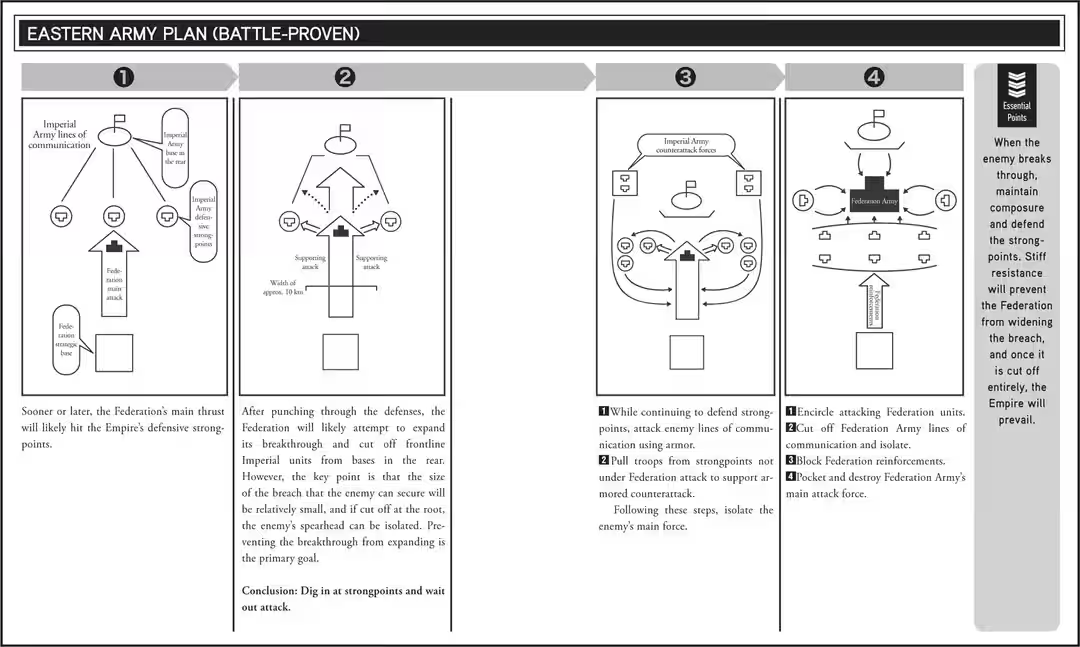
[chapter] V Dawn
JANUARY 9, UNIFIED YEAR 1928, EASTER COMMAND RECEPTION
Dumbstruck.
Tanya stares at Colonel Lergen, the word written all over her face.
We are in the reception lounge at Eastern Command. The master of this room, General Laudon, is so busy with on-site inspections that he has yet to barely set foot in it…or so said Colonel Lergen. Things are apparently tough throughout the Empire.
The room itself, however, is thoroughly clean. It has also been completely insulated. On top of that, I’ve been served steaming hot tea and even a scone to go with it.
One could almost forget they’re in a war zone. However, there are places located much farther away from the battlefield. “And what are the people in those lofty perches thinking?” I ask, speaking to Colonel Lergen. Colonel Lergen has been sent as a messenger from the capital.
I repeat myself once more.
“I’m sorry, Her Highness the Princess wants to carry out an inspection? And for a whole month, if possible?”
“Correct. And in person. Her Highness Princess Alexandra wishes to grace us with her presence directly.”
“Not a visit with General Laudon? She wishes to be on the front line?”
A high-value political target on the front lines. Even if such a thing were strategically motivated, it would tactically be beyond perilous.
Not to mention. I mentally clutch at my head.
“On the front line now, Colonel Lergen? At a time like this?”
“Correct, Colonel. Rather than trouble the commander on the ground, the court wishes to observe what officers are seeing for themselves on the front line.”
The court! So it wasn’t even General Staff behind this!
“I am sure my devotion to the imperial household is as great as any, but as to whether such a thing is feasible, speaking as someone on the ground, coming from a place of true love for Their Majesties, one cannot help but feel concerns of safety…”
“Speak plainly.”
“It is too dangerous,” I say, encouraged by Colonel Lergen’s frank nod. “If Her Highness must come, it would be far better even for General Laudon to spare his valuable time in dealing with her.”
“Is it that bad? I mean, I imagined, but judging by the frown on your face, it is worse than I thought.”
I consider the question, choosing my words exactly so as to be sure there is no room for misunderstanding.
“Even the enemy partisans are fearsome. I only learned this after returning to the east, but our pacification force was half destroyed by a counterattack that included tanks.”
“Oh,” Colonel Lergen says, frowning and nodding. “You mean the mopping-up with a force composed of an infantry battalion and aerial mage company dispatched from division headquarters?”
“Yes,” I say. “And that was just mopping up one base.”
“Security in the rear has improved quite a bit, though, thanks to cooperation from the Council for Self-Government, which General Zettour has poured so much effort into…”
Rather the opposite, I think as I internally disagree with Colonel Lergen’s words.
The idea that the people under the Communist Party’s rule welcome Communism in their hearts and look up to the Communist Party as a trusted parent may just be an illusion, but the people are well aware that the terror of the party is very real indeed.
The dream of separating from the Federation are but conditional dreams, dependent on the commitment of the Imperial Army to protect them from the party becoming fully functional.
The Imperial Army is still holding out. But so long as impending victory is not guaranteed, regardless of whatever dreams of self-determination they might hold, the Council for Self-Government will likely continue to straddle the fence. “In other words,” I say, splashing cold water on Colonel Lergen’s hopes. “The Council for Self-Government and the Federation Army partisans are fighting a phony war. To put it another way, they are essentially at a standstill.”
“Spies, we had imagined. But if our organizations in the back lines are in conversation with the enemy…”
“No, Colonel Lergen,” I say, correcting his misunderstanding.
It is not that we have been betrayed at the organizational level. At the very least, the Council for Self-Government is unlikely as of yet to have reached such a drastic decision. They are as faithful as the situation allows. After all, compared with the Federation, the Empire is the preferable option. However, if the Empire sinks, they do not plan to sink with it. Simply, this difference in position is what has created the current situation.
“It is a love triangle.”
“A…love triangle?”
“The Council for Self-Government is only cheating because it needs to. Their real target is us, but if we leave them, they have no choice but to consider alternatives. It is the unfortunate but compelling reality in which they live. Listen, for the Empire, the peace and safety of communication lines is everything. If attacks from Federation partisans decrease, morale-wise, it would likely be seen as a sign that the situation is improving. The Council for Self-Government is walking a fine line. Are they really moving to subjugate? In the end, the answer to that depends on both ourselves and the Federation.”
Even while the Council for Self-Government has hopes for the Empire, they have to prepare for the worst and reserve the possibility of returning to the Federation. Meaning the current situation has left the Council for Self-Government’s faith in the Empire shaken.
“If the Council for Self-Government dallies with the enemy or, through shady standstills, curtails attacks, that is just a necessary expedient to their continued existence. At the same time, it also improves our own circumstances. However, it gives the Federation partisans, who are likely to be very powerful in the future, time to develop within our sphere of influence.”
“I think I see what you are saying, Colonel… This strange love triangle has developed because the Council for Self-Government is playing nice to both sides. Furthermore,” Colonel Lergen says, sounding fed up, “at some point, this triangle may collapse. And…”
“It will collapse. The Council for Self-Government has no reason to share in our fate.”
Their true nature is an organization opposed to the Federation. But the organization is hardly composed of only people willing to bet everything on that opposition. To that end, to keep them from giving up, the Empire must continue to stand firm and act tough, doing all it can to prolong collapse.
“Colonel Lergen, in our present situation, until things go well, we must act as if they are going well and behave as if what we desire is already here.”
The current state of the Empire is miserable. All we can strive for is to keep operating hand to mouth, pretending not to collapse until collapse actually happens. Which is why it is important not to draw unwelcome attention.
I may laugh at the long-term planning capacities of the Communists, but I’m painfully aware of what sort of opportunists they are. If we let them see blood, they won’t be able to keep themselves from pouncing.
“Putting power aside, the supposed improvements in the rear are nothing but a paper tiger. It’s true that the front is calm, however…”
An inspection of the east by Her Highness the Princess. Just thinking of the toxic effect such a thing could have makes my stomach ache. Colonel Lergen nods.
“Colonel, you need not say more. The higher-ups wished to change Her Highness’s mind as well.
“Unfortunately, however,” Colonel Lergen continues, his face looking pained, “This request came from the court, the first such request made to the military in some time. Systematically, it is extremely difficult to openly oppose such things. We tried to convince them not to, but…” Colonel Lergen shakes his head.
“It was no use.”
“Meaning?”
“It was decided that a visit would be permissible at the present time. Even though we ourselves consider it extremely risky.”
“Perhaps if the army was to make another attempt to advise her?”
“Colonel Alexandra is very diligent…the type to pore over each and every war report. She’s inferred from the documents that it will be safe until spring. As a result, even General Zettour’s exhortations were for naught.”
“Not even General Zettour could persuade her? Unbelievable,” I say, but Colonel Lergen’s response is emphatic.
“Make no mistake,” he says. Looking into the distance, he sighs. “When I heard it from Colonel Uger, I was amazed.”
Apparently, General Zettour visited the palace and met with both the emperor himself and Her Highness the Princess, speaking with unprecedented eloquence.
“This is my own humble speculation, but there seems to be a disturbance in the enemy’s movements. The eastern army believes that the Federation’s counterattack will come in spring at the earliest, but there is reason to doubt this. Speaking plainly in absolute secrecy, the hard truth is that the enemy’s offensive is most likely only a matter of time. Indeed, the reason for sending General Laudon was to prepare for such an immediate risk. The situation at present is extremely dangerous,” he said, all of it nonsense, using his position as a specialist to stress the danger.
But Her Highness the Princess had been reading all the reports and believed she knew best. “I thought the army’s judgment, as a whole, is that the earliest the enemy will come is in spring?” she apparently said.
“Honestly,” Colonel Lergen says, furrowing his brows in consternation.
“A little knowledge is a dangerous thing.” Lergen continues, speaking offhandedly. “I was thinking, however…if, say, a suitable report from the suitable department were to make its way to the capital at the most suitable time—well, I imagine that would be very suitable. All I need is a suitable person to write it from the front lines.”
I think I understand what he’s getting at. My face, however, clouds over. This is all about what suited General Staff. It hardly requires any powers of discretion to know what is expected of her.
“So you would like me to immediately create a false report.”
“A foreboding report that contains true details but causes a convenient misunderstanding would be acceptable as well,” Colonel Lergen says, tapping the desk with his fingertips as he explains what the higher-ups would like. “Specifically, a report that predicts an impending threat from the Federation Army should be ideal.”
I sigh for the umpteenth time.
“I’m sorry, but as we are assigned directly to the General Staff, our reports tend to be fairly literal.”
If we write something careless, some very serious-minded military men might take some careless ideas seriously and wind up causing unimaginable chaos.
“That could potentially lead to a report that causes mistaken military assessments. I could write a report accurately detailing the results of extended long-range strategic reconnaissance, perhaps, but I cannot promise more than that.”
I expect to be met with scorn. As a company man, I feel half resigned as I give my answer. Instead, however, I’m greeted with an unexpectedly positive reaction.
“Huh?”
“Think of it this way… If your recon turns up nothing, it will give us some cause to relax.”
“What…?”
Colonel Lergen claps his hands together, absolutely delighted and completely ignoring Tanya, whose eyes have gone wide at this unexpected reaction.
“I will rush back to General Zettour and Colonel Lergen and inform them that reconnaissance is necessary. My love for the imperial household is just as great as your own, Colonel. And if safety can be ensured, then there is certainly nothing wrong with Her Highness learning more about the situation on the ground.”
As Colonel Lergen stares at her with unconcealed anticipation, there is only one answer that Tanya can return.
“I shall do everything in my power.”
Now that we have something to do, there is nothing to do but for us to do it.
Although a simple matter, Tanya sits on a wooden seat, likely used for farming purposes, in the barn they have dubbed with the grand name of Kampfgruppe Command Center and informs the other officers of Colonel Lergen’s orders as they all stare at a map spread out on a folding field table.
“Everyone, we have special orders from the General Staff. Eastern Command’s General Laudon has given approval once again as well. In other words, the important people are all on the same page. We’ve been ordered to carry out strategic reconnaissance.”
I don’t expect much consideration from the warmongers. In fact, she knows they are incapable of it. Thus, in this matter, they have no choice but to commit and take this reconnaissance absolutely serious.
“According to Colonel Lergen, we are to approach reconnaissance with a fresh perspective, unhampered by previous assumptions.”
The gathered officers nod as one. They are Salamander Kampfgruppe, after all. If General Staff wishes to investigate the eastern army’s assumptions, then as the on-site Kampfgruppe under direct General Staff command, Salamander are naturally the ones to do it.
The problem, however…
One of the officers raises a hand.
“Yes, Lieutenant Wüstemann?”
“Excuse me, Colonel, but when you say ‘perspective,’ does that include analysis? Or will we simply be eyes on this?”
“Good question,” I say with a laugh.
A recon squad’s job is to report on what it sees. In that sense, they are eyes. But whether to put analysis on top of that is a separate issue.
Generally, people have a tendency to add their own opinions to what they see. First Lieutenant Wüstemann’s diligence in checking to see if they have permission to do this leaves a favorable impression.
“Both. We are eyes, and we are ears, hounds tasked with reporting on something the higher-ups have caught whiff of. This is why we are under the General Staff’s direct command.”
I admonish myself internally. Veteran officers are so used to what they do that permission tends to become a grey area, but it is important to properly value the opinions of young, new recruits.
“First, let’s check our own side. We’ll start by patrolling with each company. A patrol flight to grasp the situation near the front. I want you to confirm friendly defenses.”
“I’m sorry, but didn’t you just say it was strategic recon? Aren’t we going to scout the Federation Army?”
“Come on,” First Lieutenant Grantz says, elbowing First Lieutenant Wüstemann in the side in response to this artless question.
“It’s fine, First Lieutenant Grantz. He needs to learn as well.”
“I’m sorry, Colonel, it’s just… That seems a little dense, doesn’t it?”
“What are you two talking about…?” First Lieutenant Wüstemann says, evidently confused. Major Weiss grimaces and lays a heavy hand on his shoulder.
“If you were in charge of defense, don’t you think it would put you on alert somewhat if you saw a sudden increase in enemy squads scouting your side?”
There are many benefits to reconnaissance, but if carried out in too straightforward of a manner, you can reveal what you are up to. As an extreme example, imagine what would have happened if, as part of preparations for the Normandy landings, the Allied forces had closely and repeatedly scoured only the area around Normandy? It would have likely put the Germans on alert, causing them to notice an unusual increase in enemy reconnaissance around Normandy and wonder why, leading to a pointless increase in casualties.
“At present, this reconnaissance mission is not a false flag meant to lure the enemy into mistakenly believing an attack is coming. We are here to scope out the situation, plain and simple.”
“Meaning we mustn’t allow the enemy to notice what we are doing.”
“Exactly, Visha. We must conceal our intentions and uncover theirs. The best recon is carried out without the enemy noticing it.”
Hence why satellites are best, I think privately, though I know such thoughts are pointless. Technological limitations are insurmountable, and it is important to always keep operational limitations in mind. If we had satellites, though, we could scout enemy intentions without even sending spy planes.
Of course, even with spy satellites, recon is still required. I understand that a long-range recon squad’s fate is to be forever worked to the bone. In the end, no matter what else happens, regardless of the age, armies are always eager to conceal their own intentions while uncovering the intentions of everyone else.
I put the brakes on this current tangent and get right to the point.
“Regardless of how Eastern Command has judged the situation, in regard to friendly forces or the enemy situation, I do not want us to reveal our own situation—that we are scouting the enemy—to the Federation. To put it another way,” I continue, “what is the state of the enemy’s recon activities? This can be detected to a degree even flying over our own lines. If enemy recon of our bases has increased, this could be very significant in and of itself. And if recon has fallen off, the reason for that will also need to be explored. Understood?”
In response, First Lieutenant Wüstemann nods his head rapidly. What more could be asked for?
JANUARY 11, UNIFIED YEAR 1928, SKY ABOVE EASTERN CAMP
Mage company inspection and recon operations involve long-range flight. The 203rd Aerial Mage Battalion, however, is an outstanding outfit that has paid considerable attention to its deep deployment capabilities. They aren’t given such impossible tasks by General Staff for nothing.
At minimum, battalion members are expected to be able to fly, scout, occasionally engage in combat, and engage in pursuit missions if necessary, all while keeping a cheery tune on their lips.
For a mission like this, where recon must be carried out in secret, two or three days of long-range scouting flight isn’t likely to take much more of a toll beyond a few tired grumbles. The mages quietly form ranks in the sky and begin cruising the eastern skies in high spirits, the flower on the Empire’s instrument of violence.
But no matter how much the spear tip glitters, the shaft itself may still remain dull.
For instance, take their sleeping arrangements. Those buildings are far too simple and shabby for a base, where the essence of that glittering instrument of violence, the mages, now sleep.
Although, thanks to the efforts of First Lieutenant Tospan, this village that is our camp has been transformed into the finest of Potemkin villages.
This is because First Lieutenant Tospan’s field construction has focused solely on camouflage and comfort.
Still, one must credit his creativity and ingenuity. The passion that First Lieutenant Tospan poured into improving our living conditions and disguising our base while we were away is tremendous, allowing us to just barely arrange for everyone to be able to gather indoors for sleep and recuperation without needing to worry about drafts.
Although, in exchange, when it comes to defenses, there are barely even foxholes present. The defensive capabilities differ very little from an ordinary village. Plus, the promised concrete has not arrived. All the better for camouflage, though. No matter how many times she views it from above, even to my deeply suspicious eyes, the camp does not appear to be anything more than a deserted village that is partway through reconstruction.
As a temporary residence, this is probably much safer than building a perimeter of half-assed defensive positions. The one problem, however, thinks I think with a grimace, is that the camouflage is so good that it is difficult to distinguish this place from other villages.
“Well, well. We’re just lucky that the village is next to Eastern Command. Otherwise, we might fly right past it without even noticing.”
Leading the company at its head, I begin descending. As I near the ground, I spot First Lieutenant Tospan.
“What is it, Lieutenant?”
Why is the officer coming out to greet them? Has something happened? It seems odd.
“You’re the last, Colonel, so I just thought I’d meet you partway.”
“Thank you, Lieutenant! You didn’t need to go to such trouble.”
The implied meaning is that everyone is waiting for them. With a return salute, Tanya heads toward the barn, which has been made into a command center, to show her face.
Captain Meybert, Major Weiss, First Lieutenant Grantz, and First Lieutenant Wüstemann. Add First Lieutenant Tospan, who was keeping guard outside; and Captain Ahrens, who is elsewhere at the moment due to vehicle repairs; and together with Tanya and Visha, you would have the Kampfgruppe’s entire command element.
This is the Kampfgruppe’s leadership. We are fairly small in number, but on the plus side, this allows for close coordination. Honestly, though, we are actually just short on people. As a Kampfgruppe without exclusive command personnel, command is a heavy burden to manage.
I shake my head and begin speaking.
“We’re back. It seems I’m the last,” I say, turning to the commander who was left behind and getting right down to it. “Captain Meybert, anything to report in our absence?”
“We’ve been receiving regular reports from Eastern Command. As air supremacy throughout the east is in dispute, deep reconnaissance is unavoidably imperfect, but results have been gathered to a certain degree.”
Oh? My face breaks into a smile at word of the decisive efforts of our friendly forces.
“As far as aerial recon can tell, the enemy seems to be hibernating.”
I grimace, not sure if those are good results or bad.
I’ve been thinking…if Air Fleet manages to sniff out something even slightly amiss, it would have been an excuse for the whole battalion to carry out reconnaissance in force and overinflate the threat posed by the Federation Army in reports. As great as it is that everything is peaceful and quiet, it does leave us in a jam.
Captain Meybert continues:
“The eastern army’s frontline units sent out repeated recon in force squads as well, but resistance was fairly limited.”
Captain Meybert has even more good news to share.
“As far as Air Fleet could confirm, despite antagonism, air superiority in the Empire’s field of influence has been generally maintained. A smattering of spy planes have entered our territory, but everything generally seems normal.”
“Understood,” I say, before turning my eyes toward the other commanders, who were sent out with their companies into different areas. “Okay, everyone else…what did you find?”
In response, First Lieutenant Grantz slowly stands up and gives his recently compiled report.
“It was just as Captain Meybert reported. Other than repelling a few small-scale enemy units, my unit did not encounter any fighting.”
“Small-scale recon units?”
“The largest was an approaching enemy mage company.”
“Reconnaissance in force?”
“As recon in force goes, they were fairly passive. Their skill level was passable enough, but they seemed to turn tail pretty much as soon as we entered their detection zone. The enemy is apparently quite skittish. We gave the run around a few times…even tried crossing into their area of influence slightly thinking we could pursue. But interception was positively anemic. The only thing I will say is their antiair fire was above standard. I think they may have bulked up slightly.”
“They’ve built up their air defense grid?” I ask reflexively, inviting a serious response from Major Weiss.
“Hmm. Maybe they’re settling in.”
“How about you, Major Weiss?”
“It was pretty much the same as First Lieutenant Grantz. We didn’t carry out any strikes into enemy territory, but the enemies we encountered were similarly quick to run. What about you, Colonel?”
“We experienced the same. Unless First Lieutenant Serebryakov has anything to add, it seems the sky is the same all across the front.”
“I see,” Major Weiss says, stepping back and turning his eye toward First Lieutenant Wüstemann as if to ask, Anything else? A slightly nervous expression appears on the first lieutenant’s face.
“Major Weiss, I have something to report. On what I saw in the rear…in the autonomous area I was assigned. The effect of increased security is showing. General Laudon carrying out his own inspections seems to have had quite an effect. In any case, partisan activity has calmed down.”
I can’t help but arch my eyebrows in response to this report from the new replacement officer tasked with surveilling the back lines. The fact that things are growing calmer is generally good news. However…
“…A lack of attacks and our army succeeding in suppressing the area are not the same thing,” I respond harshly.
“They have been successfully mopping up.”
“First Lieutenant Wüstemann, are you claiming that a lack of enemy attacks means that the enemy has been successfully neutralized…?”
“Yes—I mean no. Colonel, reports were that several areas have been successfully cleared out, and multiple partisan bases have been suppressed.”
The enemy partisan groups that chip away at our lines of communications, creating damage that accumulates. Their subjugation is a major issue for the Imperial Army in the east, which would make this a remarkable achievement that should be celebrated by all rights.
Hence why Tanya is unable to instantly believe what he says.
“Wait, are you serious?”
“Autonomous security forces and imperial Feldgendarmerie carried out a successful joint pacification operation.”
“The Council for Self-Government actually did something?”
“Yes,” First Lieutenant Wüstemann says, holding out the report. Glancing over it, I’m taken aback.
Security operations are generally dirty work. Being on the front lines of such operations is tough, and most would rather shirk such activity. Moreover, the Council for Self-Government ought to have been still playing with two strings to its bow. How could this be? The Council, with their knowledge of the locale, leading the way!
With appropriate guidance and support, the heavily equipped Imperial Army forces managed to mop up the enemy in a targeted operation with minimal collateral damage! And the resulting pacification allows the Council for Self-Government forces to now maintain a degree of security in occupied territories!
Just the other day, she was speaking with Colonel Lergen of the Council for Self-Government’s “dalliances,” and now here they were, acting like proud partners to the Empire.
“This is too good to be true… Regardless of General Laudon’s efforts, could we really expect to see results this quickly? I’m sorry, but this seems suspicious.”
“But,” First Lieutenant Wüstemann argues, “multiple partisan groups have fallen. My company even assisted in mopping up some enemies at the end…though only the one time.”
Hmph. I nod and urge him to continue.
“Has this put us completely back on track with previous transportation lane initiatives?”
“Led by field engineers to recruit locals in exchange for wages and food. In short, roadbuilding and maintenance as a part of incentive-based pacification ops. Is it being carried out, and can we expect results?”
Crushing the enemy partisans and ensuring the safety of transportation lanes. What could be considered an extremely important victory if we expect to build up forces and oppose the counterattack that is likely to come in spring or thereafter.
A more-than-perfect result.
First Lieutenant Wüstemann, the one who brought this report, is not the type of officer to go back on his word or to pad his reports. For better or worse, he is a serious officer by nature and, while still inexperienced, is hardly stupid. He has the intelligence to distinguish between what he has seen and his own opinions.
And yet something still bothers Tanya.
Is it just hard to believe that an organization with loyalties to both sides would suddenly roll over and become so faithful and affectionate?
I give it some thought.
Maybe this is just an example of General Laudon living up to General Zettour’s faith in him? No, there is nothing wrong with the idea of a diligent superior officer producing respectable results, but… Lost in thought, I cross my arms and sink into silence.
“Colonel…?”
Looking up in response to her adjutant’s worried voice, I shake my head.
“I know. Can I have the communication logs? I want to see how much communication has been intercepted. Between partisan forces and Federation officials.”
“But it’s encrypted.”
“Yes, I know. Honestly, it doesn’t need to be deciphered. I just want to know how much communication has been passing between the two.”
“In that case,” First Lieutenant Serebryakov says, handing over a report submitted by comms personnel. I quickly glance over it. According to the report, which is mostly just simple notes, despite a slight increase while they were carrying out mopping-up operations, there has been no major change in the total volume of communications.
Essentially, there is nothing particularly suspicious here.
“And the enemy doesn’t seem to be in a position to take proactive action…?”
“The Federation is still rebuilding,” I say. “And the enemy partisans are also hunkering down for the winter. So we were able to mop them up with relatively little trouble?”
It sounds like wonderful news. Even Tanya, there on the ground, can find no clear grounds to refute this explanation.
But. But. But.
“Something doesn’t sit right…,” I say, muttering my true feelings. “Backline territories pacified, our defensive line coming together, and the enemy still regrouping. General Laudon has arrived on scene to rearrange eastern battle arrays, which General Zettour had been so worried about. If all this is true, everything is going swimmingly…”
Everything’s coming up Empire. If all these developments can be accepted at face value, the situation is improving. The homeland. Eastern Command. The rear. All in excellent shape.
In other words, the outlook is bright. The dark winter is nearly over, and spring is just around the corner. The Empire is awash in good news.
Hope is a wonderful thing. But even the most delicious of dishes can leave you feeling sick. That’s why I continue to be hounded by vague suspicion.
Have we…fallen for something awful? Fallen for a scam?
The duties of the Commonwealth Intelligence Agency were extremely wide-reaching, with a variety of work taking place within the agency, including anti-Empire espionage, domestic counterintelligence, duties related to the colonies, schemes to build support in former colonies, and efforts to appear as a good counselor to allied nations.
Naturally, much of this work was classified. An extremely busy, high-level agent could find themselves handling several projects that were not to be revealed by any means.
It took a thief to… Well, the rest should be obvious. Thus, in his mind, the man known as Mr. John could hardly fault other nations for their brazenness.
This time, however, Mr. John was forced to humbly doff his cap.
“Very brazen of the Communists… Very brazen indeed.”
The Intelligence Agency office was currently housing the happy pair of Habergram and John. These two, who each had strong opinions about the qualities of desks, were currently face-to-face in a highly controlled corner of office headquarters, gritting their teeth in surprise and displeasure at that latest information that their liaison officer in the east had acquired.
“Sir, could this be a mistake?”
“Unlikely.”
“I see,” Mr. John said, nodding slightly in response to his superior’s words.
An urgent report had come from the officer they had dispatched. According to the report, there were signs of an impending large-scale strategic offensive by the Federation Army. If true, the implications were massive.
Launching an attack at such a time!
Despite being part of allied war efforts, the Commonwealth Intelligence Agency was taken completely by surprise when they learned of these attack plans, which were code-named Rising Dawn.
Agents assigned to the Federation were left speechless, and there were even rumors that the section chief, who had been left with considerable egg on his face, had chosen to drown his mortification in heavy drink—a behavior that was highly out of character for him.
This showed just how little Commonwealth officials had managed to successfully anticipate Rising Dawn.
And inversely, how diligent Federation officials had been in not allowing even the Commonwealth Intelligence Agency to catch wind of what they had in the works.
A thorough deception. What amounted, in the end, to intentional fraud.
And if one was to reassess the various bits of intelligence, under the assumption that what they had seen was what the Federation wished to show, Mr. John thought, asking and answering his own question.
“Yes, now I see it. Efforts to dangle the Empire’s own dream in front of its face.”
The aim of Rising Dawn was a strategic surprise attack. Any attack that caught the enemy with their pants down was always powerful. The Federation must have gone to great lengths not to reveal to the Empire any signs pointing to the timing for their attack.
Knowing of the attack, however, went far in explaining recent movements of the Federation in hindsight. Mr. John flashed a grimace of understanding at the director.
“I thought that it was strange that the Communists hadn’t been undermining the Council for Self-Government lately…”
“It is the opposite. They have finished undermining and have moved on to dividing.”
The Council for Self-Government forces were being extremely cooperative with the Imperial Army. Usually, the council had to skirt around both forces, the Federation and the Empire. At a glance…taking such clear sides would seem to indicated the Empire had come out on top.
But if it was, in fact, a sham orchestrated by Federation officials?
In other words, if they had intentionally incited those taking the Imperial line into a mopping-up operation? Luring them into fighting with the partisans would help to blunt the tip of anti-Federation forces while also damaging public perception… Plus, it would give the Imperial Army the false impression that the back lines were safe.
On the other hand, the latent New Federalists in the Council for Self-Government had considerably expanded their power as a result.
“A perfect example of infiltration.”
“Yes, not even our own office can ignore such a thing.”
“Dividing enemy from friend. Dividing and then telling them to govern. I doubt even we are capable of such malicious intent.”
Hmph. These two men of the intelligence world tittered disapprovingly, snorting—from their gentlemanly surroundings—at such ungentlemanly behavior.
The Federation Army had remained circumspect. Hence why even their allies in the Commonwealth had remained in the dark up until the last moment. To put it another way, it showed just how greedy the Federation was for victory.
“The Empire doesn’t seem to have noticed. It appears the Imperial Army in the east is snuggled up perfectly in their beds, dreaming only of the spring. At this rate…”
“Yes,” Habergram said, agreeing with his underling. “They were supposedly so desperate for mages and yet were sending the multinational volunteer unit on expeditions far and wide.”
“It makes sense now,” Mr. John said, understanding the director’s words. “They must really want to take victory on their own.”
“Understandable. It is a chance for the Federation to snatch a massive gold star for themselves while the Alliance flounders in Ildoa.”
“It’s galling,” he spat.
The two puffed away at their military tobacco, but even after tossing the butts into the growing pile in the ashtray, the bitter taste remained in their mouths.
The Federation and the Commonwealth were on the same side. Together with the Unified States, they formed a Grand Alliance. It was a term that sounded very nice, but regardless of the propaganda or what the world might think about them, in the end, they were just enemies who happened to find themselves in the same boat.
And besides, Mr. John was painfully aware. The Commonwealth, the Unified States, Ildoa, even François and the remnants of the Entente Alliance. They just kept losing against the Empire.
“It sounds better to say we keep hanging on, but…”
“I understand, public opinion would not be favorable.”
Mr. John needed no explanation.
The war was dragging on for too long, and people were growing tired. The public was desperate for someone to do something. What would happen if the Federation was to snatch victory on its own at a time such as this?
Politically, it would be a massive win. A gold mine. The Federation’s prestige would skyrocket, and their external influence would become immeasurable.
In this war against the Empire, they all wanted victory. But the state was a greedy thing. When victory was in sight and one had the luxury to choose the manner in which they won, of course, they’d choose the method that would benefit themselves the most.
For his own part, after all, Mr. John was hardly thrilled at the prospect of their unpleasant neighbors—whom they were already only interacting with reluctantly—soon being able to swing their weight around even more unpleasantly than before.
“It’s honestly confounding. Better if the Empire and the Federation were to both go down together.”
“I couldn’t agree more.”
“In that case,” Mr. John said, suggesting a curveball, “what if we were to find it in our hearts to issue the Empire a warning?”
“That an attack is already on the horizon?”
“Yes,” John said in confirmation.
If they sent the Empire a warning now, situation withstanding, the Empire still had General Zettour in their stable. If they let this information leak through appropriate channels, that warhound was sure to show his worth.
“It would depend on the channels. But if done right, it could ensure us VIP seats to a very excellent future indeed.”
In response to the suggestion, Habergram crossed his arms for a moment before groaning as if in internal conflict.
“It is a very attractive proposal…”
“Thank you very much.” The two quickly put their jokes aside. “It is not really feasible, though, is it?”
“I suppose not. There would be too many issues. We are in an alliance, after all. If the leak were to come to light, it could lead to a chain of problems for us.”
“Besides,” the Intelligence Agency head honcho said, sharing the Commonwealth’s true position with the senior agent. “Some degree of success, at the moment, is not completely unacceptable.”
“But too much is?”
“Well, yes, I suppose that is where the problem lies. But just how effective do you think this offensive of theirs will be, this Rising Dawn? Just from your own personal estimate.”
“The Federation Army has been very careful to keep the operation a secret. At the moment, there’s no way to even be sure how reliable the information acquired by our agent in the field is. In which case…”
…it is impossible to tell. The director folded his arms and shook his head. Mr. John’s answer was absolutely correct.
“It concerns me that the Empire has suddenly appointed General Laudon to Eastern Command. Why shore up command personnel at a time like this? I shrink at assuming that bilk, Zettour, will have nothing up his sleeve.”
“True,” John agreed. “General Laudon may be advanced in age and may have been sent off to fill the reserves, but they pulled him back in once the war began. Since he had been on sinecure for a while at first, we thought he was just another layman brought in to fill up officer numbers…but he had formerly been General Zettour’s superior. It may not be wise to underestimate such a man.”
“Not according to the information they had gathered on him,” the two muttered to themselves.
After essentially being pulled out of retirement, this General Laudon was immediately sent to the east as Regimental Commander Laudon, taking actual command of what was supposedly an honorary post. Then in the recent Ildoan war, despite being a high counselor, he had ridden in a twin-engine light bomber under the guise of studying Air Fleet conditions. Honorary regimental command was a sinecure post, while high counselor was a temporary holdover position, but looking at what the man had actually done, he seemed more akin to General Zettour.
“Most importantly, he was likely entrusted with the east on request of that bastard Zettour, no?”
“So it seems. Anyway, whether he’s of the same level as Zettour, he certainly looks to be of the same type.”
Hmph. The head honcho and the agents crossed their arms. The issue was simple. Had the Empire, and Zettour, grasped the situation with Rising Dawn? Or had they not? Before they could consider this further, however, the director spoke.
“Even if they do suspect an attack, they are clearly not certain. Rising Dawn may, in fact, be successful. Based on information from Ultra, they are currently fortifying defenses in preparation for an inspection by the Imperial family…”
“Wait. I’m sorry, did you just say an inspection by the Imperial family?”
“Yes, why?” the director asked, mashing his cigarette into the ashtray. “I see,” John said, sighing as if annoyed. “Perhaps those fools in the Empire don’t suspect anything after all.”
Mr. John had his doubts about the Empire’s competency when it came to matters outside war. But even the worst organizations, he believed, had at least one area in which they excelled. Yes, sure, they seemed to be shoring up command, and they had General Zettour, with his preternatural nose for such things. However…
“I thought the Empire at least knew what they were doing when it came to war.”
“Yes, it’s possible they have failed to pick up on this. I can’t disagree. Even if they did, though, if they have sniffed out an attack, they seem to have done so imperfectly. In which case, Rising Dawn is likely to succeed,” Habergram muttered, not trying to disguise the displeasure in his voice.
“If the dawn of socialism is coming, it is not going to be very pleasant for two old boys like you and me.”
“Now, now, we are allies, after all. Let’s just pray that it is an underwhelming victory.”
It would have been too much to say they hoped the Federation would lose. They were gentlemen, after all. At the same time, they couldn’t stop themselves from frowning. A great victory for the Federation on the eastern front seemed to be written on the wall.
But before long, they would see:
Zettour’s miracle.
JANUARY 13, UNIFIED YEAR 1928, SALAMANDER KAMPFGRUPPE CAMP
Operation Sham Reporting was begun at Colonel Lergen’s request.
No, the word sham is misleading. If there is no threat, that is what will be reported. It is more like Operation Overspeculation.
The most important thing is to ensure our troublesome guest does not cause any problems with her visit. Either way, we need to gather fodder for this report.
And so, the reconnaissance operation has begun. The results, however, are becoming seriously distressing, even for Tanya. Taken together with the scouting reports from the eastern army, which General Laudon provided, Tanya’s bad feeling has steadily spiraled out of control.
Of course, there is nothing wrong. Absolutely nothing. Everything is going just as perfectly as can be wished for.
It’s unnerving. Uneasiness like this, so difficult to put into words, generally turns out to be unfounded. But this feeling is far too uncanny to laugh off so easily.
When the decision is clear, determination easily follows.
“We need to go deep behind enemy lines on voluntary recon. I’ll do it myself.”
Standing up, I turn toward my second-in-command.
“Major Weiss, I leave the unit temporarily in your hands. You are in charge of Kampfgruppe command as well. But when leading the mage battalion, have Captain Meybert take care of things in your absence, like always.”
“Colonel?” Major Weiss asks dubiously. I frown and make myself clear.
“I want to peek inside the belly of the bear. We can’t be sure of what’s in there until we split it open.”
“But…we’ve checked several times, and everything we’ve found has backed up the information we already have. The Federation Army is quiet. Honestly, this seems pointless and dangerous.”
I’m grateful for Weiss’s concern, but I reiterate what I’m thinking.
“The situation is serious. Beloved members of the Imperial family will be coming to the front for inspections. Nothing unfortunate can be allowed to happen to Her Highness Princess Alexandra. This is just to make doubly sure that the possibility of any such misfortune has been eliminated.”
“Yes, but…in that case, why don’t I go?”
Major Weiss’s readiness to volunteer to take her place is heartening. I’m touched. Maybe I’ll take him up on that offer when something more dangerous comes along.
Seeing, however, is believing. And sometimes, you just need to do that seeing for yourself.
“Thank you for volunteering. However, I will go. For my wingman… First Lieutenant, will you accompany me?”
“Y-you don’t want me to go?!” Visha shouts, apparently in shock.
I turn toward her in response. Visha is not the only one who looks amazed.
“You’re going to fly recon with Grantz? That’s pretty unusual. Would you mind if I ask why, Colonel?” Major Weiss says, his face even more confused than before.
Hmph. I cross my arms. Apparently, her explanation was insufficient.
“I’ve been flying with Lieutenant Serebryakov for a very long time. For better or for worse, we are very in sync. Lieutenant Grantz was selected by General Zettour. If we’re going to spot something we haven’t been able to see before, then I think Lieutenant Grantz is the man for the job this time.”
“Are you sure it should be you and Lieutenant Grantz, though, Colonel?”
“If you put it that way, Major Weiss, since you volunteered, I could leave it all up to you and Lieutenant Grantz instead…”
“By all means,” Major Weiss answers. Major Weiss is a stalwart veteran. When given appropriate work, he can always be relied on to meet expectations. Under normal circumstances, I would have no problem relegating this task to him.
However, if management isn’t familiar with the ground, everything else is pointless.
“In the end, I feel like I need to check this out for myself.”
“You feel…?”
“Funny, right? I know it isn’t reasonable. But I need to get a feel for the pulse on the ground.”
Reports, which condense main points, are convenient. But when analyzing a situation, in some cases, you still need to see the raw data for yourself.
But only in some cases.
The important people at the top often lack analytic ability. When raw data is sent that far up the chain, it often only results in tragedy. In most cases, such people will draw completely mistaken conclusions from correct information, and if the basis for these conclusions are confidential documents, then their subordinates, who are unable to inspect them, will be unable to refute the boss’s findings. In which case, important decision-making could take place according to mistaken premises.
Hence why it is incorrect to say that everyone should see raw data. However, it is absolutely just as harmful for personnel in charge of interpreting information to lose their grip on the ground pulse. Without correct information and the correct framework through which to interpret it, even those with minute analytic powers will be unable to reach a correct conclusion.
Being unfamiliar with the situation on the ground is the same as being unable to make decisions based on actual conditions.
“So you see, I’ll leave things here to you. We’ll be two to three days at most. If we’re not back within a week, then you can assume we’re MIA1 … I’m counting on you while I’m gone,” I say, before leaving the barn.
Despite the sudden development, First Lieutenant Grantz is quickly on board, following after her, stoic and capable. The mission is sudden, but the first lieutenant is well used to that by now.
It isn’t their usual pairing, and the flight is unplanned, but First Lieutenant Grantz wastes no time, as is expected of a magic officer.
Tanya and Grantz lift off into the sky in perfect deuce formation. The only thing that doesn’t go completely smoothly is dealing with the controller at Eastern Command. After that, they rise up to an altitude of eight thousand and begin flying toward the front at nearly combat speed, a pace that feels invigorating for cruising.
However, the sun is already setting. The sun is quick to set over the gloomy winter Federation sky.
Before long, the already-meager sunlight sinks completely, leaving them flying solely by night. Usually, this would be the time to suspend a flight. But as veterans, the two have ample experience navigating during this time of day and are not bothered. Grateful instead for the curtain of darkness, they soon leave the front far behind and advance into the enemy’s sphere of influence.
Naturally, detection equipment does not sleep, not even at night. As a result, they squeeze their mana signatures down as far as they can and fly as low as possible, dragging the ground to limit their detectable area.
An altitude that normal spy planes would not even be able to fly at.
Perhaps that’s exactly why, despite it being nighttime, Tanya and First Lieutenant Grantz are able to pick up something that looks slightly out place. The surface of the ground beneath them seems almost too orderly.
“It’s all just one blanket of silver… But am I imagining things? Isn’t that a road?”
As they land on the surface, suspicion turns to certainty.
The road, which should be buried underneath snow, is right beneath their feet. And although white, when we crouch down and touch it with our fingers, it becomes immediately evident that the road has been painted.
“They must have gone through a lot of trouble just to dye it white.”
It is clearly intentional camouflage. One that would likely be impossible to spot with a sweep of a spy plane from the air. Unless they’re used to reading the terrain, even mages would be unlikely to notice this.
The presence of a military road like this behind lines cannot point to anything good.
“This road looks functional.”
“Yes,” I say, nodding toward First Lieutenant Grantz and already preparing myself for the worst. A road of this scale? I can only stare in shock.
It has to be for a large-scale convoy or for more regular back-and-forth transport. Or possibly, could it be a sign that the enemy is assembling a large-scale force? Now that we have been lucky enough to find this massive artery, however, there is only one thing to do, and that is to explore it more fully.
“We’ll set up a bivouac. An outlook. First, we need to surveil the road overnight.”
“We don’t have much food, though…”
“What? You’ve got at least two meals worth of high-calorie mage rations, don’t you?”
Flinching slightly, First Lieutenant Grantz pats his chest pocket and grimaces.
“I’ve got two days’ worth on me. Three if you include extra rations. How about you, Colonel?”
“The same. Let’s pray we spot the enemy quickly.”
“Honestly? From here?”
“Yes,” I say, confirming. “Worst-case scenario, we could be stuck here tomorrow, too, so best to settle in.”
Although difficult in the snow, we create an outlook that should be hard to notice. Working surreptitiously in the darkness of night is tough, but it has to be done.
Surveillance is a matter of patience.
Hunkering down together like this would have been easier with First Lieutenant Serebryakov, seeing as we know each other so well… Just then, First Lieutenant Grantz shifts his hand slightly, as if noticing something. As visibility is poor, I inch closer, realizing that First Lieutenant Grantz is pointing to something with his finger.
Light. Faint, but definitely moving. A vehicle.
Which must mean a convoy. And quite large in scale, taking the distance into account.
“Trucks, with their lights shielded? They certainly got here quick.”
They say that good things happen when you least expect them, but this is one stroke of luck after another. We’ve barely been scouting long when we discovered the road, and now this. It’s nice when things come easy.
Tanya smiles slightly, but then she immediately pulls a frown. The convoy that has suddenly appeared before her eyes is difficult to describe as anything other than large-scale. Even in this limited nighttime visibility, what we can make out is considerable. Tanya gulps as she stares through her binoculars at the unsettling sight.
The fact that the vehicles are loaded with cargo is fine. They are trucks, after all. That makes sense. But the tires seem to be in good shape, from what little we can see of them. That is bad news. Astonishing would be an understatement.
Good tires? On a transport truck? Transport trucks usually see a lot of use.
Maybe the truck is just well maintained. Or they’ve been careful with it. Maybe they had spares. Maybe all three?
The fact that the truck is in good repair, and is loaded with cargo, is obvious at a glance. What with the existence of this road, which appears to be a supply route, Federation preparations seem to be much further along than we imagined.
“They’re skilled, too,” I mutter. “This is risky. It’s not like they’ve got flood lights out here.”
With their lights shielded, visibility is dim, and the road surface isn’t great to begin with. Moving a convoy in organized fashion like this, under these conditions, isn’t just tricky; it’s outright dangerous.
“They seem pretty well regulated, however.”
“True,” I say, mentally jotting down First Lieutenant Grantz’s words. “For the Federation, this is a fairly well-oiled operation they’ve got going…”
Hmm? I notice shadows moving across the snow.
“A hunting team? Insane. Are those…war dogs?”
We spot what appears to be a lookout infantry team. Grantz and I have been lying low in the snow from the outset, but still, if we weren’t careful, we could have been captured. The presence of enemy hounds is particularly dangerous when hiding. If chased, unless one happens to be an aerial mage, escape could prove problematic.
“There’s no way they would have picked this up with aerial recon.”
“No. They were carrying out night recon flights, but something like this?”
“Exactly,” I say, nodding painfully at First Lieutenant Grantz’s words. Spy planes can only see so much at night. And if the enemy is on the lookout for scouts, the difficulty of spotting anything would increase dramatically. On the other hand, it would have been extremely difficult for an infantry squad to make it this far into enemy territory. And even if they discover what’s going on, it would have been extremely difficult for the scouts to make it back out again with that information.
“It seems an early spring attack is almost entirely certain… There’s a high chance, maybe, that this will be a major base for the attack.”
Despite being in good health, I can feel a powerful headache coming on. Considering the imperial family’s inspection, this definitely needs to be reported. We’re damn lucky we found this, I think, relieved.
“We really were lucky, though, weren’t we?”
“Hmm? And why is that, Lieutenant Grantz?”
“Because the enemy gathered like this in an area we just happened to be scouting. We’re lucky we noticed, I mean.”
“Yes, it’s good I brought you along. We really were quite… Wait.”
Blessed with luck? I swallow hard. Something is wrong. Something has been off this whole time.
“Colonel, what is it?” First Lieutenant Grantz asks, sounding worried. But that feeling that something is wrong is growing so loud inside Tanya’s head, she can barely hear him.
“Is this just a coincidence…?”
If so, we should celebrate. Hip, hip, hooray! If we simply happened to stumble on what the enemy is up to in this way, that would make me the luckiest person in the world.
But is it really luck?
We advanced into enemy territory in order to get a handle on their situation. It would be a massive stroke of luck to uncover something like this immediately. Would it really be so easy to discover the enemy’s true intentions among this whole vast eastern front?
“Did enemies just happen to be here?”
Or what if it isn’t a coincidence?
“What if…this is only a part?” I mutter, freezing in place.
What if this is no more than a part of the whole, and the enemy is gathering all throughout their back lines? As the thought occurs to me, I move my hand to my mouth, resisting the sudden urge to vomit.
Is it possible? Do we not have until spring?
“I can’t believe it…”
Cannot believe it nor refute it.
“Could it be? Not in spring…?”
“Not in spring? Colonel, what are you talking about?”
Confused, the lieutenant stares at Tanya in worry, but the explanation eludes her.
“Look, Lieutenant. At the enemy shadows,” I hiss in disgust, pointing toward the enemy convoy. “Do you see anything amiss?”
“I’m sorry, ‘amiss’?”
“I’m asking if they look like a normal Federation unit!” I insist, doing an artful job of keeping my voice to a muffled whisper. She peers through her binoculars, focusing on the Federation troops.
Extremely well-equipped infantry. With no magic signature. Very different from the mechanized mage unit they spotted the other day. If this happens to be something special, that would be fine. But what if this is standard?
“We have to go back, Lieutenant…! Immediately, the moment the coast is clear!”
“Huh?”
“We need to carry out long-range reconnaissance with the entire mage battalion. I… I hate to say it, but…”
The situation could be very dire indeed.
Swallowing my words, I rush into slapdash flight with Grantz as soon as the Federation unit passes, moving at maximum combat speed and dragging the ground as tightly as possible.
Their caution is so thorough that they completely elude the friendly command’s air picket, then are mistaken for enemies and nearly fired on as they approach by the infantry on guard under First Lieutenant Tospan’s command.
Despite the mix-up, Tanya heads straight toward the command center barn, as if even the time to scold them is too much to spare. She nearly kicks the door down as she hurries through.
Inside, she sees the exasperated face of Major Weiss, who was reaching for the shovel sitting next to him, ready to attack, having mistaken her for an intruder at first.
“Colonel, what in the hell?!”
“Major Weiss, I’m sorry, cancel all activities, effective immediately. We need to get the entire battalion ready for long-range reconnaissance…”
…right now, I’m about to say, barking orders at my second-in-command, but before I can finish—
“We’ve got an urgent report!” the officer on the comms shouts suddenly.
Both Tanya and Weiss turn to look before they can stop themselves. The communications officer usually doesn’t sound so panicked.
Being glared at in this manner by the number one and number two in command of the Kampfgruppe would usually have caused the officer to freeze in mortification, but today is different. Their face pale, the officer waves their hands as if drowning.
“The Federation Army is on the move!”
“Calm down. What does the report say, exactly? Is it another large-scale mechanized mage unit like before? Or is there a fire somewhere on the front that they need help putting out? This is awful timing…but where is it? Go on, make your report,” Major Weiss says soothingly. But the communications officer ignores him almost completely, their eyes turned desperately toward Tanya instead, their voice choked as they speak.
“They… They’re everywhere.”
“What?”
“The… The Federation Army. In all of Theater A.”
With a heavy sigh, Tanya casts her eyes upward.
Above her is the ceiling of the barn’s decrepit roof. And above that, she knows, is sprawling darkness. The hateful Federation winter sky, practically bursting with the malicious intent of Being X.
“It’s… It’s a full-scale offensive by the Federation Army. The enemy is advancing across all fronts in theater A!”
As the communications officer continues to speak, almost wailing, Tanya mutters a quite complaint.
“General Zettour…this isn’t what we discussed. This isn’t what we discussed at all.”
A large-scale attack. The enemy’s full-scale counterattack. Now, while the Panzer Division is diverted to Ildoa. It is the worst possible timing.
Even as a red light begins to take up residence in my brain, I can’t help but understand what is happening, whether I like it or not. This is clearly a strategic offensive—an exercise of military might for politically motivated goals.
And effectively, surprise overkill.
Right as I’m about to start giving orders, I suddenly feel the urge to throw up.
“Wha…?!”
The urge is sudden and overpowering; it doesn’t make any sense.
“Is this nervous dysfunction…? The effects of the long flight and pushing myself too hard?”
But no, physically, I feel fine.
It can be surprisingly difficult to know what is going on inside your own body, but lately, compared with when I was working for those slave drivers General Romel and General Zettour, the physical impact has been much less pronounced.
Sleep, food. Comparatively, field conditions have been much more in line with regulation.
For some reason, though, my body is shaking now. As if I’m scared, but of what?
It doesn’t matter; the enemy is coming. I need to get myself under control immediately.
“Major Weiss, prepare for immediate response. All members, assume battle positions! Call for Captain Meybert and First Lieutenant Tospan! And sound the alarm!”
Oh. I add one more thing.
“And tell Captain Ahrens in the rear that he is free to act at his own discretion! But authorization only! Safety in the rear is far from certain!”
After barking a flurry of orders, I rush into the room of the shabby house that has been allocated as my sleeping quarters, cradling my head and attempting to get my breathing under control.
A few moments is enough, but I want time to think. I breathe deeply, trying to grasp the situation as much as possible, sending oxygen to my brain until it begins to grow clear.
The attack, like a raging wave. The enemy’s hidden base. Is it possible? Could it be…?
“We were mistaken—mistaken about everything…?”
Even General Zettour completely missed the mark. Zettour assumed that even in the worst-case scenario, the Federation Army would attack in spring at the earliest.
But the current situation means a winter attack is beginning.
The enemy shouldn’t have this much excess power; it betrays all expectations. As current developments show, we miscalculated royally. But what if it’s even worse than it seems?
“They caught us with our pants completely around our ankles…!” I shout involuntarily, briefly summarizing the situation. “How could we be so mistaken?”
Of course, I think. This is the difference gut feeling makes. As an analyst, General Zettour is objective, wise, and to take it a step farther, a realist, which is about as far from an optimist as it is possible to get…but at the end of the day, analysis carried out in the capital is just inference based on reports from the front lines.
But what if there was a mistake on the front lines?
“Information based on mistaken assumptions, I suppose, can only lead to mistaken answers.”
General Zettour drew mistaken conclusions from mistaken data, and due to my trust in General Zettour, I was far too slow to identify why it was that something on the ground felt so wrong.
Deception, camouflage, a dishonest surprise attack. This was all stock-in-trade for the Soviets. I should have known it would be the same for the Federation of this world. I’ve made a terrible mistake.
The Federation is cunning.
Even if General Zettour isn’t present, his attention has been on the eastern army. Carefully controlling what information reaches him was no small task, but as unbelievable as it seems, that’s what they did.
Mistaken information led to mistaken conclusions, and that poison ate away at the Empire’s readiness, thus leading to today’s surprise attack.
“In the end, even General Zettour is only human, it seems…”
If only they could all laugh about it. But laugh all they like, their problems aren’t going to wait. Now we don’t have a moment to spare. With each tick of the clock, the situation grows worse.
Most the Empire’s strategic reserves have been sent to northern Ildoa. Nothing remains of the previous Great Army. Reinforcements can’t be relied upon; there would be few coming, maybe none if they’re unlucky.
The defensive line is unfinished. Is that our only recourse?
A creeping fear, however, begins to build in Tanya’s mind.
The east is vast.
Far too vast.
There would be no multiline positions like those forged during the fearsome fighting on the Rhine front.
A flimsy line, at most, with slightly fortified stronghold positions.
Before scouting Federation movements, we repeatedly flew over our defensive line and checked out our own bases, so I know the state they are in: full of holes and woefully lacking in reserve troops. We are a far cry from creating the kind of elastic defense so bullheadedly crafted on the Rhine front.
On top of that, because we assumed a winter attack would not be coming, we already finished battening down for the winter.
If.
What if?
Attacking simultaneously and in depth, sustained advance, mechanized units, and full encirclement and annihilation.
The combination of these four things, one of the most fearsome models of war… What if that is what the Federation Army is attempting now?
“We have been preparing to defend against the sharp thrust of a rapier. If the enemy has prepared a massive guillotine instead…”
Then the Empire has been spending its time confidently implementing the wrong countermeasure. In other words, we are about to get completely sucker punched from a blind spot in our own assumptions.
Now then, the problem.
What if the situation is disrupted and the footing is made uncertain?
They are bringing out a guillotine. Once our neck is placed inside, there will be no escape. Off with their heads.
“Fuck… Fuck.”
There is only one true counter to Soviet deep battle. And it is something Tanya is already familiar with.
But AirLand Battle2, of course, assumed the US would have air superiority in Europe, which had the edge in technology and aerial force despite inferior infantry numbers.
At the moment, the Empire has neither the air power to crush the enemy’s reserve echelons, nor a mobile striking force of superior MBTs. Even our air control is doubtful in places. We have deteriorated to the point where even our ability to maintain disciplined mage combat is in question.
Most importantly, we have fatally misread the situation. Worst case, we’ll barricade ourselves into our bases and die dreaming of a counterattack to free us from our siege. It is impossible to imagine this can mean anything but the end.
When field armies are on the brink of destruction, do they, too, dream of sweet counterattack?
“Ha-ha… Ha-ha-ha…”
JANUARY 13, UNIFIED YEAR 1928, FEDERATION CAPITAL MOSKVA
Loria had been working hard.
Ever so, ever so hard.
Almost everyone had opposed moving the spring attack up to winter as reckless, but Loria had exerted every last ounce of effort by virtue of national interest.
As it should be.
For the sake of Rising Dawn, he had been working honestly, correctly, and with integrity.
There was no hidden rhetorical meaning. He had poured himself purely, body and soul, into achieving Federation victory.
Of course, Loria was not a military man. The Rising Dawn offensive was being led by General Kutuz. For all practical purposes, Loria had been completely uninvolved in its planning. If one was to insist, they might say he provided intelligence networks or helped to facilitate coordination with the partisans. But that was all.
He may have been cheering the army on, but when it came to overthrowing the Empire, Loria was no more than a self-appointed supporting actor. But of course, the head of the secret police openly acknowledging the military as a lead actor, and not trying to get in their way, was itself a great support beyond anything the Federation Army could have hoped for.
After all, this was the secret police, choosing to both avoid getting in the way and actually support the army from the wings. If Tanya knew just how much support Loria had provided General Kutuz, she would have likely done a spit take.
After all, for those familiar with Federation power structures, this was an anomaly of antithetical proportions.
And thus, he watched and waited, waited and watched, until finally, at last, the long-awaited moment arrived. An applause, and a cheer.
“Rising Dawn! The night is over—the day begins!”
THE SAME DAY, IMPERIAL CAPITAL
The atmosphere in the capital was of lingering holiday…of a new year now beginning.
The time when the biggest schism in enthusiasm could be felt.
This could be felt particularly strongly in the General Staff Office. After all, as the daily work began to grow overwhelming, it was around that time those working in the office found that, at some point, their good holiday spirits had abandoned them.
Among these military men, the duties of the senior adjutant attached to General Zettour, who was popularly known as the Deputy Director of the Service Corps, were of nearly unprecedented scope. It had been some time since it would have been rare to see this colonel-level officer running to and fro with his plate always full.
But there were upsides as well.
For instance, if you were to see even Colonel Uger rush from the communications room and into General Zettour’s office with bad news in his hand—if you were the adjutant, you might simply think, This again?
As if in some kind of nightmare, Colonel Uger attempted to get his face, which was nearly convulsing, under control—praying that what he couldn’t get under control, he could conceal—before rushing into the general’s office, cursing that it was he who had to be the bearer of such bad news.
“General, it’s an emergency!”
“Colonel Uger? What is it?” General Zettour asked, calm and in control.
In response, Colonel Uger thrust out the message, which he had nearly crumpled up in his shaking hand.
“An alert from the eastern army. Here.”
“Thank you.”
As General Zettour took the message, his well-arranged brow arched slightly.
Now then, let’s see.
This was how General Staff officers endeavored to behave back in the good old days. With thank-yous and smiles, a quick turn of the back to conceal their emotions. With an air of reliability.
Even at a time such as this, an officer could still spare a mind to the art of maintaining a modicum of face.
So then…
…why? Good Lord, why?
What was this that Colonel Uger was now witnessing? He failed to pretend not to see.
A crack in the spine. The powerless back of an old man, bent down by the harsh despair of reality, without words, cradling only nightmares.
Later, Uger would understand.
He was seeing an old man nearly crushed by a Rising Dawn. As history’s witness, Uger saw it all.
In that moment, General Zettour was wrestling with demons. His own mistakes. His misreading of the situation.
In that single instant, his wise mind comprehended every last one of his failures.
He had already seen their fall, but he thought that he had postponed it. Had mistakenly believed that they were okay for now. That the Federation hadn’t recovered its forces yet… It was why he had drummed up what pawns he could from the east in order to send them into Ildoa.
They should have had time. Half a year. Four months at the least. There was still time. A little grace before they died. The thread was fine, yes, but it was still a thread that could be crossed. Even a spider’s thread could be clutched.
“How? I don’t understand…”
1 MIA: Missing In Action, i.e. when one goes missing during combat. In general, when one goes missing, they can often be assumed dead. In stories, this often sets the flag for a later return, but in reality, this is rarely the case. Reality is harsh.
2 AirLand Battle: A doctrine cooked up by a portion of the US military back when the Soviet Army was still alive and kicking. While a nonstop charge from the enemy could have proved dangerous, the thinking was that through clever coordination between land and air forces and maneuver tactics, by dividing the enemy while also thoroughly hitting the enemy’s reserve forces, inferior numbers would not matter.
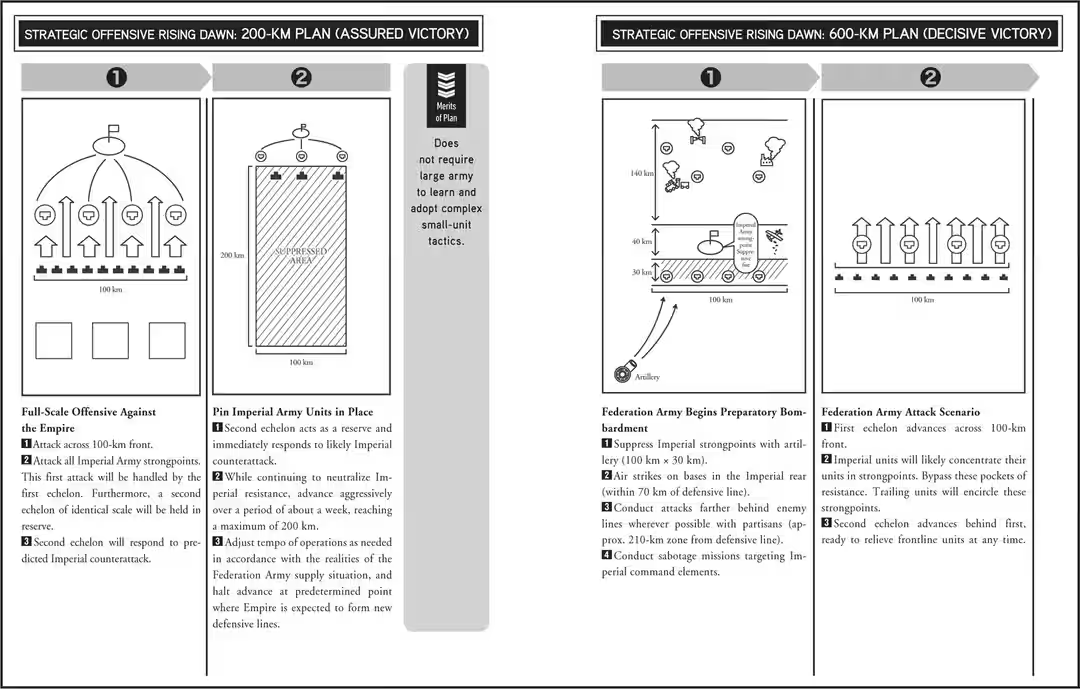
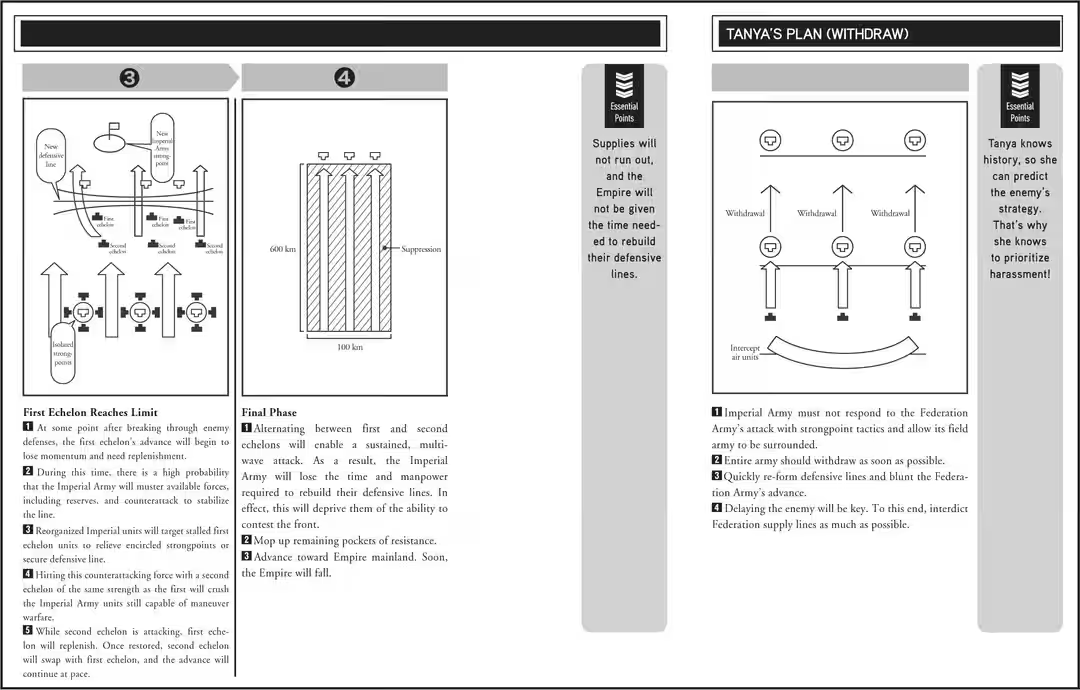
[chapter] VI Mutiny
JANUARY 14, UNIFIED YEAR 1928, THE EAST
The focus of the Federation’s strategic offensive Rising Dawn was to end their association with the Imperial Army once and for all. According to General Kutuz, the lead planner of the attack, “if the Imperials are expecting the usual party, they will instead party alone in their graves. We stand solemnly united.”
In coordinating Rising Dawn, the Federation Army prized themselves on this being an organization-wide effort. The phrase Victory Through Unity—which was very compatible with Communism—was not only ideologically appealing, but it also closely reflected the practical necessity of unity for the Federation Army.
“General Zettour has a habit of meandering deviously, striking from an unexpected angle, or even on occasion, completely upsetting a situation through repeated tactical superiority. In that case, our only option is to overwhelm him with organizational strength that is too great to be overturned.”
In other words, General Kutuz had concluded that if the Imperials were going to play cheap tricks, then the Federation should take the classic approach and simply crush them with a grand military force.
Before laughing and calling such an approach mundane, one should know that the essence lay in its thoroughness. According to General Kutuz, “the Federation chooses where to fight. The Federation chooses how to fight. The Federation chooses when to fight. We, and only we, decide.”
The Federation Army carried everything off remarkably. Resolving to fully seize initiative for themselves on the battlefield and then, after setting the table, faithfully following the party’s wishes in regards to strategic objectives.
And the Communist Party, rightly, had only one order. To end the war in a single strike. Both the Federation and the party were aware of the cost extolled by this too-long war.
Hence why they brought Rising Dawn in hopes of resolution.
As atheists, they did not pray to God. But they were willing to do all that was humanly possible. Careful, repeated preparation was their catechism. One might laugh at a military that resorted to sheer numbers, but those who laughed would soon learn the justification for this instrument of violence.
In reality, God was always on the side with more battalions.
Upon seeing the full picture that was Rising Dawn, specialists uniformly expressed one opinion: It was tremendous. General Kutuz, too, expressed this point eloquently.
“If General Zettour is as intelligent as he is rumored to be,” he muttered, shrugging like any ordinary graybeard and speaking in the level voice of a tired old man, a voice that revealed his simple nature, “then even he should be able to understand what is happening. And the moment he understands, he will only despair.”
They were going to strike head-on with a massive army.
Generally Kutuz, and the others present, understood what that meant. The moment that Moskva Stavka of Supreme High Command gave the order to begin the attack, General Kutuz spoke softly. The large crowd of people around him nodded softly but emphatically.
“In the end, we will prove that the Empire is a problem that can be solved through blood and steel.”
It was a small murmur that reverberated like a roar on the world.
The attack commenced with a battery of heavy artillery, followed by numerous rockets. So it begun: a full-depth preemptive attack against the Empire.
It was artillery that were the gods, artillery that were the true lords and masters. And properly, artillery that would turn the world on its head.
Artillery cleaned up, and infantry trampled through. So long as these basics were established, there was not a defensive line on Earth that could not be broken. This was war’s unsparing lesson. The ways of the lord are simple.
And Operation Rising Dawn was faithful to simplicity. A model elevated to the point of sublimity.
One.
Utilize air superiority to adjust the attack range of infantry, extending the range to include not just the first line of enemy defensive positions but second and third lines of resistance as well, completely bombarding all enemy facilities, installations, and infrastructure in the area with firepower.
Two.
Launch units with greater strength, mobility, and sustainability than infantry in several waves, extending offensive limits to completely cover enemy positions. In other words, carry out breakthroughs using mechanized units.
The Federation’s model was slavishly dedicated to these two simple elements.
Was it an attempt to simply crush the enemy without a plan?
Absolutely not.
An all-encompassing torrent of violence. A revelation of military knowledge thoroughly dedicated to the overall scheme. Full and total utilization of the cruel modern instruments of violence. The devil was in the details, and such an operation was truly the epitome of the military rationality available to warmongers.
General Kutuz and the Federation Communist Party, an organization of no particular military genius, were going to utilize what they had amassed to teach the world a lesson. To impose their will. To forge ahead and, with a vortex of firepower, tear apart the enemy’s defenses, their troops, their reserve positions, their communication lines, any and every last method of opposition at their disposal. Tear them up fully by the roots.
Steel showed no mercy. Leaving no room for cheap tricks, they were going to blanket the enemy in shells across every inch of a massive 100 kilometer-long front, ruthlessly pulverizing the opposition in an artillery duel.
Naturally, throwing so much firepower at the wall required an exponential number of muzzles. Getting everything in place had been daunting, and just preparing in advance had been a kind of hell. But once in place, the hammer of god was theirs to bring to bear on the battlefield.
Before the gods of steel, man, who was but weak flesh, could only beg for mercy.
A moment of crisis.
And yet…
…or perhaps, because of this…
When facing crises, organizations tended to behave in adherence to their organizational culture. The Empire’s eastern army was no exception. As soon as they heard the words Federation counterattack, they began to act reflexively. They needed to stick to what was tried-and-true—greet the enemy’s attack at their strongpoints and wait for their striking task force to counter.
They didn’t even need to wait to be ordered to do so from above. The judgment was made from shared understanding among those on the ground that such steps would see them through, and commanders at each level acted based on this assumption.
Previously, this had been correct. And so now should have been no different. A simple thing, but in this moment, the deep-seated illness that was the imperial battle doctrine began to show its fangs.
After all, the Imperial Army had thoroughly trained its officers, when under identical conditions, to make approximately identical decisions.
Even in the middle of total war, where low- and mid-level officers had a tendency to grow scarce, the army spared no efforts in maintaining this standard for at least superior officers.
They were all of one style of thinking—dedicated to enabling interior-line operations. If they were going to make enemies of everyone around them and still have some chance of winning, they needed to capitalize on interior lines, with officers behaving proactively and working in mutual cooperation without the control of High Command, so as not to miss even the slightest chance. Thus, the image of victory that had been drilled into these officers’ heads since their academy days was one of delaying defense followed by decisive support from a main force.
You could take the boy out of the academy, but you couldn’t take the academy out of the boy.
The coordinated instinct of each to hunker down separately and wait for a suitable counterattack was both fundamental and a curse. We cannot pull back. This was the major instinctive premise behind all their thinking.
Of course, tactical withdrawal to lure the enemy out was possible. That was always an option. In fact, flexibly adjusting one’s defense by exchanging place and time was considered basic. There was nothing strange to Imperial Army officers about the idea of buying time in exchange for position.
However, simply put, they had made a collective mistake.
The Empire, the Imperial Army, had raised its officers to make interior lines the axis of their strategy. But to them, the line they were to hold was not hundreds of kilometers in depth. As a result, while withdrawal could be freely chosen on the tactical dimension, the thought of considering it never even crossed their minds on the strategic dimension.
Their only thought was to identify and crush the main point of attack. But during the Federation’s Rising Dawn, everything was the main attack.
The Imperial officers didn’t know that yet. Enduring fierce shelling in their own separate positions, the thinking of each unit, ignorant as they were, was simple and based on past experience.
The area under our control must be the enemy’s main point of attack. That means we have to hold. While we hold firm in our strongpoint, friendly forces are likely mounting a counterattack.
They could not begin to imagine that the region next to them, and the next, all the regions, everywhere, were under fire.
After all, even in the far-flung trench fighting of the Rhine front, there was still a main axis of attack for Command to identify and thus prove its worth. They all made assumptions about what was happening based on what they knew. The heavy pummeling, meanwhile, was causing outages and confusion in communication, making it even more difficult to grasp the situation.
As a result, they all misunderstood what was happening.
“This point is that the army must solidify around and protect the strongpoint. If we just stand our ground, reinforcements will come, and the battle will be won!”
Imperial officers adhered to their own slavish style of thinking. It was what they had to rely on in times of crisis. And doing so was what had carried them thus far.
For those officers who had experienced victory after victory under General Zettour, they were even confident. Each unit across the entire theater decided separately to stand firm and protect their own position until either the enemy infantry, who were sure to come, were repelled or a reaction force mounted a counterattack.
In other words, they committed firmly to holding their position. They may have been surrounded, but there was no cause to worry. Friendly forces would come to clear a path.
In short, they believed they already knew what to expect from the front. Using their discretion on the ground, they all made the same choice. Their choice, to hold their ground, was brave. That none of them could even consider the fact that the whole front was under fire and that most of the field army was tied down, however, was a tragedy.
“The enemy! We’re under fire from the enemy!” “Everyone, to your posts!” “What is this?! We’re under concentrated fire! Is this the enemy’s main force?!” “Emergency alert from area thirty-two. Enemy artillery units across spectrum…” “Emergency alert. Enemy artillery across full spectrum in area twenty-three…” “Emergency alert for command. Enemy artillery units across the spectrum in area nineteen are…” “Local command, this is Aerial Field Base Command 11. Enemy aerial forces are…”
On that day, at that time, the communications officers at Imperial Army Eastern Command were inundated by a veritable deluge of reports. Once the officer in charge, pale and looking shaken, informed Command of the emergency, that a fierce attack was taking place, Eastern Command quickly realized what was happening.
The enemy was carrying out a full-scale attack—make no mistake about it.
However, Eastern Command had fallen into such chaos that even that attack had to take a back seat for now. After all, the commander himself had gone out on reconnaissance, and no one could reach him now.
“Has General Laudon died in one of the explosions?!” “General Laudon, please be alright…!” “What? The staff officers under General Laudon are under attack by the Federation Army?!” “All these reports are contradictory! Check carefully! Has anyone got in touch with his adjutant?!” “There’s no word!” “What were his guards doing?!” “Put the medic team on standby. We need to hurry and ascertain the situation…” “Get me the latest reports from the ground. Quickly!”
“Shit, shit, shit,” someone cursed amid the chaos. Despite the bedlam on the field, the chain of command itself was barely functioning.
Under these circumstances, any notion of immediately identifying the enemy’s “main point of attack” and launching an organized response was a distant dream.
Nevertheless, the staff officers whom General Laudon had left in charge in his absence were doing their best to respond, scraping together reports and analyzing the information…but it was all just too much.
“What is happening?! It’s like the whole front is receiving the brunt of the enemy’s attack!!”
“Impossible,” one senior staff officer shouted in confusion.
Selection and concentration.
Choosing one point to focus on in order to break through a defensive line. That was all the Empire knew of offensive operations. For them, this was a world first. Who would have ever imagined? To press not a point, but a whole front.
This was not the individual techniques that the Empire so excelled at, but a systematic pursuit of decisive victory. It was the epitome of combat arts based in organizational strength.
The Federation’s Rising Dawn offensive marked the world’s first deep-battle operation.
“Reserve artillery positions are under attack?! Impossible! Those are kilometers away from the front…” “The…the 7th Artillery Corps has gone silent!” “Emergency! Emergency! Enemy partisans with railway guns are…” “Emergency alert from the 4th Panzer Division!” “We’ve lost communications with the 31st Infantry Division Command!” “The 143rd Cavalry Division Command is under attack from enemy artillery…”
While the comms officers were still glancing at one another, trying to imagine what was happening and awestruck at these terrible events unfolding, fierce Federation artillery were busy saturating tens of kilometers of range across a front that was over a hundred kilometers long.
And in the end.
“What?! An alert! Enemy air units are fast approaching!!” “Partisan alert! Command, this is urgent! This is the 15th Field Command Center with an urgent request! Reinforcements! We need reinforcements!” “S…Second Light Armored Division Command is under attack!!”
Even positions far in the rear, reserves that were supposed to be safe, had come under attack. There was an overwhelming deluge of report after report. Reports of being harassed by artillery. Broken contact from the front lines. Extensive attacks on friendly air bases.
As a result, Eastern Command quickly realized the worst—that the enemy’s attack had come too soon—and once they realized, they attempted to respond using their proscribed defensive plan.
In some ways, they acted correctly. Yes, it was a full-scale attack, and a full-scale attack required a defensive plan. The Imperial Army prided itself on having often surpassed the Federation Army’s attacks.
Eastern Command were not fools.
After such concentrated shelling from artillery, it was obvious at a glance that the Federation Army was carrying out a large-scale attack. Meaning the enemy was going to advance with artillery support. Just like always.
Thus, their thinking, too, followed convention as always. To hold position, then counterattack.
It was a very reasonable response. Hence why no one within the Imperial Army had yet to realize that hunkering down in position according to their defensive plans was exactly what the Federation Army, and its strategists, wanted.
No one, that is, except Tanya von Degurechaff…
THE SAME DAY, THE EAST / SALAMANDER KAMPFGRUPPE COMMAND CENTER
Despite the low number of personnel, to better strengthen command and control, Salamander Kampfgruppe’s command center is blessed with communications equipment that is on par with that of division command centers.
Never mind that we have been deployed to a crumbling old village due to political and bureaucratic concerns, and that our command is currently lodged in an old and decrepit farmhouse. If we wish, we could exercise the same level of controls as a division. An antenna has already been affixed to the house’s chimney, allowing for long-range communications.
In other words, we are in an excellent position to listen in. As Lieutenant Colonel Tanya von Degurechaff presses her ear to the radio, the reports she picks up are hopeless.
“And on top of everything else, it seems General Laudon is missing…,” I mutter, furrowing my brow as I keep track of friendly transmissions I’ve managed to pick up.
The chatter, which seems to suggest their own command and control has become paralyzed during a full-scale enemy attack, is more than enough to warrant fear.
As a result, Tanya can only guess if it’s panic at having their head cut off or sheer inertia, but those remaining in Eastern Command made the worst possible decision they could make.
“They’re going to defend their positions…”
The direction they are setting is completely inappropriate. Tanya turns her eyes upward in recognition.
“Damn it,” I mutter, thoroughly frustrated.
A wave. Like a torrent. Once it breaks, the Empire is expecting to be able to counterattack, but it is no more than the enemy’s first wave. The moment the first wave recedes, after mustering their strength and digging in their heels, the Imperial Army will barely have time to enjoy victory before a new and massive wave of attack arrives. They will likely be helpless.
Stand firm? For how long? In a stronghold without reinforcements?
Tanya, who has the unfair advantage of knowing the following chapters of history, is the one person who sees where this is going and is afraid. Just as General Kutuz foretold.
How has this happened? I push down a rising sense of nausea and confront the current situation.
The critical nature of the situation is far too clear. Based on circumstantial evidence, there can be no mistake; the enemy has launched a full-scale attack. A front of a hundred kilometers cannot mean anything else, and I tremble at the thought of the amount of preemptive preparation it must have taken for the enemy to be ready for a winter attack.
Tanya chased the others in the command center away from the radio and is listening alone in fear.
“We failed to foresee this, and now we are fumbling the vital initial response…?”
Naturally, they had been expecting a full-scale counterattack at some point. Under Laudon, Eastern Command had been shaping up, hadn’t they? However, the presumption was that the attack would come in spring at the earliest. And it was generally assumed that summer was the most likely. The Imperial Army had been trying to rebuild its defensive line in the east, believing that we still had several months.
Even General Zettour himself approved of that estimate. In other words, even the great Zettour misread the situation. Tanya buries her head in her hands.
“Bad, bad, this is bad…!”
We’ve guessed wrong, and the enemy has completely seized the initiative. That alone speaks volumes of how thoroughly the Federation Army has deceived us and concealed their intentions in the lead-up to this strategic surprise attack against us.
“This scale, this attack…”
It is fortunate that her subordinates are not near, as Tanya’s voice sounds as if it is ready to break into tears. The enemy’s frontal attack is…cause to expect the worst.
Tanya von Degurechaff knows. There is historical precedent. In Earth’s history, which closely resembles the history of this world, the Red Army pulled off something very similar.
No one can deny that it was a massive historical feat. The Red Army’s fearsome deep battle operations. A theory of continuous operation based on sustained advance. Deep and simultaneous attack, and incursion by highly mobile operational units.
“Ah! That’s why! Of course they would do this now!” I suddenly blurt out after thinking things through.
It is reckless to attack in winter? What of the undercarriages? The spring mud season was not an option.
At the moment, the roads are probably still frozen solid. As long as one can withstand the bitter cold, mobility remains possible. And between the Federation Army and the Imperial Army, there is no need to ask which is weaker to the cold.
Even the Federation Army likely suffers in this cold. But—but—but…this is the Federation motherland. The Federation people live with this cold. And besides, the lanes of communication have been restored, haven’t they?! The mud season hasn’t come yet. And thanks to the Empire’s might, the back lines of communication are currently in the process of being repaired. Under the guise of successfully mopping up the partisans, the Imperial Army has been restoring the roads to functionality.
But of course, these roads were originally the Federation’s lanes of communication. The enemy understands the geographic situation better than we do. If they are fully utilizing the partisan network, then these might just wind up being the enemy’s roads of attack.
Speaking of which, the confused reports from earlier, suggesting that something has befallen General Laudon, makes me want to groan out loud. Was the general targeted?
“Did they intentionally incite us to rebuild back lines of communication, then decapitate the head of command at precisely this time…?”
If so, there is no room for debate. This is quite literally the beginning of the end. The entire front will be crushed by artillery. The reserves, even command, are targets of attack.
At that point, I suddenly realize that my own unit has not been attacked.
“Maybe it is a good thing we were deployed so early in the new year after all…”
Units like Tanya’s that have only just been sent forward likely happened to slip under the enemy’s radar. That would probably be why they haven’t been attacked. Or to put it another way, the enemy probably has a good grasp on the locations of the majority of friendly forces that were already hunkering down for the winter, making it highly likely that these forces will be subject to thorough attack.
The units encamped throughout the region in anticipation of wintering in place are in the process of being trapped.
“And what’s more, now—of all times—they’ve been ordered to defend their positions!”
Eastern Command is like an open book. Withstand, and once the enemy runs out of steam, ascertain the main force and counterattack.
Is this faith in the mobile defense operations that General Zettour has pulled off so many times in the east? Has the memory of the stunning victory he pulled off in that same manner last summer been burnished into their minds? Either way, it is fickle overconfidence.
A defensive line such as this cannot stop the Federation’s full-scale attack.
During the Cold War, it was widely acknowledged that a Soviet mechanized offensive could only be blunted by the full combined force of Europe plus the participation of US forces in Europe.
“And the Empire is supposed to stop it on its own, when they are just one country and already worn out, here on this eastern line full of holes…? Impossible, it’s suicide.”
So far, the Empire has repeatedly succeeded in repelling the Federation Army. Obviously, we are ahead in points. But not even General Zettour himself has ever faced a full-scale frontal assault from the Federation.
“Ha-ha-ha…ha-ha-ha-ha…ha-ha-ha…”
I laugh quietly. Of course, the imperials have gotten it wrong this whole time, thinking we stand a chance against the Federation.
While we were busy knocking down what little scraps of force the Federation Army dangled out there for us to see, we completely overlooked the fact that they were preparing.
“‘Spring,’ we said. ‘The enemy is suffering from attrition,’ we said. ‘Hunker down for the winter’? Ha-ha-ha! Mistakes are one thing, but we really screwed the pooch this time!”
Wishful thinking.
Incorrigible.
We really think we can wait out the enemy’s attack across the entire front, then seize a chance for victory? Not a fucking chance. The first wave is going to leave our defensive line in tatters. The majority of our troops, hunkered down in defensive strongpoints on the front line, will be surrounded, and they will simply continue to be battered until the enemy’s first echelon loses steam and the advance slows.
But even once the first wave stops, there will not be room for hope.
If there is only one wave, then the units in the strongpoints on the front line would then be able to block enemy lines of communication, but the Federation has likely learned that that is what the imperials do.
The enemy has probably prepared units to encircle these strongpoints. In which case, there is almost certainly a second echelon waiting behind the enemy’s first, hale and healthy and ready to punch forward.
There could even be enemy airborne forces ready to drop deep behind our lines.
If we attempt to withdraw and rebuild defensive lines while the main field army is pinned down, rescuing the army would likely be hopeless. However, if we just abandon the field army and try to rebuild defensive lines in the rear to protect whatever is left, the enemy waves will be far too strong when they come.
Can this be prevented? Where could defensive lines be built? More importantly, how would we even buy the time needed to do so? The answer to these questions is obvious.
“Any way you look at it, it’s impossible…”
In the face of the enemy’s second echelon, which is likely to bound through, the only possible future that comes to mind is one in which we are completely crushed. A steamroller is coming, one that will afford us no time to regroup.
They’re going to smoosh us into pavement. I’m sure we’ll be red enough for them then.
“Damn it…”
Forget about the second echelon—what about the first? Their artillery are raining shells down on us with about a hundred barrels per kilometer of front. Hunkering into position against an enemy like that will barely allow the main field army to even slow the first wave and reserve troops down, and in exchange, they would completely lose any semblance of mobility.
Even when General Zettour pulled such tactics off successfully, he lured the enemy, keeping room for mobility in mind, before finally counterattacking. Now that the enemy has seized the initiative, the possibility of maneuvering at our convenience is a pipe dream. Even if we were to realize our plight and retreat, how far could we get?
Let’s imagine we boldly pull back our defensive line and construct a final line as a final resting place for withdrawing friendly forces. Even if we just barely manage to stop the enemy’s first wave, I only imagine we would be completely crushed by the second wave, which has still been keeping warm that entire time.
The outcome will not change. The Imperial Army cannot stop them head-on. If they try, they will be blown clean out of the water.
Our one hope is a wall of distance.
The only option for receiving the attack is with space. After all, for now, the Empire still has a buffer of occupied territory that it can afford to abandon.
“Now—it has to be now; the army has to be made to withdraw immediately.”
A retreat.
If we are going to avoid being annihilated, we need to divert the enemy’s power through a tactical withdrawal. And then to implement AirLand Battle to the best of our ability. Thoroughly sever the lines of communication and harass the back lines. Erase the enemy’s power with repeated interdiction strikes.
That is our way out.
Everything thus far has followed logically, but beyond that, Tanya’s mind freezes.
“But how…?”
Yes, how? When it comes to how, even Tanya must despair.
She’s a Named officer who has completed staff office training and leads a Kampfgruppe under direct General Staff command, and a lieutenant colonel in possession of a Silver Wings Assault Badge. Yes, Tanya is very important. But she also has a major shortcoming.
She does not have command authority.
She could likely submit an opinion. By going through General Staff channels via Colonel Lergen, given enough time, she would probably be able to meddle in the entirety of Eastern Command. But…when it comes to authority to directly command the army, she has none.
Her discretionary powers only apply to the Kampfgruppe at best. For anything beyond that, she must first take her opinion to the higher-ups for approval and have them issue orders in her place.
For emergency situations in which that is too circuitous, she has been told she has nearly carte blanche to borrow Colonel Lergen’s name. But…
“But…but this scale is just too large.”
Colonel Lergen, of course, is one of the General Staff elite. Using his name, it would not be impossible to move Eastern Command. Add in Colonel Uger’s assistance, and even a fairly rash move could be attempted. However. I laugh.
Borrowing Lergen’s name to hijack command and control may be the height of rashness, but it is far too little to effect something as over the top as inciting the entire army to retreat.
“It isn’t enough!”
If she submits an opinion to Eastern Command now, would it accomplish anything in time? Posing questions to herself, Tanya quickly summarizes the situation.
“I…believe I have Eastern Command’s trust to a degree as well.”
Her accomplishments speak for themselves. And more importantly, the Salamander Kampfgruppe has General Zettour’s backing.
With a senior chief of staff, knowing who the boss is would likely have a tremendous effect. She could likely expect more consideration than normal. If General Laudon was here and she could talk to him directly, it might be doable.
“But…whoever’s been left in command in his absence will be in a state of confusion. Could they really be expected to scrap their existing plans at such a crucial juncture?”
The answer does not require thinking. It’s impossible, an utter no-go. Such an insane step would be impossible on the advice of a single lieutenant colonel. And even if I could somehow forcibly persuade them, it would take too much time. It would not be much better than resorting to using Colonel Lergen’s name.
Even the time it would take to persuade General Laudon and rely on his authority would be cutting it close. Every second now is a race against time.
Is the person whom General Laudon has left in charge in his absence capable of being decisive? It might even be better to act through General Zettour. But unfortunately, Zettour is far away in the capital. How long would it take to apply via organizational channels, for the bureaucratic machine to swiftly process the request, and for General Zettour to recognize the situation, investigate the proper orders, and issue them through appropriate channels, thus finally impacting Eastern Command?
And by that time, how much reserve strength and time would be left on the front to effect a withdrawal?
“Ahh… Ah! Fucking damn it!”
I suddenly want to take my anger out on the world. Is that reasonable? Of course not. But what else am I supposed to do?
While Tanya goes through the process of submitting an opinion and getting the higher-ups to investigate a response, we’d be losing precious time that we can never get back.
“It wouldn’t be fast enough. At this rate, no matter what I do, there won’t be enough time.”
The one path to avoid destruction is to act immediately. The entire army has to withdraw fully. No delay. No hesitation.
“But how?”
I know what needs to be done, but how am I supposed to do it? Tanya lacks the authority to mobilize the Imperial Army units in the east.
“Should I speak to those around us and urge those who are sensible to retreat? If they move in piecemeal fashion, however, the chances of an organized withdrawal would be doubtful…”
If one unit retreats and another one digs in, that would throw coordination out the window. Total chaos would become inevitable, which might even benefit the enemy instead. A foolish plan to sow the seeds of discord, causing the men to believe they might be abandoned by friendly forces, which could cause even more breakdowns in control.
Well then, what about trying to persuade Eastern Command directly without going through General Staff?
“What are the chances of success? Now, when they’re in confusion over what has happened to General Laudon?”
And even if I could persuade them…
“…how long time would it cost? How long would it delay us?”
Even without General Zettour or General Laudon present, if there were at least someone clearly in charge present, there might have been hope of convincing them.
If there were someone of real responsibility to persuade, that person would be able to act on behalf of the organization without hesitation. But the time required to bring an organization to a decision, compared with a person, is exponential.
In normal situations, taking the time to persuade the people at large has its benefits, but in an emergency, such a thing is nonsense. It is far too circuitous.
“Damn it, if only I had command authority,” I shout, gritting my teeth in despair and cradling my head.
An organization is an organization. And as an organization, it has areas in which it excels and areas in which it falls short. And if that organization is an army, it has authority and chains of command. In short, for better or worse, it is bound by a system of control.
Even for the Imperial Army, which respects independent decision-making when taken out of tactical necessity, the official chain of command is extremely important. Procedural legitimacy is a fine thing, but when it seems those procedures will lead to death, one can only bemoan them.
Tanya does not have enough weight to move an entire organization. As long as she works through General Staff, she can have an influence on the east through her superiors.
Even the time going in circles is a waste. This is a crisis.
“Issuing an urgent warning to General Zettour would probably be the fastest in terms of official routes, but…”
Tanya can do little besides bitterly regret the situation she finds herself in.
“…we should probably prepare for the worst. With a large-scale battle, communications are sure to be a mess. And I’d rather avoid a game of telephone. Worst-case scenario, if confusion at General Staff is bad, there’s a chance the message would not arrive anytime soon…”
Even if things do go well, I can see it would take too much time. Not to mention, the prospect of playing a game of telephone during this carnage is nerve-racking. Regardless of how correct and well-intentioned I attempt to be in submitting an opinion, there is no guarantee that it would reach the people above in an accurate and timely manner.
During times of chaos in particular, it is not unusual for even vitally important messages to go missing. This is one of an organization’s weak points.
Even if appropriate information is sent up from the front lines, in an emergency, whether or not that information is appropriately processed depends on whether the backline machinery is in place at the time.
For someone such as Tanya, who respects logic, this seems utterly baffling, but her own experience that such things occur is too vivid for her to deny it. She does not understand it, but she at least accepts it.
At this, however, Tanya’s thoughts have reached a dead end.
“Well, then what should I do?”
Follow the rules, then sit and watch the destruction? Watch as the old world is stained red?
“And what would happen to me then…?”
Only death, sooner or later.
In that case, at the very least, instead of choosing death, could anyone blame her for choosing to struggle? Even with the slimmest hope of success?
Consider it an emergency evacuation.
After all, she is essentially drowning. Who could blame her for clutching at a board and taking just a slight deviation from the rules?
Upon further consideration, by saving myself, I might also save the Empire. What is there to hesitate about? What need is there to be bound by official means?
“Fine…so be it.”
If necessity makes right, then is skirting procedural legitimacy not the one—nay, the only choice?
“Think, think, think…,” I mutter to myself, trying to arrange my discordant thoughts into something useful.
“There is a way out. There has to be. In short, instead of going down with the ship, I need to get the army, the eastern army, to withdraw. So then…”
…I need to ignore the chain of command and move the army on my own. Yes, that makes sense.
It does, but wait. Take a step back. I need to move something I can’t move. I don’t have the authority to move it.
“If it’s a problem of authority, then why not simply ignore authority?”
In other words, falsify orders. Why not falsify orders, cause the army to move, and then get ex post facto approval?
Ha-ha. I laugh cynically at my madness. Even after deviating that far, the chance of success would rise only slightly above zero. Still, logically, there is a chance.
More than zero, if done right.
This, however, is when I notice my first stumbling block.
“How am I supposed to deceive Eastern Command and get falsified orders past them? And what if General Laudon is unharmed? Doing this would plunge our forces into chaos instead…”
At the on-site level, I might be able to work something out. With the battlefield in chaos, falsifying so-called orders—or stretching their interpretation, perhaps—could probably be cloaked in some degree of legitimacy.
Some degree.
But that’s the issue. No matter what, I can only manage so far. It isn’t as if Eastern Command has lost communications or military order itself is in disarray. Would it really be possible to get all units in the theater to retreat on virtue of falsified orders?
“It seems like a real long shot…”
Even confused, an army is an army. The idea that command would immediately begin a full retreat on the basis of a single falsified order is laughable.
“Maybe it is hopeless after all.”
It’s time for Tanya to get creative. Forget falsified orders. What if she storms Eastern Command instead, forcibly and physically “removes” everyone whose rank is below staff officer, and begins issuing orders in Eastern Command’s place?
“Don’t be ridiculous… That would be even more impossible.”
Taking over to issue false orders would just be inviting friendly fire into the middle of what is already a crisis. And it would be impossible to justify it, based on intentions and results, after the fact.
As far as Tanya knows, even in the case of exceptions such as Bruce McCandless3, it’s in a military’s nature to be trigger-happy when it comes to court-martials. McCandless rescued his column from the crisis of an annihilated command and still nearly got court-martialed for it. If Tanya was to cause the annihilation herself, there would be no excuse.
If the order to withdraw is an absolutely necessary measure, General Zettour would probably understand. “Eliminating” an entire command, however…
“Wait…”
Putting her thoughts in order has provided Tanya with a hint.
“If what is necessary is necessary, General Zettour will understand necessity. That is self-evident.”
Zettour is a supreme pragmatist. He likely would not appreciate military order being disturbed, but if independent thinking is required, so long as I can keep my deviation within the limits of what can still be approved after the fact, he will likely forgive it.
“So then would he happily forgive the borrowing of his name to issue orders?”
A field officer falsely borrowing a general’s name. Usually, this would result in death by firing squad, but if necessity calls for it, the General Staff might be expected to allow such ingenuity.
But of course, one cannot be sure.
However, if Zettour behaves as reasonably expected, the possibility is there.
“Okay. So then what should I do? How can I issue an order for withdrawal, one that people will believe, using General Zettour’s name? How do I make it seem legitimate?”
Some sort of contrivance. As my brain is desperately scrambling for possibilities, I find myself dredging up the memory of a foolish conversation I once heard, something I dismissed as a joke.
It was on a day back when General Rudersdorf was still alive. But what was it about? Yes, that’s right. I pull the memory up from the back of my mind.
Tanya is aware that several of General Zettour’s plans that are related to defense in the east have been tossed into a safe. They’re backup plans, little more than notes. What’s important, however, is the fact that notes prepared by General Zettour himself have been stored in the eastern army’s safe.
Including ones drafted on the assumption of a full retreat… In other words, premised, in a sense, on the same events as of today, though the necessary measures are only roughly sketched.
They’re plans written in General Zettour’s own hand.
Now if I can just get Eastern Command to believe that higher-ups have ordered them to follow such a plan. And just in case, I need to arrange it in a way that won’t go beyond basic suspicion in the event that General Laudon turns out to be alive.
Yes, arrangements. Arrangements, what a joke. As my brain is trying to squeeze out some possibility, absolutely anything, I remember something General Zettour once said in jest.
“…I can prepare a position for you if you’re up for the job. I could make you a senior staffer at the very least.”
How did I reply that day? I must have refused. But Zettour was offering the position of inspector. Well, one could quibble it was offered at least.
“I have high hopes for you. I’m sure this is a point of pride for you?” Tanya’s boss said, but how did she reply?
Ah yes, that’s right. The east, of all places. “Is there anything I can do for the eastern front outside of leaving it as well?”
I believe that was my response.
In which case, there is at least some room to argue that I was given the appropriate qualifications. And as long as there is a crack, it is enough to shove one’s way through. This is the basics of getting your way in any organization.
“Ah…” I turn my head upward. “This is the path.”
Narrow as it is.
An outrageous move, using General Zettour’s notes as leverage to forge his name and getting the army to withdraw on doubtful authority. It is a dodgy road; I can’t help but sneer. But at least it is a way out.
However, I shake my head.
“It’s not enough. Not yet.”
Even if General Zettour gives approval after the fact, that is a matter for the distant future. The issue now, in this moment, is how to issue an order with General’s Zettour’s authority.
“What about an advance loan? Leverage the margins on a future product…”
In other words, if I pay the debt back later…
“Of course, the problem is I don’t have any means of doing so right now.”
With a sigh, I realize this course of thinking is once again a dead end.
Armies take care to preserve the chain of command. Even if Tanya claims they are General Zettour’s orders, there would be no reason for them not to confirm her claim. In other words, Tanya doesn’t even have the authority to present falsified orders.
I may just have to admit that falsifying orders is a nonstarter. Even if I am to attempt an advance loan on General Zettour’s good name, the Imperial Army’s organizational controls are not so loose as to allow me to present orders in his name simply because the Kampfgruppe is directly assigned to the General Staff.
“That’s what we get for running a tight ship.”
There are a variety of measures in place to properly authenticate orders and to see at a glance whether or not they are valid. Obviously, this makes sense, since we don’t want the enemy army to be able to use fake calls or falsified orders to interfere with operations and sow confusion.
Even if she were to attempt to pass orders off as General Zettour’s, if asked for proof, present-day Tanya would be at a complete loss. Hence, Tanya can only turn her eyes up to the sky instead and lament the current situation…
“Hmm?”
Something suddenly catches my attention.
“Present-day Tanya? But…”
…what about at other times?
What about in the past? A light suddenly goes off in my head. Still white as a sheet, with a mixture of hope and despair, I dash from the room, my feet carrying me to the office where the safe containing the battalion’s classified documents is kept.
Chasing away the guard in the room, I begin rifling through the safe’s contents on my own. As soon as I find what I’m looking for among the documents, my face cracks into an almost-convulsive smile.
“It’s here…”
It’s still here.
“The special cipher for General Zettour’s escort unit.”
This is effectively General Zettour’s private cipher.
If an encrypted message of this type were to arrive in General Zettour’s name, even Tanya would find it hard to believe that anyone who is uninvolved would know the cipher. And they still have it on hand.
“Keys like this, for one-time use, are rarely updated…and our unit was only just recently officially assigned as escort forces in Ildoa.”
In Ildoa, Tanya and the others often “interrupted” General Zettour’s orders, due to Zettour’s habit of taking the lead. At that time, we were given official communications authority under the assumption that we would be relaying messages between General Zettour and command. First Lieutenant Grantz’s unit’s authority, as General Zettour’s direct escort force, was the most recent.
Have the related ciphers been updated in the east? Like one-time pads, theoretically, the risk of them being deciphered is extremely low. After distributing these, would they really bother to change them without reason? When they haven’t even collected them from us yet?
There is reason to believe that the ciphers are still valid.
Furthermore, while the cipher might be weak on its own…we can also use Colonel Lergen’s name as “supplemental documentation.” This is enough—the key to falsifying orders from the General Staff.
“Can I…? Should I?”
Falsifying orders from General Zettour, forcing the Imperial Army into a full withdrawal, and redirecting the enemy’s attack into empty space. It is not impossible.
In other words…
“By issuing a strong, one-time encrypted message in General Zettour’s name, and using Colonel Lergen’s name as further backing, it can be done…”
My eyes widen.
“I can only manage it once, but I can move the entire army…!”
And if things go well.
“Maybe, just maybe…”
If it all goes well, if everything goes perfect, the Imperial Army will escape from destruction at the hands of the Federation Army, escape from the jaws of ruin.
A wish? Yes. But that wish has a chance of becoming reality. I know the odds. But I’m willing to make that gamble. Because I know that this is a gamble worth taking.
In the back of my overheated brain, the possibility of escaping gruesome annihilation has become real. Like a beacon of light. With this shining beam of light in hand, I can at last confront the encroaching despair.
But following the logic, I stop there.
Can is one thing. But can and should is a separate argument.
Doing this would involve assuming a superior officer’s name, falsifying written orders, deceiving Eastern Command, and arbitrarily repositioning the army. And at a time when the enemy is launching a full-scale attack?
“I’d be executed by firing squad without room for discussion.”
Ask who you like, think what you may—there would be zero room for excuse after such an attack.
But it is doable.
It’s insane. It goes against all common sense. But at least…of all the options currently open to Tanya…
“This is the only damn decent one.”
As a company man, this is a forbidden step. Horrifying to contemplate for someone like me, with the values of an average, sensible citizen.
“Why?”
Why me? Why should I have to do something like this? I groan.
“Falsify orders? Me?”
The only person who can do this now is me. If I mess it up, a firing squad will be waiting for me. But if I don’t try, I will probably be killed by the enemy. But if I deceive the army, the army will probably literally kill me. To live, I must fight, but the results of doing so will be extremely perilous.
In the regular army, actions taken to disturb the chain of command are heavy crimes. Even if I handle everything perfectly, it is unlikely I will not be dealt with in some way.
“Am I really going to do this?”
I convinced myself once already. It is an emergency evacuation. But after exploring what it would really mean, there are so many deviations. As a good company man, I can’t help but hesitate, worry, and feel conflicted.
I’m having trouble gathering my thoughts. Even though I know it is foolish, I keep racking my brain trying to think of any other way.
“Why? Why?”
Why am I never rewarded? Why, when I am so serious and so good and so upright? Surely, this is Being X’s malicious hand at work.
“Damn that Being X… I wouldn’t put it past that bastard.”
But what is even more depressing is the thought that this might not be the work of a malicious supernatural entity after all.
“Maybe it’s just sitting back licking at the sweet honey of others’ misfortune while a world full of malicious intent does its dirty work. Is that what’s going on? I swear, it’ll pay for this…”
Not that Tanya would ever begrudge someone for licking at the sweet honey of others’ misfortune. Ultimately, people are free to think what they like. Tanya respects freedom. However, she is also completely free from the kind of perverse romanticism, bordering on masochism, that would allow her to approve of a malicious entity creating an environment simply for people to suffer. Hence why her thoughts, now shaken by doubt, indignation, and contradiction, are able to overcome standards she would have stringently adhered to in normal times.
“If it is the only choice, the only thing to be considered, then is it not the right choice?”
Like reinterpreting orders. A slight deviation from what is defensible.
“Maybe…falsifying orders will even be good for my career.”
Tanya, who cherishes self-interest and sees her subordinates as personal meat shields, Tanya, the good believer in rationality, who values personal credit, prepares herself to act in direct opposition to military law.
I’m still hesitant, but that is natural.
But, but, but. While Tanya waffles, time is ticking. The sad truth is that the longer she takes to come to a decision, the more that is lost.
A few days’ delay could mean tens of thousands of soldiers transformed into mincemeat. Most importantly, her own future could be closed off forever. Unacceptable.
3 Bruce McCandless: Bruce McCandless was a communications officer in the US Navy. After gunfire obliterated his ship’s admiral, captain, and nearly all the other senior officers aboard, McCandless valiantly assumed command, issuing orders in the dead admiral’s place. And for that, he was nearly court-martialed for violating the rules?! Or? Did he act wisely and correctly? In the end, McCandless was given a Medal of Honor.
Tanya says no to red. Better dead than red.
There is totalitarianism, and then there is totalitarianism. Imagine living in a nightmare beneath the iron curtain, praising the party as always right.
Count me out.
If something isn’t done, we are going to lose this war, my life and my assets will be in peril, and even if I survive, the iron curtain will be waiting. Maybe I could defect. Naturally, that would be the plan. I’d rather get as far away from that oppressive totalitarian regime as possible.
But that is just a wish. Only what I hope would happen.
In the spirit of altruism and free will, as a freedom-loving libertarian, now is the time to evacuate, I tell myself.
“I have to do it; this is my only choice.”
Why? How? What does it matter? Who cares anymore if it is unfair?
Pulling at my hair, I realize once again that in a world such as this, where someone as good and proper as me is not rewarded, the idea of a just-world hypothesis is nonsense. Throwing the last scraps of hesitation to the wind, I fully commit to pulling myself up by the bootstraps in a glorious display of self-help.
“Ha-ha-ha, it’s time to bite the bullet.”
Splendid human rights, the beautiful rule of law, the ideal of a just world. That is the kind of world where I belong. But I’ve been ripped from that world by Being X and sent to this absurd place, full of malice, where my own career prospects are constantly dashed to pieces by war.
As a good modern citizen, Tanya has prided herself on being introspective and self-restrained. But Tanya’s belief, that this is what is good about her, has been her weakness.
“Just you wait. Just you wait, Being X.”
That’s right. I have been far too good until now.
“I knew all along I was too good of a person, but I’ve been given a painful reminder.”
I prided myself on being good, faithful, and civilized. On following the rules. But in this end, this deep respect for credit, love of the market, and pride in being faithful as a person are too correct—the result of being born in an age where, historically speaking, violence has decreased to the point of rarity.
When it comes to making an emergency evacuation, I realize now, deep down, that unusual times call for unusual answers.
“I will protect the world and my rights, and I will do it for myself…!”
First Lieutenant Grantz had grown into a veteran officer at some point.
Urgently summoned to the command center? Grantz knew this can be nothing good. Besides, spend enough time on the battlefield, and you pick up a thing or two from the radio.
Moments ago, all had been laid-back, and there were even people cracking jokes, but now the radio was frantic with war talk. Even the biggest fool would realize that the troops were being prepared for battle.
While some friendly forces who hadn’t quite accepted the situation yet might need a kick in the pants to get going, preparing for combat was as natural as breathing for Grantz. All that remained was to head to the command center, get his orders, and then implement them. In times of crisis, the only thing that needed to be done was step to the front and confront the crisis head-on. This was Grantz’s perception of his own role, and evidence of his trust in both himself and his superior officer.
However, that day, much like those confusing days when he was first appointed, despite being in the command center, Grantz was not sure of his role. But that couldn’t be helped. When he saw Lieutenant Colonel Tanya von Degurechaff waiting for him, she looked different. He had never seen her like this before, face red, eyes glistening, and staring at him as if at the end of her own rope.
“I asked you here to consult with you and to make a request.”
Grantz’s superior officer was swaying uncomfortably, as if nurturing some internal conflict, and yet her eyes were sharp and clear. In all his eventful time in the military, Grantz had never, ever, not even once, seen something like this.
The situation was strange.
“I want you to understand that I take full responsibility for what we are about to discuss.
“Do you understand? Lieutenant Colonel Degurechaff asked, smiling. The way she was staring straight into his eyes left Grantz speechless.
What is this? What’s happening?
Grantz’s eyes instantly raced around the room, turning toward Major Weiss and First Lieutenant Serebryakov, who were there as well, but they only stared back, waiting for him to answer.
Unable to bear it any longer, Grantz finally spoke directly to Lieutenant Colonel Degurechaff.
“Colonel, I don’t understand what this is about…”
What was she doing, at a time like this, when fighting was already breaking out across the front? Something seemed off.
The higher-ups decide on a direction, and we just do our best. That was how it had always been. What did she mean, “consult”? Pushing back the unpleasant sensation threatening to overtake him, Grantz, to his own astonishment, directly questioned the lieutenant colonel, his voice mixed with a tinge of wariness.
“What could there possibly be to talk about?”
“I want to confirm something with you.”
Huh? In response, the lieutenant Cclonel turned her blue eyes toward the confused Grantz. A shade of entreaty even appeared in her eyes.
“First Lieutenant Grantz, you were in charge of an escort unit underneath General Zettour, correct? I am pretty sure it hasn’t been updated yet…but do you still have your encryption code from that time?”
“If you mean the key, yes. As long as it hasn’t been updated, I think it should still be valid.”
“That’s good. In that case, we can get started.”
Started. As Lieutenant Colonel Degurechaff said the word, Grantz was certain he saw her lips turn up into a smile. On the receiving end of that smile, Grantz could still only wonder what this was all about.
“Colonel? I’m sorry, I still don’t understand…”
“It’s nothing very difficult. I would like you to read this order.”
Why him? And not Major Weiss, who was next in command? Grantz took the piece of paper, doubts withstanding.
It was an operational form. Grantz was used to seeing the format with its scribbled ink.
“There are orders?”
With that, Grantz directed his attention to what was written within.
To: Eastern Chief Inspector / Eastern Command
From: General Staff Chief of Strategy (Colonel Lergen)
1) The eastern chief inspector is to immediately transmit a response plan based on existing orders.
2) Eastern Command is to confirm instructions from General Zettour’s chief of staff using dedicated one-time pads.
3) Eastern Command is to exercise maximum confidentiality regarding this matter. Rising Dawn merits the greatest caution.
From: Eastern Chief Inspector Zettour
In accordance with directives from the General Staff, based on September 10, UY 1927 orders by Generalfeldmarschall Rudersdorf and General Zettour, chief staff for the eastern army are as follows below.
1) The following is transmitted based on orders from General Zettour.
• Regarding the current situation
The winter offensive launched by the Federation Army is a multiechelon wave attack aiming for operational depth. The enemy likely hopes to destroy our field army.
• Response
The entire line must strategically withdraw and rebuild defensive lines. Units should not become bogged down in existing defensive strongpoints. Prioritize holding lines of communication and defending against enemy thrusts as much as possible.
• Orders
1) All Air Fleet units deployed in the east are to dedicate their full force to achieve air superiority.
2) Sealed Defensive Plan No. 4 is to be opened and implemented immediately.
3) The 203rd Aerial Mage Battalion, part of the Lergen Kampfgruppe and reporting directly to the General Staff, is to be extracted, and Salamander Kampfgruppe is to be formed around said battalion. All aerial mages in the east are to give full, priority support to Salamander Kampfgruppe.
4) Die-in-place orders are suspended. Freedom to advance or retreat based on tactical judgment must be delegated to all units.
5) Eastern Chief Inspector Salamander is to commit Salamander Kampfgruppe to aerial battle.
The contents of the order reflected the current war situation. Grantz could see that. After reading, however, Grantz turned his eyes back to the contents once more.
Looking over it again, poring over every word, Grantz soon realized, albeit reluctantly, that not everything here made sense.
“What is this? What is the meaning of this? An order dated September tenth, 1927? From the eastern chief inspector? And…why Lergen Kampfgruppe?”
Grantz would not exactly say that he was familiar with the eastern army and the General Staff personnel matters. From a somewhat detached point of view, Grantz considered himself, in the end, to be a field officer who had already thoroughly buried his desires for advancement in a lonely corner of the battlefield—a different beast than high-ranking officers like Lieutenant Colonel Degurechaff and General Zettour.
He thought of himself as someone on the ground who carried out the orders of those above him.
But this talk of a Lergen Kampfgruppe? And of some eastern chief inspector he had never heard of before using Salamander Kampfgruppe? As a cornerstone officer, such orders were not easy to stomach.
“We’re Salamander Kampfgruppe. I can’t imagine General Zettour making a mistake about something like that; would he really issue an order like this?”
Lergen Kampfgruppe was the false name used when Salamander Kampfgruppe was deployed to the east. Even Grantz knew that. But there was no need to newly form Salamander Kampfgruppe; they were already right there.
“This doesn’t make any sense, does it?” Grantz said, passing the order over to Major Weiss, who was sitting next to him. Is this why they had been gathered there? he wondered.
“None of this makes any sense whatsoever. This was sent by General Staff? Is this some kind of mistake?”
“Not quite,” the lieutenant colonel said somewhat deliberately.
“Well then…,” Grantz started, wanting to know what his superior officer was getting at and unintentionally sounding somewhat accusatory. “Just what are you saying?”
Grantz was expecting an immediate answer. As an officer, Lieutenant Colonel Degurechaff sometimes tested him, but she was never reluctant to explain. Most importantly, she was the type to speak directly and clearly to her subordinates, and to readily share the essence of a situation.
In other words, to speak about what was necessary.
That was the kind of superior officer Grantz knew her to be. No. Not just Grantz. He was sure that Major Weiss and First Lieutenant Serebryakov shared this opinion as well.
So then why now of all times? In such an urgent situation? Why pull out this bizarre order…and after talking about General Zettour’s codebook?
Grantz’s thoughts suddenly froze.
“C…codebooks? General Zettour’s?”
Grantz remembered what his superior officer had said earlier. “I asked you here to consult with you and to make a request.” “I want you to understand that I take full responsibility for what we are about to discuss.”
At first, he hadn’t understood what she was getting at. But now Grantz began to wonder. The bizarre piece of paper that Major Weiss was now staring at in confusion—Grantz had no idea what it meant, but it seemed she was speaking to him not to give orders but to consult on something, something that Lieutenant Colonel Degurechaff herself would take responsibility for.
Having thought things through thus far, Grantz felt an unpleasant sensation rise in his throat. He began to speak, almost sure that she would deny what he was about to say.
“Wait—wait a second. Colonel…?”
It couldn’t be.
With confusion oozing from every pore, Grantz tuned his eyes toward his superior officer almost beseechingly. She nodded slightly, finally answering him as wished—though the answer she gave was 180 degrees from what he had hoped for.
“Lieutenant Grantz, it seems your imagination has stumbled upon the truth. Please encrypt the latter transmission and deliver it immediately to Eastern Command in the name of General Zettour’s escort company.”
““What?!”” Major Weiss and First Lieutenant Serebryakov interjected in perfect unison, their mouths agape. If it wasn’t for the circumstances they were in, Grantz might have laughed and asked if they had choreographed their reaction.
The order Grantz had just received, however, was no laughing matter.
“Colonel…are you saying—?! Do you mean—?!”
“Yes, and?”
“That would constitute falsifying orders! And forging Colonel Lergen’s name!”
“Not quite. Colonel Lergen is already on board.”
“C…Colonel Lergen? Is on board? With all this? No, just with his part?”
“Exactly. I falsified the orders. I am proposing to you that we provide the orders below to the army in General Zettour’s name.”
Grantz froze. Lieutenant Colonel Degurechaff’s statement left no room for mistake. Major Weiss, meanwhile, looked taken aback, finally understanding what it was they were talking about.
“F…falsified orders?!” he shouted.
As Major Weiss shouts in surprise and begins to rise from his seat, I stop him with a sharp stare. I make eye contact with each of my subordinates in the room.
Major Weiss is confused. First Lieutenant Grantz, while still bewildered, understands the situation and seems to have enough sense of mind to listen to my reasons. First Lieutenant Serebryakov’s face is a faint mixture of hesitation and understanding.
“Okay,” I say with a nod.
Major Weiss is too serious to understand this. First Lieutenant Grantz, who has some experience being in General Zettour’s company, is better equipped. And my adjutant has faith in me.
It’s turning out better than expected.
I suppose someone as faithful and wise as me is blessed with so-called natural magnetism. Even in a crisis, I am proud of my ability to explain the necessities of business.
Now then, I choose my words. The core of persuasion is not to impose. The key point is to elicit agreement.
After all, this is not an order grounded in authority. It is precisely because this is not a situation in which obedience to proper orders can be taken for granted that acquiring agreement from my subordinates is so important.
Thus.
It is practically the first step in the art of negotiation, but I start by putting them slightly off guard, purposefully highlighting why such a drastic step must be taken.
“Our army is on the verge of annihilation.”
I stress that we are in crisis.
I pause briefly to allow Major Weiss to get his stubborn mind around what I’ve said, before repeating myself to emphasize how important it is that they understand.
“Do you understand, Major? Our army is about to be destroyed.”
“D…destroyed?”
“That is correct, Major Weiss. The Federation army has launched an attack across the entire front, as you have heard. We were told it would come in spring at the earliest, but look around. We’ve been taken completely by surprise, don’t you agree?”
Have them say yes. It doesn’t need to be big, but that is the technique. By having them agree to something, anything, coming out of your mouth—simply agreeing with the other’s opinion will help them to unconsciously take those first steps in your direction.
“Well yes, that’s true. But…but why does that mean we have to falsify orders?!”
“Because it is necessary,” I say, staring directly at Major Weiss, in a strong voice that she hopes will ring with confidence. “The enemy’s aim is to attack our army.”
After presenting the crisis and capturing their agreement by framing it as we are under surprise attack, I present the enemy’s true aim next —the field army’s annihilation.
“Do you understand?” I glance around the room.
All three officers are still confused, but they seem to be listening to what she’s saying. To make it easier to understand, as a specific example, I venture one of their own past successes as a ghastly case study in what the future holds.
“In other words, our field army is now in nearly the same position the François Army was in when they were surrounded on the Rhine front. While not certain, there is a high possibility that something has befallen General Laudon. At the very least, Eastern Command has fallen into utter confusion. General Laudon is not at the helm.”
“That’s like…”
“Yes. You remember, don’t you, Major Weiss? What we did on the Rhine. After cutting off the enemy’s head, the remaining enemy soldiers were like rats in a trap.”
Operation Revolving Door.
It was a splendid stroke of war on the part of the Imperial Army against the François forces.
While different in nature, these consummate professionals, the filthy Federation Army Commies, were now aiming—through similarly fearsome arts—to literally crush the Imperial field army that was deployed along the eastern front.
“What happened at the Rhine does not begin to compare in scale to what the enemy is now rolling out. If we don’t withdraw immediately, the enemy’s jaws are going to swallow us whole.”
Smacking a map down on the table, I continue:
“Look here. We have just a smattering of reserve units in the rear… If our main force collapses, we’ll be wide open; defense will be meaningless.”
I hope that my next words will seem persuasive.
“Think of what happened to the Republic after it lost its field army.”
I stare at each of my subordinates in turn, meeting their eyes. At last, I speak to First Lieutenant Grantz, urging him to remember.
“The Republic lost its field army in a single blow as well, and what followed was a tragedy. Do you disagree?”
“I…” First Lieutenant Grantz swallows hard, then nods.
“After the Republic lost its main force, their line collapsed like a boulder rolling down a hill. We didn’t even need to proceed to their capital…”
“That’s right,” I confirm. “That was a glorious day for us. Do you really want to see what happens when it’s our turn, and the shoe is on the other foot?”
The answer is almost certainly a unanimous no. It doesn’t have to be much, but get them to agree often and repeatedly.
Using that as leverage, I start by positing my own sense of danger.
“Our victory on the Rhine front was accomplished by decapitating their command and destroying the enemy field army. You know this as well, don’t you, Major Weiss?”
“W-well, that is… Yes.”
After all, Major Weiss, First Lieutenant Grantz, First Lieutenant Serebryakov—they were all there with Tanya. The ones turning the revolving door to surround and annihilate the François Republic Army.
Annihilation.
After that, it was like mowing down an empty field. Yes, the remnants have holed up in the colonies where they continue to resist, but for all practical purposes, the Republic has fallen as a nation.
“Without the field army, continuing the war is impossible.”
Hence why the field army needs to be preserved. My adjutant, who is closest to me, is the first to pick up on the unsaid logic.
“And effectively, the eastern army is the Empire’s largest… If we lose this, would we even be able to regroup in the short term?”
“Absolutely not, Visha. Unfortunately, it would not be possible.”
An army is an organization. A far cry from a mob with rifles. Few groups need expect as solid a foundation for organization building as does an army.
They would need to retrain recruited reserves for commissioned and noncommissioned officers alike before they could even think of finally sending them into battle. And neither commissioned nor noncommissioned officers can be trained overnight.
Let alone during a world war like this!
While it’s true that officers grow up quickly now—as more highly experienced officers drop like flies, spread like organic matter on the earth together with their own entrails and leaving those left behind to take on the remaining burden—such mass-produced veterans are a far cry from true old hands.
Under these circumstances, if we are to lose the field army deployed in the east, where would we find the personnel to fill holes left in core staff? If we manage to paper over such deficiencies even slightly, it would be a miracle.
As my adjutant nods, Major Weiss speaks up in bewilderment.
“Lieutenant Serebryakov?! Not you too! Are you mad?!”
“The army is in danger. And if the army is in danger, we need to save it.”
“Don’t be crazy! Falsifying orders would be the real danger to the army!”
First Lieutenant Grantz watches their exchange with a nervous expression on his face, but he apparently isn’t interested in interceding. From his point of view, he probably recognizes that Major Weiss is right, but he also can’t refute the necessity posed by First Lieutenant Serebryakov.
Has he even noticed this himself? His reaction shows that, as a third party, First Lieutenant Grantz has recognized the logic in hearing out and considering what Tanya has to say, crazy as it might be.
He can be persuaded.
The moment that becomes clear, Major Weiss, unable to get anywhere with First Lieutenant Serebryakov, makes another desperate appeal to Tanya.
“Colonel, please reconsider!”
Squeezing every ounce of goodness and sincerity he can muster into his voice, the upright Major Weiss pleads.
“I’ll keep what you’ve said here to myself! I’ll take it to my grave! Just please go through the proper channels!”
Unfortunately, Grantz seems to be affected by Weiss’s desperation.
“Yes…please, Colonel!”
The two serious men plead in unison for Tanya to reconsider. It’s undeniable that they are speaking out of goodwill and concern for Tanya, who is in fact acting rashly.
“Thank you, Major Weiss. You as well, Lieutenant Grantz. I’m happy that you care so much for me.”
First, consent. Then thank, trust, and express appreciation. Only after that do I begin to twist the logic to her own ends.
“If the time ever comes that I attempt an insurrection, I’ll know that I can rely on you both,” she says with a grin.
After attempting to make their faces twitch with a showy grin, I shrug.
“However, what I’m speaking of now is neither an insurrection nor even a mutiny.”
It is an emergency evacuation. Nothing more, and nothing less.
“The neighbor’s house is on fire. We are only reaching for the hose. Nothing more than that.”
“Colonel, are you serious?! It doesn’t matter how you justify it!”
“I am sane and sober. I simply know that we need to do what must be done.”
Hesitation and distress surface in Major Weiss’s desperate eyes. “However,” I say, whispering the hard truth in a decisive voice. “I am repeating myself, but as things stand, the army is in danger. This can only mean the end of the Empire.”
There is no answer. But that means no rebuttal, either.
Putting this aside for now, I begin to work on First Lieutenant Grantz again, who is sitting next to Weiss and thinking in silence.
“Lieutenant Grantz, you saw it with me… The Federation Army, gathering in secret.”
“I saw it, but…but that doesn’t justify anything we might do,” the first lieutenant asserts. For a first lieutenant, it is a surprisingly sensible opinion, I suppose.
“It may not justify all means, but I am trying to tell you that this is necessary.”
“A withdrawal is necessary…? To the point of falsifying orders?”
“Yes,” I say, firmly answering First Lieutenant Grantz’s question. “Unfortunately, Eastern Command is in disarray and has lost the ability to maintain the chain of command. By the time they recover enough to analyze the situation, it will be too late. And even without orders from above, the units will probably hunker down in their positions and attempt to wait out the enemy, genuinely believing they will be able to repel enemy forces once a counterattack comes.”
The reality, however, is plain.
“The enemy is suppressing the field with artillery across a hundred-kilometer front and at a depth of ten kilometers. Points in the rear, such as divisional headquarters, are under attack by enemy partisans and air assets. And General Laudon is missing. The only exceptions are units such as ours that were only just deployed.”
In other words, our side’s disposition has been leaked almost completely. The enemy certainly knows where our center of resistance is located, where our defensive lines have been drawn, and where our reserve forces are standing by.
“The enemy has planned everything meticulously. With this offensive, it would not be too much to say the enemy has staked everything they has on finishing the war.”
If we hunker down in strongpoints under these circumstances…it will only postpone our own destruction. No, even more foolish, it would be like putting down a reservation on our own annihilation.
After all, the Federation Army is almost certainly acting under the assumption that this is what we will do. Hunkering down is how Imperial units respond to enemy attacks after all, isn’t it? The field army becoming enclosed in strongholds by the Federation Army would be the inevitable outcome. By holing up, under the assumption that reinforcements will come, the imperial units will miss their chance to withdraw and instead be annihilated as they wait for reinforcements that can never arrive in time.
Thus, I put it simply.
“Parry and withdraw. There is no better ward against destruction.”
“Colonel, isn’t there another way?” First Lieutenant Grantz asks, as if to be sure. I quickly respond, leaving no room for doubt.
“None. The only way to avoid catastrophe is to have the forces retreat now, while organized withdrawal is still possible.”
There is no time to spare. Even the time spent persuading them is a loss.
“But be that as it may, why not go through the proper chain?!”
Major Weiss continues to be stubborn, unable to step outside the lines. Properly speaking, he is right. His behavior is admirable. It is how a person should behave. As a company man, I even feel respect for him. Still, the flexibility to recognize necessity would be preferred this time.
“It would be too late, Major. It truly is unfortunate, but we need to decide right here, right now.”
There is no time to spare. If we did have time, I would be the first to respect the rules.
Internally, I laugh in self-contempt. Deep down, I detest breaking the rules. But placed in this detestable environment where she is forced to do such things, this is the decision she has reluctantly made.
“Imagine we dither now in hopes of finding a right way to do things. Do you understand me?” I say, placing my hands on my hips. “In two months’ time, if we are lucky, our front line will have pulled back five hundred kilometers. The most likely outcome is that, back in the Empire, they will be cradling their heads, wishing they made this decision now.”
“F…five hundred kilometers?!” Major Weiss shouts in astonishment, having the geographical knowledge to immediately understand what that figure means.
His sensibilities are admirable.
“We could lose all our strategic depth. If we want to use this space to cushion the attack, now is the critical moment. Can you see how a little independent decision-making falls within our scope of duties, if it is for the sake of hanging on to five hundred kilometers of space?”
“I’m sorry, five hundred kilometers…?”
That is how much distance we’ll need to serve as a buffer zone. Or rather, this is the distance that the Council for Self-Government can expect to lose. The Empire has been nurturing them to make up for our critical shortage of personnel, but there’s little doubt they’ll be literally blown away.
Even on the map, it is plain; they are creeping toward the Empire.
“I can’t believe it. It sounds impossible.”
“Is it? An army would have no problem advancing eight to nine kilometers per day even on an infantry’s legs. Without a field army to defend against that advance, it would be easy.”
“This can’t be…,” Major Weiss says in astonishment.
“You’re right, I lied,” I say, apologizing slightly as she corrects herself. Five hundred kilometers in two months isn’t actually true. Only five hundred? They should only be so lucky, I bemoan internally.
In the history that I know—in that other world, Earth—the Soviet Army advanced approximately seven hundred kilometers in just five weeks. With some back of the envelope math, that comes out to an average of twenty kilometers per day. More than twice the threat, simple or not.
But twenty kilometers?! Twenty?! Who would believe me? Even my own subordinates can barely believe ten is possible. They think it sounds too pessimistic!
We are in the infuriating Being X’s haphazard world. There is no way to be sure just how far it resembles Earth, but all the same, I expect the worst.
It is simple. If the main force is crushed, the Empire will be helpless. And then the old world will likely turn red.
That is bad enough, but most grave of all, my whole career will be literally thrown in the trash, my life will be in danger, and my property rights will be violated.
That can’t be allowed. The world is mistaken. And so the mistakes must be corrected!
Feeling backed into a corner, my thoughts are racing a million miles per minute, a veritable manic spring of madness. However, I can’t help but hurtle forward, as even when a person becomes derailed, they remain convinced that their thoughts remain rational.
“I’m certain. That’s exactly why the default defense policies Eastern Command is rolling out can’t be allowed to happen.
“That is why it all goes back to the falsification of orders I brought up in the beginning,” I say, trying to get my subordinates to understand.
“The only solution is to conserve our main force and sacrifice space… As a simple problem of balance, no other outcome is possible.”
This is the nature of strategic depth.
“The Ildoans used their own mainland as depth. We must use space.”
The Empire were the ones who caused it, but even the Ildoans, who were known for their love of their native land, used that land, their own nation, as their depth. In which case, there was no reason for the Empire to be so stingy with its own strategic asset of depth.
Stunned as he is, Major Weiss proves to me, with his next question, that he is far from stupid.
“Right now, are you saying we are in the same position that Ildoa and the François were in?”
Waiting for defeat? But the answer is clear, even before he finishes.
“Exactly.”
It is the only answer. I fold my arms. This is unavoidable reality.
Fortunately, however, the Empire still has strategic depth. The operative word being still. One cannot stress that point hard enough.
Thus, I extend a hand and, with eyes free of doubt, stare at each of my subordinates in turn.
“Please lend me your hands. To save the Empire.”
And for my sake. But of course, I have no obligation to say that part out loud. After all, if they don’t ask, why should I answer?
Besides, if they fail, she is the one who will be assuming all responsibility. Hesitate as much as she likes, why go out of her way to spill something now that she would never say under normal circumstances?
“There is one thing I need you all to know, however.”
It is hardly in for a penny, in for a pound…
“All the responsibility will fall on me.”
…but if I am already breaking taboo and risking firing squad, what else is there to fear? Responsibility—oh, that loathsome word. What of it? If I could die either way, the word responsibility has no more weight than a single sheet of flimsy paper!
“All of it, the orders, the requests, the commands. Lieutenant Colonel Tanya von Degurechaff is acting completely of her own accord. None of the responsibility is yours.”
If one is in a position of responsibility, one must take responsibility. In that regard, I’m prepared for the worst and does shirk at the prospect.
“If necessary, I do not mind if you testify that I threatened, deceived, or even coerced you. Of course, that is why I’ve excluded Lieutenant Wüstemann. Involving him as well seemed a little too much.”
It is hardly real immunity. But…if it is enough of an excuse to move them in their hearts, then maybe that is good enough. Well. I decide to try my luck with an appeal to patriotism as well, hoping not to sound too contrived.
“Everyone, I am willing to drink this poison for the Empire’s sake. Nothing more can frighten me. If I can take a sip, I can just as soon drain the cup.
“You are the only ones I can rely on,” I say.
“To save the Empire and prevent the Imperial Army from being destroyed, lend me your strength. Please, I’m asking you. For the Empire.”
First Lieutenant Grantz is the first to answer.
“So be it.”
“Lieutenant Grantz?!”
Major Weiss looks at Grantz as if he must be joking, but the first lieutenant makes himself clear.
“I saw them with my own eyes. Just a fraction of the enemy. But even that was massive… I don’t think the colonel is mistaken.”
“It’s our only choice.” First Lieutenant Serebryakov nods in response. “I agree.”
That is all she says. But it carries enough wait to give Major Weiss the push he needs. The idea is still new, but he sighs heavily and then speaks in a strained voice.
“Fine… Colonel, are you really prepared to do this?”
“I am.”
“In that case, there is nothing more to be said… No, there is one thing. I will support you with all my strength. Allow me to accompany you.”
Realizing she has gotten her way, I bow my head. Thank you? I’m sorry? It would be difficult to say it’s quite either of those feelings she wishes to express, but the movement comes naturally. Or perhaps this nonverbal bow is her way of expressing both of those feelings at once, when words do not suffice. Not even I truly understand.
“Now then. This may not reflect too well on me after telling you how prepared I am to face the consequences, but… First Lieutenant Grantz. I hate to do this to you, but it will be up to you to save our hides.”
“Huh?”
“In order to falsify orders, deceive the army, and ensure a happy ending once everything is said and done, we are going to need a pardon in the form of General Zettour’s ex post facto ratification.”
If they fail, it will mean death by firing squad. But if they can justify themselves, things could still work out. That was how it had gone in Bruce McCandless’s case. Exactly. If they were to be recognized as having a logical reason, their acts could be forgiven.
I want to believe it will be the same in this case.
I can see understanding in First Lieutenant Grantz’s eyes. I make a request.
“If we can just explain things to the general, he will listen. The general is someone who sees reason. Which is why failure is not an option.”
Hence why I stare into First Lieutenant Grantz’s eyes now, together with Major Weiss and First Lieutenant Serebryakov, as if to convey to him just how truly, greatly important his role is.
“I am going to have you take a long-range flight soon. As a messenger. This is authorized. Through regular channels. Head to the General Staff Office and reveal everything to General Zettour.”
“Understood… I’ll go immediately!”
A decisive response. I nod.
“I’ve prepared a note. Worst case, present this to Colonels Lergen and Uger.”
“A minimum explanation of the situation. Do not show it to anyone else. If it comes to it, burn it if need be.”
Filling him in on the main points, I urge caution.
“Explain the situation to General Zettour. The sooner, the better. If you delay and the General Staff tries to figure the situation out for themselves, things could get complicated for us.”
“So it’s a race against time?” First Lieutenant Grantz says before suddenly shaking his head as if exasperated. “You know, this is almost starting to feel like business as usual.”
“It might as well be,” I say with a nod, watching First Lieutenant Grantz as he departs.
A solo long-range flight. There’s a good chance he’s already preparing as quickly as he can and will be taking off as swiftly as possible. Whether or not he gets there safely, however… I file that concern away in the back of my mind as something not worth worrying about.
Solo or not, they would have to be pretty unfortunate for a veteran magic officer like him to fail at a mere messenger run. In such a situation, it would be doubtful if even Tanya would survive, so there is no point in considering such an unlikely scenario.
“Now then. If it were up to me, I would like to go into this fight with the full force of the Kampfgruppe.”
Unfortunately, the Salamander Kampfgruppe was expecting to take its time until spring to get ready for battle. At the moment, it is impossible. First Lieutenant Tospan is babysitting new recruits. And Captain Ahrens’s tanks are being completely overhauled at the backline maintenance parks. Captain Meybert’s artillery alone are just barely ready, but they are too slow. Besides, despite having only just been deployed, their ammo stockpile is atrocious.
Honestly. Seeing as everyone assumed war was still months away, it can’t be helped, but they are all so unprepared. And of course…
…the other units are probably in the same state, I add internally.
The most cautious among us might be minimally prepared. However, we fundamentally misread the situation. Worst-case scenario, we assumed the Federation counterattack would come in spring at the earliest. Based on that, everyone probably prioritized getting forces ready by spring. How many units are actually ready for immediate action?
Salamander Kampfgruppe is directly attached to the General Staff and supposedly receives preferential treatment. Even for us, the only component ready for immediate action is a single magic battalion.
“Damn it all,” I mutter.
The realization of just how hopeless the situation is truly shattering. Confronting the unpleasant reality directly, in any case, is aggravating.
But economics are forever logical.
After all, economics teach us that rather than losing all by trying to throw good after bad to get back what has already been put in, one must sometimes liquidate and cut their losses.
Hmph. I shake my head, alighting on the best option under these unruly circumstances.
“Prepare to receive orders. Except for the mage battalion, transfer command of all units in the Kampfgruppe to Captain Meybert. In general, requests from the eastern army can be ignored. However, I am to be informed if any orders are issued under General Laudon’s name. Outside that, until other orders are received from either myself or General Staff, the Kampfgruppe is to remain deployed near Eastern Command and should conserve its strength.”
“Are we evacuating?”
“No, guarding, in case we need to repel airborne strikes on command. Keep in mind that the enemy may also try aerial mage drops.”
We will have to do this with just the core mage battalion. Major Weiss grimaces at this decisive order.
“Are you sure? I know we’re still regrouping, but a mage-only battle?”
“Only mages have mobility. With the situation as it is, where we would rather not defend strongpoints, it would be riskier to wear out our forces.
“And besides,” I say, whispering quietly to Major Weiss. “When our side withdraws, I doubt they will do it in an orderly fashion… I’d rather our Kampfgruppe’s ground forces not get entangled in friendly chaos.”
“Are you sure about this, Colonel…?”
“I understand your concerns, Major. But I’ve issued my orders with that in mind. Our army cannot afford to meaninglessly lose even a single veteran. And besides…”
Guarding Command is an excuse to leave behind the majority of the Kampfgruppe, but it is not solely an excuse.
“…the threat of airborne assaults is real.”
“I find that hard to believe. This isn’t just the rear. We’re talking about imperial Eastern Command…”
“We’ve thrown decapitation tactics in the Federation’s face plenty of time before. I’d prefer they stay drunk on their ideology a little longer, but those Commies are surprisingly quick to pick up new tricks when it comes to war.”
Naturally, a knowing look crosses Major Weiss’ face. Cut off the enemy’s head, then kick the torso while it’s immobilized. At the end of the day, it is the Empire’s, their own unit’s, stock-in-trade.
There is no reason the enemy won’t try to do so as well. After all, they have been on the receiving end enough times themselves. It is better to be prepared.
However. I let out a soft sigh.
“It would be wonderful if we could prepare for anything, but unfortunately, there are limits.”
“I’m sorry, you’ve read the enemy’s movements, haven’t you? Is there anything worse that could happen?” First Lieutenant Serebryakov asks.
Feeling my face about to twitch, I force myself to speak calmly.
“There is one problem remaining.”
I formulated the withdrawal plan in anticipation of a first and second echelon. But even the first echelon is a massive force. The idea of the second echelon sweeping in while the first already holds the eastern army in place is terrifying. Hence the reason for withdrawing, just barely stopping the enemy once they are stretched to their limit.
That is the calculation, at least. However…
“What if… What if the enemy has a third echelon?”
What if we withdraw and rebuild our defensive line only to be overrun by a third wave?
“What should we do if that happens?”
“Unfortunately, I have no idea.”
If I were an American during the Cold War, this would be where I would suggest nuclear weapons. Rolling out the nuclear menace for the sake of world peace.
But even the fear of mutually assured nuclear destruction is out of the current Empire’s reach. The threat of human extinction at the hands of nukes is far beyond the horizon still. Whether that is a good thing or a bad thing, I honestly can’t say. As a good and pure individual, should I rejoice that humanity’s future still rests safe, or should I lament the lack of a WTO-style ultimate blow to stop the Federation Army?
“Perspective is a difficult thing.”
“It’s nothing. For now, let’s just do what we can.”
That’s right. I laugh.
“We’re going to save the Empire. It is still too early to despair. While we breathe, we hope!”
(Continued in The Saga of Tanya the Evil, Volume 14)
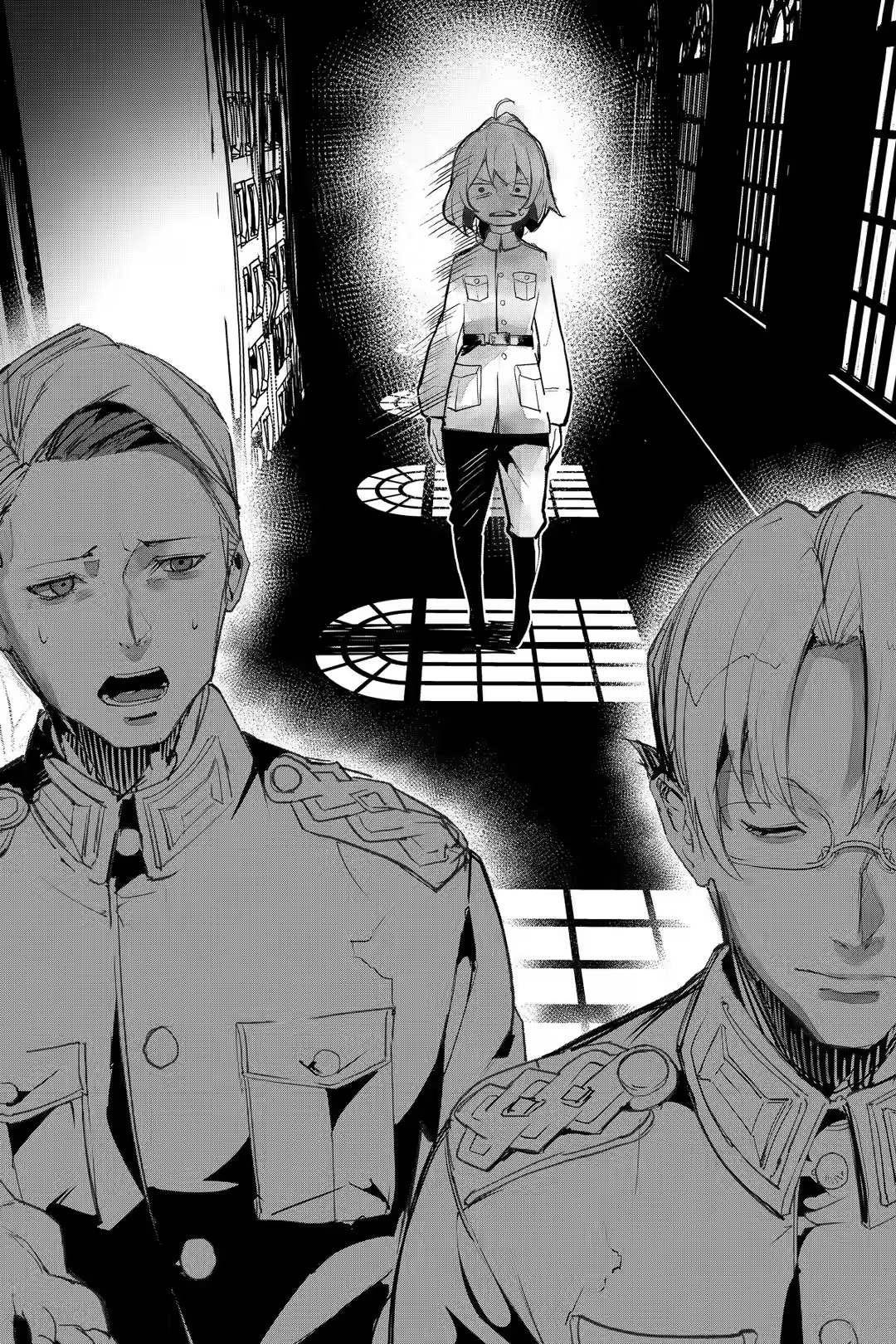
Afterword
It’s me, the author, Carlo Zen. Long time no see.
I honestly don’t spend much time worrying about word counts on a day-to-day basis, but due to page considerations and whatnot, I was actually quite restricted this time around, so you’ll have to forgive me.
In any case, I’ll try to squeeze in as much as I can of what I want to say. First off, to everyone reading, thank you.
Thank you all so much for waiting so many years for a new volume. It genuinely makes me so incredibly happy that people still want to see more of a series that hasn’t been published for such a long time.
These are inconceivable times and inconceivable developments in which we are living, but I hope I can continue to work on The Saga of Tanya the Evil until its end and that everyone will enjoy it.
The world continues to change at dizzying speed, but I pray for everyone’s good health.
I received amazing support from so many people in creating this book, and I would like to take this moment to say thank you all once again.
As for Part II, which I’m sure you’re all worried about: As I feel sincere remorse over taking a little over three years to publish this volume and still recall my once-legendary feat of serial February publishing, this time, instead of Serial February, I’m aiming for Serial Months. That’s right, Part II is already scheduled to be published next month.
And since it’s never too late to mend old ways, we’ll be making all sorts of revolutionary and innovative improvements in order to maintain this two-month commitment and avoid falling back into my old tradition of late publishing. Or to translate this kind of roundabout expression so often used in public announcements, I’ll try to get stuff out as quick as possible in the future, but I can’t promise anything. We’ll do what we can, okay?
And now I am almost at the end of my word count.
Word-count restrictions are very serious business, so I can’t go on much longer, but just know that I am always scheming for new ways to thoroughly exceed them.
Thank you again, and I look forward to seeing you next time.
August 2023, Carlo Zen